A crushing blow in the French elections is the latest setback for Europe’s far right French far-right presidential candidate, Marine Le Pen exits a voting booth before casting her ballot in Henin Beaumont, France, May 7, 2017. It follows another brutal loss in the United Kingdom. Jun 19, 2017 Emmanuel Macron’s party won a large parliamentary majority in the French elections on Sunday, an expected yet historic victory for a party created just one year ago. But the election results aren’t just important for France; they also underscore the recent losses of far-right parties across Europe. En Marche—also known as La République En Marche! (LREM) or in English, Republic on the Move—received 308 of 577 total seats [ http://www.bbc.com/news/world-europe-40178118 ] in France’s National Assembly, with 43 percent of the vote. Along with its centrist MoDem ally, En Marche will control a commanding 350 seats in the French parliament’s lower house. “This Sunday, you gave a clear majority to the president of the republic and to the government,” said French Prime Minister Édouard Philippe. “It will have a mission: to act for France. By their vote, the French, in their great majority, preferred hope to anger, confidence to withdrawal.” But the election wasn’t just a victory for centrist politics; it was also a serious blow to France’s populist far-right. Just one month ago, the National Front’s Marine Le Pen was making a bid for the presidency—which she then lost by a 30-point margin. And in Sunday’s election, the party known for its anti-immigrant and Euroskeptic views [ https://thinkprogress.org/marine-le-pen-is-using-islamophobia-to-draw-female-voters-35db5034e9dd ] won just eight seats, despite hoping to receive 15 in order to form its own parliamentary group. [...] https://thinkprogress.org/french-general-elections-defeat-fn-2fd54263f78a [with comment]
The investigation is beginning to consume the Trump Administration. Most notably, the president seems to have little capacity for managing these pressures. As suggested by his inability to stay off Twitter, he is evidently not one to “compartmentalize” sufficiently to push the inquiry to one side while carrying on regular business. Special Counsel Robert Mueller is barely into his task and so one might ask: what happens when the investigation begins to accelerate and, worse, if indictment becomes a possibility?
It is at this point that the long-standing constitutional question, so far unaddressed by any court, is again raised: do the strains on a presidency under investigation require the conclusion that the president cannot be indicted while in office? As recently as 2000 [ https://biotech.law.lsu.edu/blaw/olc/sitting_president.htm ], the Office of Legal Counsel affirmed the position it took in 1973 [ https://fas.org/irp/agency/doj/olc/092473.pdf ] with an emphatic “yes.” And does this conclusion lead inexorably to another one—that this claimed presidential immunity from indictment or prosecution extends to investigations as well?
OLC has taken the position that while the Constitution does not explicitly provide for immunity from indictment or prosecution, and the record on the Founders’ views of the question is inconclusive, the constitutional role of the president requires that he or she be afforded temporary immunity. Indictment and prosecution would have a “dramatically destabilizing effect” on the president’s capacity to discharge his or her duties. The executive’s energies would be diverted into the “substantial preparation” needed for his legal defense. The mere stigma and opprobrium of indictment, and possibly conviction, would result in “undermining the president’s leadership and efficacy both home and abroad.”
The 2000 opinion landed hard on conclusion that “given the potentially momentous political consequences for the Nation at stake, there is a fundamental, structural incompatibility between the ordinary application of the criminal process and the Office of the President." Of course, delay in either indictment or trial until a term ended would be costly to the administration of justice: but “while significant, [they] are not controlling. In the case of clear and serious criminal wrongdoing, Congress can act to impeach, and this outcome is more consistent with democratic values than “shifting an awesome power to unelected persons lacking an explicit constitutional role vis-à-vis the President.” The opinion also rejected the option of allowing for indictment but deferring trial, embracing the 1973’s judgment that this half-measure is just a gamble that the president could somehow still govern under indictment. (It characterizes this gamble, in what in the current context is a striking double entendre, as “Russian roulette.”)
This analysis was always open to serious objections, but the shocks to the system from Mr. Mueller's investigation makes its weakness all the more apparent. From the beginning it was unclear how the OLC’s reasoning distinguished between indictments and prosecutions, on the one hand, and investigations, on the other. The institution of a serious investigation into presidential wrongdoing has been sufficient to lead to” mass hysteria” in the West Wing. It has clearly and heavily burdened the president—one need only read his tweets—and disrupted normal business and the recruitment of personnel for key positions. So, while few doubt that the president is subject to investigation, it is hard to see how these disruptions can be easily distinguished from those associated with indictment. The difference is one of degree, not of kind, and as the Nixon experience established, those differences are indeed fine.
And as the current investigation continues—interviews are conducted, documents requested, witnesses hire lawyers, and inevitably leaks issue from sundry quarters—these distractions will worsen. The more serious and far-reaching the investigation becomes, the greater will be disruption. By the time of his resignation, President Nixon had not been indicted, but his capacity for governance had been all but extinguished.
It is possible, of course, to believe that for just these reasons OLC did not go far enough, and that it should have clearly extended temporary immunity to the investigative stage. The drafters in 1973 and 2000 declined to take this next step. Doubtless they were constrained by a powerful democratic norm, reflected in the Supreme Court’s pointed rejection in United States v. Nixon [ http://caselaw.findlaw.com/us-supreme-court/418/683.html , https://www.oyez.org/cases/1973/73-1766 (with full 3-hour audio of the oral argument, with transcript, embedded), https://supreme.justia.com/cases/federal/us/418/683/case.html ] of any suggestion that the president, as the head of a unitary executive branch, is somehow “above the law.” True, the Court stated that “the Framers of the Constitution sought to provide a comprehensive system” of separated powers, but “the separate powers were not intended to operate with absolute independence.” The president would have to yield some of his or her authority within this executive domain to the impartial administration of the criminal laws.
The OLC in 1973 anticipated these profound concerns and Nixon was decided a year later. Another three decades afterward, by the time of the most recent OLC pass on the question, the norm had only gained in force. The result was a president at least required to submit to investigation, even if he or she could not in the end be indicted, stand trial, and be convicted. That is the line that OLC drew and has held in assuring that the president is not “above the law.”
However, the 2000 OLC opinion did not effectively defend that line. It tried gamely, but more or less in passing, to show that investigations can be managed without undue disruption. In a footnote, it noted that a grand jury could still “collect” and “preserve” evidence, available for use once the president has left office. The picture it presented is that of the grand jury working quietly in the background. More realistic is what we had in the Nixon era and may be seeing develop today: a full-fledged investigation from within the executive branch, by special counsel dedicated to this purpose. It is not a question of a grand jury collecting and preserving but of the Special Counsel investigating. The process is active, not passive.
It is also telling that the OLC used something like this active/passive distinction to downplay the potentially disruptive impact of an investigation. An investigation in a lower key may be less of a threat to governance, but it may also suggest less of a priority for the criminal justice system. A major inquiry at full boil is most often an indication of the seriousness of the potential charges, and yet it is here—where the public interest in a presidency accountable to law is keenest—that the OLC’s concern with disruption is most obviously triggered. By a strange twist of constitutional logic, the president under investigation for the most serious wrongdoing would then have the most compelling claim to immunity.
On the other side, the opinion did not engage seriously with the question of how temporary immunity from indictment or prosecution can be reconciled with the due administration of justice. For example, it included the president’s exposure to the stigma of a criminal charge among the “dramatically destabilizing effects” of an indictment. Of course, unresolved questions of criminal misconduct also cast shadows on a presidency, as the Nixon saga showed. The opinion did not explain how the president’s credibility is enhanced by charges left hanging and defended only by a claim of immunity. It might be just as persuasively argued that the president who engages with the criminal justice process does more honor to the office and invites closer consideration of the merits of his self-defense. “I did no wrong, and here is why” has a more presidential ring and better serves the rule of law than “You can’t get me.”
The OLC opinion acknowledged that failure to subject the president to the normal criminal justice process on even a temporary basis might fatally compromise the prospects for prosecution after he leaves office. Over the course of the time, memories fade or fail, evidence is degraded, and witnesses pass away. The OLC opinion further conceded that “the consequences of any prejudicial loss of evidence that does occur in the criminal context are more grave [than even in the civil litigation], given the presumptively greater stakes for both for the United States and the defendant in criminal litigation.” Yet it discounted these costs when weighing, in the balance, other interests. Mostly the opinion fell back on a comforting image of a grand jury operating silently and (somehow) mostly out of sight and out of the way.
But that is not how it goes with high-profile, high-stakes investigations. We have them or we don’t: there is no quiet, non-disruptive version. And if we have them, accepting the disruptions they entail, then it is difficult to argue that they cannot be brought to one possible conclusion, if justified by the evidence: indictment. If a president can be investigated, then, it seems, a president can be indicted; if not in the second case, then not in either case, because it cannot be said that the government in the throes of a major investigation is measurably or reliably safer from severe “disruption” and massive loss of presidential credibility. The better, more internally consistent view in line with democratic “rule of law” norms is that the president is subject to investigation and, if the evidence supports it, indictment.
It is true that the president could use his executive authority to thwart an investigation. He can fire prosecutors one after the other until he arrives at a pliant replacement. His management of the “unitary executive” gives him at least that authority. It is also highly probable that, whatever its view of the core offense under investigation, Congress would intervene via the impeachment process to restoring the “rule of law.” Charges and evidence of obstruction are what brought about Nixon’s fatal loss of Republican support in the Congress. So far, too, Mr. Trump’s Republican supporters—including his own attorney general—have signaled to him that he should not dismiss Special Counsel Mueller. It is in constitutional theory only that a president may order an end to an investigation directed against him. In practice, he will fail.
If a president is not, then, immune from investigation or indictment, the “dramatically destabilizing effects” on government may be addressed in one of three ways. The president could resign. Congress could move to impeachment. Also available is the 25th Amendment, which permits a president to temporarily vacate the office while fighting the indictment and standing trial—perhaps, in the thick of an investigation, while fending off indictment.
The 2000 opinion was equivocal in its treatment of the 25th Amendment, particularly as an answer to the possible incarceration of a president following conviction. But it also conceded that “the amendment's terms ‘unable’ and ‘inability’ were not . . . narrowly defined, apparently out of a recognition that situations of inability might take various forms not neatly falling into categories of physical or mental illness.” A president who faced what the OLC termed the “substantial preparation” required for a criminal defense, and the “dramatically destabilizing effects” of criminal process on his capacity to govern, would have a clear choice under the 25th Amendment. The same choice is open to the vice president with the support of the Cabinet if they reach this conclusion but the president resists.
In a case where, as of now, neither impeachment nor resignation is probable, the 25th Amendment supplies more of an answer than OLC would credit to the problem of an incapacitated presidency. It is also more convincing than temporary immunity from indictment or prosecution that is grounded in dubious reasoning about the implications of the “constitutional structure” and that, if taken to its logical conclusion, would also insulate a president from investigation into serious criminal wrongdoing.
Russia to Treat U.S. Military Aircraft in Syria as 'Targets' An F/A-18E Super Hornet takes off from the flight deck of the U.S. Navy aircraft carrier USS Nimitz on October 29, 2016. The announcement comes a day after the U.S. shot down a Syrian air force plane targeting pro-U.S. rebels. Jun 19, 2017 https://www.theatlantic.com/news/archive/2017/06/russia-syria/530757/ [with comments]
U.S. Forces ‘Reposition Over Syria’ After Russian Threat American military officials said they wouldn’t give an inch in response to a veiled Russian threat to shoot down U.S. jets. But the line out of the Pentagon wasn’t so defiant. 06.19.17 http://www.thedailybeast.com/us-forces-reposition-over-syria-after-russian-threat [with comments]
Russian defence minister's plane 'buzzed' by Nato jet A Nato fighter jet has approached a Russian plane carrying the defence minister but was chased away by a Russian escort jet, Russian media say. They say the incident happened in international airspace over the Baltic when Sergei Shoigu was flying to the Russian enclave of Kaliningrad. 21 June 2017 http://www.bbc.com/news/world-us-canada-40358528
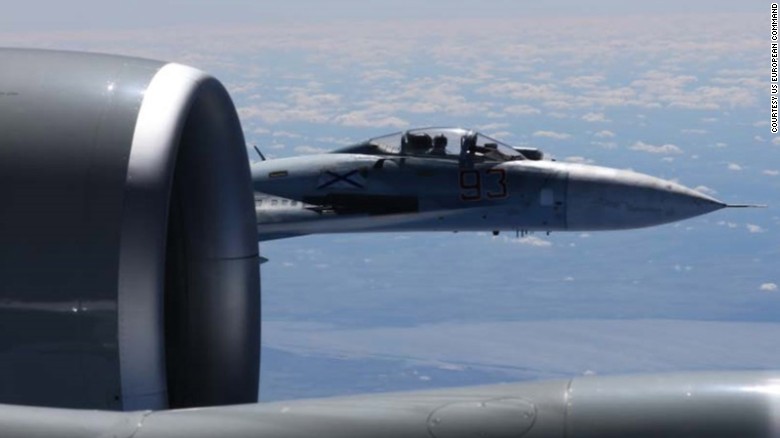
US releases dramatic photos of 'unsafe' Russian jet intercept A Russian Su-27 fighter jet flew within five feet of a US Air Force RC-135 reconnaissance aircraft over the Baltic Sea, an encounter US officials assessed to be "unsafe." June 23, 2017 Updated June 23, 2017 http://www.cnn.com/2017/06/23/politics/russian-jet-intercepts-us-aircraft-photos/
President Donald Trump is welcoming Panama's President Juan Carlos Varela to the White House for discussions on organized crime, immigration and fighting drug trafficking. The visit marks their first face-to-face meeting since Trump took office. (June 19)
Remarks by President Trump and President Juan Carlos Varela of Panama During Bilateral Meeting Oval Office June 19, 2017 11:39 A.M. EDT PRESIDENT TRUMP: It’s our great honor to have President and Mrs. Varela from Panama. And we have many things to discuss. We’re going to spend quite a bit of time today -- the Panama Canal is doing quite well. I think we did a good job building it, right? PRESIDENT VARELA: One hundred years ago. PRESIDENT TRUMP: We did a very good job. ... [...] https://www.whitehouse.gov/the-press-office/2017/06/19/remarks-president-trump-and-president-juan-carlos-varela-panama-during [official transcript]
Full Show - Russia Threatens War Over US Shootdown Of Syrian Plane, World In Turmoil - 06/19/2017
Published on Jun 20, 2017 by The Alex Jones Channel
Monday, June 19th 2017[, with an appearance by Joe Biggs, and Mike Cernovich hosting the fourth hour]: Russia: US Warplanes In Syria Now Targets - Russia says it will treat U.S. warplanes in Syria as "targets" after the U.S. downed a Syrian jet. Protesters disrupted NYC's Trump-themed Julius Caesar play by rushing the stage and shouting "CNN is ISIS." Jesse James will call in to the show and Mike Cernovich joins the broadcast live in studio to discuss America's increasingly hostile political climate and more. We will also break down Megyn Kelly's interview with Alex Jones that aired last night.
At height of Russia tensions, Trump campaign chairman Manafort met with business associate from Ukraine Donald Trump’s campaign manager, Paul Manafort, walks the floor at the Republican National Convention in Cleveland on July 21, 2016. June 19, 2017 In August, as tension mounted over Russia’s role in the U.S. presidential race, Donald Trump’s campaign chairman, Paul Manafort, sat down to dinner with a business associate from Ukraine who once served in the Russian army. Konstantin Kilimnik, who learned English at a military school that some experts consider a training ground for Russian spies, had helped run the Ukraine office for Manafort’s international political consulting practice for 10 years. At the Grand Havana Room, one of New York City’s most exclusive cigar bars[, just coincidentally located in Jared Kushner's 666 building], the longtime acquaintances “talked about bills unpaid by our clients, about [the] overall situation in Ukraine . . . and about the current news,” including the presidential campaign, according to a statement provided by Kilimnik, offering his most detailed account of his interactions with the former Trump adviser. Kilimnik, who provided a written statement to The Washington Post through Manafort’s attorney, said the previously unreported dinner was one of two meetings he had with Manafort on visits to the United States during Manafort’s five months working for Trump. The first encounter was in early May 2016, about two weeks before the Trump adviser was elevated to campaign chairman. The August dinner came about two weeks before Manafort resigned under pressure amid reports that he had received improper payments for his political work in Ukraine, allegations that he has denied. Kilimnik is of interest to investigators on the Senate Intelligence Committee, which is examining possible links between the Trump campaign and Russia, said a person familiar with the inquiry. Kilimnik’s name also appeared this spring in a previously undisclosed subpoena sought by federal prosecutors looking for information “concerning contracts for work . . . communication or other records of correspondence” related to about two dozen people and businesses that appeared to be connected to Manafort or his wife, including some who worked with Manafort in Kiev. The subpoena was issued by a federal grand jury in the Eastern District of Virginia, where, until recently, Manafort’s business was headquartered. The subpoena did not specify whether it was related to the FBI’s investigation of Russian interference in the U.S. election or a separate inquiry into Manafort’s business activities. Investigators in the Eastern District of Virginia have been assisting with the Russia investigation. In Ukraine, Kilimnik’s political adversaries have said he may be working with Russian intelligence. U.S. officials have not made that charge. Kilimnik rejected the allegation, telling The Post in his written statement that he has “no relation to the Russian or any other intelligence service.” His dinner with Manafort came as Trump’s campaign chairman was facing mounting questions about his work in Ukraine and his business ties to allies of Russian President Vladimir Putin. Kilimnik said his meetings with Manafort were “private visits” that were “in no way related to politics or the presidential campaign in the U.S.” He said he did not meet with Trump or other campaign staff members, nor did he attend the Republican National Convention, which took place shortly before the Grand Havana Room session. However, he said the meetings with Manafort included discussions “related to the perception of the U.S. presidential campaign in Ukraine.” Manafort spokesman Jason Maloni said that Kilimnik was a “longtime business associate” who would have naturally been in touch with Manafort. Manafort told Politico, which first reported his relationship with Kilimnik, that his conversations included discussions about the cyberattack on the Democratic National Committee and the release of its emails. “It would be neither surprising nor suspicious that two political consultants would chat about the political news of the day, including the DNC hack, which was in the news,” Maloni said. He added, “We’re confident that serious officials will come to the conclusion that Paul’s campaign conduct and interaction with Konstantin during that time was perfectly permissible and not in furtherance of some conspiracy.” Before joining Trump’s campaign, Manafort had built a practice in Ukraine as an adviser to the Russia-friendly Party of Regions and helped elect former president Viktor Yanukovych, who was ousted in 2014 and fled to Russia. Manafort kept his Kiev office open until mid-2015. Federal investigators have shown an interest in Manafort on several fronts beyond his work on behalf of Trump. Subpoenas in New York have sought information about Manafort’s real estate loans, according to NBC News. Justice Department officials also are exploring whether Manafort should have more fully disclosed his work for foreign political parties, as required by federal law. Former FBI director Robert S. Mueller III has been appointed special counsel to oversee the Russia inquiry, and people familiar with his work said his office has now taken over investigations of Manafort’s conduct unrelated directly to the Russia probe. A spokesman for the Eastern District of Virginia declined to discuss the subpoena there. A spokesman for Mueller also declined to comment. Manafort’s relationship with Kilimnik shows the challenge facing investigators as they seek to determine whether contacts between Russian allies and Trump associates during the height of Russian interference in the campaign amounted to collusion or reflected routine interactions between people with relationships unrelated to the campaign. Kilimnik said he grew up in southeastern Ukraine, which was then part of the Soviet Union. He said he moved to Moscow in 1987, when he was 17, and enrolled in the Military Institute of the Ministry for Defense, an elite academy for training military translators. Kilimnik said he was trained in English and Swedish and spent the early 1990s serving as a military translator, including in 1993 on a trade mission of a Russian arms company. He said the GRU, the military intelligence service that U.S. officials have linked to the 2016 cyberattacks, did not recruit from his language academy. “No one ever spoke to me ever about doing any intelligence work — neither Russians or Ukrainians or any other foreign country,” he said. Some experts disputed Kilimnik’s description of the Moscow academy. Stephen Blank, a Russia expert at the American Foreign Policy Council, a Washington think tank, and a longtime former instructor at the U.S. Army War College, called the institute a “breeding ground” for intelligence officers. Mark Galeotti, a Russia security specialist at the Institute of International Relations, a Prague-based foreign policy think tank, said the school is one of the “favored recruiting grounds” of the GRU. In 1995, amid uncertainty in the post-Soviet economy, Kilimnik said he needed money and took a job as a translator for the International Republican Institute, a pro-democracy group affiliated with the U.S. Republican Party. People who worked with Kilimnik said he was proficient in several languages and a savvy reader of people. “I relied on him,” said Sam Patten, who was Kilimnik’s boss at the Moscow office of IRI from 2001 to 2004. At the time, Kilimnik openly discussed his work in the Russian army, said Phil Griffin, a political consultant who hired him at the IRI. “He was completely upfront about his past work with Russian military intelligence,” Griffin said. “It was no big deal.” Julia Sibley, a spokeswoman for the IRI, confirmed that Kilimnik worked for the organization a decade ago but declined to provide additional information. In 2005, Griffin, who had left Moscow to work for Manafort in Ukraine, invited Kilimnik to join him there, according to both men. Kilimnik said he has worked largely in Ukraine ever since, although he declined to say whether he has become a Ukrainian citizen. Kilimnik’s role for Manafort grew over time. Beyond his work as a translator, Kilimnik would “help Manafort understand the political context and why people were doing what they were doing,” Patten said. People familiar with Kilimnik’s work in Ukraine for Manafort say his assignments included meeting with powerful Ukrainian politicians and serving as a liaison to Russian aluminum magnate Oleg Deripaska, who is close to Putin and did business with Manafort. A spokeswoman for Deripaska did not respond to a request for comment. [...] https://www.washingtonpost.com/politics/at-height-of-russia-tensions-trump-campaign-chairman-manafort-met-with-business-associate-from-ukraine/2017/06/18/6ab8485c-4c5d-11e7-a186-60c031eab644_story.html [with embedded videos, and comments]
--
Trump Appears to Be Self-Destructing | The Resistance with Keith Olbermann | GQ
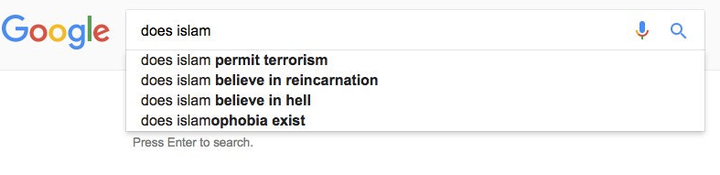
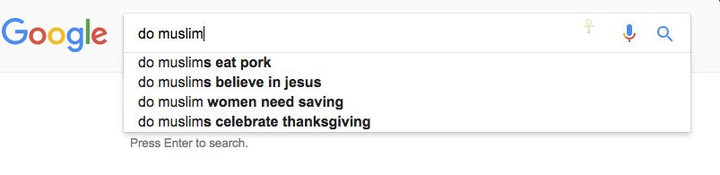
Google Search Is Doing Irreparable Harm To Muslims A Dallas imam and his organization are taking on the world’s largest search engine to stop it from spreading hate. Imam Omar Suleiman, photographed in his office in Las Colinas, Texas. Suleiman is president of the Yaqeen Institute for Islamic Research and a professor of Islamic studies at Southern Methodist University. 06/24/2017 Updated June 26, 2017 Google asks its employees to “Do the right thing.” At least, that’s what its revised 2015 motto states in an upgrade from the original company maxim, “Don’t be evil.” But when a user searches Google for information on Islam, the results often link to propaganda, anti-Muslim hate and outright lies. The algorithm for the world’s largest search engine is definitely not doing the right thing - especially when it comes to the first page of results, where most users stop their searches. Basic searches for words like “Muslim” and “Islam” return reasonable results with links to reputable sites. But more specific terms, like “sharia,” “jihad” or “taqiyya” - often co-opted by white supremacists - return links to Islamophobic sites filled with misinformation. The same thing happens with the autofill function. If a user types in “does islam,” the first suggestion that pops up to complete the query is “does islam permit terrorism.” Another egregious example occurs when a user inputs “do muslim.” The autofill results include “do muslim women need saving.” There are endless possibilities for misinformation, and the consequences are disturbing. “Ninety percent of people don’t make it past the first page,” Heidi Beirich, a project director for the Southern Poverty Law Center, told HuffPost. “It’s miseducating millions, if not billions of people on many subjects.” Indeed, there is a distinct correlation between anti-Muslim searches and anti-Muslim hate crimes, according to researchers [ https://www.nytimes.com/2015/12/13/opinion/sunday/the-rise-of-hate-search.html ]. The result? At the extreme end of the spectrum, white supremacists commit heinous acts of violence, like in Portland, Oregon [ http://www.huffingtonpost.com/entry/portland-oregon-white-terror_us_592ef9cbe4b09ec37c31055b ] and Tulsa, Oklahoma [ http://www.huffingtonpost.com/entry/khalid-jabara-killed_us_57b493b8e4b0b42c38afb448 ]. But more commonly and perhaps more nefariously, such searches normalize a culture of fear, leading to the harassment of hijab-wearing teenagers [ http://www.huffingtonpost.com/entry/man-filmed-harassing-muslims_us_5938428ee4b0c5a35c9b4f82?utm_campaign=hp_fb_pages&utm_source=news_fb&utm_medium=facebook&ncid=fcbklnkushpmg00000090§ion=crime ] and 7-Eleven store clerks [ http://www.nydailynews.com/new-york/nyc-crime/muslim-store-clerk-harassed-indian-punched-jaw-nyc-article-1.2908261 ]. [...] Google announced in a blog post in April [ https://www.blog.google/products/search/our-latest-quality-improvements-search/ ], that they were going to “surface more high-quality content from the web,” and offer users the opportunity to report inappropriate content [ https://support.google.com/websearch/answer/106230#report_prediction ]. But with tens of thousands of pages “coming online every minute of every day,” the post read, clearly they are facing an uphill battle. Beirich says Google’s actions so far are not enough. “Google’s algorithm is seriously flawed and it’s a scary thing, because millions of people around the world are using it,” she said. “It’s a fundamental problem with how search works.” Beirich points to the case of white supremacist Dylann Roof, who went “from being someone who was not raised in a racist home to someone so steeped in white supremacist propaganda [ https://www.splcenter.org/20170118/google-and-miseducation-dylann-roof ] that he murdered nine African-Americans during a Bible study.” “We are teaching [people] reasons to hate black people, Jews, Muslims and [other] minorities,” Beirich said. [...] http://www.huffingtonpost.com/entry/google-search-harming-muslims_us_59415359e4b0d31854867de8 [with comments]
Kushner's remarks at a White House summit with tech CEOs were notable less because of what he said, but because it was the first time many of us have ever heard the sound of his voice. Duration: 1:49
Trump: 'I think we did a good job' on the Panama Canal
All In with Chris Hayes 6/19/17
Thing 1/Thing 2: President Trump bragged about how “we did a very good job” building the Panama Canal. “Yes, one hundred years ago,” replied the Panamanian president. Duration: 2:19
Otto Warmbier, former North Korea captive, dies leaving questions
The Rachel Maddow Show 6/19/17
Rachel Maddow reports on the death of Otto Warmbier, the U.S. student released from 17 months of captivity in North Korea just a week ago, and the questions that remain about how he was treated by North Korea. Duration: 0:55
Newly reported subpoena shows shape of Trump Russia probe
The Rachel Maddow Show 6/19/17
Tom Hamburger, reporter for The Washington Post, talks with Rachel Maddow about a subpoena issued by a federal grand jury in the Eastern District of Virginia targeting Paul Manafort and his Ukraine business and associates. Duration: 7:31
Hotly contested Georgia special election comes to a head Tuesday
The Rachel Maddow Show 6/19/17
Rachel Maddow reports on the special election in Georgia's sixth congressional district, as well as a special election in South Carolina that are the focus of national attention as a referendum on Donald Trump's agenda. Duration: 2:37
Democrats push back as GOP sneaks health bill in secrecy
The Rachel Maddow Show 6/19/17
Senator Jeff Merkley talks with Rachel Maddow about the push by Senate Democrats to raise awareness of the secret, partisan tactics Mitch McConnell and the Senate GOP is using to sneak an Obamacare repeal with as little public notice as possible. Duration: 6:33
Is Mike Pence raising PAC money for legal defense?
The Rachel Maddow Show 6/19/17
Rachel Maddow explores the possibility that the fundraisers Mike Pence is holding to raise PAC money is being done in part to pay for his legal defense as the Trump Russia investigation moves ahead. Duration: 2:50
Lawrence: Trump has the worst lawyers of any president
The Last Word with Lawrence O'Donnell 6/19/17
Robert Mueller has hired a dream team of 13+ experienced lawyers from the DOJ and other government bodies to handle the Russia probe. Lawrence O'Donnell argues that many of Trump's lawyers lack the experience and the abilities to properly defend the president. Duration: 6:15
Donald Trump's errant tweets and public statements continually run at odds with his legal counsel, making it nearly impossible for them to be on the same page. Lachlan Markay, Ed Dowd, and David Jolly join Lawrence O'Donnell. Duration: 10:32
On the eve of the Georgia 6th District special election, Democratic candidate Jon Ossoff joins Lawrence O'Donnell to react to President Donald Trump's attacks on him and explains why he is trying to talk about health care as much as possible during the campaign. Duration: 4:28
Trump: I'm under investigation. Trump's Lawyer: No he isn't
The 11th Hour with Brian Williams 6/19/17
Trump's lawyers are hitting back hard, seemingly contradicting Trump's own comments that he is under investigation. MSNBC's Brian Williams speaks to Eli Stokols, Jonathan Lemire, & Anita Kumar. Duration: 8:05
Fmr. Watergate prosecutor: Of course Trump's under investigation
The 11th Hour with Brian Williams 6/19/17
Nick Akerman, former Watergate prosecutor, says Pres. Trump is definitely under investigation despite what the President's lawyers say. Akerman and Eugene Robinson join MSNBC's Brian Williams. Duration: 7:05
Senate Dem: 'We've got a big fight ahead of us' on health care
The 11th Hour with Brian Williams 6/19/17
Democrats held the Senate floor late on Monday to protest the GOP's health care bill which is being written behind closed doors. Sen. Tammy Baldwin (D-WI) joins MSNBC's Brian Williams. Duration: 5:16
We finally know what Trump aide Jared Kushner sounds like
The 11th Hour with Brian Williams 6/19/17
John Oliver is among many who've noted, we almost never hear Jared Kushner speak in public. On Monday that changed. MSNBC's Brian Williams has more. Duration: 1:35
So Much News, So Little Time - NRA Silence on Philando Castile & Canceling Cuba: The Daily Show
Published on Jun 19, 2017 by The Daily Show with Trevor Noah
The White House rolls back the opening of Cuba, Team Trump can't keep straight whether the president is under investigation, and Trevor reacts to the Philando Castile verdict.
this is part 3 of a 17-part post which proceeds (point arising on the given) day by (point arising on the given) day from June 17, 2017 through July 3, 2017 -- the preceding part is the post to which this is a reply; the next part is a reply to this post -- the following 'see also (linked in)' listing, updated for intervening posts along the way, is common to all 17 parts
--
in addition to (linked in) the post to which this is a reply and preceding and (other) following, see also (linked in):
Revealed: Israel's Cyber-spy Industry Helps World Dictators Hunt Dissidents and Gays
"Trump’s Lawyer, Contradicting Trump, Says President Not Under Investigation"
Haaretz investigation spanning 100 sources in 15 countries reveals Israel has become a leading exporter of tools for spying on civilians. Dictators around the world – even in countries with no formal ties to Israel – use them eavesdrop on human rights activists, monitor emails, hack into apps and record conversations
By Hagar Shezaf and Jonathan Jacobson Oct 20, 2018
During the summer of 2016, Santiago Aguirre divided his time between part-time university lecturing and working for an organization that helps locate missing people. Mexico was then in the news internationally because of presidential candidate Donald Trump’s promise to build a wall on the American border with its southern neighbor. However, for Aguirre, a Mexican human rights activist, the problems of the present were far more pressing than any future wall. At the time, he was in the midst of a lengthy investigation to solve the mystery of the disappearance and presumed murder of 43 students in the city of Iguala two years before. It was becoming increasingly clear that his findings were incompatible with the results of the investigation conducted by the government.
Aguirre wasn’t concerned when he received a series of text messages containing broken links. “Please help me with my brother, the police took him only because he is a teacher,” one message read. And another: “Professor, I encountered a problem. I am sending back my thesis, which is based on your dissertation, so that you can give me your comments.” The messages looked no different from many of the legitimate messages he received every day as part of his work. And therein lay the secret of their power. When Aguirre clicked on the links, however, he was inadvertently turning his smartphone into a surveillance device in the hands of the government.
“Those text messages had information that was personal,” Aguirre notes, “the kind of information that could make the message interesting for me so I would click. It wasn’t until later that I actually thought – well, it is actually pretty weird that I received three messages with broken links.”
Posted specifically to the content below, near bottom of an F6 big one.
Michael Flynn Worked With Foreign Cyberweapons Group That Sold Spyware Used Against Political Dissidents While serving as a top campaign adviser to Donald Trump, Flynn worked with firms linked to NSO Group — which develops spyware and sells it to governments. 06/19/2017 Updated June 20, 2017 WASHINGTON — While serving as a top campaign aide to Donald Trump [ http://www.huffingtonpost.com/topic/donald-trump ], former national security adviser Michael Flynn [ http://www.huffingtonpost.com/topic/michael-flynn ] made tens of thousands of dollars on the side advising a company that sold surveillance technology that repressive governments used to monitor activists and journalists. Flynn, who resigned [ http://www.huffingtonpost.com/entry/michael-flynn-resignation-letter_us_58a284e5e4b03df370d99aaa ] in February after mischaracterizing his conversations with the Russian ambassador to the U.S., has already come under scrutiny for taking money from foreign outfits. Federal investigators began probing Flynn’s lobbying efforts [ https://www.nytimes.com/2017/05/17/us/politics/michael-flynn-donald-trump-national-security-adviser.html ] on behalf of a Dutch company led by a businessman with ties to the Turkish government earlier this year. Flynn’s moonlighting wasn’t typical: Most people at the top level of major presidential campaigns do not simultaneously lobby for any entity, especially not foreign governments. It’s also unusual for former U.S. intelligence officials to work with foreign cybersecurity outfits. Nor was Flynn’s work with foreign entities while he was advising Trump limited to his Ankara deal. He earned nearly $1.5 million last year as a consultant, adviser, board member, or speaker for more than three dozen companies and individuals, according to financial disclosure forms released earlier [ http://www.huffingtonpost.com/entry/michael-flynn-russia-payments_us_58cac910e4b0ec9d29d9ba8c ] this year [ http://www.huffingtonpost.com/entry/flynn-russia-speeches_us_58e06f6ee4b0b3918c841b32 ]. Two of those entities are directly linked to NSO Group, a secretive Israeli cyberweapons dealer founded by Omri Lavie and Shalev Hulio, who are rumored [ https://www.forbes.com/sites/thomasbrewster/2016/08/25/everything-we-know-about-nso-group-the-professional-spies-who-hacked-iphones-with-a-single-text/ ] to have served in Unit 8200, the Israeli equivalent of the National Security Agency. Flynn received $40,280 last year as an advisory board member for OSY Technologies, an NSO Group offshoot based in Luxembourg, a favorite tax haven for major corporations. OSY Technologies is part of a corporate structure that runs from Israel, where NSO Group is located, through Luxembourg, the Cayman Islands, the British Virgin Islands, and the U.S. Flynn also worked as a consultant last year for Francisco Partners, a U.S.-based private equity firm that owns NSO Group, but he did not disclose how much he was paid. At least two Francisco Partners executives have sat on OSY’s board. Flynn’s financial disclosure forms do not specify the work he did for companies linked to NSO Group, and his lawyer did not respond to requests for comment. Former colleagues at Flynn’s consulting firm declined to discuss Flynn’s work with NSO Group. Executives at Francisco Partners who also sit on the OSY Technologies board did not respond to emails. Lavie, the NSO Group co-founder, told HuffPost he is “not interested in speaking to the press” and referred questions to a spokesman, who did not respond to queries. Many government and military officials have moved through the revolving door between government agencies and private cybersecurity companies. The major players in the cybersecurity contracting world — SAIC, Booz Allen Hamilton, CACI Federal and KeyW Corporation — all have former top government officials in leadership roles or on their boards, or have former top executives working in government. But it’s less common for former U.S. intelligence officials to work with foreign cybersecurity outfits. “There is a lot of opportunity in the U.S. to do this kind of work,” said Ben Johnson, a former NSA employee and the co-founder of Obsidian Security. “It’s a little bit unexpected going overseas, especially when you combine that with the fact that they’re doing things that might end up in hands of enemies of the U.S. government. It does seem questionable.” What is clear is that during the time Flynn was working for NSO’s Luxembourg affiliate, one of the company’s main products — a spy software sold exclusively to governments and marketed as a tool for law enforcement officials to monitor suspected criminals and terrorists — was being used to surveil political dissidents, reporters, activists, and government officials. The software, called Pegasus, allowed users to remotely break into a target’s cellular phone if the target responded to a text message. Last year, several people targeted by the spyware contacted Citizen Lab, a cybersecurity research team based out of the University of Toronto. With the help of experts at the computer security firm Lookout, Citizen Lab researchers were able to trace the spyware hidden in the texts [ https://citizenlab.org/2016/08/million-dollar-dissident-iphone-zero-day-nso-group-uae/ ] back to NSO Group spyware. After Citizen Lab publicized its findings, Apple introduced patches to fix the vulnerability. It is not known how many activists in other countries were targeted and failed to report it to experts. [...] http://www.huffingtonpost.com/entry/michael-flynn-nso-group-spyware_us_59468386e4b06bb7d273c398 [with embedded video, and comments]
Using Texts as Lures, Government Spyware Targets Mexican Journalists and Their Families President Enrique Peña Nieto vowed last month to take concrete steps to ensure the safety of journalists in Mexico. Since 2011, the Mexican government has bought around $80 million worth of spyware for the stated purpose of combating crime. JUNE 19, 2017 https://www.nytimes.com/2017/06/19/world/americas/mexico-spyware-anticrime.html [with comments]
‘Our Phones Are Being Monitored’: How a Hacking Story Unfurled Relatives at a protest in Mexico City last month carried posters of some of the 43 students from a teachers college who disappeared in September 2014. A lawyer representing families of the students was targeted by highly sophisticated spyware that could take over a cellphone. JUNE 19, 2017 https://www.nytimes.com/2017/06/19/pageoneplus/how-a-hacking-story-unfurled-mexican-journalists-monitored-phones.html
You forgot to praise the virtues of bombing them with pallets of cash! You mean the cash that belonged to them? Which was frozen after the Iranian revolution in 1979? P - Now if one really wants pallets of cash we might want to look at Israel. We provide cash to Israel to develop various defense systems...Cha ching$$$. They enlist US defense companies... https://investorshub.advfn.com/boards/read_msg.aspx?message_id=149631055