How An Entire Nation Became Russia's Cyberwar Test Lab 06.20.17 The clocks read zero when the lights went out. It was a Saturday night last December, and Oleksii Yasinsky was sitting on the couch with his wife and teenage son in the living room of their Kiev apartment. The 40-year-old Ukrainian cybersecurity researcher and his family were an hour into Oliver Stone’s film Snowden when their building abruptly lost power. “The hackers don’t want us to finish the movie,” Yasinsky’s wife joked. She was referring to an event that had occurred a year earlier, a cyberattack that had cut electricity to nearly a quarter-million Ukrainians [ https://www.wired.com/2016/03/inside-cunning-unprecedented-hack-ukraines-power-grid/ ] two days before Christmas in 2015. Yasinsky, a chief forensic analyst at a Kiev digital security firm, didn’t laugh. He looked over at a portable clock on his desk: The time was 00:00. Precisely midnight. Yasinsky’s television was plugged into a surge protector with a battery backup, so only the flicker of images onscreen lit the room now. The power strip started beeping plaintively. Yasinsky got up and switched it off to save its charge, leaving the room suddenly silent. He went to the kitchen, pulled out a handful of candles and lit them. Then he stepped to the kitchen window. The thin, sandy-blond engineer looked out on a view of the city as he’d never seen it before: The entire skyline around his apartment building was dark. Only the gray glow of distant lights reflected off the clouded sky, outlining blackened hulks of modern condos and Soviet high-rises. Noting the precise time and the date, almost exactly a year since the December 2015 grid attack, Yasinsky felt sure that this was no normal blackout. He thought of the cold outside—close to zero degrees Fahrenheit—the slowly sinking temperatures in thousands of homes, and the countdown until dead water pumps led to frozen pipes. That’s when another paranoid thought began to work its way through his mind: For the past 14 months, Yasinsky had found himself at the center of an enveloping crisis. A growing roster of Ukrainian companies and government agencies had come to him to analyze a plague of cyberattacks that were hitting them in rapid, remorseless succession. A single group of hackers seemed to be behind all of it. Now he couldn’t suppress the sense that those same phantoms, whose fingerprints he had traced for more than a year, had reached back, out through the internet’s ether, into his home. * * * The Cyber-Cassandras said this would happen. For decades they warned that hackers would soon make the leap beyond purely digital mayhem and start to cause real, physical damage to the world. In 2009, when the NSA’s Stuxnet malware silently accelerated a few hundred Iranian nuclear centrifuges until they destroyed themselves, it seemed to offer a preview of this new era. “This has a whiff of August 1945,” Michael Hayden, former director of the NSA and the CIA, said in a speech [ https://www.usnews.com/news/articles/2013/02/20/former-cia-director-cyber-attack-game-changers-comparable-to-hiroshima ]. “Somebody just used a new weapon, and this weapon will not be put back in the box.” Now, in Ukraine, the quintessential cyberwar scenario has come to life. Twice. On separate occasions, invisible saboteurs have turned off the electricity to hundreds of thousands of people. Each blackout lasted a matter of hours, only as long as it took for scrambling engineers to manually switch the power on again. But as proofs of concept, the attacks set a new precedent: In Russia’s shadow, the decades-old nightmare of hackers stopping the gears of modern society has become a reality. And the blackouts weren’t just isolated attacks. They were part of a digital blitzkrieg that has pummeled Ukraine for the past three years—a sustained cyberassault unlike any the world has ever seen. A hacker army has systematically undermined practically every sector of Ukraine: media, finance, transportation, military, politics, energy. Wave after wave of intrusions have deleted data, destroyed computers, and in some cases paralyzed organizations’ most basic functions. “You can’t really find a space in Ukraine where there hasn’t been an attack,” says Kenneth Geers, a NATO ambassador who focuses on cybersecurity. In a public statement in December, Ukraine’s president, Petro Poroshenko, reported that there had been 6,500 cyberattacks on 36 Ukrainian targets in just the previous two months. International cybersecurity analysts have stopped just short of conclusively attributing these attacks to the Kremlin, but Poroshenko didn’t hesitate: Ukraine’s investigations, he said, point to the “direct or indirect involvement of secret services of Russia, which have unleashed a cyberwar against our country.” (The Russian foreign ministry didn’t respond to multiple requests for comment.) To grasp the significance of these assaults—and, for that matter, to digest much of what’s going on in today’s larger geopolitical disorder—it helps to understand Russia’s uniquely abusive relationship with its largest neighbor to the west. Moscow has long regarded Ukraine as both a rightful part of Russia’s empire and an important territorial asset—a strategic buffer between Russia and the powers of NATO, a lucrative pipeline route to Europe, and home to one of Russia’s few accessible warm-water ports. For all those reasons, Moscow has worked for generations to keep Ukraine in the position of a submissive smaller sibling. But over the past decade and a half, Moscow’s leash on Ukraine has frayed, as popular support in the country has pulled toward NATO and the European Union. In 2004, Ukrainian crowds in orange scarves flooded the streets to protest Moscow’s rigging of the country’s elections; that year, Russian agents allegedly went so far as to poison the surging pro-Western presidential candidate Viktor Yushchenko. A decade later, the 2014 Ukrainian Revolution finally overthrew the country’s Kremlin-backed president, Viktor Yanukovych (a leader whose longtime political adviser, Paul Manafort, would go on to run the US presidential campaign of Donald Trump). Russian troops promptly annexed the Crimean Peninsula in the south and invaded the Russian-speaking eastern region known as Donbass. Ukraine has since then been locked in an undeclared war with Russia, one that has displaced nearly 2 million internal refugees and killed close to 10,000 Ukrainians. From the beginning, one of this war’s major fronts has been digital. Ahead of Ukraine’s post-revolution 2014 elections, a pro-Russian group calling itself CyberBerkut—an entity with links to the Kremlin hackers who later breached Democratic targets in America’s 2016 presidential election—rigged the website of the country’s Central Election Commission to announce ultra-right presidential candidate Dmytro Yarosh as the winner. Administrators detected the tampering less than an hour before the election results were set to be declared. And that attack was just a prelude to Russia’s most ambitious experiment in digital war, the barrage of cyberattacks that began to accelerate in the fall of 2015 and hasn’t ceased since. Yushchenko, who ended up serving as Ukraine’s president from 2005 to 2010, believes that Russia’s tactics, online and off, have one single aim: “to destabilize the situation in Ukraine, to make its government look incompetent and vulnerable.” He lumps the blackouts and other cyberattacks together with the Russian disinformation flooding Ukraine’s media, the terroristic campaigns in the east of the country, and his own poisoning years ago—all underhanded moves aimed at painting Ukraine as a broken nation. “Russia will never accept Ukraine being a sovereign and independent country,” says Yushchenko, whose face still bears traces of the scars caused by dioxin toxicity. “Twenty-five years since the Soviet collapse, Russia is still sick with this imperialistic syndrome.” But many global cybersecurity analysts have a much larger theory about the endgame of Ukraine’s hacking epidemic: They believe Russia is using the country as a cyberwar testing ground—a laboratory for perfecting new forms of global online combat. And the digital explosives that Russia has repeatedly set off in Ukraine are ones it has planted at least once before in the civil infrastructure of the United States. [...] https://www.wired.com/story/russian-hackers-attack-ukraine/ [with comments]
Watch Hackers Take Over the Mouse of a Power-Grid Computer
Senators Push Trump for Answers on Power Grid Malware Attack 06.22.17 In one of his first public statements on his priorities as president, Donald Trump promised [ https://www.youtube.com/watch?v=f2MGOkLAA7s (next below; with comments)]
to develop a "comprehensive plan to protect America's vital infrastructure from cyberattacks." That has not yet materialized. And as new evidence has emerged that a piece of sophisticated malware caused a blackout in the Ukrainian capital [ https://www.wired.com/story/crash-override-malware/ ] last December, one group of senators wants answers now about the threat of Russian grid-hacking. In a letter to the president [ https://www.energy.senate.gov/public/index.cfm/files/serve?File_id=7E986259-2284-4FD3-A9ED-F2E7E6EE21CB ] Thursday, 19 senators have called on the White House to direct the Department of Energy to conduct a new analysis of the Russian government's capabilities to disrupt America's power grid. They also want an exploration of any attempts the Kremlin may have already made to compromise America's electric utilities, pipelines, or other energy infrastructure, all within 60 days. While they made a similar request in March–to which the White House never responded–forensic reports that surfaced last week about a piece of malware known as CrashOverride [ https://www.wired.com/story/crash-override-malware/ ], which briefly took out about a fifth of the total energy capacity of Kiev, have given their query renewed urgency. "We are deeply concerned that your administration has not backed up a verbal commitment prioritizing cybersecurity of energy networks and fighting cyber aggression with any meaningful action," reads the letter, which was signed by senators Ron Wyden, Al Franken, Maria Cantwell, Bernie Sanders, Martin Heinrich and others. The Trump administration has, to its credit, issued an executive order that called for new assessments of the cybersecurity of US critical infrastructure over the next few months. But Trump's budget proposal, the senators point out, would cut funding to the Department of Energy's Office of Electricity Delivery and Energy Reliability. The recently revealed malware behind Ukranian blackout spurred action in particular because hackers could conceivably adapt it to Western Europe or American power utility targets as well. In analyses of the so-called CrashOverride attack [id.] released last week by the security firms ESET and Dragos, the two companies noted that the malware's modular design, a feature that makes it a potential threat well beyond Ukraine. Dragos tied the malware's creation to a hacker group known as Sandworm–widely believed to be Russian–that also planted malware on the networks of multiple US energy firms in 2014. Since 2014, punishing cyberattacks have hit Ukrainian media, transportation, and government agencies. The campaign has destroyed hundreds of computers, deleted data, and paralyzed organizations' basic functions. The December 2015 and December 2016 represent the most ambitious of those efforts, though, and the most ominous. [...] https://www.wired.com/story/congress-trump-power-grid-malware-letter/
Senate intel panel to hold hearing on Russian meddling in Europe 06/23/17 The Senate Intelligence Committee will turn its attention to Russia's efforts to meddle in European elections on Wednesday. The panel has for months been investigating the Kremlin's role in the 2016 U.S. presidential election, as well as possible coordination between the Trump campaign and Moscow. The hearing on Wednesday will draw from a panel of experts in international security and Europe. While the brunt of the intelligence committee's Russia-related hearings in recent weeks have focused on the Kremlin's impact on U.S. political contests, intelligence officials suspect that Russia was behind a cyberattack that sought to disrupt France's presidential election. Likewise, Montenegro underwent a series of cyberattacks in October during its election and once more in February, months before the small Balkan nation officially joined NATO. U.S. officials have warned that Russia is likely to carry out similar cyber and influence campaigns in the future in an effort to disrupt or sway elections across Europe and the U.S. Senate Intelligence Committee Chairman Richard Burr [ http://thehill.com/people/richard-burr ] (R-N.C.) has pointed to Germany's upcoming elections in the fall as a likely target of Russian meddling. "What we might assess was a very covert effort in 2016 in the United States, is a very overt effort, as well as covert, in Germany and France," Burr said, according to Agence France-Presse [ http://www.france24.com/en/20170330-russia-actively-involved-french-election-warns-us-senate-intelligence-chief ] http://thehill.com/policy/national-security/339189-senate-intel-panel-to-hold-hearing-on-russian-meddling-in-europe [with comments]
Full Show - Biggest Liars In Media Conspire To Destroy America - 06/20/2017
Published on Jun 20, 2017 by Ron Gibson
Tuesday, June 20th 2017[, with an appearance by Joe Biggs, and Paul Joseph Watson hosting the fourth hour]: Warning of a Bloody Civil War - We look inside the violent cabal of anti-Trump cultists who have transformed the left-wing into a bloodthirsty mob. The Rebel Media's Laura Loomer, who rushed the state of the Trump assassination play, reveals her experience with this cult.
Alex Jones is not the only guy making a career out of conspiracy theories. They are everywhere on the internet and here's why you have no choice but to ignore them [fine when they're just an immaterial fringe not directly tied into our current government; a choice verging into suicidal when, as now, they're not].
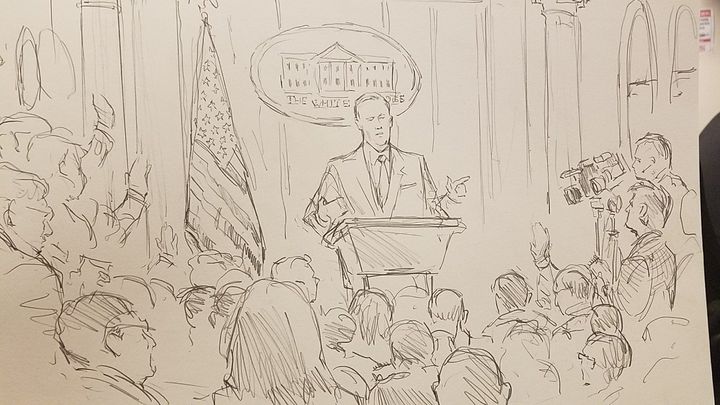
Sean Spicer banned TV cameras. Again. So we annotated his briefing. Again. June 23, 2017 White House press secretary Sean Spicer barred television cameras from a media briefing on Friday and prohibited live audio broadcasts, marking the third time this week that spokesmen for President Trump have imposed such restrictions. In keeping with a promise we made Monday, The Fix has annotated a transcript of the session, since it could not be seen on TV. We'll continue the practice when White House spokesmen go off camera. To view an annotation, click on the yellow, highlighted text. [...] https://www.washingtonpost.com/news/the-fix/wp/2017/06/23/sean-spicer-banned-tv-cameras-again-so-we-annotated-his-briefing-again/ [full transcript; with embedded video, and comments]
Attorney General Jeff Sessions retains private lawyer Attorney General Jeff Sessions raised the specter of executive privilege eight times during his testimony to the Senate Intelligence Committee Tuesday. June 20, 2017 WASHINGTON – Jeff Sessions, the nation's chief law enforcement officer and top prosecutor, has private lawyer of his own. Attorney Charles "Chuck" Cooper, a longtime advocate for conservative causes, has been providing counsel to the attorney general, most recently in preparation for his appearance last week before the Senate Intelligence Committee, which is investigating possible collusion between President Trump's campaign and Russian officials. Cooper confirmed Tuesday that he is representing the attorney general but declined further comment, citing "confidential client matters.'' Justice Department spokeswoman Sarah Isgur Flores said Cooper, a Sessions friend and former candidate to serve as U.S. solicitor general, also advised Sessions during his January confirmation hearing. In that hearing, Sessions said he had no contacts with Russian officials during the campaign, only to amend his testimony following disclosures in The Washington Post that he had met with the ambassador in July at the Republican National Convention and in September in the Washington office of the then-Alabama senator. Facing a storm of criticism about his failure to disclose the two encounters, Sessions recused himself in March [ https://www.usatoday.com/story/news/politics/2017/03/02/attorney-general-jeff-sessions-russia-probe/98644958/ ] from any involvement in the FBI’s inquiry into Russia’s interference in the 2016 election. During the Intelligence Committee hearing last Tuesday, Sessions said that any suggestion he colluded with Russian officials while he was advising the Trump campaign is "an appalling and detestable lie." https://www.usatoday.com/story/experience/beach/new-hampshire/2017/06/20/attorney-general-jeff-sessions-retains-private-lawyer/103046234/ [with comments]
Russia cancels talks with US over tightening of sanctions The US recently announced an expansion of sanctions against Russian individuals and legal entities The previously planned meeting was between Russian Deputy Foreign Minister Sergey Raybkov and Under Secretary of State Tom Shannon June 21, 2017 Updated June 21, 2017 http://www.cnn.com/2017/06/21/politics/us-russia-meeting-canceled-sanctions/ [with embedded video]
Moscow cancels meeting with U.S. diplomat after sanctions Russian Deputy Foreign Minister Sergei Ryabkov looks on at the start of two days of closed-door nuclear talks at the United Nations offices in Geneva October 15, 2013. Jun 21, 2017 MOSCOW/WASHINGTON (Reuters) - Angered by expanded U.S. sanctions, Russia on Wednesday canceled a high-level meeting between Russian Deputy Foreign Minister Sergei Ryabkov and U.S. Undersecretary of State Thomas Shannon. The move cast some uncertainty over plans for the first face-to-face meeting between U.S. President Donald Trump and Russian President Vladimir Putin on the sidelines of the upcoming G20 summit on July 7-8 in Hamburg, Germany. With two weeks to go, a senior White House official said no plans for a bilateral meeting had been finalized. "Nothing has been canceled because nothing has been set," the official said. Moscow said it was obliged to cancel the diplomatic meeting after the U.S. government on Tuesday added 38 individuals and organizations to its list of those sanctioned over Russian activities in Ukraine. The new U.S. sanctions were "a continuation of the trend set by the Obama administration aimed at ruining relations between our countries", Ryabkov said in a statement posted on the website of Russia's Foreign Ministry. [...] http://www.reuters.com/article/us-russia-usa-idUSKBN19C22Y
--
So, Does Trump Have Tapes of Comey? | The Resistance with Keith Olbermann | GQ
Trump seeks sharp cuts to housing aid, except for program that brings him millions A building in Starrett City, the largest federally subsidized rental complex in the country, located in Brooklyn. June 20, 2017 President Trump’s budget calls for sharply reducing funding for programs that shelter the poor and combat homelessness — with a notable exception: It leaves intact a type of federal housing subsidy that is paid directly to private landlords. One of those landlords is Trump himself, who earns millions of dollars each year as a part-owner of Starrett City, the nation’s largest subsidized housing complex. Trump’s 4 percent stake in the Brooklyn complex earned him at least $5 million between January of last year and April 15, according to his recent financial disclosure. [...] https://www.washingtonpost.com/investigations/trump-seeks-sharp-cuts-to-housing-aid-except-for-program-that-brings-him-millions/2017/06/20/bf1fb2b8-5531-11e7-ba90-f5875b7d1876_story.html [with comments]
--
Sen. Chris Murphy: I don't believe my GOP colleagues
All In with Chris Hayes 6/20/17
'I think behind closed doors, they're rooting Mitch McConnell on, and publicly a few of them are being sent out to register these very mild, tepid objections' on health care, says the Democratic senator. Duration: 5:50
Democratic Senators ask CBO for copy of secret bill
All In with Chris Hayes 6/20/17
The Congressional Budget office has to score a bill before a vote, according to Senate rules. So a group of Democratic senators headed over to the CBO today to see if they could sneak a peek at the Republican health care bill. Duration: 7:21
RICO lawsuit exposes Trump Russia ties on another front
The Rachel Maddow Show 6/20/17
Rachel Maddow looks at the checkered past of a Donald Trump business associate who may become a legal liability to Trump, and reports on the new access by the Senate Trump Russia investigation to FinCEN documents that will help them follow Trump's money. Duration: 15:08
Tim O'Brien, executive editor and columnist at Bloomberg View, talks with Rachel Maddow about how Donald Trump's past business dealings could integrate with the Trump Russia investigation. Duration: 4:47
Pompeo still briefed Flynn on secrets as CIA knew concerns: NYT
The Rachel Maddow Show 6/20/17
Jeremy Bash, former CIA chief of staff, talks with Rachel Maddow about a new New York Times report that while the CIA knew about the concerns about Mike Flynn, CIA Director Mike Pompeo continued to deliver briefings on U.S. secrets with Flynn present. Duration: 12:26
Rachel Maddow shows how all of the special elections to replace Trump cabinet members have shown large swings in favor of Democrats in otherwise securely Republican districts, except for Georgia 06. Duration: 1:55
Georgia Democrats see path to close gap against Republicans
The Rachel Maddow Show 6/20/17
State Rep. Stacey Abrams, Georgia minority leader, talks with Rachel Maddow about the encouragement Democrats see in the outcome of the Georgia special election. Duration: 3:46
Mueller team paints picture of Trump Russia investigation
The Rachel Maddow Show 6/20/17
Rachel Maddow reviews the people known so far to have been hired by Special Counsel Robert Mueller to work with him on the Trump Russia investigation, and notes what their various qualifications say about the focus of the investigation. Duration: 4:08
GA-06 election: 'Ominous win' for GOP in Trump era
The Last Word with Lawrence O'Donnell 6/20/17
Republican strategist Steve Schmidt tells Lawrence O'Donnell he sees trouble in Karen Handel's single-digit win over Democrat Jon Ossoff in the most expensive House race in history. Jason Johnson also joins. Duration: 9:07
GOP to force vote on Trumpcare before July 4 recess
The Last Word with Lawrence O'Donnell 6/20/17
Mitch McConnell is expected to release a draft of the bill Thursday and force a vote next week—even as Republican senators openly admit they haven't seen the bill and don’t know what's in it. Lawrence O'Donnell discusses Ezra Klein and Sam Stein. Duration: 8:43
Has Trump dumped commander-in-chief responsibilities?
The Last Word with Lawrence O'Donnell 6/20/17
Setting aside Russia's hacking of the election, in hotspots like Iraq, Afghanistan, and Syria, Donald Trump has apparently abdicated presidential decision making and left day-to-day operations to military commanders. Jeremy Bash discusses with Lawrence O'Donnell. Duration: 6:56
Fmr. Dem Rep.: Special elections don't tell us everything
The 11th Hour with Brian Williams 6/20/17
Discussing the win by Republican Karen Handel over Democrat Jon Ossoff in Georgia's Special House Election, former Rep. Donna Edwards says she thinks there may be a silver lining for Democrats. Duration: 1:01
Fmr. GOP Rep.: Republicans failed to hit reset button in Georgia
The 11th Hour with Brian Williams 6/20/17
Discussing the win by Republican Karen Handel over Democrat Jon Ossoff in Georgia's Special House Election, former Rep. David Jolly explains what he thinks it means for the party of Trump. Duration: 1:20
Spicer can't say if Trump believes Russia hacked 2016 election
The 11th Hour with Brian Williams 6/20/17
Five months into Trump's presidency, White House Press Secretary Sean Spicer says he hasn't talked to Pres. Trump about whether he believes Russia hacked the 2016 election. Our panel reacts. Duration: 6:18
Fmr. GOP Rep.: Trump scared to sign Obamacare repeal he ran on
The 11th Hour with Brian Williams 6/20/17
Mitch McConnell is being hammered by both parties for writing the GOP Senate Health Care Bill in private. But if it passes, will Trump sign it? David Jolly, Donna Edwards, & Jeremy Peters react. Duration: 7:56
Between the Scenes - Philando Castile & the Black Experience in America: The Daily Show
Published on Jun 20, 2017 by The Daily Show with Trevor Noah
In response to the police shooting death of Philando Castile, Trevor shares his own experience as a black man facing law enforcement discrimination in America.
Leaked Best Man Speech From The Wedding Trump Crashed
Published on Jun 21, 2017 by The Late Show with Stephen Colbert
The President is making a habit of crashing weddings at his golf clubs. The Late Show acquired the never-before-seen tape of his latest matrimonial interruption.
Published on Jun 21, 2017 by The Late Show with Stephen Colbert
A pro-Trump group used snippets from President Obama's audiobook to Frankenstein an attack ad. Though, to be fair, Frankenstein's monster was far more coherent.
Published on Jun 20, 2017 by Late Night with Seth Meyers
Seth invites Democratic Strategist Ben Holland to discuss the results of Georgia's 6th Congressional District special run-off election - without knowing the outcome.
this is part 4 of a 17-part post which proceeds (point arising on the given) day by (point arising on the given) day from June 17, 2017 through July 3, 2017 -- the preceding part is the post to which this is a reply; the next part is a reply to this post -- the following 'see also (linked in)' listing, updated for intervening posts along the way, is common to all 17 parts
--
in addition to (linked in) the post to which this is a reply and preceding and (any future other) following, see also (linked in):