Market Data
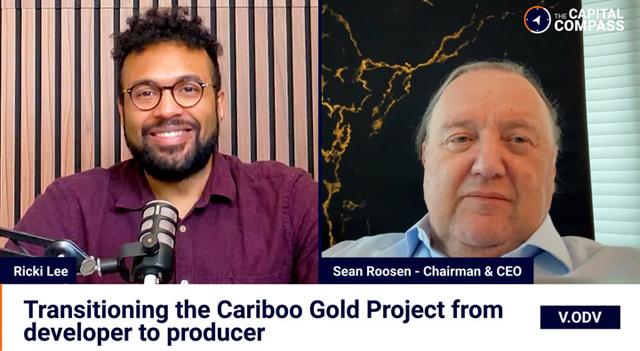
In this episode of the Capital Compass we’re joined by one of the most recognized names in the mining industry — Sean Roosen — one of the original founders of Osisko Mining and the builder behind one of Canada’s most successful modern gold stories with Canadian Malartic.
Sean is now leading Osisko Development (TSXV:ODV) (NYSE:ODV), which is advancing its fully permitted and fully funded Cariboo Gold Project in central British Columbia — a project poised to transition the company from developer to producer.
With pre-construction activities at surface and underground already underway, including infill drilling, strong financial backing, and a clear path toward a construction decision in the near term, Cariboo is one of the most closely watched gold developments in the country.
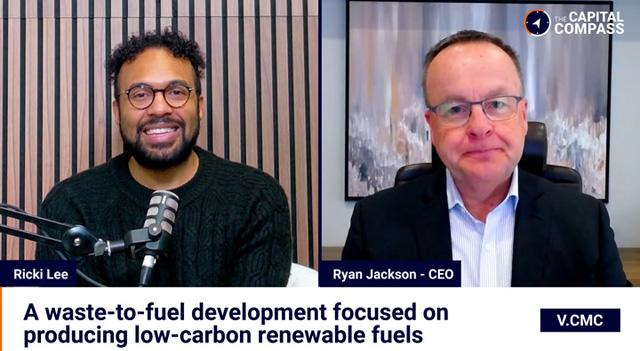
Sean Roosen joins Ricki to talk about the project, the company’s strategy & vision, and what comes next in 2026.
Ricki: Sean, many already know about Osisko, but for those who don’t, can you give us a brief overview of the business?
Sean: Certainly. I was the founder of the Osisko Group back in 2003, the original CEO and Chairman. We built the Canadian Malartic Mine which is now the eighth largest gold mine in the world. It belongs to Agnico Gold now. The largest gold mine in Canada for many years.
And I started Osisko Development back in 2015 with my friend Chris Lodder, and we acquired the Barkerville Project in north central BC located just outside of the town of Quesnel in British Columbia.
It’s a historic mine site started in 1859. We’ve drilled 800,000 meters into this deposit to define 4.4 kilometers of the mineralized trend that we identified to a measured and indicated level of 2 million ounces of reserves, 1.61 million ounces measured and indicated, another 1.81 million ounces in inferred ounces.
And we received our full mining permit and construction permit in November of 2024.
So, we’re in pre-construction development right now. We have an FID (Final Investment Decision) coming up in Q1. But we are doing pre-construction activities and we’re back at it with the exploration drilling which is a big key value builder for anybody that’s around the Osisko Group. We’ve been quite fortunate.
We’ve built $17 billion worth of company underneath the Osisko brand. This one trades currently at about $1.2, $1.3 billion market cap. We recently raised just under $940 million Canadian and we have $400 million plus of that in the bank ready to go right now. So lots going on. About 160 people on site.
Three drill rigs, active underground and two on surface and a full mining team in place driving about five meters of tunnel a day right now. So quite a bit of progress on this company.
Ricki: Amazing. Well, I can see why your reputation is what it is. Cariboo is your flagship asset and one of the most advanced gold projects in British Columbia. So what makes Cariboo so significant and how does it anchor Osisko Development’s transition toward becoming a producer?
Sean: I think it’s one of the more important gold projects in the space worldwide right now. It represents 83 kilometers of known mineralized trend. We’ve only documented in detail with 800,000 meters of drilling so far, 4.4 kilometers of that, so about 6% of the known mineralized corridor.
We’ve drilled to a level of detail. It’s quite an interesting deposit, it was discovered in 1859, which is a pretty classic story for what we do. We’re brownfield specialists. We go into old mining camps, try to figure out the mineral endowment and make sure that we understand the geology.
Do new science like we did at Canadian Malartic. When we bought Canadian Malartic for $88,888 in 2003 after Barrick had sold it for a dollar. And it now has 38 million ounces in it in total. And it’s the produces over 600,000 to 700,000 ounces a year making either the largest or second largest gold mine in Canada.
That was typical of the Osisko things that we look for, and the Cariboo Gold story is the next project in line. Very much in keeping with what we do, which is to go into places where we’d have a couple hundred million dollars of historic information available to us. And we go back, redo the geology, redo the science.
And then you know, we go with what we call the Osisko SUDS program, which stands for a Shut Up and Drill Stupid.
Ricki: Well, that sounds like that was a dollar well spent. The project is fully permitted, and you recently closed a $203 million US dollar financing, followed by another $82.5 million Canadian dollar financing in addition to the project financing, the loan with Appian for US$450 million over the summer. So what stage is Cariboo at today, and how is that capital being deployed as you move toward the next phase?
Sean: We’ve driven just under two kilometers of underground tunnel. We’ve drilled over 800,000 meters from surface. We’re now drilling from the underground. We have 2 million ounces in the reserve category, another 1.61 million in measured and indicated, and another 1.8 million in the inferred.
So, the underground drilling is focused on converting those measured and indicated ounces and the inferred ounces to reserves. So, conversion drilling, pretty important. We’ve also purchased a mill that was destined for the Hudbay Lalor Project, and it’s our yard ready to be built, and we’re in site prep and construction preparations to install that mill.
at mill had a 7,500 ton a day nameplate on it when we bought it, and we’re adding ore sorter technology, so it’s a pretty big mill. We were permitted for 4,900 tons a day. So it more than looks after our current permitted capacity, and we have a significant amount of exploration upside below us.
We’re only drilled down to a depth of about 350 meters or a thousand feet. But we have drilled down to a thousand meters, so three times as much as we have now. And we’ve averaged about 15,000 ounces a vertical meter on the way down, so it’s pretty impressive that part of it, which is spread over 4.4 kilometers.
But we have another 10 kilometers of known realization that we don’t have enough drill density to put it in the resource category which is what we’re doing now. We have a big drill program. We just announced 70,000 meters that we announced yesterday. That’s ongoing now. And the first two surface drills that are onsite drilling now.
There’ll be two more in January and hopefully get it up to six or eight drills as we get into it. But it is a very significant drill program going on. So as a catalyst for shareholders we’ll have quite a few drill results coming from that 70,000 meter drilling.
And then we’ll have the ongoing drilling from the underground as we open up the ore body from the underground where we’re drifting across. We have 27 kilometers of planned development in the underground right now.
Ricki: And continuing on from that, what work still needs to be done, technically, operationally, or strategically before a formal construction decision is made?
Sean: We’ve got some infill drilling that’s confirmation on the conversion from the surface drilling into confirmation drilling on tighter spacing and a calibration to confirm what we drilled from surface in terms of reserves to what we see when we’re actually in underground with tighter drilling.
So that’s going to be complete by the end of the year, and that’s really the last technical piece of work for the final investment decision. And that would unlock $350 million US dollars from our Appian financing. So, as you’d said, the total financing that we’ve raised so far this year is about $720 million US or about $940 million Canadian since April.
So it’s been a very successful year in terms of financing this project as well.
Ricki: Amazing. And some investors have been drawing comparisons between a Osisko Development’s potential path and the success of G Mining and Artemis Gold, both of which moved from developer to near term producer by executing efficiently on their high quality project builds. So what similarities do you see between your trajectory and theirs, and where do you see them differing also?
Sean: I think G Mining in particular is a good analog. We are an underground mine, that’s the big differentiator, but we’re starting out with a mine that’s going to produce 10 years, 190,000 ounce a year from that first tranche of 350 meters.
The second mine will be the conversion of the 1.6 million ounces of measured and indicated, as well as the inferred of 1.81 million ounces. So that would be a mine too, which is essentially the same formula that G Mining has. They trade at about a $7 billion market cap.
We’re currently trading at about $1.2 billion market cap, so we have quite a bit of distance to go for shareholders. We have the ability to scale this project, the feasibility calls for 200,000 ounces a year at 4,900 tons a day, which is what we are fully permitted for.
However, we’ll be looking for an expansion as we get more of this drilling done in more of the underground development to hopefully more than double that production. So roughly for each 4,900 tons a day that we can increase in throughput.
We can add it somewhere between 150,000 to 200,000 ounces a year, which would put us in the same category as where Artemis and G Mining are sitting in terms of annual production. So, that’s the stated goal of the company right now is to continue to convert those ounces and to drill the ounces that are below that.
And then we’re looking to generate a new discovery. We have a six kilometer long trend at Proserpine by one kilometer wide which on surface has a larger footprint than the Cariboo deposit that we’re working on now.
So that has the potential to drive the catalyst for valuation here as well. We’re on grid power, so we have a power contract with BC Hydro for 22 megawatts of power, which gives us lots of electricity to do what we want to do. And that is at 6.6 cents Canadian, a kilowatt hour, roughly 5 cents US per kilowatt hour.
It is green power from Site C in BC as well. So, there’s a very low carbon footprint, this mine. As well as very low surface disturbance because we’re underground. So, there’s a lot going on that’s very good. And we’re looking forward to converting this to one of the top 10 assets in the gold space worldwide in the long term.
But in the short term, I think we can make it into the top 20 with a little bit more conversion work on the underground.
Ricki: Well, Sean, thank you so much for joining us and sharing the latest on Osisko Development and the Cariboo Gold Project. For more information, visit osiskodev.com. I’m Ricki Lee, and this has been The Capital Compass.
This article is disseminated in partnership with Osisko Development (TSXV:ODV) (NYSE:ODV). It is intended to inform investors and should not be taken as a recommendation or financial advice.
Join the discussion: Connect with other investors on your favorite stocks or explore the top-talked-about stocks on our Breakout Boards.
This content is for informational purposes only and does not constitute financial, investment, or other professional advice. It should not be considered a recommendation to buy or sell any securities or financial instruments. All investments involve risk, including the potential loss of principal. Past performance is not indicative of future results. Always conduct your own research and consult with a qualified financial advisor before making investment decisions.
Some portions of this content may have been generated or assisted by artificial intelligence (AI) tools and been reviewed for accuracy and quality by our editorial team.

Morgan Stanley believes U.S. defense equities present an attractive opportunity heading into 2026, arguing that current share prices do not adequately capture the outlook for continued expansion in U.S. defense spending, even amid ongoing political uncertainty. In a sector outlook, analyst Kristine Liwag said the bank views the group as undervalued, noting that it “provides […]



It looks like you are not logged in. Click the button below to log in and keep track of your recent history.


 Register for Free to get streaming real-time quotes, interactive charts, live options flow, and more.