RUMSFELD ADDRESSES SECURITY CONCERNS ON LIGHTNING TRIP TO AFGHANISTAN, AZERBAIJAN Camelia Entekhabi-Fard: 8/12/04
excerpt:
US Defense Secretary Donald Rumsfeld, on a secretive and whirlwind trip to Central Asia and the Caucasus, sought to keep the Afghan election process on track and the Azerbaijani government in line.
A sense of urgency also surrounded Rumsfeld’s brief stop in Azerbaijan. Local political analysts characterized Rumsfeld’s trip to Baku as "unscheduled." The US defense secretary’s talks August 12 with top Azerbaijani officials, including President Ilham Aliyev, were driven by "concern over the latest trends in Baku’s foreign policy," said a commentary published in the Zerkalo daily on August 11.
Of late, the commentary indicated, Azerbaijani officials have shown signs of wavering in their pro-Western foreign policy orientation, an impression underscored by the visit of Iranian President Mohammad Khatami earlier in August. [For background see the Eurasia Insight archive]. Azerbaijan in recent months has sought to improve relations with a number of states – in particular Russia and Iran -- that are seen as competitors of the United States for influence in the Caucasus. [For additional information see the Eurasia Insight archive].
The diversification trend appears closely linked to mounting frustration in Azerbaijan to the stalemate in the Nagorno-Karabakh peace process. [For background see the Eurasia Insight archive]. Many in Baku hold the United States responsible for the lack of progress in the search for a Karabakh political settlement. Azerbaijan, the thinking in Baku goes, has steadfastly backed the US-led anti-terrorist campaign, including the military operations in Iraq, but has not received a reciprocal level of support from the United States on the Karabakh issue.
The Zerkalo commentary reflected the rising level of anger in Azerbaijan towards the United States. "Washington’s main goal is not to help the Azerbaijani nation to prosper, but to oust Russia from the Caucasus and build a strategically important corridor between Central Asia, the Caucasus and Europe," it said.
Political analysts, including Vafa Guluzade, who served as an adviser to former president Heidar Aliyev, suggest the Azerbaijani government has felt compelled to reach out to Russia and Iran in an effort to achieve a breakthrough on the Karabakh issue. "If the United States continues to turn a blind eye to the situation, it can lose Azerbaijan as a strategic partner," Guluzade told Zerkalo.
Azerbaijani officials made a direct appeal to Rumsfeld for stronger US support for Baku on the Karabakh question, according to local reports. Rumsfeld was reportedly non-committal in his response. Following their talks, Rumsfeld and Ilham Aliyev provided no public hints that US-Azerbaijani relations were experiencing underlying tension. Aliyev characterized bilateral strategic cooperation as operating "at the highest level," according to an August 12 report broadcast by ANS television. "I am confident that in the future we will further strengthen our ties to become a closer friend and ally," Aliyev added. Rumsfeld echoed the Azerbaijani leader’s comments, praising Azerbaijan for its "major efforts in combating terror."
Azerbaijan is key to understanding the region and the power. During the past decade the only western source of power and force projection into the region was with the USACC. The United States Azerbaijan Chamber of Commerce. It was this body that has, and remains, the source of negotiations, planning and structure in the region. Prior to many of its board members entering the present White House along with Mr. Bush, they were the force behind the U.S. Congressional effort called the Silk Road Strategy of 1996-1998; the Caspian initiative; Black Sea pipeline routes and the division of the Caspian Sea, etc.
The USACC Advisory Board consisted of "only" these seven men: Dr. Henry Kissinger, James A Baker III, Lloyd Bentsen, Zibigniew Brzezinski, Dick Cheney, Brent Scowcroft, John Sununu. It is noted here that the current Vice President’s daughter, Elizabeth Cheney-Perry, has been named Assistant Secretary of State for Near East Affairs for regional economic issues; she left Armitage Associates for the job. The USACC Vice-Chairman of the Board is James A Baker IV (Baker Botts, L.L.P.); Chairman Emeritus is T. Don Stacy (VP, Amoco); with Richard Armitage as Board President, until he resigned to become Colin Powell’s Deputy, which rounds out the US elite running the USACC. The remaining Board of Directors are a who’s who of the oil and gas multinational corporate interests of the west and specifically the United States. On the Board of Trustees or USACC the latter interests hold sway again with three primary exceptions: Senator Sam Brownback (R-KS) and Joseph R. Pitts (R-PA) (whose efforts formed the 1996 legislative backbone of the House/Senate Silk Road Strategy for Afghanistan, [Unocal, Texaco] et al) and Richard Perle (US Defense Policy Board). The Legal Counsel for USACC is Ted Jones of the Texas Law firm Baker Botts L.L.P. (James A Baker III & IV’s law firm.); Treasurer is Karl Mattison (VP, Riggs Bank, NA). It was the James A. Baker III Institute of Rice University which outlined the Cheney Strategic Energy Initiative which later became the Administration’s Strategic Energy National Security Policy. (Clearly Dick Cheney wouldn’t be interested in giving Congress the names of who he consulted on the Energy Initiative as they would amount to the remainder of the Board of Directors and Board of Trustees of USACC.) #msg-1263010
Iraq is the latest battle in the war, terrorism is one aspect, 9/11 is one catalyst. The U.S. Congressional effort called the Silk Road Strategy of 1996-1998; the Caspian initiative; Black Sea pipeline routes and the division of the Caspian Sea, etc. give an insight into the battles that have been fought and the battles that will be fought in this part of the world.
Iran is the prize. To control, or dominate Iran, Mr. Bush has to encircle it: Afghanistan to the East, Turkey/Azerbaijan to the North, Iraq to the West, the South are already U.S. stooges. Pipelines, in effect, will become the new Berlin Wall.
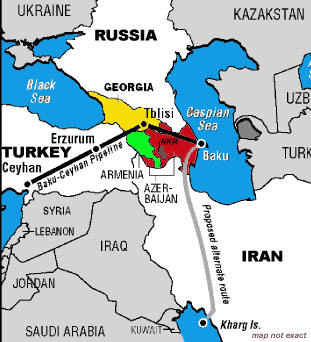
Iran proposed a southern pipeline over its territory--from Baku to the Iranian oil terminal on Kharg Island. This route would make the Caspian Sea into a hinterland of the Persian Gulf--and would secure the position of Iran and other Persian Gulf countries in the center of the world oil economy.
Some oil companies supported this Iranian plan because the Iranian route was estimated to be the cheapest. They also argued that this pipeline would give them more power within Iran--strengthening imperialist control over that important country.
The U.S.--and specifically the Clinton White House--was determined to oppose any "north/south" pipelines. The White House adopted a plan, cooked up by long-time ruling class strategist Zbigniew Brzezinski, to create an "east-west" pipe which would bypass both Russia and Iran.
The U.S. intends to strip Russia of control over this oil. And the U.S. wants the Caspian oilfields to be completely independent of the Persian Gulf--to diminish the importance of Persian Gulf states in the world economy.
The U.S.-proposed pipeline would start in Baku--traveling west through Azerbaijan. It would deliberately take a detour around Armenia--a country allied with Russia. The pipeline would circle into Georgia, and then travel southwest across Turkey. Most of its length would be through the Kurdish areas of Turkey--where there has been ongoing armed struggle against the Turkish oppression of Kurds. And the pipeline would end in a port near Ceyhan on the eastern Mediterranean. #msg-3775550
In today's world, $17 out of every $100 earned is from oil.
Even this statistical information alone is enough to emphasize the global importance of the above-mentioned product. In other words, oil plays a big role in the world gross domestic product (GDP). But the distribution of oil revenues among countries is extremely unbalanced, since it is the basic source of income for some countries, and the primary source of expenditure for others.
Up till the early 1970s, the price of crude oil was low. Rich countries, especially the United States, purchased that cheap material from Arab countries, and then sold it at exorbitant prices to the world, including the Arabs, as petroleum derivative products. Although Britain and America made the biggest profits thanks to Arab oil, they did not hesitate to support Israel against Saudi Arabia. Hence the Saudis, who could not put up with this injustice, initiated lobbying activities along with other Arab countries and they began to support the idea of implementing an oil embargo against Israel and its citizens. The shah of Iran also agreed to this, and speaking to the New York Times, said : "Of course, we have to increase oil prices ten-fold. Because the oil you buy cheaply from us, you sell it back to us at cutthroat prices under the name of petro-chemicals."
Henceforth, oil embargo was on the way. The Arab-Israeli war was only a pretext. In the three previous Arab-Israeli conflicts, the United States had openly supported Israel. When the 1973 war started, Saudi King Faisal warned the U.S. that it would shut the oil pipelines if America became involved in the war. However, the [Richard] Nixon administration did not care about the threat. Then Saudi Arabia, along with other Arab countries stopped oil sales to countries that supported Israel after U.S. tanks and aircraft were deployed in Israel. The price of crude oil that was $3.10 per barrel, all of a sudden jumped to $11.65.
The 1973-74 oil crisis was recorded as the most striking event in the world's political and economic history. For the first time ever, a group of Third World countries challenged their superiors by controlling their own fate. All right, what kind of precautions did the Western world take against this right reaction?
Arabs amassed $800 billion in a short period of time from quadrupled prices. On the other hand, poor oil importing countries experienced huge deficits. Since Arab countries lacked the banking and financial systems to deal with this kind of a situation, the big banks in Europe and America handled the issue. These institutions gave the Arab petro-dollars as loans to developing countries, including Turkey, as well as to Latin American nations. Moreover, this process played an important role in the birth and progress of the banking industry beyond national boundaries. In other words, the Western world overcame the shock and succeeded in turning the Arab embargo into its own favor.
As for the political and military dimensions of the matter… According to documents disclosed to the public, the Nixon administration had planned to occupy the oil reservoirs during the crisis. The documents indicated that the U.S refrained from doing so only after the possibility of an intervention in Iraq. In other words, it is so very obvious how long the United States has been planning to occupy Iraq.
In today's situation, where a new oil crisis is being expected, the U.S. and Britain have settled in the region; on the other side, Israel is committing more acts of violence and behaving more audaciously than ever before. Therefore, what is Turkey's role here? Turkey, which is powerful, reasonable and stable, stands as a unique deterrent force against such a trio.
Bush will attack Iran on this pipeline proposal. If possible he cannot let this pass, there are some heavy consequences attached to this route.
Bush is depending on a significant amount of Kazakhstan oil to feed his U.S. backed Baku-Tbilisi-Ceyhan pipeline and can’t be happy at the prospect of the Kazakhstan/China pipeline or that fact that the pipeline could be extended to Kazakhstan's even richer oil fields in the Caspian Sea area. #msg-4186355
In addition Kazakhstan is now proposing exporting its oil via Iran. This would be a "north/south" pipeline. The United States vehemently opposes "north/south" pipelines.
I would look for more jostling over the Strait of Hormuz. #msg-3136614
Background:
The Caspian Sea is landlocked, and far from any of the world industrial centers. This oil must be transported out of the region by pipeline--through politically explosive and contested areas. Whoever controls the pipes ultimately controls the oil.
Russia proposed to build a new northern pipeline parallel to the old pipeline from Baku to Novorossisk--and to expand companion pipelines from Tengiz to Novorossisk.
Iran proposed a southern pipeline over its territory--from Baku to the Iranian oil terminal on Kharg Island. This route would make the Caspian Sea into a hinterland of the Persian Gulf--and would secure the position of Iran and other Persian Gulf countries in the center of the world oil economy.
Some oil companies supported this Iranian plan because the Iranian route was estimated to be the cheapest. They also argued that this pipeline would give them more power within Iran--strengthening imperialist control over that important country.
The U.S.--and specifically the Clinton White House--was determined to oppose any "north/south" pipelines. The White House adopted a plan, cooked up by long-time ruling class strategist Zbigniew Brzezinski, to create an "east-west" pipe which would bypass both Russia and Iran.
The U.S. intends to strip Russia of control over this oil. And the U.S. wants the Caspian oilfields to be completely independent of the Persian Gulf--to diminish the importance of Persian Gulf states in the world economy.
The U.S.-proposed pipeline would start in Baku--traveling west through Azerbaijan. It would deliberately take a detour around Armenia--a country allied with Russia. The pipeline would circle into Georgia, and then travel southwest across Turkey. Most of its length would be through the Kurdish areas of Turkey--where there has been ongoing armed struggle against the Turkish oppression of Kurds. And the pipeline would end in a port near Ceyhan on the eastern Mediterranean.
U.S. planners propose a second pipeline --for natural gas--traveling over 1,000 miles from Turkmenistan to the Turkish city of Erzurum. #msg-3775550
-Am
Kazakhstan reiterates interest in exporting oil via Iran 05.10.2004 09:38:00 GMT Astana. (Interfax-Kazakhstan) - Kazakhstan has reiterated its interest in exporting its oil via Iran, Kazakh Prime Minister Danial Akhmetov said at a meeting with Iran's Commerce Minister Mohammad Shariat-Madari on Monday in Astana.
"We have very good prospects for developing the transport of oil. We can transport oil via our ports [on the Caspian Sea] and can ship by rail along the coast on our foreign border," Akhmetov said.
"We obviously need to do a lot of work" on this issue, he said.
Akhmetov said that relations between the two countries "are developing quite well." Mutual trade turnover was some $400 million in 2000 and was already some $370 million in the first half of 2004, Akhmetov said. "This is a good factor," he said.
Kazakhstan is delivering its oil to Iran according to a SWAP scheme. The state-owned oil and gas company KazMunaiGaz and Canada's PetroKazakhstan are delivering fuel according to this scheme.
Kazakhstan supplies oil by tanker through the Caspian to the Iranian port of Neka, and in exchange receives the equivalent at an Iranian port of Kharq in the Persian Gulf.
In turn, PetroKazakhstan currently supplies oil to Teheran Oil Refinery by rail only, but plans to set up regular oil supplies to Iran through the Caspian. In exchange the company will receive light Iranian oil in the Persian Gulf.
In 2003 oil supplies from Kazakhstan amounted to 50,000 bpd, of which KazMunaiGaz accounted for 30,000 bpd and PetroKazakhstan - 20,000 bpd.
KazMunaiGaz announced earlier that it plans to increase oil delivers to Iran to 2 million tonnes of oil under the same scheme in 2004, while PetroKazakhstan will supply 1 million tonnes.
The extinction of NATO, now there’s an idea whose time has come.
Walker's World: Spy satellites and power
By Martin Walker UPI Editor
Paris, France, Dec. 22 (UPI) -- The new twinkling star in the Christmas sky speaks French, and sometimes German and Italian and Spanish, and goes by the name of Helios 2A.
France's new spy satellite, Helios 2A was launched aboard a French Ariane rocket on Saturday, orbits the earth at a height of 400 miles and cost nearly $3 billion. It also brings the extinction of the NATO alliance a significant step closer, so for the longer-term goals of French foreign policy it is thus cheap at the price.
The United States loves NATO because it makes American presidents the leaders of the free world, at the head of a proven military alliance that always has American generals and admirals in command. Europeans used to love NATO as the guarantee of American protection against the Red Army. With no more Soviet threat, Europeans still needed the Americans in NATO to provide the kind of modern war-fighting capabilities that Europeans won't pay for.
However, slowly but surely, the French are removing that need for American hardware and are doing this through the European Union, not through NATO. The main capabilities that Europe does not provide for itself are strategic airlift, spy satellites, global positioning satellite systems, and AWACS airborne radar and command platforms.
Last year, the EU agreed to spend some $4 billion in buying its own fleet of military transport airplanes -- from Airbus, of course. The EU is also spending another $4 billion on its own global positioning satellite system, called Galileo, which means no more dependence on the Pentagon's existing system. (Just to make the Pentagon feel really good about this, the EU has also signed up the Chinese as partners in the Galileo system - and there are no guarantees that the Europeans can or will switch off Galileo if a U.S.-Chinese military confrontation looms in the Taiwan Straits.)
And now the French are trying to prove to their fellow Europeans that they no longer need the American spy satellites. France already has two very obsolete Helios satellites still operating, and beaming back to earth photographic images with a resolution of 1 meter. That means that it can identify the model of a warplane parked on a runway. Pictures from space of that quality have been available commercially for the past five years from the Spaceimaging company.
The imaging quality of Helios 2A is, according to France's DGA (Delegation Generale pour l'Armement) military procurement office, "more than four times better." That means it can tell whether the warplane has missiles and/or fuel tanks loaded on its wings, but will have trouble reading the registration plate on a car. The real benefit of Helios 2A is that it also has infra-red imaging, which means it can read heat sources at night or through cloud, and thus tell whether a tank's engine is running or not.
The French satellites are going to be part of a much broader European system. Later this year, Germany launches its own SAR-Lupe system of radar satellites, and Italy is preparing its own Cosmo-Skymed system of mixed radar and optical satellites, and a complex system of sharing data has been worked out. So the Spaniards and Belgians, as junior (and co-financing) partners with the French in Helios, can share the satellite data. The Italians and Germans, in return for French access to their radar data, have the right to ask the new Helios to look at particular spots and get the resulting imagery in encrypted form so that (theoretically) the French cannot read it.
Europe is still a long, long way from being able to duplicate the communications, logistics and reconnaissance systems on which NATO still depends, courtesy of the Pentagon. But, pushed by the French, the Europeans are getting there.
By the end of this decade, the EU's new rapid reaction task forces should be able to land somewhere like the Ivory Coast or Tunisia, with good intelligence from the satellites, with total air command from the new aircraft carriers being built in France and Britain, and reinforcements flown in steadily on the Airbus military transports, while Airbus tankers refuel the Eurofighters flying air cover. And just in case any other serious navy wants to get involved, very quiet French-built Scorpene and German-built Dolphin submarines will be securing the sea lanes.
The question is whether Britain will be taking part. The British are part of the Galileo system, have signed up for the Eurofighter warplane and the Airbus transports, and strongly backed the EU rapid reaction force. But with their own close intelligence links to the United States, the Brits are not yet involved in the EU spy satellite network. They are trying desperately, as so often, to have the best of both worlds, being America's best friend and a leading NATO power but also maintaining their credibility as a full partner of the EU.
But the way the military technology is going, it will be harder and harder for the British to have it both ways. So far, because they have the best-trained and best-equipped armed forces, the Brits are essential to almost any credible EU military operation. As one of the few European countries with the wealth and the political will to invest in new aircraft carriers, Britain is going to be pivotal for years to come.
So far, the Blair government is ducking what looks to be an inevitable choice, whether or not it joins the EU military space system with dedicated European spy satellites, or whether it continues to rely on the American alliance and NATO. The French are making its harder and harder for the British to have it both ways. But if the British do decide that their deeper strategic interests lie with Europe (where almost 60 percent of Britain's trade goes), then the EU economic superpower is going to look increasingly credible as a serious military power.
That is what the French mean when they talk of "a multipolar world." France thinks it is inevitable that the current lonely American superpower will soon be "balanced" by the new or emerging great powers of Europe, Russia, China and India. It means a world rather like 19th century Europe, when great powers like France and Britain and Germany and Russia and Austro-Hungary balanced each other - until the system failed in 1914.
France's determination to build a European military space capability independent of the Americans brings that grimly familiar 19th century world a step closer.
Bush’s master plan for world domination is contingent upon controlling the supply and transit of the world’s oil especially to China who is considered the number one threat to U.S. hegemony.
In a world that runs on oil, the nation that controls the flow of oil has great strategic power. U.S. policy-makers want leverage over the economies of competitors -- Western Europe, Japan and China -- that are more dependent on Middle Eastern oil. #msg-4798276
The U.S. is not interested in Caspian oil to supply its own internal industry. The U.S. is grabbing for control of the Caspian oil fields because other countries need this oil--and because the U.S. wants to dontrol them. Other imperialist rivals--including Germany and Japan--are "energy poor" and need access to oilfields outside their borders. Most Third World countries are heavily dependent on imported oil. #msg-3775550
In order to control the world's oil the United States must block 'north/south' pipelines.
Background:
The Caspian Sea is landlocked, and far from any of the world industrial centers. This oil must be transported out of the region by pipeline--through politically explosive and contested areas. Whoever controls the pipes ultimately controls the oil.
Russia proposed to build a new northern pipeline parallel to the old pipeline from Baku to Novorossisk--and to expand companion pipelines from Tengiz to Novorossisk.
Iran proposed a southern pipeline over its territory--from Baku to the Iranian oil terminal on Kharg Island. This route would make the Caspian Sea into a hinterland of the Persian Gulf--and would secure the position of Iran and other Persian Gulf countries in the center of the world oil economy.
Some oil companies supported this Iranian plan because the Iranian route was estimated to be the cheapest. They also argued that this pipeline would give them more power within Iran--strengthening imperialist control over that important country.
The U.S.--and specifically the Clinton White House--was determined to oppose any "north/south" pipelines. The White House adopted a plan, cooked up by long-time ruling class strategist Zbigniew Brzezinski, to create an "east-west" pipe which would bypass both Russia and Iran.
The U.S. intends to strip Russia of control over this oil. And the U.S. wants the Caspian oilfields to be completely independent of the Persian Gulf--to diminish the importance of Persian Gulf states in the world economy.
The U.S.-proposed pipeline would start in Baku--traveling west through Azerbaijan. It would deliberately take a detour around Armenia--a country allied with Russia. The pipeline would circle into Georgia, and then travel southwest across Turkey. Most of its length would be through the Kurdish areas of Turkey--where there has been ongoing armed struggle against the Turkish oppression of Kurds. And the pipeline would end in a port near Ceyhan on the eastern Mediterranean.
U.S. planners propose a second pipeline --for natural gas--traveling over 1,000 miles from Turkmenistan to the Turkish city of Erzurum. #msg-3775550
-Am
US pressing Pakistan against Iranian gasline
December 29, 2004
* Senior Pakistani official says Islamabad will take ‘own decision’
Daily Times Monitor
ISLAMABAD: In another twist to the proposed Iran-Pakistan gas pipeline, the US is believed to be pressuring Pakistan not to push for the project with Iran, as the latter is under scrutiny for its alleged nuclear programme, The Indian Express reported on Tuesday. It, however, quoted a senior Pakistani official as saying that Islamabad would take its “own decision” on the matter.
The issue was expected to be part of the talks between Pakistani Foreign Minister Khurshid Kasuri and his Iranian counterpart Kamal Kharrazi, who was in Pakistan on Tuesday, The Indian Express reported. “Islamabad is very keen on the pipeline project, but has not made much headway,” it added.
“We need gas and, in any way that you contemplate, the cheapest way to West Asia or Central Asia, or in any case that you consider, Pakistani territory has to be traversed. India will have to go through Pakistan,” Mr Kasuri told the paper.
“Pakistan’s suggestion to treat it as a ‘stand alone’ project was prompted by its own need for economic growth,” it reported. “Today, we know that our reserves will not be sufficient and we need the gas,” The Indian Express quoted Mr Kasuri as saying. India had said that for the pipeline to materialise, Pakistan needed to reciprocate by allowing transit facilities or trade benefits, the paper reported, adding that New Delhi was also willing to explore the possibility with Tehran of directly buying the gas from them.
As the pipeline’s fate became even more uncertain, the Indian and Pakistani foreign secretaries met on Tuesday to review the progress made in the first round of the composite dialogue and to take the process further.
The Erosion of Political Institutions in Turkmenistan
Washington is interested in Turkmenistan primarily because of its proximity to Afghanistan and Iran. Niyazov allowed humanitarian supplies to flow through the country to Afghanistan during the U.S. war against the Taliban regime, and permitted U.S. airplanes to refuel there. Washington would also like to see Turkmenistan's gas diverted from Russian channels to the Baku-Ceyhan pipeline through the Caucasus and to a projected pipeline through Afghanistan to Pakistan. Washington's influence in Ashgabat is relatively weak; U.S.-based oil companies are not active in Turkmenistan and Niyazov has been cool about the Caucasus route.
This reiterates Bush’s resolve to control all oil and is a primary reason why Putin has been forced to circle the wagons. #msg-4823870
-Am
The Erosion of Political Institutions in Turkmenistan 30 December 2004
On December 19, parliamentary elections were held in Turkmenistan, a Central Asian republic bordered by Kazakhstan and Uzbekistan to the north, Afghanistan and Iran to the south, and the Caspian Sea to the west.
The elections did not awaken significant international interest, because President Saparmurat Niyazov's Democratic Party was the only party to participate in them. Along with North Korea, Turkmenistan has the only remaining Stalinist regime in the world, complete with a cult of personality. Niyazov has named himself "Turkmenbashi," "Father of all Turkmens."
The significance of the elections came in the fact that although the Central Election Commission announced a 76.88 percent turnout, international journalists reported that polling stations were nearly empty and that election officials ended up carrying ballot boxes door to door in order to get people to vote. Those who did show up received gifts if they were new voters or elderly, including copies of the Rukhmana, Niyazov's book of "spiritual wisdom," which is required reading in Turkmenistan's schools, a subject on driver's license examinations and is deemed by the state and its leaders to be a "sacred" text, second only to the Quran.
The low turnout represents the passive resistance of a demoralized population. Niyazov has sufficient coercive and administrative power to remain in control of the state apparatus, but he has not been able to mobilize the soft power of persuasion that generates loyalty. Ironically, Niyazov's deepest wish is to wield soft power -- he styles himself as a philosopher and a sage, and his Rukhmana is everywhere in Turkmenistan. He portrays himself as an ideal father, generous and lenient with his charges, and at their service.
The reality is different -- documented human rights violations, forced resettlement of ethnic minorities, rigid press censorship, high unemployment, a drug epidemic among the youth, widespread corruption, a declining educational system based on the Rukhmana, vast symbolic building projects (including an ice palace in the desert), isolation of the country from the rest of the world, collapsing public health (including reported cases of plague), and a political system in which no opposition to the government is tolerated.
A Stalinist regime that cannot get its people to the polls for a show election is obviously unstable. Niyazov's control is not currently in question, but, after he is gone, Turkmenistan faces the possibility of becoming a failed state.
Turkmenistan's Geostrategic Significance
Turkmenistan, which has a population of 5 million and is 90 percent uninhabited desert, would have no global importance, except for the human rights community, were it not for its energy reserves (the fifth largest natural gas deposits in the world) and its strategic importance in the struggle with Islamic revolution.
A part of the former Soviet Union, Turkmenistan became independent in 1991, but remained dependent on Russia as the channel for its gas exports. A member of the Commonwealth of Independent States, the country is a component of Moscow's design of recapturing control over its "near abroad." More importantly, Russia relies on Turkmenistan to help it fulfill energy supply contracts.
Washington is interested in Turkmenistan primarily because of its proximity to Afghanistan and Iran. Niyazov allowed humanitarian supplies to flow through the country to Afghanistan during the U.S. war against the Taliban regime, and permitted U.S. airplanes to refuel there. Washington would also like to see Turkmenistan's gas diverted from Russian channels to the Baku-Ceyhan pipeline through the Caucasus and to a projected pipeline through Afghanistan to Pakistan. Washington's influence in Ashgabat is relatively weak; U.S.-based oil companies are not active in Turkmenistan and Niyazov has been cool about the Caucasus route.
Niyazov has responded to the external pressures and constraints on his regime by declaring a policy of "positive neutrality," according to which Ashgabat will not align itself formally with any major power bloc, but will take advantage of opportunities presented by any side. In practice, positive neutrality has meant the relative isolation of Turkmenistan from the rest of the world -- a strategy that seems to be calculated primarily to perpetuate Niyazov's rule.
As a result of Niyazov's isolationism, Turkmenistan has failed to develop economically. From 80-90 percent of its economy remains in the hands of the state, and private business is subject to administrative obstacles and arbitrary interference. Foreign investment, including in the energy sector, has consequently lagged. Australian analyst Michael Blackman summarizes the judgment of the investor community: "Vague property rights and unclear laws mean that there is little protection for foreign investors, either from each other or from corrupt officials."
Despite Niyazov's fervently romantic nationalist ideology, Turkmenistan's society continues to be structured by a dominance of clan affiliation over national identity among the 80 percent majority of Sunni Muslim ethnic Turkmens. The clan system is overlaid by the corrupt state bureaucracy, creating divided loyalties and a support base that maintains Niyazov in power -- the only chance for someone to gain an economic foothold is to get a job with the state.
As is the case in all modern dictatorships, Niyazov relies on a large internal security and military apparatus that is treated more favorably than the rest of the population. He has also exploited Turkmenistan's energy riches to make gasoline and electricity virtually free and domestic travel available at nominal cost. The mixture of repression and welfare has allowed Niyazov to retain his power despite Turkmenistan's poverty and resulting social problems.
Neither Washington nor Moscow has seen fit to challenge Niyazov, despite Turkmenistan's latent instability. Each one has its own strategic interests and Niyazov has been careful not to threaten them. Although Washington has criticized Ashgabat's human rights violations, including torture, the arrests of the families of dissidents, forced relocation and imprisonment in psychiatric hospitals, it has taken no action toward sanctions, because it is intent on keeping Niyazov's support in the "war on terrorism." Although Moscow was ruffled by Niyazov's revocation of dual citizenship for Turkmenistan's Russian minority and consequent travel restrictions, it has continued to pursue gas deals with Ashgabat.
Attempts by the human rights community to have Washington declare Turkmenistan a "state of concern" and by Russian nationalists to convince Moscow to impose sanctions on Ashgabat have not received positive responses. Niyazov has neither the capability nor the will to obtain weapons of mass destruction, is opposed to radical Islamism and is eager to sell his country's gas to support subsidized domestic energy, his security apparatus and his building projects. For the present, that is sufficient for the interested powers, despite possible longer term problems.
The Long Term Erosion of Turkmenistan's Political System
Although political strategies and policies are generally determined everywhere by group interest and power, in personalized dictatorships the leaders' idiosyncrasies can have a decisive impact. In the case of Turkmenistan, Niyazov's personality, which is marked by megalomania and self-delusion, has severely inhibited the development of stable political institutions.
Following the pattern of all would-be totalitarian regimes, Niyazov's ideology is at extreme variance with actual conditions. Having ruled Turkmenistan since 1985, when the country was still a Soviet republic, and having been nominated by parliament as president for life in 1999, Niyazov transformed himself into an ultra-nationalist after independence and became the nation's self-appointed spiritual guide, identifying himself with the Turkmen majority.
Niyazov's nationalist ideology is a variation on classical fascism, specifically a form of national socialism based on a hierarchy of sacrifice among what he defines as the three components of human existence -- life, Motherland and Allah: "Life is sacrificed to Motherland, and Motherland is in hands of the Allah." Despite the formal supremacy of Allah, effective dominance is given to Motherland as the mediating term: "Motherland holds everything dear -- both on earth and in subsoil, because there is life on earth and the realm of heaven in the 'other world.' Both life and faith can exist when there is Motherland."
Niyazov exhorts Turkmens to devote themselves to Motherland, of which he is the voice. As their father, he tells Turkmens to remain in the country with him and not to take flight -- there is "nowhere to run," because Motherland "exists not only around you but also inside of you."
The root of Niyazov's political isolationism is psychological. Orphaned as a child, he replaced family with collective and eventually identified himself with and as the father figure. In his May 7, 2004 address to Turkmenistan's Youth Organization -- "Only Motherland is Valued Above Life" -- Niyazov made a telling comment: "The most pleasant and pure feeling is to live with a sense of being part of Motherland, because exactly this feeling spares from loneliness." The lonely orphan has projected his condition on to the entire people. He wants them to be with him and to love, need and adore him. If they do not wish to stay after he has made his appeal, he will make it difficult or impossible for them to leave.
Niyazov's quest for devotion has led to a degradation of Turkmenistan's educational system, in which basic skills and technical training have been sacrificed to studies of his Rukhmana, which codifies his collectivist philosophy and ethics. Analysts agree that the current youth generation might not be able to run the country because they will lack the skills necessary to do so. Since the gap between ideology and reality is so great, there is a possibility that after Niyazov is gone, Turkmenistan will subside into clan conflict complicated by attempts of the state apparatus to preserve its standing.
The long term effects of a degraded educational system have been compounded by the consequences of Niyazov's paranoia since an unsuccessful assassination attempt on him on November 25, 2002. In addition to a crackdown on internal dissent leading to human rights violations and the flight into exile of critics within his administration, Niyazov intensified his practice of firing officials after short terms in their positions. According to analysts, this practice has led to the effective destruction of a coherent political class in Ashgabat and an increase in corruption, because officials are insecure about their futures.
Opinion is divided about whether Niyazov's policies and practices are motivated by his psychological insecurities or by a sense of the tactics that he needs to use to maintain control. Both motivations are probably in play, as they have been in other personalized dictators, for whom visionary self-inflation and self-delusion have gone hand in hand with ruthless application of the tactics of gaining and keeping power. Lenin, Hitler, Stalin and, more recently, Slobodan Milosevic and Saddam Hussein come to mind. Milosevic and Hussein also had traumatic childhoods, identified with the nation and evinced a split between visionary delusion and tactical realism.
Conclusion
Turkmenistan fell under a personalized dictatorship because its political institutions had been imposed during the Soviet period and had never been integrated with the underlying social structure, creating a power vacuum that a power-driven and emotionally needy individual could fill after independence. All the familiar socially destructive conditions of fascism have followed, leaving the country with an uncertain future.
Interested powers that are unwilling to act at present will have to cope with the fall-out when the Turkmenbashi no longer presides in Ashgabat. The parliamentary elections for which the people stayed home are a symptom and symbol of the crisis to come in Turkmenistan.
Russia Orders Construction of Siberia-Japan Oil Pipeline
Two points on the Siberia-Japan pipeline.
First the obvious, it is bad business to put in a pipeline that serves only one customer, as that customer then has control over the transaction.
The Siberia-Japan pipeline has the ability to serve other countries and add a branch to China. This will give Russia some influence over Washington who would like to manage all oil especially that headed for China the nation considered the main threat to United States global domination. #msg-4947898
Second, the United States wants leverage over Japan through the control of oil. A Japan under the control of the United States can more readily be used as an ally against China or Russia.
In a world that runs on oil, the nation that controls the flow of oil has great strategic power. U.S. policy-makers want leverage over the economies of competitors -- Western Europe, Japan and China -- that are more dependent on Middle Eastern oil. #msg-4798276
The U.S. is not interested in Caspian oil to supply its own internal industry. The U.S. is grabbing for control of the Caspian oil fields because other countries need this oil--and because the U.S. wants to dontrol them. Other imperialist rivals--including Germany and Japan--are "energy poor" and need access to oilfields outside their borders. Most Third World countries are heavily dependent on imported oil. #msg-3775550
Also note the oil development project in Azadegan, southern Iran, although against the wishes of the United States is important in light of Japan's need for independent development of oil since it lacks oil resources, #msg-4912070
The Siberia-Japan pipeline from Russia to Japan has the potential to lessen U.S. control over Japan.
This seems a smart route on Russia’s part and given what is taking place elsewhere Putin better start building a pipeline somewhere.
-Am
Russia Orders Construction of Siberia-Japan Oil Pipeline Created: 31.12.2004 14:22 MSK (GMT +3), Updated: 14:23 MSK, 3 hours 39 minutes ago
MosNews
The Russian government has signed an order for the construction of an oil pipeline from Taichet, eastern Siberia to the Pacific Ocean to serve Japan, said a source close to the government, cited by financial news agency Prime-Tass.
The pipeline will have capacity for 80 million tons, Prime-Tass said. The government press service was not immediately available to comment.
For several years, there have been two competing projects to transport eastern Siberian oil to Asia — one to Japan via the port of Nakhodka, and the other to China.
Russian officials said in September that the 4,130-km pipeline to Japan, entirely on Russian territory, was the preferred route, but a study on profitability of the project had not yet been undertaken.
Chinese authorities said the Russian government had assured them a branch of the pipeline would be built towards China.
Oil, geopolitics and war with Iran By Michael T Klare
Apr 13, 2005
If the United States attacks Iran, one thing is certain: the administration of President George W Bush will never mention oil as a reason for going to war. As in the case of Iraq, weapons of mass destruction (WMD) will be cited as the principal justification for a US assault. "We will not tolerate the construction of a nuclear weapon" by Iran is the way Bush put it in a much-quoted 2003 statement.
But just as the failure to discover illicit weapons in Iraq undermined the administration's use of WMD as the paramount reason for its invasion, so its claim that an attack on Iran would be justified because of its alleged nuclear potential should invite widespread skepticism. More important, any serious assessment of Iran's strategic importance to the US should focus on its role in the global energy equation.
Before proceeding, let me state for the record that I do not claim oil is the sole driving force behind the Bush administration's apparent determination to destroy Iranian military capabilities. No doubt there are many national security professionals in Washington who are truly worried about Iran's nuclear program, just as there were many professionals who were genuinely worried about Iraqi weapons capabilities. I respect this. But no war is ever prompted by one factor alone, and it is evident from the public record that many considerations, including oil, played a role in the administration's decision to invade Iraq. Likewise, it is reasonable to assume that many factors - again including oil - are playing a role in the decision-making now under way over a possible assault on Iran.
Just exactly how much weight the oil factor carries in the administration's decision-making is not something that we can determine with absolute assurance at this time, but given the importance energy has played in the careers and thinking of various high officials of the Bush administration, and given Iran's immense resources, it would be ludicrous not to take the oil factor into account - and yet you can rest assured that, as relations with Iran worsen, US media reports and analysis of the situation will generally steer a course well clear of the subject (as they did in the lead-up to the invasion of Iraq).
One further caveat: When talking about oil's importance in US strategic thinking about Iran, it is important to go beyond the obvious question of Iran's potential role in satisfying our country's future energy requirements. Because Iran occupies a strategic location on the north side of the Persian Gulf, it is in a position to threaten oilfields in Saudi Arabia, Kuwait, Iraq and the United Arab Emirates, which together possess more than half of the world's known oil reserves. Iran also sits athwart the Strait of Hormuz, the narrow waterway through which, daily, 40% of the world's oil exports pass. In addition, Iran is becoming a major supplier of oil and natural gas to China, India and Japan, thereby giving Tehran additional clout in world affairs. It is these geopolitical dimensions of energy, as much as Iran's potential to export significant quantities of oil to the US, that undoubtedly govern the administration's strategic calculations.
Having said this, let me proceed to an assessment of Iran's future energy potential. According to the most recent tally by Oil and Gas Journal, Iran houses the second-largest pool of untapped petroleum in the world, an estimated 125.8 billion barrels. Only Saudi Arabia, with an estimated 260 billion barrels, possesses more; Iraq, the third in line, has an estimated 115 billion barrels. With this much oil - about one-tenth of the world's estimated total supply - Iran is certain to play a key role in the global energy equation, no matter what else occurs.
It is not, however, just sheer quantity that matters in Iran's case; no less important is its future productive capacity. Although Saudi Arabia possesses larger reserves, it is now producing oil at close to its maximum sustainable rate (about 10 million barrels per day). It will probably be unable to raise its output significantly over the next 20 years while global demand, pushed by significantly higher consumption in the US, China and India, is expected to rise by 50%. Iran, on the other hand, has considerable growth potential: it is now producing about 4 million barrels per day, but is thought to be capable of boosting its output by another 3 million barrels or so. Few, if any, other countries possess this potential, so Iran's importance as a producer, already significant, is bound to grow in the years ahead.
And it is not just oil that Iran possesses in great abundance, but also natural gas. According to Oil and Gas Journal, Iran has an estimated 940 trillion cubic feet (26.6 trillion cubic meters) of gas, or approximately 16% of total world reserves. (Only Russia, with 1.68 quadrillion cubic feet, or 47.6 trillion cubic meters, has a larger supply.) As it takes approximately 170 cubic meters of gas to equal the energy content of one barrel of oil, Iran's gas reserves represent the equivalent of about 155 billion barrels of oil. This, in turn, means that its combined hydrocarbon reserves are the equivalent of some 280 billion barrels of oil, just slightly behind Saudi Arabia's combined supply. At present, Iran is producing only a small share of its gas reserves, about 76.5 billion cubic meters per year. This means that Iran is one of the few countries capable of supplying much larger amounts of natural gas in the future.
What all this means is that Iran will play a critical role in the world's future energy equation. This is especially true because the global demand for natural gas is growing faster than that for any other source of energy, including oil. While the world currently consumes more oil than gas, the supply of petroleum is expected to contract in the not-too-distant future as global production approaches its peak sustainable level - perhaps as soon as 2010 - and then begins a gradual but irreversible decline. The production of natural gas, on the other hand, is not likely to peak until several decades from now, and so is expected to take up much of the slack when oil supplies become less abundant. Natural gas is also considered a more attractive fuel than oil in many applications, especially because when consumed it releases less carbon dioxide (a major contributor to the greenhouse effect).
No doubt the major US energy companies would love to be working with Iran today in developing these vast oil and gas supplies. At present, however, they are prohibited from doing so by Executive Order (EO) 12959, signed by president Bill Clinton in 1995 and renewed by President Bush in March 2004. The United States has also threatened to punish foreign firms that do business in Iran (under the Iran-Libya Sanctions Act of 1996), but this has not deterred many large companies from seeking access to Iran's reserves. China, which will need vast amounts of additional oil and gas to fuel its red-hot economy, is paying particular attention to Iran. According to the US Department of Energy (DoE), Iran supplied 14% of China's oil imports in 2003, and is expected to provide an even larger share in the future. China is also expected to rely on Iran for a large share of its liquefied natural gas (LNG) imports. Last October, Iran signed a US$100 billion, 25-year contract with Sinopec, a major Chinese energy firm, for joint development of one of its major gas fields and the subsequent delivery of LNG to China. If this deal is fully consummated, it will constitute one of China's biggest overseas investments and represent a major strategic linkage between the two countries.
India is also keen to obtain oil and gas from Iran. In January, the Gas Authority of India Ltd (GAIL) signed a 30-year deal with the National Iranian Gas Export Corp for the transfer of as much as 7.5 million tons of LNG to India per year. The deal, worth an estimated $50 billion, will also entail Indian involvement in the development of Iranian gas fields. Even more noteworthy, Indian and Pakistani officials are discussing the construction of a $3 billion natural-gas pipeline from Iran to India via Pakistan - an extraordinary step for two long-term adversaries. If completed, the pipeline would provide both countries with a substantial supply of gas and allow Pakistan to reap $200 million to $500 million per year in transit fees. "The gas pipeline is a win-win proposition for Iran, India and Pakistan," Pakistani Prime Minister Shaukat Aziz declared in January.
Despite the pipeline's obvious attractiveness as an incentive for reconciliation between India and Pakistan - nuclear powers that have fought three wars over Kashmir since 1947 and remain deadlocked over the future status of that troubled territory - the project was condemned by US Secretary of State Condoleezza Rice during a recent trip to India. "We have communicated to the Indian government our concerns about the gas-pipeline cooperation between Iran and India," she said on March 16 after meeting with Indian Foreign Minister Natwar Singh in New Delhi. The Bush administration has, in fact, proved unwilling to back any project that offers an economic benefit to Iran. This has not, however, deterred India from proceeding with the pipeline.
Japan has also broken ranks with Washington on the issue of energy ties with Iran. In early 2003, a consortium of three Japanese companies acquired a 20% stake in the development of the Soroush-Nowruz offshore field in the Persian Gulf, a reservoir thought to hold 1 billion barrels of oil. One year later, the Iranian Offshore Oil Co awarded a $1.26 billion contract to Japan's JGC Corp for the recovery of natural gas and natural-gas liquids from Soroush-Nowruz and other offshore fields.
When considering Iran's role in the global energy equation, therefore, Bush administration officials have two key strategic aims: a desire to open up Iranian oil and gas fields to exploitation by US firms, and concern over Iran's growing ties to America's competitors in the global energy market. Under US law, the first of these aims can only be achieved after the president lifts EO 12959, and this is not likely to occur as long as Iran is controlled by anti-American mullahs and refuses to abandon its uranium-enrichment activities with potential bomb-making applications. Likewise, the ban on US involvement in Iranian energy production and export gives Tehran no choice but to pursue ties with other consuming nations. From the Bush administration's point of view, there is only one obvious and immediate way to alter this unappetizing landscape - by inducing "regime change" in Iran and replacing the existing leadership with one far friendlier to US strategic interests.
That the Bush administration seeks to foster regime change in Iran is not in any doubt. The very fact that Iran was included with Saddam Hussein's Iraq and Kim Jong-il's North Korea in the "axis of evil" in Bush's 2002 State of the Union Address was an unmistakable indicator of this. Bush let his feelings be known again in June 2003, at a time when there were anti-government protests by students in Tehran. "This is the beginning of people expressing themselves toward a free Iran, which I think is positive," he declared. In a more significant indication of White House attitudes on the subject, the Department of Defense has failed to fully disarm the People's Mujahideen of Iran (or Mujahideen-e Khalq, MEK), an anti-government militia now based in Iraq that has conducted terrorist actions in Iran and is listed on the State Department's roster of terrorist organizations. In 2003, the Washington Post reported that some senior administration figures would like to use the MEK as a proxy force in Iran, in the same manner that the Northern Alliance was employed against the Taliban in Afghanistan.
The Iranian leadership is well aware that it faces a serious threat from the Bush administration and is no doubt taking whatever steps it can to prevent such an attack. Here, too, oil is a major factor in both Tehran's and Washington's calculations. To deter a possible US assault, Iran has threatened to close the Strait of Hormuz and otherwise obstruct oil shipping in the Persian Gulf area. "An attack on Iran will be tantamount to endangering Saudi Arabia, Kuwait and, in a word, the entire Middle East oil," Iranian Expediency Council secretary Mohsen Rezai said on March 1.
Such threats are taken very seriously by the US Department of Defense. "We judge Iran can briefly close the Strait of Hormuz, relying on a layered strategy using predominantly naval, air, and some ground forces," Vice Admiral Lowell E Jacoby, the director of the Defense Intelligence Agency, testified before the Senate Intelligence Committee on February 16.
Planning for such attacks is, beyond doubt, a major priority for top Pentagon officials. In January, veteran investigative reporter Seymour Hersh reported in The New Yorker magazine that the Department of Defense was conducting covert reconnaissance raids into Iran, supposedly to identify hidden Iranian nuclear and missile facilities that could be struck in future air and missile attacks. "I was repeatedly told that the next strategic target was Iran," Hersh said of his interviews with senior military personnel. Shortly thereafter, the Washington Post revealed that the Pentagon was flying surveillance drones over Iran to verify the location of weapons sites and to test Iranian air defenses. As noted by the Post, "Aerial espionage [of this sort] is standard in military preparations for an eventual air attack." There have also been reports of talks between US and Israeli officials about a possible Israeli strike on Iranian weapons facilities, presumably with behind-the-scenes assistance from the United States.
In reality, much of Washington's concern about Iran's pursuit of WMD and ballistic missiles is sparked by fears for the safety of Saudi Arabia, Kuwait, Iraq, other Persian Gulf oil producers, and Israel rather than by fears of a direct Iranian assault on the United States. "Tehran has the only military in the region that can threaten its neighbors and Gulf security," Jacoby declared in his February testimony. "Its expanding ballistic-missile inventory presents a potential threat to states in the region." It is this regional threat that US leaders are most determined to eliminate.
In this sense, more than any other, the current planning for an attack on Iran is fundamentally driven by concern over the safety of US energy supplies, as was the 2003 US invasion of Iraq. In the most telling expression of White House motives for going to war against Iraq, Vice President Dick Cheney (in an August 2002 address to the Veterans of Foreign Wars) described the threat from Iraq as follows: "Should all [of Saddam's WMD] ambitions be realized, the implications would be enormous for the Middle East and the United States ... Armed with an arsenal of these weapons of terror and a seat atop 10% of the world's oil reserves, Saddam Hussein could then be expected to seek domination of the entire Middle East, take control of a great portion of the world's energy supplies, [and] directly threaten America's friends throughout the region." This was, of course, unthinkable to Bush's inner circle. And all one need do is substitute the words "Iranian mullahs" for "Saddam Hussein", and you have a perfect expression of the Bush administration case for making war on Iran.
So, even while publicly focusing on Iran's weapons of mass destruction, key Bush administration figures are certainly thinking in geopolitical terms about Iran's role in the global energy equation and its capacity to obstruct the global flow of petroleum. As was the case with Iraq, the White House is determined to eliminate this threat once and for all. And so, while oil may not be the administration's sole reason for going to war with Iran, it is an essential factor in the overall strategic calculation that makes war likely.
Michael T Klare is a professor of peace and world security studies at Hampshire College and the author of Blood and Oil: The Dangers and Consequences of America's Growing Dependency on Imported Oil (Metropolitan Books). This article is used here by permission of Tomdispatch.
On 5/04/2005 Bulgaria, Greece and Russia agreed to build a new trans-Balkan oil pipeline, which is expected to ease the pressure on the Bosporus when it starts operating in 2008.
More recently Bulgaria stated it will host US military forces in three bases, BulgarianDefense Minister Nikolai Svinarov was quoted by state news agency BTA as saying on Saturday.
Earlier this year, the top commander of US and NATO troops in Europe, General James Jones, said in Sofia that he would propose to the US Congress "four or five Bulgarian military facilities for use by US forces."
It is written in the Grand Game plan that Russia is to be contained, surrounded and apparently starved into submission by way of our controlling and stopping the flow of Russian oil.
These bases are used to either protect our pipelines or to hinder the flow of another country’s pipelines.
In November, a leader of the Azerbaijani parliament proposed that NATO form a special unit to protect the Baku-Ceyhan pipeline. #msg-3775550
Thus Russia reacts: Russia should respond to the move and modify its own defense policies in view of the deployment of US troops in countries such as Bulgaria.
Russia like China is under attack.
Belarus is also no champion of human rights, but from Washington's standpoint, the fact that its government is tightly bound to Moscow makes it the obvious candidate for a Ukraine-style "Orange Revolution" regime-change effort. That would complete the US encirclement of Russia on the west and of Russia's export pipelines to Europe, were it to succeed. Some 81% of all Russian oil exports today go to Western European markets. #msg-5600751
-Am
Bulgaria, Greece, Russia Sign Deal for Major Pipeline Project 02/05/2005
Bulgaria, Greece and Russia have agreed to build a new trans-Balkan oil pipeline, which is expected to ease the pressure on the Bosporus when it starts operating in 2008.
(Sofia News Agency, RIA Novosti - 15/04/05; AP, FT, BBC, AFX, VOA, BTA, Sofia News Agency, Athens News Agency, Macedonian Press Agency, Pravda, Bulgarian Government Web site - 12/04/05)
Following more than a decade of negotiations on the Bourgas-Alexandroupolis oil pipeline, Bulgaria, Greece and Russia signed a memorandum of co-operation on 12 April, paving the way for the launch of the project.
The development ministers of Bulgaria and Greece, Valentin Tserovski and Dimitris Sioufas, signed the document together with Russian Industry and Energy Minister Viktor Khristenko at a ceremony in Sofia.
"This is a very important first step for the implementation of this complex infrastructure project," Tserovski said.
The 522m-euro deal envisions the construction of a 285km pipeline that will carry Caspian crude oil from the Bulgarian Black Sea port of Bourgas to Alexandroupolis, on Greece's Aegean coast. The oil will be loaded at the Russian port of Novorossiysk and delivered via the Black Sea to Bourgas, where Bulgaria will build a 50m-tonne storage facility. It will then be piped to Alexandroupolis, to go on to Western Europe.
The pipeline, expected to start operating in 2008, will allow Russia to bypass Turkey's congested Bosporus, where oil tankers are often delayed for several days. Currently, about a third of Russian oil exports are shipped through the busy strait. The alternative route is expected to make Russian oil deliveries faster, safer and cheaper.
The pipeline will have a capacity of 700,000 barrels per day. The planned annual capacity for the initial stage of the project is 15m tonnes. That would eventually be increased to 24m tonnes in the second year and 35m tonnes in the third year, with an option for increasing it further to 50m tonnes of crude oil annually.
Initial talks on the project began in 1993, but failed to make headway quickly due to disagreements among the three countries over financial and ownership issues.
A study on the technical and economic parameters of the proposed project, conducted by the German company ILF in 1999, concluded that the Bourgas-Alexandroupolis pipeline would be the shortest, safest and financially efficient route.
"Agreement came after we shifted from a geopolitical to a market approach," Tserovski said.
Welcoming the signing of the political accord, Greek Prime Minister Costas Karamanlis described it as a "historic agreement" setting the stage for the implementation of a project of great significance not only for the countries involved, but the entire region.
None of the three governments will provide funding for the project -- it will instead be financed by companies interested in running and exploiting the pipeline.
British oil company BP's joint Russian venture TNK-BP will act as project co-ordinator. Other partners, according to the media, include Greece's Hellenic Petroleum, US Cambridge Energy Research Associates, Russia's Lukoil and Rosneft, and Bulgaria's Technoexportstroy.
US military bases in Bulgaria may lead to Russian defense policy change: report
www.chinaview.cn 2005-05-17 19:26:54
SOFIA, May 17 (Xinhuanet) -- Russian State Duma defense committee member Nikolai Bezborodov has said Russia may readjust its defense policies if the United States sets up military bases in Bulgaria and Romania and send troops there from elsewhere, Bulgaria's independent newspaper the Monitor reported on Tuesday.
Bezborodov said the eastward redeployment of US troops stationed in Europe will impose serious threats to Russia's national security.
Russia should respond to the move and modify its own defense policies in view of the deployment of US troops in countries such as Bulgaria.
Bulgaria will host US military forces in three bases, BulgarianDefense Minister Nikolai Svinarov was quoted by state news agency BTA as saying on Saturday.
"It remains still to be determined which bases are to be chosen,but so far we know that there will be three of them," Svinarov said.
US officials have said they could use Bulgarian sites to deploytroops on rotational training tours as part of a broader US strategy of shifting troops based in Europe further east.
Earlier this year, the top commander of US and NATO troops in Europe, General James Jones, said in Sofia that he would propose to the US Congress "four or five Bulgarian military facilities foruse by US forces."
Bulgaria joined NATO last year along with six other countries. Enditem