



 AI
AI








Friday, August 13, 2004 1:39:50 AM
Rumsfeld's Secret Visit to Azerbaijan
RUMSFELD ADDRESSES SECURITY CONCERNS ON LIGHTNING TRIP TO AFGHANISTAN, AZERBAIJAN
Camelia Entekhabi-Fard: 8/12/04
excerpt:
US Defense Secretary Donald Rumsfeld, on a secretive and whirlwind trip to Central Asia and the Caucasus, sought to keep the Afghan election process on track and the Azerbaijani government in line.
A sense of urgency also surrounded Rumsfeld’s brief stop in Azerbaijan. Local political analysts characterized Rumsfeld’s trip to Baku as "unscheduled." The US defense secretary’s talks August 12 with top Azerbaijani officials, including President Ilham Aliyev, were driven by "concern over the latest trends in Baku’s foreign policy," said a commentary published in the Zerkalo daily on August 11.
Of late, the commentary indicated, Azerbaijani officials have shown signs of wavering in their pro-Western foreign policy orientation, an impression underscored by the visit of Iranian President Mohammad Khatami earlier in August. [For background see the Eurasia Insight archive]. Azerbaijan in recent months has sought to improve relations with a number of states – in particular Russia and Iran -- that are seen as competitors of the United States for influence in the Caucasus. [For additional information see the Eurasia Insight archive].
The diversification trend appears closely linked to mounting frustration in Azerbaijan to the stalemate in the Nagorno-Karabakh peace process. [For background see the Eurasia Insight archive]. Many in Baku hold the United States responsible for the lack of progress in the search for a Karabakh political settlement. Azerbaijan, the thinking in Baku goes, has steadfastly backed the US-led anti-terrorist campaign, including the military operations in Iraq, but has not received a reciprocal level of support from the United States on the Karabakh issue.
The Zerkalo commentary reflected the rising level of anger in Azerbaijan towards the United States. "Washington’s main goal is not to help the Azerbaijani nation to prosper, but to oust Russia from the Caucasus and build a strategically important corridor between Central Asia, the Caucasus and Europe," it said.
Political analysts, including Vafa Guluzade, who served as an adviser to former president Heidar Aliyev, suggest the Azerbaijani government has felt compelled to reach out to Russia and Iran in an effort to achieve a breakthrough on the Karabakh issue. "If the United States continues to turn a blind eye to the situation, it can lose Azerbaijan as a strategic partner," Guluzade told Zerkalo.
Azerbaijani officials made a direct appeal to Rumsfeld for stronger US support for Baku on the Karabakh question, according to local reports. Rumsfeld was reportedly non-committal in his response. Following their talks, Rumsfeld and Ilham Aliyev provided no public hints that US-Azerbaijani relations were experiencing underlying tension. Aliyev characterized bilateral strategic cooperation as operating "at the highest level," according to an August 12 report broadcast by ANS television. "I am confident that in the future we will further strengthen our ties to become a closer friend and ally," Aliyev added. Rumsfeld echoed the Azerbaijani leader’s comments, praising Azerbaijan for its "major efforts in combating terror."
Editor’s Note: Camelia Entekhabi-Fard has reported from Afghanistan and Iran for EurasiaNet.
http://www.eurasianet.org/departments/insight/articles/eav081204.shtml

Azerbaijan is the Key to Understanding the Region
Azerbaijan is key to understanding the region and the power. During the past decade the only western source of power and force projection into the region was with the USACC. The United States Azerbaijan Chamber of Commerce. It was this body that has, and remains, the source of negotiations, planning and structure in the region. Prior to many of its board members entering the present White House along with Mr. Bush, they were the force behind the U.S. Congressional effort called the Silk Road Strategy of 1996-1998; the Caspian initiative; Black Sea pipeline routes and the division of the Caspian Sea, etc.
The USACC Advisory Board consisted of "only" these seven men: Dr. Henry Kissinger, James A Baker III, Lloyd Bentsen, Zibigniew Brzezinski, Dick Cheney, Brent Scowcroft, John Sununu. It is noted here that the current Vice President’s daughter, Elizabeth Cheney-Perry, has been named Assistant Secretary of State for Near East Affairs for regional economic issues; she left Armitage Associates for the job. The USACC Vice-Chairman of the Board is James A Baker IV (Baker Botts, L.L.P.); Chairman Emeritus is T. Don Stacy (VP, Amoco); with Richard Armitage as Board President, until he resigned to become Colin Powell’s Deputy, which rounds out the US elite running the USACC. The remaining Board of Directors are a who’s who of the oil and gas multinational corporate interests of the west and specifically the United States. On the Board of Trustees or USACC the latter interests hold sway again with three primary exceptions: Senator Sam Brownback (R-KS) and Joseph R. Pitts (R-PA) (whose efforts formed the 1996 legislative backbone of the House/Senate Silk Road Strategy for Afghanistan, [Unocal, Texaco] et al) and Richard Perle (US Defense Policy Board). The Legal Counsel for USACC is Ted Jones of the Texas Law firm Baker Botts L.L.P. (James A Baker III & IV’s law firm.); Treasurer is Karl Mattison (VP, Riggs Bank, NA). It was the James A. Baker III Institute of Rice University which outlined the Cheney Strategic Energy Initiative which later became the Administration’s Strategic Energy National Security Policy. (Clearly Dick Cheney wouldn’t be interested in giving Congress the names of who he consulted on the Energy Initiative as they would amount to the remainder of the Board of Directors and Board of Trustees of USACC.)
#msg-1263010
Iraq is the latest battle in the war, terrorism is one aspect, 9/11 is one catalyst. The U.S. Congressional effort called the Silk Road Strategy of 1996-1998; the Caspian initiative; Black Sea pipeline routes and the division of the Caspian Sea, etc. give an insight into the battles that have been fought and the battles that will be fought in this part of the world.
Iran is the prize. To control, or dominate Iran, Mr. Bush has to encircle it: Afghanistan to the East, Turkey/Azerbaijan to the North, Iraq to the West, the South are already U.S. stooges. Pipelines, in effect, will become the new Berlin Wall.
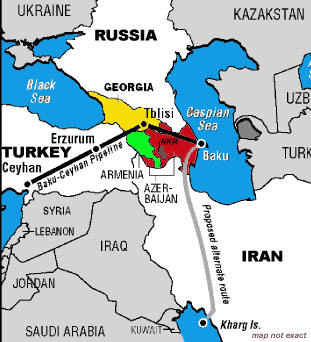
Iran proposed a southern pipeline over its territory--from Baku to the Iranian oil terminal on Kharg Island. This route would make the Caspian Sea into a hinterland of the Persian Gulf--and would secure the position of Iran and other Persian Gulf countries in the center of the world oil economy.
Some oil companies supported this Iranian plan because the Iranian route was estimated to be the cheapest. They also argued that this pipeline would give them more power within Iran--strengthening imperialist control over that important country.
The U.S.--and specifically the Clinton White House--was determined to oppose any "north/south" pipelines. The White House adopted a plan, cooked up by long-time ruling class strategist Zbigniew Brzezinski, to create an "east-west" pipe which would bypass both Russia and Iran.
The U.S. intends to strip Russia of control over this oil. And the U.S. wants the Caspian oilfields to be completely independent of the Persian Gulf--to diminish the importance of Persian Gulf states in the world economy.
The U.S.-proposed pipeline would start in Baku--traveling west through Azerbaijan. It would deliberately take a detour around Armenia--a country allied with Russia. The pipeline would circle into Georgia, and then travel southwest across Turkey. Most of its length would be through the Kurdish areas of Turkey--where there has been ongoing armed struggle against the Turkish oppression of Kurds. And the pipeline would end in a port near Ceyhan on the eastern Mediterranean.
#msg-3775550
RUMSFELD ADDRESSES SECURITY CONCERNS ON LIGHTNING TRIP TO AFGHANISTAN, AZERBAIJAN
Camelia Entekhabi-Fard: 8/12/04
excerpt:
US Defense Secretary Donald Rumsfeld, on a secretive and whirlwind trip to Central Asia and the Caucasus, sought to keep the Afghan election process on track and the Azerbaijani government in line.
A sense of urgency also surrounded Rumsfeld’s brief stop in Azerbaijan. Local political analysts characterized Rumsfeld’s trip to Baku as "unscheduled." The US defense secretary’s talks August 12 with top Azerbaijani officials, including President Ilham Aliyev, were driven by "concern over the latest trends in Baku’s foreign policy," said a commentary published in the Zerkalo daily on August 11.
Of late, the commentary indicated, Azerbaijani officials have shown signs of wavering in their pro-Western foreign policy orientation, an impression underscored by the visit of Iranian President Mohammad Khatami earlier in August. [For background see the Eurasia Insight archive]. Azerbaijan in recent months has sought to improve relations with a number of states – in particular Russia and Iran -- that are seen as competitors of the United States for influence in the Caucasus. [For additional information see the Eurasia Insight archive].
The diversification trend appears closely linked to mounting frustration in Azerbaijan to the stalemate in the Nagorno-Karabakh peace process. [For background see the Eurasia Insight archive]. Many in Baku hold the United States responsible for the lack of progress in the search for a Karabakh political settlement. Azerbaijan, the thinking in Baku goes, has steadfastly backed the US-led anti-terrorist campaign, including the military operations in Iraq, but has not received a reciprocal level of support from the United States on the Karabakh issue.
The Zerkalo commentary reflected the rising level of anger in Azerbaijan towards the United States. "Washington’s main goal is not to help the Azerbaijani nation to prosper, but to oust Russia from the Caucasus and build a strategically important corridor between Central Asia, the Caucasus and Europe," it said.
Political analysts, including Vafa Guluzade, who served as an adviser to former president Heidar Aliyev, suggest the Azerbaijani government has felt compelled to reach out to Russia and Iran in an effort to achieve a breakthrough on the Karabakh issue. "If the United States continues to turn a blind eye to the situation, it can lose Azerbaijan as a strategic partner," Guluzade told Zerkalo.
Azerbaijani officials made a direct appeal to Rumsfeld for stronger US support for Baku on the Karabakh question, according to local reports. Rumsfeld was reportedly non-committal in his response. Following their talks, Rumsfeld and Ilham Aliyev provided no public hints that US-Azerbaijani relations were experiencing underlying tension. Aliyev characterized bilateral strategic cooperation as operating "at the highest level," according to an August 12 report broadcast by ANS television. "I am confident that in the future we will further strengthen our ties to become a closer friend and ally," Aliyev added. Rumsfeld echoed the Azerbaijani leader’s comments, praising Azerbaijan for its "major efforts in combating terror."
Editor’s Note: Camelia Entekhabi-Fard has reported from Afghanistan and Iran for EurasiaNet.
http://www.eurasianet.org/departments/insight/articles/eav081204.shtml
Azerbaijan is the Key to Understanding the Region
Azerbaijan is key to understanding the region and the power. During the past decade the only western source of power and force projection into the region was with the USACC. The United States Azerbaijan Chamber of Commerce. It was this body that has, and remains, the source of negotiations, planning and structure in the region. Prior to many of its board members entering the present White House along with Mr. Bush, they were the force behind the U.S. Congressional effort called the Silk Road Strategy of 1996-1998; the Caspian initiative; Black Sea pipeline routes and the division of the Caspian Sea, etc.
The USACC Advisory Board consisted of "only" these seven men: Dr. Henry Kissinger, James A Baker III, Lloyd Bentsen, Zibigniew Brzezinski, Dick Cheney, Brent Scowcroft, John Sununu. It is noted here that the current Vice President’s daughter, Elizabeth Cheney-Perry, has been named Assistant Secretary of State for Near East Affairs for regional economic issues; she left Armitage Associates for the job. The USACC Vice-Chairman of the Board is James A Baker IV (Baker Botts, L.L.P.); Chairman Emeritus is T. Don Stacy (VP, Amoco); with Richard Armitage as Board President, until he resigned to become Colin Powell’s Deputy, which rounds out the US elite running the USACC. The remaining Board of Directors are a who’s who of the oil and gas multinational corporate interests of the west and specifically the United States. On the Board of Trustees or USACC the latter interests hold sway again with three primary exceptions: Senator Sam Brownback (R-KS) and Joseph R. Pitts (R-PA) (whose efforts formed the 1996 legislative backbone of the House/Senate Silk Road Strategy for Afghanistan, [Unocal, Texaco] et al) and Richard Perle (US Defense Policy Board). The Legal Counsel for USACC is Ted Jones of the Texas Law firm Baker Botts L.L.P. (James A Baker III & IV’s law firm.); Treasurer is Karl Mattison (VP, Riggs Bank, NA). It was the James A. Baker III Institute of Rice University which outlined the Cheney Strategic Energy Initiative which later became the Administration’s Strategic Energy National Security Policy. (Clearly Dick Cheney wouldn’t be interested in giving Congress the names of who he consulted on the Energy Initiative as they would amount to the remainder of the Board of Directors and Board of Trustees of USACC.)
#msg-1263010
Iraq is the latest battle in the war, terrorism is one aspect, 9/11 is one catalyst. The U.S. Congressional effort called the Silk Road Strategy of 1996-1998; the Caspian initiative; Black Sea pipeline routes and the division of the Caspian Sea, etc. give an insight into the battles that have been fought and the battles that will be fought in this part of the world.
Iran is the prize. To control, or dominate Iran, Mr. Bush has to encircle it: Afghanistan to the East, Turkey/Azerbaijan to the North, Iraq to the West, the South are already U.S. stooges. Pipelines, in effect, will become the new Berlin Wall.
Iran proposed a southern pipeline over its territory--from Baku to the Iranian oil terminal on Kharg Island. This route would make the Caspian Sea into a hinterland of the Persian Gulf--and would secure the position of Iran and other Persian Gulf countries in the center of the world oil economy.
Some oil companies supported this Iranian plan because the Iranian route was estimated to be the cheapest. They also argued that this pipeline would give them more power within Iran--strengthening imperialist control over that important country.
The U.S.--and specifically the Clinton White House--was determined to oppose any "north/south" pipelines. The White House adopted a plan, cooked up by long-time ruling class strategist Zbigniew Brzezinski, to create an "east-west" pipe which would bypass both Russia and Iran.
The U.S. intends to strip Russia of control over this oil. And the U.S. wants the Caspian oilfields to be completely independent of the Persian Gulf--to diminish the importance of Persian Gulf states in the world economy.
The U.S.-proposed pipeline would start in Baku--traveling west through Azerbaijan. It would deliberately take a detour around Armenia--a country allied with Russia. The pipeline would circle into Georgia, and then travel southwest across Turkey. Most of its length would be through the Kurdish areas of Turkey--where there has been ongoing armed struggle against the Turkish oppression of Kurds. And the pipeline would end in a port near Ceyhan on the eastern Mediterranean.
#msg-3775550
Discover What Traders Are Watching
Explore small cap ideas before they hit the headlines.



