Huge win for Trump? Hardly. It's been over two months since this 'release' and nothing has come of it. Trump however is in even deeper shit with his docs shenanigans and still headed for a 1/6 indictment and a GA indictment for attempting to defraud the U.S. and overturn the election.
However, a lot of information appears to still be missing in order to get to that point. The form under subpoena is, in FBI parlance, nothing more than a tip sheet containing allegations of corruption.
The documents released Wednesday provide no evidence that President Biden was ever directly involved in the alleged schemes—or even if the payments in question resulted in tangible impact on U.S. policy.
"None of the bank records reviewed by Committee staff allege, or even suggest, any potential misconduct by President Biden, nor do they show President Biden's involvement in Hunter Biden's business relationships," Representative Jamie Raskin, the Democratic ranking member of the Committee on Oversight and Accountability, wrote in a rebuttal of the GOP's findings after the press conference.
"If Hunter Biden committed a crime, he should be charged," Mark Zaid, a top national security attorney in Washington, tweeted after the press conference. "But making money off family name has been around for centuries. Anyone remember that Trump family? Chinese trademarks? Kushner & Middle East? Rule of Law requires consistent application. I'm all for it."
Well, it could be that little changes, in that case it could hardly be described as a huge win for justice in America. Gotta say, chuckle, if it does in the end turn out to be a big win for Trump's team and also for justice in America that would be a first. eh. An incredible first!
That said i don't see how after reading what you have you could say
" And don't forget, this agreement was negotiated and hashed out after months of negotiation. After all that, it is hard for me to believe that there could have been any misunderstanding between the prosecution and defense teams.
No one could forget the months of negotiation. And seems to me it's clear there was misunderstanding. Also on that, aren't you saying you think one side must have been faking their understanding of the deal before Noreika took it to where she did. Or both sides. In that case which side do you think would have changed their understanding of the plea deal. Or both.
Then you say "One more question lends light to how nefarious this immunity was."
And why do you say the judge's action was such a huge deal when apparently though it is unusual, it is not unusual for that kind of case. See:
Hunter Biden plea hearing features dramatic twists and turns, and a cliffhanger ending The plea hearing was supposed to resolve a five-year federal investigation of Biden over tax and gun charges, but the judge wanted to review the agreement after disputes between the lawyers. Bart Jansen Xerxes Wilson Meredith Newman USA TODAY July 27, 2023 [...]“It’s very unusual for a plea deal to collapse like this in front of a judge, but it’s not that unusual in these types of cases,” where concern over the ultimate sentence to be imposed may exist because a defendant could potentially be the subject of investigations in multiple jurisdictions, said Joe Valenti, a former federal counterterrorism analyst who is now a partner at Saul Ewing. .. https://www.usatoday.com/story/news/politics/2023/07/27/hunter-biden-plea-hearing-drama/70473317007/
On the diversion, since the gun charge was the charge being diverted this:
"It states that the government would "agree not to criminally prosecute Biden outside of the terms of this agreement for any federal crimes encompassed by the attached statement of facts, Attachment A to the Diversion Agreement, and the statement of facts attached as Exhibit 1 to the Memorandum of Plea Agreement filed this same day," the judge read in court." https://abcnews.go.com/US/hunter-biden-plea-agreement/story?id=101718321
from your link seems reasonable. Speaking from relative ignorance, of course.
Will just add there from reading so far i gathered the real issue for Noreika on the diversion of the gun charge was that she was to oversee Biden during his period of immunity/diversion. And that she didn't think that should be her responsibility. At least that was one of her major concerns with the plea deal.
While rambling around on this i bumped into one you may be interested in. It's very long. I've only read about twice what i'm posting here. Editing references out below became too much like work:
Andrew Manuel Crespo
The American criminal justice system is a system of pleas. Few who know it well think it is working. And yet, identifying plausible strategies for law reform proves challenging, given the widely held scholarly assumption that plea bargaining operates “beyond the shadow of the law.” That assumption holds true with respect to substantive and constitutional criminal law—the two most studied bodies of law in the criminal justice system—neither of which significantly regulates prosecutorial power. The assumption is misguided, however, insofar as it fails to account for a third body of law—the subconstitutional law of criminal procedure—that regulates and often establishes the very mechanisms by which prosecutorial plea bargaining power is both generated and deployed.
These hidden regulatory levers are neither theoretical nor abstract. Rather, they exist in strikingly varied forms across our pluralist criminal justice system. This Article excavates these unexamined legal frameworks, conceptualizes their regulatory potential, highlights their heterogeneity across jurisdictions, and exposes the institutional actors most frequently responsible for their content. In so doing, it opens up not only new scholarly terrain but also new potential pathways to criminal justice reform. --- * Assistant Professor of Law, Harvard Law School. For their thoughtful and helpful comments, I am grateful to Amna Akbar, Nicholas Bagley, Rabia Belt, Nikolas Bowie, John Goldberg, Elizabeth Kamali, Orin Kerr, Michael Klarman, Genevieve Lakier, Adriaan Lanni, Benjamin Levin, Anna Lvovsky, John Manning, Justin Murray, Eve Brensike Primus, John Rappaport, Daphna Renan, Abigail Shafroth, Jocelyn Simonson, Sonja Starr, Carol Steiker, ImeIme Umana, Alex Whiting, Crystal Yang, and the participants in the Harvard Law School Criminal Justice Workshop, the Harvard Law School Faculty Workshop, the University of Chicago Law School Constitutional Law Workshop, the University of Michigan Law School Legal Theory Workshop, the George Washington University Law School Faculty Workshop, and the Brooklyn Law School and St. John’s University School of Law Junior Scholars Criminal Justice Roundtable. --- INTRODUCTION
THE HIDDEN LAW OF CHARGE BARGAINING PILING ON Charge Piling: The Law of Joinder and Severance Case Piling: The Law of Serial Prosecutions Sentence Piling: The Law of Cumulative Punishment OVERREACHING Factual Overreaching: The Law of Pretrial Evidentiary Review Legal Overreaching: The Law of Summary Dismissal and Bills of Particulars Equitable Overreaching: The Law of Equitable Dismissal SLIDING DOWN Charge Sliding: The Law of Amendment and Dismissal Verdict Sliding: The Law of Lesser Offenses THE HYDRAULICS AND THE POLITICS OF REFORM The Hydraulics of Reform: Assessing Hidden Law’s Potential Impact The Politics of Reform: Plea Bargaining’s Hidden Lawmakers
CONCLUSION APPENDIX
Introduction[inside, references are down the side but they copied among the sentences below. Had to omit them here to make the reading easier. ]
Plea bargaining, we are told, is lawless. It “evolved in the unregulated interstices of our criminal justice system.” And it continues to be driven not by law but by power—the vast, unregulated power of prosecutors. As plea bargaining scholars have long recounted, prosecutors’ ability to threaten inflated sentences, combined with their power to trade those sentences away for pleas of guilt, allows them to control “who goes to prison and for how long.” As for law, it has abandoned, on this account, its most basic function: channeling prosecutorial power through regulatory constraints. Substantive criminal law, after all, now penalizes so much conduct, so severely, and so many times over that it serves simply to delegate power to prosecutors, transforming them into administrators of an “unwritten criminal ‘law’ that consists only of [their own] discretionary decisions” to charge certain offenses or to offer certain deals. Meanwhile, the constitutional law of criminal procedure that is ostensibly designed to regulate state power imposes virtually no constraints on prosecutors’ plea bargaining practices at all. Thus, the conventional account: Plea bargaining operates “outside the law’s shadow,” governed instead only by brute prosecutorial power that is exercised in ways “not usually written down anywhere,” let alone “governed by formal legal standards.”
Against this received wisdom, this Article offers a different account. Plea bargaining, it contends, appears lawless only if by “law” one refers to those two familiar legal pillars of the American criminal justice system—substantive and constitutional criminal law—that together consume academic discussions, in classrooms and in legal scholarship alike. Beyond those twin pillars, however, lies a third, unseen but essential body of law that has long been obscured by some of criminal justice scholarship’s most familiar blind spots: It is a creature primarily of state law (not federal law), of court rules and statutes (not constitutional doctrine), and of procedures often seen as relevant only to a bygone era of trial-based litigation (not to the system of pleas that has replaced it). And yet, as this Article will show, it is this subconstitutional state law of criminal procedure—the hidden law of plea bargaining—that time and again establishes the mechanisms and legal frameworks through which prosecutorial plea bargaining power is generated and deployed.
Take, for example, charge bargaining, the primary mechanism by which prosecutors control defendants’ sentencing exposure, and with it the so-called trial penalties defendants face if they dare refuse a prosecutor’s invitation to plead guilty. Long criticized as an illicit form of coercion, charge bargaining presents a conundrum under the traditional scholarly account: Given the breadth and depth of substantive criminal law, charge bargaining is routinely diagnosed as a major driver of plea bargaining’s pathology; but given prosecutors’ constitutional authority—indeed, their responsibility—to select the charges a defendant will face, it is also seen as an inevitable feature of criminal law’s administration. If one looks beyond substantive and constitutional criminal law, however, charge bargaining’s power dynamics become far more complex, for the essential particulars of the practice—ranging from the number of charges the prosecutor can file, to their severity, to their relationship to the defendant’s sentencing exposure, to the ease with which they can be traded away—all directly impact just how much leverage the prosecutor truly has. And crucially, those particulars are in turn dictated by the subconstitutional procedural law of the states—an interlocking set of legal frameworks that comprises the law of joinder and severance, the law of preclusion, the law of cumulative sentencing, the law of pretrial charge review, the law of dismissal and amendment, and the law of lesser offenses.
Almost entirely unexamined in existing plea bargaining literature, these hidden legal frameworks address issues that every system of criminal justice administration simply must resolve as it determines, for example, how many charges can be filed in a given case, or whether the sentences associated with those charges will run concurrently or consecutively. And yet, the answers to these inescapable questions, while necessarily shaping prosecutorial power, are neither hardwired nor predetermined. Rather, the choice of which procedural regime to adopt—from a range of potential options—inherently, if often implicitly, presents an important policy choice about how prosecutorial plea bargaining power ought to be structured.
DAVID WEISS IS WRECKING THE THE RIGHT WING STORY (AND LIKELY SANDBAGGING HUNTER BIDEN)
Embedded links in green non-italicized text, I'm experimenting today. If you go to the main link at the bottom, the comment sections are usually quite informative as well :-)
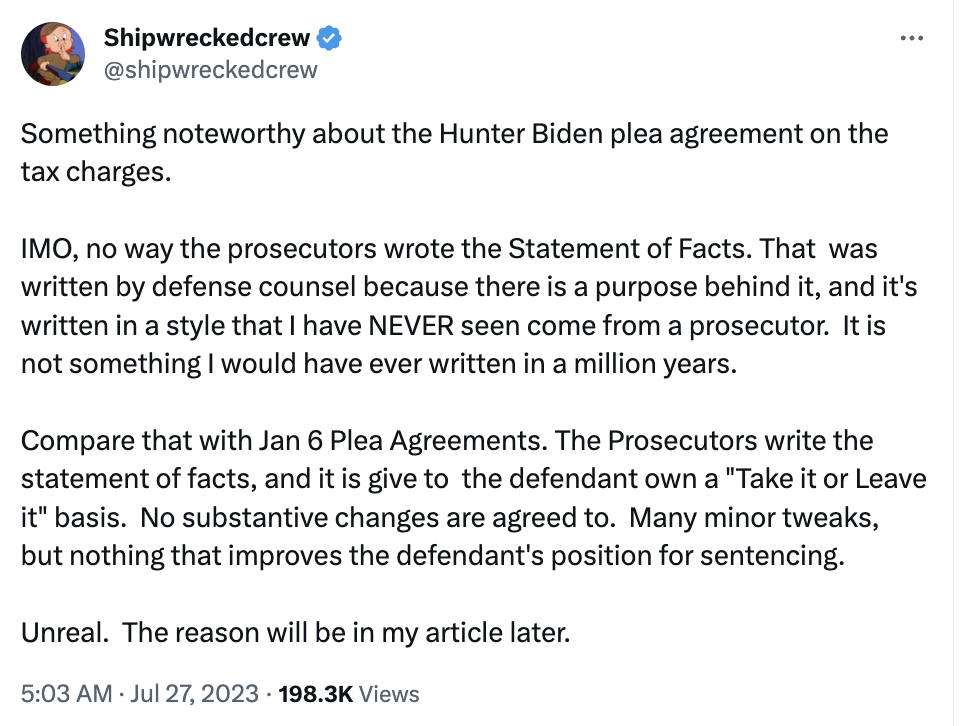
I confess I love William Shipley — AKA Shipwreckedcrew, or Wreck, for short — the prosecutor turned defense attorney for seeming zillions of Jan6ers.
Don’t get me wrong: in my opinion, he’s an utter whack and a douchebag.
But — and I mean this in good faith — because he’s batshit but also a real lawyer, it makes him the sweet spot among attorneys that Jan6ers will hire and (sometimes at least) retain, but who will give them decent and at times excellent legal representation. There are a lot of batshit grifters who are little more than parasites on Jan6 defendants. And while I want these mobsters to face justice, I also want them to have competent legal representation along the way. Many of them do not. So while I may find Wreck awful personally, I am grateful he is providing competent representation for the kind of Jan6ers who wouldn’t accept representation from superb public defenders that many Jan6ers believe are communists or pedophiles or whatever other conspiracy theory they vomit up.
I also love Wreck because it drives him insane that, even though my graduate degree is a mere PhD, my observations often are more accurate than his. My favorite is probably the time I correctlypredicted that John Durham might successfully breach Fusion’s privilege but not be able to use any of those documents at trial (Durham used one to set an unsuccessful perjury trap anyway). When I do stuff like that Wreck waggles his legal experience around and sics his trolls on me and it’s funny every … single … time.
This may be another of those times. Because Wreck is about to make my case that David Weiss tried something noxious in the abandoned Hunter Biden plea the other day.
You see, I agree with what Popehat had to say about the failed Hunter Biden plea the other day. Judge Maryellen Noreika sussed out that there was a key structural problem with the deal and refused to approve it without some more consideration of whether her role in it is even constitutional.
Friends and neighbors, that is shitty drafting. And if you’re Hunter Biden’s lawyer and telling your client that he can’t be prosecuted for crimes related to those income sources because of that language, that’s reckless advice and bad lawyering. It’s a failure by both attorneys. If Judge Noreika spotted that issue, called it out, and asked for an explanation, then good for her — she’s doing her job, which is to make sure the defendant understands the deal they are accepting.
That said, I’m pretty sure it’s a Frankenstein of a deal, in part, for reasons neither side wants to address until it’s done (Politico posted a transcript of the hearing here). Hunter, probably because he was at real risk for felony tax crimes before the government bolloxed the case so badly. His lawyer, Chris Clark, possibly because Abbe Lowell is on the scene and may be pushing a much more confrontational approach to this investigation. And the government because — on top of the things in the emails that prosecutors thought might blow the entire case — other statutes of limitation are expiring, SCOTUS might soon rule the one felony against Hunter unconstitutional. It turns out, too, that for the contested year (the one Joseph Ziegler said was so damning), both sides agree that Hunter’s accountants overstated his income on his taxes, which makes it hard to argue that Hunter’s treatment of some personal expenses as business expenses was an intent to lie to the IRS.
When asked whether there was any precedent to support what Hunter’s lawyers and the government were trying to do, AUSA Leo Wise, who was brought in to replace the team that was too tainted to prosecute this case, admitted, “No, Your Honor. This was crafted to suit the facts and circumstances.”
In other words, because both sides had fucked up so badly, this agreement is a way to move forward. Or would have been if Judge Noreika hadn’t appropriately refused to be part of a plea that might not be constitutional.
But the Frankenstein plea was written on the back of a remarkable statement of facts, a statement of facts that could have been written by Peter Schweizer, which was completely untethered from the narrow crimes in the two deals. It was so untethered from the elements of the offense involved in the crimes in the plea that Judge Noreika had to direct Wise to explain how it actually met the essential elements of the offense.
I have grave concerns about the ploy that prosecutors may have been attempting — may have succeeded in doing — with that statement of facts.
And the statement of facts is where I get to have fun with Wreck again. He agrees with me it is totally unusual. But he’s sure that that’s because the defense attorneys — who he’s sure wrote it — are trying to get away with a fast one.
“There is a purpose behind it,” Wreck said, “and it’s written in a style that I have NEVER seen come from a prosecutor.”
Only, he’s wrong about who wrote it and so undoubtedly wrong about the purpose behind it.
Hunter Biden’s lawyers didn’t write it. At one point, Chris Clark said that explicitly: “Your Honor, we didn’t write this.” Several times, Hunter or Clark struggled to explain what they believed the government meant by something in the statement of facts, in one instance when they had to address that it was totally unclear what income Hunter earned.
Mr. Clark: My understanding, Your Honor, is that sentence picks up the work described in the last couple of sentences, not just the work for Boise Schiller.
The Court: Well, Mr. Biden actually knows.
The Defendant: Yeah, exactly, Your Honor. I believe what the government intended for that sentence was that it was the total income, not just as it relates to my capacity for Boise Schiller.
When asked why the statement of facts said his addiction problems were well-documented, Hunter responded,
Well, I believe the government is referring to a book that I wrote about my struggles with addiction in that period of my life. And quite possibly other news outlets and interviews and things that have been done.
That phrase — well-documented — had absolutely no place in a document like this, certainly without citations. Indeed, how well-documented his addiction is irrelevant to both the tax crimes and the gun diversion.
Yet no one cleaned it up before this attempted plea.
Perhaps the most remarkable exchange happened when Judge Noreika asked Hunter what the statement of facts meant when it said that his tax liability should not have come as a surprise. He seemed totally unfamiliar with the passage, and when asked, Hunter said that it was a surprise.
THE COURT: All right. On the next page, at the end of the second paragraph, starting four lines from the bottom in the middle of the line, the paragraph talks about your tax liability. And it says the end of year liability should not have come as a surprise. Do you see that?
THE DEFENDANT: I’m sorry, I’m just trying —
THE COURT: That’s okay. Take your time.
THE DEFENDANT: Yes, I see that here.
THE COURT: It says it should not have come as a surprise. It wasn’t a surprise, is that right?
THE DEFENDANT: Yes, Your Honor.
THE COURT: And you knew —
THE DEFENDANT: Well, I don’t — I didn’t write this, Your Honor, so the characterization —
MR. CLARK: Can we elaborate the time there, Your Honor?
THE COURT: Yes.
MR. CLARK: So essentially there was a tax treatment that was undertaken in that year, and it changed the tax treatment at the very end of the year for a particular asset. And so I think the point is, and I didn’t write this either, there was substantial influx of income during that year. There was an issue with this last minute tax treatment change, and so there were expressions at times of surprise at that. I think the government’s point is you knew you made a lot of money, it shouldn’t have come as a surprise.
THE COURT: My only concern is when I read this as a lawyer, it shouldn’t have come as a surprise, that doesn’t preclude Mr. Biden from saying yes, it did.
MR. CLARK: Your Honor’s characterization is exactly right.
THE COURT: You’re saying it actually was a surprise?
MR. CLARK: In that year.
THE COURT: You guys are okay with that?
MR. WISE: Yes, Your Honor.
Hunter Biden was under oath for this colloquy (as all plea colloquies are), trying to explain why a document he didn’t write was riddled with ambiguous language and unsubstantiated claims.
And here’s the concern: When Hunter’s lawyers agreed to this, they believed that FARA charges were off the table. But about half the way through this hearing, Wise made it clear they were not.
THE COURT: All right. So there are references 6 to foreign companies, for example, in the facts section. Could the government bring a charge under the Foreign Agents Registration Act?
MR. WISE: Yes.
THE COURT: I’m trying to figure out if there is a meeting of the minds here and I’m not sure that this provision isn’t part of the Plea Agreement and so that’s why I’m asking.
MR. CLARK: Your Honor, the Plea Agreement —
THE COURT: I need you to answer my question if you can. Is there a meeting of the minds on that one?
MR. CLARK: As stated by the government just now, I don’t agree with what the government said.
THE COURT: So I mean, these are contracts. To be enforceable, there has to be a meeting of the minds. So what do we do now?
MR. WISE: Then there is no deal.
I can’t speak to whether any FARA charges against Hunter are meritorious or not and if they are, without taint, by all means prosecute him. The admitted facts about Burisma and CEFC, while far smaller than laid out by Republicans (including, potentially, by Joseph Ziegler and Gary Shapley under oath), are interesting as much for the kind of information operation we saw being alleged in the Gal Luft prosecution as they are for the possibility they support a FARA prosecution (which is one of two things — the other being the loan that Hunter got from Kevin Morris to pay off his taxes in the first place — for which the statute of limitations would not have expired).
But that’s as much an information operation as it is a FARA violation.
It’s my opinion that this plea deal was crafted to give DOJ a way out of grave problems that exist in their existing case file — problems that Ziegler described in testimony — while kicking off a FARA investigation with sworn admissions made based on, at best, misunderstandings — and possibly outright misrepresentations — of the scope of the deal.
It’s my opinion that this statement of facts was intended to get Hunter to admit under oath to facts underlying FARA violations that DOJ otherwise couldn’t use because the way they got this evidence has been so tainted by Trump’s political influence and hacked computers and other poisonous tree they’d never get it admitted in court.
DOJ already admitted — to Joseph Ziegler at least — that they couldn’t prosecute any of this because of some kind of taint. And it sure looks like this “plea deal” is an attempt to sheepdip the entire prosecution to get Hunter Biden to clean the taint himself.


 Market Data
  Markets


 AI
AI