Here is a comprehensive list of out of control accidents which exhibit behavior suggesting EMI induced ECU glitching, whether or not any deaths occurred, that I have found so far in 2022. This doesnt include all the 2021 accidents I have collected because they are not as well organized by date. For extra measure I have included a few examples of other EVs exhibiting these conditions. All accidents in this list occurred during ongoing solar storms/and or enhanced geomagnetic activity and seemed to warrant media attention.
How to examine the data 1.Some accidents have multiple links containing pertinent information. Those will follow links to an accident not a date. 2. Duplicate dates means multiple accidents occurred on that day 3. Understand that more accidents exist, these are only ones that can be independently verified
Aggregated number of out of control. TESLA accidents:~90 as of 7am UTC on Sept 15th
Witnesses told the Sheriff's deputies that the Tesla was speeding at a high rate of speed southbound on Seacoast Blvd when it suddenly veered into the oncoming traffic lanes and hit the curb/sidewalk.
The car went airborne and flipped into the Tijuana Sloughs National Wildlife Refuge. The male driver got out of the car and attempted to flee north along the street, but deputies who were responding were able to detain the driver. A female passenger was extricated by Firefighters and she was transported to a local hospital with unknown injuries.
The driver told the Deputies that the Tesla had simply taken off on its own and was driving itself. The male may be DUI and was letting the car drive itself. it’s not known why the male fled the scene.
I believe Tesla has indirectly acknowledged it has low frequency quasi DC EMI issues when it announced the Cybertrucks exoskeleton was a low carbon stainless steel that will be cold worked. Then followed that by announcing it was assembling a team of materials specialist to essentially port the exoskeleton to its other vehicles.
Before we delve into the Cybertrucks exoskeleton we should establish what geomagnetic induced currents are during enhanced geomagnetic activity.
GIC are often described as being quasi direct current (DC), although the variation frequency of GIC is governed by the time variation of the electric field. For GIC to be a hazard to technology, the current has to be of a magnitude and occurrence frequency that makes the equipment susceptible to either immediate or cumulative damage.
GIC modelling and simulation are typically below 50 mHz.
Then we need to determine what material properties are needed to shield the low frequency quasi DC electromagnetic fields?
1. Steel
Using thick conductive metal material such as steel, which often works well, but the drawback is the weight. Aluminium or magnesium are much lighter than steel, but they have insufficient low-frequency shielding properties and, therefore, cannot be used in this application.
Generally, below 100 kHz, steel achieves much greater attenuation than copper.
2. Low Carbon
low carbon steel is typically specified for DC and low frequency magnetic shielding high permeability and saturation point than high-carbon steel
3. Permeability
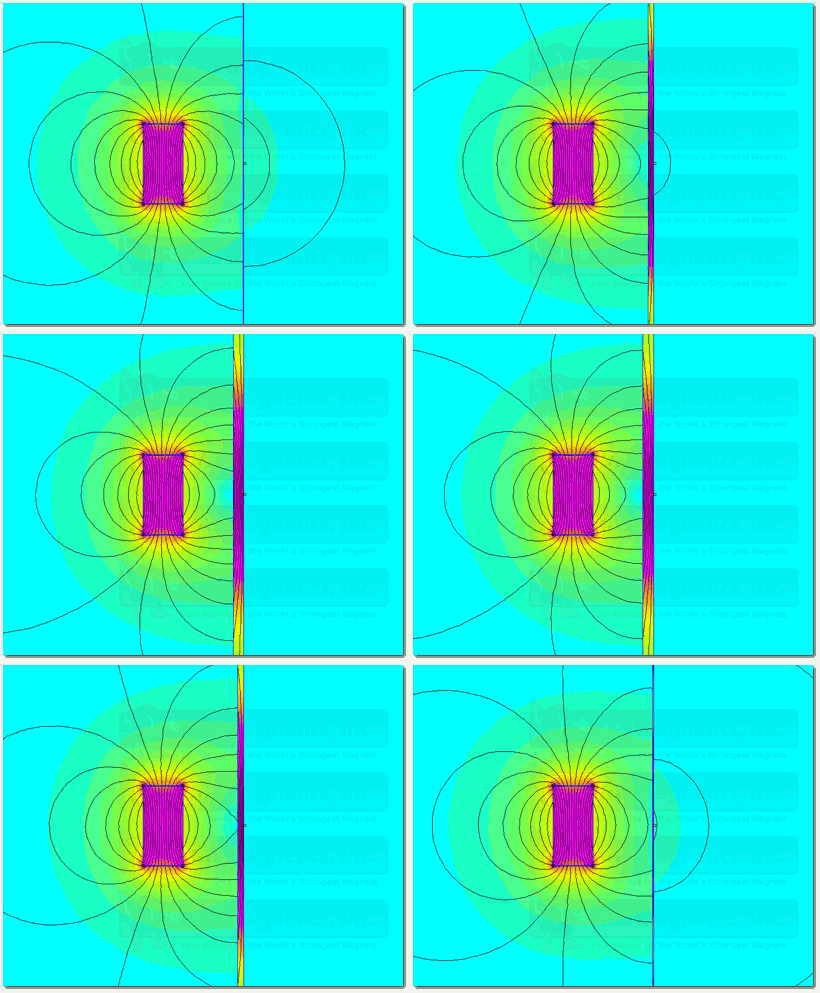
Magnetic field lines prefer to travel in materials that have certain magnetic properties, namely materials with high permeability. By placing a material of high permeability (or at least a permeability higher than the region in question) around the region you wish to shield, you effectively offer the field lines a better path to travel.
Now lets determine what the Cybertrucks exoskeleton is made of.
“We’re rapidly changing alloy constituents and forming methods, so traditional names like 304L will become more of an approximation.”
What is 304L?
Alloy 304L a T-300 series stainless steel austenitic, which has a minimum of 18% chromium and 8% nickel. Type 304L has a carbon maximum is 0.030
Probably the most important feature for shielding against quasi low frequency DC EMI is not provided by austenite steels which are a paramagnetic more than magnetic. Case closed right? What about the fact Tesla is cold working the exoskeleton, what does that do?
Impact of Cold Working Stainless Steel
Any process which can change the crystal structure of stainless steel can cause austenite to be converted to the ferromagnetic martensite or ferrite forms of iron. These processes include cold working and welding. It is also possible for austenite to spontaneously convert to martensite at low temperatures. To complicate matters further, the magnetic properties of these alloys depend on the alloy composition. Within the allowed ranges of variation of Ni and Cr, significant differences in magnetic properties may be observed for a given alloy.
There you have it folks. Cold working 304L (30X) steels causes them to convert to martensite which changes the stainless steel from a paramagnetic material to a ferromagnetic with high permeability needed for attenuating low frequency EMI. Check!
The "Cybertruck Shell"
Thus, a shell of high permeability material built around an area will effectively keep most of the magnetic field lines in the actual shell itself and out of the area inside the shell.
What might that look like? https://www.kjmagnetics.com/images/blog/article2010.01.pic3p.gif
Cybertrucks should effectively work like this shell and redirect the magnetic field lines throughout the exoskeleton, keeping the internal hardware shielded from external magnetic fields. If Tesla really believes the Cybertrucks exoskeleton will provide EMI shileding, shouldnt it want to use the material on its other vehicles?
The team has been focused on creating new alloys for its products, like new aluminum alloy for casting larger parts in Tesla vehicles or new stainless-steel alloys for SpaceX’s starship and Tesla Cybertruck’s exoskeleton.
Now, we learned that Tesla is creating a new Materials Applications Team to help integrate those new materials faster.


 Market Data
  Markets


 AI
AI