The new PPHM/ImmunoVaccine collab via AACR’17: looking at IV’s website https://www.imvaccine.com , it’s clear preclin. work has been done combining their “DepoVax” drug with PPHM’s Anti-PS, either Bavi or Fully-Human Bavi (PGN635=1N11), or the “Duke” B2GPI-indep. mab PGN632=11.31, or maybe even BetaBodies? We’ll probably find out 3-1-17 when the AACR’17 full abstracts are released.
ImmunoVaccine’s DepoVax Platformhttps://www.imvaccine.com/depovax.php “The cornerstone of all vaccine dev. efforts at Immunovaccine is the company’s DepoVax vaccine adjuvanting platform. DepoVax is a patented vaccine delivery formulation that provides controlled & prolonged exposure of antigens + adjuvant to the immune system. The result is a strong, specific and sustained immune response with the capability for single-dose effectiveness. DEPOVAX IN CANCER: Maintains remission and combats micro-metastases *Provides strong & sustained polyfunctional T cell responses *Specifically targets tumor cells”
= = = = = = = = = = = = = = Apr1-5 2017: AACR 2017, WashDC http://tinyurl.com/jxfm3hb PPHM+IMMUNOVACCINE: AACR’17 4-4-17/8am #3657 - Session: BITES BISPECIFICS & CHECKPOINTS ”Phosphatidylserine-Targeting Antibodies Enhance Anti-Tumor Activity of a Tumor Vaccine in a HPV-Induced Tumor Model” => Genevieve Weir 1, Tara Quinton 1, Jeff T. Hutchins 2, Bruce D. Freimark 2, Marianne Stanford (VP/Res., Immunovaccine) 1=Immunovaccine, Inc., Halifax, NS, Canada [ https://www.imvaccine.com ] 2=Peregrine Pharmaceuticals
POSSIBLE GENESIS OF IMMUNOVACCINE COLLAB??? 11-9-15 SITC'15: New Bavi+Checkpoint Inhibitors preclin. data (UTSW/DUKE's Herbert K. Lyerly) http://tinyurl.com/pbof95w ...Also, collab. with Dr. Bernard Fox (Immunotherapist/Earle A. Chiles Res.Inst.) on new Immuno-Profiling Clinical Test (Opal 6-plex quantitative IF Assay), PPHM roundtable with Raymond Birge (Rutgers), Douglas Graham (Emory), Dmitry Gabrilovich (Wistar), Rolf Brekken (UTSW), Maria Karasarides (AstraZeneca) - ”Combining Bavi w/anti-PD-1 significantly enhanced O/S… significant incr. CD45+, CD8+ and CD3+ T-cells… led a prolonged anti-tumor immune response which protected the animals against a re-challenge w/same tumor.”
“Targeting Phosphatidylserine in Combination with Adoptive T Cell Transfer Eliminates Advanced Tumors without Off-Target Toxicities in a Melanoma Preclinical Model”
there is no justifiable reason the IP should be sitting in the slow play lane which is where we are right now...just the four abstracts listed is a cry for help.... the technology needs to be in bigger and better hands now... there is no reason we should be sitting below a $1 per share now...
the value disconnect is not the IP... it is the mgmt team and the BOD ... that can be fixed and folks have been fighting for years to fix it... and the bod has fought harder to keep their positions than they have fought to improve share price... and what could they do to improve share price? they have absolutely nothing to offer... if just two of them stepped down and were replaced by qualified folks, that would go a long way in removing the cloud over the company... and open the way for institutional investment..
AACR’17(4-3-17) reveals a 2nd Mem.Sloan Wolchok Lab/PPHM study. Both are for Melanoma, and the lead author for both is Dr. Taha Merghoub, Co-Dir., Ludwig Collaborative Lab at MSK... This new one sounds exciting: “Targeting PS in Combination with Adoptive T Cell TransferEliminates Advanced Tumors without Off-Target Toxicities in a Melanoma Preclinical Model”. Awaiting 3-1-17 for Full AACR abstract. NOTE: “Adoptive Cell Transfer (ACT)” is the transfer of cells into a patient. The cells may have originated from the patient or from another individual. The cells are most commonly derived from the immune system, with the goal of improving immune functionality and characteristics. In cancer immunotherapy, T cells are extracted from the patient, genetically modified and cultured in vitro and returned to the same patient.
Summary of the 2 known MSKCC/PPHM Anti-PS studies to date:
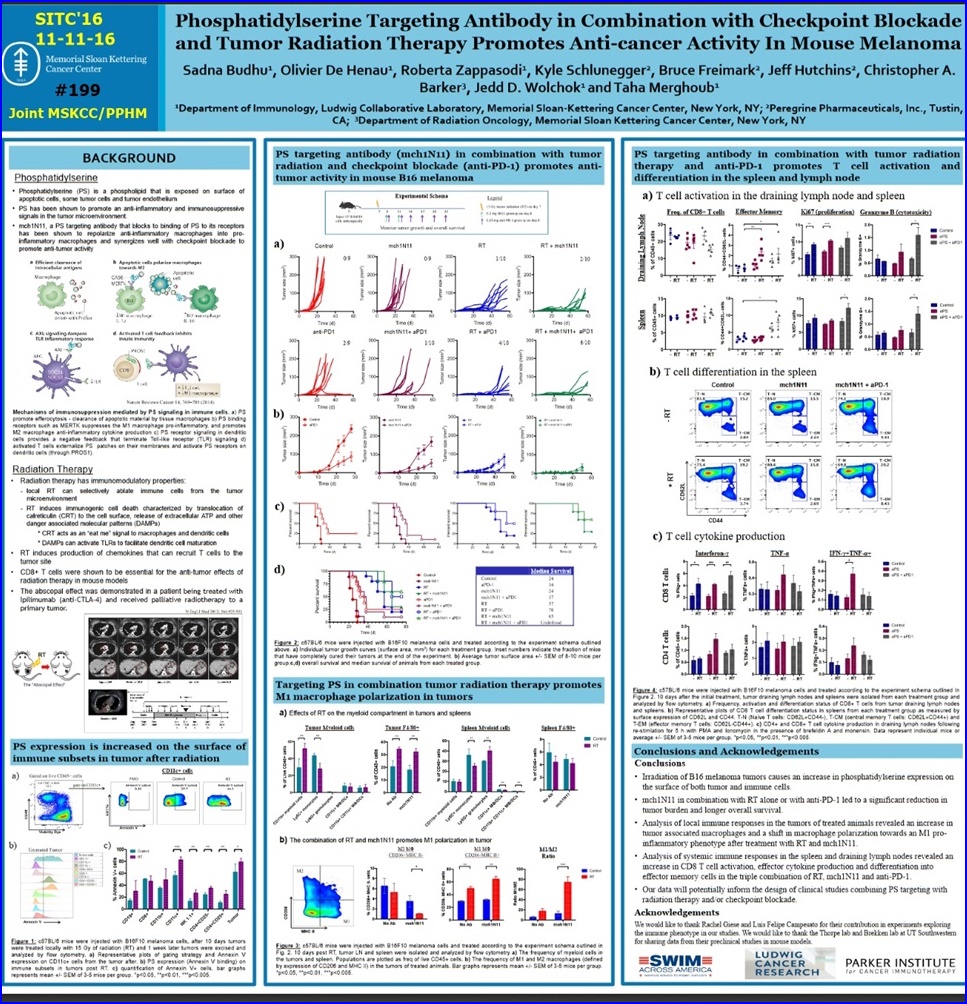
#1: SITC’16(Nov2016) => AACR’17(4-2-17 http://tinyurl.com/jxfm3hb ) SITC’16: “Phosphatidylserine Targeting Antibody in Combination with Checkpoint Blockade & Tumor Radiation Therapy Promotes Anti-Cancer Activity in Mouse Melanoma” AACR’17: “Phosphatidylserine Targeting Antibody in Combination with Tumor Radiation & Immune Checkpoint Blockade Promotes Anti-Tumor Activity in Mouse B16 Melanoma” AACR’17 AUTHORS: Sadna Budhu, Olivier De Henau, Roberta Zappasodi, Rachel Giese, Luis F. Campesato, Christopher Barker, Bruce Freimark, Jeff Hutchins, Jedd D. Wolchok, Taha Merghoub (same list as SITC’16, except K.Schlunegger dropped/now at Pfenex, and MSKCC’s L.Campesato & R.Geise added) ...From the SITC’16 abstract: http://tinyurl.com/js3fca4 “We found that the PS-targeting antibody synergizes with both anti-PD-1 and radiation therapy to improve anti-cancer activity and overall survival. In addition, the triple combination of the PS-targeting antibody, tumor radiation and anti-PD-1 treatment displayed even greater anti-cancer & survival benefit. This finding highlights the potential of combining these 3 agents to improve outcome in patients with advanced-stage melanoma and may inform the design of future clinical trials with PS targeting in melanoma and other cancers.” ...From PPHM’s 11-14-16 SITC’16 PR: http://tinyurl.com/js3fca4 DR. JEDD WOLCHOK: "Based on these study results, we believe that the targeting of PS is having meaningful activity within the tumor microenvironment in the B16 melanoma model. It appears that this activity creates a more immune active environment in which other treatments, including radiation, are able to have a greater anti-tumor impact." DR. TAHA MERGHOUB (Co-Dir., Ludwig Collaborative Lab at MSK): "We have noted that the combination of PS-targeting treatment and radiation, as well as triple combination of PS-targeting treatment, radiation and anti-PD-1, resulted in clear advantages in anti-tumor activity in the mouse B16 melanoma model. We believe that these findings suggest the potential benefit of combining these agents to improve the outcomes of patients with cancer. With this in mind, we think this research may play an important role in designing future clinical trials of PS-targeting agents in melanoma and other cancers."
#2: AACR’17(4-3-17)http://tinyurl.com/jxfm3hb 4-3-17/8am #1651 - Session: TUMOR MICROENVIRONMENT & CHECKPOINTS “Targeting Phosphatidylserine in Combination with Adoptive T Cell Transfer Eliminates Advanced Tumors without Off-Target Toxicities in a Melanoma Preclinical Model” => Daniel Hirschhorn-Cymerman 1, Sara Sara Schad 1, Sadna Budhu 1, Zhong Hong 1, Xia Yang 1, Jeff Hutchins 2, Bruce Freimark 2, Michael Gray 2, Jedd Wolchok 1, Taha Merghoub [Memorial Sloan Kettering] 1=Memorial Sloan Kettering CC, NYC [ http://www.mskcc.org/research-areas/labs/jedd-wolchok ] 2=Peregrine Pharmaceuticals ***FULL ABSTRACTS TO PUB. AT AACR.COM 3-1-17. http://www.abstractsonline.com/pp8/#!/4292 . . = = = = = = = = = = = = = = = = = = = = = = = = = = = = = = = = 5-29-15: Peregrine & Sloan Kettering Enter Collab. to “Investigate Novel PS-Targeting Immunotherapy Combos” http://tinyurl.com/o3k9ux8 ...The studies at MSK will be performed under the direction of Taha Merghoub, PhD, [ http://www.mskcc.org/research-areas/labs/members/taha-merghoub-01 ] Associate Attending Biologist, Melanoma and Immunotherapeutics Service, Ludwig Collaborative and the Swim Across America Laboratory, a part of the laboratory of Jedd D. Wolchok, MD, PhD [ http://www.mskcc.org/research-areas/labs/jedd-wolchok ], a leader in the field of cancer immunotherapy. Dr. Wolchok serves as the Chief, Melanoma and Immunotherapeutics Service, Lloyd J. Old Chair for Clinical Investigation as well as an Associate Director of the Ludwig Center for Cancer Immunotherapy at MSK. ---- ”The phosphatidylserine (PS) signaling pathway is a very interesting target for modulating the immune system's response to cancer. We look forward to exploring the potential of PS-targeting agents alone and with other immune modulators that may lead to novel advances in cancer therapy," said Dr. Jedd Wolchok. –-- As part of the collaboration, researchers at MSK will conduct research to further explore the combination of PS-targeting agents, including bavituximab, that block a primary immunosuppressive pathway thereby allowing anti-tumor immune responses with other immuno-stimulatory agents that enhance immune responses. Specifically, MSK researchers will examine the combination of bavituximab alongside models of checkpoint blockade that are unresponsive to inhibition or co-stimulation given the ability of bavituximab to reprogram myeloid derived suppressor cells (MDSC) and increase tumoricidal T-cells in tumors, a mechanism of action that is complementary to checkpoint blockade and T-cell activation. –-- "A key focus of the Wolchok Lab's research is studying novel immunotherapy combinations that work together to enable the immune system to recognize and destroy cancer. This collaboration will allow us to focus on the role and contribution of PS blockade therapy in determining which combination of the current and next generation of immune modulators is likely to increase the extent and amplitude of anti-tumor response. This important pre-clinical and translational work will potentially guide the design of the next generation of clinical studies with bavituximab," said Dr. Taha Merghoub. –-- "We are delighted to be working with a world-renowned pioneer and leader in the immuno-oncology space, recognizing that there remains significant research in order for more cancer patients to realize the benefits of combination immune therapy," said Jeff T. Hutchins, PhD, VP of Preclinical Research at Peregrine. ”Our internal and collaborative research presented over the last year has established a robust foundation of PS-targeting activity on which to initiate this next chapter in PS research and development." –-- "This collaboration is an important extension of our established research efforts to further explore and understand the potential of our PS-targeting platform including bavituximab our lead clinical candidate. This research will focus on better understanding how treatment with PS-targeting agents can assist other anti-tumor immunotherapies in order to work better," said Steven King, CEO of Peregrine. ”Our goal is to change the way cancer patients are treated by allowing their immune system to recognize and fight their disease. This collaboration will undoubtedly assist us in identifying potential new opportunities to better treat patients with cancer." . .


 Market Data
  Markets


 AI
AI