How the Satanic Temple forced Phoenix lawmakers to ban public prayer
In this 2015 file photo, a Satanic Temple of Seattle member wears horns outside a football game in Bremerton, Wash. (Meegan M. Reid/Kitsap Sun file via AP)
By Peter Holley February 5, 2016
For weeks now, Phoenix lawmakers have wrestled with the idea of allowing members of a Satanic group to give the invocation before an upcoming city meeting.
Phoenix City Council members arrived Wednesday at a controversial solution: Banning prayer altogether.
From now on, lawmakers decided in a 5-4 vote, council meetings will no longer begin with a traditional prayer, but instead open with a moment of silence.
Although the decision may block the Satanic Temple’s Feb. 17 invocation, it prompted outcries from some Phoenix residents and city officials who believe the prayer ban is a de facto victory for the Satanists.
Phoenix Mayor Greg Stanton and four members of the council voted in favor of the change and argued that an effort to silence particular groups could land the city in an expensive legal battle.
“The First Amendment to the Constitution is not ambiguous on this issue,” Stanton said, according to the Republic. “Discriminating against faiths would violate the oath that all of us on this dais took. I personally take that very, very seriously.”
Gregory Lipper, a senior attorney at Americans United for Separation of Church and State, said the mayor’s prediction is sound.
Lipper, who has represented the Satanic Temple in previous legal battles, said that two years ago, the Supreme Court held in Town of Greece v. Galloway [ http://www.scotusblog.com/case-files/cases/town-of-greece-v-galloway/ ] that a community’s practice of beginning legislative sessions with prayers does not violate the First Amendment’s Establishment Clause.
However, Lipper said, while local governments can open meetings with prayers, those governments cannot control the content of those prayers unless they denigrate other faiths or include proselytizing. Much of the resistance to the Satanic Temple, he said, comes from people who believe the group is made up of devil worshipers, and they tend to unleash fierce opposition that wouldn’t hold up in a court of law.
“This is an issue that will come up in homogeneous communities when a member of a minority religion takes advantage of the invocation and it tends to generate a backlash,” Lipper told The Post. “Most local governments are used to a steady drumbeat of Christian clergy delivering Christian prayers. We’ve seen this same issue with Muslim prayer-givers and Wiccan prayer-givers around the country.
“When they show up, all the sudden the practice generated a bunch of objections.”
Lipper said the Phoenix City Council made the right decision, but for “disturbing reasons.”
“They’re saying, ‘we don’t like their prayers, so we’re going to shut the whole thing down,'” he said. “It leaves a bad taste in the Satanist’s mouth.”
Contrary to the name, Satanic Temple members are non-theists who do not believe in the existence of the devil and promote the idea that religion can be divorced from superstition. On its Web site, the Satanic Temple describes its mission as encouraging “benevolence and empathy among all people.” Among the group’s seven tenets [ http://thesatanictemple.com/faq/ ]: “The freedoms of others should be respected, including the freedom to offend.”
“Our tenets are rational and we emphasize compassion,” Satanic Temple founder Lucien Greaves told The Washington Post. “Satan to us is metaphorical and represents a universal fight against tyranny and autocracy.”
The group has set off numerous headline-making free-speech debates in recent years by using provocative imagery. In 2014, it unveiled a proposal to place a seven-foot Satanic statue in front of the Oklahoma state capitol, next to a statue of the Ten Commandments.
Later that year, after threatening a lawsuit, the Satanic Temple — in conjunction with Americans United — convinced Florida officials to allow the temple to move forward with a holiday display in the state capitol in Tallahassee that showed an angel dropping from the sky into a pit of flames. The week-long display, which Florida officials had previously labeled “grossly offensive,” was placed in an area designated as an open forum for private speech.
Greaves said Thursday that the dispute with the Phoenix City Council began in December, when a local member of the Satanic organization applied via email to give the invocation before the governing body. Temple members, he said, assumed they’d walk in, give the invocation and leave, with their entire effort going mostly unnoticed.
That changed, the Republic reported, when news of the invocation spread and council members were “inundated” with comments from constituents.
“We’re an assertion of plurality,” Greaves told The Post. “The only way these type of open forums work is if multiple voices get involved. You need to allow for expression you might not agree with or want and we’re a hard and fast test of those principles.”
A proposal from four councilmen to let lawmakers take turns inviting different religious groups to give the prayer — indirectly blocking the satanists — was scrapped last week after city attorney Brad Holm noted it would constitute a First Amendment violation, according to the Republic.
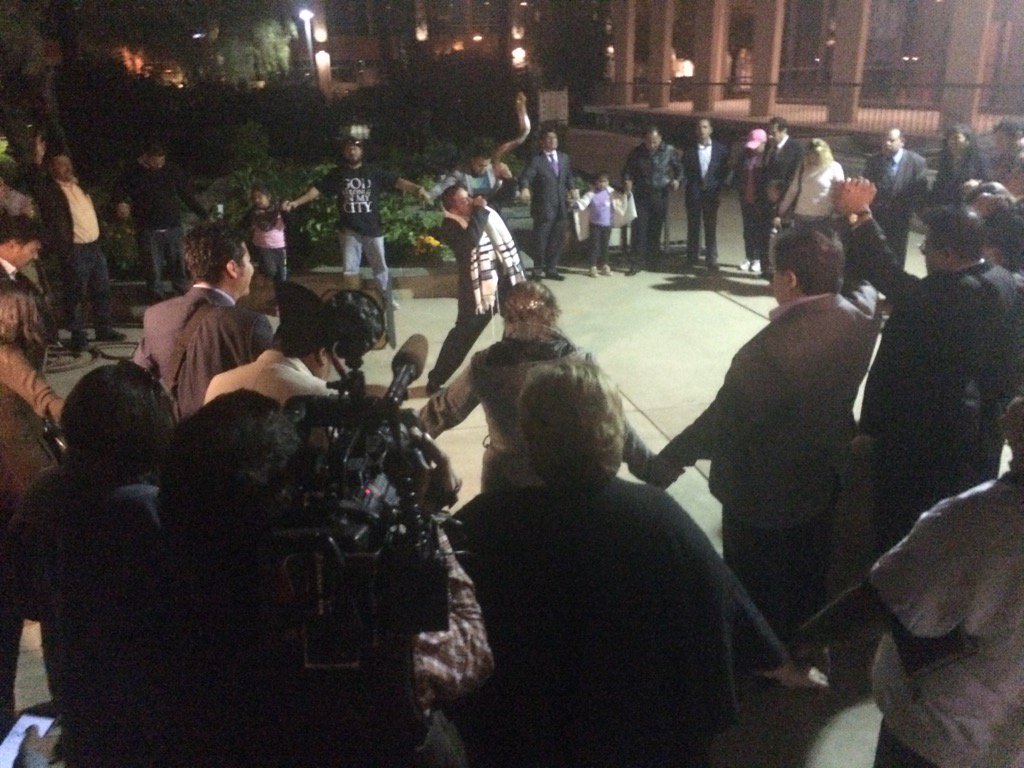
The contentious issue came to a head Wednesday when more than a hundred people gathered in the council chambers to offer testimony on the issue that lasted for more than two hours, according to the Republic.
“I am not for the silent prayer,” Pastor Darlene Vasquez told council members, according to the Republic, which reported that Vasquez broke down in tears. “I want those who believe in the one true God to pray. It breaks my heart to hear what is going on.”
No Satanic Temple members addressed the council at the meeting, but Greaves — who watched a livestream of the gathering on the other side of the country —said he was shocked by what he saw. He noted that speakers referred to the Satanic Temple as a “cult” and a “hate group” and said council members accused the group of trying only to ban prayer entirely.
“It was kind of horrifying,” he told The Post. “I noted that it seemed outright medieval in there and really took on the atmosphere of an old school tent revival. There were people weeping and calling out the name of the one true god. It was really strange, a really strange thing to see.”
After the lawmakers voted to replace prayer with a moment of silence, DiCiccio, the council member, called the ruling a “big win” for the Satanic Temple, according to the Republic. He added that the city’s religious community plans to collect signatures to force another vote and overturn the council’s decision.
Greaves called DiCiccio’s willingness to reduce a substantive debate to competitive terms “an infantile way to approach matters of public policy.”
Unsure about whether the new council ruling retroactively eliminates the invocation schedule, Greaves said there remains a chance his group will still wind up giving the invocation later this month. The Satanic Temple, he said, never intended to have a moment of silence implemented by the city council — but he considers it a welcome improvement.
“The moment of silence is the most tenable option of any in the public chambers,” he said. “Anything else is a bit difficult to manage and really not the business of a government body anyway. Ultimately, it turns out for the good, but to whether people allow this debate to educate them about Constitutional rights is an open question.
Here's Why The Preserved Body Of This Catholic Saint Is Hitting The Road
The body of Padre Pio is exposed in a glass case so that all the faithful can admire the saint. Pacific Press via Getty Images
A woman prays in front of the exhumed body of mystic saint Padre Pio in a Catholic church in Rome on February 4, 2016. FILIPPO MONTEFORTE via Getty Images
Padre Pio is one of the most popular Roman Catholic saints. FILIPPO MONTEFORTE via Getty Images
Padre Pio died in 1968 and is said to have experienced the stigmata, or the wounds of Jesus.
By GABRIELE PILERI 02/05/2016 12:09 pm ET
The body of one of the most popular Roman Catholic saints, the mystic monk Padre Pio, began an overland journey in a crystal coffin on Wednesday to go on display at the Vatican.
The Capuchin
monk who died in 1968 and is said by the Catholic Church to have had the "stigmata" - the bleeding wounds of Jesus on his hands and feet - was exhumed in 2008 in San Giovanni Rotondo, the small, southeastern Italian town where he spent most of his life.
Pope Francis wanted the body of man who spent most of his life hearing confessions and who was declared a saint in 2002, to be displayed in St. Peter's Basilica during the Catholic Church's current Holy Year on the theme of mercy.
But not all of the locals in this small town whose economy revolves around the pilgrim trade were happy that the saint was going on the road.
"Personally for me it is a sad day," said Auro Mizza, one of the hundreds of people who turned out to see the coffin off, many of them with tears in their eyes. "A saint doesn't go on pilgrimage, it is the others who go on pilgrimage to the saint."
The shrine draws close to a million people yearly.
The body, along with that of another, less famous saint that is being transported to Rome from northern Italy, will be displayed in a Rome church before both are moved in procession to St. Peter's on Friday. They will return to their regular locations later this month.
Many people said the brown-robed Padre Pio was able to predict events in their lives and knew what they were about to confess. There are thousands of "Padre Pio Prayer Groups" around the world.
Padre Pio was dogged during his life and even after his death by allegations that he was a fake but Church investigators cleared him each time.
One year ago a group of gunmen in Burundi was hired to kill a woman visiting from Australia. But the hit did not go as planned, leaving her with a chance to turn the tables on the man who wanted her dead.
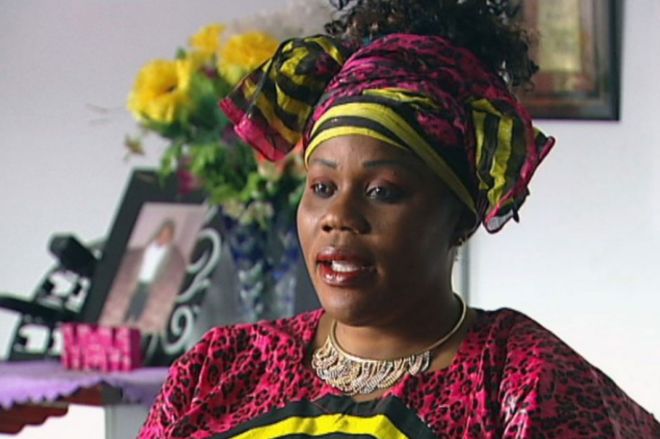
"I felt like somebody who had risen again," says Noela Rukundo.
She was supposed to be dead. The hired killers had been paid. They had even explained how they would dispose of the body.
But now, waiting outside her house for the last of the mourners to leave, she was ready to face down the man who had put out a contract for her murder.
"When I get out of the car, he saw me straight away. He put his hands on his head and said, 'Is it my eyes? Is it a ghost?'"
[...]
"It was around 7.30pm," Noela says. "He was in front of the house. People had been inside mourning with him and he was escorting a group of them into a car."
It was as they drove away that Noela sprang her surprise.
"I was stood just looking at him. He was scared, he didn't believe it. Then he starts walking towards me, slowly, like he was walking on broken glass.
"He kept talking to himself and when he reached me, he touched me on the shoulder. He jumped.
"He did it again. He jumped. Then he said, 'Noela, is it you?'… Then he start screaming, 'I'm sorry for everything.'"
Noela called the police who ordered Kalala off the premises and later obtained a court order against him. Days later, the police instructed Noela to call Kalala. Kalala made a full confession to his wife, captured on tape, begging for her forgiveness and revealing why he had ordered the murder.
"He say he wanted to kill me because he was jealous," says Noela. "He think that I wanted to leave him for another man."
She rejects the accusation.
In a police interview, Kalala denied any involvement in the plot. "The pretence," wrote the judge at his trial in December, "lasted for hours." But when confronted with the recording of his telephone conversation with Noela and the evidence she brought back from Burundi he started to cry.
Kalala was still unable to offer any explanation for his actions, suggesting only that "sometimes [the] devil can come into someone to do something but after they do it, they start thinking, 'Why I did that thing?'"
On 11 December last year, in court in Melbourne, after pleading guilty to incitement to murder, Kalala was sentenced to nine years in prison.
"His voice always comes in the night - 'Kill her, kill her,'" says Noela of the nightmares that now plague her. "Every night, I see what was happening in those two days with the kidnappers."
Ostracised by many in Melbourne's African community, some of whom blame her for Kalala's conviction, Noela sees a difficult future for her and her eight children.
"But I will stand up like a strong woman," she says.
"My situation, my past life? That is gone. I'm starting a new life now."
Kim Davis refusing to issue a marriage license to a gay couple. Photo by Ty Wright/Getty
By Lawrence M. Krauss September 8, 2015
AAs a physicist, I do a lot of writing and public speaking about the remarkable nature of our cosmos, primarily because I think science is a key part of our cultural heritage and needs to be shared more broadly. Sometimes, I refer to the fact that religion and science are often in conflict; from time to time, I ridicule religious dogma. When I do, I sometimes get accused in public of being a “militant atheist.” Even a surprising number of my colleagues politely ask if it wouldn’t be better to avoid alienating religious people. Shouldn’t we respect religious sensibilities, masking potential conflicts and building common ground with religious groups so as to create a better, more equitable world?
I found myself thinking about those questions this week as I followed the story of Kim Davis, the county clerk in Kentucky who directly disobeyed a federal judge’s order to issue marriage licenses to gay couples, and, as a result, was jailed for contempt of court. (She was released [ http://www.nytimes.com/2015/09/09/us/kim-davis-same-sex-marriage.html ] earlier today.) Davis’s supporters, including the Kentucky senator and Presidential candidate Rand Paul, are protesting what they believe to be an affront to her religious freedom. It is “absurd to put someone in jail for exercising their religious liberties,” Paul said, on CNN.
The Kim Davis story raises a basic question: To what extent should we allow people to break the law if their religious views are in conflict with it? It’s possible to take that question to an extreme that even Senator Paul might find absurd: imagine, for example, a jihadist whose interpretation of the Koran suggested that he should be allowed to behead infidels and apostates. Should he be allowed to break the law? Or—to consider a less extreme case—imagine an Islamic-fundamentalist county clerk who would not let unmarried men and women enter the courthouse together, or grant marriage licenses to unveiled women. For Rand Paul, what separates these cases from Kim Davis’s? The biggest difference, I suspect, is that Senator Paul agrees with Kim Davis’s religious views but disagrees with those of the hypothetical Islamic fundamentalist.
The problem, obviously, is that what is sacred to one person can be meaningless (or repugnant) to another. That’s one of the reasons why a modern secular society generally legislates against actions, not ideas. No idea or belief should be illegal; conversely, no idea should be so sacred that it legally justifies actions that would otherwise be illegal. Davis is free to believe whatever she wants, just as the jihadist is free to believe whatever he wants; in both cases, the law constrains not what they believe but what they do.
The Kim Davis controversy exists because, as a culture, we have elevated respect for religious sensibilities to an inappropriate level that makes society less free, not more. Religious liberty should mean that no set of religious ideals are treated differently from other ideals. Laws should not be enacted whose sole purpose is to denigrate them, but, by the same token, the law shouldn’t elevate them, either.
* * *
In science, of course, the very word “sacred” is profane. No ideas, religious or otherwise, get a free pass. The notion that some idea or concept is beyond question or attack is anathema to the entire scientific undertaking. This commitment to open questioning is deeply tied to the fact that science is an atheistic enterprise. “My practice as a scientist is atheistic,” the biologist J.B.S. Haldane wrote, in 1934. “That is to say, when I set up an experiment I assume that no god, angel, or devil is going to interfere with its course and this assumption has been justified by such success as I have achieved in my professional career.” It’s ironic, really, that so many people are fixated on the relationship between science and religion: basically, there isn’t one. In my more than thirty years as a practicing physicist, I have never heard the word “God” mentioned in a scientific meeting. Belief or nonbelief in God is irrelevant to our understanding of the workings of nature—just as it’s irrelevant to the question of whether or not citizens are obligated to follow the law.
Because science holds that no idea is sacred, it’s inevitable that it draws people away from religion. The more we learn about the workings of the universe, the more purposeless it seems. Scientists have an obligation not to lie about the natural world. Even so, to avoid offense, they sometimes misleadingly imply that today’s discoveries exist in easy harmony with preëxisting religious doctrines, or remain silent rather than pointing out contradictions between science and religious doctrine. It’s a strange inconsistency, since scientists often happily disagree with other kinds of beliefs. Astronomers have no problem ridiculing the claims of astrologists, even though a significant fraction of the public believes these claims. Doctors have no problem condemning the actions of anti-vaccine activists who endanger children. And yet, for reasons of decorum, many scientists worry that ridiculing certain religious claims alienates the public from science. When they do so, they are being condescending at best and hypocritical at worst.
This reticence can have significant consequences. Consider the example of Planned Parenthood. Lawmakers are calling for a government shutdown [ http://www.nytimes.com/2015/09/08/us/politics/congress-girds-for-fights-over-spending-iran-and-planned-parenthood.html ] unless federal funds for Planned Parenthood are stripped from spending bills for the fiscal year starting October 1st. Why? Because Planned Parenthood provides fetal tissue samples from abortions to scientific researchers hoping to cure diseases, from Alzheimer’s to cancer. (Storing and safeguarding that tissue requires resources, and Planned Parenthood charges researchers for the costs.) It’s clear that many of the people protesting Planned Parenthood are opposed to abortion on religious grounds and are, to varying degrees, anti-science. Should this cause scientists to clam up at the risk of further offending or alienating them? Or should we speak out loudly to point out that, independent of one’s beliefs about what is sacred, this tissue would otherwise be thrown away, even though it could help improve and save lives?
Ultimately, when we hesitate to openly question beliefs because we don’t want to risk offense, questioning itself becomes taboo. It is here that the imperative for scientists to speak out seems to me to be most urgent. As a result of speaking out on issues of science and religion, I have heard from many young people about the shame and ostracism they experience after merely questioning their family’s faith. Sometimes, they find themselves denied rights and privileges because their actions confront the faith of others. Scientists need to be prepared to demonstrate by example that questioning perceived truth, especially “sacred truth,” is an essential part of living in a free country.
I see a direct link, in short, between the ethics that guide science and those that guide civic life. Cosmology, my specialty, may appear to be far removed from Kim Davis’s refusal to grant marriage licenses to gay couples, but in fact the same values apply in both realms. Whenever scientific claims are presented as unquestionable, they undermine science. Similarly, when religious actions or claims about sanctity can be made with impunity in our society, we undermine the very basis of modern secular democracy. We owe it to ourselves and to our children not to give a free pass to governments—totalitarian, theocratic, or democratic—that endorse, encourage, enforce, or otherwise legitimize the suppression of open questioning in order to protect ideas that are considered “sacred.” Five hundred years of science have liberated humanity from the shackles of enforced ignorance. We should celebrate this openly and enthusiastically, regardless of whom it may offend.
If that is what causes someone to be called a militant atheist, then no scientist should be ashamed of the label.


 Market Data
  Markets


 AI
AI