News Focus
News Focus
icon url

fuagf

03/07/15 9:16 PM

#232434 RE: F6 #220574

Scientists were expecting a big El Niño this year. So where did it go?

Updated by Brad Plumer on November 8, 2014, 12:30 p.m. ET @bradplumer brad@vox.com

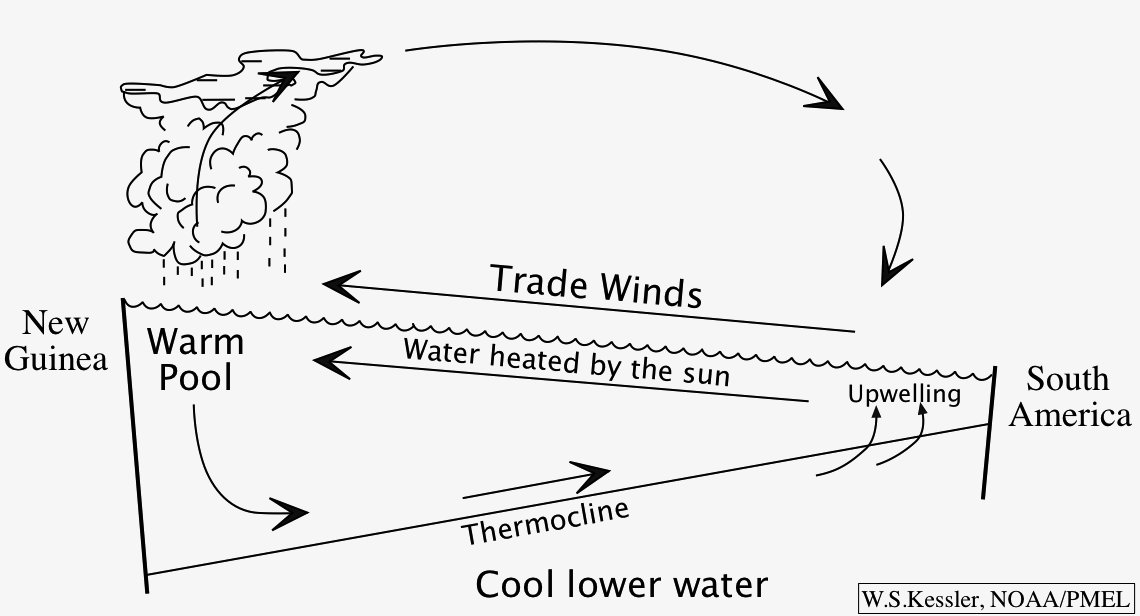
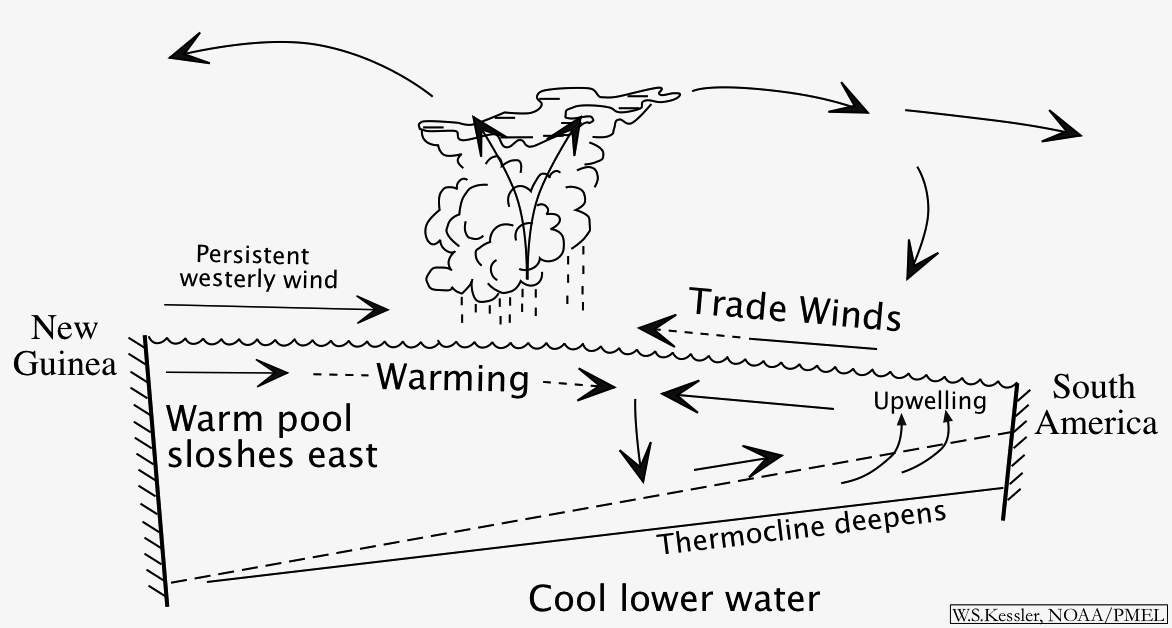
[ lol, the images are for people as me who require 2nd 3rd 4th.. looks to remind ]

1) Neutral conditions in the equatorial Pacific Ocean:


2) El Niño conditions:


http://www.vox.com/2014/11/8/7177709/el-nino-2014-forecast-weakening

===

El Nino Officially Declared for 2015

The climate pattern is here but weak

March 5, 2015 |By Andrea Thompson and Climate Central | Véalo en español


In part because of its weakness, as well as its unusual timing, the El Niño
isn’t expected to have much impact on U.S. weather patterns. Credit: NOAA

Just when everyone had pretty much written it off .. http://www.climatecentral.org/news/clock-is-ticking-on-elusive-el-nino-event-18514 , the El Niño event that has been nearly a year in the offing finally emerged in February and could last through the spring and summer, the National Oceanic and Atmospheric Administration announced Thursday .. http://www.cpc.ncep.noaa.gov/products/analysis_monitoring/enso_advisory/ensodisc.html .

This isn’t the blockbuster, 1998 repeat El Niño many anticipated when the first hints of an impending event emerged about a year ago. This El Niño has just crept across the official threshold, so it won’t be a strong event.

“We’re basically declaring El Niño,” NOAA forecaster Michelle L’Heureux said. “It’s unfortunate we can’t declare a weak El Niño.”

In part because of its weakness, as well as its unusual timing, the El Niño isn’t expected to have much impact on U.S. weather patterns, nor bring much relief for drought-stricken California.


Animation of subsurface temperature anomalies in the tropical Pacific Ocean.
Credit: NOAA


But forecasters say it could nudge weather patterns in other areas of the globe, especially if it persists or intensifies, and could boost global temperatures—following a 2014 that was already the hottest year on record .. http://www.climatecentral.org/news/record-2014-hottest-year-18502 .

“It does tilt the odds toward warmth,” L’Heureux said.

The difference a year makes

Forecasters with NOAA’s Climate Prediction Center .. http://www.cpc.ncep.noaa.gov/ .. and the International Research Institute for Climate and Society .. http://iri.columbia.edu/ (IRI) at Columbia University first raised the alert .. http://www.climatecentral.org/news/el-nino-watch-issued-for-fall-17148 .. early last year that an El Niño might be taking shape. They based it on a subsurface plume of warm water, called a Kelvin wave, surging from west to east across the tropical Pacific. (It was this large plume that drew comparisons to the monster El Niño of 1998, which caused deluges and flooding in many parts of the world and significantly amped up global temperatures. 1998 is still the only 20th century year among the top 10 warmest.)

An El Niño is marked by unusually warm waters over the central and eastern parts of this basin. The CPC officially considers it an event when the sea surface temperatures in a key region of the ocean reach at least 0.5°C, or about 1°F, warmer than average.

Multiple Kelvin waves have pulsed across the ocean basin in recent months and ocean temperatures have repeatedly been warm enough in that region to qualify as an El Niño.

But ocean temperatures alone don’t define an El Niño; CPC forecasters also look for the corresponding shifts in atmospheric patterns, namely a weakening of the typical east-to-west trade winds over the region. Those altered winds can affect weather around the globe. That’s why they are watched so carefully month after month .. http://www.climatecentral.org/news/where-is-el-nino-why-we-care-18152 .

A year after that first sign of an impending El Niño surged across the ocean, another Kelvin wave is making its way across the basin. Only this time, the ocean is already much warmer and most importantly, the atmosphere seems to have finally gotten the memo, with the trade winds weakening.


The climate impacts typically associated with an El Niño during the months of
June, July, and August. Click image to enlarge. Credit: NOAA

The coupling between ocean and atmosphere isn’t following the usual script, and the typical shifts in rain patterns haven’t emerged. But L’Heureux noted the rarity of any response from the atmosphere at this time of year. In spring, she said, it is harder for the ocean and atmosphere “to essentially see each other.”

“We’re fairly amazed,” she said.

Spring and summer

This late winter emergence of the El Niño means that the hallmark U.S. impacts .. http://www.climatecentral.org/news/why-do-we-care-so-much-about-el-nino-17806 —wet and cool conditions across the southern U.S.—won’t happen.

“Over us [the impact] becomes very, very muted” in spring, L’Heureux said.

Forecasters believe the current Kelvin wave and the already warmer ocean temperatures, signal that the El Niño is going to persist, which was another factor in officially declaring an event.

The CPC forecasts a 50 to 60 percent chance that the El Niño will chug along through the spring and summer. If it does, it could tamp down the Atlantic hurricane season .. http://www.climatecentral.org/news/struggling-el-nino-still-shaping-hurricane-activity-18008 .. and juice the season in the eastern Pacific, as many said it did last summer, before the El Niño was official.

That official designation has already spurred much debate in the climate community, since the ocean was warm enough through much of 2014 to qualify as an El Niño .. http://www.climatecentral.org/news/2014-el-nino-may-be-here-18043 .

“I’m sure it’s going to be discussed quite a bit,” L’Heureux said.

But whether or not those warm oceans meant an El Niño was in place, they, along with warm waters in other ocean basins, helped elevate global surface temperatures in 2014, leading to the warmest year on record.


Whether that could happen again in 2015 remains to be seen, though the ocean has a strong temperature memory and doesn’t respond to changes very quickly. So that warmth is likely to hang on, or even rise.

“If the El Niño intensifies, it may have a greater impact on the global temperatures, as observed from past events,” Jessica Blunden, a climate scientist with ERT, Inc., at the NOAA’s National Climatic Data Center, said in an email. “But for now we are in a wait and see mode.”

This article is reproduced with permission from Climate Central. The article was first published on March 5, 2015.

Share this Article:
Comments

http://www.scientificamerican.com/article/el-nino-officially-declared-for-2015/

See also:

New Reports Offer Clearest Picture Yet of Rising Greenhouse Gas Emissions
http://investorshub.advfn.com/boards/read_msg.aspx?message_id=111469622

F6, last night i watched the first 15 min. of Chai Jing's video in your reply to the one just above .. excellento, she is a woan .. lol
icon url

fuagf

05/02/15 1:13 AM

#233868 RE: F6 #220574

Super El Nino Likely as Huge Warm Water Wave Hits West Coast, Extreme Marine Die Off Developing

--
"El Nino May Tame Atlantic Hurricanes, Bring Beneficial Rain to California"

Noted my first earlier reply said

In part because of its weakness, as well as its unusual timing, the El Niño isn’t expected to have
much impact on U.S. weather patterns, nor bring much relief for drought-stricken California.
http://investorshub.advfn.com/boards/read_msg.aspx?message_id=111518788
--

Thu Apr 30, 2015 at 07:00 AM PDT

by FishOutofWater for Climate Change SOS 255 Comments / 255 New


Three tropical cyclones churned the waters around Australia on March 11, 2015, including
Pam, which reached category 5 and devastated the south Pacific islands of Vanuatu.

In early March, the strongest wave of tropical convection ever measured (known as the Madden Julian Oscillation .. http://www.wunderground.com/blog/JeffMasters/comment.html?entrynum=2938&page=5 ) by modern meteorology moved into the western Pacific from Indonesian waters bringing an outbreak of 3 tropical cyclones, including deadly category 5 Pam which ravaged the south Pacific islands of Vanuatu. This extreme outburst of tropical storms and organized thunderstorms pulled strong westerly winds across the equator, unleashing a huge surge of warm water below the ocean surface. Normally, trade winds blow warm water across the Pacific from the Americas to Australia and Indonesia, pushing up sea level in the west Pacific. When the trade winds suddenly reversed to strong westerlies, it was as if a dam burst, but on the scale of the earth's largest ocean, the Pacific. The front edge of that massive equatorial wave, called a Kelvin wave, is now coming ashore on the Americas.


Detailed research in California has found that nutrient upwelling was at a minimum in the El Nino year of 1992 and the super El Nino year of 1998 .. http://www.faralloninstitute.org/Publications/Garcia-ReyesEtal2014ProgOceanogr.pdf . A huge surge of warm water from an enormous deep equatorial wave called a Kelvin wave is now hitting the west coast of the Americas. A wave of similar size struck last year brought a massive marine die off to the west coast, but this year's die offs will likely be global because climate models are predicting a super El Nino. Credit NOAA.

Last year the largest Kelvin wave ever seen in the Pacific ocean developed in February. After it came ashore and the surge of warm water moved up the Pacific coast, the upwelling of nutrient rich cold water dramatically slowed, and marine life began starving up and down the coast of north America .. http://enenews.com/experts-10000-baby-sea-lions-dead-one-california-island-getting-crazy-very-difficult-death-crisis-tv-numbers-skyrocketing-alarming-rates-woman-digging-graves-beach-bury-dead-bodies-videos . As the warm water moved north from the equator it merged with an enormous mass of warm stagnant water dubbed "the blob .. http://www.audubon.org/magazine/march-april-2015/lost-sea-starving-birds-warming-world " which had built up in the central north Pacific ocean under the mound of high barometric pressure known as the Pacific high. Because the Pacific high had expanded north of its normal position, possibly because of climate change, warm, stagnant low nutrient water covered a large percentage of the surface of the north Pacific ocean. That stagnant water came ashore on the coast of the Pacific northwest and Alaska as the surge of warm water from the Kelvin wave moved up the California coast. The warm stagnant water lacked nutrients to support the growth of krill and copepods which are at the bottom of the food chain. Species that fed on krill and copepods had little to eat. Juvenile birds were the first to be affected by the lack of food. The west coast marine die off is already a crisis but it's likely to get much worse this summer and fall as the surge of warm water moves up the coast from the huge Kelvin wave now coming ashore.


"The Pacific Coast saw record numbers of dead Cassin’s Auklets this winter. " Audubon.

---
10,000 baby sea lions dead on one California island — Experts: “It’s getting crazy… This is a crisis… Never seen anything like it… Very difficult to see so much death” — TV: “Numbers skyrocketing at alarming rates”
---

An unprecedented number of auklets, a tiny sea bird that dives for plankton, were found dead in fall 2014, apparently of starvation, along the west coast from California to Canada. Nutrient poor warm waters are the probable cause of the lack of food .. http://news.nationalgeographic.com/news/2015/01/150123-seabirds-mass-die-off-auklet-california-animals-environment/ .

---
Last year, beginning about Halloween, thousands of juvenile auklets started washing ashore dead from California's Farallon Islands to Haida Gwaii (also known as the Queen Charlotte Islands) off central British Columbia. Since then the deaths haven't stopped. Researchers are wondering if the die-off might spread to other birds or even fish.

"This is just massive, massive, unprecedented," said Julia Parrish, a University of Washington seabird ecologist who oversees the Coastal Observation and Seabird Survey Team (COASST), a program that has tracked West Coast seabird deaths for almost 20 years. "We may be talking about 50,000 to 100,000 deaths. So far."
---

The warming that last year's huge Kelvin wave brought started a global coral bleaching event .. http://www.theguardian.com/environment/2015/feb/19/worlds-coral-reefs-face-major-bleaching-event-this-year-us-agency-warns .. is likely to get much worse after this year's huge wave of warm water spreads up and down the coasts of north and south America.

---
“It started in 2014 – we had severe bleaching from July to October in the northern Marianas, bad bleaching in Guam, really severe bleaching in the north western Hawaiian Islands, and the first ever mass bleaching in the main Hawaiian Islands,” said said Mark Eakin, Noaa’s Coral Reef Watch coordinator.

“It then moved south, with severe bleaching in the Marshall Islands and it has moved south into many of the areas in the western south Pacific. Bleaching just now is starting in American Samoa. In Fiji we’re starting to see some, the Solomon Islands have seen some. We’ve already seen a big event."

Bleaching takes place when corals are stressed due to changes in light, nutrients or temperature – though only the latter can cause events of this magnitude. This causes them to release algae, lose their colour and in some cases die off. It is a relatively rare occurrence. Large-scale bleaching was recorded in 1983, followed by the first global scale event in 1998. A second global wave came in 2010.

---

NOAA's CFSv2 model is forecasting a strong El Nino event will develop this summer and continue through 2015. Warm water along the west coast, combined with weaker than normal winds caused by El Nino will prevent nutrient rich cold water from welling up along the coast. Species that depend on nutrient upwelling will face starvation. Australia's Bureau of Meteorology has an excellent El Nino forecasting model which is also predicting a strong El Nino. Because the jet stream has already gone into an El Nino pattern by moving south over the eastern Pacific ocean and Mexico and further north than normal over the eastern Atlantic ocean, the likelihood of El Nino failing to strengthen is small. Last year's Kelvin wave failed to bring on a strong El Nino because trade winds in the south Pacific didn't weaken but this year they have and waters along the west coast of south America have already warmed. The south Pacific has moved out of the cool mode it was in a year ago.


attribution: NOAA

NOAA forecast of the departure from normal of Pacific ocean sea surface temperatures. NOAA's CFSv2 model predicts a strong El Nino with much above normal sea surface temperatures along the west coasts of south and north America up to January, 2016.

The forecast of a strong El Nino brings good news to California. NOAA's CFSv2 model is forecasting above well above normal precipitation for October through December, 2015. Because models are forecasting El Nino conditions to continue through January 2016 there is a good chance that heavy winter rains will break the California drought. The downside will be massive landslides and flooding in areas that have been affected by recent wild fires.


attribution: NOAA

California is likely to get relief from the drought in November and December 2015.

http://www.dailykos.com/story/2015/04/30/1380954/-Super-El-Nino-Likely-as-Huge-Warm-Water-Wave-Hits-West-Coast-Extreme-Marine-Die-Off-Developing?detail=hide

icon url

fuagf

05/08/15 10:41 PM

#233992 RE: F6 #220574

World headed for an El Nino and it could be a big one, scientists say

Date May 8, 2015 - 3:45PM 40 reading now

Peter Hannam
Environment Editor, The Sydney Morning Herald


[ LOL a VERY CUTE VIDEO ]Furry Facts: El Nino and La Nina

If you've ever found it hard to understand why Australia's swings between drought and floods, help is at hand, thanks to cartoonist John Shakespeare and Science Editor Nicky Phillips.

* A big El Nino may quell 'hiatus' debate
http://www.smh.com.au/environment/weather/a-strong-el-nino-may-quell-debate-about-a-warming-hiatus-20150507-ggwm6p.html
* What an El Nino might mean for Tony Abbott
http://www.theage.com.au/federal-politics/political-news/el-nino-what-it-could-mean-for-tony-abbott-20150507-ggwhiw.html

The world is headed into an El Nino event – potentially a big one – which will lift global temperatures and likely exacerbate bushfires and drought in eastern Australia, climate specialists say.

Fairfax Media understands that Australia's Bureau of Meteorology will announce next Tuesday that the El Nino event is all but certain.


El Nino conditions are setting in over the Pacific.

Sea-surface temperatures in the central and eastern Pacific are recording anomalies of more than 1 degree, a combination that has not previously been seen in weekly data going back to 1991, according to a bureau climate forecaster.

Australia's measure of El Nino thresholds is sustained warmth of sea-surface temperatures of 0.8 degrees above average in the key regions surveyed, a higher bar to clear than set by the US and some other agencies.

"You can see a warming in the eastern Pacific, which looks to be a classic [El Nino] event," said Agus Santoso, an El Nino modeller at the University of NSW's Climate Change Research centre.


The most recent El Nino in 2009-10, with its characteristically warm sea-surface
temperature anomalies in the central and eastern Pacific. Photo: NASA


Scientists, though, are surprised that the build-up of unusual warmth in the eastern Pacific compared with the west is happening so early in the year. "It's quite rare – this is an interesting one," Dr Santoso said.

In typical El Nino years, the usual easterly trade winds stall or even reverse in winter or later, dragging rainfall eastwards away from Australia and also south-east Asia. Droughts tend to deepen and spread and bushfire seasons are more active than normal.

A study by the bureau of 12 strong El Nino years since 1905 found rainfall declines were most evident in winter and spring – key agricultural seasons. The hardest hit areas cover most of NSW and parts of southern Queensland, while almost all of the eastern states have significantly reduced rain. (See below).


An El Nino event this year would be bad news for areas also suffering serious or severe rainfall deficiency. A bureau drought report out this week .. http://www.bom.gov.au/climate/updates/articles/a010-southern-rainfall-decline.shtml .. identified such areas over the past 30 months to include much of inland Queensland, western Victoria and north-central NSW – some of which are already receiving federal and state aid.

The bureau declined to say that its up-coming El Nino report will confirm the event.

"The tropical Pacific has continued to warm in the past week and all indices now exceed 1 degree," Andrew Watkins, head of the bureau's climate prediction services, said. "This warming has been fairly consistent since the start of the year, as noted in our fortnightly ENSO updates. Likewise, the models we survey suggest this warming will continue."

As the bureau notes, its survey of all most all model runs place the central NINO3.4 region clearly in El Nino territory:


Big El Nino possible

It's the early start to the process, though, that has climate scientists concerned the planet may be on course for a particularly strong El Nino event.

"If it peaks in winter then dies off it's interesting," Dr Santoso said. "But if it keeps going up and peaks in summer, that could potentially be a big El Nino."

Cai Wenju, a leading climate modeller at the CSIRO, said experts were predicting a strong El Nino a year ago but sustained westerly winds failed to eventuate. As a result, the atmosphere did not "couple" with, or reinforce, the warming trends in the oceans.

"Last year at this time, we didn't see the [westerly] winds," Dr Cai said. "This time, we see the strong westerly winds all along the equator."

If anything, forecasters have been overly cautious, he added. Some models generated by the US National Oceanic and Atmospheric Administration and not widely seen are pointing to "humungous anomalies" of as much as 5 degrees by October- November for parts of the eastern Pacific.

Even the ensemble of models is pointing to a 3-degree temperature anomaly by then, placing the departure from the norm in a similar league to previously powerful events such as the "super El Nino" of 1997 or 1982, Dr Cai said, cautioning that conditions could yet ease back.


Water issues

Water storage levels in eastern Australia typically drop in El Nino years as little run-off makes it into reservoirs.

Sydney is currently well-placed to cope with a lengthy dry spell after last month's storms helped lift overall storage levels to 92.4 per cent as of Wednesday.

Melbourne's storages, though, continue to see a reduction, with recent below-average rain pulling dam levels below 70 per cent, slightly lower than a year ago.

The bigger impact is likely to be felt in towns in the Murray-Darling Basin, with Broken Hill's storage levels down to about 4 per cent.

NSW MPs such as the Greens Jeremy Buckingham say the state should investigate how much rainfall from good rain events earlier in 2015 that have been trapped by large agricultural dams further upstream, including the giant Cubbie Station cotton farm.

Graeme Anderson, a climate specialist at the Victorian Department of Economic Development, said El Nino tended to double the chances of a dry spring in Victoria, though did not guarantee it.

He said it would be important strong rains occurred this winter before any El Nino event kicked in, particular for farmers in large parts of Western Victoria who suffered a dry end to last year and start of 2015.

EFFECTS OF EL NINO

Rainfall

Eastern Australian rainfall is typically below average, particularly in winter and spring, the key agricultural seasons. During 12 strong El Nino events analysed by the Bureau of Meteorology, the biggest departures from long-term average rains were in most of inland NSW and parts of southern Queensland.
Drought, frost, snow

Relatively clear skies mean areas already dry – such as western Victoria and inland parts of NSW and Queensland – may not get much near-term relief, while others may be declared drought-hit. With diminished cloud cover, frosts can also be bad.
Heatwave and bushfires

With dry soils, evaporation is reduced, leading to potentially hot summers. Warm, dry springs make for worse bushfire seasons than usual.
Shifting weather

El Nino years are also disruptive to our neighbours, with increased chance of forest fires and drought in South-East Asia and a reduced monsoon in south Asia. Across the Pacific, the reverse is true, with above-average rainfall.
Global temperatures

El Nino conditions mean the Pacific absorbs less heat from the atmosphere and can even give some back. Global temperatures typically get a 0.1-0.2 degree kick in such years, meaning 2015 and 2016 are shaping up to exceed the warmest year on record, set only last year.

With Tom Arup

http://www.smh.com.au/environment/weather/world-headed-for-an-el-nino-and-it-could-be-a-big-one-scientists-say-20150508-ggw8bo.html
icon url

fuagf

05/08/15 11:11 PM

#233994 RE: F6 #220574

United States El Niño Impacts

Author: Mike Halpert
Thursday, June 12, 2014

By this point, most of you have heard that it looks like El Niño is coming .. http://www.climate.gov/news-features/blogs/enso/details-june-2014-enso-discussion , and maybe you’re wondering why you should care. After all, why should it matter if the tropical Pacific Ocean becomes warmer than average? That’s thousands of miles away from the continental United States. Well, it turns out that El Niño often results in changes in the patterns of precipitation and temperature across many parts of the globe .. http://www.climate.gov/news-features/blogs/enso/how-enso-leads-cascade-global-impacts , including North America (Ropelewski and Halpert 1987, Halpert and Ropelewski 1992).

Many folks probably remember the heavy rainfall, flooding, and landslides that occurred in California in 1982/83 and again in 1997/98. As the region suffers through a devastating drought .. http://www.climate.gov/news-features/event-tracker/california-facing-worst-drought-record , it could be something of a relief if we knew for certain that El Niño would bring similar soaking rains. But those two events were the 2 strongest El Niños in the past 60 years, and we’ve seen many other El Niño years where California didn’t experience those types of devastating impacts. So assuming El Niño develops, what can we expect across the United States and when can we expect it?

By examining seasonal climate conditions in previous El Niño years, scientists have identified a set of typical impacts associated with the phenomenon (Figure 1). “Associated with” doesn’t mean that all of these impacts happen during every El Niño episode. However, they happen more often during El Niño than you’d expect by chance, and many of them have occurred during many El Niño events.


Figure 1. Average location of the Pacific and Polar Jet Streams and typical temperature and
precipitation impacts during the winter over North America. Map by Fiona Martin for NOAA Climate.gov.


In general, El Niño-related temperature and precipitation impacts across the United States occur during the cold half of the year (October through March). The most reliable of these signals (the one that has been observed most frequently) is wetter-than-average conditions along the Gulf Coast from Texas to Florida during this 6-month period. This relationship has occurred during more than 80% of the El Niño events in the past 100 years.

In Southern California and U.S. Southwest, strength matters

Over California and the Southwest, the relationship between El Niño and above-average precipitation is weaker, and it depends significantly on the strength of the El Niño. The stronger the episode (i.e., the larger the sea surface temperature departures across the central equatorial Pacific are), the more reliable the signal in this region has been.

For instance, during the two strongest events in the past 60 years (1982/83 and 1997/98), much-above-median rainfall amounts fell across the entire state of California. Median or above-median precipitation was recorded over the entire state during strong .. https://www.climate.gov/news-features/blogs/enso/united-states-el-ni%C3%B1o-impacts-0#strong .. episodes in both 1957/58 and 1972/73 (Figure 2). However, strong events in 1991/92 and 2009/10 only provided small surpluses in the southern part of the state, while precipitation during 1965/66 was generally average to below-average across the state.


Figure 2. DIfference from average (1981-2010) winter precipitation (December-February) in each U.S. climate division during strong (dark gray bar), moderate (medium gray), and weak (light gray) El Niño events since 1950. Years are ranked based on the maximum seasonal ONI index value observed. During strong El Niño events, the Gulf Coast and Southeast are consistently wetter than average. Maps by NOAA Climate.gov, based on NCDC climate division .. http://www.ncdc.noaa.gov/monitoring-references/maps/us-climate-divisions.php%20) .. data provided by .. http://www.esrl.noaa.gov/psd/data/usclimdivs/ .. the Physical Sciences Division at NOAA ESRL.

For weak .. https://www.climate.gov/news-features/blogs/enso/united-states-el-ni%C3%B1o-impacts-0#weak .. and moderate .. https://www.climate.gov/news-features/blogs/enso/united-states-el-ni%C3%B1o-impacts-0#moderate .. strength episodes (Figure 2), the relationship is even weaker, with approximately one-third of the events featuring above-average precipitation, one-third near-average precipitation, and one-third below-average precipitation.

Elsewhere over the United States, El Niño impacts are associated with drier conditions in the Ohio Valley, and there is a less-reliable dry signal in the Pacific Northwest and the northern Rockies. Hawaii also often experiences lower-than-average rainfall totals from the late fall through early spring period.

The climate impacts linked to El Niño help forecasters make skillful seasonal outlooks. While not guaranteed, the changes in temperature and precipitation across the United States are fairly reliable and often provide enough lead time for emergency managers, businesses, government officials, and the public to properly prepare and make smart decisions to save lives and protect livelihoods.

Definitions

Weak El Niño:
Episode when the peak Oceanic Niño Index (ONI) .. http://www.cpc.ncep.noaa.gov/products/analysis_monitoring/ensostuff/ensoyears.shtml .. is greater than or equal to 0.5°C and less than or equal to 0.9°C.

Moderate El Niño: Episode when the peak Oceanic Niño Index (ONI) is greater than or equal to 1.0°C and less than or equal to 1.4°C.

Strong El Niño: Episode when the peak Oceanic Niño Index (ONI) is greater than or equal to 1.5°C.

References

Halpert, M.S. and C.F. Ropelewski, 1992: Surface Temperature Patterns Associated with the Southern Oscillation, J. Clim., 5, 577-593.

Ropelewski, C.F. and M.S. Halpert, 1987: Global and Regional Scale Precipitation Patterns Associated with the El Nino/Southern Oscillation, Mon. Wea. Rev., 115, 1606-1626

--- Emily Becker, lead reviewer

https://www.climate.gov/news-features/blogs/enso/united-states-el-ni%C3%B1o-impacts-0

See also:

A Major Surge in Atmospheric Warming Is Probably Coming in the Next Five Years
http://investorshub.advfn.com/boards/read_msg.aspx?message_id=111462595

Stark figures but no surprises in updated climate change predictions from CSIRO, Bureau of Meteorology
http://investorshub.advfn.com/boards/read_msg.aspx?message_id=110275541

[ Posted Thursday, 03/06/14 ] - El Niño Supposedly Coming With Warmer Weather
http://investorshub.advfn.com/boards/read_msg.aspx?message_id=98404283


icon url

fuagf

05/12/15 9:29 PM

#234026 RE: F6 #220574

Here Comes Trouble: Forecasters Agree El Nino Is Here


In this photograph taken on Oct. 30, 2014, a resident pushes his bicycle carrying plastic containers filled with potable water along a dried up rice field in Lamongan
located in eastern Java island as parts of Java experience water shortages due to the long dry spell. Photographer: Juni Kriswanto/AFP/Getty Images

by Brian K Sullivan
9:00 AM AEST
May 13, 2015

Three of the big meteorological agencies on the Pacific Rim now agree: El Nino has come .. http://www.bloomberg.com/news/articles/2015-05-12/el-nino-returns-as-australia-declares-first-event-in-five-years .

The Australian Bureau of Meteorology .. http://www.bom.gov.au/climate/enso/ .. joined the U.S. Climate Prediction Center .. http://www.cpc.noaa.gov/ .. and Japan Meteorological Agency .. http://www.jma.go.jp/jma/indexe.html .. on Tuesday in declaring that sea-surface temperatures in the equatorial Pacific are high enough -- and the atmosphere above the ocean has reacted strongly enough -- to mean an El Nino has begun.

If this seems like old news, that’s because people have been talking about this El Nino .. http://www.bloomberg.com/news/articles/2014-08-15/el-nino-s-delay-spurs-memories-of-2012-when-it-never-came .. since 2013, when predictions began popping up among researchers and the media that the Pacific would warm and global weather patterns were going to be altered.

The obsession .. http://www.bloomberg.com/news/articles/2014-04-24/el-nino-risk-increases-as-pacific-gets-warmer-carbon-climate .. can be forgiven when you consider that El Ninos cause trouble. In 1982-83, an El Nino was blamed for setting off a series of droughts, wildfires and flooding from South America to Australia that cost $8 billion and killed almost 2,000 people, according to the National Oceanic and Atmospheric Administration.

The agency estimated the U.S. economic cost of the 1997-98 El Nino at $10 billion, with crops wilting or drowning in the fields and consumers spending $2.2 billion less on heating fuels.

Another part of the problem is that forecast models have been struggling to make sense of, well, uncharted waters. Large parts of the Pacific Ocean were warmer than normal last year, even while the atmosphere above the seas failed to react.

Statistical Analysis

The models based on statistical analysis of the Pacific’s past performance have been “bamboozled,” said Kevin Trenberth .. http://www.cgd.ucar.edu/staff/trenbert/ , a distinguished senior scientist in the Climate Analysis Section at the National Center for Atmospheric Research in Boulder, Colorado. “What we are seeing is unprecedented, a sort of double El Nino.”

Even though Australia, the U.S. and Japan agree an El Nino has started, there hasn’t been a lot of unity in the chorus.

On Tuesday, while Australia was saying the event was in its initial stages, Japan said it started last summer, weakened during the winter of 2015 and is now “likely to be redeveloping,” according to a statement by its Climate Prediction Division, which added it will probably persist until into the Northern Hemisphere’s fall.

In March, the U.S. Climate Prediction Center said the El Nino began in February. The agency will update its forecast on Thursday.

Varying Opinions

The three agencies have their own criteria for the phenomena, which explains some of the differences, and commercial forecasters have weighed in with their own opinions. Given the lack of unity, no one should be surprised that there is no consensus about how strong it will be or how long it will last.

“It’s come on quickly and all of our model guidance predicts it’s going to continue to strengthen,” David Jones, manager of Australia’s climate monitoring and prediction, said Tuesday. “A significant or substantial event is likely.”

Last week, U.S. Climate Prediction Center Deputy Director Mike Halpert said he wasn’t ready to make a prediction on strength yet.

Commercial forecasters’ opinions also diverge.

It is possible that “this will be a strong event, perhaps on the magnitude of the last really strong event in 1997-98,” said Todd Crawford, chief meteorologist at WSI in Andover, Massachusetts.

“A lot of these climate models have a warm bias, so like last year, it’s best to fade them,” said Matt Rogers, president of the Commodity Weather Group LLC in Bethesda, Maryland. He said because the models call for a strong El Nino, he is favoring a weak one through the summer at least.

No two El Ninos are exactly the same, Trenberth said.

Researchers tend to talk about “different flavors of El Ninos,” he said. “Mother Nature always seems to throw us a curve ball.”

http://www.bloomberg.com/news/articles/2015-05-12/here-comes-trouble-forecasters-agree-el-nino-is-here

~~~

El Nino and La Nina | Cheat Sheet


.. the video runs into a more technically instructive one .. ok, we all agree at least that it's here, so it's an El Nino wrap for now .. :)
icon url

fuagf

09/01/15 8:06 PM

#237328 RE: F6 #220574

Scientists: Current El Nino could be strongest in history

El Nino events can have significant effects on weather systems around the world -- causing droughts in some places, while encouraging flooding in others.

By Brooks Hays | Sept. 1, 2015 at 3:34 PM


A map of current sea surface temperatures. Photo by NOAA/NASA

GENEVA, Switzerland, Sept. 1 (UPI) -- El Nino is the name given to the climatic effects of warming waters in the Pacific Ocean.

As a significant portion of the ocean warms to above-average temperatures, the cross-Pacific trade winds slow and strong patterns of clouds and heavy rain begin to develop near the international date line. The event can disrupt weather patterns all over the world.

According to a new report from the World Meteorological Organization, the current El Nino event is "mature and strong." Scientists at the WMO say the event will continue to strengthen through the end of the year, with temperatures rivaling the strongest El Nino events in recorded history.

"Models and expert opinion suggest that surface water temperatures in the east-central tropical Pacific Ocean are likely to exceed 2 degrees Celsius above average," the researchers write .. https://www.wmo.int/media/sites/default/files/El-Nino-Update_Aug2015_Eng-1.pdf , "potentially placing this El Niño event among the four strongest events since 1950."

Surface water temperatures in the Pacific are already well above average, and if they continue to rise at hastening pace, the current El Nino could best the strongest event, recorded in 1997-1998.

El Nino events can have significant effects on weather systems around the world -- causing droughts in some places, while encouraging flooding in others.

Typically, exceptionally warm Pacific waters precipitate dry spells in Asia and heavy rains in many parts of North America. Similarly, El Nino typically means drier weather in southern Africa and flooding around the Horn of Africa.

Storms in the Atlantic Ocean and Gulf of Mexico are usually quelled by a prolonged El Nino event, while more violent weather is stirred up in the eastern Pacific.

Meteorologists say the current El Nino has already served to quiet the South Asian monsoon season.

"We are seeing that the Indian monsoon right now is almost 12 percent below normal. There is only a month left of the summer monsoon season making it difficult to recover," WMO's El Nino expert Rupa Kumar Kolli told the BBC .. http://www.bbc.com/news/science-environment-34120583 .

But predicting the effects if El Nino is more complicated this time around, as climatologists have yet to fully understand how the event will interact with the Arctic warming effect, which has slowed the jet stream running across North America.

"The truth is we don't know what will happen," David Carlson, the director of the World Climate Research Program, told reporters. "Will the two patterns reinforce each other? Will they cancel each other? Are they going to act in sequence? Are they going to be regional? We really don't know."

Related UPI Stories

* Three Category 4 hurricanes cross the Pacific Ocean simultaneously
http://www.upi.com/Top_News/World-News/2015/09/01/Three-Category-4-hurricanes-cross-the-Pacific-Ocean-simultaneously/5061441101965/?st_rec=4721441132159

* California is behind a whole year's worth of rain
http://www.upi.com/Science_News/2015/07/30/California-is-behind-a-whole-years-worth-of-rain/6251438275299/?st_rec=4721441132159

* Strong El Nino not expected to answer California drought
http://www.upi.com/Science_News/2015/07/11/Strong-El-Nino-not-expected-to-answer-California-drought/1731436632460/?st_rec=4721441132159

* May sets heat record; 2015 on pace to be hottest ever
http://www.upi.com/Science_News/2015/06/18/May-sets-heat-record-2015-on-pace-to-be-hottest-ever/4231434658025/?st_rec=4721441132159

http://www.upi.com/Science_News/2015/09/01/Scientists-Current-El-Nino-could-be-biggest-in-history/4721441132159/

.. much increased possibility of much decreased rainfall through spring and early summer in eastern Australia leading to increase in vegetable and meat prices

Australia continues to have the highest per capita carbon emissions in the world .. we became a laggard in the effort to reduce emissions
in 1990 and continue to be .. though Obama did not name Tony Abbott in a recent climate speech he was obviously targeting Australia .. see reply ..