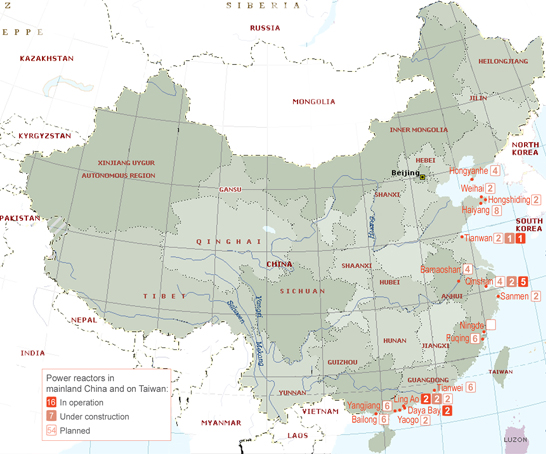
Before Fukushima, the hysteria that often surrounds nuclear power did not seem to exist in mainstream China. Questions about safety were met with a stern insistence that China needed more electricity from cleaner sources. Nuclear was just one of the many options Beijing was pursuing.
China was bullish on electricity demand and its plans for nuclear expansion. Back in 2009, officials and energy experts were predicting nuclear capacity would reach 70 GW by 2020 from just 9.1 GW, with a further 30 GW under construction by the end of this decade.
New approvals signal Beijing’s commitment to nuclear power. This year alone China is expected to add 13.95GW of new nuclear capacity, according to estimates on the World Nuclear Association’s website, almost doubling the country’s total capacity. Other estimates put capacity additions at a slower but still impressive 8.6GW this year. By 2020, China’s total capacity should reach 58GW, with that almost tripling by 2030 to 150GW.
China’s nuclear ambitions aren’t limited to its borders or state financing. Beijing is hoping to expand its influence in countries that did not abandon the energy source after Fukushima. It seems likely that Beijing is trying to capitalize on the absence of other major players in the last few years to promote its own technology. Beijing wants to export the CAP 1400, which stands for China Advanced Passive – a third generation technology based off Westinghouse’s AP 1000 reactors – to expand China’s presence in countries like Brazil, Russia and South Africa. And China’s state-owned nuclear companies are looking at opportunities in more developed markets as well. China General Nuclear Corporation and China National Nuclear Corporation are buying into the Hinkley Point nuclear power project in Somerset, England. Beijing is also looking to buy into uranium mines in other countries.
In the massive build-up planned for 2020 and beyond, two of China’s largest nuclear companies are looking to go public on the Hong Kong exchange. The move will open the companies up to further scrutiny, both at home and abroad; similar to the process China’s state-owned oil companies went through. But don’t expect an IPO to usher in greater transparency from Beijing – that will have to come from domestic pressure.
First Haiyang AP1000 takes shape The final module - the containment water tank - has been installed at the first of two AP1000 units under construction at Haiyang in China's Shandong province.
In September 2007, Westinghouse and its partners the Shaw Group received authorization to construct four AP1000 units China: two at Sanmen in Zhejiang province and two more at Haiyang in Shandong province.
The construction of the Haiyang AP1000s is being managed by Shandong Nuclear Power Company, in collaboration with State Nuclear Power Technology Corp (SNPTC) and China Nuclear Energy Construction Corp. SNPTC has a major role in the transfer of knowledge and technology from the plant supplier, Westinghouse.
Sanmen unit 1 is expected to be the first AP1000 to begin operating. The unit is scheduled to begin generating electricity in 2014. Haiyang 1 is also slated for commercial operation by the end of this year. All four Chinese AP1000s are scheduled to be in operation by 2016. Third and fourth units are planned at both Sanmen and Haiyang.
Four AP1000s are also currently under construction in the USA: Vogtle 3 and its sister unit Vogtle 4 in Georgia, and Summer units 2 and 3 in South Carolina. All of these units are currently scheduled to start operation between late 2017 and 2019.
China’s rapid urbanization is not only gulping up cement, but also water and energy. On Friday, China’s President Xi Jinping told a government meeting that development of nuclear energy should be accelerated. “By adopting top international standards and ensuring safety, China should lose no time in constructing nuclear power projects in eastern coastal regions,” Xi said, as state-run Xinhua newswire reported.
At the end of 2013, China’s 17 operational nuclear power plants were generating about 2 percent of the country’s total energy, according to Xinhua. But Ye Qizhen, an expert in nuclear energy at the Chinese Academy of Engineering, told the newswire that China should aim to get 10 percent of total energy from nuclear power.
While China suspended approving new nuclear plants in the immediate aftermath of the 2011 Fukushima disaster in Japan, China’s State Energy Commission announced plans in April to deploy an additional 8.6 gigawatts of nuclear power capacity, reported China Daily.
One of China’s nuclear power “moonshots” is a large research program in Shanghai to develop nuclear energy from thorium, as opposed to uranium. The effort is led by the politically powerful Jiang Mianheng, son of former leader Jiang Zemin. In 2012, Jiang told the Thorium Energy Conference: “China is the second largest economy in the world, [but] China is still in the stage of urbanization … which gives rise to huge demand for materials.”
Mainland China has 20 nuclear power reactors in operation, 28 under construction, and more about to start construction. Additional reactors are planned, including some of the world's most advanced, to give more than a three-fold increase in nuclear capacity to at least 58 GWe by 2020, then some 150 GWe by 2030, and much more by 2050. The impetus for increasing nuclear power share in China is increasingly due to air pollution from coal-fired plants. China’s policy is for closed fuel cycle. China has become largely self-sufficient in reactor design and construction, as well as other aspects of the fuel cycle, but is making full use of western technology while adapting and improving it. China’s policy is to ‘go global’ with exporting nuclear technology including heavy components in the supply chain.
CB&I (NYSE:CBI) today announced it has signed a memorandum of understanding (MOU) with China National Nuclear Corporation (CNNC) to facilitate enhanced cooperation and collaboration between CNNC and CB&I in the development of nuclear power plants. The areas of cooperation include operation and maintenance support services for CNNC's operating nuclear power plants in China; engineering, procurement, and construction management (EPCM) of the AP1000(R) nuclear power plants planned and owned by CNNC in China; international nuclear power market development; and nuclear power training programs and management personnel exchange in the U.S. and China.
CB&I now has cooperative agreements in place with two of the three state-owned corporations empowered by the State Council of the People's Republic of China to own and operate nuclear power plants in China. In 2013, CB&I announced an agreement with China Power Investment Corporation (CPI) to form a joint venture company to build nuclear power plants in China.
China plans to increase its nuclear power generation capacity to 58 GWe by 2020 and currently has 28 nuclear power units under construction. CB&I is providing EPCM for four AP1000 nuclear power units under construction in China, including two units at CNNC's site in Sanmen, Zhejiang province.
"This new commitment with CNNC will provide CB&I with the opportunity to expand and diversify the services offered in China while the international deployment of CNNC's indigenous nuclear power technologies will offer expanded growth in the international nuclear power marketplace," said Philip K. Asherman, CB&I's President and Chief Executive Officer.
The completed vessel, manufactured by China First Heavy Industries (CFHI) under the supervision of Westinghouse, successfully passed a pressure test on 8 June.
The vessels for the first units at Sanmen and Haiyang were produced in South Korea by Doosan Heavy Industries & Construction using some forgings fabricated by CFHI. The Chinese company produced the first forging for the component in July 2007 under the supervision of China's National Nuclear Safety Administration and supported by several companies involved in the Sanmen plant project, including State Nuclear Power Technology Corporation (SNPTC), Westinghouse and Doosan. Together, the companies had strict control of quality during the manufacturing process. The vessel for Haiyang 2 will be supplied by Shanghai Electric Group.
Westinghouse Electric Company, China's State Nuclear Power Technology Corporation (SNPTC) and Turkish power company Elektrik Üretim AS (EÜAS) have signed an agreement to begin exclusive negotiations to develop and construct a four-unit nuclear power plant in Turkey.
Westinghouse and SNPTC have a long history of close collaboration on AP1000-based nuclear reactor technology. In addition to the first four AP1000 units under construction at Sanmen and Haiyang in China, China's own CAP1400 reactor has evolved from the Westinghouse design.
With Chinese intellectual property rights and backed by full fuel cycle capability, the CAP1400 is central to Chinese policy aims to become an exporter of nuclear technology. A site at Shidaowan in Shandong province is being prepared for the start of construction of the first CAP1400.
Meanwhile, in addition to the four Chinese units, AP1000s are under construction at Vogtle and VC Summer in the USA. The reactor is also being considered for construction at Moorside in the UK and at Kozloduy in Bulgaria.
Work is expected to start next year on Turkey's first nuclear power plant, four VVER-1200 units to be built at Akkuyu. Rosatom will build, own and operate the plant as part of a long-term power purchase agreement. A second plant of four Atmea 1 reactors, designed by Areva and Mitsubishi Heavy Industries, is pencilled in for construction at Sinop.
Westinghouse expects it and its suppliers will get contracts in the near future related to construction of a dozen nuclear reactors in China, company CEO Danny Roderick said Thursday.
China may build as many as 200 new nuclear units in the coming 15 years, and a 25-30% market share for Westinghouse is "realistic," Roderick said on the sidelines of a Nuclear Energy Institute event in New York.
Unlike the initial contracts under which Chinese companies are building four 1,150-MW Westinghouse AP1000 reactors at two sites -- Sanmen and Haiyang -- future agreements will not be turnkey contracts, Roderick said.
Westinghouse agreed to transfer the AP1000 technology to China as part of the deal to sell the four units, and China is seeking to export 1,400-MW versions of the AP1000.
The US Nuclear Regulatory Commission (NRC) has approved Westinghouse's testing approach for its small modular reactor design. Approval is a significant step toward design certification and will reduce the time ultimately needed to license the Westinghouse SMR, the company said yesterday.
In a letter dated 27 February, the NRC told Westinghouse that it has granted a Safety Evaluation Report for the licensing topical report that the company submitted in April 2012 for agency review and approval. The report identified what would occur in the unlikely event of accident due to a small break in water circuit that cools the reactor, and defined the test program that Westinghouse will conduct to prove that its safety systems would safely shut down the reactor in response to a such an accident.
The Westinghouse SMR is derived from the AP1000 plant design, which received a design certification amendment from the NRC in 2011. Eight AP1000 units are currently under construction at four sites in the USA and China. This origin is "a key benefit" of the Westinghouse SMR, said Jeff Benjamin, Westinghouse senior vice president for new plants and major projects.
"The development program has involved many years of testing and analysis, which can be successfully applied to advance our SMR program as the market for the technology matures in the future," Benjamin said. Westinghouse believes the NRC action "confirms the technical maturity" of the Westinghouse SMR concept design, he added.
Westinghouse said the potential for intermediate and large breaks in the reactor coolant loop - and the correspondingly more serious accident conditions - is eliminated in the Westinghouse SMR design because there are no large primary penetrations of the reactor vessel or large loop piping. The design is an integral pressurized water reactor with all primary components located inside of the reactor vessel. As a power unit it would produce 225 MWe in operation.
China is set to build six to eight nuclear power plants annually for the next five years and operate 110 plants by 2030
More than 110 nuclear power plants will be put into operation by the end of 2030, exceeding the number of plants in the US.
China generates only about two percent of its total electricity from nuclear power plants while the average global proportion is 14 percent, adding that China is in a great position to develop its nuclear projects.
Toshiba Corp.’s Westinghouse Takes on Long-Delayed Nuclear Projects in CB&I Deal
Toshiba Corp.’s Westinghouse Electric Company LLC agreed to buy CB&I Inc.’s nuclear business in a deal that would settle disputes between the two contractors and the owners of two long-delayed U.S. power projects.
Westinghouse Electric agreed to pay $229 million for the CB&I Stone & Webster Inc. unit upon the delivery of some equipment and the completion of the two U.S. projects, Southern Co.’s Vogtle nuclear power plant in Georgia and Scana Corp.’s V.C. Summer complex in South Carolina, terms posted on CB&I’s website Tuesday show.
The sale marks a shift for CB&I away from large-scale nuclear power projects and would resolve disputes that the company and Westinghouse had with Southern and Scana over who should pay for the cost overruns of their projects. CB&I projected an after-tax charge of about $1 billion to $1.2 billion from the deal. Westinghouse will take over the construction and startup of Vogtle and V.C. Summer, both delayed by years. http://www.bloomberg.com/news/articles/2015-10-27/westinghouse-to-buy-cb-i-s-nuclear-construction-businesses
CNNC inches toward $6b nuclear plant deal in Argentina State-owned China National Nuclear Corp is inching closer to a $6 billion deal with Argentina to build the Latin American country's fourth nuclear plant. The nuclear giant has wrapped up talks for the fourth reactor and signed a framework agreement for a fifth plant. That fifth one is expected to use China's home-grown nuclear technology, according to CNNC sources.
CNNC will work with Nucleoelectrica, the state-owned nuclear operator of Argentina, on the fourth reactor, Atucha 3, which is expected to cost about $6 billion. Construction of the Atucha Nuclear Power Plant Complex in Buenos Aires province is expected to be completed in eight years.
Atucha 3 will be using a Canadian-developed Candu reactor which uses a heavy-water model, while the fifth reactor, Atucha 4, will use China's third-generation pressurized-water nuclear technology, known as Hualong One.
But the site of the project Atucha 4, which is expected to cost $7 billion, has not been decided yet.
According to earlier reports, it is most likely to be on the Paraguay River which flows through the country.
CNNC operates two Candu 6 units at its Qinshan plant in Zhejiang province, which is likely to become the reference projects for Atucha 3.
Through the contract, Nucleoelectrica will provide 62 percent of the equipment, while CNNC will provide the rest of the equipment, goods, and services.
Chinese lenders will support 38 percent of the total funding, according to a report by the Xinhua News Agency.
"The negotiation process for the fourth reactor is complete, and the deal will be closed soon by both countries," the report quoted Argentina's Ministry of Federal Planning, Public Investment and Services as saying.
Argentina says signs nuclear plant construction deals with China
Argentina has signed two nuclear power plant construction deals with China for about $15 billion, the Argentine government said in a statement on Sunday, calling the deals "a fundamental step toward diversifying our energy matrix."
The plants will add 1,750 megawatts to the energy already produced by three nuclear power plants in Argentina.
China, South Africa Sign Nuclear Energy Pact Nuclear energy regulators in South Africa and China have signed a technical cooperation agreement as Africa’s most industrialized economy presses forward with controversial plans to build eight new nuclear reactors.
The deal, which includes “licensing procedures, vendor inspections, inspector training, and joint inspections and technical support,” was signed last week in Beijing, according to a Monday announcement from South Africa’s National Nuclear Regulator (NNR).
China is competing with Russia, France, the United States and South Korea for the South African nuclear power plant construction program, which is worth up to $50 billion.
The two countries signed a nuclear energy cooperation agreement a year ago, which Pretoria said was in preparation for a “possible” utilization of Chinese nuclear technology in the country. Similar agreements have been signed with the other bidders.
South Africa has one nuclear power station but relies heavily on coal for electricity generation.
The new reactors are expected to add 9,600 megawatts — or nearly one- third of the country’s generating capacity of 30,000 MW — with the first unit to be ready in 2023.
Power shortages have hobbled South Africa’s economic growth, but the plan to expand nuclear energy production has come under fire from critics over environmental concerns and fears that the cost could cripple the economy.
Westinghouse, again, looks for the next generation of nuclear reactors
Westinghouse Electric Co.’s CEO Danny Roderick in January challenged his employees to come up with the next big thing in nuclear energy — the next generation reactor.
It had been a very long time since such words were uttered at the Cranberry-based nuclear company.
“His charter was to take a clean sheet approach and come up with the most economic [option],” said Cindy Pezze, chief technology officer. The central question was: “How can we get to a more economic future for nuclear?”
No new nuclear reactor has been built in the U.S. on time and on budget, and the overruns haven’t been trivial. That track record, along with cheap and plentiful natural gas and a lack of environmental policy that incentivizes low carbon generation, has held back the nuclear renaissance predicted a decade ago.
Even operating nuclear plants with capital costs far behind them are having trouble competing. A handful are headed for premature retirement.
For that reason, economics and scale are top priorities.
“I think that the industry in total — that includes the vendors, the government — is looking at this saying, ‘We have to figure out a way of doing this more efficiently than we have done in the past,’” Ms. Pezze said. “Everyone is talking about [how] we need to have some change.”
The Westinghouse team wasn’t given a budget or a cost target for the new reactor design and Ms. Pezze declined to speculate.
“We've been down this road before,” she said. “I won't give you a number at this point.”
The timeline, she expects, will be rather lengthy.
The company’s first step was to whittle down the possibilities. There are six types of Generation IV reactors being researched today. Westinghouse chose the lead-cooled fast neutron reactor concept, which submerges the nuclear core in molten lead and operates at extremely high temperatures.
In most of the nuclear reactors now operating, the nuclear core is placed in a pool of water. That prevents radiation from escaping into the air, but as the nuclear reaction heats up the water, cooler water must be constantly pumped in.
Lead offers a more static solution. It absorbs radiation and doesn’t boil until it reaches 3,182 degrees Fahrenheit. Those properties mean a lead-cooled reactor would need fewer pumps, thinner walls and have fewer “uncomfortable byproducts,” shaving off a portion of capital and operating expenses. The whole operation would be smaller, Ms. Pezze said.
DOE seeks new ideas for reactors
Last month, Westinghouse submitted its proposal to the Department of Energy, which had solicited ideas about advanced nuclear reactors that could be built by 2035. The agency plans to award $80 million to two teams over the next five years, but that depends on Congress’ approval going forward. In the meantime, the department is getting ready to announce the winners of a much smaller opportunity.
Westinghouse hasn’t said yet who else it has enlisted to be part of its team, only that there are more than a dozen entities and that they include universities, national labs and vendors.
A spokesman for the agency said the response has been strong with more than a dozen teams vying for funding. The winners — there will be two, and each will be awarded $6 million — are expected to be announced before the end of the year.
By nuclear standards, that’s a drop in the bucket.
“At one time, there was a fair amount of investment going on in Generation IV,” said Larry Foulke, adjunct professor at the University of Pittsburgh’s Swanson School of Engineering.
An international consortium, Gen IV, sprung up in 2000 to guide research and collaboration in advanced reactor activities.
“A number of nations were working together on these reactors,” he said. “But as with most research activities where you’re studying reactors on paper and not making them,” investment dwindles.
“Generation IV reactors are suffering from a lack of funding worldwide,” he said.
Europe and Russia are pulling ahead.
Russia is due to start construction on a demonstration lead-cooled reactor next year, and European groups are working on three reactor designs.
The investment needed to start from scratch and get to that demonstration stage is staggering. It’s not something Westinghouse can do alone, Ms. Pezze said.
The last time the company tried at its hand at getting DOE funding for a new reactors design was in 2012, when the agency snubbed its pitch for funding for a small modular reactor. The following year, the DOE again passed over Westinghouse for a small modular reactor award and last year, citing unfavorable market conditions, the company pulled back on its program.
Some 35 years ago, Westinghouse was at the forefront of a new reactor design — the liquid metal fast breeder reactor, which would have used sodium as a coolant, was designed to produce more fuel than it uses to generate electricity.
The first of its kind reactor was to have been built at on the banks of Clinch River in Tennessee. The project received hefty government funding, nearly $1 billion, and had more than 600 Westinghouse employees devoted to it.
Then, in 1977, President Jimmy Carter decided to kill the project. He didn’t want reprocessed fuel crisscrossing the country, worrying it might get into the wrong hands.
But, according to newspaper reports from that time, the industry and Congress were slow to get the message. Federal funding continued to flow for several years and the majority of equipment was either delivered to the site or on order before the effort was finally canceled in 1983.
Google ups ante, nearly doubles bet on renewable energy The long-term commitments announced Thursday cover up to 842 megawatts of power that will flow from six different wind and solar power projects scheduled to be finished within the next two years in the U.S., Chile and Sweden. Google isn't disclosing how much it expects to pay for the power.
Some of the deals were signed several weeks ago, but Google timed its announcement to coincide with the U.N. conference in Paris that is exploring ways to reduce the volume of carbon emissions widely believed to be changing the Earth's climate.
"It's an opportune time to make a strong statement," said Gary Demasi, Google's director of data center energy.
Google has now signed contracts covering 2 gigawatts of renewable energy, putting the company closer to its goal of having 3.6 gigawatts lined up by 2025. The 2 gigawatts currently under contract is enough to supply 2 million European homes annually, based on Google's estimate that the renewable energy projects will generate an average of about 7.4 billion kilowatt hours of power.
The Mountain View, California, company has pledged to have all of its 14 data centers worldwide running on renewable energy as part of its quest to minimize the pollution caused by the rising demand for its Internet search engine, YouTube video service, Gmail, digital maps and other services.
Google, part of a recently formed company called Alphabet Inc., still has a long way to reach that goal. By its latest estimates, renewable energy accounts for 37 percent of the power needed to run its data centers.
Apple, Facebook and other technology companies also have been investing heavily in renewable energy in an effort to reduce the pollution caused by the popularity of their products. All of Apple's data centers, offices and stores in the U.S. already run on renewable energy, but the company is still trying to obtain cleaner power for the overseas factories that make its iPhones, iPads and other devices.
Besides signing long-term contracts with renewable energy providers, Google also has invested about $2.5 billion in companies and projects trying to produce more wind, solar and geothermal power.
Toshiba Plans to Cut 7,800 Jobs as It Warns of Huge Loss
The Japanese company, whose financial struggles were laid bare this year in a $1.2 billion accounting scandal, said it would eliminate 7,800 jobs, mostly in its slumping consumer electronics division. That brings the number of job cuts announced this year to more than 10,000 total, or roughly 5 percent of its workforce.
Toshiba is seeking to offload whole divisions as well as employees. It said Monday it would look for a buyer for its health care arm, which makes products like medical scanners for hospitals. It already wants to offload all or part of its personal computer business as well as its U.S.-based nuclear power plant subsidiary, Westinghouse.
India closing in on Westinghouse deal to build six nuclear reactors
India expects to seal a contract with Westinghouse Electric Co LLC to build six nuclear reactors in the first half of next year, a senior government official said, in a sign its $150 billion dollar nuclear power program is getting off the ground.
The proposed power plant in Prime Minister Narendra Modi's home state of Gujarat will accelerate India's plans to build roughly 60 reactors, which would make it the world's second-biggest nuclear energy market after China.
India wants to dramatically increase its nuclear capacity to 63,000 megawatts (MW) by 2032, from 5,780 MW, as part of a broader push to move away from fossil fuels, cut greenhouse gas emissions and avoid the dangerous effects of climate change.
The United States signed a pact with India in 2008, opening the way for nuclear commerce that had previously been stymied due to New Delhi's nuclear weapons program and shunning of the global Non-Proliferation Treaty (NPT).
But hopes that reactor makers would get billions of dollars of new business evaporated after India adopted a law in 2010 giving the state-run operator Nuclear Power Corp of India Ltd (NPCIL) the right to seek damages from suppliers in the event of an accident.
A deal with Westinghouse could also put pressure on General Electric Co (GE.N), whose nuclear energy venture with Hitachi (6501.T) was offered a site six years ago to build reactors.
GE has still not decided whether it would move ahead with the plan, the official said, adding that India was keen for a decision from the company soon.
Later this week, India is expected to offer Russia a site in its southern state of Andhra Pradesh to build six reactors, on top of the six it is already expected to build in neighboring Tamil Nadu, Indian and Russian officials have said. Separately, India expects Japan, which supplies components used in most reactors, to ratify an agreement some time in the second quarter of 2016 to support its nuclear program, another senior Indian government source said. "There are no more technical hurdles in the development of nuclear energy for peaceful purposes," the source said. French nuclear company Areva (AREVA.PA), which uses Japanese components, also has a deal to build six reactors in India, although restructuring within that company was likely to delay construction until 2017, the first official said.
Exelon details plans to close Clinton and Quad Cities nuclear plants
Exelon said June 2, 2016, that it will move ahead with plans to shutter the Clinton and Quad Cities nuclear plants, blaming the lack of progress on Illinois energy legislation.
Exelon said Thursday it would move ahead with plans to shutter the Clinton and Quad Cities nuclear plants, blaming the lack of progress on Illinois energy legislation, but said its decision could be reversed.
The company, the parent of Chicago-area utilities provider ComEd, said the Clinton Power Station would close June 1, 2017, and the Quad Cities Generating Station in Cordova would close June 1, 2018. The plants have lost a combined $800 million in the past seven years, despite being "two of the best-performing plants," the company said in a statement.
The move comes after the Illinois General Assembly adjourned earlier this week without acting on legislation known as the Next Generation Energy Plan, which Exelon said would help save the nuclear plants. Consumer advocates are concerned the legislation would put consumers on the hook for fixing what ails Exelon's nuclear facilities.
Exelon said it expects the plant closings to have a significant economic impact on the regions in which they operate. Both plants support roughly 4,200 direct and indirect jobs, including 700 workers at Clinton and 800 workers at Quad Cities and produce more than $1.2 billion in economic activity annually, the company said. Exelon cited a state report that the plant closings could boost wholesale energy costs in the region by $439 million to $645 million annually.
Exelon said its proposal would raise consumer's bills by about 25 cents per month while ensuring stability and improving Illinois' energy markets. But critics have charged that consumers would see their bills climb an average of $3 per month