News Focus
News Focus
icon url

F6

11/30/12 12:54 PM

#194425 RE: StephanieVanbryce #194423

Stephanie -- we should break with Israel on this

icon url

SPARK

11/30/12 5:41 PM

#194432 RE: StephanieVanbryce #194423

Sickening...these fuckers are pushing their luck..how long can their lobby hold Washington by the balls???
icon url

fuagf

11/30/12 6:14 PM

#194434 RE: StephanieVanbryce #194423

Top Ten Reasons East Jerusalem does not belong to Jewish-Israelis

[ repeat March 24, 2010 post of yours in full, with added emphasis ]

Israeli Prime Minister Binyamin Netanyahu told the American Israel Public Affairs Council on Monday that "Jerusalem is not a settlement." He continued that the historical connection between the Jewish people and the land of Israel cannot be denied. He added that neither could the historical connection between the Jewish people and Jerusalem. He insisted, "The Jewish people were building Jerusalem 3,000 years ago and the Jewish people are building Jerusalem today." He said, "Jerusalem is not a settlement. It is our capital." He told his applauding audience of 7500 that he was simply following the policies of all Israeli governments since the 1967 conquest of Jerusalem in the Six Day War. [ http://www.abc.net.au/news/stories/2010/03/23/2854056.htm?section=justin ]

Netanyahu mixed together Romantic-nationalist cliches with a series of historically false assertions. But even more important was everything he left out of the history, and his citation of his warped and inaccurate history instead of considering laws, rights or common human decency toward others not of his ethnic group.

So here are the reasons that Netanyahu is profoundly wrong, and East Jerusalem does not belong to him.

1. In international law, East Jerusalem is occupied territory, as are the parts of the West Bank that Israel unilaterally annexed to its district of Jerusalem. The Fourth Geneva Convention of 1949 and the Hague Regulations of 1907 forbid occupying powers to alter the lifeways of civilians who are occupied, and forbid the settling of people from the occupiers' country in the occupied territory. Israel's expulsion of Palestinians from their homes in East Jerusalem, its usurpation of Palestinian property there, and its settling of Israelis on Palestinian land are all gross violations of international law. Israeli claims that they are not occupying Palestinians because the Palestinians have no state are cruel and tautological. Israeli claims that they are building on empty territory are laughable. My back yard is empty, but that does not give Netanyahu the right to put up an apartment complex on it. [ http://www.diakonia.se/sa/node.asp?node=892 ]

2. Israeli governments have not in fact been united or consistent about what to do with East Jerusalem and the West Bank, contrary to what Netanyahu says. The Galili Plan for settlements in the West Bank was adopted only in 1973. Prime Minister Yitzhak Rabin gave undertakings as part of the Oslo Peace Process to withdraw from Palestinian territory and grant Palestinians a state, promises for which he was assassinated by the Israeli far right (elements of which are now supporting Netanyahu's government). As late as 2000, then Prime Minister Ehud Barak claims that he gave oral assurances that Palestinians could have almost all of the West Bank and could have some arrangement by which East Jerusalem could be its capital. Netanyahu tried to give the impression that far rightwing Likud policy on East Jerusalem and the West Bank has been shared by all previous Israeli governments, but this is simply not true.

3. Romantic nationalism imagines a "people" as eternal and as having an eternal connection with a specific piece of land. This way of thinking is fantastic and mythological. Peoples are formed and change and sometimes cease to be, though they might have descendants who abandoned that religion or ethnicity or language. Human beings have moved all around and are not directly tied to any territory in an exclusive way, since many groups have lived on most pieces of land. Jerusalem was not founded by Jews, i.e. adherents of the Jewish religion. It was founded between 3000 BCE and 2600 BCE by a West Semitic people or possibly the Canaanites, the common ancestors of Palestinians, Lebanese, many Syrians and Jordanians, and many Jews. But when it was founded Jews did not exist.

4. Jerusalem was founded in honor of the ancient god Shalem. It does not mean City of Peace but rather 'built-up place of Shalem."

5. The "Jewish people" were not building Jerusalem 3000 years ago, i.e. 1000 BCE. First of all, it is not clear when exactly Judaism as a religion centered on the worship of the one God took firm form. It appears to have been a late development since no evidence of worship of anything but ordinary Canaanite deities has been found in archeological sites through 1000 BCE. There was no invasion of geographical Palestine from Egypt by former slaves in the 1200s BCE. The pyramids had been built much earlier and had not used slave labor. The chronicle of the events of the reign of Ramses II on the wall in Luxor does not know about any major slave revolts or flights by same into the Sinai peninsula. Egyptian sources never heard of Moses or the 12 plagues & etc. Jews and Judaism emerged from a certain social class of Canaanites over a period of centuries inside Palestine.

6. Jerusalem not only was not being built by the likely then non-existent "Jewish people" in 1000 BCE, but Jerusalem probably was not even inhabited at that point in history. Jerusalem appears to have been abandoned between 1000 BCE and 900 BCE, the traditional dates for the united kingdom under David and Solomon. So Jerusalem was not 'the city of David,' since there was no city when he is said to have lived. No sign of magnificent palaces or great states has been found in the archeology of this period, and the Assyrian tablets, which recorded even minor events throughout the Middle East, such as the actions of Arab queens, don't know about any great kingdom of David and Solomon in geographical Palestine. [ http://bit.ly/cVsPBP ]

7. Since archeology does not show the existence of a Jewish kingdom or kingdoms in the so-called First Temple Period, it is not clear when exactly the Jewish people would have ruled Jerusalem except for the Hasmonean Kingdom. The Assyrians conquered Jerusalem in 722. The Babylonians took it in 597 and ruled it until they were themselves conquered in 539 BCE by the Achaemenids of ancient Iran, who ruled Jerusalem until Alexander the Great took the Levant in the 330s BCE. Alexander's descendants, the Ptolemies ruled Jerusalem until 198 when Alexander's other descendants, the Seleucids, took the city. With the Maccabean Revolt in 168 BCE, the Jewish Hasmonean kingdom did rule Jerusalem until 37 BCE, though Antigonus II Mattathias, the last Hasmonean, only took over Jerusalem with the help of the Parthian dynasty in 40 BCE. Herod ruled 37 BCE until the Romans conquered what they called Palestine in 6 CE (CE= 'Common Era' or what Christians call AD). The Romans and then the Eastern Roman Empire of Byzantium ruled Jerusalem from 6 CE until 614 CE when the Iranian Sasanian Empire Conquered it, ruling until 629 CE when the Byzantines took it back.

The Muslims conquered Jerusalem in 638 and ruled it until 1099 when the Crusaders conquered it. The Crusaders killed or expelled Jews and Muslims from the city. The Muslims under Saladin took it back in 1187 CE and allowed Jews to return, and Muslims ruled it until the end of World War I, or altogether for about 1192 years.

8. Therefore if historical building of Jerusalem and historical connection with Jerusalem establishes sovereignty over it as Netanyahu claims, here are the groups that have the greatest claim to the city:

A. The Muslims, who ruled it and built it over 1191 years.

B. The Egyptians, who ruled it as a vassal state for several hundred years in the second millennium BCE.

C. The Italians, who ruled it about 444 years until the fall of the Roman Empire in 450 CE.

D. The Iranians, who ruled it for 205 years under the Achaemenids, for three years under the Parthians (insofar as the last Hasmonean was actually their vassal), and for 15 years under the Sasanids.

E. The Greeks, who ruled it for over 160 years if we count the Ptolemys and Seleucids as Greek. If we count them as Egyptians and Syrians, that would increase the Egyptian claim and introduce a Syrian one.

F. The successor states to the Byzantines, which could be either Greece or Turkey, who ruled it 188 years, though if we consider the heir to be Greece and add in the time the Hellenistic Greek dynasties ruled it, that would give Greece nearly 350 years as ruler of Jerusalem.

G. There is an Iraqi claim to Jerusalem based on the Assyrian and Babylonian conquests, as well as perhaps the rule of the Ayyubids (Saladin's dynasty), who were Kurds from Iraq.

9. Of course, Jews are historically connected to Jerusalem by the Temple, whenever that connection is dated to. But that link mostly was pursued when Jews were not in political control of the city, under Iranian, Greek and Roman rule. It cannot therefore be deployed to make a demand for political control of the whole city.

10. The Jews of Jerusalem and the rest of Palestine did not for the most part leave after the failure of the Bar Kochba revolt against the Romans in 136 CE. They continued to live there and to farm in Palestine under Roman rule and then Byzantine. They gradually converted to Christianity. After 638 CE all but 10 percent gradually converted to Islam. The present-day Palestinians are the descendants of the ancient Jews and have every right to live where their ancestors have lived for centuries.

---
PS: The sources are in the hyperlinks, especially the Thompson edited volume. See also Shlomo Sands recent book

published by Juan Cole 3-23-2010
http://www.juancole.com/2010/03/top-ten-reasons-east-jerusalem-does-not.html [ with comments ]

http://investorshub.advfn.com/boards/read_msg.aspx?message_id=48178776

NO surprise was it .. if the settlements are not halted it's just another stone
in the road to a Greater Israel, which seems clear is the long term goal.

See also:

What will Palestinians do after the U.N. vote?
http://investorshub.advfn.com/boards/read_msg.aspx?message_id=81922009

The issue remains the very real and very old military occupation that has deprived
the territories of their capacity to produce, trade and develop since 1967.

http://investorshub.advfn.com/boards/read_msg.aspx?message_id=81709702

—September 25, 2003 __Israel: The Alternative

Tony Judt

The Middle East peace process is finished. It did not die: it was killed. Mahmoud Abbas was undermined by the President of the Palestinian Authority and humiliated by the Prime Minister of Israel. His successor awaits a similar fate. Israel continues to mock its American patron, building illegal settlements in cynical disregard of the “road map.” The President of the United States of America has been reduced to a ventriloquist’s dummy, pitifully reciting the Israeli cabinet line: “It’s all Arafat’s fault.” Israelis themselves grimly await the next bomber. Palestinian Arabs, corralled into shrinking Bantustans, subsist on EU handouts. On the corpse-strewn landscape of the Fertile Crescent, Ariel Sharon, Yasser Arafat, and a handful of terrorists can all claim victory, and they do. Have we reached the end of the road? What is to be done?

[...]

This is where the US enters the picture. Israel’s behavior has been a disaster for American foreign policy. With American support, Jerusalem has consistently and blatantly flouted UN resolutions requiring it to withdraw from land seized and occupied in war. Israel is the only Middle Eastern state known to possess genuine and lethal weapons of mass destruction. By turning a blind eye, the US has effectively scuttled its own increasingly frantic efforts to prevent such weapons from falling into the hands of other small and potentially belligerent states. Washington’s unconditional support for Israel even in spite of (silent) misgivings is the main reason why most of the rest of the world no longer credits our good faith.
http://investorshub.advfn.com/boards/read_msg.aspx?message_id=72539722

The Israeli Ethnocracy and the Bantustanization of Palestine .. one bit ..

Is there a solution? Theoretically yes, but because of the existing constellation of forces and the one-sided attitude adopted by the United States, it is unfeasible for the time being. This solution would necessitate the dismantling of the Israeli ethnocracy and the creation of a common democratic state in which all its citizens, Jews and Palestinians, regardless of their ethnicity, religion, gender and political creed, would be equal.
http://investorshub.advfn.com/boards/read_msg.aspx?message_id=81660575

Obama's Most Dangerous GOP Opponent: Netanyahu, Ctd
http://investorshub.advfn.com/boards/read_msg.aspx?message_id=72706407


icon url

fuagf

11/30/12 8:03 PM

#194436 RE: StephanieVanbryce #194423

""Illegal construction is illegal construction, no matter where it is," Barkat said
in the statement released by his office, declining to take direct calls from the media.

[ thanks Mr. Barkat .. could you please drop a line to Netanyahu
re all illegal settlements of the West Bank .. thanks for that ]

Barkat called the neighborhood Emek HaMelech, Hebrew for "Valley of the King." There is already an Israeli-run City of David site in Silwan, which houses both an archaeological center and settlers. The Jewish settlers say they are living on the land that was King David's Jerusalem of 3,000 years ago."

is from page 2 of the first embedded link ..
http://www.csmonitor.com/World/Middle-East/2009/0226/p04s01-wome.html .. inside your first link .. http://is.gd/0uCqZ9 ..

This is from your Juan Cole article March 2010 in my first reply ..

6. Jerusalem not only was not being built by the likely then non-existent "Jewish people" in 1000 BCE, but Jerusalem probably was not even inhabited at that point in history. Jerusalem appears to have been abandoned between 1000 BCE and 900 BCE, the traditional dates for the united kingdom under David and Solomon. So Jerusalem was not 'the city of David,' since there was no city when he is said to have lived. No sign of magnificent palaces or great states has been found in the archeology of this period, and the Assyrian tablets, which recorded even minor events throughout the Middle East, such as the actions of Arab queens, don't know about any great kingdom of David and Solomon in geographical Palestine. [ http://bit.ly/cVsPBP ] .. http://www.juancole.com/2010/03/top-ten-reasons-east-jerusalem-does-not.html
http://investorshub.advfn.com/boards/read_msg.aspx?message_id=82007353

Looks just one of a toto of Israel rewriting history in the long term agenda of a Greater Israel. It begs a question.

Just what is an Israel built on discrimination, bantustanization and ethnic cleansing greater
than? Greater in size. Yes. Yet, screamingly lesser in about every other sense of greater.

========

A Silwan Story: Palestinian Child Arrested, Abused by Israeli Authorities and Barred From Finishing 9th Grade

Posted: 05/30/2012 5:01 pm

Someone is pounding on the door. It is 3:45 a.m. The pounding gets louder. The father goes to open the door, and immediately they enter: two men dressed in civilian clothes, flanked by police officers bearing heavy guns. They go straight towards the boy, who has pulled on a baggy sweatshirt and stepped out of his room, snake their hands under his arms, and take him. "He will only be gone for a few hours," they say. "Don't worry." Outside the house, the boy's hands are tied with plastic packaging bands and he is pushed into the police car. He does not understand much Hebrew, but he knows enough to understand the officer who leans close to him and whispers:

"Fuck your mother."

30 days later, after being beaten with a chair, held in solitary confinement, taunted with a knife, forced to stay awake, and otherwise abused, the boy is released from prison. He now has trouble falling asleep at night, and when he does he often has nightmares which feature his interrogators. And his punishment continues: He is under house arrest, indefinitely, and is not allowed to go to school. He is afraid that he will miss the end of his 9th grade year.

Suhaib Alawar, 14 and a half years old, is from Silwan, an East Jerusalem village directly South of the Old City. Silwan is home to a large and largely poor Palestinian population that is gravely underserved by state and municipal bodies (There are about 50,000 people living in Silwan. There are a total of eight elementary schools. There are zero public playgrounds). It is also inhabited by a small-but-visible Jewish settler population supported by Israeli governmental funds and services. Houses and other structures in Silwan are built without permits, because Palestinians are virtually never granted building permits (for example, in the neighborhood of Wadi Hilweh, Silwan, pop. 5,000, there are under 20 recorded cases of permits being granted to Palestinians since 1967). There is sporadic violence from the Palestinians towards the settlers and police, mostly in the form of rock throwing youth, and heavy-handed responses from the police and army.

In all of these ways, Silwan is a microcosm of the Israeli Occupation of the Palestinian Territories writ large. There is one phenomenon, however, whose ubiquity sets Silwan apart from most places in the West Bank and East Jerusalem: child arrests.

In the middle of the night, on March 5th, 2012, Suhaib was arrested without warning, along with four other boys from Silwan. He had already been arrested twice before, the first time when just after his thirteenth birthday. Both times the police claimed that he was "throwing rocks." 14 minors were arrested in Silwan in the month of March 2012 alone, according to Saleem Seam, a Palestinian activist from the Wadi Hilweh Information Center in Silwan, an organization that provides services and psychological care to youth in Silwan.

Suhaib was released from detention on April 5th but has remained under house arrest and is indefinitely barred from attending school. Last week, I went with Saleem to visit Suhaib and to hear his story. I am an Israeli, and I wondered about going to see someone who had recently suffered such serious abuse at the hands of other Israelis. I was greeted enthusiastically by Suhaib's grandmother, who offered lemonade and coffee and brought me into the living room where Suhaib was waiting. He smiled hesitantly and held out his hand. I was mostly struck by how he looked: like a fourteen-year-old boy.

I asked him to tell me what happened.

Suhaib nodded, took a sip of lemonade, and began, the words spilling swiftly from his mouth. After the police stormed into his house and arrested him, along with the other boys, he was moved into the police car and then to a facility called Room 4. (Suhaib: "The interrogator asked me if I knew why it was called Room 4. I said I did not, and so he told me that it is called Room 4 because this is where you Arabs leave on all fours, crawling like a baby after we've finished with you"). There, the interrogators handcuffed Suhaib and hit his head, both with fists and with keys, calling him names and taunting him as their blows rained down. He was then made to sign a document in Hebrew stating that he had not been physically abused. Suhaib, who cannot read Hebrew, and signed the document.

According to Israeli Human Rights group B'Tselem, the Israeli law known as the Youth Law mandates .. http://www.btselem.org/download/201107_no_minor_matter_eng.pdf .. that a minor's parents be present during any interrogation (this same law also forbids arresting children in the middle of the night and enacting violence against them while they are held). Suhaib told me that his father was not called in until 11:00 the next morning. When his father arrived, he was cautioned not to talk directly to his son. The investigation proceeded: they asked Suhaib a number of questions, all of which he declined to answer. Then, all the detectives left the room.

"I took the chance, and told my father that I had been beaten. I think that they were listening, because they came in right away and told my father to leave, and that the investigation was finished. I asked if I could go too, and they laughed. My father left, and the men started hitting me again, and saying that my mother is a whore. They left me in the room without food until midnight."

Suhaib's interrogation continued for the next ten days, during which he eventually found out he was accused of teaching other boys how to build Molotov Cocktails, which he denied. During these ten days, Suhaib was kept in a room that stank of feces and rotten food. He was hit with a chair and threatened with a knife. He was also told that if he did not admit he was guilty he would be "taken to an electric chair to help him." On the fourth day, Suhaib was put into a police car along with another boy "to be taken to the electric chair." The two exchanged some of their experiences and advised each other on what not to say. Video footage of this conversation was shown to him on the 10th day and was used as a confession. Suhaib continued to deny that he was guilty.

The detective extracted sentences from the conversation in the car, and forced Suhaib to sign the statement. After signing, Suhaib was held for twenty more days. During this period, he was moved into a cell with adults. "They were regular criminals, some of them were rapists and some were drug addicts, and they tried to beat me also."

He was then moved into cell of his own, where the floor was wet from a small toilet which was overflowing with excrement. Next, he was moved back with another one of the boys. There the guards prevented them from sleeping.

"Whenever we would fall asleep, they would start banging on the cell door and screaming 'Wake up, boys! You'd better watch out for the rats!' Or they would point laser pointers at ours eyes until we woke up." During the whole time he was held, Suhaib was not allowed to see his family again, and the police allowed him to call his parents only twice. After 30 days, Suhaib was released, having lost over 20 pounds during his detention. He was sentenced to house arrest at his grandmother's house and his family was required to post a deposit of 50,000 Shekels (about $15,000) in case he violated the conditions of his house arrest. One of those conditions was that Suhaib, who should be in 9th grade, was prevented from returning to school.

"I like studying history," Suhaib told me, smiling slightly,
"and I want to be a human rights lawyer when I get older."


The right to education is enshrined in Article 26 of the UN's Declaration of Human Rights. Access to education is a sine qua non of democratic and liberal societies. The fact that Suhaib's punishment includes his being barred from school indefinitely -- in a neighborhood in which dropouts rates are, according to Saleem Seam, "astronomical" -- raise a number of grave questions.

Are the arrests in Silwan aimed at remedying the violence present among many youth living in Israeli controlled territory, or are they part of a larger strategy to frighten the Palestinian population of Silwan in particular and East Jerusalem in general into submission? In other words, is the purpose of these arrests to reform violent youth, or is the arrest itself the purpose, to terrorize the village's youth -- whether violent or not -- and to make an example out of a few so as to deter the collective? Whether Suhaib is guilty or not, will any efforts be made to investigate the horrible stories this fourteen-year-old boy has told of his 30 days in prison? If investigations are pursued, will their results be taken seriously, or will children continue to be arrested and abused en masse in Silwan? And, most immediately, will Suhaib be allowed to return to school and finish his 9th grade year?

This needs to end --"this" being both the Israeli occupation of Silwan and East Jerusalem in general, and, meanwhile, the maltreatment of the children living under occupation, including nighttime arrests, physical abuse, separation from parents and, as in Suhaib's case, barring children from school and from any chance at rehabilitation or creating a better life.

---

Moriel Rothman is an American Israeli activist and writer. He is active with Rabbis for Human
Rights and the Solidarity Movement. He blogs independently at www.thelefternwall.com.


Follow Moriel Rothman on Twitter: www.twitter.com/MorielRothman

http://www.huffingtonpost.com/moriel-rothman/a-silwan-story-palestinian-child-arrested_b_1551856.html


icon url

fuagf

11/30/12 11:01 PM

#194444 RE: StephanieVanbryce #194423

Housing Move in Israel Seen as Setback for a Two-State Plan [ 29 mins ago ]


Ronen Zvulun/Reuters

A worker at a construction site in the West Bank Israeli settlement of Maale Adumim,
near Jerusalem, in June. Israel plans to link the settlement with Jerusalem. More Photos »

By JODI RUDOREN and MARK LANDLER
Published: November 30, 2012

JERUSALEM — Israel is moving forward with development of Jewish settlements in a contentious area east of Jerusalem, defying the United States by advancing a project that has long been condemned by Washington as effectively dooming any prospect of a two-state solution to the Israeli-Palestinian conflict.

Multimedia [ some of ]


E1 Development Area - [ java script link inside ]

Slide Show: A Vote Elates Palestinians and Worries Israel
http://www.nytimes.com/slideshow/2012/11/29/world/middleeast/20121129PALESTINE.html?ref=middleeast

Multimedia Feature: Challenges in Defining an Israeli-Palestinian Border
http://www.nytimes.com/interactive/2011/09/05/world/middleeast/challenges-in-defining-an-israeli-palestinian-border.html?ref=middleeast

Related

After Vote, Palestinians and Israel Search for the Next Step (November 30, 2012)
http://www.nytimes.com/2012/11/30/world/middleeast/palestinians-and-israel-seek-next-step-after-vote.html?ref=middleeast

U.N. Assembly, in Blow to U.S., Elevates Status of Palestine (November 30, 2012)
http://www.nytimes.com/2012/11/30/world/middleeast/Palestinian-Authority-United-Nations-Israel.html?ref=middleeast

Israel’s Antimissile System Attracts Potential Buyers (November 30, 2012)
http://www.nytimes.com/2012/11/30/world/middleeast/israeli-success-in-downing-hamas-rockets-has-worlds-attention.html?ref=middleeast


Rina Castelnuovo for The New York Times

From his home in East Jerusalem last year, Haj Ibrahim Ahmad Hawa looked at the separation barrier
surrounding Jerusalem with the Israeli settlement of Maale Adumim in the background. More Photos »

A day after the United Nations General Assembly voted overwhelmingly to upgrade the status of the Palestinians, a senior Israeli official said the government would pursue “preliminary zoning and planning preparations” for a development that would separate the West Bank cities of Ramallah and Bethlehem from Jerusalem. If such a project were to go beyond blueprints, it could prevent the creation of a viable, contiguous Palestinian state.

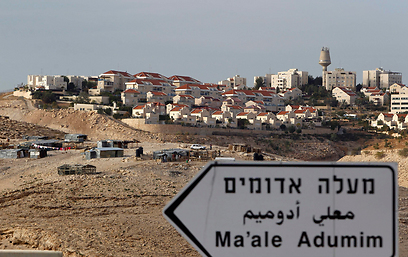
The development, in an open, mostly empty area known as E1, would connect the large settlement town of Maale Adumim to Jerusalem. Israeli officials also authorized the construction of 3,000 new housing units in parts of East Jerusalem and the West Bank.

The timing of the twin actions seemed aimed at punishing the Palestinians for their United Nations bid, and appeared to show that hard-liners in the government had prevailed after days of debate over how to respond. That represented a surprising turnaround, after a growing sense that Israeli leaders had acceded to pressure from Washington not to react quickly or harshly.

The Obama administration swiftly condemned the move as unhelpful. Senior officials expressed frustration that it came after Israeli officials had played down the importance of the Palestinian bid and suggested that they would only employ harsh retaliatory measures if the Palestinians used their new status to go after Israel in the International Criminal Court.

“We reiterate our longstanding opposition to settlements and East Jerusalem construction and announcements,” a spokesman for the National Security Council, Tommy Vietor, said. “We believe these actions are counterproductive and make it harder to resume direct negotiations or achieve a two-state solution.”

Secretary of State Hillary Rodham Clinton, in a speech on Friday night in Washington, criticized Israel’s decision to proceed with plans for construction without referring to any settlements directly by name. “These activities set back the cause of a negotiated peace,” she said at the Saban Forum at the Brookings Institution.

Israel gave the United States only a few hours’ notice of the plan, a senior official said. President Obama did not call Prime Minister Benjamin Netanyahu, the official said.

For Mr. Obama, whose most bitter clashes with Mr. Netanyahu have come over settlements, the Israeli move could undermine a series of developments in recent weeks — from the violence in Gaza to the Palestinian vote — in which the two leaders appeared to draw closer together.

For years, American and European officials have told the Israelis that E1 is a red line. The leaked, somewhat vague, announcement of plans to proceed with building is the diplomatic equivalent of what the Israeli military did last month when it massed tens of thousands of ground troops at the Gaza border. It is a potent threat that may well, in the end, not be carried out because the Israeli government worries about its consequences.

The Palestinian Authority described the plan as “a new act of defiance from the Israeli government.” Saeb Erekat, the chief negotiator, said in a statement, “At a moment where the Palestinian leadership is doing every single effort to save the two-state solution, the Israeli government does everything possible to destroy it.”

Mr. Netanyahu’s office declined to comment on the zoning and construction decisions, which were made Thursday night around the time of the General Assembly vote.

But Israel has long maintained its right to develop neighborhoods throughout East Jerusalem and the West Bank — more than 500,000 Jews already live there — and Mr. Netanyahu, responding to the United Nations speech by President Mahmoud Abbas of the Palestinian Authority, said, “Someone who wants peace does not talk in such a manner.”

While Israel has frequently announced settlement expansions at delicate political moments, often to its detriment, the E1 move came as a shock to many after a week in which both Israelis and Palestinians toned down their talk about day-after responses to the United Nations bid.

Avigdor Lieberman, the ultranationalist foreign minister who for months denounced the Palestinian initiative as “diplomatic terrorism” and said Israel should consider severe sanctions against the Palestinian Authority, had told reporters in recent days that there would be “no automatic response.”

Mr. Lieberman, who spoke before Mrs. Clinton at the Saban Forum, castigated Mr. Abbas as a failed politician who had sought to upgrade the Palestinians’ status to divert attention from an ailing economy at home.

Mr. Erekat’s spokesman declined to discuss whether the Palestinians would use their upgraded status, as a nonmember observer state with access to United Nations institutions, to pursue a case in the International Criminal Court, regarding E1 or the other settlement expansion.

Less contentious moves were already in progress: the Palestinian Authority has begun changing its name to “Palestine” on official documents, contracts and Web sites, and several nations are considering raising the level of diplomatic relations, giving Palestinian envoys the title of ambassador.

All but one European country, the Czech Republic, voted with the Palestinians or abstained in Thursday’s United Nations vote, many of them citing concerns about settlements in West Bank and East Jerusalem territories that Israel captured in the 1967 war. The settlement of E1, a 4.6-square-mile expanse of hilly parkland where some Bedouins have camps and a police station was opened in 2008, could further increase Israel’s international isolation.

“This is not just another few houses in Jerusalem or another hilltop in the West Bank,” said Daniel C. Kurtzer, a former American ambassador to Israel and Egypt. “This is one of the most sensitive areas of territory, and I would hope the United States will lay down the law.”

After a day in which Israeli government officials insisted that the United Nations vote was a purely symbolic one that had not changed anything on the ground, the revelation of the development moves late Friday stunned and outraged even some of Mr. Netanyahu’s supporters.

“A number of important countries are telling us that they think it’s wrong to do settlements, and these are our best friends,” noted one senior Israeli government official, speaking on the condition of anonymity for fear of being fired. “After they say this directly or indirectly, the immediate response is to build more settlements, even in one of the most controversial areas, E1? How does that make sense? What is the message the government is sending its best friends?”

Dani Dayan, the leader of Israel’s settler movement, said the development of E1 was an “important Israeli strategic interest,” but he, too, was somewhat dismayed by the timing. “We don’t like the idea of developing our communities as a sort of retaliatory or punitive step,” he said.

Shelly Yacimovich, head of the left-wing Labor Party, also questioned the strategy. “Construction in the Jewish neighborhoods of Jerusalem is not controversial,” she said Friday night in a television interview. “But to do this now? That’s sticking a finger in the eye.”

It is hardly the first time Israel has been criticized for bad timing on settlement expansion. In August 2011, a month before a previous bid by Mr. Abbas for upgraded status at the United Nations Security Council, Israel’s Interior Ministry gave final approval for the construction of a 1,600-unit apartment complex in the East Jerusalem neighborhood of Ramat Shlomo.

On the eve of an April 2011 meeting between Mr. Obama and Israel’s president, Shimon Peres, a Jerusalem planning committee gave its go-ahead for 1,000 units. And in 2010, Mr. Netanyahu was embarrassed by an early approval of the Ramat Shlomo development hours after a Jerusalem visit by Vice President Joseph R. Biden Jr.

But E1 — where a plan approved years ago calls for 3,910 housing units, 2,192 hotel rooms and an industrial park, in addition to the police station — is more contentious than all those projects combined. Presidents Obama, George W. Bush and Bill Clinton have all strenuously objected to any settlement there.

Dani Seidemann, a Jerusalem lawyer and peace activist, described E1 as “the fatal heart attack of the two-state solution” and said Mr. Netanyahu was wielding “the doomsday weapon.”

Still, he and others noted that the approval was only for zoning and planning, early steps in a long development process before bulldozers begin work, and could be just what he called “the dramatic flourish.”

That may be why the announcement is so vague. Turning the plans into reality is likely to take years. On the other hand, just asserting that such steps are being considered is a way of signaling Israel’s readiness, after having lost a key battle at the United Nations, to engage fully in the diplomatic war over the future of the West Bank and East Jerusalem.

Jodi Rudoren reported from Jerusalem, and Mark Landler from Washington. Michael R. Gordon
contributed reporting from Washington, Peter Baker from Hatfield, Pa., and Ethan Bronner from New York.

This article has been revised to reflect the following correction:

Correction: November 30, 2012


An earlier version of this article misspelled the given name and surname of the leader
of the Israeli Labor Party. She is Shelly Yacimovich, not Shelley Yachnimovich.

http://www.nytimes.com/2012/12/01/world/middleeast/israel-moves-to-expand-settlements-in-east-jerusalem.html?pagewanted=all
icon url

StephanieVanbryce

12/01/12 1:48 PM

#194470 RE: StephanieVanbryce #194423

Clinton and Hague attack Israel decision to build new settlements

US and UK react to Benjamin Netanyahu's approval of plans
for 3,000 new homes on occupied territory in the West Bank

Paul Harris in New York
Saturday 1 December 2012 13.28 EST


Hillary Clinton said Israeli plans to build new settlements on occupied territory would 'set
back the cause of a negotiated peace'. Photograph: Saul Loeb/AFP/Getty Images


The US secretary of state, Hillary Clinton, and British foreign secretary, William Hague, have launched attacks on an Israeli decision to build fresh settlements on occupied territory in the West Bank.

The Israeli prime minister Benjamin Netanyahu's decision to approve the construction of 3,000 new homes is widely seen as a response to the United Nations vote earlier this week that recognised a Palestinian bid to be a "non-member observer state".

The US, with Israel, strongly opposed that move, while Britain abstained in the vote. But now both countries have criticised the Israeli settlement decision, saying it hurts the chances of a two-state solution and the search for peace in the troubled region.

"Let me reiterate that this administration, like previous administrations, has been very clear with Israel that these activities set back the cause of a negotiated peace," Clinton said, in remarks delivered at the Saban Center think tank in Washington on Friday.

Hague said he was "extremely concerned" at the plans, which have been reported in the Israeli press as including a four-square-mile area just east of Jerusalem that is seen as vital to keeping open a viable land corridor between the city and any future Palestinian state.

Hague asked Israel to reverse the decision and said the prospect of a successful two solution was receding. "Israeli settlements are illegal under international law and undermine trust between the parties," he said in comments Saturday. "If implemented, these plans would alter the situation on the ground on a scale that makes the two-state solution, with Jerusalem as a shared capital, increasingly difficult to achieve."

Hague added: "They would undermine Israel's international reputation and create doubts about its stated commitment to achieving peace with the Palestinians."

Israel had strongly opposed the Palestinian bid for improved recognition at the UN, saying that the tactic was a blow for peace negotiations. It had secured strong and vocal support from the US, its traditional ally, and a handful of other nations, but was unable to derail the move which was celebrated wildly on the streets of the West Bank.

Palestinian politicians reacted to the new settlement decision with dismay. "This would be the last nail in the coffin of the peace process," the Palestinian prime minister, Salam Fayyad, told Sky News.

The firm US and British line on the Israeli decision is unlikely to mark any real shift in allegiances or policy. Clinton backed up her criticism of Israel with another strong admonition of the Palestinians and said that they had acted wrongly and unilaterally in gaining improved recognition at the UN.

"Palestinian leaders need to ask themselves what unilateral action can really accomplish for their people. President [Mahmoud] Abbas took a step in the wrong direction this week, to say the least. We opposed his resolution," Clinton said.

The fresh spat over settlements comes at a time when all sides appear to regard the prospect of a peace settlement in the region as a distant dream. Any future Palestinian state remains deeply divided between the more moderate and secular rule of Abbas in the West Bank and the militant Islamic group Hamas, which governs in the tiny and isolated Gaza Strip.

In Friday's address, the US secretary of state said Hamas had "condemned those it rules to violence and misery" and now faced a choice.

"Hamas knows what it needs to do. If it wishes to reunite the Palestinians and join the international community it must reject violence, honor past agreements with Israel and recognize Israel's right to exist," Clinton said, adding: "America has showed that it is willing to work with Islamists who reject violence and work towards real democracy, but we will never work with terrorists."

Despite the criticism over settlement building, Clinton reiterated American support for its traditional Middle East ally.

"Americans honor Israel as a homeland dreamed of for generations and finally achieved by pioneering men and women in my lifetime," she said. "What threatens Israel threatens America. What strengthens Israel strengthens us."

Israel agreed to freeze settlement construction under the Roadmap For Peace plan in 2002. But it has failed to comply with that commitment despite repeated and widespread international condemnation.

Fresh trouble continues to break out in Gaza, after Hamas and Israel spent eight days trading rocket and missile fire earlier this month.

That conflict ended with an Egyptian-brokered truce but there have been repeated flare-ups since. On Saturday a Palestinian who was shot and wounded by Israeli troops on Friday, while protesting at the Gaza Strip boundary fence, died in hospital. Five others were also wounded in the incident.


http://www.guardian.co.uk/world/2012/dec/01/hillary-clinton-william-hague-israel-settlements

there's nothing to say - This is US. The people in the US mostly agree with these pronouncements..
icon url

fuagf

12/21/12 1:36 AM

#195705 RE: StephanieVanbryce #194423

Palestinians aim to isolate Israel with new steps

Emboldened by newly upgraded UN status, Palestinian officials plan tough steps against Israel if PM Netanyahu is re-elected including ending security cooperation

Associated Press - Published: 12.20.12, 20:22 / Israel News

Weeks ahead of Israeli elections .. http://www.ynetnews.com/home/0,7340,L-10499,00.html , Palestinian officials are already plotting a series of tough steps against Israel .. http://www.ynetnews.com/articles/0,7340,L-3284752,00.html .. to be taken if, as polls predict, Prime Minister Benjamin Netanyahu .. http://www.ynetnews.com/articles/0,7340,L-4187902,00.html .. is re-elected and peace efforts remain stalled.

Emboldened by their newly upgraded status .. http://www.ynetnews.com/articles/0,7340,L-4313633,00.html .. at the United Nations, the Palestinians are talking of filing war crimes .. http://www.ynetnews.com/articles/0,7340,L-4315675,00.html .. charges against Israel, staging mass demonstrations in the West Bank, encouraging the international community to impose sanctions, and ending the security cooperation that has helped preserve quiet in recent years.

Related stories:

* Ashton condemns Jerusalem construction plans - http://www.ynetnews.com/articles/0,7340,L-4322510,00.html
* Israel pushes on with disputed J'lem building plan - http://www.ynetnews.com/articles/0,7340,L-4321190,00.html
* Abbas: We'll wave Palestinian flag in east Jerusalem - http://www.ynetnews.com/articles/0,7340,L-4313869,00.html

These plans, combined with growing international impatience with Israeli settlement construction .. http://www.ynetnews.com/articles/0,7340,L-4321190,00.html , could spell trouble and international isolation for the Israeli leader.

In a series of interviews with The Associated Press, a number of Palestinian officials all voiced a similar theme: Following the UN General Assembly's recognition of "Palestine" as a nonmember observer state in November, the status quo cannot continue.


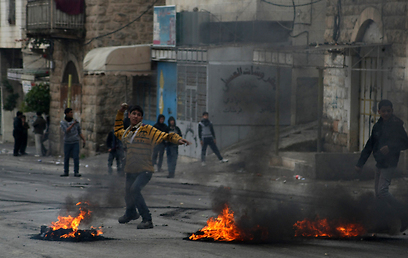
Riots in Hebron (Photo: AFP)

"2013 will see a new Palestinian political track. There will be new rules in our relationship with Israel and the world," said Hussam Zumlot, an aide to President Mahmoud Abbas.

Although the UN vote did not change the situation on the ground, it had deep implications. Opposed by just nine countries, it amounted to a strong international endorsement of the Palestinian position on future borders. It also cleared the way for them to join international agencies to press their grievances against Israel.

Netanyahu has accused the Palestinians of bypassing direct negotiations.

"One would hope we will in fact see in 2013 the re-emergence of the Israeli-Palestinian negotiating process," said Netanyahu's spokesman, Mark Regev. "There is no substitute for direct talks. You're not going to make peace in resolutions at the United Nations or other international forums."

Palestinian officials say they are hopeful that a formula for restarting peace talks can be found after Israel's election on Jan. 22, perhaps through a new initiative from President Barack Obama.

The Palestinians have begun to speak of a trial, six-month negotiating period. Azzam al-Ahmed, a top aide to Abbas, said Arab diplomats will present the plan in Western capitals, Russia and China next month. But with the Palestinians insistent on a settlement freeze, and opinion polls forecasting a new hardline Israeli coalition headed by Netanyahu, expectations are low.

Long, tough battle

The Palestinian officials said they will not rush toward any punitive measure, but they are determined not to stand pat.

"We have to prepare ourselves for a long and tough battle," added Yasser Abed Rabbo, secretary-general of the Palestine Liberation Organization, the Palestinians' top decision making body. "We will use all the political tools available."

Among the options being considered is halting cooperation between Israeli and Palestinian security forces in the West Bank. The cooperation is widely seen as a key element in preserving the calm in the West Bank in recent years, in sharp contrast to the heavy fighting a decade ago.

"There will be no security cooperation as long as there is no political horizon," said Mohammed Ishtayeh, a Palestinian Cabinet minister.

The Palestinians also talk of increasing "popular struggle," the term they use for demonstrations against Israeli soldiers. Such face-to-face confrontations frequently turn tense, with protesters throwing stones and troops firing tear gas and water cannons, and run the risk of growing more violent.

Perhaps most troubling to Israel, the Palestinians also want to use their upgraded status on the world stage to push for international action against Israel.

Officials say they will move to join the International Criminal Court, where they hope to pursue war crimes charges against Israel for its settlement activities. Although the road to taking legal action in the ICC appears to be long and complicated, it nonetheless has made Israeli officials jittery.


More construction in Ma'ale Adumin? (Photo: Reuters)

"We are going to pursue this policy to reach a point of having the international community impose sanctions on Israel," said Qais Abdelkareem, another PLO official.

This Palestinian agenda, while ambitious, is likely to encounter stiff resistance from both Israel and its international allies. Israel has a number of tools at its disposal, including possible military or economic pressure on the Palestinians. Israel's allies in the West, particularly the US, will also likely shield it from any attempt to impose broad international sanctions, at least in the near term.

Uproar caught Israel off guard

But there are signs that international patience with Israel is wearing thin.

An Israeli official said the extent of the international uproar over its recent settlement construction plans had caught officials off guard. "Something has changed," he said. "Clearly a line has been crossed." He spoke on condition of anonymity because he was discussing closed diplomatic meetings.

Yossi Beilin, a former deputy foreign minister and peace negotiator, said there is "no way" the status quo can continue and that Netanyahu "understands that this situation where the US is the only one to support Israel cannot go on forever." He said Netanyahu, after pandering to hard-liners during the election campaign, will likely try to bring in a centrist party into his coalition after the vote to give the government an image of moderation.

"Reality might impose itself in such a way that we will find him doing things, like maybe an interim agreement with the Palestinians or something that seems now unexpected," Beilin said. "He will make small steps to appease adversaries. And to Netanyahu, the whole world is an adversary."

* Follow Ynetnews on Facebook and Twitter
* Receive Ynetnews updates directly to your desktop

[links for those inside]

http://www.ynetnews.com/articles/0,7340,L-4322725,00.html