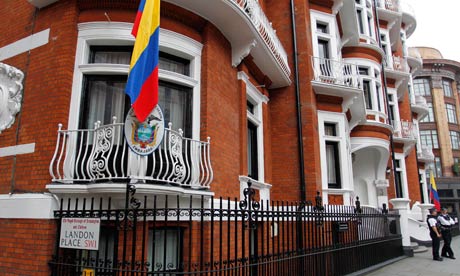
The development came two months after Assange walked into the embassy in a bid to avoid being extradited to Sweden where he faces allegations of sexual assault.
At a news conference on Wednesday, Patino said Ecuador would announce its decision regarding Assange's asylum request at 7am (noon GMT) on Thursday.
Patino also released details of a letter he said was delivered through a British embassy official in Quito, the capital of Ecuador.
The letter said: "You need to be aware that there is a legal base in the UK, the Diplomatic and Consular Premises Act 1987, that would allow us to take actions in order to arrest Mr Assange in the current premises of the Embassy."
The letter added: "We need to reiterate that we consider the continued use of the diplomatic premises in this way incompatible with the Vienna Convention and unsustainable and we have made clear the serious implications that this has for our diplomatic relations."
An Ecuadorean government spokesman said: "We are deeply shocked by the British government's threats against the sovereignty of the Ecuadorean embassy and their suggestion that they may forcibly enter the embassy.
"This a clear breach of international law and the protocols set out in the Vienna Convention.
"Throughout out the last 56 days Mr Julian Assange has been in the Embassy, the Ecuadorean government has acted honourably in all our attempts to seek a resolution to the situation.
"This stands in stark contrast to the escalation of the British government today with their threats to break down the door of the Ecuadorean embassy.
"Instead of threatening violence against the Ecuadorean embassy, the British government should use its energy to find a peaceful resolution to this situation which we are aiming to achieve."
A Foreign Office spokeswoman said: "We have consistently made our position clear in our discussions with the government of Ecuador.
"The UK has a legal obligation to extradite Mr Assange to Sweden to face questioning over allegations of sexual offences and we remain determined to fulfil this obligation.
"We have an obligation to extradite Mr Assange and it is only right that we give Ecuador the full picture.
"Throughout this process we have drawn the Ecuadoreans' attention to relevant provisions of our law, whether, for example, the extensive human rights safeguards in our extradition .. http://www.guardian.co.uk/law/extradition .. procedures, or the legal status of diplomatic premises in the UK.
"We are still committed to reaching a mutually acceptable solution."
Assange denies the allegations against him, but fears he will be sent to the United States if he goes to Sweden.
An offer to the Swedish authorities by Ecuador for investigators to interview Assange inside the London embassy was rejected.
Ecuadoreans back Rafael Correa's decision to offer Julian Assange asylum
Majority back controversial move, but some are concerned over the ramifications for trade deals with the EU and US
Irene Caselli guardian.co.uk, Thursday 16 August 2012 22.18 BST
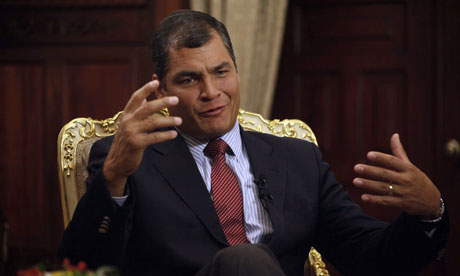
Rafael Correa, Ecuador's president, is likely to gain politically from his decision to offer asylum to WikiLeaks founder Julian Assange. Photograph: Ho/AFP/Getty
Earlier this year, Correa boycotted the Summit of the Americas .. http://www.guardian.co.uk/world/americas .., a meeting of heads of state from across the Americas, because of the refusal by the United States and Canada to allow a declaration of support for Argentina's claim to the Falkland Islands. He called the United Kingdom a colonial power and also suggested imposing sanctions against the country for not wanting to negotiate with Argentina over the islands.
On Thursday, foreign affairs minister Ricardo Patiño said the UK's reaction amounted to a strong threat: "It is basically saying, 'We are going to beat you savagely if you don't behave … but if you behave, we may not beat you savagely," he said.
Patiño has been foreign affairs minister since 2010. He represents one of the hardliners within Correa's government, who is pushing for a Venezuela-like line. Patiño was involved in a scandal at the beginning of Correa's administration in 2007, and had to resign from his post as finance and economy minister at the time. Some videos showed him meeting investment bankers discussing how the bankers and Ecuador could profit from threatening to default on debt – a decision that Ecuador took in 2008.
Since Correa came to power, Ecuador has become an increasingly polarised country and this is reflected in the reaction to the decision.
For many supporters of Correa, granting Assange asylum was positive and gave the government strength vis-a-vis foreign governments.
"This is the decision of a country that does not ask for permission to the Brits to react, of a country that does not care about fear or intimidation that the foreigners are trying to impose on us about this decision," Rosanna Alvarado, a congresswoman from Correa's party, told state-run paper El Ciudadano.
Some hardliners protested outside the UK embassy in Quito on Wednesday night and many cheered outside the foreign affairs ministry when Patiño made the announcement.
Even people that are somewhat critical of Correa were in favour of Ecuador's position.
"The United Kingdom and other developed countries don't usually allow small countries like Ecuador to challenge their decisions," said Marcelo Román from his home in northern Quito.
"Ecuador's decision is a sovereign decision and foreign governments have to respect it."
Román said that even if Correa uses the situation to garner more political support at home, it is important for Ecuador to assert itself internationally.
But others in the country are worried.
Business people are worried about the possible reaction that could come from the United States in light of a trade agreement that is up for renewal between the two countries.
Bernardo Acosta, professor of economics at Quito's San Francisco University and former vice-president of the Ecuadorean Chamber of Industries, said this decision might affect Ecuador's trade relations with both the European Union and the United States. Ecuador is currently negotiating a new agreement with the EU and a trade pact with the US is also up for review.
Ecuador's main exports are oil, shrimp and bananas and the US and the EU are Ecuador's main trade partners.
"This might be the last straw," said Acosta.
"Ecuador is a small country with a small internal market and it needs a strong export policy. But such decisions can lead to more isolation and close off more markets," he told the Guardian.
There are also worries within diplomatic corps. There has been a spat between Correa's political appointees and career diplomats within the foreign affairs ministry. The latter feel that Patiño is pushing a political line without taking into account the rules of diplomacy.
In an editorial for El Comercio newspaper .. http://elcomercio.com/jose_ayala_lasso/caso-Assange_0_740326145.html .., former foreign affairs minister and former head of the UN High Commission for Human Rights, José Ayala Lasso, said there would be "political effects" if Ecuador were to grant Assange asylum.


 Market Data
  Markets


 AI
AI