# 1. The Witwatersrand Basin is the richest gold field the world has ever known, yielding over 1.5 billion gold ounces since mining began in the late 19th century which amounts to third \of all the gold that has ever been produced - were CALVF hold the old - Eersteling Gold mines goldfield is located + platinum etc.
* The Rooipoort PGE/Au/Ni/Cu Prospect was aquired by Eersteling Gold Mines from Rustenburg Platinum, owned by Anglo Platinum Limited.
The property is located approximately 30 km southwest of the Eersteling Gold Mine property and is located in an area that saw a surge in platinum group metal exploration along the "Platreef".
In 2004, Caledonia purchased and acquired prospecting rights over an additional 342 hectares on the farm Grasvally, immediately adjacent to and south of the Rooipoort property. To date Caledonia has drilled a total of 18,450 meters in 54 holes on the Rooipoort PGE/Au/Ni/Cu Exploration Project. This drilling covers the full 6 km strike length that makes up the project area. Estimated inferred resource is 18,128 million tonnes at a grade of 1,1-1,34 2PGE+Au.
Address: 18km from Polokwane on the N1 to Makopane
The site of the country's first gold crushing site and its first gold power plant are marked by monuments.
Eersteling also played a significant part in history, at the siege of Marabastad on 17 March 1881. The Boers brought in two old boats, with obsolete guns, and used handmade ammunition.
# 2. the old Rhodesia - the current Zimbabwe - were the gold mining been going on since before Queen Sheba and King Solomon time -
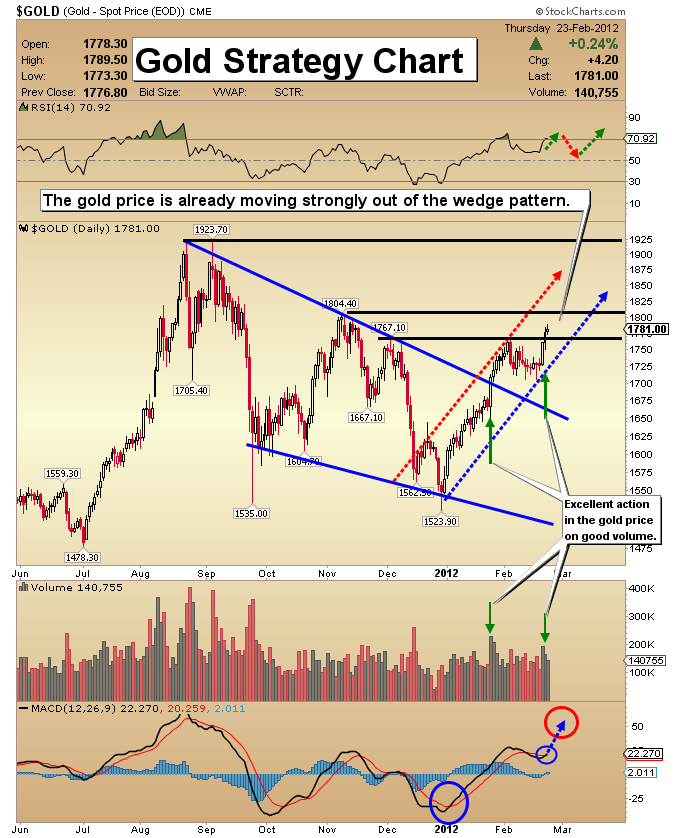
CALVF Gold Strategy Chart -
Gold - is now making a solid move to the upside, following breakout - - target zone is $1804 to $1820 - Volume analysis is pointing to even higher prices - Once $1804 has been acquired - Gold could move surprisingly quickly to $1900-$1920 -
GDX Transformation Chart -
BLANKET GOLD MINES -
CALVF's Blanket's Gold Mines - unaudited revenues and profit after tax for the year to December 31, 2011 were US$56.6 million and US$19.2 million respectively.
Mr Stefan Hayden, Caledonia's President and Chief Executive officer said: "I am pleased we have signed a MoU which, when fully implemented, will represent the conclusion of the indigenisation requirements for Blanket.
The transaction will be concluded for a value which is close to Caledonia's current market capitalisation.
( Note CALVF Total Current Market Cap: $55,060,421.--
This is a significant achievement in the current environment and the transaction is neither an expropriation nor a partial nationalisation.
Excellent progress has been made at Blanket in recent years: gold production has increased by over 300% from 3,148oz in the first quarter of 2010 to 10,533oz in the fourth quarter of 2011 and cash operating costs fell by 27% from $804/oz in the first quarter of 2010 to $583/oz in the third quarter of 2011.
I hope that Blanket and Caledonia can now build on this track record of success. The indigenisation agreement, when fully implemented, will introduce new shareholders to Blanket and I am confident that their participation will enhance Blanket's further growth and development.
We look forward to working with our new shareholders in further progressing operations at Blanket for the benefit of all stakeholders."
Renmark Financial Communications Inc. John Boidman: jboidman@renmarkfinancial.com Nadia Marks: nmarks@renmarkfinancial.com Tel.: (514) 939-3989 or (416) 644-2020 www.renmarkfinancial.com
Newgate Threadneedle Communications Laurence Read, tel +44 207 653 9855 Beth Harris, tel +44 207 653 9853 Terry Garrett, tel +44 207 653 9845
Collins Stewart Europe Limited John Prior / Sebastian Jones Tel: + 44 20 7523 8350
Collins Stewart LLC Dan Mintz Tel: +1 212 389 8022 DMintz@collinsstewartllc.com
Further information regarding Caledonia's exploration activities and operations along with its latest financials and Management Discussion and Analysis may be found at
Latest 10 SEDI filings (by transaction date) for CAL within the last 6 months [?] Amended Filing As of 11:59pm ET February 21st, 2012 Filing Date Transaction Date Insider Name Ownership Type Securities Nature of transaction # or value acquired or disposed of Unit Price Jan 20/12 Jan 17/12 Inwentash, Sheldon Control or Direction Common Shares 10 - Acquisition in the public market 242,000 $0.120
Jan 20/12 Jan 16/12 Inwentash, Sheldon Control or Direction Common Shares 10 - Acquisition in the public market 252,000 $0.120
Jan 16/12 Jan 13/12 Inwentash, Sheldon Control or Direction Common Shares 10 - Acquisition in the public market 107,500 $0.110
Jan 13/12 Jan 12/12 Inwentash, Sheldon Control or Direction Common Shares 10 - Acquisition in the public market 148,500 $0.110
Jan 11/12 Jan 9/12 Inwentash, Sheldon Control or Direction Common Shares 10 - Acquisition in the public market 150,000 $0.100
Jan 10/12 Jan 6/12 Inwentash, Sheldon Control or Direction Common Shares 10 - Acquisition in the public market 600,000 $0.934
Dec 8/11 Dec 6/11 Inwentash, Sheldon Control or Direction Common Shares 10 - Acquisition in the public market 12,500 $0.110
Dec 7/11 Dec 5/11 Inwentash, Sheldon Control or Direction Common Shares 10 - Acquisition in the public market 35,000 $0.110
Dec 6/11 Dec 2/11 Inwentash, Sheldon Control or Direction Common Shares 10 - Acquisition in the public market 148,500 $0.110
Dec 5/11 Dec 1/11 Inwentash, Sheldon Control or Direction Common Shares 10 - Acquisition in the public market 33,000 $0.110
Sign up for an account or login above to see all SEDI filings within the past 6 months.
Caledonia Mining Corp. should start a buy back their own shares program -
CALVF Long TEAM should e-mail to tell them BUY BACK CALVF biggest global Gold producing strategic Au bargain - to make it great for all LONG TEAM SHAREOLDERS!
Caledonia Mining Corporation -
E.g.,
Caledonia Has Striked A Compromise With Zimbabwe For Indigenisation? - CALVF Long Term GOLD MINES Developments and GOLD Production Is Safety Assured -
Blanket Gold Mines Located In Many Green Gold Belts Massive Large Goldfields across Zimbabwe to assured CALVF GOLD Production and will provide plenty of GOLD for the PEOPLE involved in CALVF Blanket Gold Mines :-) - long after mugabe is gone -
Europeans credited the ancient city to everyone from wandering Phoenicians to the biblical Queen of Sheba. In so doing, they began a long insidious European tradition of willful misinterpretation of Africa's past, until, in the ultimate irony, the place where human history began would become a place with no history of its own.
"Cloaked in darkness since medieval times, the spectacular ruins of the once dazzling, southern African kingdom of Great Zimbabwe posed a thorny dilemma for white settlers who claimed to have 'discovered' the region a mere hundred years before. Refusing to believe the massive, finely hewn walls could be the product of native culture, white "experts" eager to claim the land for Europeans credited the ancient city to everyone from wandering Phoenicians to the biblical Queen of Sheba.
In so doing, they began a long insidious European tradition of willful misinterpretation of Africa's past, until, in the ultimate irony, the place where human history began would become a place with no history of its own.
Now, trek inland to the remote site of Great Zimbabwe, a fabulous "lost city," which reached its glory in the 14th century. Then, sift the sands of time to uncover the equally splendid culture of Africa's Swahili Coast. The fabulously wealthy center of the thriving gold and ivory trades until the 16th century, its cities now lie all but forgotten, buried under centuries of indifference. Reclaiming their past from a long tradition of racial prejudice and neglect, the descendants of these lost cultures are only now discovering the extraordinary achievements of Africa's indigenous civilizations.
The Konkola Copper Mine in Zambia, which produces more than 200 000 tons of copper a year. File photo South Africa's Standard Bank said it has provided a $500 million loan facility to Zambia's largest mining company, Konkola Copper Mines, a unit of London-listed Vedanta Resources.
4 Shaft project which is part of Vedanta's Konkola Copper Mine's (KCM) deep ...basilread.com
Konkola Copper Mine (KCM) The No. 4 Shaft project which is part of Vedanta’s Konkola Copper Mine’s (KCM) deep mining project (KDMP). In June 2006, TWP was awarded the design of the headgear, shaft steelwork and underground and shaft rock handling systems for the new 1, 5 km deep No. 4 Shaft. The new shaft is being sunk by the main contractor, Grinaker- LTA, which is also deepening the existing No. 1 Shaft from 1 km to 1, 5 km. In addition to the shaft design, TWP is involved in designing the underground pumping and settling system, general electrical reticulation and control as well as instrumentation associated with the project.
The sinking portion of the permanent steel headgear was designed to South African standards and the contract for manufacture was awarded to DSE Structural Engineers and Contractors in December 2006. Delivery of the sinking portion of the headgear began in March 2007. At the request of the client, TWP designed the permanent portion of the steel headgear to Chinese “GB” standards utilising Chinese grade steel. The design of the permanent headgear was completed in March 2007 and the contract for the manufacture of this portion of the headgear was awarded to a Chinese supplier, Shanghai Matsuo Steel Structure Co. Ltd.
China Non-Ferrous Metal Company’s Luanshya Copper Mines (CLM) is set to recruit 1,000 employees in readiness for the beginning of production at the Muliashi open pit mine, taking the total number of workers to more than 3,000. CLM also plans to make an additional investment of more than US$150 million to rehabilitate infrastructure at Luanshya Copper Mine in 2010.
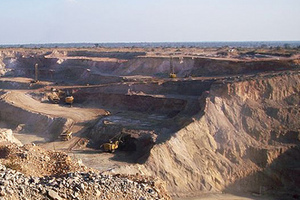
As of 2009, Chinese mining companies had invested $768 million in Zambia, such as this copper mine.
Smelting Works of a Copper Mines, Zambia -
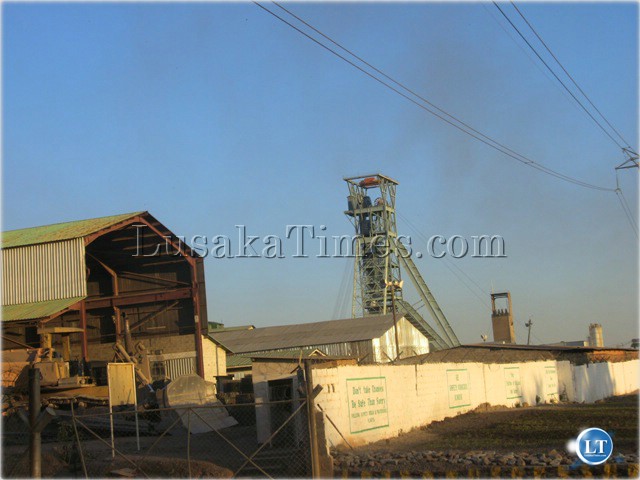
Above-Ground Buildings of an Underground Copper Mine Zambia
Train Carrying Copper Ore from Mindolo copper mine -
Harvesting potential in Zambian copper -
Bright future in growing industry - Zambia is currently ranked as the world’s seventh largest copper producer – generating 3.3 percent of the western world’s production – and Bloomberg’s recent note on the future of mining stated that the country could become the world’s fifth largest copper producer by 2013.
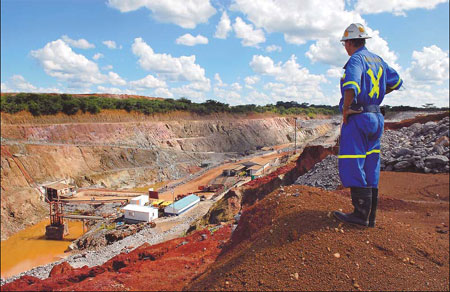
A mine supervisor overlooks Metorox's Chibuluma copper mine, near Kitwe, Zambia. [Photo/ Agencies]
Copper mine Zambia
Vedanta leads the race for Zambian copper mine
Vedanta, which owns Zambia's largest copper producer Konkola Copper Mines (KCM), is pitted against China's Non-Ferrous Copper Mine (NFC). The other contenders include UK's Lion Finance and South Africa's Shanduka Group, said the same person. However, a Vedanta Resources spokesperson declined to comment.
An investment banker said the proposed acquisition of LCM fits into Vedanta's plan to expand its copper business in Zambia. Vedanta runs its Zambian copper operations through KCM, in which it holds an 80% equity. Vedanta has four mines, one each in Konkola and Nampundwe and two in Nchanga, Zambia.
Nama Copper/Cobalt Exploration Project, Zambia: Summary of Results of the 2011 Exploration Programme and Outline of the 2012 Exploration Programme
TORONTO, March 12, 2012 /CNW Telbec/ -
Caledonia Mining Corporation (the "Company") (TSX: CAL) (OTCQX: CALVF) (AIM: CMCL) is pleased to announce the results summary of the 2011 exploration programme at its Nama Copper/Cobalt Project in Zambia and outline the exploration programme for 2012.
Highlights
The results from the 2011 drilling programme demonstrate a new and very exciting aspect to the Nama Copper/Cobalt Project
A new mineralised copper zone has been identified Estimated weighted average copper grade - 0.47%
Estimated weighted average thickness - 41 metres
Intersected depths of between 280 and 450 metres
A sufficiently large, near-surface resource up-dip from the existing drill holes may provide the basis for a future open- pit mining operation
The 2012 exploration programme will now commence as soon as possible and will include the following three phases of drilling:
Phase 1: 2,400 metre drill programme to explore for potential shallower up-dip continuation of the new mineralised zone to surface
Phase 2: 6,000 metre drill programme to explore for potential deeper down-dip continuation of the new mineralised zone
Phase 3: A possible resource drilling programme to quantify the shallower up-dip resources.
This phase cannot be finalised at this stage as the scope of this programme is entirely dependent on the evaluation of the
Phase 1 programme results. The costs of these drilling programmes will be fully funded from current cash resources.
Commenting on these exploration results, Stefan Hayden, Caledonia's Chief Executive Officer and President said: "The 2011 drilling programme at Nama identified a new and very exciting aspect to Nama.
What we have found differs markedly in mineralisation style to other properties in the region in that the zone we have identified occurs in an atypical Copperbelt setting and occurs in rocks overlying the Ore Shale.
This zone of mineralisation occurs at relatively shallow depth relative to the depth of the Ore Shale in the area and possibly extends to surface.
A sufficiently large, near-surface resource depth may therefore provide the basis for a future open-pit mining operation.
"The 2012 exploration programme will commence as soon as the rains and ground condition allow during the second quarter. The results should allow us to confirm and further refine our model of Nama's geology and copper resources potential. Caledonia has sufficient cash to complete the 2012 exploration programme and intends to manage its cash resources so that it can undertake further work at Nama without raising new equity."
Background to the Nama Project
Caledonia holds four, contiguous large scale mining licences covering approximately 800 square kilometres on the Zambian Copperbelt. The northern boundary of Caledonia's licenced area is the DRC border and the eastern boundary abuts the licence area that is held by a joint venture between Vale and African Rainbow Minerals where a new copper mine is currently under construction.
Prior to the 2011 programme, exploration activities had defined three main styles of mineralization in the Nama Licence area:
a) "A-type" cobalt oxide mineralisation; b) "D-type' iron oxide bodies which are mostly enriched in Cobalt; and c) Copper dominated ore shale hosted copper-cobalt mineralisation, commonly observed elsewhere in the Copperbelt and which is being exploited by neighbouring mines to the east and south of the Nama Licence Areas.
2011 Exploration Programme
The 2010 exploration programme identified two resource targets at Nama (being "Konkola East" and "Kafwira") which were characterised as belonging to the ore shale-hosted copper-cobalt style of mineralisation. The 2011 programme was focussed on Konkola East where a four-hole diamond drilling programme was carried out with the primary objective of confirming the existence of Ore Shale member of the Copperbelt stratigraphy. The results of this programme confirmed the existence of Ore Shale in all holes. The Ore Shale intersection in holes 1 & 2 was at depths and copper grades that do not merit further exploration at this stage. Evaluation of the drill core extracted from holes 3 and 4 identified a zone of mineralisation which occurs at considerably shallower depths than the Ore Shale and does not occupy a specific stratigraphic layer as would be expected. Assays of the mineralised zones identified in holes 3 and 4 were sufficiently encouraging to warrant a fifth hole being drilled in late 2011 and which also intersected the newly identified mineralised zone.
Preliminary Evaluation of the Results of the 2011 Drilling Programme
The new mineralised zone identified in holes 3, 4 and 5 is considered to be a contiguous zone. The assay results for the three intersections have a weighted average of 0.47% copper over a weighted average width of 41 metres at depths of between 280 and 450 metres. Holes 3 and 4 are approximately 1,650 metres apart representing a minimum strike length of the mineralisation. The interpreted structure of the mineralised zone suggests that the zone may extend to surface within the Nama Licence.
Although the copper grades of the newly identified zone are lower than existing mines in the region, the zone is relatively shallow and the ore mineralogy appears particularly suited to low-cost metallurgical processing.
2012 Exploration Programme
Caledonia's Board has reviewed the results of the 2011 exploration programme and the recommendations of management and has approved an exploration programme for Nama in 2012 which has the following objectives:
Phase 1: drilling of additional holes comprising approximately 2,400 metres with the objective of identifying a continuation of the newly discovered mineralized zone towards surface. This phase of the exploration programme is expected to start as soon as ground/weather conditions permit and results for this work are expected 4 to 5 months thereafter. Phase 2: drilling of additional holes comprising approximately 6,000 metres with the objective of identifying the nature of a deeper continuation of the above mineralised zone. This work will take place after completion of Phase 1 and is expected to take approximately 8 to 10 months. Phase 3: Provided the results of the Phase 1 programme are positive, a drilling programme focussed on delineating and evaluating resources compliant with NI43-101 will be presented to the Caledonia Board for approval prior to possible commencement. This Phase may commence during Phase 2 activities. Substantial additional exploration work may be required in future years to arrive at a NI43-101 compliant resource statement.
Caledonia has sufficient cash resources to cover all of the exploration costs for 2012. Caledonia intends to manage its cash resources so that it retains the financial capacity to progress this project as far as possible without requiring third party involvement or equity funding.
Dr Pearton, BSc Eng. (Mining Geology), PhD (Geology), and Fellow of the Geological Society of South Africa, is Caledonia's VP Exploration and a "Qualified Person" as defined by NI43-101. Dr Pearton consents to the inclusion in the release of the matters based on his information in the form and context in which it appears.
Caution Regarding Forward Looking Statements:
Information included in this release constitutes forward-looking statements. There can be no assurance that future exploration will identify mineralisation that will prove to be economic, that anticipated metallurgical recoveries will be achieved, that future evaluation work will confirm the viability of deposits that may be identified or that required regulatory approvals will be obtained.
Collins Stewart Europe Limited John Prior / Sebastian Jones Tel: + 44 20 7523 8350
Collins Stewart LLC Dan Mintz Tel: +1 212 389 8022 DMintz@collinsstewartllc.com
Further information regarding Caledonia's exploration activities and operations along with its latest financials and Management Discussion and Analysis may be found at
Source: Canada Newswire (March 12, 2012 - 8:32 AM EDT)
Caledonia reveals exciting new aspect at Nama project - 12 March 2012 | 10:00am StockMarketWire.com -
Caledonia Mining has revealed a new and very exciting aspect to the Nama copper/cobalt project in Zambia.
It said the latest drilling results differed markedly in mineralisation style to other properties in the region in that the zone.
It says this zone of mineralisation occurs at relatively shallow depth relative to the depth of the ore shale in the area and possibly extends to surface.
Chief executive and president Stefan Hayden said: "A sufficiently large, near-surface resource depth may therefore provide the basis for a future open-pit mining operation.
"The 2012 exploration programme will commence as soon as the rains and ground condition allow during the second quarter.
"The results should allow us to confirm and further refine our model of Nama's geology and copper resources potential."
Caledonia has sufficient cash to complete the 2012 exploration programme and intends to manage its cash resources so that it can undertake further work at Nama without raising new equity.
At 10:00am: (LON:CMCL) share price was +0.25p at 7.75p
dd..... Caledonia Mining's Blanket Gold Mine producing Gold 40,000oz/year - target Au 100,000 ounces - low production cost Gold @ Au $583/oz - NO DEBT - owns many great old gold mines workings to expand to and re-commission - dd....CALVF Gold Mine producer bargain play - with many massive Gold fields to reactivate -
We Have Entered The Most Favourable Era For Gold Prices In Our Lifetime -
Simon Black Mar. 26, 2012, 11:55 AM
Acclaimed screenwriter William Goldman (The Princess Bride, among many others) famously began his autobiography with three telling words: "Nobody Knows Anything."
The same logic would seem to apply to much conventional reporting of the financial markets. Any investor looking for informed analysis of market developments can therefore save themselves a few minutes every day by choosing not to read any of the 'Companies and Markets' section of the FT, which typically constitutes a fantastic piece of fiction.
(If there is a more thankless task in finance than trying to explain why certain markets did what they did yesterday, we don't know what it is... unless it's working in the PR department at Goldman Sachs.)
But as Soc Gen's Dylan Grice has frequently pointed out, human beings are suckers for stories. We seek meaning from just about everything, and financial markets are no exception. Why else would otherwise rational people shell out ~£2.50 every weekday just to read a selection of vapid and contradictory speculations about recent market price action?
At the risk of going out on a limb, here is our own inherently subjective "take" on the current market environment: Investors seem to believe that the euro zone debt metastasis has gone into remission. There is an uneasy calm to both equity and bond markets -- it feels like the calm before the storm.
Both Goldman and Barclays have issued research notes recommending equities over bonds. It is certainly difficult to get excited about G7 government bond markets except from the perspective of shorting them. As Stratton Street recently observed, there are over $10 trillion in marketable US government securities, yet their average yield amounts to less than 1%.
But it might yet be dangerous to adopt Goldman's binary response which is to advocate blanket support for stocks. This is not a black vs. white issue; just because most government bond markets are uglier than sin does not automatically justify going 'all in' on the stock market, even as deposit rates remain painfully thin.
We nurse an ongoing fear that equity markets are being largely supported by the inflationist antics of central banks. This may have led to many investors becoming addicted to the effects of cheap credit, and they may not like it when cheap credit is ultimately withdrawn.
But whatever is driving equity sentiment, there are undoubtedly pockets of value for those with the stamina and patience to embrace them. In Don Coxe's latest and typically excellent letter, "All Clear?", he highlights the opportunity in precious metals mining companies:
"If there were one over-arching theme at the BMO Global Metals & Mining Conference, it was that the gold miners are upset and even embarrassed that their shares have so dramatically underperformed bullion...
"On the one hand, they were delighted in 2011 when it was reported that since Nixon closed the gold window, a bar of bullion had delivered higher investment returns than the S&P 500 for forty years-- with dividends reinvested. But some gold mining CEOs find it an insult that what they mine is more respected than their companies' shares...
"In our view, we have entered the most favourable era for gold prices in our lifetime, and the share prices of the great mining companies will eventually outperform bullion prices."
Gold remains one of the most widely misunderstood assets in the investible world. Indeed, it may be better to refer to it as a means of saving that does not expose the saver to counterparty or credit risk or to the depredations of the monetary authorities.
As Don Coxe makes clear, governments are running deficits "beyond the forecasts of all but the hardiest goldbugs five years ago; central banks are printing money and creating liquidity beyond the forecasts of all but the most paranoid goldbugs a year ago."
The choice for the saver is essentially binary: hold money in ever-depreciating paper, or in a tangible vehicle that has the potential to rise dramatically as expressed in paper money terms.
Gold prices have now softened, offering investors yet another chance to get back on board what is perhaps the most compelling form of money- and portfolio insurance available.
Why large cap gold miners are being so undervalued by equity investors relative to gold is an open question that takes us back to the realms of stories. That the discount exists is undeniable; all that is required to crystallise that value, we believe, is patience.