News Focus
News Focus
icon url

F6

03/06/12 2:33 AM

#169572 RE: F6 #168782

NASA snaps show Arctic melt


Now you see it: Arctic multi-year sea ice in 1980...
Source: NASA


...now you don't: Multi-year sea ice in 2012.
Source: NASA


Oldest ice disappears faster

By Richard Chirgwin
29th February 2012 23:59 GMT

NASA’s latest study into Arctic sea ice concludes that the oldest, thickest ice is disappearing faster than the thinner ice at the edges of the Arctic Ocean.

The Goddard Space Flight Center researchers say the multi-year ice is disappearing in a way that will make Arctic sea ice even more vulnerable to summer declines.

The study, published in the Journal of Climate, looks at how multi-year ice (that which has made it through at least two summers) has diminished over the last three decades. The observation is illustrated by NASA in two images showing the multi-year ice extent in 1980 and 2012.

The multi-year ice extent (all areas where multi-year ice covers at lest 15 percent of the Arctic ocean surface) is diminishing by a rate of 15.1 percent per decade, while multi-year ice area (regions completely covered by mult-year ice) is shrinking by 17.2 percent, per decade.

NASA researcher, Goddard senior scientist Joey Comiso, is quoted as saying: “"The average thickness of the Arctic sea ice cover is declining because it is rapidly losing its thick component, the multi-year ice. At the same time, the surface temperature in the Arctic is going up, which results in a shorter ice-forming season.

"It would take a persistent cold spell for most multi-year sea ice and other ice types to grow thick enough in the winter to survive the summer melt season and reverse the trend."

“Perennial” sea ice – all that which has survived at least one summer, including multi-year ice – is shrinking at a rate of 12.2 percent in extent and 13.5 percent in area, per decade. This, NASA says, demonstrates that the oldest ice is shrinking fastest.

While there has been a slight recovery between the record multi-year ice minimum reached in 2008 (when it was only around 55 percent of the average extent during the late 1970s), NASA says 2012 recorded the second-lowest extent ever recorded. Even then, the last decade’s decline suggests an accelerating trend.

The raw data analysed by Comiso was collected by NASA’s Nimbus-7 satellite, which provided 32 years of passive microwave data, which he says is “the most robust and longest satellite dataset of Arctic sea ice extent data to date”.

The microwave data measures the microwave emissivity of sea ice. Over time, salts drain from ice, giving multi-year ice a different signature from more recently-frozen sea ice. The NASA link [ http://www.nasa.gov/topics/earth/features/thick-melt.html ] includes a video animation of ice decline since 1980.

© Copyright 2012 The Register

http://www.theregister.co.uk/2012/02/29/arctic_sea_ice_decline_nasa/ [with comments]


===


NASA Finds Sea Ice Decline Driving Rise in Arctic Air Pollutants

RELEASE : 12-064
March 1, 2012

WASHINGTON -- Drastic reductions in Arctic sea ice in the last decade may be intensifying the chemical release of bromine into the atmosphere, resulting in ground-level ozone depletion and the deposit of toxic mercury in the Arctic, according to a new NASA-led study.

The connection between changes in the Arctic Ocean's ice cover and bromine chemical processes is determined by the interaction between the salt in sea ice, frigid temperatures and sunlight. When these mix, the salty ice releases bromine into the air and starts a cascade of chemical reactions called a "bromine explosion." These reactions rapidly create more molecules of bromine monoxide in the atmosphere. Bromine then reacts with a gaseous form of mercury, turning it into a pollutant that falls to Earth's surface.

Bromine also can remove ozone from the lowest layer of the atmosphere, the troposphere. Despite ozone's beneficial role blocking harmful radiation in the stratosphere, ozone is a pollutant in the ground-level troposphere.

A team from the United States, Canada, Germany, and the United Kingdom, led by Son Nghiem of NASA's Jet Propulsion Laboratory in Pasadena, Calif., produced the study, which has been accepted for publication in the Journal of Geophysical Research- Atmospheres. The team combined data from six NASA, European Space Agency and Canadian Space Agency satellites, field observations and a model of how air moves in the atmosphere to link Arctic sea ice changes to bromine explosions over the Beaufort Sea, extending to the Amundsen Gulf in the Canadian Arctic.

"Shrinking summer sea ice has drawn much attention to exploiting Arctic resources and improving maritime trading routes," Nghiem said. "But the change in sea ice composition also has impacts on the environment. Changing conditions in the Arctic might increase bromine explosions in the future."

The study was undertaken to better understand the fundamental nature of bromine explosions, which first were observed in the Canadian Arctic more than two decades ago. The team of scientists wanted to find if the explosions occur in the troposphere or higher in the stratosphere.

Nghiem's team used the topography of mountain ranges in Alaska and Canada as a "ruler" to measure the altitude at which the explosions took place. In the spring of 2008, satellites detected increased concentrations of bromine, which were associated with a decrease of gaseous mercury and ozone. After the researchers verified the satellite observations with field measurements, they used an atmospheric model to study how the wind transported the bromine plumes across the Arctic.

The model, together with satellite observations, showed the Alaskan Brooks Range and the Canadian Richardson and Mackenzie mountains stopped bromine from moving into Alaska's interior. Since most of these mountains are lower than 6,560 feet (2,000 meters), the researchers determined the bromine explosion was confined to the lower troposphere.

"If the bromine explosion had been in the stratosphere, 5 miles [8 kilometers] or higher above the ground, the mountains would not have been able to stop it and the bromine would have been transported inland," Nghiem said.

After the researchers found that bromine explosions occur in the lowest level of the atmosphere, they could relate their origin to sources on the surface. Their model, tracing air rising from the salty ice, tied the bromine releases to recent changes in Arctic sea ice that have led to a much saltier sea ice surface.

In March 2008, the extent of year-round perennial sea ice eclipsed the 50-year record low set in March 2007, shrinking by 386,100 square miles (one million square kilometers) -- an area the size of Texas and Arizona combined. Seasonal ice, which forms over the winter when seawater freezes, now occupies the space of the lost perennial ice. This younger ice is much saltier than its older counterpart because it has not had time to undergo processes that drain its sea salts. It also contains more frost flowers -- clumps of ice crystals up to four times saltier than ocean waters -- providing more salt sources to fuel bromine releases.

Nghiem said if sea ice continues to be dominated by younger saltier ice, and Arctic extreme cold spells occur more often, bromine explosions are likely to increase in the future.

Nghiem is leading an Arctic field campaign this month that will provide new insights into bromine explosions and their impacts. NASA's Bromine, Ozone, and Mercury Experiment (BROMEX) involves international contributions by more than 20 organizations.

For more information about NASA programs, visit:
http://www.nasa.gov

Dwayne Brown
Headquarters, Washington
202-358-1726
dwayne.c.brown@nasa.gov

Alan Buis
Jet Propulsion Laboratory, Pasadena, Calif.
818-354-0474
alan.buis@jpl.nasa.gov

http://www.nasa.gov/home/hqnews/2012/mar/HQ_12-064_Arctic_Bromine.html


icon url

F6

03/11/12 4:26 PM

#170148 RE: F6 #168782

to note -- trees here fully leafing out -- when I first got here years ago, that happened the first week of April -- the good news, of course, is it appears they're generally still alive after last year's heat and drought (the DFW area wasn't hit as hard by the drought as the bulk of the rest of the state, and the area has been very fortunate with rainfall the last few months)

heard a bird chirping outside my window this morning -- not a bunch of 'em, just one -- and just for a little while, quiet since -- first time I recall hearing a bird outside in about eight months (since the birds, around my location anyway, just vanished in last year's heat and drought) -- where the usual here is to hear birds outside to one level or another every day year-round


icon url

fuagf

03/14/12 7:03 AM

#170390 RE: F6 #168782

F6 - Arctic With Bruce Parry .. 8:30 pm Wednesday 14th March, 2012 .. SBS Sydney

Canada - Bruce travels to the far north of Canada to live with the Gwitchin people and witness their annual spring hunt. The Gwitchin have hunted migrating caribou in the Arctic wilderness for thousands of years, but this tradition is now under threat from oil exploration. Bruce then heads south to the tar sands of Alberta, home to the second largest oil reserves in the world, to discover how native people cope when the oil industry moves into their territory. (From the UK) (Documentary Series) (Part 4 of 5) M (A) CC .. http://www.sbs.com.au/schedule/SBSONE/2012-03-14/SBS%20Sydney#2373324

He mentioned chunks of ice as big as a house were floating down the Old Crow River ..
he's down to Alberta now .. wow, with night work and overtime you can make $1000 a day ..

========


Arctic Ice October 2011

By Patrick Lockerby | October 10th 2011 04:16 PM | 47 comments |

More Articles

Fire In Brazilian Antarctic Base .. http://www.science20.com/chatter_box/fire_brazilian_antarctic_base-87300
Why I Am Peter Gleick .. http://www.science20.com/chatter_box/why_i_am_peter_gleick-87183
The Heartland Institute And Murdoch Media .. http://www.science20.com/chatter_box/heartland_institute_and_murdoch_media-87115

Arctic Ice October 2011

Ice extent, as measured down to 15% concentration, was only slightly above 2007 levels at the end of this year's melt season. The ice is now about as thin as in 2007, or thinner, and the age of remaining ice continues to decline. [edit: inserted missing clause - bolded.]

The summer sea ice melt season has ended in the Arctic. Arctic sea ice extent reached its low for the year, the second lowest in the satellite record, on September 9. The minimum extent was only slightly above 2007, the record low year, even though weather conditions this year were not as conducive to ice loss as in 2007. Both the Northwest Passage and the Northern Sea Route were open for a period during September.
...
While the melt season in 2011 got off to a slow start, the ice loss pace quickened during June. Ice retreated quite rapidly in the Kara and Barents seas, with rates more than double the average rate.
...
Continued loss of the oldest, thickest ice has prevented any significant recovery of the summer minimum extent. In essence, what was once a refuge for older ice has become a graveyard.


NSIDC .. http://nsidc.org/arcticseaicenews/2011/100411.html
(My emphasis) [his]

... “The ice has not recovered. This summer it appears to have melted to exactly the same degree as in 2007. Yes, it is exactly as thin as in the record year,” says Hendricks.

http://www.irishweatheronline.com

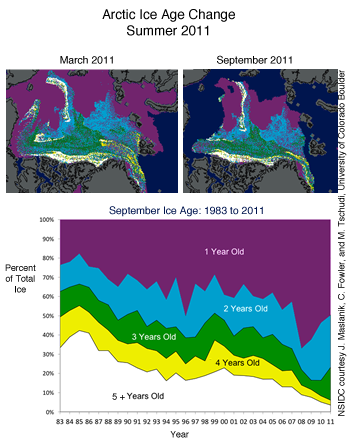
The age of Arctic ice is a very important indicator of its health. The average age of the ice continues to decline. NSIDC - link above - reports that coverage of the oldest, thickest ice types (ice four years or older) has declined over the past 28 years, as shown in the next graphic.


AMSR-E Failure

Since the commissioning of the Aqua satellite, ice extent has been measured by most observers using the satellite's AMSRE-E - Advanced Microwave Scanning Radiometer - EOS. The failure of AMSR-E was published in this press release but has not as yet been taken up by the mainstream news media. I believe that Roy Spencer deserves credit as the first blogger to publish details about this event. The line drawing below, from a NASA publication, shows the location of AMSR-E on the satellite. The other instruments are still fully functional, or as NASA prefers to say: 'operating nominally'. (Unfortunately, in British English, 'operating nominally' means 'working, but only just'.)

more .. http://www.science20.com/chatter_box/arctic_ice_october_2011-

========

The Arctic: Ocean of Ice

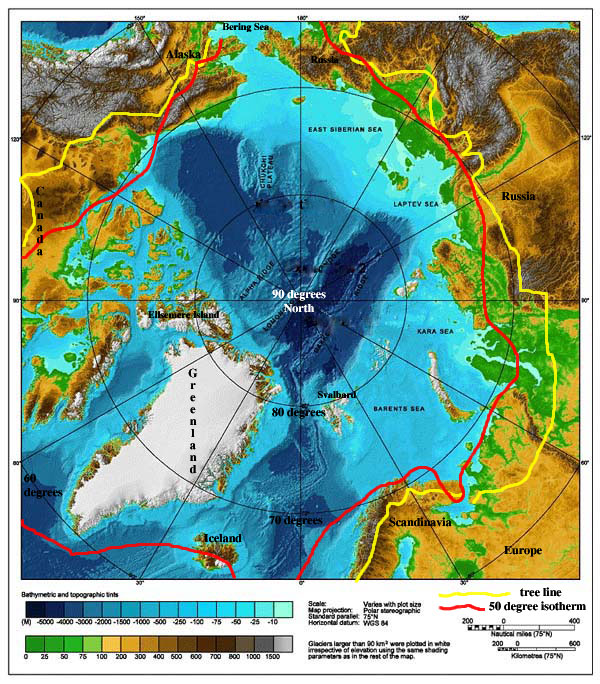
The Arctic is almost all an ocean including just the northern parts of Canada, Alaska, Russia, Scandinavia, and Greenland. It can be defined in a couple of ways. One way is to use the area inside the Arctic Circle. The Arctic Circle is a line of latitude at 66 degrees 27 minutes north, about 1,630 miles south of the North Pole. This is where the sun stays above the horizon at least one whole day each year (never setting). The farther north you go the longer the sun stays above the horizon in the summer. This is the area of the 'midnight sun.' Another way to define the Arctic is to use the area inside a line drawn around the arctic inside of which there are no trees. This is called the 'tree line.' An additional way is to define the Arctic is where the 50 degree summer isotherm is located. This is the line above which it is always colder than 50 degrees F.


Arctic Ocean Bathymetry (NOAA image). The ocean areas are all in blue with the darker blues the deeper areas. The green indicates lowlands and the browns indicate increasing altitude as the browns turn darker and get to greys. All the white on Greenland is permanent ice. Image has been edited to include the tree line (yellow) and the 50 degree F isotherm (red) (= 10 degrees C).

The Arctic was named by the ancient Greeks after a constellation they called Arktos, which is now called Ursa Major, or the Great Bear. The Arctic Ocean is the smallest of all the oceans and is covered with ice most of the year. It connects with the Pacific Ocean at the Bering Strait and with the Atlantic Ocean on either side of Greenland.

The Arctic provides the shortest route between North America and Europe by air. Commercial airlines fly this route daily. Although it is the shortest route (by a straight line -or- as they say 'as the crow flies), travel by boat or overland is nearly impossible because of the ice. It remains the domain of the airlines to have the largest number of people who traverse the Arctic. And, those of us in the airplanes are just passing through.


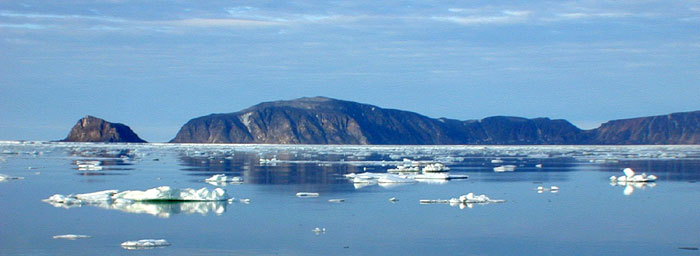
Near the northern part of Svalbard at 80 degrees north latitude in the summer.

The depth of the Arctic Ocean averages 4,362 feet. The deepest area is just north of Svalbard at about 17,880 feet. The water in the Arctic Ocean ranges from a plus 2 degrees to a minus 2 degrees Centigrade (close to freezing). As the seawater drops below a minus 2 degrees C it freezes into sea ice.

[ LOL .. one more of many photographs ]


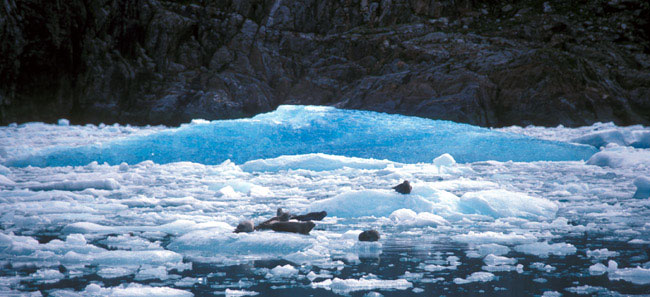
Seals resting on Arctic icebergs.

more .. http://www.marinebio.net/marinescience/04benthon/arcocean.htm
icon url

F6

03/16/12 11:43 PM

#170648 RE: F6 #168782

Record-breaking warm weather advances beginning of growing season

Figure 1. Projected weather conditions at approximately 5,000 feet above sea level, 8 p.m. on Monday March 19, 2012. Color contours depict temperature (°C) while winds are expressed in arrow/vector form on grid points in white (direction of arrow indicates direction, length of arrow depicts velocity). Solid white lines depict general pressure pattern and air flow.

Figure 2. Observed (solid colored lines), normal (solid black line) and projected (dashed line) base 50°F growing degree accumulations for 10 warmest Marches on record at Benton Harbor, Mich. Projections for the 2012 data include latest short- and medium-range National Weather Service forecast guidance through March 31. Growing degree days are calculated with the Baskerville-Emin methodology.
March 15, 2012
[an included ad-of-the-times:
]
http://www.cattlenetwork.com/e-newsletters/drovers-daily/Record-breaking-warm-weather-advances-beginning-of-growing-season-142831885.html [no comments yet]


===


Remarkable week-long March heat wave hitting U.S.

Figure 1. Is this March or June? Predicted high temperatures for Wednesday, March 14, 2012 over much of the Midwest are more typical of June than March.

Figure 2. New daily high temperature records were set at 208 locations yesterday, according to our new Extremes web page, with data from NOAA's National Climatic Data Center.
March 14, 2012
A highly unusual week-long heat wave is building over much of the U.S., and promises to bring the warmest temperatures ever seen so early in year to a large portion of the Midwest. The exceptional heat will also be exceptionally long-lasting: record-breaking temperatures 20 - 30 degrees F above normal are expected today through next Wednesday for much of the Midwest and Northeast U.S. The weather system responsible is a large upper-level ridge of high pressure that is "stuck" in place--a phenomenon known as a "blocking pattern." The jet stream is bending far to the south over the Western U.S., then bending far to the north over the Rockies and into Canada, and lies far to the north of the eastern U.S. Since the jet stream acts as the boundary between cold air to the north and warm air to the south, the current looping pattern is bringing colder than normal temperatures and snow to the mountains of the West, and summer-like warmth to the Eastern U.S. It is common for the jet stream to get stuck in a blocking pattern for a period of a week or more, but not in to this extremity. If the current model forecasts prove correct, a high pressure ridge over the U.S. bringing heat this intense and long-lasting in March will be unprecedented in the historical record, going back to 1872.
[...]

http://www.wunderground.com/blog/JeffMasters/comment.html?entrynum=2050 [with comments]


===


(linked in) http://investorshub.advfn.com/boards/read_msg.aspx?message_id=73110507 and preceding and following