



 AI
AI








Wednesday, March 14, 2012 7:03:25 AM
F6 - Arctic With Bruce Parry .. 8:30 pm Wednesday 14th March, 2012 .. SBS Sydney
Canada - Bruce travels to the far north of Canada to live with the Gwitchin people and witness their annual spring hunt. The Gwitchin have hunted migrating caribou in the Arctic wilderness for thousands of years, but this tradition is now under threat from oil exploration. Bruce then heads south to the tar sands of Alberta, home to the second largest oil reserves in the world, to discover how native people cope when the oil industry moves into their territory. (From the UK) (Documentary Series) (Part 4 of 5) M (A) CC .. http://www.sbs.com.au/schedule/SBSONE/2012-03-14/SBS%20Sydney#2373324
He mentioned chunks of ice as big as a house were floating down the Old Crow River ..
he's down to Alberta now .. wow, with night work and overtime you can make $1000 a day ..
========

Arctic Ice October 2011
By Patrick Lockerby | October 10th 2011 04:16 PM | 47 comments |
More Articles
Fire In Brazilian Antarctic Base .. http://www.science20.com/chatter_box/fire_brazilian_antarctic_base-87300
Why I Am Peter Gleick .. http://www.science20.com/chatter_box/why_i_am_peter_gleick-87183
The Heartland Institute And Murdoch Media .. http://www.science20.com/chatter_box/heartland_institute_and_murdoch_media-87115
Arctic Ice October 2011
Ice extent, as measured down to 15% concentration, was only slightly above 2007 levels at the end of this year's melt season. The ice is now about as thin as in 2007, or thinner, and the age of remaining ice continues to decline. [edit: inserted missing clause - bolded.]
The summer sea ice melt season has ended in the Arctic. Arctic sea ice extent reached its low for the year, the second lowest in the satellite record, on September 9. The minimum extent was only slightly above 2007, the record low year, even though weather conditions this year were not as conducive to ice loss as in 2007. Both the Northwest Passage and the Northern Sea Route were open for a period during September.
...
While the melt season in 2011 got off to a slow start, the ice loss pace quickened during June. Ice retreated quite rapidly in the Kara and Barents seas, with rates more than double the average rate.
...
Continued loss of the oldest, thickest ice has prevented any significant recovery of the summer minimum extent. In essence, what was once a refuge for older ice has become a graveyard.
NSIDC .. http://nsidc.org/arcticseaicenews/2011/100411.html
(My emphasis) [his]
... “The ice has not recovered. This summer it appears to have melted to exactly the same degree as in 2007. Yes, it is exactly as thin as in the record year,” says Hendricks.
http://www.irishweatheronline.com
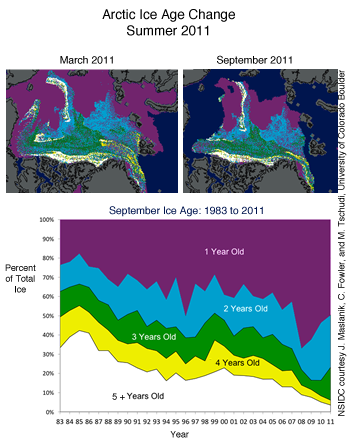
The age of Arctic ice is a very important indicator of its health. The average age of the ice continues to decline. NSIDC - link above - reports that coverage of the oldest, thickest ice types (ice four years or older) has declined over the past 28 years, as shown in the next graphic.
AMSR-E Failure
Since the commissioning of the Aqua satellite, ice extent has been measured by most observers using the satellite's AMSRE-E - Advanced Microwave Scanning Radiometer - EOS. The failure of AMSR-E was published in this press release but has not as yet been taken up by the mainstream news media. I believe that Roy Spencer deserves credit as the first blogger to publish details about this event. The line drawing below, from a NASA publication, shows the location of AMSR-E on the satellite. The other instruments are still fully functional, or as NASA prefers to say: 'operating nominally'. (Unfortunately, in British English, 'operating nominally' means 'working, but only just'.)
more .. http://www.science20.com/chatter_box/arctic_ice_october_2011-
========
The Arctic: Ocean of Ice
The Arctic is almost all an ocean including just the northern parts of Canada, Alaska, Russia, Scandinavia, and Greenland. It can be defined in a couple of ways. One way is to use the area inside the Arctic Circle. The Arctic Circle is a line of latitude at 66 degrees 27 minutes north, about 1,630 miles south of the North Pole. This is where the sun stays above the horizon at least one whole day each year (never setting). The farther north you go the longer the sun stays above the horizon in the summer. This is the area of the 'midnight sun.' Another way to define the Arctic is to use the area inside a line drawn around the arctic inside of which there are no trees. This is called the 'tree line.' An additional way is to define the Arctic is where the 50 degree summer isotherm is located. This is the line above which it is always colder than 50 degrees F.
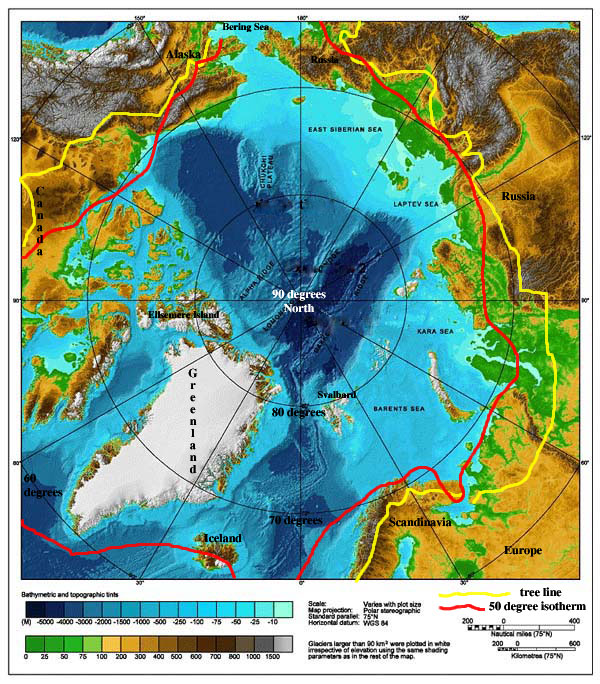
Arctic Ocean Bathymetry (NOAA image). The ocean areas are all in blue with the darker blues the deeper areas. The green indicates lowlands and the browns indicate increasing altitude as the browns turn darker and get to greys. All the white on Greenland is permanent ice. Image has been edited to include the tree line (yellow) and the 50 degree F isotherm (red) (= 10 degrees C).
The Arctic was named by the ancient Greeks after a constellation they called Arktos, which is now called Ursa Major, or the Great Bear. The Arctic Ocean is the smallest of all the oceans and is covered with ice most of the year. It connects with the Pacific Ocean at the Bering Strait and with the Atlantic Ocean on either side of Greenland.
The Arctic provides the shortest route between North America and Europe by air. Commercial airlines fly this route daily. Although it is the shortest route (by a straight line -or- as they say 'as the crow flies), travel by boat or overland is nearly impossible because of the ice. It remains the domain of the airlines to have the largest number of people who traverse the Arctic. And, those of us in the airplanes are just passing through.
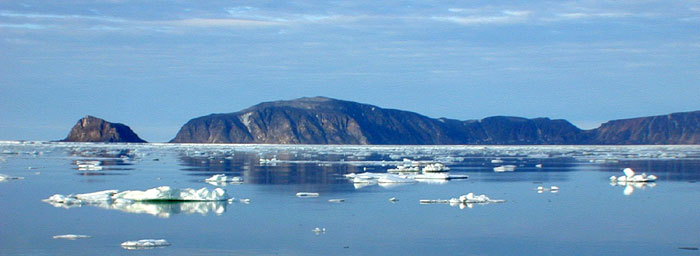
Near the northern part of Svalbard at 80 degrees north latitude in the summer.
The depth of the Arctic Ocean averages 4,362 feet. The deepest area is just north of Svalbard at about 17,880 feet. The water in the Arctic Ocean ranges from a plus 2 degrees to a minus 2 degrees Centigrade (close to freezing). As the seawater drops below a minus 2 degrees C it freezes into sea ice.
[ LOL .. one more of many photographs ]
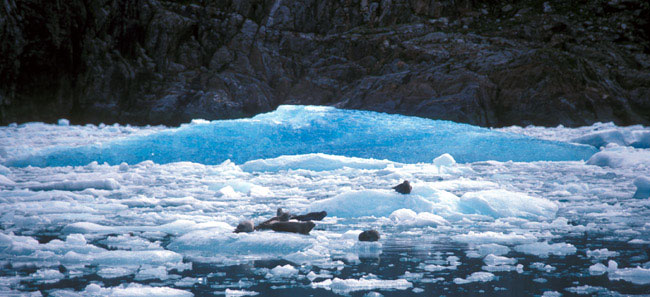
Seals resting on Arctic icebergs.
more .. http://www.marinebio.net/marinescience/04benthon/arcocean.htm
Canada - Bruce travels to the far north of Canada to live with the Gwitchin people and witness their annual spring hunt. The Gwitchin have hunted migrating caribou in the Arctic wilderness for thousands of years, but this tradition is now under threat from oil exploration. Bruce then heads south to the tar sands of Alberta, home to the second largest oil reserves in the world, to discover how native people cope when the oil industry moves into their territory. (From the UK) (Documentary Series) (Part 4 of 5) M (A) CC .. http://www.sbs.com.au/schedule/SBSONE/2012-03-14/SBS%20Sydney#2373324
He mentioned chunks of ice as big as a house were floating down the Old Crow River ..
he's down to Alberta now .. wow, with night work and overtime you can make $1000 a day ..
========
Arctic Ice October 2011
By Patrick Lockerby | October 10th 2011 04:16 PM | 47 comments |
More Articles
Fire In Brazilian Antarctic Base .. http://www.science20.com/chatter_box/fire_brazilian_antarctic_base-87300
Why I Am Peter Gleick .. http://www.science20.com/chatter_box/why_i_am_peter_gleick-87183
The Heartland Institute And Murdoch Media .. http://www.science20.com/chatter_box/heartland_institute_and_murdoch_media-87115
Arctic Ice October 2011
Ice extent, as measured down to 15% concentration, was only slightly above 2007 levels at the end of this year's melt season. The ice is now about as thin as in 2007, or thinner, and the age of remaining ice continues to decline. [edit: inserted missing clause - bolded.]
The summer sea ice melt season has ended in the Arctic. Arctic sea ice extent reached its low for the year, the second lowest in the satellite record, on September 9. The minimum extent was only slightly above 2007, the record low year, even though weather conditions this year were not as conducive to ice loss as in 2007. Both the Northwest Passage and the Northern Sea Route were open for a period during September.
...
While the melt season in 2011 got off to a slow start, the ice loss pace quickened during June. Ice retreated quite rapidly in the Kara and Barents seas, with rates more than double the average rate.
...
Continued loss of the oldest, thickest ice has prevented any significant recovery of the summer minimum extent. In essence, what was once a refuge for older ice has become a graveyard.
NSIDC .. http://nsidc.org/arcticseaicenews/2011/100411.html
(My emphasis) [his]
... “The ice has not recovered. This summer it appears to have melted to exactly the same degree as in 2007. Yes, it is exactly as thin as in the record year,” says Hendricks.
http://www.irishweatheronline.com
The age of Arctic ice is a very important indicator of its health. The average age of the ice continues to decline. NSIDC - link above - reports that coverage of the oldest, thickest ice types (ice four years or older) has declined over the past 28 years, as shown in the next graphic.
AMSR-E Failure
Since the commissioning of the Aqua satellite, ice extent has been measured by most observers using the satellite's AMSRE-E - Advanced Microwave Scanning Radiometer - EOS. The failure of AMSR-E was published in this press release but has not as yet been taken up by the mainstream news media. I believe that Roy Spencer deserves credit as the first blogger to publish details about this event. The line drawing below, from a NASA publication, shows the location of AMSR-E on the satellite. The other instruments are still fully functional, or as NASA prefers to say: 'operating nominally'. (Unfortunately, in British English, 'operating nominally' means 'working, but only just'.)
more .. http://www.science20.com/chatter_box/arctic_ice_october_2011-
========
The Arctic: Ocean of Ice
The Arctic is almost all an ocean including just the northern parts of Canada, Alaska, Russia, Scandinavia, and Greenland. It can be defined in a couple of ways. One way is to use the area inside the Arctic Circle. The Arctic Circle is a line of latitude at 66 degrees 27 minutes north, about 1,630 miles south of the North Pole. This is where the sun stays above the horizon at least one whole day each year (never setting). The farther north you go the longer the sun stays above the horizon in the summer. This is the area of the 'midnight sun.' Another way to define the Arctic is to use the area inside a line drawn around the arctic inside of which there are no trees. This is called the 'tree line.' An additional way is to define the Arctic is where the 50 degree summer isotherm is located. This is the line above which it is always colder than 50 degrees F.
Arctic Ocean Bathymetry (NOAA image). The ocean areas are all in blue with the darker blues the deeper areas. The green indicates lowlands and the browns indicate increasing altitude as the browns turn darker and get to greys. All the white on Greenland is permanent ice. Image has been edited to include the tree line (yellow) and the 50 degree F isotherm (red) (= 10 degrees C).
The Arctic was named by the ancient Greeks after a constellation they called Arktos, which is now called Ursa Major, or the Great Bear. The Arctic Ocean is the smallest of all the oceans and is covered with ice most of the year. It connects with the Pacific Ocean at the Bering Strait and with the Atlantic Ocean on either side of Greenland.
The Arctic provides the shortest route between North America and Europe by air. Commercial airlines fly this route daily. Although it is the shortest route (by a straight line -or- as they say 'as the crow flies), travel by boat or overland is nearly impossible because of the ice. It remains the domain of the airlines to have the largest number of people who traverse the Arctic. And, those of us in the airplanes are just passing through.
Near the northern part of Svalbard at 80 degrees north latitude in the summer.
The depth of the Arctic Ocean averages 4,362 feet. The deepest area is just north of Svalbard at about 17,880 feet. The water in the Arctic Ocean ranges from a plus 2 degrees to a minus 2 degrees Centigrade (close to freezing). As the seawater drops below a minus 2 degrees C it freezes into sea ice.
[ LOL .. one more of many photographs ]
Seals resting on Arctic icebergs.
more .. http://www.marinebio.net/marinescience/04benthon/arcocean.htm
It was Plato who said, “He, O men, is the wisest, who like Socrates, knows that his wisdom is in truth worth nothing”
Discover What Traders Are Watching
Explore small cap ideas before they hit the headlines.



