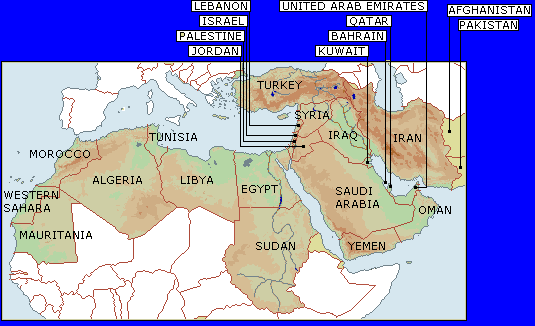
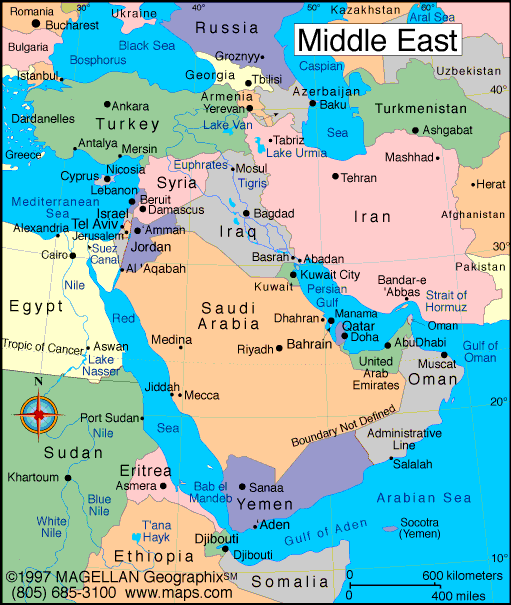
This ‘Holy Land’ base could take the place of Incirlik in Turkey. It might mean the Kurds will get their own state in Iraq much to Turkey’s horror.
Incirlik becomes logistical, potential “operations” to the East. #msg-6003766
Greenpeace: The US has nukes at Incirlik International environmental group Greenpeace yesterday claimed that the U.S. has nuclear bombs at Turkey's Incirlik Airbase. Greenpeace have opened a “Peace Embassy” in the Incirlik area of Adana to publicize the find to the public. #msg-6405164
I read while ago that the IDF had agreed to let the US stockpile Military Supplies in Israel. That is actually a good thing for Israel on a number of levels. Second, In the event of an emergency, Israel could take these materials immediately after receiving the OK from the US. This is far better than having to wait for material to be shipped from US bases Germany or Turkey. For what that's worth.
The Council on Foreign Relations, which usually reflects State Department thinking, has recommended the restructuring of Iraq into six states under a single national government. The council, in a report entitled "Power-Sharing in Iraq," warned that even with elections an Iraq led by a strong central government might not be democratic.
Phillips, a former adviser to the U.S. government, proposed the establishment of two or three states dominated by Shi'ites. Another state would be comprised of mostly Sunnis and a third state would be Kurdish. Baghdad would be a separate state. #msg-6977807
If the Kurds get their own state Turkey may scratch its name off the list of U.S. allies.
Posted: Sunday, July 10, 2005 - written by jerry golden
Many have written asking me about the Barry Chamish Report of the American Base here in Israel. Barry and I went there today and I can tell you that it is there. In fact, it isn’t even being hidden, but how would they hide such a thing anyway. What they are doing is saying it is a storage facility and the US is building it for Israel. But let me tell you that makes absolutely no sense. I don’t know how many buildings are already constructed or what they are for but we can make some good guesses. Look at these for example.
Start by looking from the left side, you will notice that there are 4 rows of buildings, the first row are buildings with only small doors, there are no large doors we can see for trucks so I don’t believe they are warehouses, those doors are for people to walk through. You will noticed the next two rows are the same and then the forth row are buildings for offices or storage they have larger doors.
Now look at another section of buildings being built,
These buildings are warehouses, the reasons I am showing you both is so you can see that this American base being built in Israel is going to be used for both housing and mass storage of military hardware.
Below is another shot at some more buildings, many look like they are for people and others for storage.
I want to show you a shot that Barry showed everyone the other day because I want to point out something else in that picture, not just the US flag but there is a date mentioned as well.
You will notice a sign to the left
It says this base will be completed on August 31st 2005. meaning to me that they are in a really big hurry. And we saw heavy equipment working over a very large area. And by the way we guessed this base will cover at least 25 square miles, I think possibly a lot more. It is also prime real estate about ten minutes from the International airport. And right along side the new interstate highway 6 Israel’s new tow road running from Ashdod to Haifa. As most of you may know Israel just built a new International Airport Terminal. Leaving a very large and very good Airport in tack. They tried to tell the public it would be used for domestic use, which makes no sense at all, for the few flights from Tel-Aviv to Eilat and to Haifa. But it would make a really great military base for really large military planes and it is only a few minutes away from this new base.
We could guess for ever what all these buildings could be used for, but I think it is obvious, some are barracks and others are warehouses, but let’s move on to some other things to see.
Below is a round Helicopter Pad with two underground bunkers near by.
These underground bunkers are complete with blast protection built near by. VIP’s (or top brass) will be able to come in by choppers and quickly be put underground. But they tell us this is just a storage facility.
You will notice what looks like a water tower in the background, well I don’t think so, to begin with there is plenty of water supply as the city of Petah Tikvah is within sight of this base so they have plenty of water, and there is no water lines leading to or from this large tank, Lets take a closer look at it as well.
With the high voltage-wiring going into this unit it is obviously a high power communications and radar system. Please keep in mind none of this is Israeli, it is all being built by the US Government and the labors other than Americans are Arabic.
This next picture when first looked at makes you think it is just a water way but look closer and you will discover it is the entrance to underground tunnels. If we can discover so many of these tunnels in just a few minutes just imagine how many there are in this whole base.
We traveled around the back side of the base and it was a long hot ride on some very rough roads to get these pictures. The back of the base runs right along with the original “Green line” being built by the US Government you wouldn’t expect anything less.
The fence or wall will be build on this foundation.
I took over 40 pictures but have tried to pick out the ones that show you what is happening. Now I will tell you what I think this is all about, for what that is worth.
Somewhere in the near future the US will have to go after Syria, and when they do Iran may react with nukes and Egypt could and most likely will join in the attempt to destroy Israel, again. The US is in a hurry to build this base in order to fill it with their military supplies and to have a base of operations to settle this Islamic problem once and for all.
But it doesn’t end there, the New World Order under the name of the EU and the UN will move into the picture soon after this thing kicks off. So even though this base is being built by the United States it is in fact a New World Order Base being put into place. Of course it is stripping Israel of its sovereignty with the help of Ariel Sharon, who I am sure by now has convinced himself that he is doing the best thing for the Jews of Israel. It’s also interesting that 99% of the population of Israel knows nothing about this base being built, not one story has been reported in any Israeli newspaper. No mention of it on the TV it is just being done very quickly and very quietly. What is so amazing is how quickly they can accomplish such a task these days.
There is one other possibility, and that is to house the tens of thousands of protesters who will fight the Sharon Disengagements, but I don’t think so, such a large base would not be needed, and certainly not all the warehouses.
It should also be noted that there are no US troops on this base at this time, but it is obvious that many soon will be. And for those in the US they haven’t heard any of this from the US Government either.
If the U.S. pulls out of Iraq I think one would be justified in believing that a large percentage of U.S. troops will be stationed in The Base.
Israel can kiss its sovereignty goodbye compliments in part of the many American Jews unable to see beyond partisan politics. It seems now in backing Bush they literally voted for the demise of Israel.
Forget Israeli sovereignty. Our precious and holy land will soon be used as a forward base for the impending New Middle East. #msg-6977807 #msg-7033642
-Am
Iraq Wants Quick Withdrawal of U.S. Troops
Updated 4:06 PM ET July 27, 2005
By ROBERT BURNS
BAGHDAD, Iraq (AP) - Iraq's transitional prime minister called Wednesday for a speedy withdrawal of U.S. troops and the top U.S. commander here said he believed a "fairly substantial" pullout could begin next spring and summer.
Prime Minister Ibrahim al-Jaafari said at a joint news conference with Defense Secretary Donald H. Rumsfeld that the time has arrived to plan a coordinated transition from American to Iraqi military control throughout the country.
Asked how soon a U.S. withdrawal should happen, he said no exact timetable had been set. "But we confirm and we desire speed in that regard," he said, speaking through a translator. "And this fast pace has two aspects."
First, there must be a quickening of the pace of U.S. training of Iraqi security forces, and second there must be closely coordinated planning between the U.S.-led military coalition and the emerging Iraq government on a security transition, he said.
"We do not want to be surprised by a withdrawal that is not in connection with our Iraqi timing,"' he said.
Speaking earlier with U.S. reporters traveling with Rumsfeld, Gen. George Casey, the top American commander in Iraq, said he believed a U.S. troop withdrawal could begin by spring 2006 if progress continues on the political front and if the insurgency does not expand.
Rumsfeld was planning to get a firsthand look at the training of Iraqi security forces by watching a demonstration by a group of Iraqi special forces soldiers using live ammunition at a training range run by American troops.
U.S. officials describe a variety of security forces being developed. Foremost is the Iraqi army, comprised mainly of infantry battalions, although there also are to be four tank battalions. The army now has about 77,000 soldiers, and it is scheduled to expand to about 85,000 by December. It includes "intervention forces," to lead the Iraqi effort against the insurgency.
There are now about 94,000 police, most for standard traffic and patrol work. That is to grow to about 145,000 by December, and it includes "special police" commando battalions as well as a mechanized police brigade that will be a paramilitary, counterinsurgency unit intended to deploy to high-risk areas using light armored personnel carriers.
The organization in charge of training and equipping Iraqi security forces is the Multinational Security Transition Command, headed by Lt. Gen. David Petraeus, who last week was announced by the Pentagon as the next commander of the Army's Combined Arms Center at Fort Leavenworth, Kan. He is to be replaced in Iraq by Maj. Gen. Martin Dempsey, who spent more than a year in Iraq as commander of the 1st Armored Division.
The effort to build a reliable Iraq security force has been slowed by a number of problems. One that can be traced to the earliest days of the U.S. military occupation was the virtual disintegration of the Iraqi army that existed when American troops invaded in March 2003. Some say this was made worse by the decision of L. Paul Bremer, the U.S. civilian administrator of Iraq starting in May 2003, to formally disband the Iraqi security forces.
Another problem has been infiltration of the security forces by insurgents. In its report to Congress last week, the Pentagon acknowledged that this remains a problem and it still is unable to say just how much infiltration there is, despite efforts to improve vetting of recruits.
Rumsfeld said en route to Iraq on Wednesday that Iraqi leaders must take a more aggressive stance against what he called harmful interference from neighboring Syria and Iran.
He said he would be pushing the Iraqis to provide more people who can be trained by U.S. personnel to handle the growing number of detainees in the country, now estimated to number at least 15,000.
With a permanent Iraqi government scheduled to take power in January, following adoption of a constitution and an election in December, they need trained prison guards "so that as soon as it is feasible we can transfer responsibility for Iraqi prisoners to the Iraqi government," he said.
Rumsfeld has often criticized Iran and Syria for meddling in Iraq's affairs. In his remarks Wednesday, he put the main onus on Iraqi leaders to do more to fix the problem.
"They need to be aggressively communicating with their neighbors to see that foreign terrorists stop coming across those borders and that their neighbors do not harbor insurgents and finance insurgents," he said in an in-flight interview with reporters accompanying him from Tajikistan.
Considering Bush’s overly aggressive offensive to install Bolton I then see that at some point we will turn the Holy Land Base over to the United Nations. I am tempted to view this thing with Bolton and the turnover of the base as related.
Holy Land Base This is exactly what I was told in 2001, and I quote: "It is the intention of the U.S. administration, to ultimately turn over to the United Nations, the military base that is being considered for construction in the heart of Israel. It is the leaders of the NWO/Illuminati who will decide the appropriate time when all that will occur. The U.S. is to build the military base within Israel under the guise that it is for the use of the U.S. military. It is not. It is to be turned over to the United Nations at the appropriate time. The sole purpose of this base is for the United Nations use, not the U.S., and not Israel. This base will be a disaster to the best interests of Israel. It will be used against Israelis." #msg-6977807
The White House says the former undersecretary of state for arms control, who has long been one of Bush's most conservative foreign policy advisers, is exactly the man to whip the United Nations into shape.
By whipping the United Nations into shape the White House means exerting even more control over the United Nations. The base will not in my opinion be turned over to the UN until we gain more control over that body probably through Bolton.
-Am
Officials: Bush Plans to Install Bolton
Updated 9:31 PM ET July 29, 2005
By JENNIFER LOVEN
WASHINGTON (AP) - President Bush intends to announce next week that he is going around Congress to install embattled nominee John Bolton as the U.S. ambassador to the United Nations, senior administration officials said Friday.
Bush has the power to fill vacancies without Senate approval while Congress is in recess. Under the Constitution, a recess appointment during the lawmakers' August break would last until the next session of Congress, which begins in January 2007.
An end run around the Senate confirmation process would certainly annoy senators _ particularly Democrats _ at a time when Bush's nomination of John Roberts to serve on the Supreme Court hangs in the balance. It also could hamper Bolton at the United Nations, by sending him there as a short-timer without the Senate's backing.
"There's just too much unanswered about Bolton and I think the president would make a truly serious mistake if he makes a recess appointment," Sen. Joseph Biden of Delaware, the top Democrat on the Foreign Relations Committee, said in an interview.
Two officials, speaking on condition of anonymity because the president had not made the announcement and Congress wasn't yet in recess, said Bush planned to exercise that authority before he leaves Washington on Tuesday for his ranch. The House recessed on Thursday and the Senate's break was scheduled to begin later Friday.
Earlier in the day, White House press secretary Scott McClellan gave the strongest indication yet that Bush planned to do so, noting that the U.N. General Assembly has its annual meeting in mid-September.
"It's important that we get our permanent representative in place," he said. "This is a critical time and it's important to continue moving forward on comprehensive reform."
Bush counselor Dan Bartlett said the president had not made a decision on whether to make a recess appointment.
"He retains that right to do, but he will continue to work with the Senate as long as he can," Barlett said. "But he has not made a decision."
Bolton's nomination, announced in March by the president, was controversial from the start and has been stalled in the Senate by Democrats.
Critics say Bolton, who has been accused of mistreating subordinates and has been openly skeptical about the United Nations, would be ill-suited to the sensitive diplomatic task at the world body. The White House says the former undersecretary of state for arms control, who has long been one of Bush's most conservative foreign policy advisers, is exactly the man to whip the United Nations into shape.
This week, critics raised a fresh concern, saying Bolton had neglected to tell Congress he had been interviewed in a government investigation into faulty prewar intelligence on Iraq.
The State Department said Thursday that Bolton was interviewed in 2003 by the department inspector general. The office was conducting a joint investigation with the CIA into allegations that Iraq attempted to buy nuclear materials from Niger. Bolton had earlier submitted a questionnaire to the Senate in which he had said he had not testified to a grand jury or been interviewed by investigators in any inquiry over the past five years.
Republican Sen. Lincoln Chafee said he would vote against Bolton _ if given the chance _ and would oppose a recess appointment if it is accurate that Bolton's form was originally incorrect. "Any intimidation of the facts, or suppression of information getting to the public which led us to the war, absolutely should preclude him from a recess appointment," said Chafee, of Rhode Island.
Also Friday, 35 Democratic senators and one independent, Sen. Jim Jeffords of Vermont, sent a letter to Bush urging against a recess appointment. "Sending someone to the United Nations who has not been confirmed by the United States Senate and now who has admitted to not being truthful on a document so important that it requires a sworn affidavit is going to set our efforts back in many ways," the letter said.
US planning bases across Middle East, Central Asia
as well as the establishment of two new storage hubs, one in a classified Middle Eastern country “west” of Saudi Arabia and the other in a yet to be decided “Central Asian state.”
‘West’ of Saudi Arabia could be the holy land base in Israel. Pls see: #msg-6977807 #msg-4563707
-Am
US planning bases across Middle East, Central Asia
Sunday, March 26, 2006
WASHINGTON: The United States is planning to build at least six bases across the Middle East and Central Asia in the next 10 years for “deep storage” of munitions and equipment to prepare for regional war contingencies.
According to William M Arkin, author of more than 10 books on military affairs, and a former US army intelligence analyst and nuclear weapons expert during the Cold War, the plan came to attention this month through contracting documents that call for the continued storage of everything from packaged meals ready to eat (MREs) to missiles in Bahrain, Kuwait, Qatar, and Oman, as well as the establishment of two new storage hubs, one in a classified Middle Eastern country “west” of Saudi Arabia and the other in a yet to be decided “Central Asian state.”
The plans to continue to “pre-position” war material in the Persian Gulf region leave ambiguous whether the US military foresees the ability to establish a permanent present in Iraq in the long-term. By 2016, the contracting documents show that the tonnage of air munitions stored at sites outside Iraq will double from current levels.
According to Arkin, “In 2001, existing headquarters and bases were used to run air operations from Saudi Arabia and the Gulf, ground operations were directed from a virtual US permanent base in Kuwait, and special operations were centered on Oman. New expeditionary bases were established in places like Pakistan and Uzbekistan, as well as new bases in places like Bulgaria and Romania, but it was the existing web of forward operating locations and contingency facilities that allowed the immediate deployment.” Arkin writes, “Central to the US military presence in the Middle East to fight both the Afghanistan and Iraq wars has been the use of pre-positioned war materiel and the quick establishment of expeditionary bases. At the height of operations in both countries in 2003, the Air Force, for instance, operated from 36 bases in and around the region. That number has since shrunk to 14 today, including four main operating bases in Iraq. Under the review, up to 70,000 troops will be relocated to the continental United States, primarily drawn from forces in Germany and Europe, and the Cold War presence in many parts of the world will end altogether.
More central to the review though was the articulation of a basing strategy for those parts of the world - especially the Middle East - where no “permanent” combat forces are assigned. Here the strategy relies on a network of forward operating sites (FOS) capable of supporting rotational forces, as well as a set of more austere cooperative security locations (CSL) used for contingency purposes.”
He points out that with the elimination of a permanent American presence that includes families and the typical Cold War accoutrements, the United States will not only have greater flexibility, but many political impediments will be eliminated as host countries will also be able to claim that there are no American “bases” on their soil. Though the United States began to pre-position war material in the Middle East after President Jimmy Carter established the Rapid Deployment Force to operate against a Soviet attack on the Gulf, it was the build-up for the 1990 Gulf War that cemented many of the basing relationships today. After 9/11, these airbases as well as the continued presence of pre-positioned material in countries like Oman and Qatar became central to the US rapid response in Afghanistan. Another factor that began to influence US basing in the Middle East during the 1990’s was information technologies that allowed forward operations with reduced manpower. The concept called “reach back,” is defined as “the process of obtaining products, services, and applications or forces, equipment, or material from Air Force organisations that are not forward deployed.” After the current Iraq war, there are plans to shift the future US forward presence in the Middle East from the “ever present” posture to one characterised as “enduring access” and “episodic employment.” Pre-positioned materiel and ready-to-use though largely unoccupied bases are central to this strategy. This allows the maintenance of military capabilities without a large or visible US presence, and compensates for the loss of Saudi Arabian bases and infrastructure closed with the toppling of Saddam Hussein in 2003. Arkin writes, “Despite impressive physical facilities in Saudi Arabia, freedom of action from Saudi bases had always been a sticking point between the United States and the Kingdom. Prior to 9/11, the US was already in the process of moving capabilities to Qatar and Kuwait and Air Force aircraft operations shifted to Al Dhafra air base in the United Arab Emirates. Now bases in Bahrain, Kuwait, Qatar, Oman, and the UAE constitute the permanent basing of the United States, no matter what the new fangled Pentagon labelling. Countries like Jordan, Egypt, and Yemen, and even Saudi Arabia, will continued to be pressured to support episodic operations and clandestine forces, just as they actually are doing today.” khalid hasan


 Market Data
  Markets