










Sunday, March 26, 2006 10:20:48 AM
US planning bases across Middle East, Central Asia
as well as the establishment of two new storage hubs, one in a classified Middle Eastern country “west” of Saudi Arabia and the other in a yet to be decided “Central Asian state.”
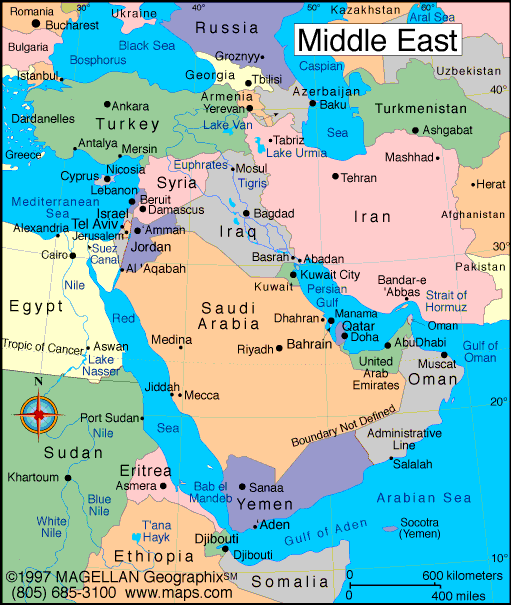
‘West’ of Saudi Arabia could be the holy land base in Israel.
Pls see:
#msg-6977807
#msg-4563707
-Am
US planning bases across Middle East, Central Asia
Sunday, March 26, 2006
WASHINGTON: The United States is planning to build at least six bases across the Middle East and Central Asia in the next 10 years for “deep storage” of munitions and equipment to prepare for regional war contingencies.
According to William M Arkin, author of more than 10 books on military affairs, and a former US army intelligence analyst and nuclear weapons expert during the Cold War, the plan came to attention this month through contracting documents that call for the continued storage of everything from packaged meals ready to eat (MREs) to missiles in Bahrain, Kuwait, Qatar, and Oman, as well as the establishment of two new storage hubs, one in a classified Middle Eastern country “west” of Saudi Arabia and the other in a yet to be decided “Central Asian state.”
The plans to continue to “pre-position” war material in the Persian Gulf region leave ambiguous whether the US military foresees the ability to establish a permanent present in Iraq in the long-term. By 2016, the contracting documents show that the tonnage of air munitions stored at sites outside Iraq will double from current levels.
According to Arkin, “In 2001, existing headquarters and bases were used to run air operations from Saudi Arabia and the Gulf, ground operations were directed from a virtual US permanent base in Kuwait, and special operations were centered on Oman. New expeditionary bases were established in places like Pakistan and Uzbekistan, as well as new bases in places like Bulgaria and Romania, but it was the existing web of forward operating locations and contingency facilities that allowed the immediate deployment.” Arkin writes, “Central to the US military presence in the Middle East to fight both the Afghanistan and Iraq wars has been the use of pre-positioned war materiel and the quick establishment of expeditionary bases. At the height of operations in both countries in 2003, the Air Force, for instance, operated from 36 bases in and around the region. That number has since shrunk to 14 today, including four main operating bases in Iraq. Under the review, up to 70,000 troops will be relocated to the continental United States, primarily drawn from forces in Germany and Europe, and the Cold War presence in many parts of the world will end altogether.
More central to the review though was the articulation of a basing strategy for those parts of the world - especially the Middle East - where no “permanent” combat forces are assigned. Here the strategy relies on a network of forward operating sites (FOS) capable of supporting rotational forces, as well as a set of more austere cooperative security locations (CSL) used for contingency purposes.”
He points out that with the elimination of a permanent American presence that includes families and the typical Cold War accoutrements, the United States will not only have greater flexibility, but many political impediments will be eliminated as host countries will also be able to claim that there are no American “bases” on their soil. Though the United States began to pre-position war material in the Middle East after President Jimmy Carter established the Rapid Deployment Force to operate against a Soviet attack on the Gulf, it was the build-up for the 1990 Gulf War that cemented many of the basing relationships today. After 9/11, these airbases as well as the continued presence of pre-positioned material in countries like Oman and Qatar became central to the US rapid response in Afghanistan. Another factor that began to influence US basing in the Middle East during the 1990’s was information technologies that allowed forward operations with reduced manpower. The concept called “reach back,” is defined as “the process of obtaining products, services, and applications or forces, equipment, or material from Air Force organisations that are not forward deployed.” After the current Iraq war, there are plans to shift the future US forward presence in the Middle East from the “ever present” posture to one characterised as “enduring access” and “episodic employment.” Pre-positioned materiel and ready-to-use though largely unoccupied bases are central to this strategy. This allows the maintenance of military capabilities without a large or visible US presence, and compensates for the loss of Saudi Arabian bases and infrastructure closed with the toppling of Saddam Hussein in 2003. Arkin writes, “Despite impressive physical facilities in Saudi Arabia, freedom of action from Saudi bases had always been a sticking point between the United States and the Kingdom. Prior to 9/11, the US was already in the process of moving capabilities to Qatar and Kuwait and Air Force aircraft operations shifted to Al Dhafra air base in the United Arab Emirates. Now bases in Bahrain, Kuwait, Qatar, Oman, and the UAE constitute the permanent basing of the United States, no matter what the new fangled Pentagon labelling. Countries like Jordan, Egypt, and Yemen, and even Saudi Arabia, will continued to be pressured to support episodic operations and clandestine forces, just as they actually are doing today.” khalid hasan
http://www.dailytimes.com.pk/default.asp?page=2006\03\26\story_26-3-2006_pg7_14
as well as the establishment of two new storage hubs, one in a classified Middle Eastern country “west” of Saudi Arabia and the other in a yet to be decided “Central Asian state.”
‘West’ of Saudi Arabia could be the holy land base in Israel.
Pls see:
#msg-6977807
#msg-4563707
-Am
US planning bases across Middle East, Central Asia
Sunday, March 26, 2006
WASHINGTON: The United States is planning to build at least six bases across the Middle East and Central Asia in the next 10 years for “deep storage” of munitions and equipment to prepare for regional war contingencies.
According to William M Arkin, author of more than 10 books on military affairs, and a former US army intelligence analyst and nuclear weapons expert during the Cold War, the plan came to attention this month through contracting documents that call for the continued storage of everything from packaged meals ready to eat (MREs) to missiles in Bahrain, Kuwait, Qatar, and Oman, as well as the establishment of two new storage hubs, one in a classified Middle Eastern country “west” of Saudi Arabia and the other in a yet to be decided “Central Asian state.”
The plans to continue to “pre-position” war material in the Persian Gulf region leave ambiguous whether the US military foresees the ability to establish a permanent present in Iraq in the long-term. By 2016, the contracting documents show that the tonnage of air munitions stored at sites outside Iraq will double from current levels.
According to Arkin, “In 2001, existing headquarters and bases were used to run air operations from Saudi Arabia and the Gulf, ground operations were directed from a virtual US permanent base in Kuwait, and special operations were centered on Oman. New expeditionary bases were established in places like Pakistan and Uzbekistan, as well as new bases in places like Bulgaria and Romania, but it was the existing web of forward operating locations and contingency facilities that allowed the immediate deployment.” Arkin writes, “Central to the US military presence in the Middle East to fight both the Afghanistan and Iraq wars has been the use of pre-positioned war materiel and the quick establishment of expeditionary bases. At the height of operations in both countries in 2003, the Air Force, for instance, operated from 36 bases in and around the region. That number has since shrunk to 14 today, including four main operating bases in Iraq. Under the review, up to 70,000 troops will be relocated to the continental United States, primarily drawn from forces in Germany and Europe, and the Cold War presence in many parts of the world will end altogether.
More central to the review though was the articulation of a basing strategy for those parts of the world - especially the Middle East - where no “permanent” combat forces are assigned. Here the strategy relies on a network of forward operating sites (FOS) capable of supporting rotational forces, as well as a set of more austere cooperative security locations (CSL) used for contingency purposes.”
He points out that with the elimination of a permanent American presence that includes families and the typical Cold War accoutrements, the United States will not only have greater flexibility, but many political impediments will be eliminated as host countries will also be able to claim that there are no American “bases” on their soil. Though the United States began to pre-position war material in the Middle East after President Jimmy Carter established the Rapid Deployment Force to operate against a Soviet attack on the Gulf, it was the build-up for the 1990 Gulf War that cemented many of the basing relationships today. After 9/11, these airbases as well as the continued presence of pre-positioned material in countries like Oman and Qatar became central to the US rapid response in Afghanistan. Another factor that began to influence US basing in the Middle East during the 1990’s was information technologies that allowed forward operations with reduced manpower. The concept called “reach back,” is defined as “the process of obtaining products, services, and applications or forces, equipment, or material from Air Force organisations that are not forward deployed.” After the current Iraq war, there are plans to shift the future US forward presence in the Middle East from the “ever present” posture to one characterised as “enduring access” and “episodic employment.” Pre-positioned materiel and ready-to-use though largely unoccupied bases are central to this strategy. This allows the maintenance of military capabilities without a large or visible US presence, and compensates for the loss of Saudi Arabian bases and infrastructure closed with the toppling of Saddam Hussein in 2003. Arkin writes, “Despite impressive physical facilities in Saudi Arabia, freedom of action from Saudi bases had always been a sticking point between the United States and the Kingdom. Prior to 9/11, the US was already in the process of moving capabilities to Qatar and Kuwait and Air Force aircraft operations shifted to Al Dhafra air base in the United Arab Emirates. Now bases in Bahrain, Kuwait, Qatar, Oman, and the UAE constitute the permanent basing of the United States, no matter what the new fangled Pentagon labelling. Countries like Jordan, Egypt, and Yemen, and even Saudi Arabia, will continued to be pressured to support episodic operations and clandestine forces, just as they actually are doing today.” khalid hasan
http://www.dailytimes.com.pk/default.asp?page=2006\03\26\story_26-3-2006_pg7_14
Discover What Traders Are Watching
Explore small cap ideas before they hit the headlines.



