News Focus
News Focus
icon url

sideeki

09/04/11 11:51 AM

#153472 RE: F6 #153470

That is an excellent and interesting post. Thanks.

But where do Adam and Eve fit in? Why did god experiment with different humanoids if he made them in his image?
icon url

sortagreen

09/04/11 12:26 PM

#153474 RE: F6 #153470

Nice piece of work.. I saved that for later. I want to read it some more.

Lot of work today. Must get motivated here...

icon url

Welcome2Pinkyland

09/04/11 5:05 PM

#153486 RE: F6 #153470

thanks for the info. it was an interesting read- however, it's like most evolutionary writings i have read- a lot of:

educated guessing and assumptions-

it's true these educated guessing and assumptions could turn out to be true- but maybe they will be turn out to be like the assumption and guessing of natural selection- and not be able to stand the test of time? we shall see.

these educated guesses and assumptions reminds me of a tv program i watched awhile back. the program was about the story of the parting of the red sea in the bible. in the program they used a computer simulation program and then proceeded to guess about how an earth quake and and a heavy wind, combined with known weather history in the area, all coming to getter at the same time, made the story of the parting of the red seem plausible. i wasn't convinced of that either.
icon url

fuagf

09/22/11 11:08 PM

#154709 RE: F6 #153470

First Aboriginal genome sequenced
Published online 22 September 2011 | Nature |

1920s hair sample reveals Aboriginal Australians' explorer origins.

Ewen Callaway .. http://www.nature.com/news/author/Ewen+Callaway/index.html


Aboriginal dancerDescendent of the
first humans to leave Africa.
Mark Kolbe / Getty Images

A 90-year-old tuft of hair has yielded the first complete genome of an Aboriginal Australian, a young man who lived in southwest Australia.

He, and perhaps all Aboriginal Australians, the genome indicates, descend from the first humans to venture far beyond Africa more than 60,000 years ago, and thousands of years before the ancestors of most modern Asians trekked east in a second migration out of Africa.

"Aboriginal Australians are descendents of the first human explorers. These are the guys who expanded to unknown territory into an unknown world, eventually reaching Australia," says Eske Willerslev, a palaeogeneticist at the University of Copenhagen, Denmark, who led the study. It appears online today in Science.

Hanging on a hair

The oldest human remains in Australia date to around 50,000 years ago, and yet older stone tools found in India and elsewhere hint at an early southern migration of anatomically modern humans out of Africa and through India and Southeast Asia.

However, genetic studies of contemporary Asians and Oceanians haven't always told the same story. The most comprehensive genetic analysis carried out so far pointed to a single migration that spawned all Asian populations, including Aboriginal Australians. But estimated times of the separation of European and Asian ancestors in this population does not chime well with the archaeological evidence for the continuous settlement of Australia from much earlier times.

“These papers make an overwhelming case for multiple waves of migration.”

A complete genome from an Aboriginal Australian would settle this debate, Willerslev says. Many contemporary Aboriginal Australians also descend from Europeans because of recent interbreeding between Aboriginals and Australian colonists. To get a better picture of the ancient history of Aboriginals, Willerslev wanted to sequence the genome of someone who did not descend from Europeans.

About a year ago, his team obtained a hair sample originally collected by the British ethnologist Alfred Cort Haddon. Historical records suggest that Haddon got the hair from a young Aboriginal man in the early 1920s while on a train journey from Sydney to Perth.

Willerslev believes that the man offered his hair to Haddon willingly, and a Danish bioethics review board saw no problem with sequencing his genome. Willerslev later received the blessing of a committee that represents Aboriginal people in the region where the man probably lived.

An analysis of his genome indicates that his ancestors started their journey more than 60,000 years ago, branching off from humans who left Africa. The ancestors of contemporary Europeans and most other Asians probably went their separate ways less than 40,000 years ago, according to Willerslev's team.

Ancient relations

Like other populations outside Africa, the Australian Aboriginal man owes small chunks of his genome to Neanderthals. More surprisingly, though, his ancestors also interbred with another archaic human population known as the Denisovans. This group was identified from 30,000–50,000-year-old DNA recovered from a finger bone found in a Siberian cave. Until now, Papua New Guineans were the only modern human population whose ancestors were known to have interbred with Denisovans.

A second study incorporating genomic surveys from different Aboriginal Australians paints an even clearer picture of their ancestors' exploits with the Denisovans. Researchers led by Mark Stoneking at the Max Planck Institute for Evolutionary Anthropology in Leipzig, Germany, calculated the portion of Denisovan ancestry found in the genomes of 243 people representing 33 Asian and Oceanian populations. Patterns of Denisovan interbreeding in human populations could reveal human migration routes through Asia, reasoned the team. The paper is published today in the American Journal of Human Genetics.

This comparison revealed a patchwork in which some populations, including Australian Aboriginals, bore varying levels of Denisovan DNA, while many of their neighbours, like the residents of mainland Southeast Asia, contained none.

Stoneking says that this pattern hints at at least two waves of human migration into Asia: an early trek that included the ancestors of contemporary Aboriginal Australians, New Guineans and some other Oceanians, followed by a second wave that gave rise to the present residents of mainland Asia. Some members of the first wave (though not all of them) interbred with Denisovans. However, the Denisovans may have vanished by the time the second Asian migrants arrived. This also suggests that the Denisovan's range, so far linked only to a cave in southern Siberia, once extended to Southeast Asia and perhaps Oceania.

"Put together, these two papers make an overwhelming case for multiple waves of migration," says David Reich, a population geneticist at Harvard Medical School in Boston, an author on the second study.

Alan Redd, a biological anthropologist at the University of Kansas in Lawrence, says that the peopling of Australia may have been more complicated than either paper suggests. Dingoes, for instance, were brought to the island continent by humans who arrived in the last 5,000 years. "It's certainly possible that people were trickling in at different times," he says.

http://www.nature.com/news/2011/110922/full/news.2011.551.html .. 6 references inside ..

Science continues to evolve in it's everlasting search for info on the what, the where, and the
why .. science continues to reveal more about our history and of our physical and mental states.

Good ol' science continues to reveal more to us of the world of us. Thank you, to science!
icon url

fuagf

11/07/11 4:15 AM

#159236 RE: F6 #153470

F6 .. gee, no Starchild in there .. a nip ..

Analysis

Young children with hydrocephalus typically have an abnormally large head, as fluid pressure causes individual skull bones to bulge outward.

Steven Novella of Yale University Medical School concludes that the cranium exhibits all of the characteristics of a child who has died as a result of congenital hydrocephalus, and that the cranial deformations were the result of accumulations of cerebrospinal fluid within the skull.

DNA testing

DNA testing in 1999 at BOLD (Bureau of Legal Dentistry), a forensic DNA lab in Vancouver, British Columbia found standard X and Y chromosomes in two samples taken from the skull, "conclusive evidence that the child was not only human (and male), but both of his parents must have been human as well, for each must have contributed one of the human sex chromosomes". Further DNA testing in 2003 at Trace Genetics, which specializes in extracting DNA from ancient samples, isolated mitochondrial DNA from both recovered skulls. The child belongs to haplogroup C. Since mitochondrial DNA is inherited exclusively from the mother, it makes it possible to trace the offspring's maternal lineage. The DNA test therefore confirmed that the child's mother was a Haplogroup C human female. However, the adult female found with the child belonged to haplogroup A. Both haplotypes are characteristic Native American haplogroups, but the different haplogroup for each skull indicates that the adult female was not the child's mother. .. more .. http://en.wikipedia.org/wiki/Starchild_skull

and yet .. to many the Starchild skull is, yup, is still a mystery ..

..

http://thebeastinbetween.blogspot.com/2009/07/starchild-skull-hoax-or-hybrid.html

which i thought fit nicely with your comments downstream, the two here, and here.

I linked it as an alien contribution and because i missed the great post of yours earlier.

The post just happened because for some mysterious reason i've left, William Shatner,
on my tv just now, who, by the way, left the DNA testing above out of his ucky program.

I wonder if Shatner is a buddy of Chuck B? Anyway i'll switch channels now. LOLOL


icon url

F6

01/01/12 6:04 AM

#164481 RE: F6 #153470

Amazing photos of Kanzi the bonobo lighting a fire and cooking a meal

30 Dec 2011

[photos at the source link below, gotta go there and click through; the photos are very cool -- below are the respection captions in sequence, with brief descriptions of the photos added]

These extraordinary photos show a bonobo - also known as a pygmy chimpanzee - named Kanzi collecting wood, breaking it up and putting it into a pile [this first photo] before striking a match to light the fire, and then cooking his meal on the fire.

The 12-stone male (170lb) collects firewood and breaks the sticks [this photo] into smaller sizes.

After arranging them in a pile [tidying the pile this photo]...

...Kanzi [striking a match], 31, ignites them with matches or a lighter and then watches the flames take hold.

Impressive enough, but then Kanzi [placing an entirely human campfire grill with legs over the started fire] erects a grill over his fire so he can cook barbecue food over it using a frying pan.

"Kanzi [placing pan on grill] makes fire because he wants to," said Dr Sue Savage-Rumbaugh, his main handler at the Great Ape Trust in Des Moines, Iowa, and the only scientist ever to conduct language research with bonobos. "His fascination began when he was a child, watching the film 'Quest for Fire'. The movie was released about a year after Kanzi was born and was about early man struggling to control fire. Kanzi watched this spellbound over and over hundreds of times."

Spending much of his childhood outdoors with Dr Savage-Rumbaugh, Kanzi [eating cooked food from pan using a spatula] showed interest in the campfires she made to cook food. "At age five he began making small piles of sticks and tried to light them," she added. "I had to keep a close eye on him, but I allowed it because he was clearly interested in practising it. His demeanour when he focused on making fire was just like when he watched the movie. He seemed engrossed in it and it appeared that he associated making fires with watching the film."

Kanzi [toasting a marshmallow on the end of a stick in the embers of the fire, grill gone] and two other apes trained in language at the centre use paper keyboards to communicate with Dr Savage-Rumbaugh and fellow primatologist Liz Pugh, who helped raise them. Symbols, known as lexigrams, represent different words on the keys and help the primates to speak their mind. Kanzi understands 2000 words and even has a symbol for his own name, which he and others use to refer to him. Now, whenever Kanzi 'tells' Dr Savage-Rumbaugh he wants to make a fire, she tries to oblige. "His fire making skills interest us because fire is one of the most important factors in our evolution," said Dr Savage-Rumbaugh.

"It is not clear that Kanzi [eating the marshmallow off end of stick] can do all aspects of making, controlling and employing fire at this point in time. For example he doesn't stay close and carefully monitor the fire once it is going, though he will throw on wood at a distance. But he has not had the true environmental pressures on him that would lead him to desire to use fires for warmth. He has a warm bed every night so he doesn't need to keep himself warm, like the humans who first harnessed fire did, and he has never encountered predators, so he doesn't need to frighten any away. If these were employed in the future, his fire-making skills might leap into the action at a much higher level. He doesn't need to sit around a fire at night, as early humans did. He heads to the safety of the concrete buildings that make up the facility. But what if they he had no such shelter? Would he want to keep their fire going to keep predators away and stay warm at night? For now, for Kanzi, fire is about making cooked food, which he enjoys very much."

Bonobos [Kanzi sitting looking into camera] are listed as endangered by the IUCN Red List and are found only in the Democratic Republic of the Congo, Africa. Over the last 30 years their population has been decreasing severely due to destruction of their habitat by humans. An old Congolese tribal legend tells that man and bonobo used to live side by side in the forests of the Congo - but went their separate ways after humans invented fire. Bonobos, the legends say, were able to make fire, but unlike the humans always put their fires out and moved on. Humans wanted to keep their fires going and so they ended up staying in villages while bonobos continued to live in the forests.

The Great Ape Trust is currently under threat due to a loss of funding - leaving Kanzi [wearing a pack, hiking with (apparently) Dr Savage-Rumbaugh]'s future unclear. Sadly today (FRI) the research centre where he has perfected his mastery of fire announced it faces closure due to a major funding crisis. Without help the researchers who raised Kanzi from birth will not be able to continue studying the incredible link between man and ape - through Kanzi's use of fire and language. Research at the Trust is funded by grants from universities and other educational institutions. But feeding and housing Kanzi and his fellow apes is the responsibility of the Trust. "Without money we will have to close down," said Dr Savage-Rumbaugh. "We feel we are doing important work here and we want to continue." To help the Great Ape Trust donate at http://www.bonobohope.org

*

Great apes use head shaking to say no, scientists believe
Bonobos, our closest animal relatives, have been filmed for the first time appearing to "say no" by shaking their heads.
05 May 2010
http://www.telegraph.co.uk/science/7683012/Great-apes-use-head-shaking-to-say-no-scientists-believe.html

*

© Copyright of Telegraph Media Group Limited 2011

http://www.telegraph.co.uk/news/picturegalleries/howaboutthat/8985122/Amazing-photos-of-Kanzi-the-bonobo-lighting-a-fire-and-cooking-a-meal.html

---

(linked in):

http://investorshub.advfn.com/boards/read_msg.aspx?message_id=69344803 and preceding and following

http://investorshub.advfn.com/boards/read_msg.aspx?message_id=69487263 and preceding (and any future following)

http://investorshub.advfn.com/boards/read_msg.aspx?message_id=70251772 and preceding and following; http://investorshub.advfn.com/boards/read_msg.aspx?message_id=66773465 and http://investorshub.advfn.com/boards/read_msg.aspx?message_id=66821790 and preceding and following; http://investorshub.advfn.com/boards/read_msg.aspx?message_id=66764610 and following

http://investorshub.advfn.com/boards/read_msg.aspx?message_id=70307942 and preceding and following

http://investorshub.advfn.com/boards/read_msg.aspx?message_id=70414767 and preceding (and any future following)

icon url

fuagf

03/14/12 8:18 PM

#170462 RE: F6 #153470

Lost for 11,500 years ... another part of the family

Deborah Smith .. March 15, 2012

The Red Deer Cave people .. [embedded video]

Associate Professor Darren Curnoe from UNSW talks about the discovery that they have made in China.

THEY have been dubbed the Red Deer Cave people and they are a big mystery. Fossils of this previously unknown group of prehistoric humans, who lived as recently as 11,500 years ago, have been discovered in south-west China by a team that includes Sydney researchers.

Their highly unusual mix of archaic and modern features raises the possibility that they represent a new species of human.

The team co-leader, Darren Curnoe, of the University of NSW, said the physical appearance of these extinct people, who liked to eat venison, was unique. "They look very different to all modern humans, whether alive today or in Africa 150,000 years ago." .. more ..


Unusual mix of archaic and modern features ... an artist's reconstruction of fossils. Photo: Peter Schouten

He said one possibility was that they were modern humans who left Africa very early on and reached China, but then did not contribute genetically to people alive in east Asia today.

Alternatively, they could be a previously unknown species of human, an explanation he cautiously favours. "While finely balanced, I think the evidence is slightly weighted towards the Red Deer Cave people representing a new evolutionary line," Professor Curnoe said.

The find follows the discoveries of two new human species in Asia, dubbed the Hobbit and the Denisovans, in the past eight years.


Not quite "us" ... a skull found in Longlin Cave, Guangxi Zhuang. Photo: Darren Curnoe

The research describing the Red Deer Cave people is published today in the journal PLoS One.

The discovery team, co-led by Professor Curnoe and Ji Xueping, a professor at Yunnan University in Kunming, includes researchers from five Australian and six Chinese institutions.

The fossils, dated between 14,500 and 11,500 years old, were found in Maludong, or Red Deer Cave, in Yunnan province and in Longlin Cave in Guangxi Zhuang autonomous region.

The prehistoric people had short, flat faces with archaic features such as big teeth and thick skulls but brains with modern-looking frontal lobes.

They cooked and ate lots of venison, including a giant extinct red deer. They might have survived in isolation from the modern-looking people who lived around them and were beginning to develop a farming culture.

Colin Groves, of the Australian National University, who was not involved in the find, said: "I think it is potentially very important, telling us something about species close to us but not quite 'us'."

In 2004 the discovery of a tiny species, Homo floresiensis, who lived on the Indonesian island of Flores until about 17,000 years ago, was announced.

Then, in 2010, a mysterious group of humans who lived about 30,000-50,000 years ago was identified from DNA extracted from a pinkie finger found in Denisova Cave in Siberia.

The Red Deer Cave people are the youngest population to have been found who do not look like modern humans.

http://www.smh.com.au/world/science/lost-for-11500-years--another-part-of-the-family-20120314-1v3r7.html

========

Mysterious Chinese Fossils May Be New Human Species

Charles Choi, LiveScience Contributor
Date: 14 March 2012 Time: 11:01 AM ET


A view of a skull from the Red Deer Cave People. Researchers found the species had unique
features seen neither in modern nor known archaic lineages of humans. .. CREDIT: Darren Curnoe

Mysterious fossils of what may be a previously unknown type of human have been uncovered in caves in China, ones that possess a highly unusual mix of bygone and modern human features, scientists reveal.

Surprisingly, the fossils are only between 11,500 and 14,500 years old. That means they would have shared the landscape with modern humans when China's earliest farmers were first appearing.

"These new fossils might be of a previously unknown species, one that survived until the very end of the ice age around 11,000 years ago," said researcher Darren Curnoe, a palaeoanthropologist at the University of New South Wales in Australia.

"Alternatively, they might represent a very early and previously unknown migration of modern humans .. http://www.livescience.com/16171-denisovans-humans-widespread-sex-asia.html .. out of Africa, a population who may not have contributed genetically to living people," Curnoe added.

The skeletons

At least three fossil specimens were uncovered in 1989 by miners quarrying limestone at Maludong or Red Deer Cave near the city of Mengzi in southwest China. They remained unstudied until 2008. The scientists are calling them the "Red Deer Cave People," because they cooked extinct red deer in their namesake cave. [Photos of the Red Deer Cave People] .. http://www.livescience.com/19038-photos-human-species.html

"They clearly had a taste for venison, with evidence they cooked these large deer in the cave," Curnoe said.

Carbon dating, a technique that estimates the radioactive decay of carbon in samples of charcoal found with the fossils helped establish their age. The charcoal also showed they knew how to use fire. Stone artifacts found at the Maludong site also suggest they were toolmakers.

A Chinese geologist found a fourth partial skeleton, which looks very similar to the Maludong fossils, in a cave near the village of Longlin in southwest China in 1979 while prospecting the area for oil. It stayed encased in a block of rock neglected in the basement of an archaeological research institute until 2009, when the international team of scientists rediscovered the fossils.

"In 2009, when I was in China working with co-author Professor Ji Xueping, he showed me the block of rock that contained the skull," Curnoe recalled. "After picking my own jaw up from the floor, we decided we had to make the remains a priority of our research."

Jutting jaws and flaring cheeks

The Stone Age fossils are unusual mosaics of modern and archaic human anatomical features, .. http://www.livescience.com/15952-closest-human-ancestor-rewrite-evolution.html .. as well as previously unseen characteristics. This makes them difficult to classify as either a new species or an unusual type of modern human.


This artist's reconstruction by Peter Schouten suggests what the Red Deer Cave People may have looked like when alive some time between 11,500 and 14,500 years ago.
CREDIT: Peter Schouten

For instance, the Red Deer Cave people had long, broad and tall frontal lobes like modern humans. These brain lobes are located immediately behind the forehead, and are linked with personality and behavior.

However, the Red Deer Cave people differ from modernHomo sapiens in their prominent brow ridges, thick skull bones, flat upper faces with a broad nose, jutting jaws that lack a humanlike chin, brains moderate in size by ice age human standards, large molar teeth, and primitively short parietal lobes — brain lobes at the top of the head associated with sensory data. "These are primitive features seen in our ancestors hundreds of thousands of years ago," Curnoe said. [Learn About the Human Skeleton] .. http://human-skeleton-model-review.toptenreviews.com/physiological-human-skeleton-model-phil-review.html?cmpid=ttr-ls

Unique features of the Red Deer Cave people seen neither in modern nor known archaic lineages of humans include a strongly curved forehead bone, very broad nose and eye sockets, and very flat cheeks that flare widely to the sides to make space for large chewing muscles. In addition, the place where the lower jaw forms a joint with the base of the skull is unusually wide and deep.

All in all, the Red Deer Cave people are the youngest population to be found anywhere in the world whose anatomy does not comfortably fit within the range of modern humans, whether they be modern humans from 150 or 150,000 years ago, the researchers noted.

"In short, they're anatomically unique among all members of the human evolutionary tree," .. http://www.livescience.com/9750-human-evolution.html .. Curnoe told LiveScience.

Mysterious population in Asia

The Red Deer Cave people lived in China at the end of the ice age. "They survived the final and one of the worst cold episodes, known as the Last Glacial Maximum, which ended around 20,000 years ago," Curnoe said.

"The period around 15,000 to 11,000 years ago when they thrived in southwest China is known as the Pleistocene-Holocene transition, and it saw a shift to climates and ecological communities the same as those of today," Curnoe added. "It also saw the demise of the megafauna .. http://www.livescience.com/7283-catastrophic-comet-chilled-killed-ice-age-beasts.html .. in most places, including a giant deer that was exploited by the Red Deer Cave people and recovered in large numbers from the Maludong site."

"This time also saw a major shift in the behavior of modern humans in southern China, who began to make pottery for food storage and to gather wild rice — this marks some of the first steps towards full-blown farming," Curnoe said. "The Red Deer Cave people were sharing the landscape with these early pre-farming communities, but we have no idea yet how they may have interacted or whether they competed for resources." [10 Things That Make Humans Special] .. http://www.livescience.com/15689-evolution-human-special-species.html

Although modern-day Asia contains more than half of the world's population, researchers still know little about humans there after our ancestors settled Eurasia about 70,000 years ago, Curnoe said. No human fossils less than 100,000 years old had been found in mainland East Asia that resembled anything other than anatomically modern humans until now. These new findings are fossil evidence that this region may not have been devoid of our evolutionary cousins.

"The discovery of the Red Deer Cave People opens the next chapter in the latest stage of the human evolutionary story, the Asian chapter," Curnoe said. "It's a story that's just beginning to be told."

Defining a human

A key reason the scientists have not yet decided how to classify the Red Deer People scientifically has to do with one of the major ongoing questions for scientists investigating human evolution — "the lack of a satisfactory biological definition of our own species, Homo sapiens," Curnoe said. "We still don't have one that most of us agree upon."

"I think the evidence is slightly weighted towards the Red Deer Cave people representing a new evolutionary line," Curnoe said. "First, their skulls are anatomically unique — they look very different to all modern humans, whether alive today or in Africa 150,000 years ago. And second, the very fact they persisted until almost 11,000 years ago when we know that very modern-looking people lived at the same time immediately to the east and south suggests they must have been isolated from them. We might infer from this isolation that they either didn't interbreed or did so in a limited way."

Recent findings suggest that other, different evolutionary lines may have also lived in the region, such as the "hobbit" or Homo floresiensis .. http://www.livescience.com/10326-giant-storks-fed-real-hobbits.html .. on the island of Flores in Indonesia.

"This paints an amazing picture of diversity, one we had no clue about until this last decade," Curnoe said.

The Red Deer Cave people might possibly even be related to a mysterious branch of humanity known as the Denisovans .. http://www.livescience.com/9194-finger-bone-points-branch-humanity.html .. only discovered in the past two years, whose DNA suggests they were neither like us nor Neanderthals.

"It is certainly possible that the Red Deer Cave people (represent) an interbreeding event between modern humans and some other population like the Denisovans," Curnoe said.

Ultimately, to see how closely or distantly related the Red Deer Cave people are to modern humans or even the Denisovans, the scientists want to extract and test DNA from the fossils. "We've had one attempt already, but without success," Curnoe said. "We'll just have to wait and see if we're successful in our future work."

The scientists detailed their findings online March 14 in the journal PLoS ONE.

Follow LiveScience for the latest in science news and discoveries on Twitter @livescience and on Facebook.

http://www.livescience.com/19039-human-species-china-cave.html
icon url

fuagf

03/13/13 9:33 PM

#199455 RE: F6 #153470

World's Oldest Ritual Discovered -- Worshipped The Python 70,000 Years Ago

Nov. 30, 2006 — A startling archaeological discovery this summer changes our understanding of human history. While, up until now, scholars have largely held that man's first rituals were carried out over 40, 000 years ago in Europe, it now appears that they were wrong about both the time and place.


Python stone. (Photo Credit: Sheila Coulson)

Associate Professor Sheila Coulson, from the University of Oslo, can now show that modern humans, Homo sapiens, have performed advanced rituals in Africa for 70,000 years. She has, in other words, discovered mankind's oldest known ritual.

The archaeologist made the surprising discovery while she was studying the origin of the Sanpeople. A group of the San live in the sparsely inhabited area of north-western Botswana known as Ngamiland.

Coulson made the discovery while searching for artifacts from the Middle Stone Age in the only hills present for hundreds of kilometers in any direction. This group of small peaks within the Kalahari Desert is known as the Tsodilo Hills and is famous for having the largest concentration of rock paintings in the world.

The Tsodilo Hills are still a sacred place for the San, who call them the "Mountains of the Gods" and the "Rock that Whispers".

The python is one of the San's most important animals. According to their creation myth, mankind descended from the python and the ancient, arid streambeds around the hills are said to have been created by the python as it circled the hills in its ceaseless search for water.

Sheila Coulson's find shows that people from the area had a specific ritual location associated with the python. The ritual was held in a little cave on the northern side of the Tsodilo Hills. The cave itself is so secluded and access to it is so difficult that it was not even discovered by archaeologists until the 1990s.

When Coulson entered the cave this summer with her three master's students, it struck them that the mysterious rock resembled the head of a huge python. On the six meter long by two meter tall rock, they found three-to-four hundred indentations that could only have been man-made.

"You could see the mouth and eyes of the snake. It looked like a real python. The play of sunlight over the indentations gave them the appearance of snake skin. At night, the firelight gave one the feeling that the snake was actually moving".

They found no evidence that work had recently been done on the rock. In fact, much of the rock's surface was extensively eroded.

When they saw the many indentations in the rock, the archaeologists wondered about more than when the work had been done. They also began thinking about what the cave had been used for and how long people had been going there. With these questions in mind, they decided to dig a test pit directly in front of the python stone.

At the bottom of the pit, they found many stones that had been used to make the indentations. Together with these tools, some of which were more than 70,000 years old, they found a piece of the wall that had fallen off during the work.

In the course of their excavation, they found more than 13,000 artifacts. All of the objects were spearheads and articles that could be connected with ritual use, as well as tools used in carving the stone. They found nothing else.

As if that were not enough, the stones that the spearheads were made from are not from the Tsodilo region but must have been brought from hundreds of kilometers away.

The spearheads are better crafted and more colourful than other spearheads from the same time and area. Surprisingly enough, it was only the red spearheads that had been burned.

"Stone age people took these colourful spearheads, brought them to the cave, and finished carving them there. Only the red spearheads were burned. It was a ritual destruction of artifacts. There was no sign of normal habitation. No ordinary tools were found at the site. Our find means that humans were more organised and had the capacity for abstract thinking at a much earlier point in history than we have previously assumed. All of the indications suggest that Tsodilo has been known to mankind for almost 100,000 years as a very special place in the pre-historic landscape." says Sheila Coulson.

Sheila Coulson also noticed a secret chamber behind the python stone. Some areas of the entrance to this small chamber were worn smooth, indicating that many people had passed through it over the years.

"The shaman, who is still a very important person in San culture, could have kept himself hidden in that secret chamber. He would have had a good view of the inside of the cave while remaining hidden himself. When he spoke from his hiding place, it could have seemed as if the voice came from the snake itself. The shaman would have been able to control everything. It was perfect." The shaman could also have "disappeared" from the chamber by crawling out onto the hillside through a small shaft.

While large cave and wall paintings are numerous throughout the Tsodilo Hills, there are only two small paintings in this cave: an elephant and a giraffe. These images were rendered, surprisingly, exactly where water runs down the wall.

Sheila Coulson thinks that an explanation for this might come from San mythology.

In one San story, the python falls into a body of water and cannot get out by itself. The python is pulled from the water by a giraffe. The elephant, with its long trunk, is often used as a metaphor for the python.

"In the cave, we find only the San people's three most important animals: the python, the elephant, and the giraffe. That is unusual. This would appear to be a very special place. They did not burn the spearheads by chance. They brought them from hundreds of kilometers away and intentionally burned them. So many pieces of the puzzle fit together here. It has to represent a ritual." concludes Sheila Coulson.

It was a major archaeological find five years ago that made it possible for Sheila Coulson to date the finds in this little cave in Botswana. Up until the turn of the century, archaeologists believed that human civilisation developed in Europe after our ancestors migrated from Africa. This theory was crushed by Archaeologist Christopher Henshilwood when he published his find of traces from a Middle Stone Age dwelling in the Blombos Cave in Southern Cape, South Africa.

http://www.sciencedaily.com/releases/2006/11/061130081347.htm
icon url

fuagf

03/05/15 8:27 PM

#232326 RE: F6 #153470

Jawbone Fossil Fills a Gap in Early Human Evolution

By JOHN NOBLE WILFORDMARCH 4, 2015


The Ledi-Geraru mandible fossil. Credit William H. Kimbel/Arizona State University

On the morning of Jan. 29, 2013, Chalachew Seyoum was climbing a remote hill in the Afar region of his native Ethiopia .. http://topics.nytimes.com/top/news/international/countriesandterritories/ethiopia/index.html?inline=nyt-geo , his head bent, eyes focused on the loose sediment. The site, known as Ledi-Geraru, was rich in fossils. Soon enough, he spotted a telltale shape on the surface — a premolar, as it turned out. It was attached to a piece of a mandible, or lower jawbone. He collected other pieces of a left mandible, and five teeth in all.

Mr. Seyoum, a graduate student in paleoanthropology at Arizona State University .. http://topics.nytimes.com/top/reference/timestopics/organizations/a/arizona_state_university/index.html?inline=nyt-org , had made a discovery that vaulted evolutionary science over a barren stretch of fossil record between two million and three million years ago. This was a time when the human genus, Homo, was getting underway. The 2.8-million-year-old jawbone of a Homo habilis predates by at least 400,000 years any previously known Homo fossils.

Related Coverage

Skull Fossil Offers New Clues on Human Journey From Africa JAN. 28, 2015
http://www.nytimes.com/2015/01/29/science/ancient-skull-adds-new-insight-to-story-of-human-evolution.html

Observatory: Fossils Expand the Menagerie of Jurassic MammalsFEB. 13, 2015
http://www.nytimes.com/2015/02/17/science/earth/more-evidence-that-mammals-coexisted-with-dinosaurs.html

Matter: A Tiny Emissary From the Ancient PastSEPT. 25, 2014
http://www.nytimes.com/2014/09/25/science/a-tiny-emissary-from-the-ancient-past.html

More significant, scientists say, is that this H. habilis lived only 200,000 years after the last known evidence of its more apelike predecessors, Australopithecus afarensis, the species made famous by “Lucy,” whose skeleton was found in the 1970s at the nearby Ethiopian site of Hadar.


The fossil of Olduvai Hominid 7, includes a partial lower jaw,
bones of the brain case and hand bones. Credit John Reader

William H. Kimbel, director of the Institute of Human Origins at Arizona State, said the Ledi-Geraru jaw “helps narrow the evolutionary gap between Australopithecus and early Homo,” adding that it was an excellent “transitional fossil in a critical time period in human evolution.”

The discovery was announced Wednesday in two .. http://www.sciencemag.org/content/early/2015/03/03/science.aaa1343.abstract .. reports .. http://www.sciencemag.org/content/early/2015/03/03/science.aaa1415.abstract .. for the journal Science by researchers at Arizona State, the University of Nevada, Las Vegas, and Pennsylvania State University .. http://topics.nytimes.com/top/reference/timestopics/organizations/p/pennsylvania_state_university/index.html?inline=nyt-org . One paleoanthropologist not on the teams, Fred Spoor of University College London and the Max Planck Institute for Evolutionary Anthropology in Germany, endorsed the analysis.


The Ledi-Geraru mandible fossil.
Credit William Kimbel/Arizona State University

Dr. Spoor said in an email that he agreed with the hypothesis that the new Ledi-Geraru mandible “derives from Australopithecus afarensis, and at 2.8 million years shows morphology that is ancestral to all early Homo.”

How could Dr. Spoor not agree with the interpretation of the findings in the new report by Brian A. Villmoare of the University of Nevada, Las Vegas, and colleagues on the Arizona State team? By coincidence, Dr. Spoor was ready to predict many of the findings .. http://www.nature.com/nature/journal/v519/n7541/full/nature14224.html .. in the journal Nature a day before his predictions would have been proved right in the journal Science. When the relationship between the studies became clear, the two journals agreed to simultaneous publication of the articles on Wednesday.


The hills of the Lee Adoyta region in Ethiopia expose sediments that are less than 2.67 million
years old, which helps to date the mandible. Credit Erin DiMaggio/Penn State University

Dr. Spoor’s predictions were drawn from a digital reconstruction of the disturbed remains of the jaws of the original 1.8-million-year-old Homo habilis specimen found 50 years ago by the legendary fossil hunters Louis and Mary Leakey at Olduvai Gorge in Tanzania.

The reconstruction, suggesting a plausible evolutionary link between A. afarensis and H. habilis, yielded a remarkably primitive picture of a deep-rooted diversity of a species that emerged much earlier than the 2.3 million years ago suggested by some specimens. The teeth and jaws appeared to be more similar to A. afarensis than to subsequent Homo erectus or Homo sapiens, modern humans that emerged about 200,000 years ago.


By The New York Times

[.. shucks no names, so have some fun and make it a geography test, then mark it yourself inside .. ]

Dr. Spoor’s analysis also seemed to put a new face on H. habilis. He said that individual species of early Homo were more easily recognizable by jaw structure and facial features than by differences in brain size, which tend to be highly variable. Dr. Villmoare and colleagues made similar observations in their article. Both the predictions and the mandible findings called attention to smaller teeth with the emergence of H. habilis and evidence suggesting that the species probably split in different evolutionary lines, only one of which might have been ancestral to later H. erectus and H. sapiens.

In an email, Dr. Spoor explained that the split occurred sometime before 2.3 million years ago. The lineage leading to H. habilis must have kept the primitive jaw morphology. The Ledi-Geraru specimen kept the primitive, sloping chin that links it to a Lucy-like ancestor. Other lineages must account for the fact that H. erectus and H. habilis existed together for a period more than a million years ago.

In a second report for the journal Science, Erin N. DiMaggio of Penn State and other geologists examined soil, vegetation and fossils at Ledi-Geraru. They determined that when the H. habilis left its jaw there, the habitat was dominated by mammals that lived in a more open landscape — grasslands and low shrubs — than the more wooded land often favored by A. afarensis.

But after about 2.8 million years ago, increased African aridity has been cited as a possible result of widespread climate change .. http://topics.nytimes.com/top/news/science/topics/globalwarming/index.html?inline=nyt-classifier .. affecting species changes and extinctions. Kaye E. Reed, co-leader of the Arizona State team, noted that the “aridity signal” had been observed at the Ethiopian fossil site. However, she said, “it’s still too soon to say this means climate change is responsible for the origin of Homo.”

For that, Dr. Reed said, “we need a larger sample of hominin fossils, and that’s why we continued to come to the Ledi-Geraru area to search.” That, and to learn more about the evolution of our genus, Homo.

Correction: March 5, 2015

Because of an editing error, earlier versions of two picture credits with this article misspelled the surname of a scientist involved in the new research. As the article correctly noted, he is William H. Kimbel, not Kimble.

http://www.nytimes.com/2015/03/05/world/jawbones-discovery-fills-barren-evolutionary-period.html?_r=0

See also

Post-Debate Answers Live w/Ken Ham
http://investorshub.advfn.com/boards/read_msg.aspx?message_id=97385139


icon url

F6

06/08/17 1:39 PM

#270086 RE: F6 #153470

315,000-Year-Old Fossils From Morocco Could Be Earliest Recorded Homo Sapiens

Paleoanthropologists carefully excavate the remains of five ancient individuals, discovered in what was once a large cave. The cave at what's now known as the Jebel Irhoud site in Morocco became buried, over the eons, under layers of rock and sediment.

Virtual palaeoanthropology is able to correct distortions and fragmentations of fossil specimens. This reconstruction of the mandible from the Morocco specimen known as Irhoud 11 allows its comparison with archaic hominins, such as Neandertals, as well as with early forms of anatomically modern humans.

A composite reconstruction of what its discovers believe is the the earliest known Homo sapien fossil (from Jebel Irhoud), based on scans of multiple specimens. The virtual imprint of the braincase (blue) indicates that brain shape, and possibly brain function, evolved within the Homo sapien lineage, the scientists say.
June 7, 2017
[...]
Archaic forms of humans — other, earlier species of Homo — emerged more than a million years ago. Exactly how and when our species — Homo sapiens — evolved is a mystery. Up to now, the oldest known bones widely recognized as Homo sapiens were from people who lived in East Africa about 200,000 years ago. The new discovery in Morocco would push the date for the emergence of our species back another 100,000 years.
[...]
What is clear, now more than ever, is that humanity's ancestors, and eventually early forms of "us," were popping up all over Africa. They evolved in eastern Africa, southern Africa and now, apparently, northern Africa. And it's increasingly evident that these ancestors moved all over the continent, swapping tool technology as well as genes.
"If there was a 'Garden of Eden'," Hublin says metaphorically, "it's Africa. So the Garden of Eden is the size of Africa." And eventually, after all that evolutionary experimentation on the human form, the current form evolved — somewhere yet to be determined.

http://www.npr.org/sections/health-shots/2017/06/07/531804528/315-000-year-old-fossils-from-morocco-could-be-earliest-recorded-homo-sapiens


*


New fossils from Jebel Irhoud, Morocco and the pan-African origin of Homo sapiens
Nature 546, 289–292 (08 June 2017)
doi:10.1038/nature22336
Published online 07 June 2017
Abstract
Fossil evidence points to an African origin of Homo sapiens from a group called either H. heidelbergensis or H. rhodesiensis. However, the exact place and time of emergence of H. sapiens remain obscure because the fossil record is scarce and the chronological age of many key specimens remains uncertain. In particular, it is unclear whether the present day ‘modern’ morphology rapidly emerged approximately 200 thousand years ago (ka) among earlier representatives of H. sapiens1 or evolved gradually over the last 400 thousand years2. Here we report newly discovered human fossils from Jebel Irhoud, Morocco, and interpret the affinities of the hominins from this site with other archaic and recent human groups. We identified a mosaic of features including facial, mandibular and dental morphology that aligns the Jebel Irhoud material with early or recent anatomically modern humans and more primitive neurocranial and endocranial morphology. In combination with an age of 315?±?34 thousand years (as determined by thermoluminescence dating)3, this evidence makes Jebel Irhoud the oldest and richest African Middle Stone Age hominin site that documents early stages of the H. sapiens clade in which key features of modern morphology were established. Furthermore, it shows that the evolutionary processes behind the emergence of H. sapiens involved the whole African continent.
http://www.nature.com/nature/journal/v546/n7657/full/nature22336.html


*


Oldest Homo sapiens fossil claim rewrites our species' history

Fossils of early members of Homo sapiens found in Morocco (left) display a more elongated skull shape than do modern humans (right).
Remains from Morocco dated to 315,000 years ago push back our species' origins by 100,000 years — and suggest we didn't evolve only in East Africa.
07 June 2017 Corrected: 08 June 2017
https://www.nature.com/news/oldest-homo-sapiens-fossil-claim-rewrites-our-species-history-1.22114 [commenting currently unavailable]


--


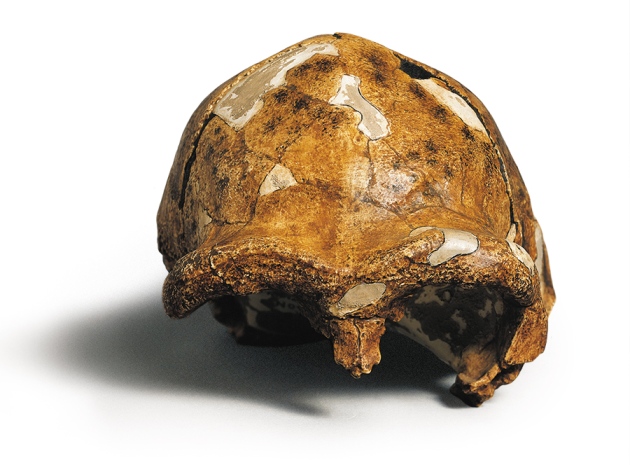
How China is rewriting the book on human origins

The reconstructed skull of Peking Man, the fossil that launched discussions of human origins in China.


Fossil finds in China are challenging ideas about the evolution of modern humans and our closest relatives.
12 July 2016
http://www.nature.com/news/how-china-is-rewriting-the-book-on-human-origins-1.20231


--


Oldest ancient-human DNA details dawn of Neanderthals
Sequence of 430,000-year-old DNA pushes back divergence of humans and Neanderthals.
14 March 2016
http://www.nature.com/news/oldest-ancient-human-dna-details-dawn-of-neanderthals-1.19557 [with comment]


--


in addition to (linked in) the post to which this is a reply and preceding and (other) following, see also (linked in):

http://investorshub.advfn.com/boards/read_msg.aspx?message_id=71728518 and preceding (and any future following)

http://investorshub.advfn.com/boards/read_msg.aspx?message_id=82566440 and preceding (and any future following)

http://investorshub.advfn.com/boards/read_msg.aspx?message_id=92494737 and preceding (and any future following)

http://investorshub.advfn.com/boards/read_msg.aspx?message_id=95210155 and preceding and following

http://investorshub.advfn.com/boards/read_msg.aspx?message_id=95553376 and preceding (and any future following)

http://investorshub.advfn.com/boards/read_msg.aspx?message_id=107495083 and preceding (and any future following)

http://investorshub.advfn.com/boards/read_msg.aspx?message_id=108436422 and preceding and following,
http://investorshub.advfn.com/boards/read_msg.aspx?message_id=108526643 and preceding and following

http://investorshub.advfn.com/boards/read_msg.aspx?message_id=109130818 and preceding (and any future following)

http://investorshub.advfn.com/boards/read_msg.aspx?message_id=111062469 and preceding (and any future following)

http://investorshub.advfn.com/boards/read_msg.aspx?message_id=111517899 and following

http://investorshub.advfn.com/boards/read_msg.aspx?message_id=111748492 and preceding (and any future following)

http://investorshub.advfn.com/boards/read_msg.aspx?message_id=112469581 and preceding and following

http://investorshub.advfn.com/boards/read_msg.aspx?message_id=113381741 and preceding and following

http://investorshub.advfn.com/boards/read_msg.aspx?message_id=121817509 and preceding (and any future following)

http://investorshub.advfn.com/boards/read_msg.aspx?message_id=128634774 and preceding (and any future following)

http://investorshub.advfn.com/boards/read_msg.aspx?message_id=131421027 and preceding (and any future following)