Russia should not control the flow of all Caspian oil but Russia has every right to get their own oil to market.
The strategic significance of Ukraine. Eighty percent of Russian gas and oil exports to Europe—its most important source of foreign exchange—flows through Ukrainian pipelines which is why Bush set out to take possession of Ukraine. #msg-4921554 http://www.eia.doe.gov/emeu/cabs/choke.html
Our grand strategists in Washington have turned to the legendary Caspian "Silk Road" to OIL riches, reviving the dream of a trans-Caucasian OIL pipeline that will fill the gas tanks of Europe, bring down prices rapidly – and hand over control of much of the world's hydrocarbons to U.S. corporate interests and their allies.
Forget all this melodramatic folderol about UKRAINE's "orange revolution" – and follow the money. The mythologizing of the Ukrainian "democratic" opposition serves certain Western economic interests, as John Laughland has pointed out:
"Efforts are being redoubled to crank into action the various pipelines which are supposed to transport Caspian OIL to Western markets. One of these is the Brody pipeline which runs between the Ukrainian town of that name and the Black Sea port of Odessa (a RUSSIAn city but also in UKRAINE). The Brody pipeline was initially supposed to take US-controlled Caspian OIL to Western markets, but it has instead been pumping RUSSIA OIL, something the Americans do not like. #msg-4674009
Russia has an alternative route in the Baltic Sea this also looks to be heating up. The Baltic Sea like the Black Sea is in the process of being surrounded by NATO. #msg-6643379
-Am
The Baltic Sea: A Second Persian Gulf?
by Benjamin Weissman The Moscow News In 2004 the volume of Russian oil shipped from Baltic ports has surpassed that of Black Sea shipping. While Russians are pleased with larger exports, their Baltic neighbors are less than happy
In January and February this year oil exports through Baltic ports were 11 percent higher than exports through the Black Sea terminals, a recent International Energy Agency report says. "The present tendency points to the Baltic Sea becoming the main export terminal for Russian oil," says David Fyfe, one of the report's authors. The report says that the main catalyst for the recent, and most probably sustained, growth in deliveries is the seaport of Primorsk (840,000 barrels per day). In addition, a further increase of 340,000 bpd will be seen once the LUKoil-controlled port at Vysotsk is opened at the end of spring. The result of the rapid growth should see oil exports from Russian ports on the Baltic Sea reach 3.4 mbpd, a prospect that does not exactly please Russia's neighbors.
The irritation culminated last week when the prime ministers of Estonia, Latvia, Lithuania, Denmark, Sweden, and Finland met, pledging to combine strengths to force Russia to sign a document to protect the Baltic Sea. The document essentially calls on Russia "to pledge to protect nature" and move towards double-hulled tankers.
The Baltic countries are not the first to demand that the oil-shipping industry move away from single-hulled craft. In fact, their move was nearly a mirror of a decision by the International Maritime Organization that called for shippers to discontinue using singled-hulled tankers after April 5 in favor of double-hulled vessels with a dead-weight over five tons. By 2010 the organization could call on its members to terminate using single-hulled tankers altogether.
Such a decision would put Baltic and Ukrainian shipping companies under great strain, as the majority of their fleets are single-hulled vessels. Russian companies are in a much better situation, as 90 percent of the ships belonging to the two largest Russian shipping companies, Sovkomflot and Novoship, have been refurbished to international standards.
Latvia, in particular, has more than just environmental problems with Russian shipping. Its main port at Ventspils has seen reductions in oil shipping for the past three years. In fact, from 2001 to 2002 Latvia's GDP was half a percentage point lower because Russian oil shipments fell from 22.3 million tons to 13.8 million. Vagit Alekperov, the head of LUKoil, explains that exports through what once was the main Soviet port on the Baltic have fallen because of "additional capacity to export oil through Russian ports." In other words, Russian oil companies do not have to pay tariffs when using their own ports.
"The main condition for Ventsilps' survival is investment of $100 to $200 million, which only Russian companies are capable of doing," says Valery Nesterov, an analyst with Troika-Dialog. That, explains David Fyfe, is unlikely to happen in the immediate future, considering the growing selection of Russian ports.
The Lithuanian port at Butinge faces a similar problem. The port's total oil shipping capacity is at least a third below estimated levels because an expected deal with Sibneft has fallen through. The port, however, is in better shape than its Latvian counterpart because it is 53 percent owned by LUKoil, thus guaranteeing oil shipments.
Russia has yet to respond officially to the Baltic countries' call, but as in any industry, the bottom line is the deciding factor. If Baltic and Nordic ports choose to close themselves to Russian exporters, this country's ships will find new buyers in other ports.
Russian Oil and Gas Export Pipelines/Ports Location: Russian oil and gas exports transit via pipelines that pass through Russia, Ukraine, Belarus, Hungary, Slovakia, the Czech Republic, and Poland, Major Oil Export Ports: Novorossiisk (Russia -- Black Sea); Primorsk (Russia -- Baltic Sea/Gulf of Finland); Tuapse (Russia); Ventspils (Latvia); Odessa (Ukraine) Major Oil Pipelines (capacity, 2003E): Druzhba (1.2 million bbl/d); Baltic Pipeline System/Primorsk (840,000 bbl/d) Major Natural Gas Pipelines (capacity, 2003E): Brotherhood, Progress, and Union (1 trillion cubic feet -- tcf -- capacity each); Northern Lights (0.8 tcf); Volga/Urals-Vyborg, Finland (0.1 tcf). Yamal (to Europe, via Belarus; 1.0 Tcf, partly operational); Blue Stream (to Turkey via Black Sea; 0.56 Tcf, construction completed in October 2002) Destination of Oil and Gas Exports: Eastern Europe, Netherlands, Italy, Germany, France, other Western Europe. Concerns/Background: Russia is a major supplier of crude oil and natural gas to Europe. All of the ports and pipelines are operating at or near capacity, leaving limited alternatives if problems arose at Russian export terminals. With a windfall in oil export tariffs over the past several years, Transneft, the state oil transport monopoly, has taken steps to upgrade the country's pipeline system, with an emphasis on building new export pipelines to increase and diversify export routes for oil exporters.
Nearly 90% of Russia's natural gas exports to Europe are routed through Ukraine. In an effort to diversify its export routes, as well as reach new markets, Russia is expanding its natural gas pipeline system. The Blue Stream pipeline to Turkey is the centerpiece of Russia's export diversification strategy. Construction on the 565-Bcf-capacity pipeline, which consists of twin pipelines laid on the bottom of the Black Sea, was completed in October 2002.
Haydarpasa is strategically located on the Bospourous Straits. The Bospourous Straits and the Baltic Sea are two pertinent avenues by which Russia ships oil to market.
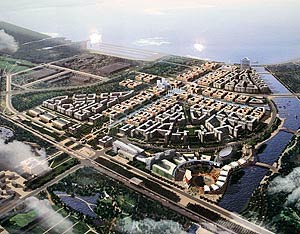
I see in this project a similarity with that of a Chinatown to be built right on the Baltic Sea in the Krasnoselsky district of St. Petersburg, a very strategic location with great military potential, in NATO’s face. This thing is huge and it is China’s first such endeavor. The Baltic Sea is important as it is a major expressway for Russian oil very much like the Bosphorus Straits where this new ‘private’ city is to be built.
St. Petersburg, Krasnoselsky
In the following text the protestors chant of closing Incirlik where the United States has stashed 90 nuclear bombs. They also compare the privatization to the invasion of Istanbul in 1918 when military ships stopped at the shores of Haydarpasa. #msg-6405164
Is the privatization of Haydarpasa a means to put this strategically located port in the hands of a foreign entity such as the United States in order to control the Bospourous Straits?
Incirlik was built in 1954 in Turkey's Adana province on the eastern Mediterranean coast
"H.Pasa" is the name of the domestic Istanbul train station (Haydarpasa).
-Am
Close Incirlik, not Haydarpasa
ISTANBUL - A protest rally against the privatization of the Haydarpasa Train Station and its surrounding area brought hundreds of people to Haydarpasa docks under the burning noon sun yesterday.
Participants wore t-shirts reading “We won't let Haydarpasa be invaded.”
The Istanbul branch of the Turkish Union of Engineers' and Architects' Chambers (TMMOB) and the Union of Transportation Employees organized the rally at Haydarpasa Train Station to protest against its privatization. Over 50 nongovernmental organizations (NGOs) of vocational unions and associations joined the call and participated along with representatives from six political parties.
The Istanbul TMMOB protested about the project, which concerns 4 million square meters of public property, including the Haydarpasa station and docks. If the project comes to fruition then the area will become a “World Trade Center and Cruise Dock” closed to the public. It will house a gated community of 1 million people, and seven skyscrapers will be erected in the area. Protestors also emphasized that 10,000 workers at the train station and the docks would lose their jobs.
The privatization was likened to the invasion of Istanbul in 1918 when military ships stopped at the shores of Haydarpasa. Statements underlined that “The legendary silhouette of Istanbul will be destroyed, and the city will be robbed of its historical and cultural value.”
The special Law No. 5234, widely known as the Haydarpasa decree, bequeaths the immovable public properties of Haydarpasa station and the dock area to the Turkish State Railways (TCDD) without charge. The TCDD was earlier included in the privatization program by the Supreme Board of Privatization (OYAK) by Law No. 5335, widely known as the “bag” law.
The Marmaray project also disconnects Haydarpasa from Istanbul and Anatolia's train and sea routes by connecting Harem to Sogutlucesme.
Under Law No. 5234, the Public Works and Housing Ministry has authority over all planning, approval, and license transactions. The same law states that municipalities will be notified about plans once they're finalized, and that implementation of the plans is obligatory.
Protestors called for Incirlik Airbase in Adana to be closed instead of Haydarpasa. Boats passing by Haydarpasa saluted the group by blowing their horns and received a great deal of applause.
Rail and sea workers and prominent figures from the arts were present at the meeting, where the music group Babazula also performed. Before the concert a member of Babazula said, “The first places to be shut down in war by enemies are docks and railways.”
Reference: Finally, the Turkish government cynically announced that they had "discovered" major environmental problems with letting huge oil tankers pass through the Bosphorus straits--the mouth of the Black Sea which they control. In other words, Turkey is threatening to stop oil-tankers from Novorossisk, which quickly made investors wary of building a pipeline that ended in Novorossisk.
BTC is projected to reach 1 million barrels a day - roughly 1.2% of global production. Compare it with the 500,000 barrels of the Caspian Pipeline Consortium, which moves crude from Baku to the Russian port of Novorossiysk.
Thus controlling the Bosphorus straits is a major factor in making the only pipeline that seemed practical the BTC and stopping Russia from getting her oil to market.


 Market Data
  Markets


 AI
AI