News Focus
News Focus
icon url

fastlizzy

06/28/11 7:54 AM

#145303 RE: fuagf #145301

We need signs like that one!!!
icon url

ordinarydude

06/28/11 9:29 AM

#145308 RE: fuagf #145301

"...President Nicolas Sarkozy told a news conference in Paris that French banks had reached a draft agreement with the authorities on a voluntary rollover of maturing bonds."

The EU is scared shitless, fuagf. They are covering all their bases in case the Greek government votes against the proposal.

"...But if other countries are drawn in through contagion, it could be bigger than Lehman.."

...to the tune of of some 300 billion Euro's (total bad debts accumulated with all the PIIGS). That's a LOT of money....

"...Defections over the past 13 months have cut Papandreou's support in the 300-member parliament to 155 seats, meaning a handful of votes could decide the issue, which may be further complicated if one bill passes and the other does not."

The problem with Greece is Greece. Nearly 80 years of bad governing, bad debts, a bloated government (55% of folks receive benefits or work for the Greek government), and poor decision making has finally come down to a crucial vote.

A vote, mind you, that will make little difference in the grand scheme of things. It will take at least a generation before any meaningful change will occur.

Ordinary
icon url

StephanieVanbryce

06/28/11 1:14 PM

#145338 RE: fuagf #145301

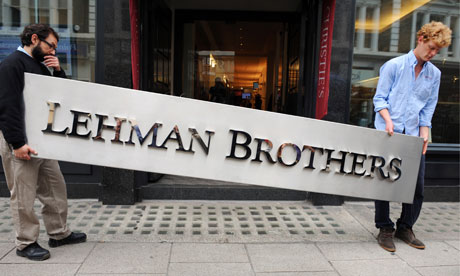
Greece is no Lehman Brothers

Politicians are using misguided comparisons in their efforts to ignore Europe's sick, undercapitalised banking system


Greece has been frequently compared to Lehman Brothers.

"If it is Greece alone, that's already big," Deutsche Bank's Ackermann said. "But if other countries are drawn in through contagion, it could be bigger than Lehman," he said, referring to the disastrous 2008 collapse of Wall Street investment bank Lehman Bros.

Raoul Ruparel Tuesday 28 June 2011 07.00 BST

The narrative now cemented in the public imagination that Greece could be the "next Lehman Brothers" is, for the most part, largely overblown. There's no doubt that a Greek default would be incredibly painful. But while on the surface the analogy may seem apt – two bankrupt, systemically important players in search of bailouts – dig a little deeper and it becomes clear that the comparison is misguided and even misleading.

Over the last few days, bankers, politicians and journalists have competed for the prize of most dramatic-sounding Lehman-style analogy. A Greek bankruptcy, said European Central Bank executive board member Jürgen Stark, could "overshadow the effects of the Lehman bankruptcy"; Gary Jenkins, head of fixed-income research at Evolution Securities, has warned that "Greece could become the next Lehman's as investors move from one target to the next, just like they did in the banking crises of 2008"; while the head of the Eurogroup, Jean-Claude Juncker, suggested that offering Athens debt relief is akin to "playing with fire".

But, beyond the headline-grabbing rhetoric, the comparisons simply don't stack up. Firstly, the majority of those peddling this myth have a significant vested interest in avoiding a Greek default or restructuring. It was the European Central Bank that first floated the Lehman analogy. Why? Sheer self-interest. By propping up Greek banks and the Greek state, the ECB has taken on €190bn worth of Greek assets, which would face radical write-downs should Greece default.

Many commercial banks across Europe have joined the chorus of scaremongers ("liquidity will dry up", "contagion will spread", "savings will be wiped out", etc) for much the same reason. The banks' passion for more bailouts is not altruistic, but stems from the desire to ensure that profits remain private, while losses continue to be socialised.

But here lies the crucial difference. Unlike with Lehman, both governments and the financial markets have had over a year to prepare for a potential Greek default, with plenty of warnings leading up to last year's (first) breaking point. Even as late as February this year, investors could have walked away from Greek bonds with only 20% losses (as they continued to trade at 80% of their nominal value) – a good deal considering the mess Greece is in.

Lehman was an opaque institution riddled with complex inconsistencies and, combined with its misleading accounting practices, there was no clear picture of who was truly exposed to a bankruptcy (everyone, as it turned out). Admittedly, Greece fudged its numbers in order to join the euro, and continued to massage them, but exposures to and holdings of Greek debt are reasonably well documented and understood by comparison.

On top of this, the Lehman crisis was the tip of a huge iceberg. It revealed banks' huge exposures to the US mortgage market – large parts of which turned out to be bust. Again, note the contrast to Greece. The problems with the eurozone periphery are well documented but are also country specific. A Greek default would not reveal a new hidden world of risk. Neither are the connections to Greek debt within Europe's banking sector as substantial, despite remaining opaque. But rather than finding new ways to safeguard banks' exposure to Greece, shouldn't we really be asking why these banks haven't reduced their exposure to Greece and deleveraged?

Let's not kid ourselves – contagion remains a real risk. But let's consider some further points here. Firstly, Ireland and Portugal's funding for the next two years has been secured by their bailout packages, which are already in place, so they're already out of the market. Although there will be impacts on secondary markets, the impact would be felt less directly by the countries' government finances.

Secondly, the EU's sickest banks are already heavily reliant on ECB support to stay afloat, which is itself a problem, but their situation can hardly worsen. In contrast to the Lehman situation, where credit and liquidity dried up immediately, the ECB has existing mechanisms in place to deal with this, which should help absorb the impact.

In addition, there has been contagion, even with the original bailouts, as most people see a Greek default as inevitable. Therefore, contagion is still a significant risk even with a second bailout, particularly if Greece fails to meet the tough austerity measures imposed on it (not unlikely given the domestic outrage and the continuing failure to meet the original bailout conditions). Under that scenario we could be stuck with a second failed €100bn-plus bailout and massive contagion, with taxpayers left to foot the bill.

Ultimately, if a country with a GDP of only 2.5% of the European economy can bring down the entire system, that's probably a sign that the system is fundamentally flawed. Regrettably, politicians are using the misguided comparisons with Lehman Brothers as an excuse to ignore and perpetuate Europe's real problem: an unhealthy, undercapitalised banking system and a monetary union based on the premise that political leaders' commitment alone could make economic and democratic realities disappear.

Now that's what you call playing with fire.


http://www.guardian.co.uk/commentisfree/2011/jun/28/greece-is-no-lehman-brothers


icon url

fuagf

07/21/11 4:20 AM

#148184 RE: fuagf #145301

The Real Reason Tax Cuts Won't Stimulate The Economy In The Short Term
Gregory White | Sep. 7, 2010, 2:59 PM | 1,585 | 35


President Obama is going to announce a sweeping set of new tax cuts .. http://www.businessinsider.com/obama-business-tax-break-2010-9 .. aimed at jump starting business in the U.S. and attacking the unemployment problem.

But they aren't going to do anything to stimulate the economy.

Right now, businesses and individuals aren't interested in spending money. This isn't because they find the situation in Washington unsettling, as some have suggested, [eg: Steve Wynn] but rather because they are too-deeply in debt themselves and want to start getting out.

The situation businesses say they are in, loaded with cash ready to spend, is not the reality. Instead, many businesses have assets that have fallen in value, even while liabilities have remained stagnant. Notably, real estate is at the core of this problem. And businesses certainly aren't interested in telling the market they have serious debt worries.

So instead of spending excess capital or record profits on new investment or new purchases, companies are paying down debt to clean up their positions.

Richard Koo explains this scenario at greater length here .. insert from link ..

"Richard Koo's Awesome Presentation That Explains Why Austerity In The US Is Insane" .. 3 of many charts ..


http://www.businessinsider.com/richard-koo-austerity-2010-7#-2 ..

and here. .. excerpt ..

"Koo follows on by saying that, yes, this will be a period of slow growth for the economy, no matter what. But
if we bring in austerity now, to tame U.S. government deficits, then we're likely to be in this mess much longer.

According to Koo, the U.S. government needs to engage in further stimulus now,
to speed up the process of U.S. corporations and individuals paying down their debt
."
http://www.businessinsider.com/richard-koo-balance-sheet-recession-2010-7 ..

This means that any tax cuts for new investment may hardly be used. Businesses aren't suddenly going to invest more money, when they are more concerned about their own balance sheets and those of potential consumers of their goods. And even if they do, their spending is liable to be more of a "cash for clunkers" .. http://www.businessinsider.com/obama-200-billion-tax-break-for-business-2010-9 .. scenario than something that can help the real economy.

The same goes for any proposed maintenance of the Bush Tax cuts, .. http://www.businessinsider.com/pter-orszag-on-extending-bush-tax-cuts-2010-9 .. which would just be pocketed or used to pay down debts on underwater mortgages by consumers. And, in some cases, those who may even be in good financial shape may elect to save money as their confidence is so low .. http://www.businessinsider.com/can-the-economy-even-recover-when-92-of-the-population-things-things-are-horrible-2010-9 .. in the future of the economy.

That means all that stimulus cash, in the form of tax rebates, will likely not go back into the real economy or create more jobs.

But there is a bright spot: All that cash WILL help companies and people pay down debt, which will help to drive the economy out of this deleveraging period at a faster rate. But it's going to take time.

The only entity that can spend right now to create a large amount of jobs right now is the U.S. government, and its $50 billion stimulus package not only falls short, but looks likely to fail. .. http://www.businessinsider.com/why-obamas-new-50-billion-infrastructure-stimulus-will-flop-on-every-level-2010-9 ..

Check out what a balance sheet recession is and why we're in one right now >
http://www.businessinsider.com/richard-koo-austerity-2010-7#-1

Please follow Business Insider on Twitter and Facebook.
Follow Gregory White on Twitter.
http://www.businessinsider.com/obama-tax-cuts-stimulus-2010-9


http://www.youtube.com/watch?v=HaNxAzLKegU