good info, can't dispute the reasoning but something is keeping Greece from pull out / default. May just be the fact that no one would lend to them for decades. But I have a feeling there is a contagion of Credit Default Swaps out there, probably multiples more in the last year. Banks aren't dumb but it's hard to break bad habits... SS
Commentators are preaching a panegyric over an empty coffin
Where have all the Europhiles gone? Almost overnight, politicians in all three parties have stopped defending the euro bailouts. The best Newsnight could manage yesterday was Richard Corbett, a Labour MEP who lost his seat at the last election and now works for Herman Van Rompuy.
Martin Kettle, one of the most committed Euro-enthusiasts in Fleet Street, has written a touchingly honest column in the Guardian, well worth reading in full, declaring that the EU is finished. Having ignored the crisis for 18 months, newspapers and broadcasters are, predictably enough, overcompensating. Correspondents who, a few weeks ago, were singing paeans to the euro are now chanting threnodies over its coffin.
Don’t get ahead of yourselves, gentlemen. It’s true that a Greek default is now inevitable. Indeed, on some definitions, it’s already happening. It doesn’t automatically follow, though, that the single currency will break apart. Just as California can go bankrupt without leaving the dollar, so Greece could theoretically restructure its debts without leaving the euro.
There is no question that Greece should leave the euro. To take the hit of a default without the accompanying advantage of a devaluation would elevate bad government to a whole new level. But never underestimate the EU’s Hideous Strength: its ability to make politicians act against their national interest. Most Eurocrats want the euro to hold together and, as they have amply demonstrated during the present crisis, they are prepared to pay almost any price – or rather, to demand that their peoples pay any price – to that end. Most Greek politicians, too, want to remain in the club. Like their counterparts elsewhere in the EU, they make the classic mistake of believing that, because the Brussels system has been kind to them personally, it must also be kind to their constituents.
“But the EU can’t carry on like this,” you say. No, it can’t, but that hasn’t stopped it yet. Again and again, we empirical British make the mistake of thinking that, because something can’t work, it won’t happen. It’s what we said about Soviet Communism and, of course, we were right. But it wouldn’t have been much fun to have been born in, say, Minsk in 1917 and lived through the process of it not working.
My best guess is that Greece will default within months, and that the monetary union will limp on – battered and cheapened, but intact. Such an outcome, after all, suits businesses in the contributor countries as well as Euro-integrationist politicians. As I’ve argued since the crisis began, the real threat to the peoples of Europe is not that the euro won’t hold together, but that it will. http://blogs.telegraph.co.uk/news/danielhannan/100093762/greece-will-default-but-the-euro-isnt-finished/ .. links inside ..
**********************
Can Europe escape the debt trap? Yes – and here's how
Today activists in Ireland are following Greece's example by launching a public audit of the country's debt to establish its legitimacy
Costas Lapavitsas and Andy Storey guardian.co.uk, Wednesday 4 May 2011 14.00 BST
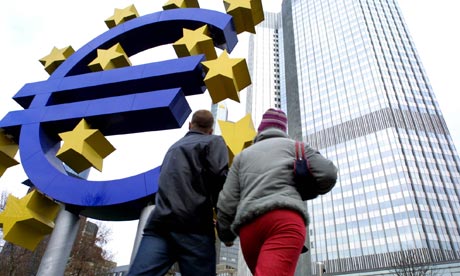
A euro sculpture in front of the European Central Bank building in Frankfurt, central Germany. Photograph: Michael Probst/AP
Financial markets have successfully demanded the imposition of severe austerity on the periphery of the eurozone – Greece, Ireland and Portugal – to deal with public debt. The markets have also raised concerns about it in the United States, Britain and Japan, clamouring for austerity. Public debt seems to operate like a mask behind which lies a shadowy world of creditors to whose upkeep entire economies are mortgaged.
Can that mask be lifted? It has been in other countries, through the mechanism of a debt audit. Initiatives like this have happened in Brazil, Ecuador and elsewhere in order to untangle the web of secrecy around the debt and work out who lent what to whom, when and for what purpose. Typically, there is an expectation that some, at least, of the debt, will be found to be "illegitimate", and can therefore be repudiated.
Ecuador provides a striking example. In 2007 President Correa established a debt audit commission, which reported in 2008 that a portion of the country's debt was indeed illegitimate and had done "incalculable damage" to Ecuador's people and environment. The price of illegitimate debt subsequently collapsed in the open markets, and Ecuador got rid of it easily.
Despite predictions of economic disaster the country registered 3.7% economic growth in 2010, and the forecast is for growth in excess of 5% in 2011. The salience of the Ecuadorian example for current debates in Europe is obvious.
This is why a campaign for a Greek audit commission was launched in March with the support of civil organisations, trade unions and political parties. One of its greatest successes has been the documentary Debtocracy, which has been watched by a million people. In a country that feels humiliated and dejected, the campaign has offered a modicum of hope. Such has been its popular appeal that, in a singularly ill-judged remark, a minister denounced it for equating Greece with "Latin American banana republics".
In an example of European solidarity several bodies, including Action from Ireland, the Irish Debt and Development Coalition and the trade union Unite, are, on 4 May, launching a debt audit in Ireland. Academics with expertise in economics, finance, law and related disciplines are being commissioned to trawl through the public accounts to tackle several questions. To whom is the bank debt owed? When was it contracted? Specifically, was it before or after the government's September 2008 bank guarantee was issued? When is the debt due for repayment? How much has already been repaid, and to whom?
Meanwhile the Greek campaign is taking steps to start its own investigations. What is the legal status of debt contracted with the helpful services of Goldman Sachs that presented public borrowing as a derivative transaction? How legal is debt to finance further arms procurement in one of the most militarised countries in the world? Above all, how legitimate is the extraordinary loan of €110bn by the European Union and the International Monetary Fund that it is claimed is needed to "bail out" the country – at the price of ferocious public spending austerity? The loan did not follow the normal procedure for contracting public debt, including approval by Greece's parliament.
These preliminary investigations will establish facts to further the demand for a full democratic audit and a sovereign response to debt. What is ultimately necessary is full access to debt data, the power to examine witnesses, and even the ability to examine bank accounts. On this basis properly constituted audit commissions could make credible recommendations on debt that is illegitimate or simply unsustainable. The sovereign state could then take appropriate action, including repudiation of debt and cessation of payments.
The campaigns for debt audits will also have an important educational function to perform across Europe. People in core countries, including Germany, seem not to have yet grasped that the loans provided by the EU and the IMF are not bailing out feckless Mediterraneans and Celts. In fact they are bailing out banks that engaged in profitable and irresponsible lending throughout the 2000s. And that will be a theme of a gathering of activists in Athens on 6-8 May. Participants from across the world will trade ideas on how to tackle European public debt. After more than three years of crisis, grassroots movements are at last emerging to oppose the grip of debt, austerity and neoliberalism across Europe. http://www.guardian.co.uk/commentisfree/2011/may/04/european-debt-crisis-audit-commission .. links inside ..
Just heard bonds had moved whichever way they would if investors were confident Greece would not default .. must be up ..
GREEK WOMAN: I've just finished the medical school here in Athens.
EMMA ALBERICI: And what are the job prospects like for you?
GREEK WOMAN: Nothing. There is - it's very difficult for a young doctor here in Greece to be employed and start his life with this job.
Most of my colleagues are working in other field and with very low wages.
EMMA ALBERICI: And no jobs in public hospitals?
GREEK WOMAN: No jobs in public hospitals because austerity measures have decreased a lot the money for the public health.
EMMA ALBERICI: What in particular are you protesting against?
GREEK MAN: Against the increase of the taxes, the decrease of salaries, pensions, everything.
EMMA ALBERICI: Something has to happen though, doesn't it? You can't get the money for free.
GREEK MAN: Yes of course, but actually we were not the ones who borrowed the money from other countries.
They knew that we were not strong economy as a country but they were still borrowing money and some politicians that we had all these years that were not very good for our country, so…
EMMA ALBERICI: Are you also suggesting that the Germans and the French should not have lent you the money?
GREEK MAN: Yes, of course. Because actually they knew that we were not a very strong economy as a country, so…
GREEK MAN II: How much can you take from people? I mean somebody else also has to be pay, isn't it true?
EMMA ALBERICI: You mean the richer in society?
GREEK MAN II: The government and the richer, yes, yes.
TONY EASTLEY: Protesters in Athens talking to our correspondent there, Emma Alberici.


 Market Data
  Markets


 AI
AI