News Focus
News Focus
icon url

StephanieVanbryce

05/02/11 7:05 PM

#138800 RE: F6 #138788

Osama bin Laden: Dead, but how did he hide so long?

Al-Qaida leader's death on its soil leaves Pakistan facing awkward questions


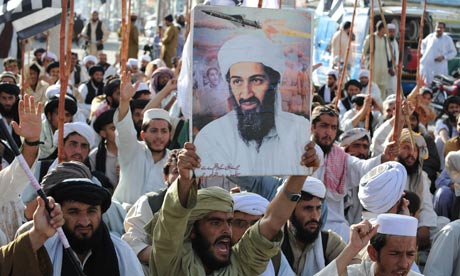
A protest in Quetta after the killing of Osama Bin Laden Photograph: Banaras Khan/AFP/Getty Images

Ewen MacAskill, Washington and Declan Walsh, Abbottabad Monday 2 May 2011 21.44 BST

The Obama administration is demanding an explanation from Pakistan on how Osama bin Laden was able to hide in the country for so long before he was killed by US special forces.

Bin Laden was staying in a prominent million dollar, high-security residence in an area full of soldiers and close to the country's premier military academy.

John Brennan, a counter-terrorism adviser to Barack Obama, told journalists at the White House: "People have been referring to this as hiding in plain sight. We are looking right how he was able to hide out there for so long."

He added it was "inconceivable" that Bin Laden did not enjoy a "support system" in Pakistan.

The al-Qaida leader was killed by US special forces who attacked the compound in Abbottabad, about 30 miles from Islamabad on Sunday, according to US officials. His body was taken by helicopter to a US aircraft carrier in the Arabian Gulf and buried at sea.

One of his adult sons was also killed, as was one of his four wives, whom the White House claimed had been used by Bin Laden as a shield.

Obama said: "The world is safer. It is a better place because of the death of Osama bin Laden."

Although Obama, Hillary Clinton, the secretary of state and Brennan all expressed the importance of Pakistan in helping to fight al-Qaida, the presence of Bin Laden so close to the capital and just streets away from the principal training ground for the country's officer corps threatened to create a fresh rift in already-strained US-Pakistan relations.

Such was the American distrust of the notoriously leaky Pakistan government that it did not even inform it of the raid in its own territory until after US helicopters had cleared Pakistani airspace.

Members of Congress threatened to withhold economic aid to Pakistan over the affair. Carl Levin, a Democrat who heads the powerful Senate armed services committee, reflected scepticism in the US about Bin Laden's ability to remain hidden in Pakistan."I think the Pakistani army and intelligence have a lot of questions to answer given the location, the length of time and the apparent fact that this facility was actually built for Bin Laden and its closeness to the central location of the Pakistani army," he told a press conference.

The US will step up pressure on Pakistan to hand over the Taliban leader, Mullah Omar and Bin Laden's deputy, Ayman al-Zawahiri, if they are in Pakistan. The death of Bin Laden could also lead to a rethink of the scale of the US involvement in Afghanistan.

Embassies, airports and defence bases were placed on high alert for possible retaliation by al-Qaida sympathisers. David Cameron warned the world still faced a threat from "extremist terrorism" but hailed a "massive step forward".

The mood in the US was one of celebration as Americans gathered at New York's Ground Zero, pleased finally to have retribution. Obama called it "a good day for America" that had made the world a safer place.

The White House and Pentagon provided fresh details of the mission by Navy Seals. Bin Laden was killed with a shot to the head, according to US officials.

Brennan denied that the special forces had been told not to capture him, only kill him. "If we had the opportunity to take him alive, we would have done that," he said.

Clinton, anxious not to alienate a partner that may yet be needed for actions against al-Qaida and the Taliban, emphasised America's "close co-operation" with Pakistan. She said: "In fact, co-operation with Pakistan helped lead us to Bin Laden and the compound in which he was hiding."

The Pakistan government welcomed the killing as "a major setback to terrorist organisations around the world".

But the former Pakistan president Pervez Musharraf reflected his country's unease over a breach of sovereignty. "America coming to our territory and taking action is a violation of our sovereignty," Musharraf told CNN.

"Handling and execution of the operation [by US forces] is not correct. The Pakistani government should have been kept in the loop."

Clinton suggested that US policy on Afghanistan would not shift but other officials hinted that the dynamics may have changed. The Pentagon only wants to see a token force of a few thousand withdrawn beginning in the summer but Obama may want a more significant reduction.

A senior Afghan government official said he feared the death would give "justification for US premature disengagement from the region".

It was a view echoed by Ahmed Wali Massoud, an Afghan politician and brother of Ahmed Shah Massoud, the legendary resistance fighter who was assassinated just two days before the September 11 attacks in 2001 on the orders of Bin Laden.

"Obviously this is a huge relief for our family that justice has been done, but it also raises other concerns," Massoud said. "Already the US has been thinking about shifting its policy on the war on terror and there is a risk that the American public will continue to question why their troops are still fighting there," he said.

One of the most senior American officers serving in Afghanistan, General William Caldwell, told the Guardian the death might encourage moderate elements within the Taliban to give up.


http://www.guardian.co.uk/world/2011/may/02/osama-bin-laden-pakistan-awkward-questions

.....excellent post F6, All three of them ......It's good to have them together like this as we can see
the little inconsistencies that are NOT certain YET ...to any of the writers ..
icon url

fuagf

05/02/11 10:19 PM

#138840 RE: F6 #138788

Obama and the End of Al-Qaeda
Posted on 05/02/2011 by Juan

All emphasis is mine.

An American president, himself the son of a Muslim father and a Christian mother, has taken down notorious terrorist Usama Bin Laden. Despite being a Christian, Obama, it seems to me, had a personal stake in destroying someone who had defamed the religion of his birth father and his relatives. His 2007-2008 presidential campaign was in part about the need of the US to refocus on the threat from al-Qaeda. He said that the Bush administration had taken its eye off the ball by running off to Iraq to pursue an illegal war and neglecting the eastern front, from which the US had been attacked, and where riposting was legitimate in international law. Obama began threatening to act unilaterally against al-Qaeda in Pakistan in August 2007, during the early period of the Democratic primary.

Ironically, Obama had to admit that Pakistani intelligence helped the US develop the lead that allowed the US to close in on Bin Laden. So the operation was not unilateral, and young candidate Obama was too over-confident. The US story that the Pakistanis were not given prior notice of the operation is contradicted by the Pakistani news channel Geo, which says that Pakistani troops and plainsclothesmen helped cordon off the compound in Abbotabad. CNN is pointing out that US helicopters could not have flown so far into Pakistan from Afghanistan without tripping Pakistani radar. My guess is that the US agreed to shield the government of Prime Minister Yousuf Raza Gilani and President Asaf Ali Zardari from al-Qaeda reprisals by putting out the story that the operation against Bin Laden was solely a US one. And it may be that suspect elements of the Pakistani elite, such as the Inter-Services Intelligence, were kept out the the loop because it was feared they might have ties to Bin Laden and might tip him off.

Usama Bin Laden was a violent product of the Cold War and the Age of Dictators in the Greater Middle East. He passed from the scene at a time when the dictators are falling or trying to avoid falling in the wake of a startling set of largely peaceful mass movements demanding greater democracy and greater social equity. Bin Laden dismissed parliamentary democracy, for which so many Tunisians and Egyptians yearn, as a man-made and fallible system of government, and advocated a return to the medieval Muslim caliphate (a combination of pope and emperor) instead. . The masses who rose up this spring mainly spoke of “nation,” the “people,” “liberty” and “democracy,” all keywords toward which Bin Laden was utterly dismissive. The notorious terrorist turned to techniques of fear-mongering and mass murder to attain his goals in the belief that these methods were the only means by which the Secret Police States of the greater Middle East could be overturned.

Dr Wahid Abd-al-Majid, an adviser at the Al-Ahram Center for Political Studies, spoke to al-Arabiya on April 15 about al-Qaeda no. 2 leader (and now no. 1) Ayman al-Zawahiri’s dismissive statement that all the Egyptian uprising had produced was an untrustworthy military junta. Since Egypt is moving toward parliamentary elections, al-Zawahiri’s description is a caricature. Abd al-Majid, said, “Al-Zawahiri wanted to declare a stance on what is happening in Egypt, especially when he saw the end of the road for Al-Qa’ida and religious violence, or violence that hides behind religion, in Egypt, because what the Egyptians accomplished peacefully negates any need or justification for violence in Egypt. Al-Zawahiri dreamt of being the one who topples President Husni Mubarak, only for the president to be toppled by the youth in a peaceful and democratic revolution that has absolutely no connection to Al-Qa’ida’s long-held claims.” (USG Open Source Center translation).

The son of a Yemeni immigrant to Saudi Arabia who went from rags to riches by doing construction and engineering work for the Saudi royal family, Usama Bin Laden grew up one of dozens of sons of a billionaire, in an absolute monarchy which maintains that the holy Qur’an itself is its only constitution. It wasn’t a system that dealt well with rebelliousness or dissent.

Unlike most of the Bin Ladens, who are worldly business-people (a niece, Wafa, posed provocatively for GQ) Usama was known as a serious and religious young man. At university in Jeddah he probably came under the influence of Abdullah Azzam, a radical Muslim fundamentalist of Palestinian heritage.

The Palestine issue helped radicalize Bin Laden. He and his circle in Afghanistan were obsessed with the Israeli occupation of Islam’s third holiest site, Jerusalem, and gave one another sermons about what they saw as a modern crusade against Muslims in that city. The perfidy of successive British governments in conquering Palestine, agreeing to its becoming a Class A League of Nations Mandate (i.e. a nation-state in training), but at the same time giving Palestine away to the international Zionist movement, had resulted in the end in the ethnic cleansing of most Palestinians and their reduction to the status of stateless refugees. But the religious Usama seemed to care most of all about the 1967 Israeli military occupation of all of Jerusalem, including the Muslim holy site of the Dome of the Rock. Although Israel may have been a democracy for Israelis, it was a foreign military occupying power in the Palestinian West Bank and the Gaza Strip, and ruled there with an iron fist.

In 1978, young officers made a Communist coup in Afghanistan. By fall of 1979 the enterprise had turned unstable because of faction-fighting among the officers. In December of 1979 Soviet dictator Leonid Brezhnev, perhaps baited by the Carter administration, sent in Soviet troops and began a brutal 8-year occupation of among the least developed and most poverty-stricken countries in the world.

The Reagan administration and the Democratic Congress took the small Carter administration program that supported a Muslim insurgency against the Soviets in Afghanistan and vastly expanded it, ultimately to the tune of billions of dollars. Reagan also twisted the arm of Saudi King Fahd to match US expenditures. Seven major Afghan guerrilla groups were fostered and given CIA training in camps. The Soviets fought back viciously. In that decade, perhaps a million Afghans were killed, 3 million were displaced to Pakistan, 2 million were displaced to Iran, and 2 million were displaced inside Afghanistan. In a country of, at that time, perhaps 15 million persons. It was Apocalypse Now, Kabul version. The two opponents were not attractive. The Communist regime was a cruel dictatorship. The Mujahidin were a mix of tribal and religious forces, but some groups were radical fundamentalists, as with the Hizb-i Islami or Islamic Party of Gulbuddin Hikmatyar, the most bloodthirsty of the Mujahidin. He got a lion’s share of the CIA money (he is today a die-hard opponent of the US whose men have killed many US troops in Afghanistan).

When Reagan convinced King Fahd to help get up a covert paramilitary to fight the Soviets (Reagan really liked private, unaccountable militias; he also backed them in Central America), Fahd had his ministers look around for a fundraiser who could get money from private sources in Saudi Arabia for the Arab volunteers to fight in Afghanistan. Usama Bin Laden was chosen, being a well-known socialite who also had a serious and religious side. Bin Laden jetted back and forth between the mosques of Saudi Arabia and the the Pakistani city of Peshawar, his headquarters in the struggle against the Soviets. The “Arab Afghans” who gathered around him may not have gotten direct CIA training for the most part, though some likely did, but they learned everything they needed to know about setting up cells and carrying out covert operations from the Afghans who had been through the CIA schools.

The Soviets completely withdrew from Afghanistan in late 1988 through early 1989. Soon thereafter, the Soviet bloc began collapsing.

Bin Laden was left without a task there in Afghanistan, and he returned to Jedda in Saudi Arabia. He gave a guest sermon at his mosque on the first Palestinian Intifada or uprising, and already had begun turning on his former ally, the United States, whom he blamed for enabling Israeli repression of the Palestinians. When Saddam Hussein invaded Kuwait in 1990, Bin Laden suggested to King Fahd that he be allowed to gather together his old gang of Arab Afghans to push Saddam back out. King Fahd wisely rejected the idea of having a bunch of scruffy Mujahidin crawling all over his country. The crisis had been provoked by a Baathist president-for-life, Saddam Hussein, another dictator acting arbitrarily. That Fahd instead brought in non-Muslim Westerners to do the job stuck in Bin Laden’s craw. A couple of years later he went to the Sudan and began his career as a terrorist. Then the US pressured Sudan to expel him, and he went to Afghanistan. He initially hooked up with his old Mujahidin buddies, but he was introduced to Mulla Omar, leader of the Taliban, and ultimately became very close to him.

They were all dictatorships– the Soviet Union, the Communist government of Afghanistan, Saudi Arabia, Iraq, Sudan, and the Taliban. Usama learned to take the law into his own hands because he had no other way to effect change. He wanted to see the region’s dictatorship overthrown in favor of his renewed Islamic Caliphate. It was a crackpot, fringe, pipe dream, but he brought to the aspiration all the experiences and training he and his men had learned during the Reagan Jihad against the Soviets. Then he and his number two man, Egyptian Ayman al-Zawahiri, came to the conclusion that the reason they could not overthrow the governments of Egypt (Hosni Mubarak’s dictatorship) and Saudi Arabia and so forth was that these were backed by the United States. They decided it had been a mistake to hit the “near enemy” first. They decided to hit the “far enemy” on American soil. Bin Laden thought that if only he could entice the US into the Middle East, he could do to it what he thought he had done to the Soviet Union.

Hence the horrific attacks on the US of September 11, 2001.

It was those attacks that created Informed Comment. I started it in spring of 2002 initially to cover al-Qaeda and to present analysis about how to defeat it. Like all Americans, I was personally devastated by September 11. I was depressed for a year. I felt it in distinctive ways because I had lived nearly 10 years in the Greater Middle East. Most of that time I was a student or, later on, academic researcher. But although I studied history, I was living in the present. I had been in Egypt in the late 1970s when Ayman al-Zawahiri’s Egyptian Islamic Jihad began becoming notorious. I lived in Pakistan off and on in the early 1980s and went up to Peshawar and talked with Mujahidin.

I supported the first phase of the Afghanistan War, which involved a light Western footprint in that country. There were 40 al-Qaeda training camps, which produced thousands of potential terrorists, and if they had not been destroyed they would have gone on manufacturing threats to the US. I discovered that there was a lot of good information on the Arabic internet about al-Qaeda, and I paraphrased the reports I thought significant. I began being invited to private security conferences in Washington, sponsored by think tanks at the request of government agencies, where the audience was typically inter-agency. There, I presented my analyses of al-Qaeda along with other academics and security experts. I hoped that the insights might be useful to State Department, Pentagon, CIA, DIA and other officials on the front lines of dismantling al-Qaeda. I had opposed the Vietnam War, something that had been painful for my father, who was a 20-year man in the army. But if the US government could benefit from my studies of al-Qaeda and other radical fringe movements trying to hurt Americans, I was just delighted.

(Just a note: I often challenged Washington orthodoxies, the honoraria were small, and I was only invited a few times a year, so the suggestion of some of my detractors that I sold out by doing these presentations is frankly silly. I just want my government to be as informed as it can be, and I’ll tell them the same things I tell the peace groups who also invite me to speak. If I had wanted to sell out, I could have formed a consultancy and purveyed the party line and made big bucks).

I was deeply dismayed when it became apparent that the Bush administration intended to use September 11 as a pretext to launch an illegal invasion of Iraq. I thought it was most unwise, and would be seen as an act of neo-imperialism and resisted. I told friends that if the UN Security Council voted against it, and Bush proceeded, I’d be out in the streets protesting. But then the UNSC never really was given a chance to vote, and Bush ran off to war. I prefer peace to war, but am not a pacifist. I don’t believe the use of military force is always wrong or counter-productive. I am from an army family after all. But I do believe that wars should be like abortion: rare and legal. The UN was established after the horrors of the Axis in WW II in an attempt to deploy collective security to stop the practice of aggressive wars of conquest and annexation. President Dwight Eisenhower invoked the UN Charter when he made Britain, France and Israel withdraw from Egypt in 1956-1957. By waging a war that was neither in self-defense nor authorized by the UNSC, in contravention of the UN Charter (a treaty to which the US is signatory), W. and Dick Cheney were throwing away the achievement of the founders of the UN, and returning us to the international jungle, where the strong fall upon the weak with no framework of law.

I was also dismayed by the propagandistic way the White House promoted its war on and then occupation of Iraq. They only had two speeds, progress and slow progress. A big bombing that killed hundreds was “slow progress.” Fantastic historical analogies were trotted out. The reality was obscured. Since I know Arabic, I read the multiplying Iraqi newspapers on the web, watched Arabic satellite t.v., developed correspondents in Iraq, and tried to describe the situation more realistically at this blog. Interestingly, I still got invited to Washington to speak to audiences of security and intelligence personnel. Then-senator Joe Biden asked me to testify on Iraq before the Senate Foreign Relations Committee. And I even got invited to share my (pessimistic) views with the British foreign ministry, the French foreign ministry, the Japanese Institute of Middle East Economies, etc., etc. Not to mention a lot of correspondence with people in similar institutions in other countries.

What pained me most of all, aside from the sheer scale of destruction in Iraq set off by Bush’s illegal and ill-considered adventurism, was that the Iraq War clearly gave al-Qaeda an opening to grow and expand and recruit. I think if Bush had gone after Bin Laden as single-mindedly as Obama has, he would have gotten him, and could have rolled up al-Qaeda in 2002 or 2003. Instead, Bush’s occupation of a major Arab Muslim country kept a hornet’s nest buzzing against the US, Britain and other allies.

Now that Obama has eliminated the monster Usama Bin Laden and vindicated the capability of the United States to visit retribution on its dire enemies, he can do one other great good for this country abroad. He can get us out of Iraq altogether. The US military presence there is the fruit of a poisonous tree. It will always provoke Iraqi Muslim activists, whether Sunni or Shiite or secular nationalist. And it angers the whole Arab world.

The Arab Spring has demonstrated that the Arab masses yearn for liberty, not thuggish repression, for life, not death and destruction, for parliamentary democracy, not theocratic dictatorship. Bin Laden was already a dinosaur, a relic of the Cold War and the age of dictators in which a dissident such as he had no place in society and was shunted off to distant, frontier killing fields. The new generation of young Arabs in Egypt and Tunisia has a shot at a decent life. Obama has put the US on the right side of history in Tunisia, Egypt, Syria and Libya (where I see crowds for the first time in my life waving American flags). People might want a little help from a distance, but they don’t want to see Western troops deployed in fighting units on their soil.

If Obama can get us out of Iraq, and if he can use his good offices to keep the pressure on the Egyptian military to lighten up, and if he can support the likely UN declaration of a Palestinian state in September, the US will be in the most favorable position in the Arab world it has had since 1956. And he would go down in history as one of the great presidents. If he tries to stay in Iraq and he takes a stand against Palestine, he risks provoking further anti-American violence. He can be not just the president who killed Bin Laden, but the president who killed the pretexts for radical violence against the US. He can promote the waving of the American flag in major Arab cities. And that would be a defeat and humiliation for Bin Laden and Al-Qaeda more profound than any they could have dreamed.

http://www.juancole.com/2011/05/obama-and-the-end-of-al-qaeda.html
icon url

fuagf

05/03/11 12:41 AM

#138861 RE: F6 #138788

The Status of al-Qaida Leaders
VOA News May 02, 2011

Related Articles

Al-Qaida Expected to Try to Avenge bin Laden’s Death
http://www.voanews.com/english/news/usa/Al-Qaida-Expected-to-Try-to-Avenge-bin-Ladens-Death-121128044.html
Bin Laden Operation Combined Intelligence and Military Capabilities
http://www.voanews.com/english/news/usa/Bin-Laden-Operation-Combined-Intelligence-and-Military-Capabilities-121122469.html
US: Bin Laden Would Have Been Taken Alive If Possible
http://www.voanews.com/english/news/usa/US-Bin-Laden-Would-Have-Been-Taken-Alive-If-Possible-121115434.html

KILLED:

Osama bin Laden, Saudi. Al-Qaida founder. Killed by U.S. forces in a raid on a compound in the Pakistani city of Abbottabad on May 2, 2011.

Abu Laith al-Libi, Libyan. Al-Qaida operative. Killed in a U.S. missile strike in northwest Pakistan on January 29, 2008.

Omar al-Farouq, Kuwaiti. Al-Qaida operations chief for Southeast Asia. Killed by British troops in Basra, Iraq on September 25, 2006 after he escaped from a maximum security prison in Afghanistan in 2005.

Abu Musab al-Zarqawi, Jordanian. Al-Qaida in Iraq leader. Killed in a U.S. air strike north of Baghdad on June 7, 2006.

CAPTURED:

Ramzi bin al-Shibh, Yemeni. 9/11 planner. Captured in Pakistan on September 11, 2002. Held at U.S. prison at Guantanamo Bay, Cuba.

Abu Faraj al-Libbi, Libyan. Senior al-Qaida operative. Captured near the northwestern Pakistani city of Mardan on May 4, 2005. Suspected of involvement in assassination attempts on Pakistan's then-military president General Pervez Musharraf. Held at U.S. prison at Guantanamo Bay, Cuba.

Khalid Shaikh Mohammed, Kuwaiti. Suspected 9/11 mastermind. Captured by Pakistani and U.S. operatives in the Pakistani city of Rawalpindi on March 1, 2003. Held at U.S. prison at Guantanamo Bay, Cuba.

Abd al-Rahim al-Nashiri, Saudi. Al-Qaida operations chief in the Gulf region. Captured in the United Arab Emirates in October 2002. Suspected of planning the October 12, 2000 bombing of the USS Cole that killed 17 U.S. sailors off the coast of Yemen. Held at U.S. prison at Guantanamo Bay, Cuba.

Abu Zubaydah, Palestinian. One of Osama bin Laden's top lieutenants. Captured in Pakistan on March 28, 2002. Held at U.S. prison at Guantanamo Bay, Cuba.

AT LARGE:

Ayman al-Zawahiri, Egyptian. Age - 59. Bin Laden's deputy. Suspected of playing a major role in the September 11th, 2001 terrorist attacks on the United States. Went into hiding with bin Laden when U.S.-led forces invaded Afghanistan weeks later, ousting the country's Taliban militant rulers, who had sheltered the terror network. Survived a U.S. air strike that targeted him in a Pakistani tribal region in January 2006 and remains at large. FBI has a $25 million reward for information leading to his arrest or conviction.

Abdullah Ahmed Abdullah, Egyptian. Age - late 40s. Wanted by the FBI for the 1998 bombings of the U.S. embassies in Kenya and Tanzania. U.S. investigators say he fled Nairobi, Kenya in August 1998 and went to Karachi, Pakistan. FBI has offered a $5 million reward for information leading to his arrest or conviction.

Saif al-Adel, Egyptian. Age about 50. Suspected high-ranking al-Qaida member wanted by the FBI in connection with 1998 bombings of the U.S. embassies in Kenya and Tanzania. FBI has offered a $5 million reward for information leading to his arrest or conviction.

Anwar al-Awlaki, US/Yemeni citizen. 40 years old. Radical Islamic preacher. Suspected leader of al-Qaida in the Arabian Peninsula. Accused of inspiring a series of attacks on the United States in recent years. Identified by the U.S. Treasury Department as a "Specially Designated National" whose U.S. assets are blocked. Not on the FBI's most wanted terrorist list.

Adam Yahiye Gadahn. American convert to Islam. Age 32. Known as al-Qaida's "American spokesman." Charged in a U.S. court with treason and providing material support to al-Qaida. FBI has offered a $1 million reward for information leading to his arrest.

Sulaiman Abu Ghaith, Kuwaiti. Al-Qaida spokesman and radical preacher. Stripped of Kuwaiti citizenship in 2001 for alleged involvement in 9/11. Fled to Iran, where the government said it detained him in 2003. Kuwaiti media said Iran allowed him to leave the country in 2010.

Ali Saed Bin Ali El-Hoorie, Saudi. Age 45. Suspected member of Saudi Hizballah terrorist group. Charged in a U.S. court with involvement in the June 25, 1996 bombing of the Khobar Towers military housing complex in Saudi Arabia that killed 19 U.S. personnel.

Anas al-Liby (also known as Nazih Abdul-Hamed al-Raghie), Libyan. Age late 40s. Charged in a U.S. court with involvement in the 1998 bombings of the U.S. embassies in Kenya and Tanzania. FBI has offered a $5 million reward for information leading to his arrest or conviction.

Fazul Abdullah Mohammed, Comoros Islands national. Age late 30s. Al-Qaida leader in East Africa suspected of links to Somali Islamists. Wanted by the FBI in connection with the 1998 bombings of the U.S. embassies in Kenya and Tanzania. FBI has offered a $5 million reward for information leading to his arrest or conviction.

Fahd Mohammed Ahmed al-Quso, Yemeni. Age 36. Charged in a U.S. court with involvement in the October 12, 2000, bombing of the USS Cole that killed 17 U.S. sailors off the coast of Yemen. FBI has offered a $5 million reward for information leading to his arrest or conviction.

http://www.voanews.com/english/news/middle-east/The-Status-of-al-Qaida-Leaders-121117689.html

/////////////////////

Potential al-Qaida leaders after Osama bin Laden's death .. 8 slides ..


# 1 - Ayman al Zawahiri .. AP Photo/IntelCenter

Ayman al-Zawahiri serves as al-Qaida's chief commander. He led the organization while Osama bin-Laden remained in hiding. According to the Federal Bureau of Investigation's most wanted terrorist list, Zawahiri is an Egyptian physician who founded the Egyptian Islamic Jihad (EIJ), which seeks to overthrow the Egyptian Government by violent means. The EIJ eventually merged with al-Qaeda. He considered a contender for the position as the new leader of al-Qaida.


# 2 - Saif al-Adel .. Image released by the FBI

Saif al-Adel succeeded Mohamed Atef as al-Qaida's chief military strategist, making him one of al-Qaida's top operatives. Saif al-Din is also thought to be associated with the Egyptian Islamic Jihad (EIJ). He allegedly wanted to fly a plane into the Egyptian Parliament. He provided military training to al-Qaeda in various countries such as Afghanistan, Pakistan and Sudan. He also trained anti-UN Somali tribes and established an al-Qaida training facility in Ras Kamboni, Somalia.


# 3 - Abu Yahya al-Libi .. Associated Press

Abu Yahya al-Libi is not only a high-ranking member of al-Qaida, but is also believed to be a member of the Libyan Islamic Fighting Group. Al-Libi escaped from an American prison in Afghanistan, and his fame amongst jihadists has been increasing since. It was thought that al-Libi was killed by a U.S. Drone strike in Pakistan in 2009, but the body was later identified as someone else.

As a cleric, he is considered to be "the scholar" of al-Qaida and takes on the role
of preacher. Al-Libi has released a number of video sermons in an attempt to recruit.


# 4 - Sulaiman Abu Ghaith .. AP Photo/Al Jazeera

Sulaiman Abu Ghaith is the official spokesman for al-Qaida. No one knows where he is currently. He was allegedly imprisoned in Iran, but Kuwaiti officials speculate that he was released to return to Afghanistan. After being banned from giving sermons at a mosque in Kuwait, he became a high school religion teacher. He left Kuwait for Afghanistan where he met Osama bin-Laden and joined al-Qaida in 2000.

In the photo: (From left) Sulaiman Abu Ghaith, Osama bin Laden, Ayman al-Zawahiri, Muhammad Atef

# 5 - Mahfouz Ould al-Walid .. no image available

Though the United States government has reported his death twice, al-Walid, a veteran of the Soviet war in Afghanistan, is thought
to be alive and possibly in Iran. He is said to be one of bin-Laden's top aides and has been sought out since the Sept. 11 attacks.

# 6 - Ahmad Mohammad ali al-hada .. no image available

Ahmad Mohammad ali al-Hada is the head of a large family whose members were involved
in the Sept. 11 attacks. He has been described as "a prominent al-Qaida member."

# 7 - Abu Ubeid al-Qurashi .. no image available

According to an MSNBC.com report on terrorism in 2008, al-Qurashi was an aide to
bin-Laden and sees himself as an al-Qaida intellectual, propagandist and writer.


# 8 - Fazul Abdullah Mohammed .. AP Photos/Files

Fazul Abdullah Mohammed is said to be the head of al-Qaeda in East Africa.
Mohammed is wanted in connection with a bombing of a US Embassy in 1998.
http://www.deseretnews.com/top/150/1369/Potential-al-Qaida-leaders-after-Osama-bin-Ladens-death-Fazul-Abdullah-Mohammed.html
icon url

fuagf

05/03/11 1:58 AM

#138865 RE: F6 #138788

President Barack Obama and Vice President Joe Biden, along with members of the national security team,
receive an update in the situation room of the White House, as the mission to kill Osama bin Laden unfolded.


Obama and National Security Adviser Tom Donilon during a meeting in the White House's Situation Room.


Obama in the Situation Room


Obama edits his remarks in the Oval Office prior to making a televised statement detailing the mission that resulted
in the death of bin Laden.

9 slides


icon url

StephanieVanbryce

05/04/11 7:09 PM

#139147 RE: F6 #138788

Bin Laden Raid Revives Debate on Value of Torture


The discussion of what led to Bin Laden’s demise has revived a national debate about torture that raged during the Bush years. A rally against torture was held in Washington in 2008.

By SCOTT SHANE and CHARLIE SAVAGE May 3, 2011

WASHINGTON — Did brutal interrogations produce the crucial intelligence that led to the killing of Osama bin Laden?

As intelligence officials disclosed the trail of evidence that led to the compound in Pakistan where Bin Laden was hiding, a chorus of Bush administration officials claimed vindication for their policy of “enhanced interrogation techniques” like waterboarding.

Among them was John Yoo, a former Justice Department official who wrote secret legal memorandums justifying brutal interrogations. “President Obama can take credit, rightfully, for the success today,” Mr. Yoo wrote Monday in National Review, “but he owes it to the tough decisions taken by the Bush administration.”

But a closer look at prisoner interrogations suggests that the harsh techniques played a small role at most in identifying Bin Laden’s trusted courier and exposing his hide-out. One detainee who apparently was subjected to some tough treatment provided a crucial description of the courier, according to current and former officials briefed on the interrogations. But two prisoners who underwent some of the harshest treatment — including Khalid Shaikh Mohammed, who was waterboarded 183 times — repeatedly misled their interrogators about the courier’s identity.

The discussion of what led to Bin Laden’s demise has revived a national debate about torture that raged during the Bush years. The former president and many conservatives argued for years that force was necessary to persuade Qaeda operatives to talk. Human rights advocates, and Mr. Obama as he campaigned for office, said the tactics were torture, betraying American principles for little or nothing of value.

Glenn L. Carle, a retired C.I.A. officer who oversaw the interrogation of a high-level detainee in 2002, said in a phone interview Tuesday, that coercive techniques “didn’t provide useful, meaningful, trustworthy information.” He said that while some of his colleagues defended the measures, “everyone was deeply concerned and most felt it was un-American and did not work.”

Obama administration officials, intent on celebrating Monday’s successful raid, have tried to avoid reigniting a partisan battle over torture.

“The bottom line is this: If we had some kind of smoking-gun intelligence from waterboarding in 2003, we would have taken out Osama bin Laden in 2003,” said Tommy Vietor, spokesman for the National Security Council. “It took years of collection and analysis from many different sources to develop the case that enabled us to identify this compound, and reach a judgment that Bin Laden was likely to be living there.”

From the moment the first Qaeda suspects were captured, interrogators at both the military’s prison at Guantánamo Bay, Cuba, and the C.I.A.’s secret prisons were focused on identifying Qaeda members who served as couriers.

“We knew that it was likely that if we were ever to get Osama bin Laden, it would be because we somehow came upon somebody closely associated with him that he trusted,” said Charles D. Stimson, the top Pentagon official on detainee affairs from 2004 to 2007.

In 2002 and 2003, interrogators first heard about a Qaeda courier who used the nom de guerre Abu Ahmed al-Kuwaiti, but his name was just one tidbit in heaps of uncorroborated claims.

After the capture in March 2003 of Mr. Mohammed, the chief planner of the Sept. 11, 2001, attacks, he was subjected to the most harrowing set of the so-called enhanced measures, which included slamming prisoners into walls, shackling them in stress positions and keeping them awake for as long as 180 hours. Like two other prisoners, he was subjected to waterboarding.

According to an American official familiar with his interrogation, Mr. Mohammed was first asked about Mr. Kuwaiti in the fall of 2003, months after the waterboarding. He acknowledged having known him but said the courier was “retired” and of little significance.

In 2004, however, a Qaeda operative named Hassan Ghul, captured in Iraq, gave a different account of Mr. Kuwaiti, according to the American official. Mr. Ghul told interrogators that Mr. Kuwaiti was a trusted courier who was close to Bin Laden, as well as to Mr. Mohammed and to Abu Faraj al-Libi, who had become the operational chief of Al Qaeda after Mr. Mohammed’s capture.

Mr. Kuwaiti, Mr. Ghul added, had not been seen in some time — which analysts thought was a possible indication that the courier was hiding out with Bin Laden.

The details of Mr. Ghul’s treatment are unclear, though the C.I.A. says he was not waterboarded. The C.I.A. asked the Justice Department to authorize other harsh methods for use on him, but it is unclear which were used. One official recalled that Mr. Ghul was “quite cooperative,” saying that rough treatment, if any, would have been brief.

Armed with Mr. Ghul’s account of the courier’s significance, interrogators asked Mr. Mohammed again about Mr. Kuwaiti. He stuck to his story, according to the official.

After Mr. Libi was captured in May 2005 and turned over to the C.I.A., he too was asked. He denied knowing Mr. Kuwaiti and gave a different name for Bin Laden’s courier, whom he called Maulawi Jan. C.I.A. analysts would never find such a person and eventually concluded that the name was Mr. Libi’s invention, the official recalled.

Again, the C.I.A. has said Mr. Libi was not waterboarded, and details of his treatment are not known. But anticipating his interrogation, the agency pressured the Justice Department days after his capture for a new set of legal memorandums justifying the most brutal methods.

Because Mr. Mohammed and Mr. Libi had both steered interrogators away from Mr. Kuwaiti, C.I.A. officials concluded that they must be protecting him for an important reason.

“Think about circles of information — there’s an inner circle they would protect with their lives,” said an American official who was briefed on the C.I.A. analysis. “The crown jewels of Al Qaeda were the whereabouts of Bin Laden and his operational security.”

The accumulating intelligence about Mr. Kuwaiti persuaded C.I.A. officials to stay on his trail, leading to the discovery of his real name — which American officials have not disclosed — and whereabouts. He in turn unwittingly led the agency to Bin Laden’s lair, where Mr. Kuwaiti and his brother were among those who died in Monday’s raid.

Before a day had passed, the torture debate had flared. The chairman of the House Homeland Security Committee, Representative Peter T. King, Republican of New York, told Fox News that the success of the hunt for Bin Laden was due to waterboarding. The next morning, Senator Dianne Feinstein, Democrat of California and chairwoman of the Senate Intelligence Committee, said just as flatly that “none of it came as a result of harsh interrogation practices.”

This Same Information has been concluded formerly on May 2 2011 by several detail orientated people who have followed The Torture lines from the very beginning. I will list a few of them here:

The First ONE being the Post that I am responding to.

Joan McCarter May 2, 2011 - [ http://www.dailykos.com/story/2011/05/02/972427/-Waterboarding-did-not-reveal-OsamabinLadentrail ]

Marcy Wheeler May 2, 2011 - [ http://emptywheel.firedoglake.com/2011/05/02/the-osama-bin-laden-trail-shows-waterboarding-didnt-work/ ]

Truly, there are too many to mention. I'm leaving it at that


http://www.nytimes.com/2011/05/04/us/politics/04torture.html?_r=1&hp

..........Just a side note, I still don't see the NYT using the word torture in a declarative sentence ..The word Torture is on their photo..They go on to say .."Obama called it ________"..but I still couldn't find YET where the NYT used the word torture as IF it was a fact that was accepted .. A Fact that WE DID TORTUE people during the Bush Years and That Torture is AGAINST our LAWS AND against International LAW.... oh well. maybe someday
icon url

F6

05/27/11 2:29 AM

#141338 RE: F6 #138788

a tie-in re the bin Laden raid:

(items linked in) http://investorshub.advfn.com/boards/read_msg.aspx?message_id=50730667 and preceding and following

icon url

F6

08/15/11 8:03 AM

#151501 RE: F6 #138788

Tomgram: Nick Turse, Uncovering the Military's Secret Military

Posted by Nick Turse [ http://www.tomdispatch.com/authors/nickturse/ ] at 6:21pm, August 3, 2011.

In “Getting bin Laden [ http://www.newyorker.com/reporting/2011/08/08/110808fa_fact_schmidle?currentPage=all ],” Nicholas Schmidle’s New Yorker report on the assault on Osama bin Laden’s compound in Abbottabad, Pakistan, here’s the money sentence, according to [ http://www.wired.com/dangerroom/2011/08/u-s-commandos-raid-pakistan-all-the-time/ ] Noah Shachtman of Wired Magazine’s Danger Room blog: “The Abbottabad raid was not DEVGRU’s maiden venture into Pakistan, either. The team had surreptitiously entered the country on ten to twelve previous occasions, according to a special-operations officer who is deeply familiar with the bin Laden raid.” DEVGRU is the acronym for the Naval Special Warfare Development Group, better known as SEAL Team Six (think “SEAL-mania [ http://www.msnbc.msn.com/id/43044332/ns/us_news-life/t/seal-mania-grips-us-wake-bin-laden-raid/ ]”), the elite special operations outfit that killed bin Laden.

His assassination -- and Schmidle’s piece makes clear that his capture was never an objective -- brought on a blitz of media coverage. But without reading that single, half-buried sentence, who knew that the same SEAL team had been dropped into Pakistan to do who knows what 10 to 12 times before the bin Laden mission happened? Not most Pakistanis, nor 99.99% of Americans, myself included. Keep in mind that this was only a team of 23 elite troops (plus a translator and a dog). But there are now about 20,000 full-time special operations types, at least 13,000 [ http://www.washingtonpost.com/wp-dyn/content/article/2010/06/03/AR2010060304965.html ] of them deployed somewhere abroad at this moment. In other words, we simply don’t know the half of it. We probably don’t know the tenth of it -- neither the breadth or number of their missions, nor the range of their targets [ http://www.nytimes.com/2011/08/02/world/middleeast/02iraq.html ]. According to Schmidle again, on the day of the bin Laden raid, special operations forces in nearby Afghanistan conducted 12 other “night raids.” Almost 2,000 of them have been carried out in the last couple of years.

These are staggering figures. And since we didn’t know that U.S. special operations forces were secretly conducting Pakistan missions in such numbers, it might be worth asking what else we don’t know. Former Secretary of Defense Donald Rumsfeld, speaking to the press in 2002 about the lack of evidence linking Saddam Hussein’s Iraq to the 9/11 attacks, made a famous (or infamous) distinction [ http://en.wikipedia.org/wiki/There_are_known_knowns ] among “known knowns,” (things we know we know), “known unknowns” (things we know we don’t know), and “unknown unknowns” (things we don’t know we don’t know). How apt those “unknown unknowns” turn out to be when it comes to the ever-expanding special operations forces inside the U.S. military.

Think of them, in fact, as the unknown unknowns of twenty-first century American warfare. Fortunately, thanks to TomDispatch regular [ http://www.tomdispatch.com/archive/175393/nick_turse_obama%27s_reset ] Nick Turse, we now have a far better idea of the size and scope of the global war being fought in our name by tens of thousands of secret warriors fighting “in the shadows.” Tom

*

A Secret War in 120 Countries

The Pentagon’s New Power Elite


By Nick Turse

Somewhere on this planet an American commando is carrying out a mission. Now, say that 70 times and you’re done... for the day. Without the knowledge of the American public, a secret force within the U.S. military is undertaking operations in a majority of the world’s countries. This new Pentagon power elite is waging a global war whose size and scope has never been revealed, until now.

After a U.S. Navy SEAL put a bullet in Osama bin Laden’s chest and another in his head, one of the most secretive black-ops units in the American military suddenly found its mission in the public spotlight. It was atypical. While it’s well known that U.S. Special Operations forces are deployed in the war zones of Afghanistan and Iraq [ http://www.nytimes.com/2011/07/03/world/middleeast/03iraq.html ], and it’s increasingly apparent that such units operate in murkier conflict zones like Yemen [ http://www.newyorker.com/reporting/2011/08/08/110808fa_fact_schmidle?currentPage=all ] and Somalia [ http://www.nationinstitute.org/featuredwork/fellows/2283/the_cia%27s_secret_sites_in_somalia/?page=entire ], the full extent of their worldwide war has remained deeply in the shadows.

Last year, Karen DeYoung and Greg Jaffe of the Washington Post reported [ http://www.washingtonpost.com/wp-dyn/content/article/2010/06/03/AR2010060304965.html ] that U.S. Special Operations forces were deployed in 75 countries, up from 60 at the end of the Bush presidency. By the end of this year, U.S. Special Operations Command spokesman Colonel Tim Nye told me, that number will likely reach 120. “We do a lot of traveling -- a lot more than Afghanistan or Iraq,” he said recently. This global presence -- in about 60% of the world’s nations [ http://www.state.gov/s/inr/rls/4250.htm ] and far larger than previously acknowledged -- provides striking new evidence of a rising clandestine Pentagon power elite waging a secret war in all corners of the world.

The Rise of the Military’s Secret Military

Born of a failed 1980 raid to rescue American hostages in Iran, in which eight U.S. service members died, U.S. Special Operations Command (SOCOM) was established in 1987. Having spent the post-Vietnam years distrusted and starved for money by the regular military, special operations forces suddenly had a single home, a stable budget, and a four-star commander as their advocate. Since then, SOCOM has grown into a combined force of startling proportions. Made up of units from all the service branches, including the Army’s “Green Berets” and Rangers, Navy SEALs, Air Force Air Commandos, and Marine Corps Special Operations teams, in addition to specialized helicopter crews, boat teams, civil affairs personnel, para-rescuemen, and even battlefield air-traffic controllers and special operations weathermen, SOCOM carries out the United States’ most specialized and secret missions. These include assassinations, counterterrorist raids, long-range reconnaissance, intelligence analysis, foreign troop training, and weapons of mass destruction counter-proliferation operations.

One of its key components is the Joint Special Operations Command, or JSOC, a clandestine sub-command whose primary mission is tracking and killing [ http://www.washingtonpost.com/wp-dyn/content/article/2010/01/26/AR2010012604239.html ] suspected terrorists. Reporting to the president and acting under his authority, JSOC maintains a global hit list that includes American citizens [ http://www.washingtonpost.com/wp-dyn/content/article/2010/01/26/AR2010012604239.html ]. It has been operating an extra-legal “kill/capture” campaign that John Nagl, a past counterinsurgency adviser to four-star general and soon-to-be CIA Director David Petraeus, calls [ http://www.pbs.org/wgbh/pages/frontline/kill-capture/what-is-kill-capture/ (watch at http://www.pbs.org/wgbh/pages/frontline/kill-capture/ ; YouTubes at http://investorshub.advfn.com/boards/read_msg.aspx?message_id=63898418 )] "an almost industrial-scale counterterrorism killing machine."

This assassination program has been carried out by commando units like the Navy SEALs and the Army’s Delta Force as well as via drone strikes as part of covert wars in which the CIA is also involved in countries like Somalia [ http://www.washingtonpost.com/national/national-security/us-drones-target-two-leaders-of-somali-group-allied-with-al-qaeda/2011/06/29/AGJFxZrH_story.html ], Pakistan, and Yemen [ http://www.wired.com/dangerroom/2011/06/cias-drones-join-shadow-war-over-yemen/ ]. In addition, the command operates a network of secret prisons [ http://www.wired.com/dangerroom/2011/04/commandos-hold-afghan-detainees-in-secret-jails/ ], perhaps as many as 20 black sites in Afghanistan alone, used for interrogating high-value targets [ http://www.marinecorpstimes.com/news/2011/04/ap-secret-detention-040811/ ].

Growth Industry

From a force of about 37,000 in the early 1990s, Special Operations Command personnel have grown to almost 60,000, about a third of whom are career members of SOCOM; the rest have other military occupational specialties, but periodically cycle through the command. Growth has been exponential since September 11, 2001, as SOCOM’s baseline budget almost tripled from $2.3 billion to $6.3 billion. If you add in funding for the wars in Iraq and Afghanistan, it has actually more than quadrupled to $9.8 billion in these years. Not surprisingly, the number of its personnel deployed abroad has also jumped four-fold. Further increases, and expanded operations, are on the horizon.

Lieutenant General Dennis Hejlik, the former head of the Marine Corps Forces Special Operations Command -- the last of the service branches to be incorporated into SOCOM in 2006 -- indicated [ http://www.marinecorpstimes.com/news/2011/07/marine-marsoc-hejlik-grow-get-air-assets-072411w/ ], for instance, that he foresees a doubling of his former unit of 2,600. “I see them as a force someday of about 5,000, like equivalent to the number of SEALs that we have on the battlefield. Between [5,000] and 6,000,” he said at a June breakfast with defense reporters in Washington. Long-term plans already call for the force to increase by 1,000.

During his recent Senate confirmation hearings, Navy Vice Admiral William McRaven [ http://www.wired.com/dangerroom/tag/william-mcraven/ ], the incoming SOCOM chief and outgoing head of JSOC (which he commanded during the bin Laden raid) endorsed a steady manpower growth rate of 3% to 5% a year, while also making a pitch for even more resources, including additional drones and the construction of new special operations facilities.

A former SEAL who still sometimes accompanies troops into the field, McRaven expressed a belief that, as conventional forces are drawn down in Afghanistan, special ops troops will take on an ever greater role. Iraq, he added, would benefit if elite U.S forces continued to conduct missions there past the December 2011 deadline for a total American troop withdrawal. He also assured the Senate Armed Services Committee that “as a former JSOC commander, I can tell you we were looking very hard at Yemen and at Somalia.”

During a speech at the National Defense Industrial Association's annual Special Operations and Low-intensity Conflict Symposium earlier this year, Navy Admiral Eric Olson, the outgoing chief of Special Operations Command, pointed to a composite satellite image of the world at night. Before September 11, 2001, the lit portions of the planet -- mostly the industrialized nations of the global north -- were considered the key areas. "But the world changed over the last decade," he said [ http://www.socom.mil/News/Pages/Specialoperationsunlitspaces.aspx ]. "Our strategic focus has shifted largely to the south... certainly within the special operations community, as we deal with the emerging threats from the places where the lights aren't."

To that end, Olson launched "Project Lawrence [ http://www.soc.mil/UNS/Releases/2011/February/110211-02.html ]," an effort to increase cultural proficiencies -- like advanced language training and better knowledge of local history and customs -- for overseas operations. The program is, of course, named after the British officer, Thomas Edward Lawrence (better known as "Lawrence of Arabia"), who teamed up with Arab fighters to wage a guerrilla war in the Middle East during World War I. Mentioning Afghanistan, Pakistan, Mali, and Indonesia, Olson added that SOCOM now needed "Lawrences of Wherever."

While Olson made reference to only 51 countries of top concern to SOCOM, Col. Nye told me that on any given day, Special Operations forces are deployed in approximately 70 nations around the world. All of them, he hastened to add, at the request of the host government. According to testimony by Olson before the House Armed Services Committee earlier this year, approximately 85% of special operations troops deployed overseas are in 20 countries in the CENTCOM area of operations in the Greater Middle East: Afghanistan, Bahrain, Egypt, Iran, Iraq, Jordan, Kazakhstan, Kuwait, Kyrgyzstan, Lebanon, Oman, Pakistan, Qatar, Saudi Arabia, Syria, Tajikistan, Turkmenistan, United Arab Emirates, Uzbekistan, and Yemen. The others are scattered across the globe from South America to Southeast Asia, some in small numbers, others as larger contingents.

Special Operations Command won’t disclose exactly which countries its forces operate in. “We’re obviously going to have some places where it’s not advantageous for us to list where we’re at,” says Nye. “Not all host nations want it known, for whatever reasons they have -- it may be internal, it may be regional.”

But it’s no secret (or at least a poorly kept one) that so-called black special operations troops, like the SEALs and Delta Force, are conducting kill/capture missions in Afghanistan, Iraq, Pakistan, and Yemen, while “white” forces like the Green Berets and Rangers are training indigenous partners as part of a worldwide secret war against al-Qaeda and other militant groups. In the Philippines, for instance, the U.S. spends $50 million a year [ http://www.usatoday.com/news/world/2011-03-30-secretwar30_ST_N.htm ] on a 600-person contingent of Army Special Operations forces, Navy Seals, Air Force special operators, and others that carries out counterterrorist operations with Filipino allies against insurgent groups like Jemaah Islamiyah and Abu Sayyaf.

Last year, as an analysis of SOCOM documents, open-source Pentagon information, and a database of Special Operations missions [ http://nationalsecurityzone.org/specialops/maps/ ] compiled by investigative journalist Tara McKelvey (for the Medill School of Journalism’s National Security Journalism Initiative) reveals, America’s most elite troops carried out joint-training exercises in Belize, Brazil, Bulgaria, Burkina Faso, Germany, Indonesia, Mali, Norway, Panama, and Poland. So far in 2011, similar training missions have been conducted in the Dominican Republic, Jordan, Romania, Senegal, South Korea, and Thailand, among other nations. In reality, Nye told me, training actually went on in almost every nation where Special Operations forces are deployed. “Of the 120 countries we visit by the end of the year, I would say the vast majority are training exercises in one fashion or another. They would be classified as training exercises.”

The Pentagon’s Power Elite

Once the neglected stepchildren of the military establishment, Special Operations forces have been growing exponentially not just in size and budget, but also in power and influence. Since 2002, SOCOM has been authorized to create its own Joint Task Forces -- like Joint Special Operations Task Force-Philippines -- a prerogative normally limited to larger combatant commands like CENTCOM. This year, without much fanfare, SOCOM also established its own Joint Acquisition Task Force, a cadre of equipment designers and acquisition specialists.

With control over budgeting, training, and equipping its force, powers usually reserved for departments (like the Department of the Army or the Department of the Navy), dedicated dollars in every Defense Department budget, and influential advocates in Congress [ http://www.wired.com/dangerroom/2011/05/in-wake-of-bin-laden-kill-congress-smooches-spec-ops/ ], SOCOM is by now an exceptionally powerful player at the Pentagon. With real clout, it can win bureaucratic battles, purchase cutting-edge technology, and pursue fringe research like electronically beaming messages into people’s heads [ http://www.bloomberg.com/news/2011-06-07/special-operations-spending-quadruples-with-commando-demand.html ] or developing stealth-like cloaking technologies [ http://www.wired.com/dangerroom/2011/04/socom-wants-invisible-commandos/ ] for ground troops. Since 2001, SOCOM’s prime contracts awarded to small businesses -- those that generally produce specialty equipment and weapons -- have jumped six-fold.

Headquartered at MacDill Air Force Base in Florida, but operating out of theater commands spread out around the globe, including Hawaii, Germany, and South Korea, and active in the majority of countries on the planet, Special Operations Command is now a force unto itself. As outgoing SOCOM chief Olson put it earlier this year, SOCOM “is a microcosm of the Department of Defense, with ground, air, and maritime components, a global presence, and authorities and responsibilities that mirror the Military Departments, Military Services, and Defense Agencies.”

Tasked to coordinate all Pentagon planning against global terrorism networks and, as a result, closely connected to other government agencies, foreign militaries, and intelligence services, and armed with a vast inventory of stealthy helicopters, manned fixed-wing aircraft, heavily-armed drones, high-tech guns-a-go-go speedboats, specialized Humvees and Mine Resistant Ambush Protected vehicles, or MRAPs, as well as other state-of-the-art gear (with more on the way [ http://www.msnbc.msn.com/id/43859070/ns/technology_and_science-future_of_technology/ ]), SOCOM represents something new in the military. Whereas the late scholar of militarism Chalmers Johnson used to refer to the CIA as "the president's private army [ http://www.tomdispatch.com/post/174824/%20chalmers_johnson_agency_of_rogue ]," today JSOC performs that role, acting as the chief executive’s private assassination squad, and its parent, SOCOM, functions as a new Pentagon power-elite, a secret military within the military possessing domestic power and global reach.

In 120 countries across the globe, troops from Special Operations Command carry out their secret war of high-profile assassinations [ http://abcnews.go.com/Blotter/osama-bin-laden-killed/story?id=13505703 ], low-level targeted killings [ http://www.nationinstitute.org/featuredwork/fellows/2283/the_cia%27s_secret_sites_in_somalia/?page=entire ], capture/kidnap operations [ http://www.wired.com/dangerroom/2011/07/floating-gitmo/ ], kick-down-the-door night raids [ http://www.reuters.com/article/2011/02/24/us-afghanistan-raids-idUSTRE71N15U20110224 ], joint operations with foreign forces [ http://www.nytimes.com/slideshow/2011/06/28/world/middleeast/20110629-IRAQ-7.html ], and training missions with indigenous partners as part of a shadowy conflict unknown to most Americans. Once “special” for being small, lean, outsider outfits, today they are special for their power, access, influence, and aura.

That aura now benefits from a well-honed public relations campaign which helps them project a superhuman image [ http://www.washingtonpost.com/national/seal-spotting-becomes-local-sport-in-virginia-beach-after-navy-commandos-return-from-bin-laden-raid/2011/05/10/AFhWdI1G_story.html ] at home and abroad, even while many of their actual activities remain in the ever-widening shadows. Typical of the vision they are pushing was this statement from Admiral Olson: “I am convinced that the forces… are the most culturally attuned partners, the most lethal hunter-killers, and most responsive, agile, innovative, and efficiently effective advisors, trainers, problem-solvers, and warriors that any nation has to offer.”

Recently at the Aspen Institute’s Security Forum [ http://aspensecurityforum.org/ ], Olson offered up similarly gilded comments and some misleading information, too, claiming [ http://www.aspeninstitute.org/video/admiral-eric-olson-aspen-security-forum ] that U.S. Special Operations forces were operating in just 65 countries and engaged in combat in only two of them. When asked about drone strikes in Pakistan, he reportedly replied, “Are you talking about unattributed explosions?”

What he did let slip, however, was telling. He noted, for instance, that black operations like the bin Laden mission, with commandos conducting heliborne night raids, were now exceptionally common. A dozen or so are conducted every night, he said. Perhaps most illuminating, however, was an offhand remark about the size of SOCOM. Right now, he emphasized, U.S. Special Operations forces were approximately as large as Canada’s entire active duty military. In fact, the force is larger than the active duty militaries of many of the nations where America’s elite troops now operate each year, and it’s only set to grow larger.

Americans have yet to grapple with what it means to have a “special” force this large, this active, and this secret -- and they are unlikely to begin to do so until more information is available. It just won’t be coming from Olson or his troops. “Our access [to foreign countries] depends on our ability to not talk about it,” he said in response to questions about SOCOM’s secrecy. When missions are subject to scrutiny like the bin Laden raid, he said, the elite troops object. The military’s secret military, said Olson, wants "to get back into the shadows and do what they came in to do.”

Nick Turse is a historian, essayist, and investigative journalist. The associate editor of TomDispatch.com [ http://tomdispatch.com/ ] and a new senior editor at Alternet.org, his latest book is The Case for Withdrawal from Afghanistan [ http://www.amazon.com/dp/1844674517/ref=nosim/?tag=tomdispatch-20 ] (Verso Books). This article is a collaboration between Alternet.org and TomDispatch.com.

Copyright 2011 Nick Turse

*

http://www.tomdispatch.com/post/175426/tomgram%3A_nick_turse%2C_uncovering_the_military%27s_secret_military/

---

(linked in):

http://investorshub.advfn.com/boards/read_msg.aspx?message_id=60215813 and preceding and following

from earlier/elsewhere this string, http://investorshub.advfn.com/boards/read_msg.aspx?message_id=62769546 and preceding and following

http://investorshub.advfn.com/boards/read_msg.aspx?message_id=63131916 and preceding and following

http://investorshub.advfn.com/boards/read_msg.aspx?message_id=63132944 and preceding (and any future following)

http://investorshub.advfn.com/boards/read_msg.aspx?message_id=65249732 and preceding and following

http://investorshub.advfn.com/boards/read_msg.aspx?message_id=66165206 (and any future following)

http://investorshub.advfn.com/boards/read_msg.aspx?message_id=66175494 and preceding and (future) following

icon url

F6

10/31/11 1:23 AM

#158347 RE: F6 #138788

U.S. Agencies Infiltrating Drug Cartels Across Mexico


Jesús Vicente Zambada-Niebla, center, known as Vicentillo, at the attorney general's office in Mexico City in 2009.
Luis Acosta/Agence France-Presse — Getty Images


Jaime J. Zapata, an American immigration agent killed in February.
Immigration and Customs Enforcement, via Associated Press


By GINGER THOMPSON
Published: October 24, 2011

WASHINGTON — American law enforcement agencies have significantly built up networks of Mexican informants that have allowed them to secretly infiltrate some of that country’s most powerful and dangerous criminal organizations, according to security officials on both sides of the border.

As the United States has opened new law enforcement and intelligence outposts across Mexico in recent years, Washington’s networks of informants have grown there as well, current and former officials said. They have helped Mexican authorities capture or kill about two dozen high-ranking and midlevel drug traffickers, and sometimes have given American counternarcotics agents access to the top leaders of the cartels they are trying to dismantle.

Typically, the officials said, Mexico is kept in the dark about the United States’ contacts with its most secret informants — including Mexican law enforcement officers, elected officials and cartel operatives — partly because of concerns about corruption among the Mexican police, and partly because of laws prohibiting American security forces from operating on Mexican soil.

“The Mexicans sort of roll their eyes and say we know it’s happening, even though it’s not supposed to be happening,” said Eric L. Olson, an expert on Mexican security matters at the Woodrow Wilson Center.

“That’s what makes this so hard,” he said. “The United States is using tools in a country where officials are still uncomfortable with those tools.”

In recent years, Mexican attitudes about American involvement in matters of national security have softened, as waves of drug-related violence have left about 40,000 people dead. And the United States, hoping to shore up Mexico’s stability and prevent its violence from spilling across the border, has expanded its role in ways unthinkable five years ago, including flying drones in Mexican skies.

The efforts have been credited with breaking up several of Mexico’s largest cartels into smaller — and presumably less dangerous — crime groups. But the violence continues, as does the northward flow of illegal drugs.

While using informants remains a largely clandestine affair, several recent cases have shed light on the kinds of investigations they have helped crack, including a plot this month in which the United States accused an Iranian-American car salesman of trying to hire killers from a Mexican drug cartel, known as Los Zetas, to assassinate the Saudi ambassador to Washington.

American officials said Drug Enforcement Administration informants with links to the cartels helped the authorities to track down several suspects linked to the February murder of a United States Immigration and Customs Enforcement agent, Jaime J. Zapata, who is alleged to have been shot to death by members of Los Zetas in central Mexico.

The D.E.A.’s dealings with informants and drug traffickers — sometimes, officials acknowledged, they are one and the same — are at the center of proceedings in a federal courthouse in Chicago, where one of the highest-ranking leaders of the Sinaloa cartel is scheduled to go on trial next year.

And last month, a federal judge in El Paso sentenced a midlevel leader of the Sinaloa cartel to life in prison after he was found guilty on drug and conspiracy charges. He was accused of working as a kind of double agent, providing the Immigration and Customs Enforcement agency with information about the movements of a rival cartel in order to divert attention from his own trafficking activities.

As important as informants have been, complicated ethical issues tend to arise when law enforcement officers make deals with criminals. Few informants, law enforcement officials say, decide to start providing information to the government out of altruism; typically, they are caught committing a crime and want to mitigate their legal troubles, or are essentially taking bribes to inform on their colleagues.

Morris Panner, a former assistant United States attorney who is a senior adviser at the Center for International Criminal Justice at Harvard Law School, said some of the recent cases involving informants highlight those issues and demonstrate that the threats posed by Mexican narcotics networks go far beyond the drug trade.

“Mexican organized crime groups have morphed from drug trafficking organizations into something new and far more dangerous,” Mr. Panner said. “The Zetas now are active in extortion, human trafficking, money laundering, and increasingly, anything a violent criminal organization can do to make money, whether in Mexico, Guatemala or, it appears, the U.S.”

Because of the clandestine nature of their communications with informants, and the potential for diplomatic flare-ups between the United States and Mexico, American officials were reluctant to provide any details about the scope of their confidential sources south of the border.

Over the past two years, officials said, D.E.A. agents in Houston managed to develop “several highly placed confidential sources with direct access” to important leaders of the Gulf Cartel and Los Zetas. This paid informant network is a centerpiece of the Houston office’s efforts to infiltrate the “command and control” ranks of the two groups.

One of those paid informants was the man who authorities say was approached last spring by a man charged in Iran’s alleged plot to assassinate the Saudi ambassador. Law enforcement documents say the informant told his handlers that an Iranian-American, Mansour J. Arbabsiar, had reached out to him to ask whether Los Zetas would be willing to carry out terrorist attacks in the United States and elsewhere.

Authorities would provide only vague details about the informant and his connections to Los Zetas, saying that he had been charged in the United States with narcotics crimes and that those charges had been dropped because he had “previously provided reliable and independently corroborated information to federal law enforcement agents” that “led to numerous seizures of narcotics.”

The Justice Department has been more forthcoming about the D.E.A.’s work with informants in a case against Jesús Vicente Zambada-Niebla, known as Vicentillo. Officials describe Mr. Zambada-Niebla as a logistics coordinator for the Sinaloa cartel, considered one of the world’s most important drug trafficking groups. His lawyers have argued that he was an informant for the Drug Enforcement Administration, which offered him immunity in exchange for his cooperation.

The D.E.A. has denied that allegation, and the Justice Department took the rare step of disclosing the agency’s contacts with him in court documents. The intermediary was Humberto Loya-Castro, who was both a confidant to the cartel’s kingpin, Joaquín Guzmán, known as El Chapo, and an informant to the D.E.A.

The documents do not say when the relationship between the agency and Mr. Loya-Castro began, but they indicate that because of his cooperation, the D.E.A. dismissed a 13-year-old conspiracy charge against him in 2008.

In 2009, the documents said, Mr. Loya-Castro arranged a meeting between two D.E.A. agents and Mr. Zambada-Niebla, who was floating an offer to negotiate some kind of cooperation agreement. But on the day of the meeting, the agents’ supervisors canceled it, expressing “concern about American agents meeting with a high-level cartel member like Zambada-Niebla.”

Mr. Zambada-Niebla and Mr. Loya-Castro showed up at the agents’ hotel anyway. The D.E.A. agents sent Mr. Zambada-Niebla away without making any promises, the documents said. A few hours later, Mr. Zambada-Niebla was captured by the Mexican police, and was extradited to the United States in February 2010.

Vanda Felbab-Brown, an expert on organized crime at the Brookings Institution, said that while some had criticized the D.E.A. for entertaining “deals with the devil,” she saw the Zambada case as an important intelligence coup. Even in an age of high-tech surveillance, she said, there is no substitute for human sources’ feeding authorities everything from what targeted traffickers like to eat to where they sleep most nights.

A former senior counternarcotics official echoed that thought.

“A D.E.A. agent’s job, first and foremost, is to get inside the body of those criminal organizations he or she is investigating,” the former official said, asking not to be identified because he occasionally does consulting work in Mexico. “Nothing provides that microscopic view more than a host that opens the door.”

Charlie Savage contributed reporting.

*

Related

Mexico’s President Works to Lock In Drug War Tactics (October 16, 2011)
http://www.nytimes.com/2011/10/16/world/americas/calderon-defends-militarized-response-to-mexicos-drug-war.html

Times Topic: Mexican Drug Trafficking
http://topics.nytimes.com/top/news/international/countriesandterritories/mexico/drug_trafficking/index.html

*

© 2011 The New York Times Company

http://www.nytimes.com/2011/10/25/world/americas/united-states-infiltrating-criminal-groups-across-mexico.html [ http://www.nytimes.com/2011/10/25/world/americas/united-states-infiltrating-criminal-groups-across-mexico.html?pagewanted=all ] [comments at http://community.nytimes.com/comments/www.nytimes.com/2011/10/25/world/americas/united-states-infiltrating-criminal-groups-across-mexico.html ]

---

(linked in):

http://investorshub.advfn.com/boards/read_msg.aspx?message_id=68412534 and preceding and following

http://investorshub.advfn.com/boards/read_msg.aspx?message_id=68186998 and preceding and following

icon url

F6

08/31/13 11:26 PM

#208607 RE: F6 #138788

Bin Laden's Identity Verified By DNA Test After Deadly Raid, Report Reveals

08/29/13
http://www.huffingtonpost.com/2013/08/30/bin-laden-dna-test_n_3842906.html [with embedded video report, and comments]