News Focus
News Focus
icon url

benzdealeror2

11/28/10 4:10 PM

#118283 RE: StephanieVanbryce #118281

Yep. Just shows what a rank amateur Obama and his Admin really Is. Pathetic.

icon url

StephanieVanbryce

11/28/10 4:12 PM

#118284 RE: StephanieVanbryce #118281


http://www.guardian.co.uk/world/the-us-embassy-cables

.....everything can be found here.
icon url

StephanieVanbryce

11/28/10 4:19 PM

#118286 RE: StephanieVanbryce #118281

Saudi Arabia urges US attack on Iran to stop nuclear programme

• Embassy cables show Arab allies want strike against Tehran
• Israel prepared to attack alone to avoid its own 9/11
• Iranian bomb risks 'Middle East proliferation, war or both'


Embassy cables reveal the US, Israel and Arab states suspect Iran is close to acquiring nuclear weapons despite Tehran's insistence that its programme is designed to supply energy.

Sunday 28 November 2010 20.54 GMT

King Abdullah of Saudi Arabia has repeatedly urged the United States to attack Iran to destroy its nuclear programme, according to leaked US diplomatic cables that describe how other Arab allies have secretly agitated for military action against Tehran.

The revelations, in secret memos from US embassies across the Middle East, expose behind-the-scenes pressures in the scramble to contain the Islamic Republic, which the US, Arab states and Israel suspect is close to acquiring nuclear weapons. Bombing Iranian nuclear facilities has hitherto been viewed as a desperate last resort that could ignite a far wider war.

The Saudi king was recorded as having "frequently exhorted the US to attack Iran to put an end to its nuclear weapons programme", one cable stated. "He told you [Americans] to cut off the head of the snake," the Saudi ambassador to Washington, Adel al-Jubeir said, according to a report on Abdullah's meeting with the US general David Petraeus in April 2008.

The cables also highlight Israel's anxiety to preserve its regional nuclear monopoly, its readiness to go it alone against Iran – and its unstinting attempts to influence American policy. The defence minister, Ehud Barak, estimated in June 2009 that there was a window of "between six and 18 months from now in which stopping Iran from acquiring nuclear weapons might still be viable". After that, Barak said, "any military solution would result in unacceptable collateral damage."

The leaked US cables also reveal that:

• Officials in Jordan and Bahrain have openly called for Iran's nuclear programme to be stopped by any means, including military.

• Leaders in Saudi Arabia, the United Arab Emirates and Egypt referred to Iran as "evil", an "existential threat" and a power that "is going to take us to war".

• Robert Gates, the US defence secretary, warned in February that if diplomatic efforts failed, "we risk nuclear proliferation in the Middle East, war prompted by an Israeli strike, or both".

• Major General Amos Yadlin, Israeli's military intelligence chief, warned last year: "Israel is not in a position to underestimate Iran and be surprised like the US was on 11 September 2001."

Asked for a response to the statements, state department spokesman PJ Crowley said today it was US policy not to comment on materials, including classified documents, which may have been leaked.

Iran maintains that its atomic programme is designed to supply power stations, not nuclear warheads. After more than a year of deadlock and stalling, a fresh round of talks with the five permanent members of the UN security council plus Germany is due to begin on 5 December.

But in a meeting with Italy's foreign minister earlier this year, Gates said time was running out. If Iran were allowed to develop a nuclear weapon, the US and its allies would face a different world in four to five years, with a nuclear arms race in the Middle East. King Abdullah had warned the Americans that if Iran developed nuclear weapons "everyone in the region would do the same, including Saudi Arabia".

America is not short of allies in its quest to thwart Iran, though some are clearly more enthusiastic than the Obama administration for a definitive solution to Iran's nuclear designs. In one cable, a US diplomat noted how Saudi foreign affairs bureaucrats were moderate in their views on Iran, "but diverge significantly from the more bellicose advice we have gotten from senior Saudi royals".

In a conversation with a US diplomat, King Hamad bin Isa al-Khalifa of Bahrain "argued forcefully for taking action to terminate their [Iran's] nuclear programme, by whatever means necessary. That programme must be stopped. The danger of letting it go on is greater than the danger of stopping it." Zeid Rifai, then president of the Jordanian senate, told a senior US official: "Bomb Iran, or live with an Iranian bomb. Sanctions, carrots, incentives won't matter."

In talks with US officials, Abu Dhabi crown prince Sheikh Mohammad bin Zayed favoured action against Iran, sooner rather than later. "I believe this guy is going to take us to war ... It's a matter of time. Personally, I cannot risk it with a guy like [President Mahmoud] Ahmadinejad. He is young and aggressive."

In another exchange , a senior Saudi official warned that Gulf states may develop nuclear weapons of their own, or permit them to be based in their countries to deter the perceived Iranian threat.

No US ally is keener on military action than Israel, and officials there have repeatedly warned that time is running out. "If the Iranians continue to protect and harden their nuclear sites, it will be more difficult to target and damage them," the US embassy reported Israeli defence officials as saying in November 2009.

There are differing views within Israel. But the US embassy reported: "The IDF [Israeli Defence Force], however, strikes us as more inclined than ever to look toward a military strike, whether launched by Israel or by us, as the only way to destroy or even delay Iran's plans." Preparations for a strike would likely go undetected by Israel's allies or its enemies.

The Israeli prime minister, Binyamin Netanyahu, told US officials in May last yearthat he and the Egyptian president, Hosni Mubarak, agreed that a nuclear Iran would lead others in the region to develop nuclear weapons, resulting in "the biggest threat to non-proliferation efforts since the Cuban missile crisis".

The cables also expose frank, even rude, remarks about Iranian leaders, their trustworthiness and tactics at international meetings. Abdullah told another US diplomat: "The bottom line is that they cannot be trusted." Mubarak told a US congressman: "Iran is always stirring trouble." Others are learning from what they describe as Iranian deception. "They lie to us, and we lie to them," said Qatar's prime minister, Hamad bin Jassim Jaber al-Thani.

Embedded Links
http://www.guardian.co.uk/world/2010/nov/28/us-embassy-cables-saudis-iran

........I hope they all go to Hell! fast.
icon url

StephanieVanbryce

11/28/10 4:47 PM

#118289 RE: StephanieVanbryce #118281

Fear of 'different world' if Iran gets nuclear weapons

Embassy cables reveal how US relentlessly cajoles and bullies governments not to give succour to Tehran


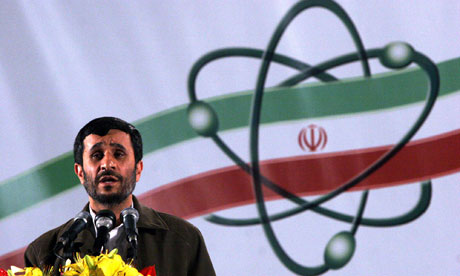
Mahmoud Ahmadinejad, the Iranian president, speaks at the Natanz nuclear enrichment facility. Regional powers and the US are desperate to stop Iran developing a nuclear weapon.

Sunday 28 November 2010 18.16 GMT

Sitting in the Rome office of Franco Frattini, the Italian foreign minister, in February this year, Robert Gates, the veteran US defence secretary and former CIA chief, issued a chilling warning of war in our time.

"Without progress in the next few months, we risk nuclear proliferation in the Middle East, war prompted by an Israeli strike, or both," Gates said. If Iran were allowed to develop a nuclear weapon, he added, the US and its allies would face "a different world" in four to five years.

As thousands of leaked state department cables show, Gates's visit was part of a tireless, round-the-clock offensive by US government officials, politicians, diplomats and military officers to curb Iran's nuclear ambitions and roll back its advance across the Middle East.

Ringed by professional "Iran watchers" based in neighbouring countries, besieged by electronic, cyber and human intelligence gathering and surveillance, squeezed by sanctions, bans and prohibitions, destabilised by unacknowledged internal covert action programmes, and isolated by myriad diplomatic and political means, Iran is the most scrutinised, interrogated country on earth.

But as the cables also show, Iran is fighting back. From Iraq to Afghanistan and from Azerbaijan to the Gulf, the battle between the US and Iran for the upper hand in the Middle East is, as one regional diplomat put it, "the great hegemonic contest of modern times".

Washington's thinking proceeds from three premises. First, Iran is developing a nuclear weapons capability and matching missile systems. Second, it is intent on regional hegemony in Iraq, the Gulf and across the Middle East. Third, Iran's leadership poses a clear and present – and growing danger – to Israel.

The cables illuminate other aspects of the American approach. It is clear US officials are not averse to pressurising, even bullying, third countries to attain their policy objectives. It is also clear that, lacking an embassy in Tehran and with a limited American presence of any kind inside the country, the US sorely lacks first-hand intelligence.

In his talks with Frattini, Gates sought to underscore the seriousness of the overall Iranian threat.

"SecDef [Gates] emphasised that a UNSC resolution was important because it would give the European Union and nations a legal platform on which to impose even harsher sanctions against Iran. SecDef pointedly warned that urgent action is required," the cable states. Then came his chill warning about proliferation, war in the Middle East and a permanently changed world.

One of the more ruthless examples of American pressure to contain and isolate Iran is seen in a December 2008 letter from the then US deputy secretary of state, John Negroponte, to the Armenian president, Serzh Sargsyan, concerning an arms shipment to Iran that went via Armenia.

"We value our positive relationship with your government, as we explore a range of shared interests," Negroponte's letter to Sargsyan begins ominously. "At the same time, we are dismayed by a serious and, indeed, deadly arms re-export case." He goes on to convey Washington's "deep concerns about Armenia's transfer of arms to Iran which resulted in the death and injury of US soldiers in Iraq". Then he wields the big stick, warning of sanctions up to and including a discontinuation of US aid. Sargsyan is forced to back down, admit the arms sales and promise action including periodical "unannounced visit by US experts" to ensure compliance.

'Fascist' state

When rallying western allies, US officials frequently find they are knocking on an open door. In a meeting in Paris in September 2009, assistant secretary of state Phil Gordon is told by President Nicolas Sarkozy's senior foreign policy adviser, Jean-David Levitte, that Iran's response to Barack Obama's offer of talks on the nuclear issue is a "farce".

According to the cable, Levitte goes on: "The current Iranian regime is effectively a fascist state and the time has come to decide on next steps … The Iranian regime must understand that it will be more threatened by economic harm and the attendant social unrest than it would be by negotiating with the west."

Levitte says it is important to obtain Chinese and Russian support and he is actively trying to obtain it. "Levitte said that he informed the Chinese FM [foreign minister] that if they delay until a possible Israeli raid, then the world will have to deal with a catastrophic energy crisis as well."

But Levitte is plainly worried that if European governments take tougher action, Beijing may undermine them. He warns Gordon: "The debate over stopping the flow of gasoline into Iran will be very sensitive and would have to take into account which countries would be only too willing to step in and replace European companies."

William Burns, US under-secretary of state, finds a sympathetic hearing in a less expected quarter when he visits Baku, capital of Azerbaijan, one of Iran's closest neighbours, in February 2010.

According to a confidential American embassy account of their meeting [ID: 250649/summary subbed kb], President Ilham Aliyev tells Burns "that although the visible side of Azerbaijan's relations with Iran appears normal", the substance was very different. "I do not exclude that relations will be become more difficult," the president added.

Aliyev tells Burns that Iranian provocations in Azerbaijan are on the rise, specifically citing Tehran's "financing of radical Islamic groups and Hezbollah terrorists" and "the use of the President's photo alongside the Star of David on the Azeri-language [Iranian state-owned] Seher [Sahar] TV broadcast into Azerbaijan". He adds that fraud in Iran's June, 2009 presidential election was "outrageous". Aliyev "viewed the situation as very tense within Iran and believed it could erupt at any time".

Turkey, a key Iranian neighbour and close trading partner, is uphill work, however. In November 2009, Turkish foreign minister Ahmet Davutoglu, chief architect of Ankara's policy of "zero problems with neighbours" and advocate of closer Turkish ties across the Middle East, tells US envoy Gordon that Iran cannot be bullied into compliance with western demands.

It is clearly a prickly encounter. When Gordon says Ankara should send a stern public message to Tehran about the consequences of ignoring UN resolutions, Davutoglu replies that [Turkish prime minister Recep Tayyip] Erdogan made just such a statement during a recent visit to Tehran. "Only Turkey can speak bluntly and critically to the Iranians, Davutoglu contended, but only because Ankara is showing public messages of friendship."

The testy exchange continues: "Noting that Davutoglu had only addressed the negative consequences of sanctions or the use of military force, Gordon pressed Davutoglu on Ankara's assessment of the consequences if Iran gets a nuclear weapon. Davutoglu gave a spirited reply, that 'of course' Turkey was aware of this risk. 'This is precisely why Turkey is working so hard with the Iranians.' "

Much of the US surveillance of Iran is channelled through its so-called "Iran regional presence office" at the US consulate in Dubai, a sort of grandiose listening-post-cum-embassy-in-exile. The IRPO produces long cables full of political and economic news, Iranian media reports, and information gleaned from Iranian sources, foreign businessmen and exiles. But every US embassy in the countries around Iran (and further afield) appears to have its designated "Iran watcher".

A cable marked "secret" sent from the US embassy in Azerbaijan in June 2009, for example, reports "increasing security problems in Iranian Baluchistan, including alleged disruption of Iran-Pakistan railroad links; a message from a senior GOAJ [government of Azerbaijan] military official about the dangers of stirring up Iranian minorities; the apparent quadrupling in first quarter 2009 (compared to first quarter 2008) seizures in Azerbaijan of Iranian-transited heroin; and scepticism about Iranian gas export contracts, related by industry participants at the recently completed Baku oil and gas show".

The Iran watcher in Turkmenistan sent out a cable in June 2009, at the height of the turmoil that followed Iran's presidential election, in which a prominent Iranian source is quoted condemning Ahmadinejad's victory as a "coup d'etat" engineered by the Iranian Revolutionary Guard Corps (IRGC). The source says opposition leader Mir Hossein Mousavi gained 26 million votes, 61% of the total, against "a maximum of 4 to 5 million" for Ahmadinejad.

The cable quotes the source saying that Iranians "are puzzled by the muted reaction thus far of the US and EU governments, as well as 'very disappointed' by the number of Arab rulers who have sent messages to Ahmadinejad congratulating him on his 'victory' … He said the IRGC was behind the 'coup'. Even Supreme Leader [Ayatollah Ali] Khamenei, he said, to whom the IRGC owes allegiance, is 'not totally in control' of the IRGC … It would appear that the IRGC has taken on 'a life of its own.' "

Iraq interference

The cables also lay bare US preoccupation with Iran's attempts to influence and interfere in the political process in Iraq, including its attempts to promote pro-Tehran Shia parties in Iraq's March 2010 elections. Iraqis in Najaf, "the epicentre of Shia Islam", say they fear that a power vacuum after the Americans leave next year will be filled by Iran.

Particular worries attach to the role in Iraq of the revolutionary guard as the US gradually hands over security to Iraqi forces. Fairly representative is a cable from the Baghdad embassy dated April 2009 which discusses IRGC support for the insurgency and possibly lethal US reprisals. "Islamic [Iranian] Revolutionary Guard Corps – Quds [Jerusalem] Force (IRGC-QF) officers are active in Iraq, conducting traditional espionage and supporting violent extremists as well as supporting both legitimate and malign Iranian economic and cultural outreach," it says.

"Iraqis and their government have demonstrated increasing willingness to push back against malign Iranian influence in the last year. Working with the Iraqis, we have succeeded in stopping some IRGC-QF activity through military operations and diplomatic engagement, while we prevented some IRGC-QF officers from entering Iraq through explicit warnings that we would target them unilaterally."

The embassy cable frankly acknowledges that US leverage in Iraq is diminishing. "Under the security agreement effective 1 January [2009], all operations in Iraq must be conducted in conjunction with Iraqi security forces (ISF), and our previous unilateral warnings carry less weight. As coalition forces continue the period of responsible drawdown, we will rely increasingly on the GOI [government of Iraq] to keep the pressure on the IRGC-QF."

Kuwait and the Sunni-led Gulf states, backed by Saudi Arabia, help complete the psychological and geographical encirclement of Iran. A key concern is Iranian incitement of Shia populations in the Gulf region.

A cable from Kuwait City highlights American interest in an assertion from the Kuwait armed forces deputy chief of staff (DCOS), Lieutenant-General Ahmed Khalid al-Sabah, about Iranian activity in the region. "The DCOS also mentioned Kuwaiti understanding that Iran was supporting Shia in the Gulf and extremists in Yemen." Yemen's internal strife and al-Qaida-linked "export terrorism" has made it a particular concern to the US and its western allies; Iran's involvement there is no longer in doubt.

That the great Iranian-American struggle for control and influence in the Middle East is far from over – and may in fact be hotting up – was made plain again when US under-secretary William Burns held yet another meeting with the reluctant Turks in Ankara in February 2010. Burns insists Washington would prefer a negotiated settlement with Iran. Then, like Gates, he uses the spectre of an Israeli military attack to dramatise his arguments and unsettle the Turks.

"Burns strongly urged [Turkish foreign ministry under-secretary Feridun] Sinirlioglu to support action to convince the Iranian government it is on the wrong course. Sinirlioglu reaffirmed the GoT's [government of Turkey] opposition to a nuclear Iran; however, he registered fear about the collateral impact military action might have on Turkey and contended sanctions would unite Iranians behind the regime and harm the opposition.

"Burns acknowledged Turkey's exposure to the economic effects of sanctions as a neighbour to Iran, but reminded Sinirlioglu Turkish interests would suffer if Israel were to act militarily to forestall Iran's acquisition of nuclear weapons or if Egypt and Saudi Arabia were to seek nuclear arsenals of their own. 'We'll keep the door open to engagement,' he [Burns] stressed."

And for once, it appears he has made some headway.

"A visibly disheartened Sinirlioglu conceded a unified message is important. He acknowledged the countries of the region perceive Iran as a growing threat: 'Alarm bells are ringing even in Damascus.' "

http://www.guardian.co.uk/world/2010/nov/28/united-states-iran-nuclear-weapons

Now, we all know there is 'NO TERRORISTS' and or 'terrorism', which is NOT MADE UP! ...lol.

icon url

StephanieVanbryce

11/28/10 5:06 PM

#118291 RE: StephanieVanbryce #118281

Arab states scorn 'evil' Iran

US embassy cables reveal Tehran's reputation as a meddling, lying troublemaker intent on building nuclear weapons


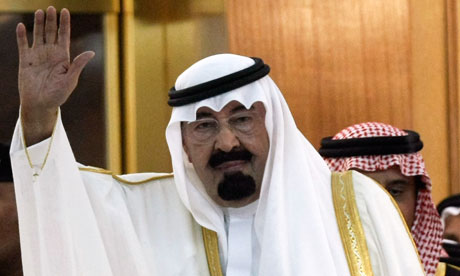
US embassy cables said King Abdullah of Saudi Arabia (above) told a senior White House official that Iran's goal was to cause problems

King Abdullah of Saudi Arabia urged Iran's foreign minister to "spare us your evil" in a meeting that reflected profound Arab hostility to the Islamic Republic – a recurrent theme of high-level private conversations in the Middle East in recent times.

Leaked state department cables catalogue a litany of complaints from the Saudis and smaller Gulf states, as well as Egypt, Jordan and others, on issues from Tehran's nuclear ambitions, to its involvement in Iraq and support for Hezbollah in Lebanon and the Palestinian Hamas.

"You as Persians have no business meddling in Arab matters," the Saudi monarch was quoted as telling Manouchehr Mottaki, Iran's foreign minister. "Iran's goal is to cause problems," he continued in a conversation with a senior White House official. "There is no doubt something unstable about them."

Leaked state department cables catalogue a litany of complaints from the Saudis and smaller Gulf states, as well as Egypt, Jordan and others, on issues from Tehran's nuclear ambitions, to its involvement in Iraq and support for Hezbollah in Lebanon and the Palestinian Hamas.

"You as Persians have no business meddling in Arab matters," the Saudi monarch was quoted as telling Manouchehr Mottaki, Iran's foreign minister. "Iran's goal is to cause problems," he continued in a conversation with a senior White House official. "There is no doubt something unstable about them."

Abdullah declared: "May God prevent us from falling victim to their evil. We have had correct relations over the years, but the bottom line is that they cannot be trusted." US diplomats recorded similar comments earlier this year from the United Arab Emirates, described as being "46 seconds from Iran as measured by the flight time of a ballistic missile". Abu Dhabi's crown prince and deputy commander of the UAE armed forces, Sheikh Mohammed bin Zayed al-Nahyan, referred to Iran as an "existential threat" and was concerned about "getting caught in the crossfire if Iran is provoked by the US or Israel". In one earlier conversation Bin Zayed even suggested that the US should send in ground forces if air strikes were not enough to "take out" Iranian nuclear targets.

Arab-Persian enmity, with a strong undercurrent of rivalry between Sunni and Shia Muslims, dates back centuries but increased markedly after the overthrow of the shah and the Islamic revolution in 1979 and is now viewed as a struggle for hegemony in the region. The conservative Sunni-ruled regimes in Saudi Arabia and the other Gulf states detect the "hidden hand" of Iranian subversion, sometimes where none exists. Tehran's fervent support for Hezbollah and Hamas are seen as ways of extending Iranian influence.

In the UAE the foreign minister is described as viewing "Iran as a huge problem that goes far beyond nuclear capabilities", the embassy reported in February 2010. "Iranian support for terrorism is broader than just Hamas and Hezbollah. Iran has influence in Afghanistan, Yemen, Kuwait, Bahrain, the Eastern Province of Saudi Arabia and Africa."

Speaking to General David Petraeus of US central command in late 2009, Bahrain's King Hamad bin Isa al-Khalifa "pointed to Iran as the source of much of the trouble in both Iraq and Afghanistan … [and] argued forcefully for taking action to terminate their nuclear programme, by whatever means necessary. That programme must be stopped. The danger of letting it go on is greater than the danger of stopping it."

In Oman, Sultan Qaboos bin Said al-Said told the then commander of US central command, Admiral William Fallon: "Iran is a big country with muscles and we must deal with it." A senior Omani minister singled out Kuwait, Bahrain and Qatar as the three Gulf countries that would probably want the US to attack Iran.

Kuwait's military intelligence chief told Petraeus that Iran was supporting Shia groups in the Gulf and extremists in Yemen. Yemen and Saudi Arabia have repeatedly accused Iran of supplying weapons and money to the Houthi rebels in Yemen's Saada region, though the evidence is not conclusive. US diplomatic cables also confirmed that Qatar, the wealthiest country in the region, was an outspoken critic of Iran in private, while maintaining cordial public relations with it and the US.

"Iran is clever and makes its opponents dizzy in the quest for deals," said the Qatari prime minister, Hamad bin Jassim bin Jaber al-Thani. "They will keep you working on a deal and then start from scratch with a new interlocutor. Iran will make no deal. Iran wants nuclear weapons." Bin Jassim "would not be surprised to see Iran test one to demonstrate to the world its achievement". Late last year he gave a succinct summary of Doha's relationship with Tehran: "They lie to us, and we lie to them".

Washington's main Arab allies outside the Gulf, Jordan and Egypt – which both have unpopular peace treaties with Israel – are also deeply hostile to Iran.

Egyptian views on Iran are uniformly negative, as quoted by US interlocutors. General Omar Suleiman, its intelligence chief, called Iran "a significant threat to Egypt … supporting jihad and spoiling peace". He said he had warned Iran against meddling in domestic affairs (and supporting groups like the Muslim Brotherhood) and received a "very positive message" from his Iranian counterpart indicating that Iran would not interfere in Egypt.

President Hosni Mubarak attacked his Iranian counterpart, Mahmoud Ahmadinejad, as an extremist who "does not think rationally". He told a US congressman: "Iran is always stirring trouble".

Mubarak, like Saudi Arabia's King Abdullah, was sceptical about US plans to try to engage with Tehran after Barack Obama's inauguration. Margaret Scobey, the US ambassador in Cairo, described Mubarak as having "a visceral hatred for the Islamic Republic, referring repeatedly to Iranians as 'liars', and denouncing them for seeking to destabilise Egypt and the region. He sees the Syrians and Qataris as sycophants to Tehran and liars themselves."

http://www.guardian.co.uk/world/2010/nov/28/arab-states-scorn-iranian-evil?intcmp=239

Just imagine Saudi Arabia without oil..


icon url

fuagf

11/28/10 9:09 PM

#118299 RE: StephanieVanbryce #118281

Just on and had the NYT one from Yahoo news, thank goodness as i still cannot access NYT from here .. only read to this one so far ..

Suspicions of corruption in the Afghan government: When Afghanistan’s vice president visited the United Arab Emirates last year, local authorities working with the Drug Enforcement Administration discovered that he was carrying $52 million in cash. With wry understatement, a cable from the American Embassy in Kabul called the money “a significant amount” that the official, Ahmed Zia Massoud, “was ultimately allowed to keep without revealing the money’s origin or destination.” (Mr. Massoud denies taking any money out of Afghanistan.)
http://www.nytimes.com/2010/11/29/world/29cables.html?_r=1&no_interstitial

Am just assuming it's the same link as yours, as it's 5 pages. Damn, now the link i've put up here i get the sign in page.

They have my email address, but cannot retrieve my password and they don't reply to my 'please help me' notes.
icon url

StephanieVanbryce

11/29/10 10:35 AM

#118383 RE: StephanieVanbryce #118281

Wikileaks on Israel, Iraq and the Iranian Specter

Juan Cole November 29, 2010

A 2007 cable from then US ambassador to Israel to Secretary of State Condi Rice shows a) that the Israeli leadership did not want the US to withdraw from Iraq and b) that Israeli politicians think that even if Iran never used a nuclear weapon, just for it to have one would doom Israel.

Since the US is in fact withdrawing from Iraq, and will be mostly out by next year this time, we may conclude that the Israeli leadership is very nervous about Tel Aviv – Baghdad relations. That the new government being formed by Prime Minister-designate Nuri al-Maliki depends deeply on the support of Muqtada al-Sadr and his Sadrist movement, the most anti-Israel political force in Shiite Iraq, must petrify Prime Minister Netanyahu and his security cabinet. The likelihood of the Sadrists further coordinating with Lebanon’s Hizbullah party-militia is high. So the fall of Saddam did not in fact take away the Iraq file from consideration in Israel’s future.

As for Iran, US intelligence still cannot find evidence of a nuclear weapons program, and the UN inspectors again certified spring, 2010, that no nuclear material has been diverted from the Natanz facility to non-civilian purposes.

But the cable shed light on the thinking of high Israeli officials about why Israel cannot, as many US analysts have suggested, just live with an Iranian bomb if one is achieved. They believe that such a development would create a psychological nervousness in the Israeli public that would likely doom it as a Jewish state.

What is being implicitly referred to is the expectation that if the Middle East turns even more dangerous for Israelis, such that they lose their status as the sole nuclear regional superpower, then Israeli Jews may well simply emigrate in large numbers. Over time, this development would ensure that Palestinian-Israelis, now over 20% of the population, become a plurality and even a majority.

At some point the Palestinian-Israelis and those Jewish Israelis tired of the increasing boycotts and constant wars may just vote to give citizenship to the Palestinians outside the green zone, creating a binational state. This process, which is likely whether Iran gets a bomb or not, resembles what happened to the Maronite Catholics of Lebanon, who were a majority in the 1920s when the French created the country, but whose high rates of out-migration and low population growth rates reduced them to about 22% of the population (if you count the children) today. Israel will likely be Lebanonized over the next five decades, in any case.

Natan Sharansky has admitted that the days of mass migration of Jews to Israel are over, and only 18,000 are likely to come in 2010. In one recent year, 2005, over 21,000 Israelis emigrated out, almost all of them Jews or ex-Soviets, and they had not returned by 2008. Because thousands of expatriates do return, there is not a net outflow at the moment, but obviously immigration no longer gives Jewish Israelis a demographic edge.

In polling, a third of Israelis say that they would emigrate if Iran got the atomic bomb, so the Israeli officials are not imagining things. Here is how the cable reported the sentiment.

… the very fact that Iran possesses nuclear weapons would completely transform the Middle East strategic environment in ways that would make Israel’s long-term survival as a democratic Jewish state increasingly problematic. That concern is most intensively reflected in open talk by those who say they do not want their children and grandchildren growing up in an Israel threatened by a nuclear-armed Iran…

The Israelis and their US supporters lobbied to destroy Iraq because of similar fears. Now they are pulling out the stops to get up a US war on Iran. But given that the al-Maliki government called for the diplomatic isolation of Israel during the Gaza War in 2008-2009, the policy of having hostile neighbors’ legs broken by Washington has not actually worked out very well. There is no guarantee that a post-Khomeinist government in Iran will be friendly to Israel. And, Israelis who worry so much about the Bomb are losing sight of the real dangers of modern warfare– asymmetrical movements and micro-weapons.

Here are the relevant passages:

“Monday, 08 January 2007, 16:38
S E C R E T SECTION 01 OF 03 TEL AVIV 000064
SIPDIS
SIPDIS
EO 12958 DECL: 01/05/2017
TAGS PREL, PTER, PGOV, IS, KWBG
SUBJECT: SCENESETTER FOR THE SECRETARY’S JANUARY 13-15
VISIT TO ISRAEL
Classified By: Ambassador Richard H. Jones, Reason 1.4 (b) (d)

… 4. (S) While Israeli anxiety over a possible dramatic shift of U.S. policy as a result of the Iraq Study Group’s report has been allayed by statements by you and the President, there continues to be deep uneasiness here that the Baker-Hamilton recommendations reflect the shape of things to come in U.S. policy. Israelis recognize that U.S. public support for the Iraq war is eroding and are following with interest the President’s upcoming articulation of the revamped policy, but they are deeply concerned that Israeli-Palestinian issues not become linked in American minds to creating a more propitious regional environment for whatever steps we decide to take to address the deteriorating situation in Iraq.

5. (S) Iran’s nuclear program continues to cause great anxiety in Israel. Given their history, Israelis across the political spectrum take very seriously Ahmadinejad’s threats to wipe Israel off the map. Olmert has been quite clear in his public comments that Israel cannot tolerate a nuclear-armed Iran, a position stated even more emphatically by opposition leader Netanyahu, who compares today’s Iran to Nazi Germany in 1938. Despite the worst-case assessments of Israeli intelligence, however, there is a range of views about what action Israel should take. The MFA and some of the think tank Iran experts appear increasingly inclined to state that military action must be a last resort and are taking a new interests in other forms of pressure, including but not limited to sanctions, that could force Iran to abandon its military nuclear program. The IDF, however, srikes us as more inclined than ever to look toward a military strike, whether launched by Israel or by us, as the only way to destroy or even delay Iran’s plans. Thoughtful Israeli analysts point out that even if a nuclear-armed Iran did not immediately launch a strike on the Israeli heartland, the very fact that Iran possesses nuclear weapons would completely transform the Middle East strategic environment in ways that would make Israel’s long-term survival as a democratic Jewish state increasingly problematic. That concern is most intensively reflected in open talk by those who say they do not want their children and grandchildren growing up in an Israel threatened by a nuclear-armed Iran.” [ http://www.guardian.co.uk/world/us-embassy-cables-documents/91784 ]

http://www.juancole.com/2010/11/wikileaks-on-israel-iraq-and-the-iranian-specter.html
icon url

StephanieVanbryce

11/29/10 11:54 AM

#118397 RE: StephanieVanbryce #118281

“4.34pm: The chorus of voices demanding some sort of retribution against Wikileaks is
coming most loudly from the Republicans and their allies…”

http://www.guardian.co.uk/news/blog/2010/nov/29/wikileaks-us-embassy-cables-live-updates

icon url

StephanieVanbryce

11/29/10 6:02 PM

#118551 RE: StephanieVanbryce #118281

Wikileaks founder says next target will be a major U.S. bank - Forbes.com http://bit.ly/eWYkmv "

Forbes link - http://blogs.forbes.com/andygreenberg/2010/11/29/an-interview-with-wikileaks-julian-assange/

.....glenn greenwald on twitter
http://twitter.com/ggreenwald/status/9377867737595904
icon url

StephanieVanbryce

11/29/10 6:09 PM

#118552 RE: StephanieVanbryce #118281

Palin: Hunt down Assange like a terrorist

She asks why the WikiLeaks chief is not hunted "with the same urgency we pursue al Qaeda and Taliban leaders"

http://www.salon.com/news/politics/war_room/2010/11/29/palin_hunt_down_assange/
icon url

StephanieVanbryce

12/01/10 12:02 PM

#118654 RE: StephanieVanbryce #118281

From WikiChina

By THOMAS L. FRIEDMAN November 30, 2010

While secrets from WikiLeaks were splashed all over the American newspapers, I couldn’t help but wonder: What if China had a WikiLeaker and we could see what its embassy in Washington was reporting about America? I suspect the cable would read like this:

Washington Embassy, People’s Republic of China, to Ministry of Foreign Affairs Beijing, TOP SECRET/Subject: America today.

Things are going well here for China. America remains a deeply politically polarized country, which is certainly helpful for our goal of overtaking the U.S. as the world’s most powerful economy and nation. But we’re particularly optimistic because the Americans are polarized over all the wrong things.

There is a willful self-destructiveness in the air here as if America has all the time and money in the world for petty politics. They fight over things like — we are not making this up — how and where an airport security officer can touch them. They are fighting — we are happy to report — over the latest nuclear arms reduction treaty with Russia. It seems as if the Republicans are so interested in weakening President Obama that they are going to scuttle a treaty that would have fostered closer U.S.-Russian cooperation on issues like Iran. And since anything that brings Russia and America closer could end up isolating us, we are grateful to Senator Jon Kyl of Arizona for putting our interests ahead of America’s and blocking Senate ratification of the treaty. The ambassador has invited Senator Kyl and his wife for dinner at Mr. Kao’s Chinese restaurant to praise him for his steadfastness in protecting America’s (read: our) interests.

Americans just had what they call an “election.” Best we could tell it involved one congressman trying to raise more money than the other (all from businesses they are supposed to be regulating) so he could tell bigger lies on TV more often about the other guy before the other guy could do it to him. This leaves us relieved. It means America will do nothing serious to fix its structural problems: a ballooning deficit, declining educational performance, crumbling infrastructure and diminished immigration of new talent.

The ambassador recently took what the Americans call a fast train — the Acela — from Washington to New York City. Our bullet train from Beijing to Tianjin would have made the trip in 90 minutes. His took three hours — and it was on time! Along the way the ambassador used his cellphone to call his embassy office, and in one hour he experienced 12 dropped calls — again, we are not making this up. We have a joke in the embassy: “When someone calls you from China today it sounds like they are next door. And when someone calls you from next door in America, it sounds like they are calling from China!” Those of us who worked in China’s embassy in Zambia often note that Africa’s cellphone service was better than America’s.

But the Americans are oblivious. They travel abroad so rarely that they don’t see how far they are falling behind. Which is why we at the embassy find it funny that Americans are now fighting over how “exceptional” they are. Once again, we are not making this up. On the front page of The Washington Post on Monday there was an article noting that Republicans Sarah Palin and Mike Huckabee are denouncing Obama for denying “American exceptionalism.” The Americans have replaced working to be exceptional with talking about how exceptional they still are. They don’t seem to understand that you can’t declare yourself “exceptional,” only others can bestow that adjective upon you.

In foreign policy, we see no chance of Obama extricating U.S. forces from Afghanistan. He knows the Republicans will call him a wimp if he does, so America will keep hemorrhaging $190 million a day there. Therefore, America will lack the military means to challenge us anywhere else, particularly on North Korea, where our lunatic friends continue to yank America’s chain every six months so that the Americans have to come and beg us to calm things down. By the time the Americans do get out of Afghanistan, the Afghans will surely hate them so much that China’s mining companies already operating there should be able to buy up the rest of Afghanistan’s rare minerals.

Most of the Republicans just elected to Congress do not believe what their scientists tell them about man-made climate change. America’s politicians are mostly lawyers — not engineers or scientists like ours — so they’ll just say crazy things about science and nobody calls them on it. It’s good. It means they will not support any bill to spur clean energy innovation, which is central to our next five-year plan. And this ensures that our efforts to dominate the wind, solar, nuclear and electric car industries will not be challenged by America.

Finally, record numbers of U.S. high school students are now studying Chinese, which should guarantee us a steady supply of cheap labor that speaks our language here, as we use our $2.3 trillion in reserves to quietly buy up U.S. factories. In sum, things are going well for China in America.

Thank goodness the Americans can’t read our diplomatic cables.

Embassy Washington.

http://www.nytimes.com/2010/12/01/opinion/01friedman.html?src=ISMR_AP_LO_MST_FB
icon url

StephanieVanbryce

12/01/10 12:20 PM

#118655 RE: StephanieVanbryce #118281

Putin Criticizes U.S. Remarks on Russia

...remember, He's our Alpha Dog or Batman ..according to our diplomatic corp..


The Russian prime minister Vladimir V. Putin at the Kremlin’s St. George Hall to listen to President
Dmitri A. Medvedev addressing Parliament on Tuesday.


December 1, 2010

MOSCOW — Prime Minister Vladimir V. Putin responded sharply on Wednesday to criticism of Russia revealed in United States diplomatic cables published by the whistle-blowing Web site WikiLeaks, warning Washington not to interfere in Russian domestic affairs.

His comments, made in an interview to be aired on CNN’s “Larry King Live,” referred to a cable that said “Russian democracy has disappeared” and described the government as “an oligarchy run by the security services,” a statement attributed to the American defense secretary, Robert M. Gates.

Mr. Putin said Mr. Gates was “deeply misled,” and said Washington does not welcome critiques of its own political system.

In the interview, Mr. Putin also warned that Russia would develop and deploy new nuclear weapons if the United States does not accept its proposals on integrating Russian and European missile defense forces — amplifying a comment by President Dmitri A. Medvedev in his annual state of the nation address on Tuesday.

“We’ve just put forward a proposal showing how all of us, tackling the shared problem of security, could share responsibility between ourselves,” Mr. Putin said, according to excerpts released by CNN. “But if our proposals will be met with negative answers, and if additional threats are built on our borders, Russia will have to ensure her own security through different means,” including “new nuclear missile technologies.”

Mr. Putin said Moscow would like to avoid this scenario.

“This is no threat on our part,” he said. “We are simply saying this is what we expect to happen if we don’t agree on a joint effort there.” Last month, during a NATO-Russia summit meeting in Lisbon, the delegations discussed President Obama’s invitation for Russia to take some role in the future missile shield, perhaps through linkage between Russian facilities and the European shield.

At that meeting, Mr. Medvedev proposed “sectoral missile defense,” which would divide the missile defense shield into “zones of responsibility,” and involve deep coordination between the European and Russian sectors, said Dmitri V. Trenin, a military analyst and director of the Carnegie Moscow Center. NATO’s proposals for cooperation are less ambitious, involving information exchange but not interdependence, and some members remain deeply mistrustful of Russian involvement, he said.

In his Wednesday interview, Mr. Putin broke from the restrained response that Russian leaders have so far given to the WikiLeaks cables. While a number of the cables refer to Russia, they have so far offered few real revelations about sensitive topics like corruption or power relationships within the political elite. The comments attributed to Mr. Gates, contained in a cable dated Feb. 8, 2010, used the harshest language made public so far.

Mr. Putin said several American presidents had been elected through the electoral college system even though they did not win a majority of the popular vote, but that Russia does not press the point.

“When we are talking with our American friends and tell them there are systemic problems” with the electoral college system, “we hear from them, ‘Don’t interfere with our affairs, this is our tradition and it’s going to continue like that.’ We are not interfering.”

“But to our colleagues, I would also like to advise you not to interfere with the sovereign choice of the Russian people,”
Mr. Putin said.

He played down the impact of the cables’ release, calling it “no catastrophe,” and went on to suggest that they might be fakes being circulated for obscure political purposes.

“Some experts believe that somebody is deceiving WikiLeaks, that their reputation is being undermined to use them for their own political purposes later on,” he said. “That is one of the possibilities there. That is the opinion of the experts.”

http://www.nytimes.com/2010/12/02/world/europe/02putin.html?_r=1&hp
icon url

StephanieVanbryce

12/01/10 1:51 PM

#118663 RE: StephanieVanbryce #118281

Gates: Warnings of WikiLeaks fallout overblown

Craig Whitlock 11/30/2010

The Obama administration has warned WikiLeaks that the group's release of a huge cache of U.S. diplomatic cables could threaten the lives of "countless innocent individuals" and ruin relations with allies.

But count Defense Secretary Robert M. Gates as a skeptic that the fallout will be so dire. At a press conference Tuesday, he reminded reporters that the U.S. government's habit of leaking secrets about other countries is as old as the republic, and that predictions of doom rarely pan out.

"Let me just offer some perspective of somebody whose been at this for a long time," said Gates, a former director of the CIA. "Every other government in the world knows the United States government leaks like a sieve, and it has for a long time."

Gates then reached back more than 200 years to quote the second president, John Adams, bemoaning the same problem: "How can a government go on, publishing all their negotiations with foreign nations, I know not. To me it appears as dangerous and pernicious as it is novel."

Gates followed that up with another example, this time reaching back 35 years to his own career as a spook.

"When we went to real congressional oversight of intelligence in the mid-70s, there was a broad view that no other foreign intelligence service would ever share information with us again," he said. "Those fears all proved unfounded."

"Now I've heard the impact of these releases on our foreign policy described as a meltdown, as a game-changer and so on. I think those descriptions are fairly significantly overwrought," Gates added. "The fact is governments deal with the United States because it is in their interest, not because they like us, not because they trust us and not because they believe we can keep secrets.

"Some governments deal with us because they fear us, some because they respect us, most because they need us. We are still essentially, it's been said before, the indispensable nation."


And that won't change or stop, Gates said, even if it means a temporary period of deep chagrin for U.S. leaders.

"Is this embarrassing? Yes. Is it awkward? Yes. Consequences for U.S. foreign policy? I think fairly modest."

http://voices.washingtonpost.com/checkpoint-washington/2010/11/the_obama_administration_has_w.html?wprss=checkpoint-washington
icon url

StephanieVanbryce

12/01/10 4:05 PM

#118682 RE: StephanieVanbryce #118281

Big Web

Josh Marshall | December 1, 2010, 2:19PM

Amazon has terminated the account of Wikileaks and apparently the site has been down most of the day. Joe Lieberman has issued a statement on Amazon's decision. Amazon has not commented directly on what happened to Wikileaks account. But they appear to have told Lieberman -- or that's the clear import of Lieberman's statement -- that they unilaterally terminated the account.

[Update: Wikileaks has reportedly moved the documents back to its original Swedish hosting service, though that is unconfirmed. They seem to be back up online. -- 3:00 pm.]

Most consumers aren't aware of this. But in addition to the Amazon retailer you know, Amazon has also become a big, big player in the 'cloud' web hosting market. I assume they're the largest. But I do not know that last point for certain. Regardless, they're a huge player in the market. A few parts of TPM, though not the whole site, is hosted in the Amazon cloud.

When I'd heard that Amazon had agreed to host Wikileaks I was frankly surprised given all the fish a big corporation like Amazon has to fry with the federal government.

http://www.talkingpointsmemo.com/archives/2010/12/big_web.php?ref=fpblg


icon url

StephanieVanbryce

12/02/10 1:54 PM

#118779 RE: StephanieVanbryce #118281

How the Government and Its Press Flacks Collude in Lies

What the Wiki-Saga Teaches Us

The reaction to WikiLeaks and its founder, Julian Assange tells us all we need to know about the total corruption of our “modern” world, which in fact is a throwback to the Dark Ages.

Some member of the United States government released to WikiLeaks the documents that are now controversial. The documents are controversial, because they are official US documents and show all too clearly that the US government is a duplicitous entity whose raison d’etre is to control every other government.

The media, not merely in the US but also throughout the English speaking world and Europe, has shown its hostility to WikiLeaks. The reason is obvious. WikiLeaks reveals truth, while the media covers up for the US government and its puppet states.

Why would anyone with a lick of sense read the media when they can read original material from WikiLeaks? The average american reporter and editor must be very angry that his/her own cowardice is so clearly exposed by Julian Assange. The american media is a whore, whereas the courageous blood of warriors runs through WikiLeaks’ veins.

Just as american politicians want Bradley Manning executed because he revealed crimes of the US government, they want Julian Assange executed. In the past few days the more notorious of the dumbshits that sit in the US Congress have denounced Assange as a “traitor to america.” What total ignorance. Assange is an Australian, not an american citizen. To be a traitor to america, one has to be of the nationality. An Australilian cannot be a traitor to america any more than an american can be a traitor to Australia. But don’t expect the morons who represent the lobbyists to know this much.

Mike Huckabee, the redneck baptist preacher who was governor of arkansas and, to
america’s already overwhelming shame, was third runner up to the Republican presidential nomination, has called for Assange’s execution. So here we have a “man of God” calling for the US government to murder an Australian citizen. And americans wonder why the rest of the world hates their guts.

The material leaked from the US government to WikiLeaks shows that the US government is an extremely disreputable gang of gangsters. The US government was able to get British prime minister Brown to “fix” the official Chilcot Investigation into how former prime minister Tony Blair manipulated and lied the British government into being mercenaries for the US invasion of Iraq. One of the “diplomatic” cables released has UK Defense Ministry official Jon Day promising the United States government that prime minister Brown’s government has “put measures in place to protect your interests.”

Other cables show the US government threatening Spanish prime minister Zapatero, ordering him to stop his criticisms of the Iraq war or else. I mean, really, how dare these foreign governments to think that they are sovereign.

Not only foreign governments are under the US thumb. So is Amazon.com. Joe Lieberman from Connecticut, who is Israel’s most influential senator in the US Senate, delivered sufficiently credible threats to Amazon to cause the company to oust WikiLeaks content from their hosting service.

So there you have it. On the one hand the US government and the prostitute american media declare that there is nothing new in the hundreds of thousands of documents, yet on the other hand both pull out all stops to shut down WikiLeaks and its founder. Obviously, despite the US government’s denials, the documents are extremely damaging. The documents show that the US government is not what it pretends to be.

Assange is in hiding. He fears CIA and Mossad assassination, and to add to his troubles the government of Sweden has changed its mind, perhaps as a result of american persuasion and money, about sex charges that the Swedish government had previously dismissed for lack of credibility. If reports are correct, two women, who possibly could be CIA or Mossad assets, have brought sex charges against Assange. One claims that she was having consensual sexual intercourse with him, but that he didn’t stop when she asked him to when the condom broke.

Think about this for a minute. Other than male porn stars who are bored with it all, how many men can stop at the point of orgasm or when approaching orgasm? How does anyone know where Assange was in the process of the sex act?

Would a real government that had any integrity and commitment to truth try to blacken the name of the prime truth teller of our time on the basis of such flimsy charges?

Obviously, Sweden has become another two-bit punk puppet government of the US.

The US government has got away with telling lies for so long that it no longer hesitates to lie in the most blatant way. WikiLeaks released a US classified document signed by Secretary of State Hillary Clinton that explicitly orders US diplomats to spy on UN Security council officials and on the Secretary General of the United Nations. The cable is now in the public record. No one challenges its authenticity. Yet, today the Obama regime, precisely White House Press Secretary Robert Gibbs, declared that Hillary had never ordered or even asked US officials to spy on UN officials.

As Antiwar.com asked: Who do you believe, the printed word with Hillary’s signature or the White House?

Anyone who believes the US government about anything is the epitome of gullibility.


December 2 2010
http://www.counterpunch.org/roberts12022010.html
icon url

StephanieVanbryce

12/02/10 5:31 PM

#118797 RE: StephanieVanbryce #118281

Was Julian Assange Of WikiLeaks Set Up?
http://www.youtube.com/watch?v=Bvhv7wXiHa8

CENK UYGUR: "Julian Assange is now a wanted man. They have issued a RED NOTICE, Interpol has. They've put him on a wanted poster. He's wanted for SEX CRIMES! Of course, Julian Assange is the head of WikiLeaks. Look at that. That looks DANGEROUS. Man, there's like a world with a sword in it and such. That dude is WANTED. For SEX CRIMES.

He must be a really dangerous guy.

Yeah. Let me tell you something, o.k.? Of course, I'm open to the evidence, and if there was a trial and I was on the jury, I would listen to see who was right and who was wrong, obviously.

Right now? NOT BUYING IT - AT ALL...

Now what you will hear from other places is equivacation. 'Well, it's a serious charge, and there's these two women, who are claiming, da, da, da... and so, you know, we have to be, to call it even...' No, no. It's not even.

You're telling me that a guy who was doing these massive leaks, which is infuriating, not only the United States government, but governments all across the world, because he's telling us what they're actually doing, that all of a sudden, at the same exact time, there's rape charges against him. Just coincidental. Just coincidental.

Oh, hell no, man. Come on, how naive do you have to be? Doesn't mean it didn't happen; it doesn't mean I wouldn't listen to evidence. But you'd have an overwhelming case to convince me that this is the wildest coincidence of all time.

And remember, the charges were first filed, and then one of the prosecutors in Sweden was like: 'What the hell is this crap?' and withdrew them. And then somebody above that prosecutor came along and said: 'No, no. Be cool. Be cool. We have to press the case forward.' One of the charges of the women was that 'Oh, we were having consensual sex, but then the condom broke, and he didn't take it out in time.' O.K., I don't know, look, if it goes to a trial, fine, I'll have an open mind.

But you're telling me this isn't a witch-hunt? This isn't a smear job? Come on. Come on.

And, you know, I said this yesterday off-air, as we were preparing the MSNBC show, and I was like: 'Look, if you thought they came after Assange before, when he revealed government documents, wait till you see what they got coming up next, 'cause now he's going to reveal the inner workings of the banks - remember he told Forbe's Magazine I'm coming after a big bank and you're going to see their unethical practices.' Right? And I said in the morning meeting yesterday 'Oh, ho, ho. That smear campaign, it's just warming up.'

And today... Interpol. Oh my... WARNING! WARNING: SEX CRIMES, WANTED, RED ALERT, RED NOTICE!

Funny how... do you know why? It's just so you understand why? Look, when you go against the government, you know, a lot of people are affected, etc. etc., but not one person necessarily loses money over it. Yeah, some people might lose prestige, etc. etc., but when you go after the banks, there's real money on the line. Person X and Person Y and Person Z might lose a lot of their compensation when those leaks happen. They're not happy about that. When money ain't happy, all of a sudden, you get red alerts all across the world.

So, if they're going to come at Assange, you ought to be incredibly skeptical about what they're coming with, o.k.?

And I certainly am."

http://journals.democraticunderground.com/Hissyspit/8423
icon url

StephanieVanbryce

12/02/10 6:09 PM

#118801 RE: StephanieVanbryce #118281

Alexander Cockburn: Julian Assange: wanted by the Empire, dead or alive

How the US press have colluded with government in their fury at the WikiLeaks founder

DECEMBER 2, 2010

The American airwaves quiver with the screams of parlour assassins howling for Julian Assange's head. Jonah Goldberg, contributor to the National Review, asks in his syndicated column, "Why wasn't Assange garroted in his hotel room years ago?" Sarah Palin wants him hunted down and brought to justice, saying: "He is an anti-American operative with blood on his hands."

Assange can survive these theatrical blusters. A tougher question is how he will fare at the hands of the US government, which is hopping mad. The US attorney general, Eric Holder, announced on Monday that the Justice Department and Pentagon are conducting "an active, ongoing criminal investigation" into the latest Assange-facilitated leak under Washington's Espionage Act.

Asked how the US could prosecute Assange, a non-US citizen, Holder said, "Let me be clear. This is not sabre-rattling," and vowed "to swiftly close the gaps in current US legislation…"

In other words the espionage statute is being rewritten to target Assange, and in short order, if not already, President Obama – who as a candidate pledged "transparency" in government - will sign an order okaying the seizing of Assange and his transport into the US jurisdiction. Render first, fight the habeas corpus lawsuits later.

Interpol, the investigative arm of the International Criminal Court at The Hague, has issued a fugitive notice for Assange. He's wanted in Sweden for questioning in two alleged sexual assaults, one of which seems to boil down to a charge of unsafe sex and failure to phone his date the following day.

This prime accuser, Anna Ardin has, according to the journalist Israel Shamir, writing on the CounterPunch site, "ties to the US-financed anti-Castro and anti-communist groups. She published her anti-Castro diatribes in the Swedish-language publication Revista de Asignaturas Cubanas put out by Misceláneas de Cuba…Note that Ardin was deported from Cuba for subversive activities."

It's certainly not conspiracism to suspect that the CIA has been at work in fomenting these Swedish accusations. As Shamir reports, "The moment Julian sought the protection of Swedish media law, the CIA immediately threatened to discontinue intelligence sharing with SEPO, the Swedish Secret Service."

The CIA has no doubt also pondered the possibility of pushing Assange off a bridge or through a high window (a mode of assassination favoured by the Agency from the earliest days*) and has sadly concluded that it's too late for this sort of executive solution.

The irony is that the thousands of diplomatic communications released by WikiLeaks contain no earth-shaking disclosures that patently undermine the security of the American empire. We are supposed to be stunned that the King of Saudi Arabia wishes Iran was wiped off the map, that the US uses diplomats as spies, that Afghanistan is corrupt?

This is not to downplay the great importance of this latest batch of WikiLeaks. Millions in America and around the world have been given a quick introductory course in international relations and the true arts of diplomacy – not least the third-rate, gossipy prose with which the diplomats rehearse the arch romans à clef they will write when they head into retirement.

Years ago Rebecca West wrote in her novel The Thinking Reed of a British diplomat who, "even when he was peering down a woman's dress at her breasts managed to look as though he was thinking about India." In the updated version, given Hillary Clinton's orders to the State Department, the US envoy, pretending to admire the figure of the charming French cultural attaché, would actually be thinking how to steal her credit card information, obtain a retinal scan, her email passwords and frequent flier number.

There are also genuine disclosures of great interest, some of them far from creditable to the establishment US press. Gareth Porter has identified a diplomatic cable from last February released by WikiLeaks which provides a detailed account of how Russian specialists on the Iranian ballistic missile program refuted the US suggestion that Iran has missiles that could target European capitals or that Iran intends to develop such a capability. Porter points out that:

"Readers of the two leading US newspapers never learned those key facts about the document. The New York Times and Washington Post reported only that the United States believed Iran had acquired such missiles - supposedly called the BM-25 - from North Korea. Neither newspaper reported the detailed Russian refutation of the US view on the issue or the lack of hard evidence for the BM-25 from the US side.

"The Times, which had obtained the diplomatic cables not from WikiLeaks but from the Guardian, according to a Washington Post story Monday, did not publish the text of the cable. The Times story said the newspaper had made the decision not to publish 'at the request of the Obama administration'. That meant that its readers could not compare the highly distorted account of the document in the Times story against the original document without searching the Wikileaks website."

Distaste among the "official" US press for WikiLeaks has been abundantly apparent from the first of the two big releases of documents pertaining to the wars in Iraq and Afghanistan. The New York Times managed the ungainly feat of publishing some of the leaks while simultaneously affecting to hold its nose, and while publishing a mean-spirited hatchet job on Assange by its reporter John F Burns, a man with a well burnished record in touting the various agendas of the US government.

There have been cheers for Assange and WikiLeaks from such famed leakers as Daniel Ellsberg, but to turn on one's television is to eavesdrop on the sort of fury that Lord Haw-Haw used to provoke in Britain in World War II. As Glenn Greenwald writes in his column on the Salon site:

"On CNN, Wolf Blitzer was beside himself with rage over the fact that the US government had failed to keep all these things secret from him... Then - like the Good Journalist he is - Blitzer demanded assurances that the Government has taken the necessary steps to prevent him, the media generally and the citizenry from finding out any more secrets: 'Do we know yet if they've [done] that fix? In other words, somebody right now who has top secret or secret security clearance can no longer download information onto a CD or a thumb drive? Has that been fixed already?' The central concern of Blitzer - one of our nation's most honoured 'journalists' - is making sure that nobody learns what the US Government is up to."

These latest WikiLeaks files contains some 261,000,000 words - about 3,000 books. They display the entrails of the American Empire. As Shamir writes, "The files show US political infiltration of nearly every country, even supposedly neutral states such as Sweden and Switzerland. US embassies keep a close watch on their hosts. They have penetrated the media, the arms business, oil, intelligence, and they lobby to put US companies at the head of the line."

Will this vivid record of empire in the early 21st century soon be forgotten? Not if some competent writer offers a readable and politically vivacious redaction. But a warning: in November 1979 Iranian students seized an entire archive of the State Department, the CIA and the Defense Intelligence Agency (DIA) at the American embassy in Tehran. Many papers that were shredded were laboriously reassembled.

These secrets concerned far more than Iran. The Tehran embassy, which served as a regional base for the CIA, held records involving secret operations in many countries, notably Israel, the Soviet Union, Turkey, Pakistan, Saudi Arabia, Kuwait, Iraq and Afghanistan.

Beginning in 1982, the Iranians published some 60 volumes of these CIA reports and other US government documents from the Tehran archive, collectively entitled Documents From The US Espionage Den. As Edward Jay Epstein, a historian of US intelligence agencies, wrote years ago, "Without a doubt, these captured records represent the most extensive loss of secret data that any superpower has suffered since the end of the Second World War."

In fact the Tehran archive truly was a devastating blow to US national security. It contained vivid portraits of intelligence operations and techniques, the complicity of US journalists with US government agencies, the intricacies of oil diplomacy. The volumes are in university libraries here. Are they read? By a handful of specialists.
The inconvenient truths were swiftly buried – and perhaps the WikiLeaks files will soon be forgotten too.

And Assange? Hopefully he will have a long reprieve from burial. Ecuador has offered him sanctuary and they say Quito, once you get used to the altitude, is a pleasant place.

* Footnote: in 1953 the CIA distributed to its agents and operatives a killer's training manual (made public in 1997) full of hands-on advice: "The most efficient accident, in simple assassination, is a fall of 75 feet or more onto a hard surface. Elevator shafts, stair wells, unscreened windows and bridges will serve... The act may be executed by sudden, vigorous [excised] of the ankles, tipping the subject over the edge. If the assassin immediately sets up an outcry, playing the 'horrified witness', no alibi or surreptitious withdrawal is necessary."

http://www.thefirstpost.co.uk/72286,news-comment,news-politics,alexander-cockburn-julian-assange-wanted-by-the-empire-dead-or-alive-wikileaks?DCMP=NLC-daily


icon url

StephanieVanbryce

12/02/10 6:18 PM

#118802 RE: StephanieVanbryce #118281

icon url

StephanieVanbryce

12/03/10 6:24 PM

#118939 RE: StephanieVanbryce #118281

WikiLeaks cables claim first scalp as German minister's aide is sacked

Helmut Metzner admitted acting as a mole for the US embassy during negotiations to form a government


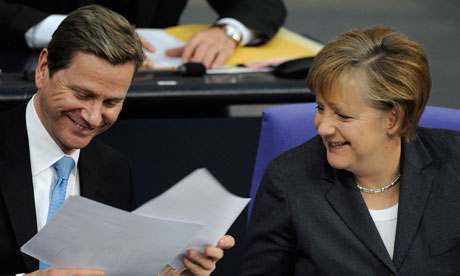
WikiLeaks cables contained unflattering descriptions of the German foreign minister, Guido Westerwelle, and Angela Merkel

Friday 3 December 2010 12.40 GMT

The WikiLeaks revelations have claimed their first political scalp in Europe with the sacking of the German foreign minister's chief of staff, who acted as a mole for the Americans, keeping the US embassy in Berlin posted last year on the confidential negotiations to form Angela Merkel's new government.

Amid a mood of increasing anger in the German political class at the disparaging observations on the chancellor's cabinet from US officials, a liberal MP today demanded the withdrawal of the American ambassador in Berlin, Philip Murphy.

Guido Westerwelle, the German foreign minister and leader of the liberal Free Democrats, the junior partner in the Merkel coalition, is described unflatteringly in the US cables from Berlin as inexperienced, "exuberant" and "wild".

The cables relate how an FDP insider – "a fly on the wall, a young, up-and-coming party loyalist who was taking notes during the marathon talks" – delivered documents to the US embassy and kept US diplomats informed on the new government formation in October last year.

On Monday Westerwelle dismissed the reports as false and insisted there was no mole. But Helmut Metzner, his chief of staff, was sacked after admitting he was the source of the US intelligence.

"The staff member of the FDP's federal headquarters, who has admitted his contacts with the US embassy in Berlin, has been relieved of his duties as chief of staff for the FDP chairman," said a party statement.

Hans-Michael Goldmann, an FDP MP, told the Bildzeitung newspaper today that a German ambassador abroad behaving like Murphy would be promptly "called home". He added that Murphy had failed to apologise for the scandal.

http://www.guardian.co.uk/media/2010/dec/03/wikileaks-first-scalp-german-aide
icon url

StephanieVanbryce

12/03/10 6:48 PM

#118941 RE: StephanieVanbryce #118281

US blocks access to WikiLeaks for federal workers

Employees unable to call up WikiLeaks on government computers as material is still formally classified, says US

...I guess it's legal if it's at your place of employment. As long as they can still go to WikiLeaks
at their homes, no problem .. if that is breached ...well then.


WikiLeaks has been blocked from being accessed by federal employees of the US, because the files are still seen as classified

Friday 3 December 2010 22.16 GMT

The Obama administration is banning hundreds of thousands of federal employees from calling up the WikiLeaks site on government computers because the leaked material is still formally regarded as classified.

The Library of Congress tonight joined the education department, the commerce department and other government agencies in confirming that the ban is in place.

Although thousands of leaked cables are freely available on the Guardian, New York Times and other newspaper websites, as well as the WikiLeaks site, the Obama administration insists they are still classified and, as such, have to be protected.

The move comes at a time when civil rights and other liberal groups are becoming increasingly critical, inviting parallels with the kind of bans on information imposed by China and other oppressive governments.

The Library of Congress, one of the biggest libraries in the world, serving both Congress and the public, and essentially the library of record for the US, issued a statement tonight, which read: "The library decided to block WikiLeaks because applicable law obligates federal agencies to protect classified information. Unauthorised disclosures of classified documents do not alter the documents' classified status or automatically result in declassification of the documents."

Disclosure of the ban brought a flood of criticism from liberal bloggers, critical of the Library of Congress's behaviour.

News of the ban was first reported by the Washington Post.

The commerce department, in an email circulated to employees on Monday, said the WikiLeaks material remained classified and "is NOT authorised for downloading, viewing, printing, processing, copying or transmitting" on government computers or communication devices.

It warned anyone downloading the WikiLeaks material: "Accessing the WikiLeaks documents will lead to sanitisation of your PC to remove any potentially classified information from your system, and the result in possible data loss."

The education department said any employees who had already looked at the material should contact their internet technology department. An internal email said that IT staff "will work with you to remediate your device".

http://www.guardian.co.uk/world/2010/dec/03/wikileaks-cables-blocks-access-federal


LOLOL... what else can you do but laugh? This is OUTRAGEOUS!

icon url

StephanieVanbryce

12/06/10 11:02 AM

#119120 RE: StephanieVanbryce #118281

Wikileaks: The internet ideal triumphs

As hundreds of mirror sites circumvent attempts at internet censorship of the Cablegate documents, Wikileaks
journalist James Ball calls on the US remember its principles on internet freedom


06 Dec 2010

If Wikileaks were to disappear permanently from the internet today, tomorrow’s embassy cables stories would still appear.

Not that removing Wikileaks would prove straightforward: though the main site has had to move its servers after Amazon withdrew hosting, and change its web address after EveryDNS cancelled Wikileaks’ account, it is still up and running.

Even on Wednesday, the day the site was most disrupted, Cablegate received 54m hits, from at least 3.6m unique individuals. Duplicate copies of Wikileaks are now loaded hundreds of different servers worldwide. Even PayPal’s closure of Wikileaks’ account has so far proved little more than an annoyance.

But even these could all vanish tomorrow, thanks to an even more traditional fallback: old media. The New York Times, Guardian, Der Spiegel, Le Monde and El Pais are all running Wikileaks material.

All shared the same editorial judgement as Wikileaks having seen the material: they judged it in the public interest and chose to run it. At this point, these sites are running the same cables as Wikileaks. They have contributed to the redactions.

The Guardian website, at the time of writing, actually contains more US material than Wikileaks’ own. None have faced the political or technical backlash of the main Wikileaks site, yet all would have to be taken offline to bury the Embassy Cables story.

Yet the ineffectiveness of the censorship efforts from the US Government, Senator Joe Lieberman and others does not detract from their troubling nature.

In a sense, attempts by Lieberman and the French government to prevent web hosts providing servers to Wikileaks are the least problematic issue — in the print press era, printers and distributors were regularly targeted with lawsuits when governments or private individuals sought to prevent stories getting out.

Targeting web hosts is merely the modern take on an old trick; and one which doesn’t seem to work nearly so well in the web era. Controversial publications which lack Wikileaks’ audience and resilience, on the other hand, may be anxiously watching current developments.

What is newer — and disturbing — is attempts by governments to prevent millions of their citizens from reading this material. America’s 19m federal government employees have been told not to read the cables material — or any publication containing them. Agencies have added virtually every mainstream news outlet to web filters and blocks, a move reminiscent of China’s Great Firewall.

Students at Columbia University have been advised not to comment on the cables if they might want a government job. And a US data visualisation company, Tableau, has even retracted derivative works based on the Wikileaks stories, without receiving a single specific request to do so.

The US government’s efforts to stop this story show both a distressing lack of commitment to the core internet principles of transparency and neutrality, and also a fundamental lack of understanding of its infrastructure.

Recent events should not disturb only journalists or campaigners – based on their recent public comments, it should prove a cause for concern for a pair of prominent Americans, too.

The first strident voice, speaking at a town hall meeting in China said: “The more freely information flows, the stronger the society becomes, because then citizens of countries around the world can hold their own governments accountable. They can begin to think for themselves.

He concluded, “I can tell you that in the United States, the fact that we have free internet — or unrestricted internet access is a source of strength, and I think should be encouraged,”

A second speaker called, in January this yea said “Censorship should not be in any way accepted by any company from anywhere. And in America, American companies need to make a principled stand…This needs to be part of our national brand. I’m confident that consumers worldwide will reward companies that follow those principles”

The identities of these two radical firebrands? None other than President Barack Obama, and Secretary of State Hilary Clinton.

I couldn’t agree with them more.


Embedded Links
http://www.indexoncensorship.org/2010/12/wikileaks-internet-censorship-united-states/


icon url

StephanieVanbryce

12/06/10 11:36 AM

#119123 RE: StephanieVanbryce #118281

Wikileaks and State Department correspondence

28 Nov 2010

Index on Censorship has obtained copies of correspondence between whistleblowing website Wikileaks and the US embassy in the United Kingdom, which took place between Friday and Sunday. They reveal Wikileaks editor in chief’s last-minute attempt to seek the cooperation of the United States government in redacting information from the latest controversial release of documents.

26 November 2010

Dear Ambassador Susman,

I refer to recent public statements by United States Government officials expressing concern
about the possible publication by WikiLeaks and other media organisations of information
allegedly derived from United States Government records. I understand that the United States
Government has recently devoted substantial resources to examination of these records over
many months.

Subject to the general objective of ensuring maximum disclosure of information in the public
interest, WikiLeaks would be grateful for the United States Government to privately nominate
any specific instances (record numbers or names) where it considers the publication of
information would put individual persons at significant risk of harm that has not already been
addressed.

WikiLeaks will respect the confidentiality of advice provided by the United States Government
and is prepared to consider any such submissions made without delay. [ http://www.indexoncensorship.org/wp-content/uploads/2010/11/Letter-to-US-Ambassador-from-Julian-Assange-26-November-2010.pdf ]

Yours sincerely,

Julian Assange


our reply


......27 November

Harold Hongju Koh, Legal Adviser, United States Department of State [ http://www.indexoncensorship.org/wp-content/uploads/2010/11/US-Department-of-State-to-Assange-27-Nov.pdf ]

28 November

I understand that the United States government would prefer not to have the information that will be published in the public domain and is not in favour of openness. That said, either there is a risk or there is not. You have chosen to respond in a manner which leads me to conclude that the supposed risks are entirely fanciful and you are instead concerned to suppress evidence of human rights abuse and other criminal behaviour. [ http://www.indexoncensorship.org/wp-content/uploads/2010/11/Letter-to-US-Ambassador-from-Julian-Assange-28-Nov-2010.pdf ]

http://www.indexoncensorship.org/2010/11/wikileaks-and-state-department-correspondence/


icon url

StephanieVanbryce

12/06/10 6:01 PM

#119148 RE: StephanieVanbryce #118281

US looks to prosecute Julian Assange

Attorney general signs off raft of steps to help stem flow of leaked embassy cables as pressure mounts on site founder


US turns the heat on WikiLeaks's founder Julian Assange over leaked embassy cables.

Monday 6 December 2010 21.15 GMT

International pressure on Julian Assange intensified tonight, as the US attorney general disclosed that he had authorised "significant" actions aimed at prosecuting the WikiLeaks founder over the release of thousands of diplomatic cables.

Eric Holder, who did not specify what these actions might be, also said his justice department was examining ways to stem the flow of leaked cables.

His comments came as a Swiss bank announced it had closed Assange's account because he had given "false information". Earlier the US-based commerce business PayPal also froze the WikiLeaks account. Assange has $61,000 (£38,000) in PayPal and $37,000 in the Swiss account, sources said.

The US attorney general, speaking at a press conference in Washington, said: "The lives of people who work for the American people have been put at risk. The American people themselves have been put at risk by these actions that I believe are arrogant, misguided and ultimately not helpful in any way. We are doing everything that we can."

Asked if he might mount a prosecution under the Espionage Act, Holder said: "That is certainly something that might play a role, but there are other statutes, other tools at our disposal." Holder added that he had given the go-ahead for a number of unspecified actions as part of a criminal investigation into WikiLeaks. "I personally authorised a number of things last week and that's an indication of the seriousness with which we take this matter and the highest level of involvement at the department of justice," he said.

He refused to say whether the Obama administration would try to shut down WikiLeaks. "I don't want to get into what our capabilities are," Holder said. "We are looking at all the things we can do to try to stem the flow of this information."


The Obama administration is facing criticism, mainly from conservatives, over what they claim is an inadequate response to WikiLeaks.

The Swiss bank that closed Assange's account today, Swiss PostFinance, the banking arm of the Swiss post office, said: "The decision comes after it was revealed that Assange provided false information regarding his place of residence when opening the account."

WikiLeaks had advertised the PostFinance account details online to "donate directly to the Julian Assange and other WikiLeaks Staff Defence Fund," giving an account name of "Assange Julian Paul, Geneve". The bank said there was no proof of residence.

The leaks have created major disruption and embarrassment at the US state department, throwing into question whether some of the more critical and candid diplomats can remain in post.

The Daily Beast website quoted an unnamed Obama administration source saying the state department is planning to recall some of them and that, in some cases, it would be dangerous for them to remain in their posts. "We're going to have to pull out some of our best people … because they dared to report back the truth about the nations in which they serve," a senior US national security official said, according to the Daily Beast.

A state department official did not confirm such moves were planned, only that staff would be transferred if necessary.

John Kerry, the Democratic chairman of the Senate foreign affairs committee, in a weekend interview, suggested he thought a reshuffle is necessary and that he would be advocating that behind the scenes.

The former US ambassador to Afghanistan, Zalmay Khalilzad, was more specific, saying comments made about corruption by the present incumbent, Karl Eikenberry, made him redundant as an interlocutor. A German political party has called for the US ambassador there to be brought home because of remarks he made about it.

John H Coatsworth, dean of Columbia university's school of international and public affairs (Sipa), today sent a note to students affirming that freedom of information and expression was at the core of the school's beliefs.

The school's office had sent out a warning from a state department official that their future job prospects could be jeopardised if they look at the leaked cables, which remain officially classified.

Coatsworth said: "Sipa's position is that students have a right to discuss and debate any information in the public arena that they deem relevant to their studies or to their roles as global citizens, and to do so without fear of adverse consequences. The WikiLeaks documents are accessible to Sipa students (and everyone else) from a wide variety of respected sources, as are multiple means of discussion and debate both in and outside of the classroom."

In a Time magazine poll, Assange is the leading contender to be named Person of the Year.

http://www.guardian.co.uk/world/2010/dec/06/wikileaks-cables-founder-julian-assange

icon url

StephanieVanbryce

12/06/10 6:15 PM

#119149 RE: StephanieVanbryce #118281

MasterCard pulls plug on WikiLeaks payments

http://news.cnet.com/8301-31921_3-20024776-281.html
icon url

StephanieVanbryce

12/06/10 7:04 PM

#119164 RE: StephanieVanbryce #118281

So..Why is WikiLeaks a Good Thing Again ?

http://sowhyiswikileaksagoodthingagain.com/

icon url

StephanieVanbryce

12/06/10 7:12 PM

#119167 RE: StephanieVanbryce #118281

Defend WikiLeaks or lose free speech

Journalists should wake up and realize that the attacks on the whistle-blower are attacks on them, too


Dan Gillmor Monday, Dec 6, 2010 17:45 ET

Journalists cover wars by not taking sides. But when the war is on free speech itself, neutrality is no longer an option.

The WikiLeaks releases are a pivotal moment in the future of journalism. They raise any number of ethical and legal issues for journalists, but one is becoming paramount.

As I said last week, and feel obliged to say again today, our government -- and its allies, willing or coerced, in foreign governments and corporations -- are waging a powerful war against freedom of speech.

WikiLeaks may well make us uncomfortable in some of what it does, though in general I believe it's done far more good than harm so far. We need to recognize, however, as Mathew Ingram wrote over the weekend, that "Like It or Not, WikiLeaks is a Media Entity." What our government is trying to do to WikiLeaks now is lawless in stunning ways, as Salon's Glenn Greenwald forcefully argued today.

These are also acts of outright censorship.
No, Amazon is not bound by the First Amendment. But if it's bowing to government pressure, it's helping a panicked government tear up one of our most basic freedoms.

And, no, the government's campaign is not fully working. Internet "mirror" sites are springing up to host WikiLeaks' material faster than governments can take them down. But WikiLeaks is the beneficiary, in this respect, of a wide swath of support from people who will make it part of their life's mission to help prevent this particular instance of censorship from succeeding. How ready or able will they be to defend free speech every time it's threatened in the future?

The political class' frothing against WikiLeaks is to be expected, even if it's stirring up the kind of passion that almost always leads to bad outcomes. But what to make of the equally violent suggestions from people who call themselves journalists?

Two Washington Post columnists, among many others, have been racing to see who can be the more warmongering. The reliably bellicose Charles Krauthammer invited the U.S. government to kill Julian Assange, while his colleague Marc A. Thiessen was only slightly less bloodthirsty when he urged cyber attacks on WikiLeaks and any other sites that might be showing the leaked cables.

Of course, the New York Times, Washington Post and many other news organizations in the U.S. and other nations have published classified information themselves in the past -- many, many times -- without any help from WikiLeaks. Bob Woodward has practically made a career of publishing leaked information. By the same logic that the censors and their media acolytes are using against WikiLeaks, those organizations and lots of others could and should be subject to censorship as well. By Krauthammer's sick standards, the death squads should be converging soon on his own offices, as well as those of the Times and London's Guardian and more.

Media organizations with even half a clue need to recognize what is at stake at this point. It's more than immediate self-interest, namely their own ability to do their jobs. It's about the much more important result if they can't. If journalism can routinely be shut down the way the government wants to do this time, we'll have thrown out free speech in this lawless frenzy.

Like Clay Shirky, I'm deeply ambivalent about some of what WikiLeaks does, and what this affair portends. Governments need to keep some secrets, and laws matter. So does the First Amendment, and right now it's under an attack that could shred it.

Embedded Links
http://www.salon.com/technology/dan_gillmor/2010/12/06/war_on_speech/index.html

icon url

StephanieVanbryce

12/08/10 12:13 PM

#119618 RE: StephanieVanbryce #118281

PayPal admits US pressure over WikiLeaks account freeze

• Online payment company says State Department intervened

8 December 2010 14.13 GMT


WikiLeaks is battling to stay online as major corporations cease trading with it.

PayPal today admitted it suspended payments to WikiLeaks after an intervention from the US State Department.

The site's vice-president of platform, Osama Bedier, told an internet conference the site had decided to freeze WikiLeaks's account on 4 December after government representatives said it was engaged in illegal activity.

"State Dept told us these were illegal activities. It was straightforward," he told the LeWeb conference in Paris, adding: "We ... comply with regulations around the world, making sure that we protect our brand."

PayPal is the first major corporation to admit that its decision to suspend dealings with WikiLeaks was a result of US government pressure.

It will intensify criticism from supporters of WikiLeaks that the site is being targeted for political reasons. Visa, Amazon, the Swiss bank PostFinance and others have also announced in recent days that they will cease trading with the whistleblowing site.

The moves have led to concerted attempts by hackers to target companies they deem guilty of "censoring" WikiLeaks.

Earlier today, the website of the international credit card MasterCard was hacked into and partially paralysed in revenge for the payment network's decision to cease taking donations to WikiLeaks.

MasterCard is the biggest scalp yet taken in what is becoming an increasingly high-stakes technological battle over the site's right to publish freely.

In an attack it is calling "Operation: Payback", a group of online activists calling themselves Anonymous appear to have orchestrated a DDOS (distributed denial of service) attack on the site, bringing its service to a halt.

Attempts to access www.mastercard.com have been unsuccessful since shortly after 9.30am.

MasterCard announced on Monday that it would no longer process donations to WikiLeaks, which it claimed was engaged in illegal activity.

The group, which has been targeting commercial sites that have cut their ties with WikiLeaks for some days, has also made threats to other organisations including Twitter, which it says is suppressing the site.

"We will fire at anything or anyone that tries to censor WikiLeaks, including multibillion-dollar companies such as PayPal," a statement circulating online, apparently from Operation: Payback, said.

"Twitter, you're next for censoring #WikiLeaks discussion. The major shitstorm has begun," it said.

The group, which calls itself "an anonymous, decentralised movement that fights against censorship and copywrong", and has been linked to the influential internet messageboard 4Chan, argues that such steps "are long strides closer to a world where we cannot say what we think and are unable to express our opinions and ideas".

"We cannot let this happen," it said. "This is why our intention is to find out who is responsible for this failed attempt at censorship. This is why we intend to utilise our resources to raise awareness, attack those against and support those who are helping lead our world to freedom and democracy."

The action was confirmed on Twitter at 9.39am by user @Anon_Operation, who later tweeted: "WE ARE GLAD TO TELL YOU THAT http://www.mastercard.com/ is DOWN AND IT'S CONFIRMED! #ddos #WikiLeaks Operation:Payback(is a bitch!) #PAYBACK"

The Swiss bank PostFinance was successfully hacked on Monday after it shut down one of the site's key bank accounts, accusing Assange of lying. Its service since has been seriously disrupted.

PayPal, which ceased processing payments to WikiLeaks at the weekend due to a "violation of the PayPal acceptable use policy", has also been targeted a number of times.

But while its internal blog was paralysed for more than eight hours, the payment processing facility has so far been able to withstand the attacks.

Other cyber attacks were mounted yesterdayon EveryDNS.net, which suspended dealings on 3 December, while Amazon, which removed WikiLeaks content from its EC2 cloud on 1 December, and Visa, which suspended its dealings yesterday, may also be possible targets. According to bloggers monitoring the cyber attacks, those involved in the protests have also been targeting the websites of the Swedish prosecutors, the US senator Joe Lieberman, who is an outspoken critic of WikiLeaks, Sarah Palin, who said Julian Assange, the site's founder, should be treated like a terrorist, and Claes Bergstrom, the lawyer of the two women who claim Assange raped or assaulted them.

Bergstrom confirmed his website was shut down overnight, as was the site of a lawyer representing Assange in Sweden. This was the first time such an attack had occurred, he said.

No one from MasterCard could be reached for immediate comment, but a spokesman, Chris Monteiro, has said the site suspended dealings with WikiLeaks because "MasterCard rules prohibit customers from directly or indirectly engaging in or facilitating any action that is illegal".

DDOS attacks, which often involve flooding the target with requests so that it cannot cope with legitimate communication, are illegal.

http://www.guardian.co.uk/media/2010/dec/08/paypal-us-pressure-wikileaks-mastercard?CMP=twt_gu
icon url

StephanieVanbryce

12/08/10 12:22 PM

#119620 RE: StephanieVanbryce #118281

US 'lobbied Russia on behalf of Visa and MasterCard'

US diplomats intervened to try to amend draft law so that it would not 'disadvantage' US credit card firms, cable says


MasterCard and other payment firms have severed ties with WikiLeaks in recent days.

Wednesday 8 December 2010 14.30 GMT

The US lobbied Russia this year on behalf of Visa and MasterCard in an attempt to ensure the payment companies were not "adversely affected" by new legislation, according to American diplomats in Moscow.

A state department cable released this afternoon by WikiLeaks reveals that US diplomats intervened to try to amend a draft law going through Russia's Duma. Their explicit aim was to ensure the new law did not "disadvantage" the two US firms, the cable states.

The revelation comes a day after Visa – apparently acting under intense pressure from Washington – announced it was suspending all payments to WikiLeaks, the whistle-blowing website. Visa was following MasterCard, PayPal and Amazon, all of which have severed ties with the site and its founder Julian Assange in the last few days.

The companies have justified their decision to stop donations on the grounds that WikiLeaks is acting "illegally". Each has quickly become the target of sustained online revenge attacks by disgruntled hackers, with mastercard.com paralysed today.

The cable, dated 1 February 2010, states that the Obama administration took up the companies' plight with senior Russian government officials. Earlier this year Moscow unveiled plans to create a new National Payment Card System (NPCS) that would collect all credit card fees on domestic transactions – depriving Visa and MasterCard of a major chunk of revenue.

A consortium of state-owned Russian banks would administer the system and collect processing fees "estimated at $4 billion a year", the cable claims. Additionally, sending payment data abroad would be forbidden under the law going through Russia's rubberstamp lower house of parliament – another potential blow to the US credit card companies.

In the cable Matthias Mitman, a US diplomat specialising in economic affairs, and based at the Moscow embassy, urged Obama's presidential commission on Russia to take up the issue. Obama agreed to found a new bilateral commission with the Russian president, Dmitry Medvedev, as part of the reset in US-Russian relations.

Mitman comments: "This draft law continues to disadvantage US payment card market leaders Visa and MasterCard, whether they join the National Payment Card System (NPCS) or not. If they join, the NPCS operator will collect the fees, leaving them to collect processing fees only when card-holders travel abroad – a tiny section of the market.

"If they do not join but choose to compete with NPCS cards, they will have to set up payment processing centers in Russia, a very large investment in itself, and compete against a system likely backed by the largest Russian state banks."

The answer, Mitman suggests, is for the Obama administration to actively bat for Visa and MasterCard. "While the draft legislation has yet to be submitted to the Duma and can still be amended, post will continue to raise our concerns with senior GOR officials.

"We recommend that senior USG officials also take advantage of meetings with their Russian counterparts, including through the Bilateral Presidential Commission, to press the GOR to change the draft text to ensure US payment companies are not adversely affected."

Embassy Cable US embassy cables: Revealed: US secret operation to help Visa and Mastercard [ http://www.guardian.co.uk/world/us-embassy-cables-documents/246424 ]

http://www.guardian.co.uk/world/2010/dec/08/wikileaks-us-russia-visa-mastercard

.......Some fascism with your lunch? anyone ?
icon url

StephanieVanbryce

12/08/10 1:29 PM

#119632 RE: StephanieVanbryce #118281

key points at a glance - Day 9, Tuesday 7 December

The Guardian

• Burma's military junta considered making a $1bn (£634m) bid to buy Manchester United around the time the regime faced UN censure over its slow response to cyclone Nargis in 2008. Than Shwe, commander-in-chief of the country's armed forces and United fan, was urged to mount a takeover bid by his grandson.

• Nato has drawn up a secret military plan to defend Poland and the Baltic states from Russia.

• The US privately lobbied to block an Iranian scientist's appointment to a key position on the Intergovernmental Panel on Climate Change (IPCC).

• Intelligence co-operation has improved so much that the US now considers Algeria the key player in the fight against al-Qaida in the Maghreb region.

• US embassy cables revealed America's ongoing battle to stem the flow of arms from eastern Europe to the Middle East.

Der Spiegel

Der Spiegel focuses on a "non-paper" describing US attempts to co-opt Riyadh's assistance in its quest to cut off the flow of funds from Saudi Arabia to al-Qaida. The magazine highlights the US state department's barely concealed frustration with America's partners: "The authorities in Qatar are described as 'largely passive' in the fight against terror and 'overall ... considered the worst in the region'. Indonesia is said to be an 'alphabet soup' of government bodies supposedly responsible, and a 'universe of aliases' of suspected terrorists and terrorism sponsors."

New York Times

• The cables reveal that a week after Syria's president, Bashar al-Assad, assured a top US state department official that his country was not sending weapons to Hezbollah in Lebanon, the Obama administration lodged a confidential protest accusing Damascus of doing precisely that.

• They also show US diplomats expressing concern that huge cargo planes operated by Badr Airlines of Sudan were flying weapons from Tehran to Khartoum, from where they were shipped to Hamas in Gaza. The US asked countries in the region to deny overflight rights to the airlines. Jordan and several other countries agreed, but Yemen declined, a February 2009 cable reported.

• The New York Times reports how North Korea has abetted the arms race in the Middle East by providing missile technology to Iran and Syria, which then backed Hamas and Hezbollah, according to American intelligence officials and a cable from the US secretary of state, Hillary Clinton. US diplomats raised questions in the spring of 2009 about planned purchases from North Korea of rocket launchers by Sri Lanka and Scud missile launchers by Yemen.

El País

• The former Spanish foreign minister complained to the US ambassador about the contemptuous way President George Bush was treating Spain: "Spain is the eighth world power and we are treated like a country which does not matter."

• Spain is worried by the prospect of Mauritania becoming a failed state, a "second Somalia" and an al-Qaida base as it is only 185 miles from the Canary Islands.

• The US embassy in Nicaragua describes the country as a corrupt criminal state financed by drugs and "suitcases full of money sent by President Hugo Chávez of Venezuela. President Daniel Ortega is seen as unhinged and obsessed by his own security.

Le Monde

• The US and Russia decided to join forces to fight a drug war and identified the main culprit as Afghanistan.

These are KEY points ONLY..not all the cables that were released yesterday AND there is Embedded Links to ALL
http://www.guardian.co.uk/world/2010/nov/29/wikileaks-embassy-cables-key-points
icon url

StephanieVanbryce

12/09/10 8:57 PM

#119915 RE: StephanieVanbryce #118281

Julian Assange put in segregation unit as lawyers aim for bail

Editor-in-chief of WikiLeaks transferred to segregation unit of Wandsworth prison, where authorities plan to give him limited internet access

Notice how they specify his title .."The Editor -in- Chief of WikiLeaks ..........that is the key

Thursday 9 December 2010 21.30 GMT

Julian Assange, the editor-in-chief of WikiLeaks, has been transferred to the segregation unit of Wandsworth prison where the authorities are planning to give him limited access to the internet, it emerged tonight.

Assange, the most famous inmate in the Victorian jail, met his legal team after being sent there on remand when he was refused bail on Tuesday. Sweden is seeking his extradition over allegations of sexual assault.

Assange is thought to have asked to be housed away from other prisoners, who had shown a high degree of interest in him after he arrived. A source said other inmates had been supportive of Assange, whom the US has accused of jeopardising its national security by releasing a flood of confidential diplomatic documents.

Assange's legal team will attempt to secure bail for him from Westminster magistrates next Tuesday.

His solicitor, Mark Stephens, said Assange was "quite chipper – he seemed to be bearing up". Assange was wearing a grey prison tracksuit because he did not have any of his own clothes. The decision by the judge to remand him in custody had taken the WikiLeaks founder and his lawyers by surprise, and he went to prison in the clothes he was wearing.

Assange complained about the daytime TV, Stephens said, adding that "he doesn't have access to a computer, even without an internet connection, or to writing material. He's got some files but doesn't have any paper to write on and put them in."

In the wake of online attacks on corporations by pro-WikiLeaks hackers, Stephens said Assange was concerned that "people have unjustly accused WikiLeaks of inspiring cyber attacks".

Assange, 39, was seen by a doctor when he arrived at Wandsworth – all prisoners are assessed to see if they pose a suicide risk. He was kept for a night in the prison's Onslow centre, which contains sex offenders and others assessed to be vulnerable.

As part of a scheme called "access to justice", prison authorities are arranging for Assange to be given a computer so he can work on his case. The computer will have limited internet access.

Assange asked for one of his legal team to be allowed to bring him a laptop, but was refused – prisoners are not commonly allowed their own computers.

Assange, who was born in Australia, also saw officials from the Australian high commission. He has his own cell and because of the consular and legal visits did not exercise, but will normally get one hour a day. Because he is in the segregation unit, his association with other prisoners will be limited.

Swedish prosecutors want to interview Assange about allegations of sexual assault against two women. His lawyers say they fear the US will attempt to extradite him to face charges over the release of hundreds of thousands of secret cables, although Washington has not so far launched any legal action against him.

In a letter to the Guardian appearing tomorrow, prominent supporters including John Pilger, Terry Jones, Miriam Margolyes and AL Kennedy call for Assange's immediate release. "We protest at the attacks on WikiLeaks and, in particular, on Julian Assange," they write, adding that the leaks have "assisted democracy in in revealing the real views of our governments over a range of issues".

http://www.guardian.co.uk/media/2010/dec/09/julian-assange-wikileaks-wandsworth-segregation

icon url

StephanieVanbryce

12/09/10 9:03 PM

#119919 RE: StephanieVanbryce #118281

WikiLeaks cables: Pfizer used dirty tricks to avoid clinical trial payout


Thursday 9 December 2010 21.33 GMT

The world's biggest pharmaceutical company hired investigators to unearth evidence of corruption against the Nigerian attorney general in order to persuade him to drop legal action over a controversial drug trial involving children with meningitis, according to a leaked US embassy cable.

Pfizer was sued by the Nigerian state and federal authorities, who claimed that children were harmed by a new antibiotic, Trovan, during the trial, which took place in the middle of a meningitis epidemic of unprecedented scale in Kano in the north of Nigeria in 1996.

Last year, the company came to a tentative settlement with the Kano state government which was to cost it $75m.

But the cable suggests that the US drug giant did not want to pay out to settle the two cases – one civil and one criminal – brought by the Nigerian federal government.

The cable reports a meeting between Pfizer's country manager, Enrico Liggeri, and US officials at the Abuja embassy on 9 April 2009. It states: "According to Liggeri, Pfizer had hired investigators to uncover corruption links to federal attorney general Michael Aondoakaa to expose him and put pressure on him to drop the federal cases. He said Pfizer's investigators were passing this information to local media."

The cable, classified confidential by economic counsellor Robert Tansey, continues: "A series of damaging articles detailing Aondoakaa's 'alleged' corruption ties were published in February and March. Liggeri contended that Pfizer had much more damaging information on Aondoakaa and that Aondoakaa's cronies were pressuring him to drop the suit for fear of further negative articles."

The release of the Pfizer cable came as:

• The American ambassador to London denounced the leak of classified US embassy cables from around the world. In tomorrow'sGuardian Louis Susman writes: "This is not whistleblowing. There is nothing laudable about endangering innocent people. There is nothing brave about sabotaging the peaceful relations between nations on which our common security depends."

• It emerged that Julian Assange had been transferred to the segregation unit in Wandsworth prison and had distanced WikiLeaks from cyber attacks on MasterCard, Visa, PayPal and other organisations.

• Other newly released cables revealed that China is losing patience with the failure of the Burmese regime to reform, and disclosed US fears that Europe will cave in to Serbian pressure to partition Kosovo.


While many thousands fell ill during the Kano epidemic, Pfizer's doctors treated 200 children, half with Trovan and half with the best meningitis drug used in the US at the time, ceftriaxone. Five children died on Trovan and six on ceftriaxone, which for the company was a good result. But later it was claimed Pfizer did not have proper consent from parents to use an experimental drug on their children and there were questions over the documentation of the trial. Trovan was licensed for adults in Europe, but later withdrawn because of fears of liver toxicity.

The cable claims that Liggeri said Pfizer, which maintains the trial was well-conducted and any deaths were the direct result of the meningitis itself, was not happy about settling the Kano state cases, "but had come to the conclusion that the $75m figure was reasonable because the suits had been ongoing for many years costing Pfizer more than $15m a year in legal and investigative fees".

In an earlier meeting on 2 April between two Pfizer lawyers, Joe Petrosinelli and Atiba Adams, Liggeri, the US ambassador and the economic section, it had been suggested that Pfizer owed the favourable outcome of the federal cases to former Nigerian head of state Yakubu Gowon.

He had interceded on Pfizer's behalf with the Kano state governor, Mallam Ibrahim Shekarau – who directed that the state's settlement demand should be reduced from $150m to $75m – and with the Nigerian president. "Adams reported that Gowon met with President Yar'Adua and convinced him to drop the two federal high court cases against Pfizer," the cable says.

But five days later Liggeri, without the lawyers present, enlarged on the covert operation against Aondoakaa.

The cable says Liggeri went on to suggest that the lawsuits against Pfizer "were wholly political in nature".

He alleged that Médecins sans Frontières, which was in the same hospital in Kano, "administered Trovan to other children during the 1996 meningitis epidemic and the Nigerian government has taken no action".

MSF – which was the first to raise concerns about the trial – vehemently denies this. Jean-Hervé Bradol, former president of MSF France, said: "We have never worked with this family of antibiotic. We don't use it for meningitis. That is the reason why we were shocked to see this trial in the hospital."

There is no suggestion that the attorney general was swayed by the pressure. However, the dropping of the federal cases provoked suspicion in Nigeria. Last month, the Nigerian newspaper Next ran a story headlined, "Aondoakaa's secret deal with Pfizer".

The terms of the agreement that led to the withdrawal of the $6bn federal suit in October 2009 against Pfizer "remain unknown because of the nature of [the] deal brokered by … Mike Aondoakaa", it said. Pfizer and the Nigerian authorities had signed a confidentiality agreement. "The withdrawal of the case, as well as the terms of settlement, is a highly guarded secret by the parties involved in the negotiation," the article said.

Aondoakaa expressed astonishment at the claims in the US cable when approached by the Guardian. "I'm very surprised to see I became a subject, which is very shocking to me," he said. "I was not aware of Pfizer looking into my past. For them to have done that is a very serious thing. I became a target of a multinational: you are supposed to have sympathy with me … If it is true, maybe I will take legal action."

In a statement to the Guardian, Pfizer said: "The Trovan cases brought by both the federal government of Nigeria and Kano state were resolved in 2009 by mutual agreement. Pfizer negotiated the settlement with the federal government of Nigeria in good faith and its conduct in reaching that agreement was proper. Although Pfizer has not seen any documents from the US embassy in Nigeria regarding the federal government cases, the statements purportedly contained in such documents are completely false.

"As previously disclosed in Pfizer's 10-Q filing in November 2009, per the agreement with the federal government, Nigeria dismissed its civil and criminal actions against the company. Pfizer denied any wrongdoing or liability in connection with the 1996 study. The company agreed to pay the legal fees and expenses incurred by the federal government associated with the Trovan litigation. Pursuant to the settlement, payment was made to the federal government's counsel of record in the case, and there was no payment made to the federal government of Nigeria itself. As is common practice, the agreement was covered by a standard confidentiality clause agreed to by both parties."

http://www.guardian.co.uk/business/2010/dec/09/wikileaks-cables-pfizer-nigeria
icon url

StephanieVanbryce

12/10/10 12:43 PM

#119960 RE: StephanieVanbryce #118281

Sex Charges Against Assange May Collapse, As One Accuser Reportedly Stops Cooperating

Joe Weisenthal | Dec. 9, 2010, 7:22 AM

The popular Australian website Crikey has a report suggesting that the prosecution of Julian Assange in Sweden may be hitting the skids

Anna Ardin, one of the two complainants in the rape and sexual assault case against WikiLeaks editor-in-chief Julian Assange, has left Sweden, and may have ceased actively co-operating with the Swedish prosecution service and her own lawyer, sources in Sweden told Crikey today.

Where is she?

Ardin, who also goes by the name Bernardin, has moved to the West Bank in the Palestinian Territories, as part of a Christian outreach group, aimed at bringing reconciliation between Palestinians and Israelis. She has moved to the small town of Yanoun, which sits close to Israel’s security/sequestration wall. Yanoun is constantly besieged by fundamentalist Jewish settlers, and international groups have frequently stationed themselves there.

Weird.

Also, you can follow Anna Ardin on Twitter. Her last Tweet translates to:

CIA agent, rabid feminist / Muslim lover, a Christian fundamentalist, flat & fatally in love with a man, can you even be all the time? [ http://twitter.com/#!/annaardin ]


http://www.businessinsider.com/anna-ardin-stops-cooperating-in-assange-prosecution-2010-12#ixzz17jQBvdFT

Imo, it's STILL all speculation .. but .........?
icon url

StephanieVanbryce

12/16/10 10:42 PM

#120616 RE: StephanieVanbryce #118281

WikiLeaks cables: Mervyn King plotted banks bailout by four cash-rich nations

Bank of England governor suggested new group of UK, US, Swiss and Japan could facilitate global bailout, cable shows


Mervyn King said the G7 group of powerful economies was 'dysfunctional'.

Monday 13 December 2010 23.00 GMT

he Bank of England governor, Mervyn King, was so concerned about the health of the world's banks in March 2008 that he plotted a secret bailout of the system using funds from cash-rich nations, according to a US embassy cable released by WikiLeaks.

Six months before the world financial crisis reached its peak, forcing taxpayers to rescue collapsing financial institutions, King told US officials in London that the UK, US, Switzerland and Japan could jointly enable a multibillion-pound cash injection into global banks, overriding the "dysfunctional" G7 nations.

The leak may allow King to claim that he – rather than Gordon Brown – was one of the brains behind the bailout of the banks, which took place in October 2008.

According to the cable, King told Robert Tuttle, the US ambassador to Britain, and the treasury deputy secretary Robert Kimitt, who was visiting London, that there needed to be a "coordinated effort to possibly recapitalise the global banking system" as well as a way to rid the banks of the toxic loans on their balance sheets.

The ambassador said in the cable, dated March 2008, that King's proposals "were not casual ideas developed in the course of a luncheon conversation. It was clear that his principal objective in the meeting was to outline his outside-the-box thinking for Kimmitt. King suggested that the US, UK, Switzerland and perhaps Japan might form a temporary new group to jointly develop an effort to bring together sources of capital to recapitalise all major banks."

The grouping of the four nations would have been in addition to the 35-year-old G7, which comprises the finance directors of Canada, France, Germany, Italy, Japan, the UK and the US. King appeared concerned that the G7 did not include cash-rich China, Singapore and countries in the Middle East that might have been tapped for a global bank bailout.

King said the G7 was "almost dysfunctional on an economic level" as key economies were not included. "It could be a temporary group and he suggested that perhaps the central banks and finance ministers of the US, the UK and Switzerland could coordinate discussions with other countries that have large pools of capital, including sovereign wealth funds, about recycling dollars to recapitalise banks," the cable went on. "King said Japan might not be included because it has little to offer. King noted though that including the Japanese might force their hand in finally marking to market impaired assets."

King had spelt out to the US officials that he was certain the UK's banks would need fresh cash. "He [King] said is it hard to look at the big four UK banks (Royal Bank of Scotland, Barclays, HSBC and Lloyds TSB) and not think they need more capital. A coordinated effort among central banks and finance ministers may be needed to develop a plan to recapitalise the banking system."

It seems likely that the banks identified in the cable were provided as examples for Washington rather than named by the governor.

Shortly after the meeting between King and the US officials, leading UK banks began trying to shore up their balance sheets by launching cash calls on their shareholders. RBS stunned the markets in April 2008 by preparing the ground for a £12bn rights issue. HBOS, later rescued by Lloyds, tried – and failed – to raise £4bn from its shareholders, while Bradford & Bingley, later part-nationalised, also tried to raise fresh funds.

By October, RBS, Lloyds and HBOS had all been bailed out by the taxpayer, while Barclays raised funds from Middle Eastern investors and managed to avoid taking a direct injection of funds from taxpayers. HSBC launched a £12.5bn cash call in March 2009 and also avoided any government bailout.

King appeared before the Treasury select committee later in March 2008 and warned MPs that the financial crisis had "moved into a new different phase".

At the 28 March committee session, the governor raised his concerns about the need for fresh capital. He told the committee that the right response to the crisis was to "think very, very deeply about the causes of this crisis and whether levels of bank capital and the sort of financial system that generated this crisis does not require some action".

"I would not be opposed to a process in which the banks would find more capital, I think most central banks would regard that as a very desirable development," King told the MPs.

http://www.guardian.co.uk/business/2010/dec/13/wikileaks-mervyn-king-bank-bailout
icon url

StephanieVanbryce

12/22/10 3:02 PM

#121388 RE: StephanieVanbryce #118281

Here's how mature, non-hysterical, non-exploitative political leaders respond
to disclosure groups like WikiLeaks:

Germany’s top security official said Monday that WikiLeaks is “irritating and annoying for Germany, but not a threat.”

12/21/2010

Interior Minister Thomas de Maiziere also he said he was opposed to financial entities cutting off payments to WikiLeaks under pressure from Washington.

“If this occurs under pressure from the U.S. government, I don't think it is acceptable,” de Maiziere, a confidant of Chancellor Angela Merkel, said in an interview with the German weekly Der Spiegel. “If a company freely decides to do so, then that is a corporate decision, but it is also politically problematic. I am a big advocate of what is known as net neutrality. This means that providers are compelled to transmit content without political or commercial pre-selection.”

PayPal and Bank of America have announced they will no longer process payments to WikiLeaks.

De Maiziere, Merkel's former chief of staff, also questioned how “intelligent” the U.S. government is for allowing so many people access to classified documents.

“From an international perspective, I see their actions as totally irresponsible,” de Maiziere said of WikiLeaks. “One might also ask, however, if a government is acting intelligently when it organizes its entire diplomatic correspondence on a network that can be accessed by 2.5 million people.”

The Government Accountability Office reported last year that over 2.4 million people have security clearances.

De Maiziere, the chancellor’s former chief of staff, cautioned that he wasn’t making a case for “total transparency” in foreign relations.

“Governments also have to be able to communicate confidentially. Confidentiality and transparency are not mutually exclusive, but rather two sides of the same coin,” he said.

But he said he was “astounded” to learn from WikiLeaks that Secretary of State Hillary Rodham Clinton had ordered U.S. diplomats to “spy” on their foreign counterparts at the United Nations, by gathering such personal information as their “credit card account numbers; frequent flyer account numbers; work schedules, and other relevant biographical information,” as a cable signed by her said.

Such an order was “unprecedented,” former State Department intelligence chief Carl W. Ford told SpyTalk on Nov. 29, but other U.S. diplomats said such headquarters directives were a longtime and routine practice, one not always fully obeyed.

In any event, de Maiziere said, a better target for WikiLeaks would be truly closed governments like those of China and Russia.

“I would actually prefer it if WikiLeaks focused less on transparent and open Western democracies and more on the world's dictatorships and oppressive regimes,” he said. “Then it could at least have a genuine informative purpose.”

http://voices.washingtonpost.com/spy-talk/2010/12/wikileaks_no_threat_top_german.html

The point that Thom de Maiziere is missing is that WIKILEAKS does NOT control the leaks.. The leakers control the leaks.. I mean really, don't you think it would be pretty hard to get a leaker out of China .. they all ready have internet control there ..

.....also, I must add, I read today .. that a cable that was released, I think today or yesterday ... exposed that it was NOT the state department that was the author of "spying on the ambassadors" .. but, no surprise .. was Instructed to do so by the Pentagon ......
icon url

StephanieVanbryce

12/22/10 8:19 PM

#121424 RE: StephanieVanbryce #118281

Assange says his lawyers see jail in his future
http://www.youtube.com/watch?feature=player_embedded&v=U6mcSXge4Qo

Richard Brenneman 2010 December 22

David Frost interviews Julian Assange for his AlJazeeraEnglish show, Frost Over the World. It’s the best interview we’ve seen to date, as Frost doesn’t enter into the discussion in search of “gotcha” quotes and asks the kinds of questions that offer some insight into Assange’s motives and ideas. At 24 minutes, it’s a conversation well worth your time.

http://richardbrenneman.wordpress.com/2010/12/22/assange-says-his-lawyers-see-jail-in-his-future/
icon url

StephanieVanbryce

12/23/10 2:33 PM

#121460 RE: StephanieVanbryce #118281

Wikimania and the First Amendment


Ralph Nader December 22, 2010 at 17:12:41

Thomas Blanton, the esteemed director of the National Security Archive at George Washington University described Washington's hyper-reaction to Wikileaks' transmission of information to some major media in various countries as "Wikimania."

In testimony before the House Judiciary Committee last Thursday, Blanton urged the Justice Department to cool it. Wikileaks and newspapers like The New Yorks Times and London's Guardian, he said, are publishers protected by the First Amendment. The disclosures are the first small installment of a predicted much larger forthcoming trove of non-public information from both governments and global corporations.

The leakers inside these organizations come under different legal restrictions that those who use their freedom of speech rights to publish the leaked information.

The mad dog, homicidal demands to destroy the leaders of Wikileaks by self-styled liberal Democrat and Fox commentator, Bob Beckel, the radio and cable howlers and some members of Congress, may be creating an atmosphere of panic at the politically sensitive Justice Department. Attorney General Eric Holder has made very prejudicial comments pursuant to his assertion that his lawyers considering how they may prosecute Julian Assange, the Wikileaks leader.

Mr. Holder declared that both "the national security of the United States" and "the American people have been put at risk." This level of alarm was not shared by the public statements of defense Secretary Robert Gates and Secretary of States Hillary Clinton who downplayed the impact of these disclosures.

The Attorney General, who should be directing more of his resources to the corporate crime wave in all its financial, economic and hazardous manifestations, is putting himself in a bind.

If he goes after Wikileaks
too broadly using the notorious Espionage Act of 1917 and other vague laws, how is he going to deal with The New York Times and other mass media that reported the disclosures?

Consider what Harvard Law Professor Jack Goldsmith, who was head of the Office of Legal Counsel in George W. Bush's Justice Department just wrote:.."In Obama's Wars, Bob Woodward, with the obvious assistance of many top Obama administration officials, disclosed many details about top secret programs, code names, documents, meetings, and the like. I have a hard time squaring the anger the government is directing towards Wikileaks with its top officials openly violating classification rules and opportunistically revealing without authorization top secret information."

On the other hand, if Mr. Holder goes the narrow route to obtain an indictment of Mr. Assange, he will risk a public relations debacle by vindictively displaying prosecutorial abuse (i.e. fixing the law around the enforcement bias.) Double standards have no place in the Justice Department.

Wikileaks is also creating anxiety in the corporate suites. A cover story in the December 20, 2010 issue of Forbes magazine reports that early next year a large amount of embarrassing material will be sent to the media by Wikileaks about a major U.S. bank, followed by masses of exposé material on other global corporations.

Will these releases inform the people about very bad activities by drug, oil, financial and other companies along with corruption in various countries? If so, people may find this information useful. We can only imagine what sleazy or illegal things our government has been up to that have been covered up. Soon, people may reject those who would censor Wikileaks. Many people do want to size up what's going on inside their government in their name and with their tax dollars.

Wasn't it Jefferson who said that "information is the currency of democracy" and that, given a choice between government and a free press, he'll take the latter? Secrecy-keeping the people and Congress in the dark-is the cancer eating at the vitals of democracy.

What is remarkable about all the official hullabaloo by government officials, who leak plenty themselves, is that there never is any indictment or prosecution of government big wigs who continually suppress facts and knowledge in order to carry out very devastating actions like invading Iraq under false pretenses and covering up corporate contractors abuses. The morbid and corporate-indentured secrecy of government over the years has cost many American lives, sent Americans to illegal wars, bilked consumers of billions of dollars and harmed the safety and economic well-being of workers.

As Cong. Ron Paul said on the House floor, why is the hostility directed at Assange, the publisher, and not at our government's failure to protect classified information? He asked his colleagues which events caused more deaths, "Lying us into war, or the release of the Wikileaks papers?"

Over-reaction by the Obama administration could lead to censoring the Internet, undermining Secretary Clinton's Internet Freedom initiative, which criticized China's controls and lauded hacktivism in that country, and divert attention from the massive over classification of documents by the Executive Branch.

A full throttle attack on Wikileaks is what the government distracters want in order to take away the spotlight of the disclosures on their misdeeds, their waste and their construction of an authoritarian corporate state.

Professor and ex-Bushite Jack Goldsmith summed up his thoughts this way: "The best thing to do....would be to ignore Assange and fix the secrecy system so this does not happen again."

That presumably is some of what Peter Zatko and his crew are now trying to do at the Pentagon's famed DARPA unit. That secret initiative may ironically undermine the First Amendment should they succeed too much in hamstringing the Internet earlier advanced by that same Pentagon unit.

http://www.opednews.com/articles/Wikimania-and-the-First-Am-by-Ralph-Nader-101222-900.html
icon url

StephanieVanbryce

12/30/10 1:38 AM

#121705 RE: StephanieVanbryce #118281

Many Arab officials have close CIA links: Assange

By MOBIN PANDIT & AHMED EL AMIN Thursday, 30 December 2010

DOHA: Top officials in several Arab countries have close links with the CIA, and many officials keep visiting US embassies in their respective countries voluntarily to establish links with this key US intelligence agency, says Julian Assange, founder of the whistle-blowing website, WikiLeaks.

“These officials are spies for the US in their countries,” Assange told Al Jazeera Arabic channel in an interview yesterday.

The interviewer, Ahmed Mansour, said at the start of the interview which was a continuation of last week’s interface, that Assange had even shown him the files that contained the names of some top Arab officials with alleged links with the CIA.

Assange or Mansour, however, didn’t disclose the names of these officials. The WikiLeaks founder said he feared he could be killed but added that there were 2,000 websites that were ready to publish the remaining files that are in possession of WikiLeaks after “he has been done away with”.

“If I am killed or detained for a long time, there are 2,000 websites ready to publish the remaining files. We have protected these websites through very safe passwords,” said Assange.

Currently, his whistle-blowing website is exposing files in a ‘responsible’ manner, he claimed. “But if I am forced we could go to the extreme and expose each and every file that we have access to,” thundered the WikiLeaks founder. “We must protect our sources at whatever cost. This is our sincere concern.”

Some Arab countries even have torture houses where Washington regularly sends ‘suspects’ for ‘interrogation and torture’, he said.

WikiLeaks is receiving sensitive files from Afghanistan, Kenya, Russia and China, among other countries. For nine years the US and Nato forces have failed to silence people in Afghanistan because the people there are loyal and truthful. The US marines fighting in Afghanistan are not happy being there and don’t really know why they are there and fighting for what, said Assange.The US is trying to use latest technology to disrupt his website but in vain. “Washington is also projecting me as a terrorist and wants to convince the world that I am another Osama bin Laden,” he said. According to Assange, he will be put on a trial for his various expose in a special court in London from January 11, 2011 and this court deals with terror-related cases. “If the UK (where I am based right now) decides to hand me over to Sweden for alleged cases of sexual abuse, they (Stockholm) would hand me over to the US,” he said. Assange said he feared that the US might slap laws declaring him as a spy who had been acting against Washington. The Pentagon has set up a ‘war room’ manned by 120 officials and their job is just to disrupt and destroy WikiLeaks, he said.

“We have more files dealing with defense issues of Central Europe, but I or my staff didn’t have the time to go through all of them.” What is being published by the five media partners of WikiLeaks are publishing only those details which they think are interesting for their readers. There are some Arab officials who are ‘stealing’ oil of their countries. “We need these media partners to focus more on this issue,” Assange said in this extensive, interesting and last version of his interface with Doha-based Aljazeera. US embassies around the world are very anxious about Israel, Iran, Labour unions, arms dealings (mainly selling of American arms), and spying through high-tech devices.

http://www.thepeninsulaqatar.com/qatar/137385-many-arab-officials-have-close-cia-links-assange-.html

...........THERE is NOTHING backing this up! ..I posted this ONLY because I have now seen it on three reliable websites - The Nation, Salon and DU ...IF anyone is interested in this ... there is RECENT, I mean today RECENT updates of so many things that have only just happened .......so fascinating !

All the latest can be found HERE
http://www.thenation.com/blog/157348/blogging-wikileaks-news-views-wednesday-day-32
icon url

StephanieVanbryce

01/08/11 12:09 PM

#122413 RE: StephanieVanbryce #118281

U.S. seeks Twitter info on WikiLeaks' Assange, others

Saturday, January 8, 2011

WASHINGTON — A U.S. magistrate in Virginia has ordered Twitter to turn over to the Justice Department whatever information it has about five of its users, including WikiLeaks founder Julian Assange and Army PFC Bradley Manning, the one-time Baghdad-based intelligence analyst accused of unauthorized downloading of hundreds of thousands of classified U.S. government documents.

The subpoena was issued Dec. 14, but was unsealed Wednesday at Twitter's request so that it could notify the persons whose records had been demanded. In addition, to Assange and Manning, the subpoena seeks the records of Birgitta Jonsdottir, a member of Iceland's parliament and a former volunteer for WikiLeaks. She made public the subpoena in an interview with the British newspaper The Guardian on Friday.

The subpoena seeks, in addition to IP addresses and other account information, "records of any activity to and from the accounts," including the size of files that may have been transferred to them or from them and when those transfers occurred. The subpoena requests the information beginning Nov. 1, 2009, while Manning was still working in Baghdad. He was arrested in May shortly after WikiLeaks posted a video taken from a U.S. helicopter as it fired on and killed two employees of the Reuters news agency in Baghdad.

In addition to Assange, Manning and Jonsdottir, the subpoena seeks the records of Rop Gonggrijp, a well known Dutch computer programmer whose surnname the subpoena misspelled as Gongrijp, and those of another WikiLeaks figure, Jacob Appelbaum, who is not identified by name, but whose Twitter username is used to identify the account. In addition to Appelbaum's ioerror handle, the subpoena seeks account information on usernames rop_g and birgittaj.

Late Friday, Appelbaum warned followers in a Twitter post not to message him privately — something Twitter allows — because "my twitter account contents apparently have been invited" to a grand jury reportedly considering the case in Alexandria, Va..

The subpoenas mark an intensification of the Justice Department's efforts to tie WikiLeaks and Assange to Manning, who is currently jailed at the Marine Corps base at Quantico, Va., facing charges that could send him to prison, if convicted, for 52 years. Pentagon officials have said that while prosecutors believe the files Manning is accused of downloading were passed to WikiLeaks, they have yet to establish a direct link between Manning and Assange. Without that link, it may be difficult to charge Assange with a crime in connection to the ongoing publication of the documents by the website.

Read The Guardian's account here.

The CNET.com website quotes Jonsdottir as saying that Twitter notified her of the order's existence and told her she has 10 days to oppose the request.

Read the CNET account here.

A PDF of the subpoena can be found here.

http://www.mcclatchydc.com/2011/01/08/106419/us-seeks-twitter-account-info.html#ixzz1ASrdyKZ0

.........What country is this ? ...
icon url

StephanieVanbryce

01/10/11 12:45 PM

#122989 RE: StephanieVanbryce #118281

Wikileaks: Israelis ‘Intend to Keep the Gazan Economy on the Brink of Collapse’

Juan Cole 01/05/2011

The Norwegian newspaper Aftenpost has released a March, 2008, US embassy cable describing the Israeli blockade and siege of Occupied Gaza as an attempt to reduce the society to the lowest possible level of functioning without provoking a “humanitarian crisis” (presumably mass starvation). [ http://www.aftenposten.no/spesial/wikileaksdokumenter/article3972840.ece ]

“Israeli officials have confirmed to Embassy officials on multiple occasions that they intend to keep the Gazan economy functioning at the lowest level possible consistent with avoiding a humanitarian crisis.”

And, with regard to taking money out of circulation in Gaza, a deflationary policy used as a tool of oppression:

‘ As part of their overall embargo plan against Gaza, Israeli officials have confirmed to econoffs on multiple occasions that they intend to keep the Gazan economy on the brink of collapse without quite pushing it over the edge ‘

It seems to me the Israeli right-wingers missed their mark, since 55% of Palestinians in Gaza are food-insecure and 10% of children show signs of stunting from malnutrition. I’d call that a humanitarian crisis. What the despicable Israeli officials meant by their phrase, of course, is that a mass die-off should be avoided that would bring to bear world pressure to abandon this criminal policy. The Israeli blockade of Gaza is illegal in international law and violates explicit United Nations Security Council resolutions. (Wasn’t defying UNSC resolutions given as a reason by the American Right for invading and overthrowing the Iraqi government?) [ http://www.juancole.com/2010/06/historic-unsc-condemnation-of-israel-and-of-gaza-blockade-world-body-demands-release-of-aid-activists-ships.html ]

Although the MSM is putting the blockade in the past tense (“Israel intended”), it is still very much being pursued. Virtually no Palestinian made goods are allowed to be exported. A very slight easing of imports has been permitted, and Egypt is letting in some volunteer aid, as with the recent Asian flotilla. You wouldn’t want your own child to live as Palestinian children are mostly living in today’s Gaza.

This Israeli policy also violates the Fourth Geneva Convention of 1949 on the treatment of populations in Occupied Territories (yes, Israel still occupies Gaza even though it is not actively colonizing it any more) [ http://www.icrc.org/ihl.nsf/385ec082b509e76c41256739003e636d/6756482d86146898c125641e004aa3c5 ]:

‘Art. 55. To the fullest extent of the means available to it, the Occupying Power has the duty of ensuring the food and medical supplies of the population; it should, in particular, bring in the necessary foodstuffs, medical stores and other articles if the resources of the occupied territory are inadequate…

Art. 59. If the whole or part of the population of an occupied territory is inadequately supplied, the Occupying Power shall agree to relief schemes on behalf of the said population, and shall facilitate them by all the means at its disposal. Such schemes, which may be undertaken either by States or by impartial humanitarian organizations such as the International Committee of the Red Cross, shall consist, in particular, of the provision of consignments of foodstuffs, medical supplies and clothing. All Contracting Parties shall permit the free passage of these consignments and shall guarantee their protection.’

The Convention did not envisage a situation where the population of the occupied territory is deliberately left ‘inadequately supplied’ by the Occupying Power, apparently not able to imagine the full sadism of the Likud Party. Israel is in violation of both the Geneva Convention of 1949 (passed to prevent a repeat of the kinds of policies toward occupied populations pursued by the Axis Powers) and of the Hague Convention of 1907 on the treatment of populations in occupied territories. The Israeli officials who told the US embassy what they were doing are war criminals. While the cable is not sympathetic to these Israeli policies, neither does it note their criminal nature.

By the way, Art. 59 clearly vindicates the Turkish aid flotilla to Gaza of last May. I believe you will find that no American media ever cited it in that regard, since the United States increasingly resembles a mob rather than a Republic.

The Cable reveals that the Israelis deliberately starved the Fatah-dominated Palestine Authority of funds in Gaza, preventing them from paying their loyalists, and so inevitably strengthened Hamas rule.
These officials are not only sadists, keeping children on the brink of starvation, but are also, like, terminally stupid, to boot.

Another document shows that even before the blockade, in 2006, corrupt Israeli officials were making money off the misery of the Palestinians in Gaza by insisting on large bribes to let in American goods past the checkpoint. There must be a special place in hell… [ http://www.aftenposten.no/spesial/wikileaksdokumenter/article3974066.ece ]

The strangulation cable follows in full:

S E C R E T TEL AVIV 002447

SIPDIS

NEA/IPA INR/TNC TREASURY FOR GLASER, D.

E.O. 12958: DECL: 10/28/2018 TAGS: PREL, KPAL, KTFN, EFIN, IS SUBJECT: CASHLESS IN GAZA?

REF: A. 10/22/08 AGOR-BURNETT HOLMSTROM ET. AL. E-MAIL B. TEL AVIV 2144 C. TEL AVIV 2291 D. TEL AVIV 1742 E. TEL AVIV 1508 F. TEL AVIV 1075 G. TEL AVIV 624 H. 07 TEL AVIV 3201 I. JERUSALEM 1840

Classified By: DCM Luis G. Moreno for Reasons 1.4 (b) and (d)

——-

SUMMARY

——-

1.(S) Since the Hamas takeover, Israel has designated Gaza as a &hostile entity,” and maintained an economic embargo against the territory. Under this designation, decisions on shekels in circulation in Gaza and the territorys economy in general are treated by the GOI as security matters, and therefore are subject to the same high levesl of uncertainty that the GOI uses to keep potential sources of security threat off-balance. Israeli officials have confirmed to Embassy officials on multiple occasions that they intend to keep the Gazan economy functioning at the lowest level possible consistent with avoiding a humanitarian crisis. The Palestinian Authoritys request for a guaranteed “floor” transfer rate of NIS 100 million per month will not be seriously considered by the GOI until after January 2009, when the Palestinian political situation becomes more clear. In any case, given the size of the population and economy in Gaza, GOI interlocutors find it implausible that the number of workers on the Palestinian Authority,s (PA) payroll there and the amount of money to be paid each month accurately reflect the current size of the territory,s civil service or its future government service requirements, nor do they agree with the PAs contention that these payments are buying loyalty. Furthermore, GOI officials doubt the effectiveness and authority of the Palestinian Monetary Authority (PMA) to regulate and police banks in Gaza. Israeli officials reject the PA,s argument that denying banks the liquidity to pay PA salaries in full bolsters the Hamas regime. While some acknowledge the gains to Hamas from a weakened formal banking sector in Gaza, they argue that such gains are small relative to the cost of giving Hamas greater access to shekels or the economic benefits they bring to Gazans. A USG policy that encourages the GOI to review its present policies (as requested by the Office of the Quartet Representative and the PA) while pressing the Israelis to approve as much funding each month as possible under security constraints, assisting the PA to improve its regulatory regimes and due diligence procedures, and continuing to foster direct dialogue between officials of the GOI and PA on Gaza issues in the monthly Joint Economic Commission meetings is our best bet for minimizing economic/political gains to Hamas in Gaza.

————————

GAZA IS A HOSTILE ENTITY

————————

2.(C) While the GOI believes that maintaining the shekel as the currency of the Palestinian Territories is in Israel,s interests, it treats decisions regarding the amount of shekels in circulation in Gaza as a security matter. Requests by Palestinian banks to transfer shekels into Gaza are ultimately approved, partially approved, or denied by the National Security Council (NSC), an organ of the Israeli security establishment, not by the Bank of Israel (BOI). As part of their overall embargo plan against Gaza, Israeli officials have confirmed to econoffs on multiple occasions that they intend to keep the Gazan economy on the brink of collapse without quite pushing it over the edge (see reftel &D8). The PAs request to set an NIS 100 million floor on monthly transfers to Gaza is being looked at, but no action will be taken until after January 2009, when the Palestinians political situation becomes more clear. Complicating the Gaza issue, and Palestinian banking as a whole, is Bank Hapoalim,s recent decision to terminate its correspondent banking relationship with the Palestinian banking sector (see reftel &C8). Hapoalim remains determined to stand by its objective to sever ties on November 30, though observers have their doubts that Hapoalim will follow through on the initiative (septel).

3.(SBU) The GOIs monetary policy towards Gaza is consistent with its declaration that Gaza is a “hostile entity.” Some observers have told Emboffs that political pressure arising from the issue of captured Israeli soldier, Gilad Shalit, may have influenced high-level Israeli officials to tighten their stance on monetary policy (see ref &A8). However, this has not been raised or confirmed by any high-level GOI contacts. The GOI position on cash to Gaza has remained negative since the Knessets declaration that it was a hostile entity.

——————————————— —————

THE PAYROLL DILEMMA: WHO IS ACTUALLY RECEIVING PA PAYCHECKS IN HAMAS-CONTROLLED GAZA?

——————————————— —————

4.(S) The PA contends that Hamas, ability to pay its workers, salaries each month combined with the inability of the PA to do so causes further deterioration in support for PA/Fatah relative to Hamas (reftel &I8). The GOI, on the other hand, believes that many of the estimated 77,000 wage earners on the PAs payroll may actually be Hamas members or affiliates. Israeli security analysts argue that a considerable portion of the civil service salaries that the PA attempts to pay each month to its Gazan employees actually find their way to Hamas or Hamas supporters (see reftel “D”). They have therefore determined that full coverage of the payroll is contrary to Israel,s security interests, even if Hamas gains some political advantage from being able to pay its salaries in full. Whether money finds its way into the territory by means of the PA payroll or the Hamas payroll, says the GOI, Hamas experiences a net increase in its funding. Israeli analysis suggests that it is best to deny the terrorist regime a larger pool of funds in Gaza, no matter the origin, preferring to minimize Hamas, ability to purchase weapons or equipment for use against Israeli civilians. Thus, they reject the PA,s argument that denying banks the liquidity to pay PA salaries in full bolsters the Hamas regime (see reftel &I8).

5.(S) Furthermore, GOI officials, while often praising the credentials of PA technocrats, doubt the effectiveness and authority of the Palestinian Monetary Authority (PMA) to regulate and police Palestinian, and especially Gazan banks. This double standard in the treatment of Gaza and the West Bank by the GOI is yet another example of how Gaza is becoming increasingly isolated from the West Bank, despite the best efforts of the PA/Fatah to maintain unity. These issues come to the fore at the end of every month when the PA tries to make payment to its &employees8 in Gaza.

—————————————

HOW MUCH MONEY DOES GAZA ACTUALLY HAVE?


—————————————

6.(S) Observers speculate as to the amount of shekels circulating in Gaza. The BOI has established a history of routinely approving all requests from the Palestinian banks to exchange spoiled shekel notes from Gaza for new notes. This is not a security issue as it does not increase the total number of shekels in circulation. In order to support a minimal level of commerce and provide for minimal necessities such as food, utilities, and medical supplies, analysts agree that there must also be a certain outflow of cash from the territory to Israel, the West Bank, or other countries. The September 11, 2008 report of the International Crisis Group Middle East Briefing estimates this outflow as 30 percent of Gaza,s total shekel holdings each month. Unfortunately, since Gaza tends more and more towards a cash economy based upon movement of goods through its tunnels to the Sinai, it becomes increasingly difficult to estimate this amount with accuracy. Udi Levi (strictly protect), a high-ranking official in the Israeli security establishment, commented to Econcouns in October that at least 1.8 billion shekels are currently unaccounted for in Gaza.

——————————————— —–

WHO APPROVES THE INTRODUCTION OF NEW CASH TO GAZA?

——————————————— —–

7.(C) The NSC, an organ of the Israeli security and intelligence community, ultimately has the final say in permitting new liquidity into Gaza. When the PA or a Palestinian commercial bank ask to move shekel bank notes into Gaza, the request is usually submitted to the BOI. The BOI defers to the NSC though it may act in an advisory capacity to inform the NSC on the state of the Gazan economy or possible consequences of action or failure to act. When the NSC ultimately approves a particular amount, the IDF routinely permits the cash to enter Gaza. In determining how much new liquidity can enter Gaza at any given time, the NSC considers several factors, including the humanitarian situation in the territory. The NSC abides by the principal that Gaza should receive just enough money for the basic needs of the population but it is not interested in returning the Gazan economy to a state of normal commerce and business. The agency tries to approve a reasonable amount of new money for entry into the territory each month; however, it will not permit any large scale transfer of assets from Ramallah-based banks to their branches in Gaza for fear of improving the purchasing power of entities wishing to harm Israel. NSC officials have been unable to advise econoffs of any particular formula used in arriving at a figure, but the fluid state of Gazan, PA, and Israeli politics make it difficult to anticipate factors that might have a bearing on the decision from month to month.

————————–

SO WHAT SHOULD THE USG DO?

————————–

8.(S) Embassy Tel Aviv has encouraged the GOI to review its policy on Gaza liquidity, as requested by the Office of the Quartet Representative and the PA. As noted above, we do not expect that review to result in any changes until the political situation between Hamas and Fatah becomes more clear, presumably after January 9, 2009. In the meantime, we believe the USG should continue to encourage the Israelis to approve as much funding as possible each month, consistent with our mutual political/security objectives in Gaza. We should continue to assist the PA to improve its regulatory regimes and due diligence. Finally, the USG should continue to promote use of the Israeli-Palestinian Joint Economic Committee as the appropriate venue for resolving Gaza liquidity issues.

********************************************* ********************

Visit Embassy Tel Avivs Classified Website:

You can also access this site through the State Departments Classified SIPRNET website.

http://www.juancole.com/2011/01/wikileaks-israelis-intend-to-keep-the-gazan-economy-on-the-brink-of-collapse.html


icon url

StephanieVanbryce

01/12/11 8:35 PM

#123552 RE: StephanieVanbryce #118281

WikiLeaks: Julian Assange claims to have Rupert Murdoch 'insurance files'

Founder claims WikiLeaks has more than 500 US diplomatic cables on one broadcasting organisation


Julian Assange said the 'insurance files' will be released 'if something happens to me or to WikiLeaks'.

Wednesday 12 January 2011 17.40 GMT

Julian Assange, the founder of WikiLeaks, claimed today he was in possession of "insurance" files on Rupert Murdoch and his global media company, News Corporation.

Assange also claimed that WikiLeaks holds more than 500 confidential US diplomatic cables on one broadcasting organisation.

Speaking to journalist John Pilger for an interview to be published tomorrow in the latest edition of the New Statesman, Assange said: "There are 504 US embassy cables on one broadcasting organisation and there are cables on Murdoch and News Corp."

Assange refers to these specific cables as "insurance files" that will be released "if something happens to me or to WikiLeaks".

The Guardian has published stories based on more than 700 of the cables and has access to all 250,000.

He said yesterday that the whistleblowers' site would "shortly" continue publishing cables stories which would "speak more of the same truth to power".

WikiLeaks began publishing the leaked cables through international media partners including the Guardian, part of the group that publishes MediaGuardian.co.uk, in late November.

Their release slowed over Christmas as the partner media organisations, which supplied redacted versions of the documents to WikiLeaks, scaled back their cable operations.

The 39-year-old Australian is currently fighting extradition from the UK to Sweden on accusations of rape and sexual assault. Pilger, who counts Assange as a personal friend, last month offered to stand £20,000 in surety to secure the whistleblower's bail.

Attempts by the US to take legal action against Assange should worry the mainstream media, he said.

"I think what's emerging in the mainstream media is the awareness that if I can be indicted, other journalists can, too," he added.

"Even the New York Times is worried. This used not to be the case. If a whistleblower was prosecuted, publishers and reporters were protected by the first amendment, which journalists took for granted. That's being lost."

Despite pressure from the US on private companies to severe ties with WikiLeaks, Assange insisted that China is the real "technological enemy" of the site.

China has deployed "aggressive and sophisticated" interception technology to stop details of the diplomatic dispatches reaching its citizens, he said, adding that there were now "all sorts of ways" Chinese users could access the controversial material.

http://www.guardian.co.uk/media/2011/jan/12/wikileaks-rupert-murdoch


icon url

StephanieVanbryce

01/16/11 8:14 PM

#124041 RE: StephanieVanbryce #118281

Swiss find signs of illegal US surveillance

Sun Jan 16, 8:37 am ET

GENEVA (AFP) – Bern has found signs that the US embassy in Geneva has been conducting illegal surveillance on Swiss territory, the justice ministry told AFP Sunday, confirming local press reports.

The Swiss government had in 2007 rejected requests made by the US missions in Bern and Geneva to protect their buildings through a surveillance programme "due to a lack of legal basis and bilateral accords on this domain," the ministry said in a statement.

However, it emerged late last year that US embassies in Norway and Denmark had been conducting similar programmes.

Following the disclosures in Scandinavia, "Swiss authorities have found, during last autumn, indications showing that such a programme is ongoing at the US mission in Geneva."

Swiss authorities have sought the immediate suspension of the programme and are "now proceeding with an in-depth examination of the situation in Geneva," added the ministry.

Since news broke in Scandinavia of the programme, Washington has acknowledged conducting surveillance through its embassies, but has insisted it is aimed solely at protecting its missions against attack and is carried out within the laws of the host countries.

http://news.yahoo.com/s/afp/20110116/ts_alt_afp/switzerlandusdiplomacyespionage

icon url

StephanieVanbryce

01/23/11 11:25 PM

#124797 RE: StephanieVanbryce #118281

Introducing The Palestine Papers

Al Jazeera has obtained more than 1,600 internal documents from a decade of Israeli-Palestinian negotiations.

Gregg Carlstrom Last 23 Jan 2011 15:32 GMT

Over the last several months, Al Jazeera has been given unhindered access to the largest-ever leak of confidential documents related to the Israeli-Palestinian conflict. There are nearly 1,700 files, thousands of pages of diplomatic correspondence detailing the inner workings of the Israeli-Palestinian peace process. These documents – memos, e-mails, maps, minutes from private meetings, accounts of high level exchanges, strategy papers and even power point presentations – date from 1999 to 2010.

The material is voluminous and detailed; it provides an unprecedented look inside the continuing negotiations involving high-level American, Israeli, and Palestinian Authority officials.

Al Jazeera will release the documents between January 23-26th, 2011. They will reveal new details about:

* the Palestinian Authority’s willingness to concede illegal Israeli settlements in East Jerusalem, and to be “creative” about the status of the Haram al-Sharif/Temple Mount;

* the compromises the Palestinian Authority was prepared to make on refugees and the right of return;

* details of the PA’s security cooperation with Israel;

* and private exchanges between Palestinian and American negotiators in late 2009, when the Goldstone Report was being discussed at the United Nations.

Because of the sensitive nature of these documents, Al Jazeera will not reveal the source(s) or detail how they came into our possession. We have taken great care over an extended period of time to assure ourselves of their authenticity.

We believe this material will prove to be of inestimable value to journalists, scholars, historians, policymakers and the general public.

We know that some of what is presented here will prove controversial, but it is our intention to inform, not harm, to spark debate and reflection – not dampen it. Our readers and viewers will note that we have provided a comments section in which to express opinions. In keeping with our editorial policies, we reserve the right to excise comments that we deem inappropriate, but all civil voices will be heard, all opinions respected.

We present these papers as a service to our viewers and readers as a reflection of our fundamental belief – that public debate and public policies grow, flourish and endure when given air and light.

http://english.aljazeera.net/palestinepapers/2011/01/201112214310263628.html

the PA .. SELLS OUT it very OWN PEOPLE ..! .. .They NEED to RESIGN!
icon url

StephanieVanbryce

01/23/11 11:50 PM

#124799 RE: StephanieVanbryce #118281

"The biggest Yerushalayim"

PA offered to concede almost all of East Jerusalem, an historic concession for which Israel offered nothing in return.

http://www.youtube.com/watch?v=sSE4rY1DFPo

Gregg Carlstrom Last Modified: 23 Jan 2011 20:48 GMT

Ramat Shlomo, Israel – For all the international controversy over construction at this quiet settlement in north Jerusalem, there is little of it in evidence.

The controversy came last year, when the Jerusalem municipality approved 1,600 new housing tenders while Joe Biden, the US vice-president, was visiting Israel. But construction has yet to begin, and residents of this settlement – populated mostly by Orthodox Jews, a group with one of the highest birth rates in Israel – say politics are interfering with family life.

“It shouldn’t be a question of politics,” said Avraham Goldstein, a student waiting at a bus stop in the settlement. “People need to build, they want to have their families nearby. There are more than 18,000 people here. And Ramat Shlomo is obviously part of Jerusalem.”

The US responded to the Ramat Shlomo announcement with anger; Biden said it "undermines the kind of trust we need" to restart talks between Israel and the Palestinian Authority (PA).

But The Palestine Papers reveal that Israel had no reason to halt construction in Ramat Shlomo. That’s because Palestinian negotiators agreed in 2008 to allow Israel to annex this settlement, along with almost every other bit of illegal construction in the Jerusalem area – an historic concession for which they received nothing in return.

"We proposed that Israel annexes all settlements"


The unprecedented offer by the PA came in a June 15 trilateral meeting in Jerusalem, involving Condoleezza Rice, the then-US secretary of state, Tzipi Livni, the then-Israeli foreign minister, Ahmed Qurei, PA's former prime minister, and Saeb Erekat, the chief Palestinian negotiator. [ http://transparency.aljazeera.net/document/2825 ]

Qurei: This last proposition could help in the swap process. We proposed that Israel annexes all settlements in Jerusalem except Jabal Abu Ghneim (Har Homa). This is the first time in history that we make such a proposition; we refused to do so in Camp David.

Erekat went on to enumerate some of the settlements that the PA was willing to concede: French Hill, Ramat Alon, Ramat Shlomo, Gilo, Talpiot, and the Jewish Quarter in Jerusalem’s old city. Those areas contain some 120,000 Jewish settlers. (Erekat did not mention the fate of other major East Jerusalem settlements, like Pisgat Ze’ev and Neve Ya’akov, but Qurei’s language indicates that they would also remain a part of Israel.)

In an October 2009 meeting, Erekat also proposed a geographical division of Jerusalem’s Old City, with control of the Jewish Quarter and "part of the Armenian Quarter" going to the Israelis.

Settlements in East Jerusalem are illegal under international law, but the Israelis have long treated them as suburbs.

Ramat Shlomo, indeed, feels little different from Jewish neighbourhoods of Jerusalem. It is a 10-minute drive from the Knesset building, the first exit on highway 1 after crossing the Green Line. The Jerusalem municipality provides services in settlements like Ramat and Neke Ya’akov. Pisgat Ze’ev will soon be connected with downtown Jerusalem via a light rail line currently under construction.

Israelis are deeply divided on East Jerusalem settlements – polls conducted last year by Yedioth Ahronoth and Ha’aretz found that 46 per cent and 41 per cent (respectively) support an East Jerusalem settlement freeze – but the government’s position is resolute. Binyamin Netanyahu, the Israeli prime minister, likes to say that "building in Jerusalem is no different than building in Tel Aviv”; Tzipi Livni says her Kadima party will "never divide Jerusalem" in an agreement with the Palestinians.

That is the Israeli framing. But the PA embraces a similar view, according to The Palestine Papers. And it does so unilaterally: The Israeli side refused to even place Jerusalem on the agenda, let alone offer the PA concessions in return for its historic offer.

In July 2008, Udi Dekel, adviser to then-Israeli prime minister Ehud Olmert, asked Erekat why “your side keeps mentioning Jerusalem in every meeting.” Six weeks earlier, he told PA map expert Samih al-Abed that he wasn’t allowed to discuss the subject. [ http://transparency.aljazeera.net/document/2648 ]

Dekel: I do not have permission to discuss Jerusalem without knowing what arrangements will be in Jerusalem.

Al-Abed: And Abu Ala said we cannot discuss Ma’ale Adumim.

Dekel: So let’s eat lunch together, and let them [leaders] decide what to do.

The PA, in other words, never even really negotiated the issue; their representatives gave away almost everything to the Israelis, without pressuring them for concessions or compromise. Erekat seemed to realise this – perhaps belatedly – in a January 2010 meeting with [US president Barack] Obama's adviser David Hale.

Erekat: Israelis want the two-state solution but they don’t trust. They want it more than you think, sometimes more than Palestinians. What is in that paper gives them the biggest Yerushalaim in Jewish history, symbolic number of refugees return, demilitarised state… what more can I give?

An impossible choice?

Palestinian leaders took a more principled stand on other major settlement blocs in the West Bank. In the same meeting where he conceded East Jerusalem, Qurei told Livni that the PA "cannot accept the annexation of Ma’ale Adumim, Ariel, Giv’at Ze’ev, Ephrat and Har Homa settlements".

All of those (with the exception of Har Homa) are located deep in the West Bank, and their inclusion in Israel would be ruinous for the territorial contiguity of a future Palestinian state. Ariel, for example, is nearly halfway to Jordan, connected to Israel by an 18km stretch of highway 5.

But dismantling these settlements is also not an option for the Israeli government. Ariel is a major industrial zone with nearly 18,000 residents. Ma’ale Adumim, east of Jerusalem, is a fast-growing "bedroom community" of 30,000 people; during a recent visit, a group of Palestinian construction worker was building family homes on the settlement’s northeastern slopes.


Palestinian laborers work on a housing development in the illegal settlement of Ma'ale Adumim

"The people who will buy these homes, they will not just leave in a few years," said one of the workers, from the nearby village of al-Jahalin.

The Palestine Papers, then, underscore the seeming impossibility of resolving the status of settlements like Ma’ale Adumim and Ariel: Palestinian negotiators cannot accept them, and Israeli negotiators cannot dismantle them.

There is a third option, which Palestinian negotiators raised in several meetings: those Jewish settlements could be allowed to remain as part of the future Palestinian state. Ahmed Qurei made that suggestion to Tzipi Livni several times in 2008, including this exchange in June:

Qurei: Perhaps Ma’ale Adumim will remain under Palestinian sovereignty, and it could be a model for cooperation and coexistence.

Livni: The matter is not simply giving a passport to settlers.

The Israeli foreign minister refused to entertain the idea. “You know this is not realistic,” she told Qurei in May.

Asked about Qurei’s offer earlier this month, residents in Ma’ale Adumim reacted with a mix of laughter and disbelief. Some wrote it off as a political impossibility; others worried about their safety, claiming that they would be killed.

There is, in other words, seemingly no mutually acceptable policy for Ma’ale Adumim, Ariel, and other major West Bank settlements within a two-state solution – a fact the Bush administration was willing to acknowledge in July 2008.

Rice: I don’t think that any Israeli leader is going to cede Ma’ale Adumim.

Qurei: Or any Palestinian leader.

Rice: Then you won’t have a state!

Rice may prove to be correct: Two and a half years later, the parties are no closer to a solution on settlements, and the Israeli government may be gearing up to issue a “massive” new round of housing permits for illegal settlers in the West Bank.

http://english.aljazeera.net/palestinepapers/2011/01/2011122112512844113.html