Palestinian mother tells of a family tragedy during protest against separation barrier
Daughter becomes third casualty in a West Bank family dedicated to 'non-violent resistance' against Israeli barrier
The family of Jawaher Abu Rahme, 35, say she died after inhaling massive quantities of tear gas fired by Israeli forces
Ana Carbajosa, Bil'in, West Bank Sunday 9 January 2011
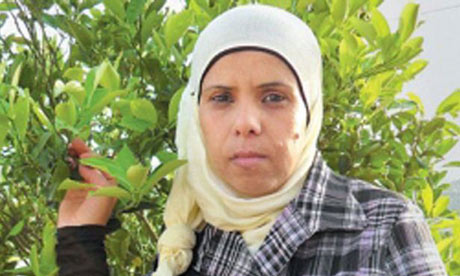
Sitting on a bed in the family house, surrounded by posters that commemorate the death of her son, Subhaia Musa Abu Rahme laments her latest loss. Jawaher, her 35-year-old daughter, died on New Year's Day after collapsing in her home village of Bil'in during a demonstration against the Israeli separation barrier. Despite assurances to the contrary from the Israeli army, her family insist that she died after inhaling massive quantities of tear gas.
"How do you think I feel?" says Abu Rahme softly, a white scarf covering her head and an almost absent look in her eyes. She can hardly comprehend what has happened to her family or the repeated horrors that have been inflicted on it. The family has come to symbolise the Palestinian struggle against the occupation of the West Bank.
Last year, Abu Rahme's son, Bassam – a charismatic member of the committees that organise "non-violent resistance" against the barrier – died after being struck by a gas canister at a demonstration. Another son, Ashraf, has been left with a limp after being shot at close range with rubber-coated steel bullets by an Israeli soldier. And now, Jawaher.
"She was the nicest girl in Bil'in. Here, everyone liked her. The wall confiscated our lands, and now my children are gone. I have nothing left", says Abu Rahme, a 55-year-old widow.
"But every time we lose someone we love, we gain strength to fight against the occupation," she adds. "This is our land and we are going to defend it. We will not stop until we tear down the wall."
Outside the house, on the patio, a group of men mourn Jawaher. They eat dates, drink spiced coffee and chain smoke – but barely speak. Next door, the women gather in a separate room, as tradition dictates. Political delegations, friends, relatives and schoolchildren pass by to express their condolences for the kind-hearted young woman who had worked as a carer for two disabled children in nearby Ramallah.
From the Abu Rahmes' neighbourhood, the barrier that separates the Palestinian territories from Israel – and which cuts off the famil y from its olive groves – is clearly visible. For more than five years, they have participated with their neighbours in the struggle against the construction. But for them, more than for any other family in the village, the battle has brought tragedy. And last week, Jawaher's death returned them to the headlines.
Her family are adamant she died after inhaling the tear gas fired by Israeli soldiers during the demonstration in Bil'in. The army questions the reliability of Palestinian reports, including the hospital documents, and has complained in a statement of "lack of co-operation with the Palestinians". It also says that although the army inquiry has not yet been completed, "a number of scenarios have been posited, among them the possibility that Abu Rahme's death was entirely unrelated to the demonstration last Friday."
For a visibly exhausted Subhaia Musa Abu Rahme, there is no such doubt.
"I was with my daughter, a bit far away from where the clashes were taking place, when the soldiers started shooting gas," she remembers. "The wind brought the gas. We were very affected. I was feeling bad when my daughter told me that she could not take it any more and started vomiting." Another of Jawaher's brothers, Samir Ibrahim, 34, recalls calling an ambulance to take his sister to the hospital in which she later died.
"She was in a very bad condition," he says. "They took her to a house and she was vomiting foam from her mouth. In four or five minutes, an ambulance came. They [the doctors] told us that she lacked oxygen due to the gas."
Every Friday, Samir attends the demonstration against the Israeli separation barrier, built in the aftermath of the second intifada.
Clashes at the protests are common, with some Palestinians throwing stones and the army shooting tear gas, a fetid liquid known as skunk and employing other crowd dispersal weapons. A dense cloud of smoke fills the air and spreads over the village within seconds. It is not unusual for people to vomit in the streets, their eyes burning from the tear gas. But still, Samir, his family and friends keep up their display of defiance.
"We go to show our suffering," he says. "It is our way to denounce that they are raping our land." When asked if the hardships his family has gone through make them special, he says no. "We are like the others. This is only a test from God."
Bil'in, about two miles from the 1967 armistice border, or Green Line, has always been an agricultural village. But the villagers, according to Michael Sfard, the Israeli lawyer representing them, are now prevented from getting to about 50% of their farmlands by the barrier. The impoverished Abu Rahmes are among those who lost their land.
Like the rest they can, in principle, enter their groves through a gate that the army is obliged to open for a certain number of hours a day. However, according to Sfard, the army does not always comply.
Back in the family home, Ashraf, the brother who was shot two years ago, listens attentively to his mother and Samir, a red-and-white Palestinian scarf tied around his neck. His shooting was filmed by an Israeli human rights group and the images travelled around the world. He considers himself lucky; not only did he escape with relatively minor injuries, but the lieutenant-colonel who ordered the shooting is now being judged in a military court. But last week there was no reason to be cheerful. "Our family is destroyed," he says. "There will always be sadness in our family."
Irving Moskowitz demolishes part of Jerusalem hotel to build settler housing
US millionaire's plans for 20 homes on historic Palestinian site will inflame already tense situation, say critics
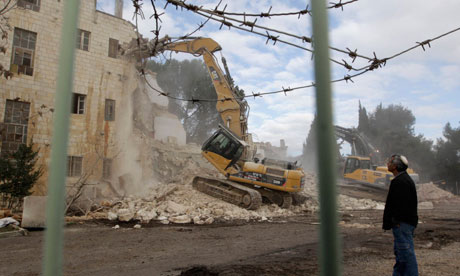
Bulldozers demolish part of the Shepherd Hotel to make way for settler housing. Irving Moskowitz bought the building in 1985.
Harriet Sherwood in Sheikh Jarrah Sunday 9 January 2011 18.48 GMT
Heavy duty demolition equipment razed a section of the historic Shepherd Hotel in East Jerusalem today to make way for a new Jewish settlement in a move which opponents said further jeopardised the shaky prospects for peace.
Work began without warning in the early morning, and by 10am a wing of the hotel in the Palestinian neighbourhood of Sheikh Jarrah was reduced to rubble. The building, once the headquarters of Haj Amin al-Husseini, the former grand mufti of Jerusalem, has been the subject of controversial redevelopment plans since it was bought in 1985 by the US millionaire Irving Moskowitz, who is strongly pro-settlement. His ownership is contested by the Husseini family.
Both the US and UK governments have raised objections to the hotel's replacement by a Jewish settlement. East Jerusalem was annexed by Israel in 1967, and settlements there are illegal under international law. The hotel was declared "absentee property" after 1967. Approval was given last year by the Jerusalem district planning and building council to demolish part of the building to make way for 20 housing units.
Sheikh Jarrah has been targeted by hardline settlers over the past few years, and a number of Palestinian families have been evicted from their homes. Israel says Jews have the right to build and live anywhere in the city. The area has become a focal point for weekly protests by locals and leftwing Israelis.
"Israel is not looking for peace but to take more land," said Adnan Husseini, the Palestinian-appointed governor of Jerusalem, outside the gates of the hotel that were guarded by armed security personnel. "It's clear they are doing everything to violate the situation. They are disfiguring this area by building a settlement here."
Israeli actions, said resident Nasser Jawi, were "torpedoing the peace process".
Nasser Isa Hidmi, of the Jerusalem Committee Against Demolition and Deportation, said the international community should act to prevent Jewish settlers moving into Palestinian neighbourhoods: "We don't want sympathy – we want them to stop Israel from doing what it's doing."
A handful of settler supporters witnessed the demolition. Daniel Luria of Ateret Cohanim, a rightwing pro-settler organisation, said: "There is no more beautiful sound than the destruction of the house of a notorious, not just Nazi sympathiser, but Nazi." Haj Amin al-Husseini was an ally of Hitler.
The demolition of part of the hotel follows an internal EU report on East Jerusalem last month that urged diplomatic intervention over demolitions, evictions, arrests, court cases and intimidation by Israeli authorities.
The EU heads of mission report, which is published annually and circulated privately to European diplomats, said the likelihood of East Jerusalem becoming the capital of a future Palestinian state is faint in the light of "interlinked Israeli policies and measures", including continued settlement expansion, restrictions on access and movement, demolitions and evictions.
"The past year has again seen a further deterioration of the overall situation in East Jerusalem," the report said. "If current trends are not stopped as a matter of urgency, the prospect of East Jerusalem as the future capital of a Palestinian state becomes increasingly unlikely and unworkable. This, in turn, seriously endangers the chances of a sustainable peace."
The report called for an EU presence "when there is a risk of demolitions or evictions of Palestinian families … at Israeli court cases on house demolitions or evictions … [and] EU intervention when Palestinians are arrested or intimidated by Israeli authorities for peaceful cultural, social or political activities in East Jerusalem."
Settlement construction in the east of the city, which, said the report, "embodies the essence of the conflict: territory, nationhood and religion", resumed intensively two months after the end of the Israeli government's building moratorium.
The report identified two types of settlements: small groups of ideologically-motivated settlers taking over homes in Palestinian neighbourhoods in an attempt to prevent the division of Jerusalem in any peace deal; and Israeli government initiatives squeezing East Jerusalem and separating it from the West Bank.
Assange fears death penalty if extradited to US .. AFP .. ~~~~~~~~~~~~~~~~~~~~~~~~~~~~~~~~~~~~~~~~~~~~~~~~~~~~~~~~~~~~~~~~~ Insert: I just saw an interview with one of Julian's lawyers, she was very good. Can't find it, this a sub for now .. 'refusing bail for Assange ummm, just a little unusual' ..
50 years ago, Rupert Murdoch wrote, aomething like .. the truth will win the war between truth and secrecy .. something has happened to Murdoch since. ~~~~~~~~~~~~~~~~~~~~~~~~~~~~~~~~~~~~~~~~~~~~~~~~~~~~~~~~~~~~~~~~~ AFP – WikiLeaks founder Julian Assange arrives at Belmarsh Magistrates Court in southeast London. Assange has …
– Tue Jan 11, 11:19 am ET
LONDON (AFP) – British lawyers for WikiLeaks founder Julian Assange accused Swedish prosecutors of "corrupt" behaviour in their efforts to extradite him over allegations of sex crimes, defence papers revealed on Tuesday.
His legal team also says there is a "real risk" that if extradited to Sweden, Assange may be sent on to the United States, where the papers say he could be detained at Guantanano Bay or even face the death penalty.
The claims are contained in lawyer Geoffrey Robertson's provisional skeleton argument, which Assange's team will use to fight the extradition request during a hearing at a London court on February 7-8.
In the document, released after a brief hearing on Tuesday, Robertson contests Swedish prosecutor Marianne Ny's right to issue a European arrest warrant, which prompted British police to arrest Assange on December 7.
Assange was bailed on December 16.
Robertson questions the credibility of the alleged victims, accuses Swedish prosecutors of illegal behaviour and warns Assange could be sent to the United States, where he has been vilified over WikiLeaks' release of secret US cables.
"Mr. Assange has been the victim of a pattern of illegal and/or corrupt behaviour by the Swedish Prosecuting Authorities," the document says.
It claims that prosecutors acted illegally by releasing his name to the press and leaking evidence against him, and that they refused to accept his repeated offers to give an interview before the warrant was issued.
Elsewhere in the skeleton argument, Robertson claims that Ny did not have the right to issue a European arrest warrant, saying that only the Swedish national police board can issue such warrants.
And he said it should not have been issued when Assange was only wanted for questioning about the alleged sexual assault of two women, insisting that "mere suspicion should not found a request for extradition".
The draft argument also says there has not been full disclosure of the evidence, including text messages between the alleged victims which "speak of revenge and the opportunity to make lots of money".
The document further repeats Assange's argument that the allegations against him are linked to the WikiLeaks disclosures.
"It is submitted that there is a real risk that, if extradited to Sweden, the US will seek his extradition and/or illegal rendition to the USA, where there will be a real risk of him being detained at Guantanamo Bay or elsewhere," Robertson says.
He adds: "There is a real risk that he could be made subject to the death penalty. It is well-known that prominent figures have implied, if not stated outright, that Mr. Assange should be executed."
WikiLeaks Founder Said to Fear ‘Illegal Rendition’ to U.S.
The WikiLeaks founder Julian Assange left court in London on Tuesday.
By RAVI SOMAIYA and ALAN COWELL .. Published: January 11, 2011 .. about 15 minutes ago
LONDON — Lawyers for Julian Assange, the founder of the WikiLeaks antisecrecy group, said on Tuesday they would argue against a demand for his extradition to Sweden on the grounds that he might subsequently face “illegal rendition” to the United States, risking imprisonment at Guantánamo Bay or even the death penalty.
The assertion came in defense documents released after Mr. Assange made a brief appearance in a British high-security court for a largely procedural hearing concerning his resistance to Swedish demands for his extradition, following allegations of sexual misconduct.
The documents also for the first time publicly named the two WikiLeaks’s volunteers who have accused Mr. Assange of forcing sex on them without using a condom in Sweden last August, in one case while the woman, according to her account, was asleep. In keeping with Sweden’s policy of anonymity for those involved in rape cases, they had previously only been referred to as Ms. A and Ms. W.
Karin Rosander, a spokeswoman for the Swedish prosecutors’ office, could not immediately say whether the disclosure of the women’s names constituted a crime, but said it was possible under certain circumstances and that investigations would take place. Jennifer Robinson, one of Mr. Assange’s London lawyers, said that the inclusion of the women’s names in the defense documents was an oversight that would be corrected.
The court hearing set the dates for the extradition hearing as Feb. 7 and 8. The sexual accusations, which Mr. Assange denies, have overlapped with WikiLeaks’s publication of about 2,000 State Department documents — from a trove of around 250,000 in its possession — exposing confidential or secret communications to broad public scrutiny on its Web site and in publications including The New York Times, The Guardian, Der Spiegel, Le Monde and El País.
“Our work with WikiLeaks continues unabated, and we are stepping up our publishing for matters relating to Cablegate and other materials,” Mr. Assange said after Tuesday’s 10-minute hearing, using the organization’s term for State Department documents. “Those will shortly be appearing through our newspaper partners throughout the world,” he said, without elaborating on the content of the threatened disclosures. In recent weeks the flow of new documents has slowed to a trickle.
Mr. Assange was jailed in Britain in early December after a Swedish prosecutor issued a European arrest warrant seeking his extradition to be questioned about the sexual accusations. He was released on $370,000 bail nine days later, on Dec. 16.
In a 35-page outline of their case against extradition, released on the WikiLeaks Web site, Mr. Assange’s lawyers said: “It is submitted that there is a real risk that, if extradited to Sweden, the United States will seek his extradition and/or illegal rendition to the U.S.A., where there will be a real risk of him being detained at Guantánamo Bay or elsewhere.”
The document also cited statements by senior American politicians calling for the execution of those who leaked the State Department documents as proof that he could face the death penalty.
“Indeed, if Mr. Assange were rendered to the U.S.A. without assurances that the death penalty would not be carried out, there is a real risk that he could be made subject to the death penalty.”
Mr. Assange’s lawyers released the outline of the defense case within minutes of Tuesday’s court hearing, saying they would also argue that Swedish law did not permit their client to be extradited on “the mere suspicion” that he had committed offenses. The lawyers argued that Swedish prosecutors had said publicly they were seeking his extradition solely to question him about the accusations of sexual misconduct.
The defense also said Mr. Assange had been “the victim of a pattern of illegal or corrupt behavior” by Swedish prosecutors who were alleged to have made a series of procedural and other errors in their handling of the case.
Previous hearings in the case have been held in central London courts. But the hearing on Tuesday was set for the Belmarsh high-security court in the southeast of the city, which is more usually associated with terrorism cases. Britain’s court service said the move was designed to accommodate reporters and camera crews who had scrimmaged for position outside and inside the other courts.
Wearing a gray duffle coat over a dark suit and tie, Mr. Assange arrived with his British lawyer, Mark Stephens. Once in court, he made thumbs-up gestures toward associates in the public gallery and seemed relaxed.
The WikiLeaks disclosures have incensed officials in Washington, including Secretary of State Hillary Rodham Clinton. American Justice Department officials are seeking to determine whether they can bring charges against him.
Prosecutors have gone to court to demand records of the Twitter account activity of several people linked to WikiLeaks, including Mr. Assange, according to the group and a copy of a subpoena made public on Friday.
The subpoena is the first public evidence of a criminal investigation, announced last month by Attorney General Eric H. Holder Jr., that has been urged on by members of Congress of both parties but is fraught with legal and political difficulties for the Obama administration.
It was denounced by WikiLeaks, which has so far made public only about 1 percent of the quarter-million diplomatic cables in its possession but has threatened to post them all on the Web if criminal charges are brought.
When Mr. Assange, a 39-year-old Australian, was released from jail last month, his bail conditions require him to stay in Ellingham Hall, a luxurious mansion on a 650-acre estate in eastern England, wear an electronic tag and report to local police officers every day. He has described the conditions as “hi-tech house arrest.”
During his stay there, he has signed deals to publish an autobiography that, he told a British newspaper, might be worth $1.7 million.
On Tuesday, the court agreed for him to move to central London for two days during the full extradition hearing next month. He will be staying at the Frontline Club, founded by Vaughan Smith, the owner of Ellingham Hall.
Ravi Somaiya reported from London, and Alan Cowell from Paris


 Market Data
  Markets


 AI
AI