Sea Levels Rising in Indian Ocean Article by Asheesh (4,122 pts ) Edited & published by Lamar Stonecypher (20,356 pts ) Aug 3, 2010
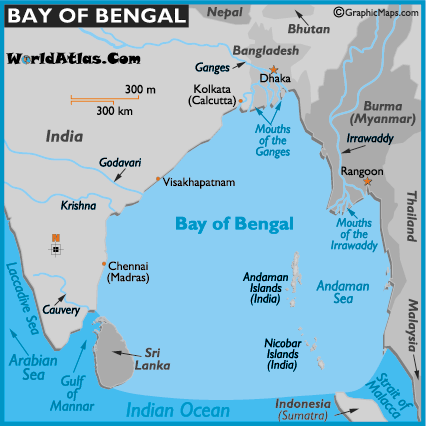
Good luck to the people of Norfolk, Va., and to those of "the coastal areas of the Bay of Bengal, Sri Lanka, the Arabian Sea, Sumatra, and Java. This will increase the monsoon flooding in Bangladesh and India."
The sea level in the Indian Ocean is rising continuously, and with a higher rate compared to the global average sea level rise. This is a big Issue for coastal areas in this region and will affect shipping and livelihoods, local climates, and food production.
Introduction
The Indian Ocean is the third largest ocean in the world. This ocean has about 20 percent of the water present on the earth’s surface. It touches the boundaries of East Africa on the west, India on the north, Australia on the east, and it also meets the Southern Ocean off the coast of Antarctica in the south.
A big problem has been introduced in the Indian Ocean, and this problem is going to increase rapidly. Actually, the sea level of this ocean is rising unevenly, and this problem is very dangerous for some populated coastal areas and islands.
Organizations that are studying the sea level rise in the Indian Ocean
The study of the sea level rise in the Indian Ocean has been conducted by scientists at the University of Colorado at Boulder and the National Center for Atmospheric Research (NCAR). Funding for these studies have been provided by NCAR, the National Science Foundation of NASA, and the U.S. Department of Energy.
Affected areas due to the sea level rise in Indian Ocean
The increase in sea level of the Indian Ocean also affects the sea level of the Bay of Bengal and the Arabian Sea. Due to this, it will affect the coastal areas of the Bay of Bengal, Sri Lanka, the Arabian Sea, Sumatra, and Java. This will increase the monsoon flooding in Bangladesh and India. This will also impact global climate as well. Small islands will tend to struggle to survive.
Insert: substitute image
The causes of Sea level rise in Indian Ocean
* Temperature increase in Indian Ocean
The main cause of this problem is the increase in temperature. In the past 50 years, the temperature of the indo-pacific warm pool has increased by approximately 1 degree Fahrenheit, or 0.5 degrees Celsius. This is because of emission of greenhouse gases by human actions. The rise in sea level was measured along the coasts of the northern Indian Ocean to be an average of about 13 millimeters per ten years.
* Wind patterns of the Indian Ocean
Two primary atmospheric wind patterns circulating over the Indian Ocean are the important cause of the sea level rise. These two patterns are called the Hadley Circulation and the Walker Circulation. The Hadley Circulation is controlled by the air currents developed above the highly heated steamy waters. These air currents are present near to equator and are moving poleward at the upper levels. Further, they reach down to the subtropic water areas of the ocean surface. This process forces surface air to flow towards the equator.
The Walker Circulation works just opposite; this causes the development of air currents that move westward at the upper levels. This circulation also goes down to the surface and moves eastward towards the indo-pacific warm pool.
The whole process restricts the waters from spreading equally and increases the sea level of coastal areas of the Indian Ocean.
Some exceptions to sea level rise in Indian Ocean
* Some coastal areas of the Indian Ocean are not experiencing the sea level drop. For example, the Seychelles Islands and the island of Zanzibar off Tanzania's coast are showing the highest sea level drop, and this is because of the wind patterns of the Indian Ocean.
* The sea level around the Maldives is experiencing a negligible sea level rise (but it shows a measurable sea level rise in the winter season).
Effect on shipping
Although, the sea level is rising continuously, it is predicted that this is not likely to affect shipping in the next 50 to 100 years. Afterward, if the sea level continuously rises, then obviously dangerous climate changes will be introduced, which will create big problems for shipping. Increased water in the ocean increases the energy of the ocean, and the increased energy is responsible for an increase in the action of the currents. Therefore, the currents will flow with more speed. A bad climate always creates difficulties for ships. This will also affect travel time, fuel cost, and the ultimate economy of shippping in the region.
Future problems due the sea level rise in Indian Ocean
* The currents of the Indian Ocean are changing with time, and these currents will have a negative effect to the ecosystem of the coasts. * The warmer water around the coasts will reduce the quantity of oxygen. This is one of the most dangerous problems. * Small Islands will be affected the most by the rise in sea level. * The coasts will suffer flooding problems due to the sea level rise.
Summary
The results from these studies indicates that the coasts of Indonesia, Sumatra, and India will suffer a continuous increase in sea level. This will cause climate change and different problems like climate change, floods, worsening monsoons, and food supply problems. Therefore, it is very important to find appropriate remedies for these problems. Governments should create strategies to face this dangerous problem.
Shipping through this ocean will not be affected by the sea level rise in the next 50 to 100 years. This is the only good news for humans that enters the picture.
THE news from this Midwestern farm is not good. The past four years of heavy rains and flash flooding here in southern Minnesota have left me worried about the future of agriculture in America’s grain belt. For some time computer models of climate change have been predicting just these kinds of weather patterns, but seeing them unfold on our farm has been harrowing nonetheless.
My family and I produce vegetables, hay and grain on 250 acres in one of the richest agricultural areas in the world. While our farm is not large by modern standards, its roots are deep in this region; my great-grandfather homesteaded about 80 miles from here in the late 1800s.
He passed on a keen sensitivity to climate. His memoirs, self-published in the wake of the Dust Bowl of the 1930s, describe tornadoes, droughts and other extreme weather. But even he would be surprised by the erratic weather we have experienced in the last decade.
In August 2007, a series of storms produced a breathtaking 23 inches of rain in 36 hours. The flooding that followed essentially erased our farm from the map. Fields were swamped under churning waters, which in places left a foot or more of debris and silt in their wake. Cornstalks were wrapped around bridge railings 10 feet above normal stream levels. We found butternut squashes from our farm two miles downstream, stranded in sapling branches five feet above the ground. A hillside of mature trees collapsed and slid hundreds of feet into a field below.
The machine shop on our farm was inundated with two feet of filthy runoff. When the water was finally gone, every tool, machine and surface was bathed in a toxic mix of used motor oil and rancid mud.
Our farm was able to stay in business only after receiving grants and low-interest private and government loans. Having experienced lesser floods in 2004 and 2005, my family and I decided the only prudent action would be to use the money to move over the winter to better, drier ground eight miles away.
This move proved prescient: in June 2008 torrential rains and flash flooding returned. The federal government declared the second natural disaster in less than a year for the region. Hundreds of acres of our neighbors’ cornfields were again underwater and had to be replanted. Earthmovers spent days regrading a 280-acre field just across the road from our new home. Had we remained at the old place, we would have lost a season’s worth of crops before they were a quarter grown.
The 2010 growing season has again been extraordinarily wet. The more than 20 inches of rain that I measured in my rain gauge in June and July disrupted nearly every operation on our farm. We managed to do a bare minimum of field preparation, planting and cultivating through midsummer, thanks only to the well-drained soils beneath our new home.
But in two weeks in July, moisture-fueled disease swept through a three-acre onion field, reducing tens of thousands of pounds of healthy onions to mush. With rain falling several times a week and our tractors sitting idle, weeds took over a seven-acre field of carrots, requiring many times the normal amount of hand labor to control. Crop losses topped $100,000 by mid-August.
The most recent onslaught was a pair of heavy storms in late September that dropped 8.2 inches of rain. Representatives from the Federal Emergency Management Agency again toured the area, and another federal disaster declaration was narrowly averted. But evidence of the loss was everywhere: debris piled up in unharvested cornfields, large washouts in fields recently stripped of pumpkins or soybeans, harvesting equipment again sitting idle.
My great-grandfather recognized that weather is never perfect for agriculture for an entire season; a full chapter of his memoir is dedicated to this observation. In his 60 years of farming he wrote that only one season, his final crop of 1937, had close to ideal weather. Like all other farmers of his time and ours, he learned to cope with significant, ill-timed fluctuations in temperature and precipitation.
But at least here in the Midwest, weather fluctuations have been more significant during my time than in his, the Dust Bowl notwithstanding. The weather in our area has become demonstrably more hostile to agriculture, and all signs are that this trend will continue. Minnesota’s state climatologist, Jim Zandlo, has concluded that no fewer than three “thousand-year rains” have occurred in the past seven years in our part of the state. And a University of Minnesota meteorologist, Mark Seeley, has found that summer storms in the region over the past two decades have been more intense and more geographically focused than at any time on record.
No two farms have the same experience with the weather, and some people will contend that ours is an anomaly, that many corn and bean farms in our area have done well over the same period. But heavy summer weather causes harm to farm fields that is not easily seen or quantified, like nutrient leaching, organic-matter depletion and erosion. As climate change accelerates these trends, losses will likely mount proportionately, and across the board. How long can we continue to borrow from the “topsoil bank,” as torrential rains force us to make ever more frequent “withdrawals”?
Climate change, I believe, may eventually pose an existential threat to my way of life. A family farm like ours may simply not be able to adjust quickly enough to such unendingly volatile weather. We can’t charge enough for our crops in good years to cover losses in the ever-more-frequent bad ones. We can’t continue to move to better, drier ground. No new field drainage scheme will help us as atmospheric carbon concentrations edge up to 400 parts per million; hardware and technology alone can’t solve problems of this magnitude.
To make things worse, I see fewer acres in our area now planted with erosion-preventing techniques, like perennial contour strips, than there were a decade ago. I believe that federal agriculture policy is largely responsible, because it rewards the quantity of acres planted rather than the quality of practices employed.
But blaming the government isn’t sufficient. All farmers have an interest in adopting better farming techniques. I believe that we also have an obligation to do so, for the sake of future generations. If global climate change is a product of human use of fossil fuels — and I believe it is — then our farm is a big part of the problem. We burn thousands of gallons of diesel fuel a year in our 10 tractors, undermining the very foundation of our subsistence every time we cultivate a field or put up a bale of hay.
I accept responsibility for my complicity in this, but I also stand ready to accept the challenge of the future, to make serious changes in how I conduct business to produce less carbon. I don’t see that I have a choice, if I am to hope that the farm will be around for my own great-grandchildren.
But my farm, and my neighbors’ farms, can contribute only so much. Americans need to see our experience as a call for national action. The country must get serious about climate-change legislation and making real changes in our daily lives to reduce carbon emissions. The future of our nation’s food supply hangs in the balance.


 Market Data
  Markets


 AI
AI