Would it be wrong to think that Moscow is a lot more vulnerable to U.S. land based nuclear attack than Beijing as long as Beijing keeps Japan non nuclear? Greenland is pretty close to Moscow. I did not know Denmark was involved to the U.S militarily.
Seabed around North Pole coveted Sunday, October 10, 2004 - Page updated at 12:00 A.M.
By Andrew C. Revkin The New York Times
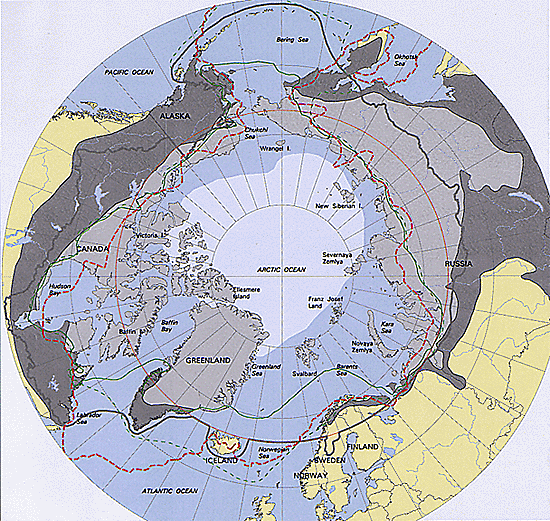
For an imaginary point in the midst of an ice-capped sea, the North Pole is a surprisingly hot piece of real estate. Earlier this month, the Danish government announced it planned a $25 million surveying project aimed at expanding the country's territorial waters — possibly to the very top of the world.
The Danes hope to show that their northernmost bit of turf, 420 miles from the pole in Greenland, is geologically linked to an underwater mountain range called the Lomonosov Ridge. They could then argue that the polar region is a natural extension of Greenland, which, under a murky clause in the U.N. Convention on the Law of the Sea, could mean that the marine resources and the seabed under and around the pole belong to Denmark.
But nearly three years ago, Russia submitted a treaty claim to almost half of the Arctic Ocean, including part of the area around the pole, based in part on its contention that the very same ridge was an extension of Siberia.
Norway, Canada and the United States, the other nations with Arctic Ocean coasts, dispute these claims. What is at stake is not tax revenue generated by Santa's workshop or the tourist camps erected on the floating polar ice each spring, but hundreds of miles of seabed two miles down, territory that may contain oil and natural-gas reserves.
The other resource is simply open water. The Northeast Passage over the shoulders of Russia is the one that could, if clear of ice, cut shipping distances between Europe and Asia nearly in half. That sea route is already nearly free of summer ice.
And the polar thaw continues. American scientists tracking the changes reported that the ice pulled back last month 13.4 percent beyond the long-term average for September. The newly exposed waters covered an area twice the size of Texas.
Open water would allow not only shipping but seismic testing, thumping and drilling of the seabed to begin.


 Market Data
  Markets


 AI
AI