Millennium Challenge Corp. poured millions into Honduras in months leading up to putsch Posted by Bill Conroy - August 9, 2009
U.S. aid agency, established under Bush, seeks to promote “economic freedom”
Many links inside
The coup d'état that rocked Honduras in late June and removed democratically elected President Manuel Zelaya from office, sending him into exile in Costa Rica, was preceded by a multi-million dollar build-up of foreign aid from a U.S. agency that includes on its board of directors the president of the International Republican Institute as well as Secretary of State Hillary Clinton.
That taxpayer-funded agency, called the Millennium Challenge Corporation (MCC), oversees a multi-billion dollar foreign-aid fund called the Millennium Challenge Account. It was established in 2004 under the Bush administration as means of combating terrorism by funding development in poor nations under a strict neo-conservative free-trade model.
A review of publicly available financial records reveals that between April 1 and July 31 of this year, nearly $17 million in aid was disbursed to Honduras through the MCC program. That money flowed into Honduras after President Zelaya called for a national referendum in March to decide whether a ballot question should be included in that nation’s November 2009 general elections — which would have asked voters to decide if a national assembly should be convened to amend the Honduran constitution.
But Zelaya had fallen out of favor with the Honduran business class that controls the country well before that point. He was accused of becoming too intertwined with the agenda of Venezuelan President Hugo Chavez, a long-time nemesis of the Washington political class and Wall Street capital interests. That drift toward the left was marked by Zelaya’s decision to join the Chavez-led, Latin American-centered Bolivarian Alternative for the Americas (ALBA in its Spanish initials) — a move ratified by the Honduran Congress in October 2008.
At the time, media reports warned that Honduras’ decision to join ALBA might result in the MCC rescinding its five-year, $215 million aid compact with Honduras — inked in 2005. But it seems quite the opposite happened.
In fact, since Oct. 1, 2008, according to public records, a total of $45.3 million in MCC aid has been pumped into Honduras, representing 56 percent of all aid disbursed under the program through July 31 of this year. (Even though the MCC compact with Honduras calls for an aid package of $215 million to be distributed between 2005 and 2010, as of July 31, 2009, according to MCC records, a total of only $80.3 million in aid has been disbursed to the country — more than half, as mentioned, since October 2008.)
The MCC Honduras program is designed to fund agricultural and transportation projects that “will increase the productivity and business skills of farmers and their employees who operate small- and medium-sized farms, and will reduce transportation costs between targeted production centers and national, regional, and global markets,” according to the MCC’s description of the aid compact.
But a criticism of the MCC program is that, though designed in theory to help the poor, its programs actually do more to benefit the wealthy and business class.
A 2007 U.S. Government Accountability Office report focused on the MCC’s aid program in the South Pacific island nation of Vanuatu spells out that criticism:
MCC states that the [Vanuatu] compact is expected to benefit approximately 65,000 poor, rural inhabitants “living nearby and using the roads to access markets and social services.” According to the MCC’s underlying documentation, 57 percent of the compact’s monetary benefits will accrue to tourism services providers, transport providers, government workers, and local businesses and 43 percent of the benefits will go to the local population — that is, local producers, local consumers, and inhabitants of remote communities. However, MCC does not establish the proportion of local-population benefits that will go to the rural poor.
The MCC’s overtly neo-conservative, pro-oligarch underpinnings are further illuminated by its strongest proponents, including the conservative Heritage Foundation think tank.
From an article on the Heritage Foundation’s Web site:
The MCC has a number of advantages over traditional assistance. MCC programs encourage and allocate aid to countries that embrace policies linked to economic growth and development. The objective indicators used by the MCC to determine which countries will receive funding —"based on their performance in governing justly, investing in their citizens, and encouraging economic freedom" — mirror those used by The Heritage Foundation in preparing its Index of Economic Freedom.
Among the indicators established under MCC for providing, or continuing to provide, aid to a foreign nation, include: business start-ups, trade policy, fiscal policy, and land rights and access.
Whether the MCC’s approach to doling out taxpayers’ money is appropriate, or not, really is not the point in this case, however. The question here is why would a taxpayer-funded federal agency with a conservative, free-market/free-trade agenda suddenly start ramping up aid to Honduras after it’s president, Zelaya, clearly took a turn to the left toward Venezuela’s Chavez, a perceived arch-enemy of that conservative agenda?
One possible explanation is that the huge flow of MCC money into Honduras had nothing to do with the agency's objectives in Latin American and everything to do with its budget agenda in Washington.
MCC has a terrible track record of disbursing funds under its control — preferring instead to keep them stashed away in its own coffers. And so to overcome that image, it may have simply began rapidly ramping up disbursements to secure additional funding from Congress — the old trick of spending down your old budget to assure your new budget isn’t cut.
Sen. Patrick Leahy, D-Vermont, in a statement made on the Senate Floor in November 2008, seems to verify that this is, in fact, one possible scenario in play in the case of MCC.
From Leahy’s Floor statement justifying the Senate’s move to cut President Bush’s $2 billion funding request for MCC to $254 million for fiscal 2009:
We also considered the fact that Congress had appropriated $7.5 billion for the MCC, and by July 18 only $235 million had been disbursed of which a significant portion was for administrative expenses. While we made clear that we were not advocating faster disbursements, we do not support additional [foreign aid] compacts until more of the funds we have already appropriated produce sustainable results.
In the wake of Leahy’s chastisement, the MCC, it can be aruged, took action to address its bloated books by ramping up disbursements under the aid program — resulting in some $45.3 million in MCC funds being disbursed to Honduras alone between Oct. 1, 2008, and July 31, 2009 — again, representing 56 percent of all funds disbursed under the MCC Honduras compact as of July 31 of this year.
But, there are some who might see a more cynical motive for the rapid unleashing of MCC funds in Honduras, given that it is a hard case to make that those funds would have been distributed if they were deemed to be assisting Zelaya’s perceived alliance with Chavez. Surely, the MCC could have ramped up its disbursements in other regions of the world outside Chavez' reach to address the concerns raised by Leahy, no?
Funding Change
Once MCC funds are provided to a foreign nation, such as Honduras, under the agency’s guidelines, the further distribution of that money is overseen and managed by the receiving county. In the case of Honduras, the entity in charge of spending the MCC funds (under the terms and reporting guidelines established by the MCC) is called MCA-Honduras — which is overseen by a board that includes presidential ministers from that nation.
A review of documents obtained from MCA-Honduras outlining its projections for future MCC funding reveals that a total of $28.5 million in MCC funds are slated for delivery between July and September 2009. And, for the following three quarters (through June 2010) the MCC is scheduled to disburse nearly $80 million in funding to MCA-Honduras under the Honduran foreign-aid compact.
That money, if it comes through, would go into the coffers of the putsch regime now in control of Honduras — assuming it remains behind the wheel of power. Whether by design or coincidence, that represents a hefty nest egg for the putsch leadership to tap — even if in violation of MCC rules — as those usurpers seek to ride out the worst of the world’s short-term memory over their illegal coup.
In addition, the $45 million in MCC funds already taken in since October 2008 surely gave a lift to the coup plotters — to the extent that not all of that money was actually distributed to grant targets within Honduras, or to the extent it was distributed to players in line with the coup regime’s interests.
A thorough accounting of what happened to those funds, vetted outside the MCC or the putsch Honduran government, seems to be in order given recent developments in that nation.
Now, there have been a few media reports indicating that some of the MCC funds targeted for Honduras post-coup are on hold — to the tune of $11 million, according to a report by The Hill.com.
But, based on a review of proceeding transcripts and press releases posted on the MCC Web site, the agency’s board has taken no official action, to date, to either suspend or terminate its Honduran foreign-aid compact — as the MCC has done recently in other cases where it has determined the receiving nations have violated the agency's rules.
For example, in early June, the MCC partially terminated its’ foreign-aid compact with Nicaragua after alleging that nation (which borders Honduras and has a left-leaning government) had violated the agency’s rules with respect to “economic freedom,” “democracy” and the “rule of law.” And in May, the MCC board terminated its compact with Madagascar in the wake of the coup in that nation.
Maybe a similar fate is in store for Honduras down the road, if the current coup regime fails to find a path to MCC-style democracy. But just how that will be judged by the MCC remains a mystery — other than it seems clear that democratic path will be good for business interests.
That pursuit by the MCC of a vibrant corporate-centered slant to democracy in Honduras (which by definition would be anti-Chavez in tone) seems to be a given, since the current board of the MCC includes not only Secretary of State Clinton and Secretary of the Treasury Timothy Geithner — both sensitive to Wall Street concerns — but also former Republican Sen. William Frist; venture capitalist Alan Patricof; and Lorne Craner, the president of the International Republican Institute — which is chaired by Republican Sen. John McCain.
The MCC board also includes the president of Catholic Relief Services, Ken Hackett. That is of note since the Catholic archbishop of Honduras, Oscar Andres Rodriguez Maradiaga, has been very vocal in his opposition to Zelaya. Archbishop Rodriquez Maradiaga has warned, as reported by the conservative American Spectator, that Zelaya’s return to power could lead to a “blood bath” and he has demanded that the Organization of American States investigate the alleged “illegal deeds” carried out under Zelaya’s administration — referring, it seems, to Zelaya’s call for a ballot referendum on the matter of convening a constitutional convention.
As Secretary Clinton put it (striking a more diplomatic note) when asked about the future of MCC funding at a press briefing on June 29, the day after the coup in Honduras played out (and first reactions are normally the most honest):
... Much of our [foreign] assistance is conditioned on the integrity of the democratic system. But if we were able to get to a status quo that returned to the rule of law and constitutional order within a relatively short period of time, I think that would be a good outcome.
So the end game for the putsch regime now headed by President Robert Micheletti and backed by the oligarchical business interests of Honduras must entail holding out until the nation’s general election in November. With those elections, the illegal regime, and the business oligarchs propping it up, can attempt to put the glossy sheen of the “status quo” and “rule of law” on their raw, undemocratic power grab.
Clinton and the MCC have invested a lot of political and economic capital, to date, in ensuring that is the outcome, it appears.
The civil society in Honduras now working nonviolently from below to assert authentic democracy — not linked to MCC or U.S. State Department preconditions — clearly sees a different landscape ahead.
The fate of Latin America, in many ways, will be revealed in that as yet undiscovered country.
'The Americans seem to be happy with their drug consumption. That's fine, but why should Mexico fight their drug war for them? Drugs only affect a small number of Mexicans The government should be concentrating on things which affect the Mexican people, like assaults, kidnapping...... . The Americans are not fighting a drug war, that's smart, i don't think they should. But, if they do want to let them fight it. Why should Mexico fight their drug war for them?'
The above is a paraphrase of some comments made in an interview with the BBC i just heard. He mentioned 40000 deaths, they are told related to the drug war, but doesn't know how many actually are. He was an ex Mexican foreign minister, so guessing he was Jorge Castaneda, of the article below. ............................. fp: (from previous) .. Drugs
"On February 22, 2008, Zelaya called on the United States to legalize drugs, in order, he said, to prevent the majority of violent murders occurring in Honduras. Honduras is used by cocaine smugglers as a transit point between Colombia and the US. Honduras, with a population of 7 million, suffers an average of 12 murders a day, an estimated 70% of which result from the international drug trade. He also said that Guatemala, El Salvador and Mexico face the same problem."
DO WALL STREET TRADERS STILL USE COCAINE ON THE JOB? YEARS BACK MANY REPORTS CONFIRMED MANY DID. ............................. Former Mexican official urges legalizing marijuana February 02, 2010| By Tom Evans, CNN
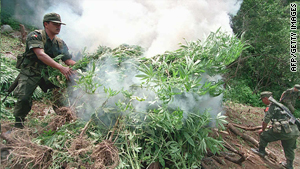
Members of the "Mars Work Force" anti-narcotics special brigade burn marijuana in Sinaloa State in western Mexico.
The United States and Mexico should both legalize marijuana in an attempt to break the power of the Mexican drug cartels and end the spiraling violence south of the border, a former Mexican foreign minister said Tuesday.
Jorge Castaneda, in an interview with CNN's Christiane Amanpour, said marijuana "should be legalized in both countries," and said it is ridiculous for Mexico to try to stop marijuana from entering the United States when it's legally sold for medical purposes in California.
"The Drug Enforcement Administration says that 60 percent of the Mexican (drug) cartels' profits come from marijuana. If we start with that, it's a big chunk," he added.
"We can't do everything overnight ... and we can't do it in Mexico if the U.S. doesn't do it at the same time."
Castaneda strongly criticized Mexican President Felipe Calderon for declaring war against the drug cartels, a war that has cost as many as 17,000 lives since he took office in December 2006.
In the past month alone, 900 people were killed -- a new monthly record, he said. Sixteen students died in what's thought to be a drug-related massacre in the border city of Juarez over the weekend.
"It's hard for me quite honestly -- and I think for many Mexicans -- to accept that the more deaths we have, the more successful the strategy is," he added.
"I think President Calderon rushed into this, and now we're paying the consequences."
Mexico's consul general in New York, Ruben Beltran, who also served in the U.S. border states of California and Arizona, strongly disagreed with Castaneda's assessment.
"Are we going to raise the white flag? Are we going to surrender? Are we going to surrender the ability of the government to look for the rule of law and secure the rule of law?" he asked.
"I don't think there's an alternative," he said. "The monopoly of force -- use of force -- pertains to the state, and the state is the one who should use the force to secure the stability of the country."
Calderon has sent 45,000 troops to help overstretched police departments fight the drug cartels.
Mexico, chief casualty of America's 'war on drugs'
With the death toll ever rising, it's high time the US stopped sponsoring a bloody, unwinnable conflict with the drugs cartels
John Ackerman .. guardian.co.uk, Friday 18 February 2011 13.10 GMT .. Comments (152)
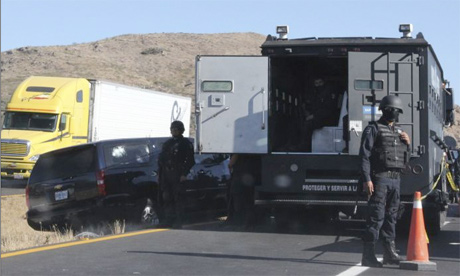
Mexican police guard a US embassy vehicle after it came under fire from gunmen on Highway 57 between Mexico City and Monterrey, on 15 February 2011. A US immigration and customs enforcement agent was killed and another wounded in the attack. Photograph: AP Photo/Teodoro Blanco Vazquez
Mexico has, indeed, reached a tipping point. But an escalation of the present military strategy will only make the situation worse. The best response to recent events is to end the war and proceed towards disarmament, instead of aggravating the conflict. Gil Kerlikowske, director of the Office of National Drug Control Policy, has declared .. http://online.wsj.com/article/SB124225891527617397.html .. the end of the metaphorical "war on drugs" within US borders. The time has come also to bring a stop to the very real war on the drug cartels south of the border.
The central problem with the military strategy is that it does not distinguish between violent and non-violent criminals, or serious and less harmful crimes. As Kerlikowske has pointed out, the Mexican cartels are not "insurgents" or "terrorists", but "multivalent criminal organisations", which have diversified into a wide variety of activities including kidnapping, extortion, piracy, human trafficking, money-laundering and government corruption, as well as the transportation and sale of illegal drugs.
Of all of these crimes, by far the least harmful for social and economic development is the transportation of drugs. Although drug consumption is clearly damaging, simply transporting illegal substances does not, in itself, create violence, economic crisis or human suffering. And even the harm of drug consumption pales in comparison to the effects of kidnappings, beheadings and human trafficking, especially when the consumption involves marijuana, sales of which make up two thirds of the profits of the Mexican cartels.
Nevertheless, due to pressure from the US government, the Mexican authorities have been forced to concentrate their scarce law enforcement resources on pursuing the least harmful crimes. This strategy has had the obvious consequence of pushing the criminals towards more dangerous and violent activities. The result: a stratospheric increase in violence, with over 35,000 assassinations in the past four years, 15,000 during 2010 alone. The problem in Mexico is, therefore, not a lack of firepower or support for the "war on drugs", but the very strategy of "war" itself.
The real priority should be on punishing violent crimes, not the transportation of drugs. By turning the typical strategy on its head, Mexico would slowly start to separate the violent, dangerous criminals from those drug traffickers who are in the business principally for the money. Although this might not bring down the prices of illegal drugs on the streets of US cities, it would help end the violence, which today is paramount and may at some point spill over to the US.
This proposal should not be confused with either legalisation or negotiation approaches. Increased liberalisation of marijuana consumption would reduce the urgency of controlling transportation routes, but this strategy is by no means dependent on the legalisation of drug use. And this idea in no way implies a pact with the cartels, in the style of the past authoritarian Mexican governments. On the contrary, the proposal is to increase, not reduce, the pressure on the most serious criminals.
Such a change in strategy would immediately receive vigorous applause from the Mexican people. A growing number of Mexicans have come to the conclusion that peace and prosperity are more important than stopping the flow of drugs towards eager consumers in the United States. A broad new citizen movement has even emerged, rallying around the cry of: "No more blood!" .. http://www.change.org/petitions/tell_congress_ya_basta_de_sangre_no_more_blood_spilled_in_mexico_legalize_drugs .. Movement leaders agree that the drug cartels need to be controlled – but in a way that does not destroy the very fabric of society. It makes no sense to win the war, if it leaves the country in shambles.
It is time for the Obama administration to listen to the Mexican people and not only to his military advisers. The roots of the problem obviously lie in the lack of regulation of the sale of assault weapons and in the high drug consumption in the US: 90% of weapons confiscated from Mexican cartels come from the US. But if it is not politically feasible to attend to these issues, the Obama administration can at least change the emphasis of its policy towards Mexico. The central objective should be the reduction of violence and the establishment of the rule of law. Without this, everything else is doomed to fail. Discussion thread shortcut
The author of this piece, John Ackerman, has been participating in the conversation below as JohnMAckerman. This is an excerpt selected by a Cif editor:
Whendovescry observes:
The current violence started from a turf war that will wind down when the losers are eliminated.
JohnMAckerman responds:
You are absolutely correct. The problem is that if we continue along the same path the "winners" will not be US and Mexican government law enforcement, but a rival gang. This might lead to short term peace, but to long term consolidation of a "narco state" in Mexico. http://www.guardian.co.uk/commentisfree/cifamerica/2011/feb/18/drugs-trade-drugs


 Market Data
  Markets


 AI
AI