



 AI
AI








Thursday, April 07, 2011 6:45:32 AM
'The Americans seem to be happy with their drug consumption. That's fine, but why should Mexico fight their drug war
for them? Drugs only affect a small number of Mexicans The government should be concentrating on things which
affect the Mexican people, like assaults, kidnapping...... . The Americans are not fighting a drug war, that's smart,
i don't think they should. But, if they do want to let them fight it. Why should Mexico fight their drug war for them?'
The above is a paraphrase of some comments made in an interview with the BBC i just heard. He
mentioned 40000 deaths, they are told related to the drug war, but doesn't know how many actually
are. He was an ex Mexican foreign minister, so guessing he was Jorge Castaneda, of the article below.
.............................
fp: (from previous) .. Drugs
"On February 22, 2008, Zelaya called on the United States to legalize drugs, in order, he said, to prevent the majority of violent murders occurring in Honduras. Honduras is used by cocaine smugglers as a transit point between Colombia and the US. Honduras, with a population of 7 million, suffers an average of 12 murders a day, an estimated 70% of which result from the international drug trade. He also said that Guatemala, El Salvador and Mexico face the same problem."
DO WALL STREET TRADERS STILL USE COCAINE ON THE JOB? YEARS BACK MANY REPORTS CONFIRMED MANY DID.
.............................
Former Mexican official urges legalizing marijuana
February 02, 2010| By Tom Evans, CNN
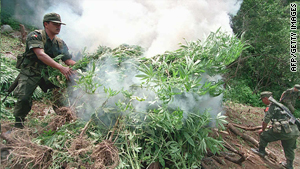
Members of the "Mars Work Force" anti-narcotics
special brigade burn marijuana in Sinaloa State in
western Mexico.
The United States and Mexico should both legalize marijuana in an attempt to break the power of the Mexican
drug cartels and end the spiraling violence south of the border, a former Mexican foreign minister said Tuesday.
Jorge Castaneda, in an interview with CNN's Christiane Amanpour, said marijuana "should be legalized in both countries," and said it
is ridiculous for Mexico to try to stop marijuana from entering the United States when it's legally sold for medical purposes in California.
"The Drug Enforcement Administration says that 60 percent of the Mexican (drug)
cartels' profits come from marijuana. If we start with that, it's a big chunk," he added.
"We can't do everything overnight ... and we can't do it in Mexico if the U.S. doesn't do it at the same time."
Castaneda strongly criticized Mexican President Felipe Calderon for declaring war against the
drug cartels, a war that has cost as many as 17,000 lives since he took office in December 2006.
In the past month alone, 900 people were killed -- a new monthly record, he said. Sixteen students
died in what's thought to be a drug-related massacre in the border city of Juarez over the weekend.
"It's hard for me quite honestly -- and I think for many Mexicans -- to accept
that the more deaths we have, the more successful the strategy is," he added.
"I think President Calderon rushed into this, and now we're paying the consequences."
Mexico's consul general in New York, Ruben Beltran, who also served in the U.S. border
states of California and Arizona, strongly disagreed with Castaneda's assessment.
"Are we going to raise the white flag? Are we going to surrender? Are we going to surrender
the ability of the government to look for the rule of law and secure the rule of law?" he asked.
"I don't think there's an alternative," he said. "The monopoly of force -- use of force -- pertains
to the state, and the state is the one who should use the force to secure the stability of the country."
Calderon has sent 45,000 troops to help overstretched police departments fight the drug cartels.
"What we're witnessing right now is maybe the peak of that violence," Beltran said. "Let me assure you that the Mexican
government is not going to relinquish its duty to confront organized crime, and that's what's happening right now."
http://articles.cnn.com/2010-02-02/world/us.mexico.marijuana_1_drug-cartels-cartels-profits-calderon-government?_s=PM:WORLD
Mexico, chief casualty of America's 'war on drugs'
With the death toll ever rising, it's high time the US stopped sponsoring a bloody, unwinnable conflict with the drugs cartels
John Ackerman .. guardian.co.uk, Friday 18 February 2011 13.10 GMT .. Comments (152)
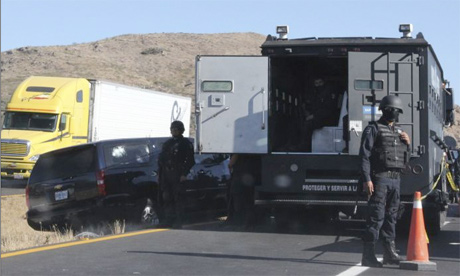
Mexican police guard a US embassy vehicle after it came under fire from gunmen on Highway 57 between Mexico City and Monterrey, on 15 February 2011. A US immigration and customs enforcement agent was killed and another wounded in the attack. Photograph: AP Photo/Teodoro Blanco Vazquez
Tuesday's brutal attack on two US law enforcement agents in Mexico has led to the normal sabre-rattling. .. http://www.pbs.org/newshour/rundown/2011/02/mexico-shooting.html .. Representative Michael McCaul of Texas has called it a "game-changer" and a "wake-up call" to the "war on our nation's doorstep". Last week, James Westphal, undersecretary of the Army, .. http://thefastertimes.com/news/2011/02/10/joseph-westphals-comment-on-mexican-insurgency-suggests-hidden-depths-to-the-war-on-drugs/ .. had already spoken of an "armed insurgency" in Mexico, and the possibility of sending "armed and fighting" troops across the border to prevent a "takeover of government". Secretary Janet Napolitano continually speaks of the "war" south of the border. James Clapper, national intelligence director, recently announced .. http://news.yahoo.com/s/ap/us_congress_intelligence_threat .. that Mexico has been promoted to being a top national security threat.
Mexico has, indeed, reached a tipping point. But an escalation of the present military strategy will only make the situation worse. The best response to recent events is to end the war and proceed towards disarmament, instead of aggravating the conflict. Gil Kerlikowske, director of the Office of National Drug Control Policy, has declared .. http://online.wsj.com/article/SB124225891527617397.html .. the end of the metaphorical "war on drugs" within US borders. The time has come also to bring a stop to the very real war on the drug cartels south of the border.
The central problem with the military strategy is that it does not distinguish between violent and non-violent criminals, or serious and less harmful crimes. As Kerlikowske has pointed out, the Mexican cartels are not "insurgents" or "terrorists", but "multivalent criminal organisations", which have diversified into a wide variety of activities including kidnapping, extortion, piracy, human trafficking, money-laundering and government corruption, as well as the transportation and sale of illegal drugs.
Of all of these crimes, by far the least harmful for social and economic development is the transportation of drugs. Although drug consumption is clearly damaging, simply transporting illegal substances does not, in itself, create violence, economic crisis or human suffering. And even the harm of drug consumption pales in comparison to the effects of kidnappings, beheadings and human trafficking, especially when the consumption involves marijuana, sales of which make up two thirds of the profits of the Mexican cartels.
Nevertheless, due to pressure from the US government, the Mexican authorities have been forced to concentrate their scarce law enforcement resources on pursuing the least harmful crimes. This strategy has had the obvious consequence of pushing the criminals towards more dangerous and violent activities. The result: a stratospheric increase in violence, with over 35,000 assassinations in the past four years, 15,000 during 2010 alone. The problem in Mexico is, therefore, not a lack of firepower or support for the "war on drugs", but the very strategy of "war" itself.
The real priority should be on punishing violent crimes, not the transportation of drugs. By turning the typical strategy on its head, Mexico would slowly start to separate the violent, dangerous criminals from those drug traffickers who are in the business principally for the money. Although this might not bring down the prices of illegal drugs on the streets of US cities, it would help end the violence, which today is paramount and may at some point spill over to the US.
This proposal should not be confused with either legalisation or negotiation approaches. Increased liberalisation of marijuana consumption would reduce the urgency of controlling transportation routes, but this strategy is by no means dependent on the legalisation of drug use. And this idea in no way implies a pact with the cartels, in the style of the past authoritarian Mexican governments. On the contrary, the proposal is to increase, not reduce, the pressure on the most serious criminals.
Such a change in strategy would immediately receive vigorous applause from the Mexican people. A growing number of Mexicans have come to the conclusion that peace and prosperity are more important than stopping the flow of drugs towards eager consumers in the United States. A broad new citizen movement has even emerged, rallying around the cry of: "No more blood!" .. http://www.change.org/petitions/tell_congress_ya_basta_de_sangre_no_more_blood_spilled_in_mexico_legalize_drugs .. Movement leaders agree that the drug cartels need to be controlled – but in a way that does not destroy the very fabric of society. It makes no sense to win the war, if it leaves the country in shambles.
It is time for the Obama administration to listen to the Mexican people and not only to his military advisers. The roots of the problem obviously lie in the lack of regulation of the sale of assault weapons and in the high drug consumption in the US: 90% of weapons confiscated from Mexican cartels come from the US. But if it is not politically feasible to attend to these issues, the Obama administration can at least change the emphasis of its policy towards Mexico. The central objective should be the reduction of violence and the establishment of the rule of law. Without this, everything else is doomed to fail.
Discussion thread shortcut
The author of this piece, John Ackerman, has been participating in the conversation below as JohnMAckerman. This is an excerpt selected by a Cif editor:
Whendovescry observes:
The current violence started from a turf war that will wind down when the losers are eliminated.
JohnMAckerman responds:
You are absolutely correct. The problem is that if we continue along the same path the "winners" will not be US and Mexican government law enforcement, but a rival gang. This might lead to short term peace, but to long term consolidation of a "narco state" in Mexico.
http://www.guardian.co.uk/commentisfree/cifamerica/2011/feb/18/drugs-trade-drugs
.. links to Ackerman just above inside ..
for them? Drugs only affect a small number of Mexicans The government should be concentrating on things which
affect the Mexican people, like assaults, kidnapping...... . The Americans are not fighting a drug war, that's smart,
i don't think they should. But, if they do want to let them fight it. Why should Mexico fight their drug war for them?'
The above is a paraphrase of some comments made in an interview with the BBC i just heard. He
mentioned 40000 deaths, they are told related to the drug war, but doesn't know how many actually
are. He was an ex Mexican foreign minister, so guessing he was Jorge Castaneda, of the article below.
.............................
fp: (from previous) .. Drugs
"On February 22, 2008, Zelaya called on the United States to legalize drugs, in order, he said, to prevent the majority of violent murders occurring in Honduras. Honduras is used by cocaine smugglers as a transit point between Colombia and the US. Honduras, with a population of 7 million, suffers an average of 12 murders a day, an estimated 70% of which result from the international drug trade. He also said that Guatemala, El Salvador and Mexico face the same problem."
DO WALL STREET TRADERS STILL USE COCAINE ON THE JOB? YEARS BACK MANY REPORTS CONFIRMED MANY DID.
.............................
Former Mexican official urges legalizing marijuana
February 02, 2010| By Tom Evans, CNN
Members of the "Mars Work Force" anti-narcotics
special brigade burn marijuana in Sinaloa State in
western Mexico.
The United States and Mexico should both legalize marijuana in an attempt to break the power of the Mexican
drug cartels and end the spiraling violence south of the border, a former Mexican foreign minister said Tuesday.
Jorge Castaneda, in an interview with CNN's Christiane Amanpour, said marijuana "should be legalized in both countries," and said it
is ridiculous for Mexico to try to stop marijuana from entering the United States when it's legally sold for medical purposes in California.
"The Drug Enforcement Administration says that 60 percent of the Mexican (drug)
cartels' profits come from marijuana. If we start with that, it's a big chunk," he added.
"We can't do everything overnight ... and we can't do it in Mexico if the U.S. doesn't do it at the same time."
Castaneda strongly criticized Mexican President Felipe Calderon for declaring war against the
drug cartels, a war that has cost as many as 17,000 lives since he took office in December 2006.
In the past month alone, 900 people were killed -- a new monthly record, he said. Sixteen students
died in what's thought to be a drug-related massacre in the border city of Juarez over the weekend.
"It's hard for me quite honestly -- and I think for many Mexicans -- to accept
that the more deaths we have, the more successful the strategy is," he added.
"I think President Calderon rushed into this, and now we're paying the consequences."
Mexico's consul general in New York, Ruben Beltran, who also served in the U.S. border
states of California and Arizona, strongly disagreed with Castaneda's assessment.
"Are we going to raise the white flag? Are we going to surrender? Are we going to surrender
the ability of the government to look for the rule of law and secure the rule of law?" he asked.
"I don't think there's an alternative," he said. "The monopoly of force -- use of force -- pertains
to the state, and the state is the one who should use the force to secure the stability of the country."
Calderon has sent 45,000 troops to help overstretched police departments fight the drug cartels.
"What we're witnessing right now is maybe the peak of that violence," Beltran said. "Let me assure you that the Mexican
government is not going to relinquish its duty to confront organized crime, and that's what's happening right now."
http://articles.cnn.com/2010-02-02/world/us.mexico.marijuana_1_drug-cartels-cartels-profits-calderon-government?_s=PM:WORLD
Mexico, chief casualty of America's 'war on drugs'
With the death toll ever rising, it's high time the US stopped sponsoring a bloody, unwinnable conflict with the drugs cartels
John Ackerman .. guardian.co.uk, Friday 18 February 2011 13.10 GMT .. Comments (152)
Mexican police guard a US embassy vehicle after it came under fire from gunmen on Highway 57 between Mexico City and Monterrey, on 15 February 2011. A US immigration and customs enforcement agent was killed and another wounded in the attack. Photograph: AP Photo/Teodoro Blanco Vazquez
Tuesday's brutal attack on two US law enforcement agents in Mexico has led to the normal sabre-rattling. .. http://www.pbs.org/newshour/rundown/2011/02/mexico-shooting.html .. Representative Michael McCaul of Texas has called it a "game-changer" and a "wake-up call" to the "war on our nation's doorstep". Last week, James Westphal, undersecretary of the Army, .. http://thefastertimes.com/news/2011/02/10/joseph-westphals-comment-on-mexican-insurgency-suggests-hidden-depths-to-the-war-on-drugs/ .. had already spoken of an "armed insurgency" in Mexico, and the possibility of sending "armed and fighting" troops across the border to prevent a "takeover of government". Secretary Janet Napolitano continually speaks of the "war" south of the border. James Clapper, national intelligence director, recently announced .. http://news.yahoo.com/s/ap/us_congress_intelligence_threat .. that Mexico has been promoted to being a top national security threat.
Mexico has, indeed, reached a tipping point. But an escalation of the present military strategy will only make the situation worse. The best response to recent events is to end the war and proceed towards disarmament, instead of aggravating the conflict. Gil Kerlikowske, director of the Office of National Drug Control Policy, has declared .. http://online.wsj.com/article/SB124225891527617397.html .. the end of the metaphorical "war on drugs" within US borders. The time has come also to bring a stop to the very real war on the drug cartels south of the border.
The central problem with the military strategy is that it does not distinguish between violent and non-violent criminals, or serious and less harmful crimes. As Kerlikowske has pointed out, the Mexican cartels are not "insurgents" or "terrorists", but "multivalent criminal organisations", which have diversified into a wide variety of activities including kidnapping, extortion, piracy, human trafficking, money-laundering and government corruption, as well as the transportation and sale of illegal drugs.
Of all of these crimes, by far the least harmful for social and economic development is the transportation of drugs. Although drug consumption is clearly damaging, simply transporting illegal substances does not, in itself, create violence, economic crisis or human suffering. And even the harm of drug consumption pales in comparison to the effects of kidnappings, beheadings and human trafficking, especially when the consumption involves marijuana, sales of which make up two thirds of the profits of the Mexican cartels.
Nevertheless, due to pressure from the US government, the Mexican authorities have been forced to concentrate their scarce law enforcement resources on pursuing the least harmful crimes. This strategy has had the obvious consequence of pushing the criminals towards more dangerous and violent activities. The result: a stratospheric increase in violence, with over 35,000 assassinations in the past four years, 15,000 during 2010 alone. The problem in Mexico is, therefore, not a lack of firepower or support for the "war on drugs", but the very strategy of "war" itself.
The real priority should be on punishing violent crimes, not the transportation of drugs. By turning the typical strategy on its head, Mexico would slowly start to separate the violent, dangerous criminals from those drug traffickers who are in the business principally for the money. Although this might not bring down the prices of illegal drugs on the streets of US cities, it would help end the violence, which today is paramount and may at some point spill over to the US.
This proposal should not be confused with either legalisation or negotiation approaches. Increased liberalisation of marijuana consumption would reduce the urgency of controlling transportation routes, but this strategy is by no means dependent on the legalisation of drug use. And this idea in no way implies a pact with the cartels, in the style of the past authoritarian Mexican governments. On the contrary, the proposal is to increase, not reduce, the pressure on the most serious criminals.
Such a change in strategy would immediately receive vigorous applause from the Mexican people. A growing number of Mexicans have come to the conclusion that peace and prosperity are more important than stopping the flow of drugs towards eager consumers in the United States. A broad new citizen movement has even emerged, rallying around the cry of: "No more blood!" .. http://www.change.org/petitions/tell_congress_ya_basta_de_sangre_no_more_blood_spilled_in_mexico_legalize_drugs .. Movement leaders agree that the drug cartels need to be controlled – but in a way that does not destroy the very fabric of society. It makes no sense to win the war, if it leaves the country in shambles.
It is time for the Obama administration to listen to the Mexican people and not only to his military advisers. The roots of the problem obviously lie in the lack of regulation of the sale of assault weapons and in the high drug consumption in the US: 90% of weapons confiscated from Mexican cartels come from the US. But if it is not politically feasible to attend to these issues, the Obama administration can at least change the emphasis of its policy towards Mexico. The central objective should be the reduction of violence and the establishment of the rule of law. Without this, everything else is doomed to fail.
Discussion thread shortcut
The author of this piece, John Ackerman, has been participating in the conversation below as JohnMAckerman. This is an excerpt selected by a Cif editor:
Whendovescry observes:
The current violence started from a turf war that will wind down when the losers are eliminated.
JohnMAckerman responds:
You are absolutely correct. The problem is that if we continue along the same path the "winners" will not be US and Mexican government law enforcement, but a rival gang. This might lead to short term peace, but to long term consolidation of a "narco state" in Mexico.
http://www.guardian.co.uk/commentisfree/cifamerica/2011/feb/18/drugs-trade-drugs
.. links to Ackerman just above inside ..
Jonathan Swift said, "May you live all the days of your life!"
Discover What Traders Are Watching
Explore small cap ideas before they hit the headlines.



