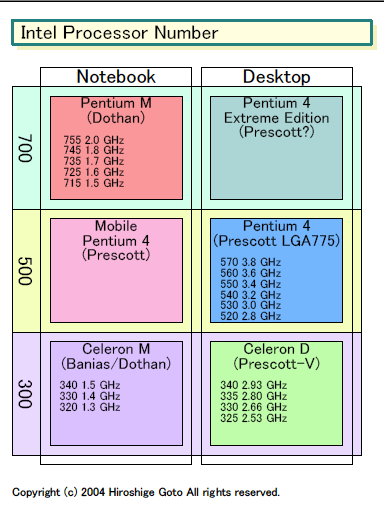
Petz, Re: [Intel's] 500 series will include both desktop and mobile Pentium 4 chips,
>> Now, if OEMs leave off the GHz rating, consumers will assume that any Dothan 700-series chip is faster than any P4 chip. I don't think that is what Intel wants.
Do consumers assume that an Opteron 846 is faster than an Opteron 246? Ok, maybe it has the potential to be, if you use multiple CPUs, but I think people have already gotten used to the first digit having something to do with other than performance. BMW uses their first digit to group their models. The 545i and 745i sedans have identical engines, but the first digit represents the class of car, with the 700 series having a larger body and more features (and also a larger price tag). I think Intel intends to do the same with Dothan. Banias already offers performance rivaling the 2.6GHz Pentium 4. Dothan's performance may give a 3.06GHz or 3.2GHz (Mobile, 533MHz FSB) Prescott a run for its money, while being lower power and including those features which set it apart in a class of its own. The second and third digit measure performance, and if Intel is consistent between their market segments, they could have something far less confusing than AMD's haphazard rating scheme that uses 3-digits for server parts, 2-digits for enthusiast parts, and 4-digit Pentium wannabehertz for desktop/mobile parts (and even those are not consistent).
Re: [Intel's] 300 series will include desktop and mobile Celeron chips
>> If Celeron M's and regular Celerons are both assigned 300 series numbers, this is a horrible mistake.
Again, if Intel is consistent, and Celeron M gets a much higher rating than Celeron within the 300 series, then it could be just the thing that Intel has needed.


 Market Data
  Markets


 AI
AI