News Focus
News Focus
icon url

eastunder

01/07/26 9:44 AM

#18077 RE: eastunder #18058

Warner Discovery Rejects Paramounts Amended Hostile Bid - WSJ 1/7/26 6:40 am

Warner Bros. Discovery recommended its shareholders reject Paramount's amended hostile bid for the company, saying its existing deal with Netflix is stronger.

In a letter to shareholders made public on Wednesday, Warner said the amended Paramount offer wasn't superior, "or even comparable," to the $72 billion Netflix deal for its movie and TV studios and the HBO Max streaming service.

Paramount recently made changes to its $77.9 billion all-cash bid for the entire company, hoping it would prompt Warner to walk away from its agreement with the streaming giant.

Warner's board unanimously decided Paramount's latest offer "remains inadequate particularly given the insufficient value it would provide." The board also cited uncertainty in Paramount's ability to close the deal and the potential risks to shareholders if the proposed transaction fails.

The board's decision to rebuff Paramount is the latest development in the fight for the future of Warner. The company's storied library, home to Harry Potter and Batman, is coveted in Hollywood , offering a way for Paramount or Netflix to add scale and attract and retain streaming customers.

Paramount's amended bid included a personal guarantee from billionaire Larry Ellison , the father of Paramount Chief Executive David Ellison , for $40.4 billion of equity financing. Paramount also increased what is called the breakup fee it would owe Warner if regulators block its deal, matching Netflix 's $5.8 billion figure. Warner rejected Paramount's initial tender offer last month.

Ellison and his backers have repeatedly said they believe they addressed all of Warner's stated concerns and that Paramount's financing for the bid is solid.

In its Wednesday letter, Warner said it would incur billions of dollars in additional costs if it were to drop the Netflix deal in favor of Paramount , adding more risk. Those costs include a $2.8 billion termination fee Warner would have to pay Netflix and a $1.5 billion fee it would incur for failing to complete its debt exchange, which the company said it would not be able to execute under Paramount's offer.

Warner said the Paramount offer is "in effect" a leveraged buyout and would be the biggest such transaction in history. Leveraged buyouts are risky, Warner said, with the dangers increasing with the amount of debt involved. It noted that in such deals, buyers and their financing sources sometimes try to renegotiate the terms before closing.

The Paramount deal would require a massive amount of debt financing to pull off, which carries additional risk and could make it more difficult to close, Warner said.

"Changes in the performance or financial condition of either the target or acquirer, as well as changes in the industry or financing landscapes, could jeopardize these financing arrangements," Warner told shareholders.

Warner shareholders have until Jan. 21 to decide whether to accept Paramount's tender offer after it recently extended the deadline. That date can be extended again.

Netflix signed a deal to pay $27.75 a share in cash and stock for Warner's studios and HBO Max after the entertainment company splits itself in two. Part of Warner's reasoning for favoring Netflix 's deal has been the fact that its stockholders would retain shares in the portion of the company that Netflix doesn't buy, giving them access to potential upside.

Warner's cable TV networks are poised to be housed in a separate publicly traded company called Discovery Global.

Paramount had offered $30 a share for all of Warner, including its cable channels such as CNN , TBS and Food Network. In a sign Warner shareholders expect Paramount to increase the price of its bid, Warner's shares have been trading above the price of the Netflix deal.

On Monday, Warner rival Comcast spun out Versant, which includes many of its TV and media assets. Versant shares closed down 13% on their first day of trading and fell further Tuesday. Wall Street is closely monitoring how Versant trades, as a proxy for the value of Warner's planned cable-TV spinoff. Paramount has argued that Warner's cable networks aren't worth as much as they are being valued at in the deal with Netflix .

A deal with either Warner suitor would need approval from regulators. Some lawmakers and other constituencies, including President Trump , have raised concerns about the market share Netflix would command if it owned HBO Max.

Netflix executives have said they are confident that the deal will pass regulatory muster.

A combination of Warner and Paramount could also face scrutiny because it would put two powerful content producers under one roof. Paramount has said its proposal has a cleaner path to regulatory approval than Netflix 's.

Hollywood unions have expressed concern about both potential combinations and the possible effect on workers.
icon url

eastunder

01/07/26 1:57 PM

#18080 RE: eastunder #18058

In connection with its determination, today the Board sent a letter to WBD shareholders providing detail on its recommendation.

Full text of the letter follows below.

Dear Fellow Shareholders,

As you know, at the end of last year, your Board of Directors concluded its process to maximize shareholder value by entering into our merger agreement with Netflix. Since then, Paramount Skydance ("PSKY"), a bidder in that process, has commenced a hostile tender offer to acquire WBD, which it recently amended on December 22, 2025.

As described further below, your Board unanimously determined that the PSKY amended offer remains inadequate, particularly given the insufficient value it would provide, the lack of certainty in PSKY's ability to complete the offer and the risks and costs borne by WBD shareholders should PSKY fail to complete the offer. Accordingly, the Board unanimously recommends that shareholders not tender your shares into the PSKY offer. For a full discussion of the reasons for the Board's recommendation, we urge you to read the full Schedule 14D-9 filing, including the amendment filed today.

PSKY Offer's Insufficient Value

PSKY's offer is inferior given significant costs, risks and uncertainties as compared to the Netflix merger. Under the Netflix merger agreement, WBD shareholders will receive significant value with $23.25 in cash and shares of Netflix common stock representing a target value of $4.50 based on a collar range in the Netflix stock price at the time of closing, which has future value creation potential.

Additionally, WBD shareholders will receive value through their ownership in Discovery Global, which will have considerable scale, a diverse global footprint, and leading sports and news assets, as well as the strategic and financial flexibility to pursue its own growth initiatives and value-creation opportunities.

The Board also considered the costs and loss of value for WBD shareholders associated with accepting the PSKY offer. WBD would be obligated to pay Netflix a $2.8 billion termination fee for abandoning our existing merger agreement; incur a $1.5 billion fee for failing to complete our debt exchange, which we could not execute under the PSKY offer without PSKY's consent; and incur incremental interest expense of approximately $350 million. The total cost to WBD would be approximately $4.7 billion, or $1.79 per share. These costs would, in effect, lower the net amount of the regulatory termination fee that PSKY would pay to WBD from $5.8 billion to $1.1 billion in the event of a failed transaction with PSKY. In comparison, the Netflix transaction imposes none of these costs on WBD.

Lack of Certainty in PSKY's Ability to Close the Transaction

The extraordinary amount of debt financing, as well as other terms of the PSKY offer, heighten the risk of failure to close, particularly when compared to the certainty of the Netflix merger. PSKY is a company with a $14 billion market capitalization attempting an acquisition requiring $94.65 billion of debt and equity financing, nearly seven times its total market capitalization. To effect the transaction, it intends to incur an extraordinary amount of incremental debt – more than $50 billion – through arrangements with multiple financing partners.

The transaction PSKY is proposing is in effect a leveraged buyout ("LBO"). In fact, it would be the largest LBO in history with $87 billion of total pro forma gross debt and an estimated gross leverage of approximately 7x 2026E EBITDA before synergies. The WBD Board considered that an LBO structure introduces risks given the acquiror's reliance on the ability and willingness of its lenders to provide funds at close. Changes in the performance or financial condition of either the target or acquiror, as well as changes in the industry or financing landscapes, could jeopardize these financing arrangements. Many prior large LBOs illustrate that acquirors or their equity and/or debt financing sources can, and do, seek to assert failures of closing conditions in order to terminate a transaction or renegotiate transaction terms. This aggressive transaction structure poses materially more risk for WBD and its shareholders when compared to the conventional structure of the Netflix merger.

The risks inherent in the LBO structure are exacerbated by the amount of debt PSKY must incur, its current financial position and future prospects, as well as the lengthy period to close the transaction – which PSKY itself estimates to be 12-18 months following signing. PSKY already has a "junk" credit rating and it has negative free cash flows with a high degree of dependency on its legacy linear business. Certain fixed obligations that PSKY has incurred or may incur prior to closing, such as the multi-year programming and sports licensing deals, could further strain its financial condition.

Further, the operating restrictions between signing and closing imposed on WBD by the PSKY offer could damage our business, allowing PSKY to abandon the offer. The onerous covenants include, among others, restricting WBD's ability to modify, renew or terminate affiliation agreements. These restrictions may hamper WBD's ability to perform and could lead PSKY to assert that WBD has suffered a "material adverse effect," enabling PSKY and its financing partners to terminate the transaction or renegotiate the terms of the transaction.

In contrast, Netflix is a company with a market capitalization of approximately $400 billion, an investment grade balance sheet, an A/A3 credit rating and estimated free cash flow of more than $12 billion for 2026. The merger agreement with Netflix also provides WBD with more flexibility to operate in a normal course until closing. Given these factors, the Board determined that the Netflix merger remains superior to PSKY's amended offer.

Consequences for WBD Shareholders Should PSKY Fail to Close the Transaction

If PSKY fails to close its offer, WBD shareholders would incur significant costs and potentially considerable value destruction. In addition to potentially enabling PSKY to abandon or amend its offer, the operating restrictions that PSKY would impose on WBD between signing and closing could impair WBD's financial condition and ability to maintain its competitive position in the markets in which it operates, and hinder its ability to retain key talent. This includes prohibiting WBD from pursuing the planned separation of Discovery Global and Warner Bros., which was designed to derisk our businesses by allowing each to focus on its own strategic plan. The PSKY offer would also prevent WBD from completing the contemplated debt exchange and refinancing our $15 billion bridge loan without PSKY's consent, which would limit our financial flexibility. If the PSKY offer fails to close, WBD shareholders would be left with shares in a business that has been restricted from pursuing its key initiatives for up to 18 months.

Further, WBD shareholders would receive insufficient compensation for the damage to our businesses should the PSKY offer not close. The $1.1 billion net amount of the regulatory termination fee that PSKY would pay to WBD represents an unacceptably low 1.4% of the transaction equity value and would not come close to helping WBD address the likely damage to our businesses.

In contrast, should Netflix fail to complete the merger for regulatory reasons, WBD would receive a $5.8 billion termination fee and WBD shareholders would still benefit from the initiatives that the Board and management team are implementing to secure the value of our businesses and ensure their long-term success, including the planned separation of Discovery Global and Warner Bros.

The PSKY Offer Is Not Superior, or Even Comparable, to the Netflix Merger

PSKY has repeatedly failed to submit the best proposal for WBD shareholders despite clear direction from WBD on both the deficiencies and potential solutions. The WBD Board, management team and our advisors have extensively engaged with PSKY and its representatives and provided it with explicit instructions on how to improve each of its offers. Yet PSKY has continued to submit offers that still include many of the deficiencies we previously repeatedly identified to PSKY, none of which are present in the Netflix merger agreement, all while asserting that its offers do not represent its "best and final" proposal.

PSKY's transaction team, including many of their employees, several law firms, investment and lending banks and consultants, had several months to engage extensively with WBD. They are well aware of the reasons behind the Board's determination that the Netflix merger agreement is superior to its offer. If on December 4 PSKY did not recognize the weaknesses of its proposal when the Board concluded the process, it has now had several weeks to study the Netflix merger agreement and adjust its offer accordingly. Instead PSKY has, for whatever reason, chosen not to do so.

Your Board negotiated a merger with Netflix that maximizes value while mitigating downside risks, and we unanimously believe the Netflix merger is in your best interest. We are focused on advancing the Netflix merger to deliver its compelling value to you.

Sincerely,

The Warner Bros. Discovery Board of Directors

The basis for the Board's decision is set forth in Amendment No. 3 to the Solicitation/Recommendation Statement on Schedule 14D-9 (the "Schedule 14D-9") filed today with the U.S. Securities and Exchange Commission.

Allen & Company, J.P. Morgan and Evercore are serving as financial advisors to Warner Bros. Discovery and Wachtell Lipton, Rosen & Katz and Debevoise & Plimpton LLP are serving as legal counsel.
icon url

eastunder

01/12/26 9:41 AM

#18100 RE: eastunder #18058

Is Netflix a Buy Ahead of Earnings? It Looks Like It
By Sam Quirke | January 12, 2026, 8:25 AM

https://finviz.com/news/273423/is-netflix-a-buy-ahead-of-earnings-it-looks-like-it

Shares of streaming giant Netflix Inc. (NASDAQ: NFLX) head into their next earnings report in a pretty uncomfortable position. Since hitting all-time highs last summer, the stock has fallen roughly 30% in a sustained downtrend, effectively erasing all its 2025 gains. For a stock once viewed as an ultra-reliable performer, the drop has been jarring.

The selloff has been driven by a combination of factors rather than a single shock. The stock was already on the back foot heading into October's earnings report, and the missed earnings per share (EPS) print only added to the negative sentiment.

Since then, uncertainty around Netflix's proposed acquisition of Warner Bros. Discovery (NASDAQ: WBD) has further weighed on the stock, as investors remain uneasy about rising debt levels, execution risk, and strategic distraction.

However, with its next earnings report due in less than two weeks, there are reasons to think that much of the downside is already priced in—let's take a look at why this could be a buy-the-dip opportunity.

Why the Dip Is Starting to Look Compelling

From a technical perspective, Netflix is starting to flash classic signals that the bears are exhausted. The stock's relative strength index (RSI) is sitting around 29, firmly in oversold territory. That alone does not guarantee a reversal, but it does suggest selling pressure has become stretched. Adding to that, the stock's MACD just printed a bullish crossover, a reasonably reliable signal that downside momentum is starting to fade.

The company's valuation also looks very different from where it stood last summer. Netflix's price-to-earnings (P/E) ratio is now at its lowest level in years, reflecting a sharp reset in expectations and bolstering the case that the stock is on sale at a discount. For investors with a long-term horizon, that matters—the attractive entry point could make it easier to weather any volatility that may appear in the near term.

It is also worth noting that aside from October's EPS miss, Netflix has a solid track record of outperforming analyst expectations each quarter.

That history does not erase recent disappointment, but it does make it harder for the bears to argue that further downside is inevitable.

Analysts See Far More Upside Than Downside
Sell-side commentary suggests the market may be leaning too far toward worst-case assumptions. In recent weeks, both Morgan Stanley and Wolfe Research have reiterated Buy or equivalent ratings, with price targets around the $120 mark—not bad considering the stock is trading around $90 currently.

Even the more cautious voices suggest the stock can only go up from here. The team at CFRA downgraded Netflix to a Hold earlier this month, but paired that with a $100 price target.

With the stock trading well below that level, even a neutral stance implies the shares are oversold rather than expensive.

The common thread across analyst commentary is that a large portion of the disappointment is likely already priced into the stock.

Concerns around the Warner Bros. deal have been extensively debated, and there's little room for fresh negativity unless earnings miss materially again.

Some Risks Remain

None of this removes the risks. Netflix is heading into this month's report with more riding on the results than usual, and another bad miss would likely trigger further selling. Investors will also want clarity on the company's strategic direction.

That said, the setup is asymmetric. With the stock down 30% from its highs, sentiment weak, and valuation compressed, the downside from here appears more limited than at any point over the past year. Any signs that growth is accelerating or that profitability is back on track should drive a sharp recovery rally.

The tricky part, of course, is timing. Buying into this rebound potential ahead of earnings always carries uncertainty. But with expectations low and so much disappointment already priced in, the risk/reward profile is leaning heavily in favor of the bulls right now.
icon url

eastunder

01/12/26 3:13 PM

#18106 RE: eastunder #18058

Paramount Sues Warner Bros for information Barrons.com

Paramount Skydance is planning to nominate directors to the Warner Bros. Discovery board and has filed a lawsuit asking for more financial information as it ramps up its effort to persuade Warner shareholders to vote against the Netflix takeover deal and in favor of its own hostile bid.

Paramount CEO David Ellison wrote in a letter to investors on Monday that the company intends to nominate directors who will advise against the Netflix offer at an upcoming annual meeting.

"If WBD calls a special meeting ahead of its annual meeting to vote on the Netflix Agreement, Paramount will solicit proxies against such approval," Ellison added.

Paramount is still offering $30 a share and encouraging shareholders to tender their shares into its bid.

Paramount has also filed a suit in a Delaware court requesting Warner provide information related to how it valued its global networks business when it was weighing the rival bids. Netflix 's cash and stock offer values Warner's streaming and studios business at $27.75 a share, with the Discovery cable assets being spun out to investors. Paramount's offer is for all of Warner Bros. Discovery .

"WBD has provided increasingly novel reasons for avoiding a transaction with Paramount , but what it has never said, because it cannot, is that the Netflix transaction is financially superior to our actual offer," Ellison wrote. He added that Paramount believes the Discovery shares would have "zero equity value."
Warner Bros. and Netflix didn't immediately respond to a request for comment from Barron's.

Warner last week rejected Paramount's latest amended offer, which included $40.4 billion in personal guarantees from Oracle founder Larry Ellison , who is David Ellison's father.

"The Board unanimously determined that...Paramount's latest offer remains inferior to our merger agreement with Netflix across multiple key areas," Samuel A. Di Piazza , Jr., chair of Warner's board of directors, said in a statement, adding that the offer Paramount made on Dec. 22 still included "an extraordinary amount of debt financing."

Warner shares dropped 1.4% to $28.48 on Monday. Paramount climbed 0.7% to $12.15 , and Netflix gained 0.8% to trade at $90.17 .
icon url

eastunder

01/15/26 10:52 AM

#18115 RE: eastunder #18058

Netflix Is Five Days From Answering A $59 Billion Question
By Surbhi Jain | January 15, 2026, 8:54 AM

https://finviz.com/news/277327/netflix-is-five-days-from-answering-a-59-billion-question

Netflix Inc (NASDAQ:NFLX) isn't trading as a company headed into earnings — it's trading like a company already on trial.

With the stock deeply oversold and well below its 200-day moving average, investors are no longer debating quarterly numbers. They're trying to price a decision that could reshape Netflix's balance sheet for years.

The $59 Billion Overhang

Netflix's proposed acquisition of Warner Bros Discovery Inc (NASDAQ:WBD) — and the roughly $59 billion in new debt that could come with it — remains at the center of the selloff. (Of course it is)

For a company that only recently earned Wall Street's trust as a cash-flow generator, the idea of levering up at this scale has rattled investors. The risk isn't theoretical anymore. A hostile all-cash counterbid from Paramount Skydance Corp (NASDAQ:PSKY) has raised the stakes, turning what looked like a strategic expansion into a potential balance-sheet stress test.


Chart created using Benzinga Pro
Why NFLX Chart Is Breaking
This isn't a routine technical breakdown. Netflix's slide below the 200-day reflects uncertainty, not collapse.

There’s regulatory risk — a record $5.8 billion breakup fee if the deal is blocked. The chart indicates the market is already preparing for worst-case outcomes.

The result is a stock being sold on fear of optionality, not evidence of deterioration.

Trader anxiety is compounded by where Netflix is in its growth cycle:

The password-sharing boost is now lapping, and
U.S. and Canadian penetration is effectively saturated
Guidance matters now, more than ever.

In a market chasing AI-driven multiple expansion, Netflix looks expensive not because it's failing — but because it's asking investors to absorb risk at the wrong moment.

Why It Matters

Jan. 20 isn't just an earnings date — it's a referendum.

If Netflix delivers clarity on deal structure, debt tolerance and strategic intent, the stock's deeply oversold condition leaves room for a sharp relief rally.

If it doesn't, the market may decide that this $59 billion question deserves a lower multiple. Either way, the resolution is likely to be swift — and the positioning already suggests the market is leaning defensive.
icon url

eastunder

01/16/26 9:09 AM

#18117 RE: eastunder #18058

Netflix And Its Real Value
Jan. 16, 2026 4:12 AM ETNetflix, Inc. (NFLX) StockNFLX:CA
https://seekingalpha.com/article/4860420-netflix-real-value
Grant Gigliotti
Investing Group Leader

Summary

Netflix demonstrates strong fundamentals, with robust global scale, high ROE, and consistent margin expansion despite recent acquisition-related uncertainty.

Recent merger speculation with Warner Bros. Discovery (WBD) has pressured NFLX’s share price, but core operations remain resilient and cash flow positive.

NFLX trades below its historical PE range and intrinsic value estimates, suggesting the stock is currently undervalued relative to long-term growth prospects.

This article focuses on the fundamentals, the real value versus the current share price, and if NFLX is currently worth investing in.

Netflix, Inc. (NFLX) is a broadly known worldwide entertainment corporation and the most well-known subscription-based streaming platform, which incorporates a diverse variety of original and licensed movies, documentaries, and live shows. Netflix has been at the center of the reinvention of media consumerism. With its operational location in over 190 countries, it is considered among the largest streaming services globally and has a powerful competitive edge in its size, its distribution potential, its originality, and its data-driven personalization power.

Investors are concerned with more than subscriber growth and margins at Netflix. The recent events related to a potential merger with Warner Bros. Discovery (WBD) have increased the uncertainty regarding Netflix’s strategic forecast, spawning legal issues, shareholder doubts, and valuation discussions. Although the management has focused on trusting the transaction and the long-term advantages of this decision, issues related to regulatory approval, integration risk, and competitive reactions still hover over the sentiment.

In a filing with the SEC, Netflix executives Greg Peters and Ted Sarandos said that the transaction with Warner Bros. Discovery (WBD) would be beneficial to consumers by providing more content and contributing to long-term growth. After this proposal, Paramount also came up with a competing offer and mounting pressure on Warner Bros. Discovery shareholders to change their mind about the Netflix deal. The constant speculation about the deal has taken a toll on investor trust and is part of a recent fall in the share price of Netflix.

However, the key business of Netflix is not weak. The company has also shown that it is capable of scaling content investments in a manner that is efficient, growing margins, and increasing cash flows. Its development of an ad-supported tier as well as its entrance into live events is transforming Netflix into not only a discretionary streaming service but a more sustainable entertainment platform with recurring engagement and enhanced monetization prospects.

Snapshot of the Company
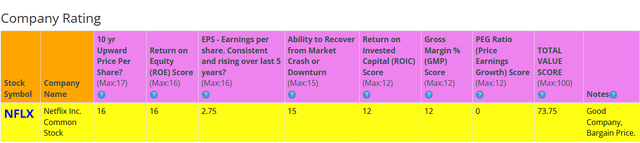
Netflix (NFLX) has a company rating score of 73.75 out of 100. It appears to have above-average fundamentals.


(Source: BTMA Stock Analyzer)

Fundamentals

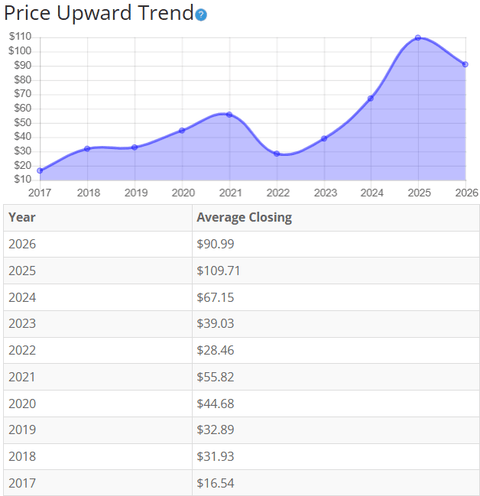
In the chart below, we can see that the price per share has been mostly consistent at increasing over the last 10 years, with only one year when the share price declined greatly in 2022. Now, due to the uncertainty regarding the probable acquisition, we can see there has also been a significant drop in stock in the past year. Overall, the share price average has grown by about 450.14% over the past 10 years, or a Compound Annual Growth Rate of 20.86%. This is an excellent return.


(Source: BTMA Stock Analyzer – Price Per Share History)

Earnings

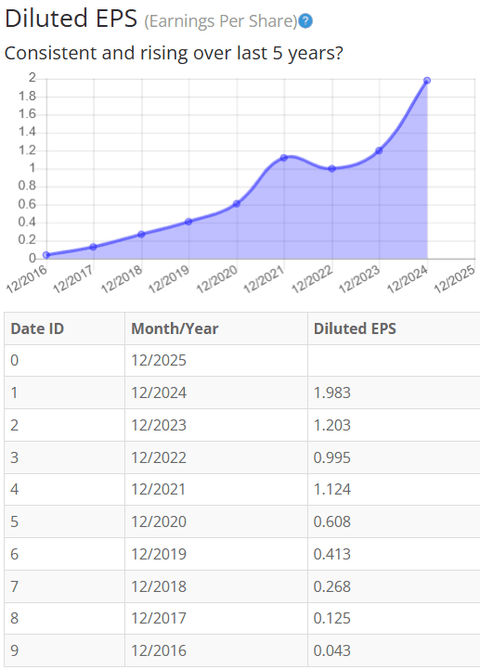
The earnings of Netflix have been increasing steadily in the last couple of years; the long-term upward trend in diluted earnings per share is evident. Although there have been some small ups and downs, the growth in earnings has generally been high given Netflix’s focus on growth.

Netflix’s profitability has been fueled by the increase in its subscriber base, global expansion, and monetization. The COVID-19 pandemic came at a time when Netflix was enjoying the benefits of an increased level of at-home entertainment consumption, leading to faster subscriber growth and uptake. In more recent times, the growth in earnings has been aided by pricing moves, enhanced cost control in relation to content expenditure, and the publication of an ad-supported level of subscription. Nevertheless, as the streaming market grows, Netflix will have less and less uninterrupted customer traffic and may experience pressure due to the possible increased content expenditure.


(Source: BTMA Stock Analyzer – EPS History)

Return on Equity

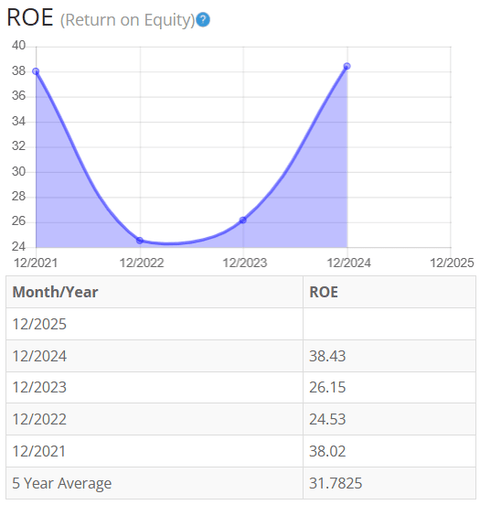
The return on equity decreased significantly in 2022, but there has been a noticeable increase in recent years. For return on equity (ROE), I look for a 5-year average of 16% or more. NFLX has an average of 31.78%, so it easily meets my requirements.


(Source: BTMA Stock Analyzer – ROE History)

Let’s compare the ROE of this company to its industry. The average ROE of 99 Entertainment companies is 6.09%.

Therefore, NFLX’s 5-year average of 31.78% is well above average, and so is its current ROE of 38.43.

Return on Invested Capital

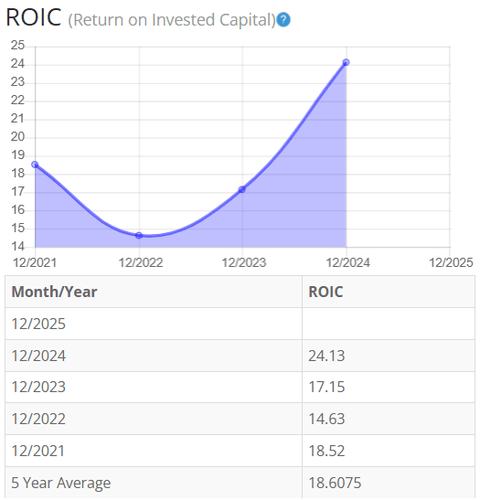
The return on invested capital fell in 2022 but has been consistently increasing ever since. The 5-year average ROIC is above expectations at around 18.61%. For return on invested capital (ROIC), I also look for a 5-year average of 16% or more. So, NFLX passes this test as well.


(Source: BTMA Stock Analyzer – Return on Invested Capital History)

Gross Margin Percent

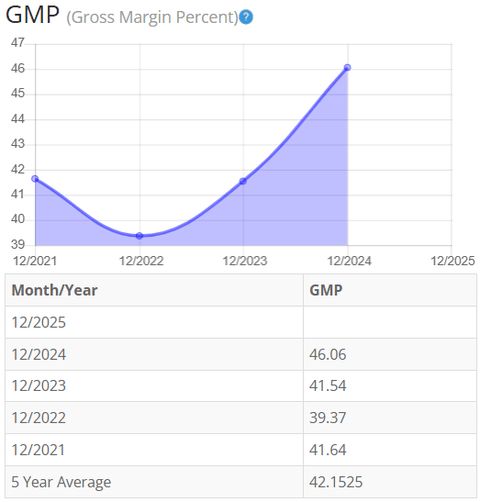
The gross margin percent (GMP) decreased in 2022 but has been on a steady increase since then. Five-year GMP is good at around 42.15%. I typically look for companies with gross margin percent consistently above 30%. So, NFLX has proven that it has the ability to maintain acceptable margins over a long period.


(Source: BTMA Stock Analyzer – Gross Margin Percent History)

Financial Stability

Looking at the fundamentals relating to NFLX’s balance sheet, the debt-to-equity ratio is less than 1. It is marked at 0.56, indicating that the company has nearly double the equity compared to its debt. It shows that Netflix is in a good financial position and has enough equity to pay off its debt.

Moreover, the current ratio of 1.33 is also reliable. It reflects that the company can use its current assets to pay its short-term liabilities. Ideally, a current ratio greater than 1 is satisfactory, and NFLX exceeds this amount.

Netflix operates with high capital and content investment requirements, which are characteristic of a large entertainment and streaming company. Over the past years, Netflix has been enhancing its financial standing by increasing its free cash flow as well as reducing the rate of content expenditure increase. This means that the company has had more capacity to finance its operations.

Netflix does not pay a regular dividend.

Value vs. Price

Netflix has a price-earnings ratio of 36.99.

The 10-year and 5-year average PE ratios of NFLX have typically been 103.04 and 42.6, respectively. This indicates that NFLX could be currently trading at a low price when compared to its average historical PE Ratio range.


(Source: BTMA Stock Analyzer – Stock Value)

The Estimated Value of the Stock is $108.12, versus the current stock price of $88. This indicates that NFLX is currently selling at a bargain price.


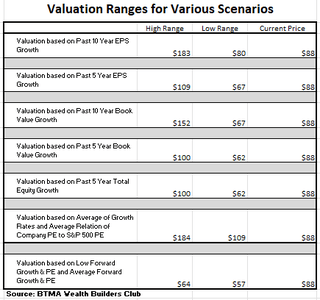
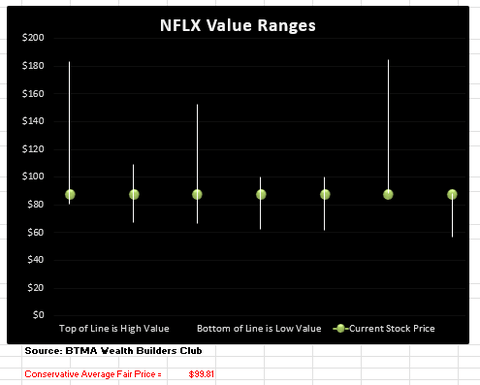
(Source: BTMA Wealth Builders Club)

This analysis shows an average valuation of around $100 per share versus its current price of about $88; this would indicate that Netflix is undervalued.

Summarizing the Fundamentals

As the facts indicate, Netflix seems to be financially sound in the long-term perspective, with the support of increased cash flow generation and a more restrained attitude towards expenditure. Netflix has shown that it has a great capacity to finance its operations internally and manage its long-term liabilities.

The company also has a good earnings history and has an upward trend in the long-term diluted earnings per share. In addition, Netflix has been able to scale its streaming business across the globe.

Other fundamentals are in good standing. The return on equity, the return on invested capital, and the gross margins are all higher than industry averages. Although certain metrics have dropped around 2022, they have since been on the rise, which indicates better efficiency and profitability as the company was able to realign its cost base to further monetize the business.

The other factor that Netflix should consider is the changing landscape of the streaming industry. With a maturing market, Netflix is becoming more competitive with consumer attention and costs over content. Nevertheless, efforts like the ad-based subscription plan and the development of live shows are meant to enhance interaction, reduce churn, and increase monetization in the long term.

Multiple forms of valuation analysis indicate that NFLX is currently selling at a discount price.

NFLX vs. The S&P 500

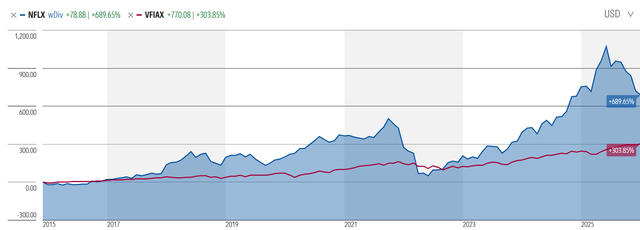
From the chart below, we can see that NFLX has mostly outperformed the general market. NFLX is clearly a high-growth stock that continues to be in a growing industry (entertainment). After the surge from COVID, we can see a clear drop during 2022, but it recovered quickly. After being at the highest point in the past decade, NFLX’s price has dropped. But it has still greatly outperformed the general market. If the stock continues to drop, it could provide a great opportunity to invest at an even better bargain price.


Morningstar


Forward-Looking Conclusion

Over the next five years, the analysts that follow this company are expecting it to grow earnings at an average annual rate of 23.83%.

In addition, the average one-year price target for this stock is at $124.53, which is about a 37.8% increase in a year.

Here is an alternative scenario based on NFLX’s past earnings growth. During the past 10- and 5-year periods, the average EPS growth rate was about 52% and 26%, respectively.

But when considering cash flow growth over the past 5 years, the average growth rate was 28%.

Does NFLX Pass My Checklist?
Company Rating 70+ out of 100? YES (73.75)
Share Price Compound Annual Growth Rate > 12%? YES (20.86%)
Earnings history mostly increasing? YES
ROE (5-year average 16% or greater)? YES (31.78%)
ROIC (5-year average 16% or greater)? YES (18.61%)
Gross Margin % (5-year average > 30%)? YES (42.15%)
Debt-to-Equity (less than 1)? YES
Current Ratio (greater than 1)? YES
Outperformed the S&P 500 during most of the past 10 years? YES
Do I think this company will continue to successfully sell their same main product/service for the next 10 years? LIKELY BUT NOT CERTAIN IN THIS EVER-CHANGING STREAMING INDUSTRY
NFLX scored 9.5/10 or 95%. Therefore, NFLX is definitely worth considering as a potential investment!

Is NFLX Currently Selling at a Bargain Price?
Price Earnings less than NFLX’s average historical PE range of 42-103? YES (36.99)
Estimated Value greater than Current Stock Price? YES (Value $108.12 > $88 Stock Price)
Detailed Valuation greater than Current Stock Price? YES (Value $100 > $88 Stock Price)
I would consider adding NFLX to my watch list of stocks and potentially consider investing in it because it did tick all of the boxes in my checklist. Netflix seems to be able to cover its long-term liabilities as it can finance its operations in the short term without interruptions to its business operations, as indicated in the balance sheet.

I would like to see how the anticipated acquisition impacts the fundamentals of the company before I invest. Since changes in this streaming technology industry can cause great price swings, it is imperative to add a margin of safety. Therefore, I will wait for the acquisition news and fundamentals to settle and look for a potential drop in share price to invest.

Grant Gigliotti is the founder of Beat The Market Analyzer, a leading value investing stock software and has been an active investor for 20+ years. He focuses on the value investing strategies of Warren Buffett to find good companies at bargain prices. He aims to show you how he buys good companies with strong fundamentals at large discounts from their intrinsic value.
icon url

eastunder

01/20/26 9:35 AM

#18120 RE: eastunder #18058

Netflix and Warner Bros. Discovery Amend Agreement to All-Cash Transaction
By PR Newswire | January 20, 2026, 7:05 AM

https://finviz.com/news/280804/netflix-and-warner-bros-discovery-amend-agreement-to-all-cash-transaction

All-Cash Structure Increases Value Certainty for WBD Stockholders, Accelerates WBD Stockholder Vote and Underscores Netflix's Financial Strength

WBD Files Preliminary Proxy Statement for Transaction Approval

HOLLYWOOD, Calif. and NEW YORK, Jan. 20, 2026 /PRNewswire/ -- Netflix, Inc. (NASDAQ:NFLX) ("Netflix") and Warner Bros. Discovery, Inc. ("WBD" or "Warner Bros. Discovery") announced they have amended their definitive agreement for Netflix's pending acquisition of Warner Bros. to an all-cash transaction. The revised agreement simplifies the transaction structure, provides greater certainty of value for WBD stockholders, and accelerates the path to a WBD stockholder vote.


Netflix + Warner Bros. Discovery

The all-cash transaction continues to be valued at $27.75 per WBD share, unchanged from the prior transaction structure. WBD stockholders will also receive the additional value of shares of Discovery Global following its separation from WBD. The transaction will be financed through a combination of cash on hand, available credit facilities and committed financing.

The revised structure enhances execution certainty, aligns with Netflix's disciplined capital allocation framework and provides clear benefits, including:

Greater Value Certainty: The all-cash transaction provides enhanced certainty around the value WBD stockholders will receive at closing, eliminating market-based variability.

Faster Path to Stockholder Vote: The revised transaction structure is expected to enable WBD stockholders to vote on the proposed transaction by April 2026. To support this accelerated timeline, WBD has today filed its preliminary proxy statement with the SEC.

Netflix's strong cash flow generation supports the revised all-cash transaction structure while preserving a healthy balance sheet and flexibility to capitalize on future strategic priorities.

"Today's revised merger agreement brings us even closer to combining two of the greatest storytelling companies in the world and with it even more people enjoying the entertainment they love to watch the most," said David Zaslav, President and CEO of Warner Bros. Discovery. "By coming together with Netflix, we will combine the stories Warner Bros. has told that have captured the world's attention for more than a century and ensure audiences continue to enjoy them for generations to come."

"The WBD Board continues to support and unanimously recommend our transaction, and we are confident that it will deliver the best outcome for stockholders, consumers, creators and the broader entertainment community," said Ted Sarandos, co-CEO of Netflix. "Our revised all-cash agreement will enable an expedited timeline to a stockholder vote and provide greater financial certainty at $27.75 per share in cash, plus the value from the planned separation of Discovery Global. Together, Netflix and Warner Bros. will deliver broader choice and greater value to audiences worldwide, enhancing access to world-class television and film both at home and in theaters. The acquisition will also significantly expand U.S. production capacity and investment in original programming, driving job creation and long-term industry growth."

"Over the last decade, when much of the entertainment industry has contracted, Netflix has grown and invested tremendously in the business of film and television in the U.S. and abroad. This transaction will further fuel that growth and investment," said Greg Peters, co-CEO of Netflix. "By amending our agreement today, we are underscoring what we have believed all along: not only does our transaction provide superior stockholder value, it is also fundamentally pro-consumer, pro-innovation, pro-creator and pro-growth. Our revised all-cash agreement demonstrates our commitment to the transaction with Warner Bros. and provides WBD stockholders with an accelerated process and the financial certainty of cash consideration, while maintaining our commitment to a healthy balance sheet and our solid investment grade ratings. We will continue to work closely with WBD to successfully complete the transaction as we remain focused on our mission to entertain the world and, together, define the next century of storytelling."

"Our amended agreement with Netflix is a testament to the Board's unrelenting focus on representing and advancing our stockholders' interests," said Samuel A. Di Piazza, Jr., Chair of the Warner Bros. Discovery Board of Directors. "By transitioning to all-cash consideration, we can now deliver the incredible value of our combination with Netflix at even greater levels of certainty, while providing our stockholders the opportunity to participate in management's strategic plans to realize the value of Discovery Global's iconic brands and global reach. We look forward to continuing to engage with our investors about the compelling benefits of the transaction as we progress toward our stockholder vote on an accelerated timeline."

As previously announced, WBD will separate Warner Bros. and Discovery Global into two separate publicly traded companies. This separation is expected to be completed in six to nine months, prior to the closing of the proposed Netflix and Warner Bros. transaction.

The amended, all-cash transaction was unanimously approved by the Boards of Directors of both Netflix and WBD. Closing remains subject to completion of the Discovery Global separation, receipt of required regulatory approvals, approval of WBD stockholders and other customary closing conditions. The financing structure is not subject to review by the Committee on Foreign Investment in the United States (CFIUS).

Netflix and WBD have each submitted their Hart-Scott-Rodino (HSR) filings and are engaging with competition authorities, including the U.S. Department of Justice and European Commission. Netflix and WBD remain committed to working closely with regulators and all stakeholders to ensure a smooth and successful transaction. As previously disclosed, the transaction is expected to close 12-18 months from the date that Netflix and WBD originally entered into their merger agreement.
icon url

eastunder

01/26/26 9:20 AM

#18153 RE: eastunder #18058

Netflix earnings shed light on why it needs Warner - Heard on the street - WSJ

The new Netflix is still a ways off, but the old one is doing fine. Given what Netflix is trying to accomplish, though, fine doesn't quite cut it.

Netflix 's shares slipped Tuesday after the streaming giant posted generally strong fourth-quarter results. That came just hours after the company amended its acquisition deal with Warner Bros. Discovery . Netflix will now pay all cash for the storied Hollywood studio and its associated streaming business, removing a stock component that was looking problematic considering Netflix shares have tumbled more than 30% in the past three months.

That theoretically should strengthen Netflix 's hand against competing bidder Paramount Skydance , which has offered a higher price for the entire company but faces the prospect of having to take on a crippling amount of debt to pay for the deal. Warner now expects to hold a shareholder vote on the deal by April, which might also work in Netflix 's favor, given that it limits the time for Paramount to press a proxy challenge to take over the Warner board.

Still, a combined Netflix -Warner would also need to survive the regulatory scrutiny that will likely last into next year. That includes getting a nod from President Trump , who has expressed personal interest in Warner's fate and is close with Paramount backer Larry Ellison .

In the meantime, Netflix is showing that its core business remains strong but is also challenged by size and scale. The company grew revenue by 16% last year but sees only 13% growth this year, at the midpoint of the projection it gave on Tuesday. And driving that growth isn't getting any cheaper, especially now that Netflix is seeking to be a player in pricey areas such as live sports. The company projected about $11 billion in free cash flow for this year, which was below the $12.1 billion analysts were expecting, according to estimates from Visible Alpha .

Dialing down the content spending doesn't seem to be an option, given the voracious appetite of Netflix 's global base of subscribers that now numbers more than 325 million. The company admitted in its shareholder letter Tuesday that engagement took a hit in the latter half of last year because of a lower volume of content it licensed from other companies. Netflix remains the undisputed leader in streaming, but competition keeps picking up. Market research firm Luminate estimates that the company's share of U.S. original content viewing time fell below 60% in 2025, a new low.

Netflix always has the option to raise prices to boost revenue growth. But doing so now with the scrutiny of the Warner deal might prove unwise. "If Netflix wants to convince regulators that the transaction is not anticompetitive and that it is pro consumers, increasing prices for their service could raise red flags," Laurent Yoon of Bernstein wrote in a report last week.

And if Netflix does end up closing the Warner deal, there remains the question of what the business looks like once the pure-play streamer also becomes a theatrical distributor and third-party TV producer. Netflix has appealed to investors over the past decade precisely because it has been able to focus on streaming without the baggage of managing a declining cable-TV business and dealing with a temperamental theatrical market.

Netflix has a very strong record of adaptation, evidenced by its not-too-distant past as a mail-order DVD outfit. But its future as a Hollywood studio conglomerate is a script investors haven't yet bought.
icon url

eastunder

02/10/26 10:47 AM

#18193 RE: eastunder #18058

Recent NFLX filings regarding bid for Warner Bros Discovery


Date: February 9, 2026
On February 9, 2026, Clete Willems, Chief Global Affairs Officer of Netflix, Inc., joined “The Claman Countdown” with Liz Claman. A copy of the transcript for the interview can be found below.
https://www.sec.gov/Archives/edgar/data/1065280/000119312526043329/d28121ddfan14a.htm

Date: February 3, 2026
Written Testimony of Ted Sarandos, Co-Chief Executive Officer of Netflix, Inc., Before the Senate Judiciary Committee Subcommittee on Antitrust, Competition Policy, and Consumer Rights Hearing on “Examining the Competitive Impact of the Proposed Netflix-Warner Brothers Transaction” 2.3.2026
https://www.sec.gov/Archives/edgar/data/1065280/000119312526035873/d860690ddfan14a.htm

Date: January 23, 2026
Netflix says Paramount bid ‘doesn’t pass sniff test’ as Warner battle intensifies
https://www.sec.gov/Archives/edgar/data/1065280/000119312526021283/d50553ddfan14a.htm
icon url

eastunder

02/13/26 11:02 AM

#18211 RE: eastunder #18058

Another company in the opportunistic category is Netflix, Inc. (NASDAQ:NFLX)

-Benzinga

which remains the global leader in streaming. Subscriber growth has been steady and substantial from about 220 million five years ago to roughly 325 million today. 

The stock has been under pressure amid concerns about strategic expansion in buying Warner Bros, and the potential cost of acquiring premium film and television assets. Large media deals have a mixed history, so it's understandable that investors are cautious.
Netflix has consistently shown an ability to adapt. The company has reinvented itself multiple times. Management has navigated industry disruption since the company's founding in 1997. 

The current uncertainty creates an opportunity to own a category-defining platform with global scale, strong execution, and strategic optionality at a more reasonable valuation than we've seen in recent years.

icon url

eastunder

02/17/26 9:24 AM

#18220 RE: eastunder #18058

WBD Files Definitive Proxy Statement and Schedules Special Meeting for March 20, 2026, to Approve the WBD-Netflix Transaction

February 17, 2026 7:09 AM
PR Newswire (US)

The WBD-Netflix Transaction Delivers Incredible Value and Certainty to WBD Stockholders with Clear Path to Timely Regulatory Approval

Netflix is the Superior Deal and the Only Deal Before WBD Stockholders

Together WBD and Netflix will Protect U.S. Jobs, Bring Great Value to Consumers and Assure Growth of the Broader Entertainment Industry

A PSKY transaction does not have an easier or faster path to regulatory approval and PSKY's financing challenges and rapid deleveraging plans pose tremendous risk to the entertainment industry

HOLLYWOOD, Calif., Feb. 17, 2026 /PRNewswire/ -- Netflix, Inc. today issued the following statement regarding its fully financed definitive agreement with Warner Bros. Discovery, Inc. (WBD) to acquire Warner Bros., including its film and television studios, HBO Max and HBO:

Today marks another important milestone for our transaction with WBD. WBD has filed and commenced the mailing of its definitive proxy statement for the special meeting to be held on March 20, 2026, to approve our Board-recommended transaction and superior offer.

Throughout the robust and highly competitive strategic review process, Netflix has consistently taken a constructive, responsive approach with WBD, in stark contrast to Paramount Skydance (PSKY). While we are confident that our transaction provides superior value and certainty, we recognize the ongoing distraction for WBD stockholders and the broader entertainment industry caused by PSKY's antics. Accordingly, we granted WBD a narrow seven-day waiver of certain obligations under our merger agreement to allow them to engage with PSKY to fully and finally resolve this matter.

This does not change the fact that we have the only signed, board-recommended agreement with WBD, and ours is the only certain path to delivering value to WBD's stockholders. In its press release today, WBD reaffirmed its recommendation that WBD stockholders vote to approve the Netflix transaction at WBD's special meeting.

Together, Netflix and Warner Bros. will deliver more choice and greater value to audiences worldwide with expanded access to exceptional films and series – both at home and in theaters. Our transaction also expands production capacity and increases investment in original content, leading to long-term job creation. The Netflix transaction is centered on growth, opportunity, and a reinforced commitment to creating world-class films and television – not consolidation and layoffs.

Netflix is confident that our transaction, a largely vertical merger of complementary assets, has a clear path to timely regulatory approval. Netflix and WBD have each submitted their Hart-Scott-Rodino (HSR) filings and are engaged constructively with competition authorities across the world, including the U.S. Department of Justice (DOJ), state Attorneys General, the European Commission, and the U.K. Competition and Markets Authority (CMA). Netflix and WBD are driving the regulatory process forward — collaboratively and constructively and focused on a clear path to closing.

By contrast, PSKY has repeatedly mischaracterized the regulatory review process by suggesting its proposal will sail through, misleading WBD stockholders about the real risk of their regulatory challenges around the world. WBD stockholders should not be misled into thinking that PSKY has an easier or faster path to regulatory approval – it does not.

PSKY is also quick to publicize routine checkpoints to exaggerate "progress." For example, PSKY cited securing German FDI clearance on January 27, 2026, as evidence of their "regulatory certainty." In fact, Netflix received German FDI clearance on the very same day.

Separately, the foreign funding behind PSKY's bid is already raising serious national security concerns. We expect government reviewers globally, including CFIUS and Team Telecom in the U.S., as well as European authorities, to scrutinize the Middle Eastern investors in PSKY's consortium and to be skeptical of claims that they are purely passive investors.

In reality, PSKY is far from obtaining all of the regulatory clearances required. Enforcers will focus on the impact of PSKY's proposal on competition, job losses, reduced output, and downward pressure on wages for film and television workers. PSKY's offer results in significant horizontal overlaps that will concern antitrust enforcers globally by combining:

two of the five major Hollywood studios,
two major theatrical distribution channels,
two of the major TV studios,
two major news networks, and
two major sports distributors.
Beyond their regulatory hurdles, PSKY's aggressive financing package, rapid deleveraging plans, and performance track record pose tremendous risks to both the completion of their proposed deal and the industry.

PSKY has promised to rapidly de-lever following its proposed transaction which can only be achieved through unprecedented job cuts (on top of the previous PSKY layoffs):

Post-merger, PSKY would be over-leveraged with approximately $84 billion of total proforma debt — the largest proposed leveraged buyout in history — and an estimated ~7x leverage ratio (Debt / 2026 LTM EBITDA).
PSKY has promised its concerned investors that it "will be below, call it, at closing with accounting for synergies around 4x. And [will] de-lever quickly to below 3x and almost 2x over the convening 2 years to 2.5 years."1
This means PSKY would need to realize ~$16 billion of cost savings in order to meet the midpoint of its leverage target range, far in excess of the $6+ billion synergy figure PSKY has publicly communicated2.
The only way to achieve this would be through greater, even deeper job cuts that would irreparably harm the entertainment industry.
PSKY is already undershooting its financial projections. Based on their most recent published "Adjusted OIBDA" guidance for 2026, they have underperformed their initial Paramount acquisition business plan by 15%3, which could mean even more cost cuts.
This extraordinary execution risk and track record of operational underperformance could impact PSKY's ability to fund and close a transaction.
A business plan that is dependent upon $16 billion in cost savings should be an unmistakable red flag for regulators, policymakers, union leaders and creatives.

Netflix's strong cash flow generation supports our all-cash transaction structure while preserving a healthy balance sheet and flexibility to capitalize on future strategic priorities. A combined Netflix and Warner Bros. will strengthen the entertainment industry, preserve choice and value for consumers, and give creators more opportunities.

WBD Stockholders — your vote is crucial. Vote FOR the Netflix and Warner Bros. deal at votewbdnetflix.com. A dedicated website providing ongoing information and resources about the transaction is available at netflixwbtogether.com.
icon url

eastunder

02/25/26 5:14 PM

#18255 RE: eastunder #18058

NFLX Gap 78.12

icon url

eastunder

02/27/26 5:09 PM

#18268 RE: eastunder #18058

Paramount Is Officially Buying Warner Bros. It’s a Victory for Shareholders.

Paramount Skydance investors are set to get a fairy tale ending, with the CBS owner winning the Warner Bros. Discovery bidding war. The companies announced late Friday that Paramount would pay $31 per share in cash for Warner Bros. stock. It’s a great outcome for Paramount, which only had to raise its hostile tender offer by $1 a share to avoid a prolonged bidding war.
----------------------------------------------------------------

"Yeah - because we didn't really want you" said everyone at Netflix.

icon url

eastunder

04/17/26 8:53 AM

#18400 RE: eastunder #18058

NFLX to gap down after earnings 107.79 close (97.88 pre trade currently)

Continue TRK on 86.50 2-26-26 and 78.12 2-24-26 unfilled gaps
Target 86.50 to replace hc shares sold in 107's and add those back in if possible
on rebuild

Alerts set on both gaps


New price targets After earnings:

Jefferies Adjusts Price Target on Netflix to $128 From $134, Maintains Buy Rating
Guggenheim Adjusts Price Target on Netflix to $120 From $130, Maintains Buy Rating
Seaport Global Adjusts Price Target on Netflix to $119 From $115, Maintains Buy Rating
JPMorgan Adjusts Price Target on Netflix to $118 From $120, Maintains Overweight Rating
Piper Sandler Adjusts Price Target on Netflix to $115 From $103, Maintains Overweight Rating
Bernstein Adjusts Netflix Price Target to $110 From $115, Maintains Outperform Rating
Barclays Adjusts Price Target on Netflix to $110 From $115, Maintains Equalweight Rating
Fubon Securities Adjusts Price Target on Netflix to $110 From $98, Maintains Neutral Rating
China Renaissance Adjusts Price Target on Netflix to $100 From $90, Maintains Hold Rating
Pivotal Research Adjusts Price Target on Netflix to $96 From $95, Maintains Hold Rating
Rosenblatt Trims Price Target on Netflix to $95 From $96, Maintains Neutral Rating