"Completely new to me, has anyone seen earlier mention of this? -- Russia’s Hidden War Debt"
January 28, 2025
“The Hard Way” — Special Envoy Keith Kellogg’s proposed oil-price manipulations targeting Russia would actually devastate U.S. oil production and the U.S. economy.
Zapolyarnoye oil and gas condensate field in Okrug, Russia, in the Arctic, December 2021. (Chursaev13, Wikimedia Commons, CC BY 4.0)
By Scott Ritter Special to Consortium News
“I’m not looking to hurt Russia,” President Donald Trump recently declared in a statement he posted on his TruthSocial account. “I love the Russian people, and always had a very good relationship with President Putin.”
Trump, however, comes from the school of “hard love,” where punishment is applied to achieve the desired results.
And punishment was on Trump’s mind as he expressed his love and admiration for the Russian people and their leader, Vladimir Putin.
“I’m going to do Russia,” Trump wrote, “whose Economy is failing, and President Putin, a very big FAVOR. Settle now, and STOP this ridiculous War! IT’S ONLY GOING TO GET WORSE.”
The odd use of capitalization aside, one would imagine that if you are in the business of expressing your love in a public fashion, you might want to make sure that your facts align with the reality of that for which you’ve declared amorous intent.
Otherwise, you will find yourself living in a fantasy world of your own construction, populated not by your ostensible paramours, but rather figments of your imagination.
If you’re sincere about doing the Russian people and Vladimir Putin a “big FAVOR,” you might want to make sure it’s a favor they want to receive.
Calling the Russian economy “failing” considering the plethora of data showing it is anything but that, probably isn’t the best way to start date night.
“If we don’t make a ‘deal,’ and soon,” Trump threatened, “I have no other choice but to put high levels of Taxes, Tariffs, and Sanctions on anything being sold by Russia to the United States, and various other participating countries.”
“We can do it the easy way,” Trump warned, “or the hard way.”
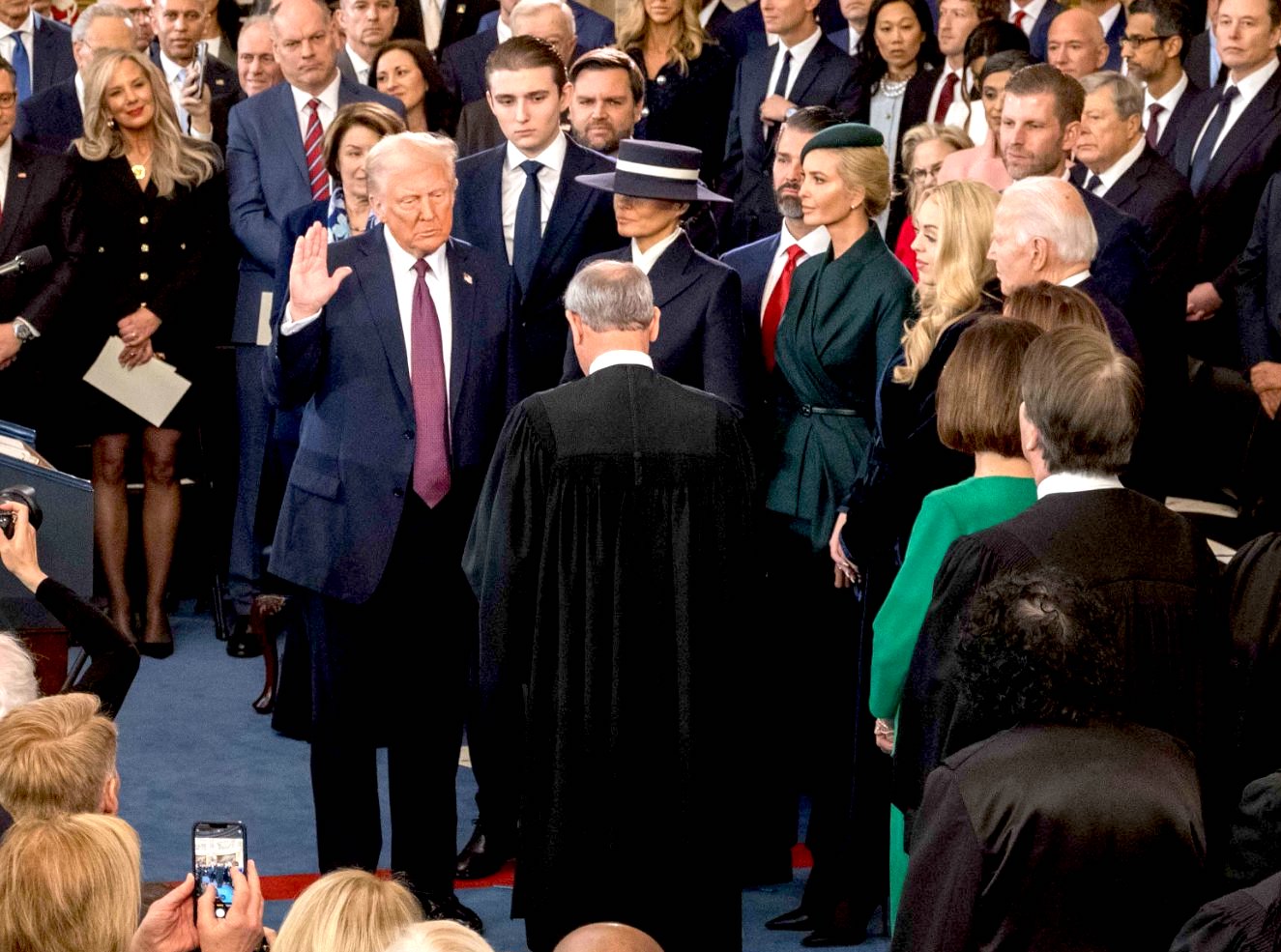
Trump taking his second oath of office, administered by Chief Justice John Roberts in the Capitol rotunda, on Jan. 20. (Wikimedia Commons, Public domain)
But what happens if Russia, like any jilted lover, opts for the “hard way”?
In short — nothing good for the United States or Trump.
First and foremost, any “deal” Trump puts on the table has to be realistic. In short the Russians must believe that they will be in a better position taking the deal than they would be turning it down (something Trump, ostensibly a master negotiator, should know).
The “deal” that Trump is putting on the table, however, is a non-starter.
[So Trump's declaration that he would end the war in a day wasn't realistic. Who knew. He did. Idiot? Not so much in that when you know it was meant solely as an electioneering slogan and that he knew it, as false a declaration as it was, would win him some votes, and it would have. Just confirmed his whole strategy was to appeal to emotion. And lie. Is all. He knew to most supporters don't care what he says.]
According to these reports, the proposed agreement prevents Ukraine from becoming a member of NATO, instead of officially declaring itself to be neutral. The agreement would open the door for Ukraine to become a member of the European Union by 2030, and tasks the EU with taking responsibility for post-war reconstruction.
There would be no “demilitarization.” Rather, Ukraine would maintain its army at its present size and continue to receive military support from the U.S. and NATO. Ukraine would need to likewise cede territories occupied by Russia to Russia and recognize the sovereignty of the Russian Federation.
[See again: As of 2024, Ukraine's peace terms are that Russia withdraw its troops, that its leaders be prosecuted for war crimes, and that Ukraine have security guarantees. Russia's terms are that Russia must be allowed to keep all the land it occupies, that it also be given all of the provinces that it claims but does not fully control, and that Ukraine end plans to join NATO. https://en.wikipedia.org/wiki/Peace_negotiations_in_the_Russian_invasion_of_Ukraine [...] The twin dangers are Trump pressing Ukraine into a Putin-shaped deal or Trump walking away when there is no early agreement and declaring it Europe’s problem. The latter might result in further Russian gains, eroding Ukraine’s ability to function as a sovereign nation and putting pressure on Europe to defend itself without U.S. help. https://investorshub.advfn.com/boards/read_msg.aspx?message_id=175670887]
But there are many elements of this “leaked” plan which simply ring false — such as linking finalization of the plan to May 9 — Victory Day, one of the most important holidays on the Russian calendar. This year May 9 will celebrate the 80th anniversary of the Allied Victory — the Soviet victory — over Nazi Germany.
The chances of Vladimir Putin sullying this solemn occasion by buying into a peace “deal” which allows the Banderist nationalists — whose ideology and history are closely linked with Nazi Germany — to survive after Putin declared “de-Nazification” as a primary goal for the Special Military Operation are slim to none.
Kellogg’s ‘Peace Plan’
What we do know is that Donald Trump’s designated special envoy for Ukraine — retired Lieutenant General Keith Kellogg — has floated a “peace plan” to the president which has been apparently well received. The elements of this plan are drawn from a paper Kellogg authored .. https://americafirstpolicy.com/issues/america-first-russia-ukraine .. back in the spring of 2024 — a paper as nonsensical and lacking in fact-based argument as one could imagine.
The core elements of this plan involved the establishment of “normal” relations with Russia and its president — basically stopping the Russophobic demonization that was prevalent during the Biden administration.
Once the U.S. and Russia were talking again, to then open negotiations with both Russia and Ukraine about bringing an end to the conflict.
The “carrot” for Russia included postponing Ukraine’s membership in NATO for 10 years, allowing Russia to retain the Ukrainian territories it currently occupies and gradually lifting sanctions to lead the way to the normalization of relations with the United States — all subject to the conclusion of peace agreements acceptable to Ukraine.
For Ukraine, the “deal” offered both continued military assistance from the U.S. and NATO and bilateral security guarantees. While Ukraine is not required to officially recognize Russia’s control over the conquered territories, it would need to refrain from changing the status quo by force.
[Imagine Trump to Zelensky, I you don't accept a deal soon i will make sure you get much less support from MY country. Why do you think Zelensky is pressuring Europe even more: Zelensky says he wants to end war 'quickly but fairly and reliably' in 2025 [...] Zelensky underscored the need for strong European engagement, calling for allies to provide accurate information to U.S. President Donald Trump. P - "We have very good relations with President Trump," he said, adding that "voices conveying disinformation or pro-Russian positions could present risks." P - Zelensky also expressed concerns over possible Russian demands in peace negotiations, including calls for Ukraine to reduce its military and abandon NATO membership. https://investorshub.advfn.com/boards/read_msg.aspx?message_id=175696551]
If Russia refused to cooperate, the U.S. would impose crippling sanctions.
And if Ukraine refused the “deal,” the U.S. would cut off all military aid.
This “deal,” while never formally expressed, had been hinted at before and after Trump’s electoral victory in November 2024.
And it took no one with any insight into Russia’s goals and objectives regarding the Special Military Operation by surprise when Russian President Vladimir Putin summarily rejected this “deal” in an answer to a media question on Dec. 26, 2024.
Russian Foreign Minister Sergey Lavrov and Russian President Vladimir Putin in November 2024. (Alexei Nikolskiy, RIA Novosti, President of Russia)
Three days later Russian Foreign Minister Sergei Lavrov likewise threw cold water on the Kellogg “peace plan,” declaring that Russia was “not happy with the proposals made by members of the Trump team to postpone Ukraine’s admission to NATO for 20 years and to station British and European peacekeeping forces in Ukraine.”
The Hard Way
But what exactly does “the hard way” mean?
According to Scott Bessent, Donald Trump’s new Treasury secretary, the answer lies in ratcheting up sanctions on the Russian oil industry. “I will be 100 percent on-board for taking sanctions up” that target the major Russian oil companies, Bessent said during his Senate confirmation hearing.
But Bessent will be working against a history of the U.S. and its European allies overselling sanctions as a tool to tear down the Russian economy (the opposite, in fact, has happened.) Moreover, given Russia’s status as a leading oil producer, any successful application of sanctions could have a negative economic impact on the U.S.
This is something that seems to have escaped the attention of Keith Kellogg, Trump’s “peace deal” guru. Noting that, under the Biden administration, the United States and its allies imposed a cap of $60/barrel on Russian oil (the market price for oil hovers around $78/barrel), Kellogg observed that, despite this, “Russia earns billions of dollars from oil sales.”
“What if,” Kellogg mused during an interview on Fox News, “you lower the price to $45 a barrel, which is essentially the breakeven point?”
[The Real Reasons for High Oil and Gas Prices "Four Ways Trump Plans to Raise Energy Costs for American Consumers" [...]In the wake of the devastating Russian invasion of Ukraine, U.S. gas prices soared, averaging $4.25 a gallon. Now fossil fuel companies and their political allies have seized the opportunity to suggest that additional fossil fuel investment is the solution. Their arguments are rife with misinformation. This is calculated, of course, meant to pad the industry’s pockets and lock more generations into fossil fuel dependence. That would, in turn, further delay the clean energy future necessary to achieve real energy independence .. https://www.nrdc.org/experts/john-bowman/clean-energy-key-real-energy-independence . Here are some of the myths to look out for and the facts that refute them. https://investorshub.advfn.com/boards/read_msg.aspx?message_id=175119245]
Scott Bessent in December 2024. (Senator Ted Cruz, Wikimedia Commons, Public Domain)
The concept of “breaking even,” when it comes to Russia, has two separate fiscal realities. The first is what the price of oil needs to be for Russia, which is heavily dependent upon the sale of oil for its national economy, to balance its national budget.
This number is assessed to be around $77/barrel for 2025. Let there be no doubt — if the price of oil dropped to $45/barrel, Russia would face a budget crisis. But not an oil production crisis. You see, the second “breakeven point” for Russia is the cost of production of a barrel of oil, which currently is set at $41/barrel.
Russia would be able to produce oil without any interruptions if Kellogg were able to achieve his goal of cutting the price of oil to $45/barrel.
To achieve the goal, Trump would have to get the Saudis onboard the oil-price-manipulation bandwagon.
The problem is the Saudis have their own “breakeven point” realities. To balance its budget, Saudi Arabia needs oil to be selling at around $85/barrel. But the cost of oil production in Saudi Arabia is very low .. https://oilprice.com/Energy/Energy-General/Saudi-vs-Shale-The-Breakeven-Myth.html .. — hovering around $10/barrel.
Saudi Arabia could simply flood the market with cheap oil if it wanted.
So could Russia.
How about the United States?
The Permian Basin, in West Texas, accounts for all of the U.S. growth in oil production since 2020.
Active Permian Basin pumpjack near Andrews, Texas, in 2009. (Zorin09, Wikimedia Commons, CC BY 3.0)
If drilling were to stop in the Permian Basin, U.S. oil production would decline by 30 percent over the course of two years.
In short, if Keith Kellogg were to successfully implement his “plan” to cut the price of oil to $45/barrel, he would effectively destroy the U.S. oil economy.
And if you destroy the U.S. oil economy, you destroy the U.S. economy.
Russia can ride out $45/barrel oil far longer than the U.S. can.
Donald Trump would do well to pay the wildcat oil producers of the Permian Basin — the ones who have sunk everything they own into a business venture that hinges on the promise of $78/barrel for the foreseeable future, and ask them how they feel about $45/barrel oil.
The bottom line is that if Keith Kellogg and Donald Trump made such a trip, they’d quickly understand the errors of their way.
Because if Donald Trump opts to go the route of “the hard way” with Russia, the consequences for him and the American people will be among the hardest imaginable.
Scott Ritter is a former U.S. Marine Corps intelligence officer who served in the former Soviet Union implementing arms control treaties, in the Persian Gulf during Operation Desert Storm and in Iraq overseeing the disarmament of WMD. His most recent book is Disarmament in the Time of Perestroika, published by Clarity Press.
The views expressed are solely those of the author and may or may not reflect those of Consortium News.


 Market Data
  Markets


 AI
AI