



 AI
AI








Wednesday, January 15, 2025 11:13:46 PM
Completely new to me, has anyone seen earlier mention of this? -- Russia’s Hidden War Debt
"One of Russia's 'shadow fleet' may have sabotaged power cables in the Baltic Sea. But what is it?"
Related:
Good to see - Ukraine takes another bite out of Russia as Moscow grinds on in Donetsk
Ukraine also announced significant investments in unmanned and long-range systems, where it has an edge.
https://www.aljazeera.com/news/2025/1/9/ukraine-takes-another-bite-out-of-russia-as-moscow-grinds-on-in-donetsk
**
Volodymyr Zelenskyy claims Ukraine has captured two North Korean soldiers in Kursk region of Russia
By Esther Linder with wires 6h ago
https://www.abc.net.au/news/2025-01-12/ukraine-captures-two-north-korean-pows-zelenskyy-claims/104807876
https://investorshub.advfn.com/boards/read_msg.aspx?message_id=175652119
Putin's goal now is that maximum leverage so that he can basically impose neutrality on Ukraine, retrofit and come back and do this again in 4 or 5 years. And that's not an outcome.
https://investorshub.advfn.com/boards/read_msg.aspx?message_id=175668765
Moscow has been stealthily funding much of its war costs with risky, off-budget financing overlooked
by the West. That funding is now under pressure, offering new leverage to Ukraine and its allies.
Craig Kennedy
Jan 12, 2025
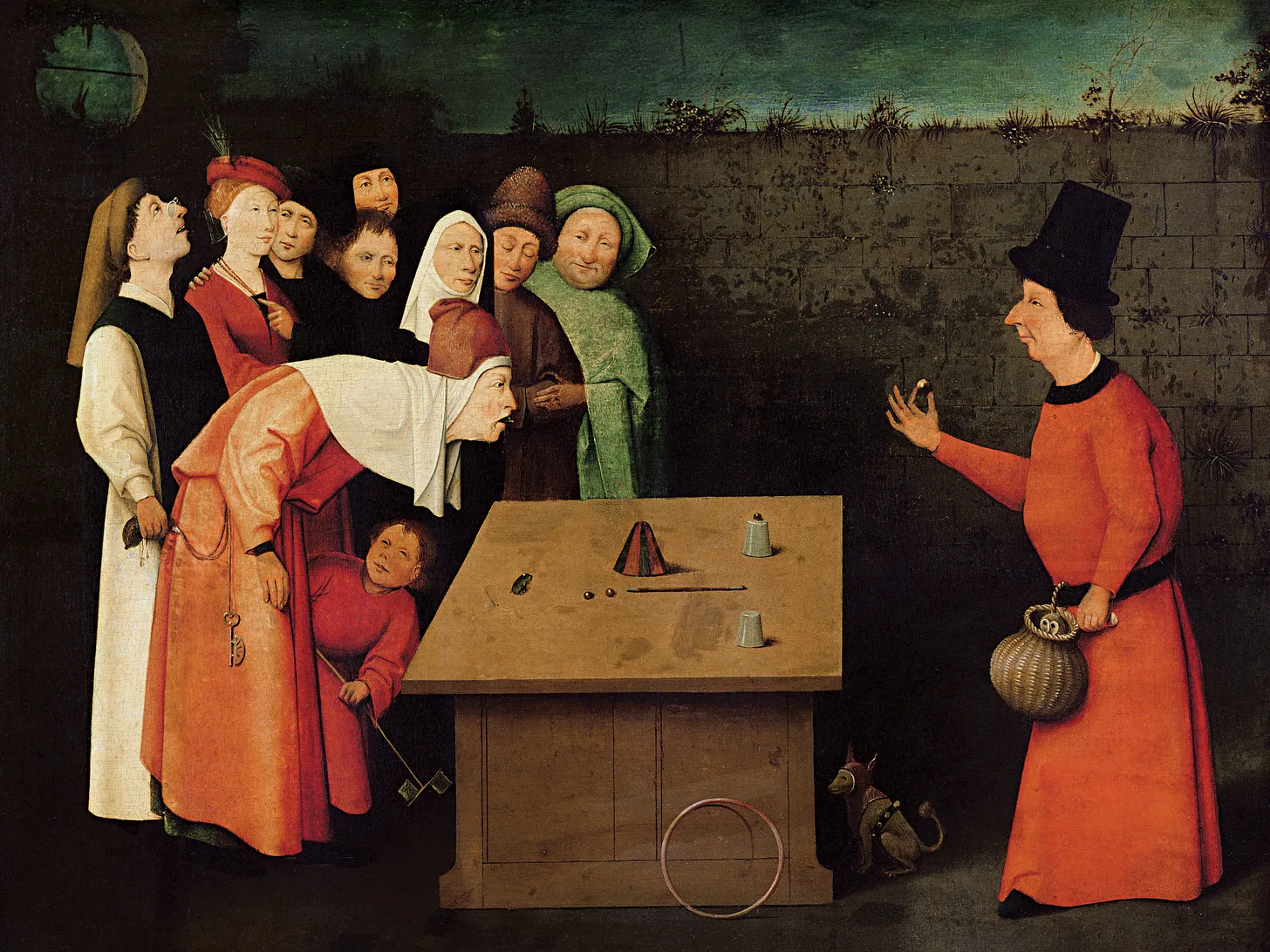
Hieronymus Bosch, The Conjurer, ca. 1502
[Below is the draft Executive Summary from a forthcoming report entitled Russia’s Hidden War Debt.
The full report is expected to be published in the coming days on Navigating Russia.]
Moscow has been stealthily pursuing a dual-track strategy to fund its mounting war costs. One track consists of the highly scrutinized defense budget, which analysts have routinely deemed “surprisingly resilient.” The second track—largely overlooked until now—consists of a low-profile, off-budget financing scheme that appears equal in size to the defense budget. Under legislation enacted on the second day of the full-scale invasion, the Kremlin has been compelling Russian banks to extend preferential loans to war-related businesses on terms set by the state. Since mid-2022, this off-budget financing scheme has helped drive an unprecedented $415 billion surge in overall corporate borrowing. This report estimates that $210 to $250 billion of this surge consists of compulsory, preferential bank loans extended to defense contractors—many with poor credit—to help pay for war-related goods and services.
Initially, this off-budget defense financing scheme proved advantageous to Moscow by enabling it to maintain its official defense budget at manageable levels. That misled observers into concluding—incorrectly as it turns out—that Moscow faces no serious risks to its ability to sustain funding its war. More recently, however, Moscow’s heavy reliance on its off-budget, compulsory lending scheme has begun to cause serious, adverse consequences at home. Not only has it become the main driver of inflation and interest rate hikes, but it is also creating the preconditions for a systemic credit crisis.
In late 2024, the Kremlin became increasingly aware that its off-budget funding scheme is unleashing potentially disruptive systemic financial risks, such as prohibitively high interest rates, liquidity and reserve problems at banks, and a severely compromised monetary transmission mechanism. For Moscow, credit event risk—with its seismically disruptive potential—will be of far more immediate concern than slow-burn risks like declining GDP. Moscow now faces a dilemma: the longer it puts off a ceasefire, the greater the risk that credit events—such as corporate and bank bailouts—uncontrollably arise and weaken Moscow’s negotiating leverage. Moscow’s emerging financing dilemma is likely to weigh on its war calculus and offers unexpected negotiating leverage to Ukraine and its allies. This report details ways well-informed negotiators can exploit Moscow’s growing financial vulnerability.
Executive Summary
This report examines Russia’s strategy for funding its war on Ukraine. It assesses Russia’s ability to sustain elevated war-time expenditures and identifies vulnerabilities that can be exploited by Ukraine and its allies.
It has three key findings:
1) The Russian state has been pursuing a two-track strategy to cover its mounting war costs, supplementing its highly scrutinized defense budget expenditures with funding from an off-budget defense financing scheme that is similar in scale, but has been overlooked by analysts;
2) Unlike its federal defense budget expenditures, which remain at sustainable levels, Russia’s off-budget funding scheme is proving much more problematic to sustain;
3) This now poses a funding dilemma for Moscow that could weigh on its war calculus, while providing Ukraine and its allies valuable, new negotiating leverage; this report details ways to exploit Moscow’s growing financial vulnerability.
What follows is a summary of each of these three findings.
[...]
Moscow now faces a dilemma: the longer it puts off a ceasefire, the greater the risk that credit events uncontrollably arise and weaken Moscow’s negotiating leverage.
This is a serious enough concern to factor into Moscow’s ceasefire calculus. Specifically, it could incentivize Moscow in two ways:
i. to prioritize relief around revenue-constraining sanctions as a condition of a ceasefire; this would provide much needed additional resources for restructuring large-scale, toxic corporate war debt while also funding rearmament;
ii. to favor a ceasefire sooner rather than later, to reduce the risk that a credit event weakens its negotiating leverage; if, however, Moscow believes significantly greater sanctions relief could be achieved by prolonging hostilities, it may be prepared to take the risk of doing so.
Ukraine and its allies can exploit Moscow’s funding dilemma by taking two measures:
i. Quietly voice confidence that Western resources can outmatch Russian resources in a war of attrition, backing up that message with a renewed package of funding and arms along with stepped up sanctions enforcement—following up on the January 10, 2025 ratcheting up of energy sanctions. Moscow fully understands it simply cannot prevail against a resolute deployment of Western resources. Which is why it invests so much effort into persuading Western opinion otherwise, in hopes of inducing despair and fatigue that lead to unnecessary concessions. A renewed display of Western resolve will weaken Moscow’s confidence in its ability to secure negotiating advantage through bluff and deception. The prospects of having to match superior Western resources in an extended conflict will only deepen Moscow’s concerns over its newly emerging funding vulnerability. This will pressure it to quietly reconsider its calculus of confrontation, as we have seen it do many times before.
ii. State robustly and categorically that sanctions relief is entirely off the table in any ceasefire negotiations and will only be considered as part of a comprehensive peace settlement—including reparations—that is negotiated and approved by Ukraine. In the face of renewed Western resolve, one thing that could cause Moscow to prolong fighting is if it believed it could gain additional sanctions relief by fighting on. By categorically removing sanctions relief from any ceasefire talks—and persuading Moscow that this is non-negotiable—it will weaken Moscow’s incentive to prolong fighting. It is also tantamount to calling Moscow’s bluff that its finances remain robust and sanctions have been ineffectual. Moreover, maintaining sanctions—with robust enforcement—will also constrain Moscow’s ability to rearm following a ceasefire, while leaving Ukraine and its allies with powerful negotiating leverage in any eventual comprehensive settlement.
Moscow’s funding challenges only increase from here, especially if coalition countries enforce more fully the powerful energy sanction tools at their disposal.Through continued resolve and a clear understanding of Moscow’s vulnerabilities, Ukraine and its allies can realize the full potential of their negotiating leverage, avoid making unnecessary concessions, and reduce the longer-term risks posed by Russian revanchism.
About the author
The author worked for many years as an investment banker at Morgan Stanley and Bank of America Merrill Lynch, where he was a vice chairman. During his banking career, he advised companies and governments around the world and led numerous financings, including Russia’s largest ever corporate transaction. He received an undergraduate degree in Russian studies and a doctorate in Russian and Middle Eastern history from Harvard and a masters in Middle Eastern languages from Oxford, where he was a Rhodes Scholar. Currently, he conducts research on Russia’s energy economy at Harvard’s Davis Center and is writing a history of the Russian oil industry and its impact on civil society. He also is the author of the Substack Navigating Russia.
https://navigatingrussia.substack.com/p/russias-hidden-war-debt
"One of Russia's 'shadow fleet' may have sabotaged power cables in the Baltic Sea. But what is it?"
Related:
Good to see - Ukraine takes another bite out of Russia as Moscow grinds on in Donetsk
Ukraine also announced significant investments in unmanned and long-range systems, where it has an edge.
https://www.aljazeera.com/news/2025/1/9/ukraine-takes-another-bite-out-of-russia-as-moscow-grinds-on-in-donetsk
**
Volodymyr Zelenskyy claims Ukraine has captured two North Korean soldiers in Kursk region of Russia
By Esther Linder with wires 6h ago
https://www.abc.net.au/news/2025-01-12/ukraine-captures-two-north-korean-pows-zelenskyy-claims/104807876
https://investorshub.advfn.com/boards/read_msg.aspx?message_id=175652119
Putin's goal now is that maximum leverage so that he can basically impose neutrality on Ukraine, retrofit and come back and do this again in 4 or 5 years. And that's not an outcome.
.@marcorubio says the next step on Ukraine "begins with some ceasefire," and that negotiations will be defined by concessions and leverage: "There will have to be concessions made by the Russian Federation, but also by the Ukrainians and the United States has lent itself there.…
— Nick Schifrin (@nickschifrin) January 15, 2025
https://investorshub.advfn.com/boards/read_msg.aspx?message_id=175668765
Moscow has been stealthily funding much of its war costs with risky, off-budget financing overlooked
by the West. That funding is now under pressure, offering new leverage to Ukraine and its allies.
Craig Kennedy
Jan 12, 2025
Hieronymus Bosch, The Conjurer, ca. 1502
[Below is the draft Executive Summary from a forthcoming report entitled Russia’s Hidden War Debt.
The full report is expected to be published in the coming days on Navigating Russia.]
Moscow has been stealthily pursuing a dual-track strategy to fund its mounting war costs. One track consists of the highly scrutinized defense budget, which analysts have routinely deemed “surprisingly resilient.” The second track—largely overlooked until now—consists of a low-profile, off-budget financing scheme that appears equal in size to the defense budget. Under legislation enacted on the second day of the full-scale invasion, the Kremlin has been compelling Russian banks to extend preferential loans to war-related businesses on terms set by the state. Since mid-2022, this off-budget financing scheme has helped drive an unprecedented $415 billion surge in overall corporate borrowing. This report estimates that $210 to $250 billion of this surge consists of compulsory, preferential bank loans extended to defense contractors—many with poor credit—to help pay for war-related goods and services.
Initially, this off-budget defense financing scheme proved advantageous to Moscow by enabling it to maintain its official defense budget at manageable levels. That misled observers into concluding—incorrectly as it turns out—that Moscow faces no serious risks to its ability to sustain funding its war. More recently, however, Moscow’s heavy reliance on its off-budget, compulsory lending scheme has begun to cause serious, adverse consequences at home. Not only has it become the main driver of inflation and interest rate hikes, but it is also creating the preconditions for a systemic credit crisis.
In late 2024, the Kremlin became increasingly aware that its off-budget funding scheme is unleashing potentially disruptive systemic financial risks, such as prohibitively high interest rates, liquidity and reserve problems at banks, and a severely compromised monetary transmission mechanism. For Moscow, credit event risk—with its seismically disruptive potential—will be of far more immediate concern than slow-burn risks like declining GDP. Moscow now faces a dilemma: the longer it puts off a ceasefire, the greater the risk that credit events—such as corporate and bank bailouts—uncontrollably arise and weaken Moscow’s negotiating leverage. Moscow’s emerging financing dilemma is likely to weigh on its war calculus and offers unexpected negotiating leverage to Ukraine and its allies. This report details ways well-informed negotiators can exploit Moscow’s growing financial vulnerability.
Executive Summary
This report examines Russia’s strategy for funding its war on Ukraine. It assesses Russia’s ability to sustain elevated war-time expenditures and identifies vulnerabilities that can be exploited by Ukraine and its allies.
It has three key findings:
1) The Russian state has been pursuing a two-track strategy to cover its mounting war costs, supplementing its highly scrutinized defense budget expenditures with funding from an off-budget defense financing scheme that is similar in scale, but has been overlooked by analysts;
2) Unlike its federal defense budget expenditures, which remain at sustainable levels, Russia’s off-budget funding scheme is proving much more problematic to sustain;
3) This now poses a funding dilemma for Moscow that could weigh on its war calculus, while providing Ukraine and its allies valuable, new negotiating leverage; this report details ways to exploit Moscow’s growing financial vulnerability.
What follows is a summary of each of these three findings.
[...]
Moscow now faces a dilemma: the longer it puts off a ceasefire, the greater the risk that credit events uncontrollably arise and weaken Moscow’s negotiating leverage.
This is a serious enough concern to factor into Moscow’s ceasefire calculus. Specifically, it could incentivize Moscow in two ways:
i. to prioritize relief around revenue-constraining sanctions as a condition of a ceasefire; this would provide much needed additional resources for restructuring large-scale, toxic corporate war debt while also funding rearmament;
ii. to favor a ceasefire sooner rather than later, to reduce the risk that a credit event weakens its negotiating leverage; if, however, Moscow believes significantly greater sanctions relief could be achieved by prolonging hostilities, it may be prepared to take the risk of doing so.
Ukraine and its allies can exploit Moscow’s funding dilemma by taking two measures:
i. Quietly voice confidence that Western resources can outmatch Russian resources in a war of attrition, backing up that message with a renewed package of funding and arms along with stepped up sanctions enforcement—following up on the January 10, 2025 ratcheting up of energy sanctions. Moscow fully understands it simply cannot prevail against a resolute deployment of Western resources. Which is why it invests so much effort into persuading Western opinion otherwise, in hopes of inducing despair and fatigue that lead to unnecessary concessions. A renewed display of Western resolve will weaken Moscow’s confidence in its ability to secure negotiating advantage through bluff and deception. The prospects of having to match superior Western resources in an extended conflict will only deepen Moscow’s concerns over its newly emerging funding vulnerability. This will pressure it to quietly reconsider its calculus of confrontation, as we have seen it do many times before.
ii. State robustly and categorically that sanctions relief is entirely off the table in any ceasefire negotiations and will only be considered as part of a comprehensive peace settlement—including reparations—that is negotiated and approved by Ukraine. In the face of renewed Western resolve, one thing that could cause Moscow to prolong fighting is if it believed it could gain additional sanctions relief by fighting on. By categorically removing sanctions relief from any ceasefire talks—and persuading Moscow that this is non-negotiable—it will weaken Moscow’s incentive to prolong fighting. It is also tantamount to calling Moscow’s bluff that its finances remain robust and sanctions have been ineffectual. Moreover, maintaining sanctions—with robust enforcement—will also constrain Moscow’s ability to rearm following a ceasefire, while leaving Ukraine and its allies with powerful negotiating leverage in any eventual comprehensive settlement.
Moscow’s funding challenges only increase from here, especially if coalition countries enforce more fully the powerful energy sanction tools at their disposal.Through continued resolve and a clear understanding of Moscow’s vulnerabilities, Ukraine and its allies can realize the full potential of their negotiating leverage, avoid making unnecessary concessions, and reduce the longer-term risks posed by Russian revanchism.
About the author
The author worked for many years as an investment banker at Morgan Stanley and Bank of America Merrill Lynch, where he was a vice chairman. During his banking career, he advised companies and governments around the world and led numerous financings, including Russia’s largest ever corporate transaction. He received an undergraduate degree in Russian studies and a doctorate in Russian and Middle Eastern history from Harvard and a masters in Middle Eastern languages from Oxford, where he was a Rhodes Scholar. Currently, he conducts research on Russia’s energy economy at Harvard’s Davis Center and is writing a history of the Russian oil industry and its impact on civil society. He also is the author of the Substack Navigating Russia.
https://navigatingrussia.substack.com/p/russias-hidden-war-debt
It was Plato who said, “He, O men, is the wisest, who like Socrates, knows that his wisdom is in truth worth nothing”
Discover What Traders Are Watching
Explore small cap ideas before they hit the headlines.



