A forgotten war and the hidden struggles of African Australians
"Sudan - Darfur - South Sudan "Pursuant to my first reply - 'The World's Worst Humanitarian Crisis': Understanding the Darfur Conflict""
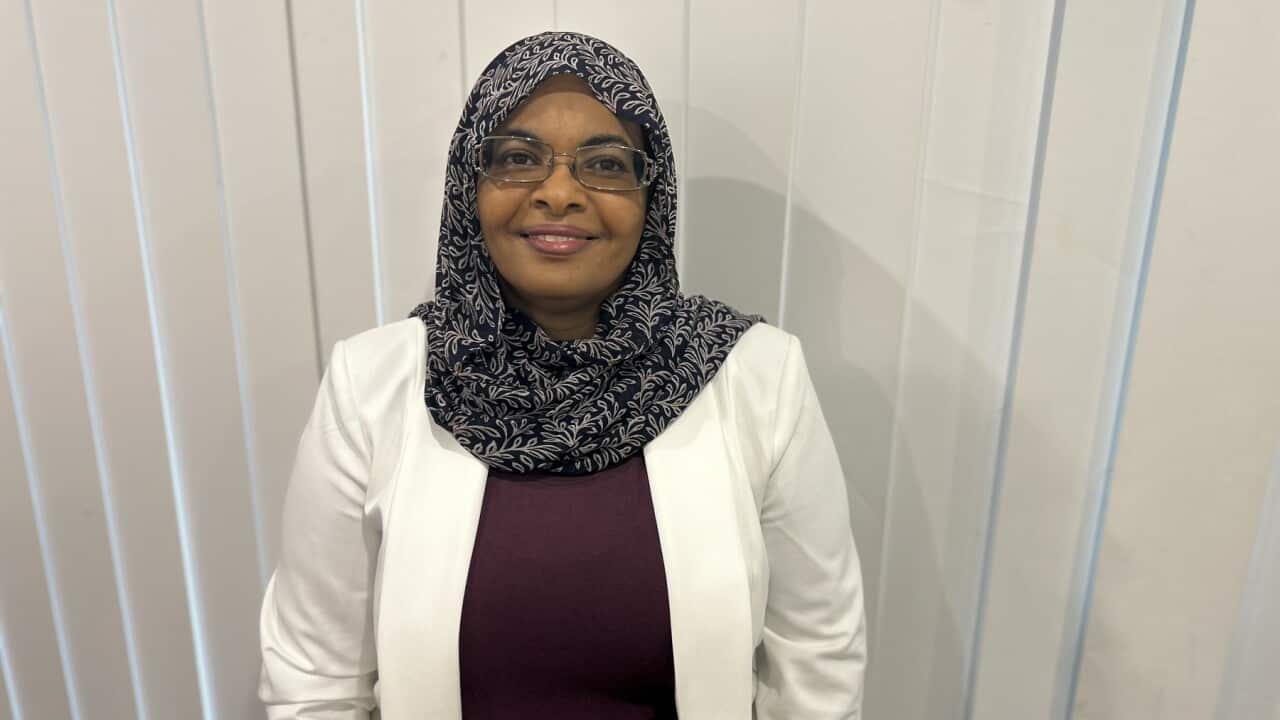
Ahlam Ibraheem says the war in her native Sudan has taken an emotional toll (SBS)
After almost a year and a half of fierce conflict in Sudan, the Sudanese-Australian community still fears for the lives of their loved ones as the humanitarian disaster worsens. Community leaders have also expressed a frustration at the lack of media coverage of the issue, arguing that it has slipped under the radar with wars in Ukraine and Gaza taking priority. With tens of thousands estimated killed and over 10 million people displaced by the violence, the war has left deep scars on civilians in Sudan and their concerned families in Australia. Listen to Australian and world news, and follow trending topics with SBS News Podcasts
TRANSCRIPT:
Yasir EL-HASSAN: "Most nights we go to sleep and we don't know if tomorrow we're going to get a phone call that something horrible has happened to one of our own loved ones or family."
[...]
While information is scarce, the United Nations estimates that tens of thousands have been killed in the power struggle over the past year and a half.
Dr Ahlam Ibraheem, a Sudanese-Australian GP in Sydney whose family remains in Sudan, says she doesn't call the conflict a civil war.
"It's not a civil war. It is a war between military and paramilitary and who's the victim? It's the people there, the innocent people. They are fighting each other in the street, in the small towns, in the village. Killing, raping, all the crime. Whatever crime comes to your mind, it is happening over there. Now more than half of the Sudanese people are displaced by force. They're now in the street. No shelter, no food, the health system is completely collapsed and destroyed."
While Dr Ibraheem and her son first moved to Australia back in 2011, her family largely remains in Sudan.
Her brothers and mother have been displaced by the war with her mother escaping through Egypt in the first months of the conflict and eventually joining her in Australia.
One brother has been directly affected by the violence, with Dr Ibraheem claiming he suffered a devastating head injury at the hands of a Rapid Support Forces militant which caused the loss of his vision.
She says the disruption of communication networks in Sudan has made it very difficult to make sure her loved ones are safe.
"It's very hard to communicate. I still have my two brothers there and one of my brothers, he was hit in his head. He lost his vision. Just his son, he sent us a message, 'Dad lost his vision' and we couldn't communicate with them for a whole month. We didn't know what happened, was he shot by a gun? It was a very hard time. I couldn't tell my mum who was with me here. It was very stressed time for me. Sadly, one of our colleagues - she's a doctor - she was found dead in her house. They just left her body in her backyard."
Her son Yasir El Hassan says it's been incredibly painful to see the country he was born in devastated by violence.
"It is really difficult seeing over the internet, just seeing places you grew up in and visited and just hold so much memories in just being destroyed and you start to think that it's kind of gone forever. Hopefully in the future Sudan will be rebuilt and that's the best outcome we can hope for, but it's just not going to be the same."
He also mentions this pain is amplified by a lack of awareness of the issue in Australia.
"It feels like Sudan is just being forgotten about. Not even forgotten about because no one actually knows to begin with. Like you tell someone you're from Sudan here and they ask, 'oh, how is it there?' No one actually has any awareness of the situation at hand. And then when you start telling them, they're like, 'oh, I'm so sorry to hear that', but it doesn't really bother them too much. You won't really hear too much about it. The next time you have a conversation with said person, they've already forgotten."
So, why is it that we rarely hear about this crisis in Australia?
Emeritus Professor of Sociology at the University of Technology Sydney, Andrew Jakubowicz, says war zones like Sudan are difficult to cover for Australian media and are often considered a low priority.
"You need resources and assets on the ground in those places. And that's both expensive and dangerous. But also, I think, there's that sort of axiom in media studies that one person killed in your local area is as important, or probably more important, than 100,000 people killed on the other side of the world."
South African officials weigh up rescue mission for illegal miners underground
"Sudan - Darfur - South Sudan "Pursuant to my first reply - 'The World's Worst Humanitarian Crisis': Understanding the Darfur Conflict" [...]The Darfur Genocide Darfur is a three-state regional area in western Sudan about the size of Spain. This is the site of a third Sudanese crisis. This area has been hit especially hard by increasing desertification. P - As desert areas expand, it is increasingly difficult for herders to find places to graze their animals. The herders encroach on farmers’ lands, and the result is often a violent battle over the land. P - In Darfur, the nomadic herders are Arabs. The settled farmers are Africans. At the local level, the conflict is about basic resources – both the Arab grazers and the African herders need land and water. The Arab government wants the land from the Africans. [UNIVERSITY OF PENNSYLVANIA - AFRICAN STUDIES CENTER Who Is an Arab? WHO IS AN ARAB? W. Montgomery Watt and Pierre Cachia https://www.africa.upenn.edu/K-12/Who_16629.html ] At the regional level, the conflict is portrayed as a tribal or ethnic conflict, with the government inciting the Arabs against the Africans. P - The national level is political. Oil is the foreign direct investment that provides money for weapons, which bring power and the ability to attack people and grab their land. Whoever controls oil and other resources gets the power."
Police say 350-400 people have stayed in Stilfontein mine to avoid arrest after minister vowed to ‘smoke them out’
Rachel Savage Southern Africa correspondent Tue 19 Nov 2024 23.41 AEDT
Police at the scene of the standoff with illegal miners in Stilfontein. Photograph: Ihsaan Haffejee/Reuters
South African authorities are assessing whether it is safe to rescue potentially thousands of illegal miners who may be trapped underground, after police stopped food, water and medicine being delivered to them about two weeks ago to try to force the miners to the surface.
A police spokesperson, Athlenda Mathe, insisted to reporters on Tuesday that the miners were not trapped in the abandoned goldmine in Stilfontein, a town about 100 miles south-west of Johannesburg, but rather staying underground to avoid being arrested.
She said experts would be putting cameras down the mineshaft to see if it was safe for emergency workers to undertake a rescue mission.
As many industrial mines have been exhausted in South Africa .. https://www.theguardian.com/world/africa .. in recent decades, illegal mining has flourished. While precise numbers are not known, analysts estimate there are as many as 30,000 “zama zama” illegal miners, mining about 10% of South Africa’s gold output in up to 6,000 abandoned mineshafts.
The illegal mining operations are often controlled by criminal syndicates and have been linked to fatal shootouts and other violent crime. A month ago, the government launched Operation Vala Umgodi (plug the hole) in an attempt to crack down on the sector.
“We are going to smoke them out. They will come out,” Khumbudzo Ntshavheni, a government minister, said last Wednesday. “We are not sending help to criminals. Criminals are not to be helped, criminals are to be persecuted.”
Her comments provoked uproar amid fears that the miners underground could become too weak to come out themselves and might die underground.
Local volunteers have been lowering food and water by rope into the mine. Photograph: Ihsaan Haffejee/Reuters
A local community member previously told reporters there were about 4,000 people still in the mine, but Mathe said that was an exaggeration and put the figure at 350-400.
The Society for the Protection of Our Constitution, a legal campaign group, launched a court case to demand access to the mineshaft. On Saturday the high court issued an interim order stating that supplies could be delivered to the miners.
The same day, local volunteers lowered 600 packets of instant porridge and 600 litres of water by rope into the mine, said Johannes Qankase, a community leader. They hauled up at least two men by rope, who appeared frail and dehydrated. skip past newsletter promotion
South Africa’s president, Cyril Ramaphosa, said on Monday that about 1,000 zama zamas had emerged from the Stilfontein mineshaft and been arrested since the operation had started, and any who needed medical attention had been taken to hospital.
“Acts of violence and intimidation of communities by illegal miners is well documented. Some illegal miners have been implicated in serious and violent crimes, including murder and gang-rape. Many are in the country illegally,” he said in a statement.
He acknowledged there was “a great deal of public debate about the rights of illegal miners” and said: “The police must take great care to ensure that lives are not put at risk and that the rights of all people are respected.”
Sudan paramilitary group accused of killing 2,000 civilians in El-Fasher
"Sudan - Darfur - South Sudan "Pursuant to my first reply - 'The World's Worst Humanitarian Crisis': Understanding the Darfur Conflict""
Related: In Sudan, U.S. Policies Paved the Way for War "Sudan conflict: why is there fighting and what is at stake in the region? "Sudan crisis explained: What’s behind the latest fighting and how it fits nation’s troubled past "Sudan Will Decide the Outcome of the Ethiopian Civil War "Mali’s President Exits After Being Arrested in Military Coup [...]Suggest skimming the first up there before reading this article. A misguided effort to integrate the RSF into the Sudanese Armed Forces led to a tragic but predictable conflict. [...] August, 2023 -- https://investorshub.advfn.com/boards/read_msg.aspx?message_id=172636118
Wednesday 29 October
People have been forced to flee famine and siege warfare in the Sudanese city of El-Fasher. (Reuters: Mohammed Jamal)
In short:
Reports of ethnically motivated atrocities against civilians in Sudan's EL-Fasher are mounting, with allies of the Sudanese army accusing militia of executing thousands.
A crisis monitor said "door-to-door clearance operations" appeared to have been undertaken in the city, in a "systematic and intentional" process of ethnic cleansing.
What's next?
Analysts say Sudan is now effectively partitioned along an east-west axis, with the RSF having already set up a parallel government.
Sudanese paramilitary forces have been accused of having "executed more than 2,000 unarmed civilians" since taking control of the western city of El-Fasher, as alarming reports of atrocities emerge.
El-Fasher fell to the Rapid Support Forces (RSF) on Sunday after more than 18 months of brutal siege warfare, giving the group control over every state capital in the vast Darfur region.
Allies of the army, the Joint Forces, said on Tuesday that the RSF "committed heinous crimes against innocent civilians in the city of El-Fasher, where more than 2,000 unarmed citizens were executed and killed on October 26 and 27, most of them women, children and the elderly".
Local groups and international NGOs had warned El-Fasher's fall could trigger mass atrocities, fears that Yale University's Humanitarian Research Lab said were coming true.
The monitor, which relies on open source intelligence and satellite imagery, said the city "appears to be in a systematic and intentional process of ethnic cleansing of Fur, Zaghawa, and Berti indigenous non-Arab communities through forced displacement and summary execution".
This included what appeared to be "door-to-door clearance operations" in the city.
In a report published on Monday, it said the actions of the RSF "may be consistent with war crimes and crimes against humanity and may rise to the level of genocide".
The same day, UN rights chief Volker Turk spoke of a growing risk of "ethnically motivated violations and atrocities" in El-Fasher.
His office said it was "receiving multiple, alarming reports that the Rapid Support Forces are carrying out atrocities, including summary executions".
Pro-democracy activists, meanwhile, said El-Fasher residents had endured "the worst forms of violence and ethnic cleansing" since the RSF claimed control.
Displaced families have fled El-Fasher for Tawila, in Sudan's North Darfur region. (Reuters: Mohammed Jamal)
A video released by local activists and authenticated by the AFP news agency shows a fighter known for executing civilians in RSF-controlled areas shooting a group of unarmed civilians sitting on the ground at point-blank range.
The paramilitaries have a track record of atrocities, having killed as many as 15,000 civilians from non-Arab groups in the West Darfur capital of El-Geneina.
The army, which has been fighting the RSF since April 2023, has also been accused of war crimes.
'Harder to unwind'
More than a year-and-a-half of siege warfare made El-Fasher one of the grimmest places in a war that the UN has labelled among the world's worst humanitarian crises.
Displacement camps outside the city were officially declared to be in famine, while inside it, people turned to animal fodder for food.
The UN warned before the city's fall that 260,000 people remained trapped there without aid, half of them children.
Conditions in parts of Sudan are being subjected to what some agencies describe as a "systematic and intentional process of ethnic cleansing". (Reuters: Mohammed Jamal)
The African Union's chairman Mahmoud Ali Youssouf on Tuesday expressed "deep concern over the escalating violence and reported atrocities", and condemned "alleged war crimes and ethnically targeted killings of civilians".
The Sudanese army chief, General Abdel Fattah al-Burhan, said on Monday that his forces had withdrawn from El-Fasher "to a safer location", acknowledging the loss of the strategic city.
He pledged to fight "until this land is purified", but analysts said that Sudan was now effectively partitioned along an east-west axis, with the RSF having already set up a parallel government.
Alan Boswell, project director for the Horn of Africa at the International Crisis Group, told AFP: "The longer this war drags on, this division will likely only grow more concrete and harder to unwind."
Foreign backers
Anwar Gargash, an adviser to the president of the United Arab Emirates, called the city's capture a "turning point" that showed "the political path is the only option to end the civil war".
The UAE has been accused by the UN of supplying the RSF with weapons, a charge it denies.
It is also a member of the so-called Quad — alongside the United States, Saudi Arabia and Egypt — which is working for a negotiated peace.
The group has proposed a ceasefire and a transitional civilian government that excludes both the army and the RSF from power.
Talks last week in Washington involving the Quad made no progress.
The army has its own foreign backers in Egypt, Saudi Arabia, Iran and Turkey, observers have reported. They too have denied the claims.


 Market Data
  Markets


 AI
AI