News Focus
News Focus
icon url

Augie Boukalis

01/02/24 1:26 PM

#780609 RE: bradford86 #780605

I am going to give you an A for effort nice job 🇺🇲🌵🛹
icon url

Augie Boukalis

01/02/24 1:29 PM

#780610 RE: bradford86 #780605

It's going to be a lot less then 18 months I got the inside scoop 🇺🇲
icon url

The Man With No Name

01/02/24 1:58 PM

#780616 RE: bradford86 #780605

Biden is a seasoned politician surrounded by skilled strategists.


Oh yeah


icon url

Donotunderstand

01/02/24 4:02 PM

#780637 RE: bradford86 #780605

Biden will start the recap and release process, claim credit for solving the housing crisis, and appropriate the 100 billion warrant money to congressional districts in a variety of programs to address affordability but more importantly SUPPLY. This is the easiest big idea win available in the current election cycle.

As I have said many times - the above makes a bunch of sense to me (and I do not know why BO and DJT did not do it !!!)

At same time --- as we get diluted by the 4B new shares or so ----- this action and dilution is ONLY relatively good for current holders if the offset is that LP - SP is marked down to zero. Then dilution from our current "100% ownership to 20% ownership would look good --- compared to "100% to 1% ownership if diluted by a conversion of the entire LP - SP. at say 100B

Biden should do it - but should also say that GOV got 300B for its 200B - kill the LP - and then claim the 100B as EXTRA now available due to conserving in the conservatorship. it can be used for housing or lots of other stuff - 50-50 with Republicans

Not saying this is great or fair or honest - but from prior posts by many - at PE of 10 or so --- this is say $20 - $30 a share without even leaving the conservatorship

do it
icon url

Wise Man

01/03/24 2:54 AM

#780676 RE: bradford86 #780605

The law doesn't authorize the sacking of private corporations during a Conservatorship and under the Charter Act.
What Pagliara is doing with that tweet, is stock price manipulation.
The judges haven't authorized it either (judge Willett and justice Alito), with some exceptions, for instance, the U.S. Court of Appeals for the Sixth Circuit.
The same court that omitted the count of 210 days under the FVRA (Rop case. Berkowitz's attorney, David Thompson), because it coincided exactly with the Final Rule July 20, 2011, that enables the 2nd and 3rd phases of the Separate Account plan "a capital distribution for Recap", CFR 1237.12, and where DeMarco set a trap declaring in 2011 that the Lamberth damages are a capital distribution too, that would uncover 12 years later, that the other capital distributions (a financial concept that has been covered up in court all along), like dividends and gifted SPS, are restricted too when FnF are undercapitalized (IN GENERAL)
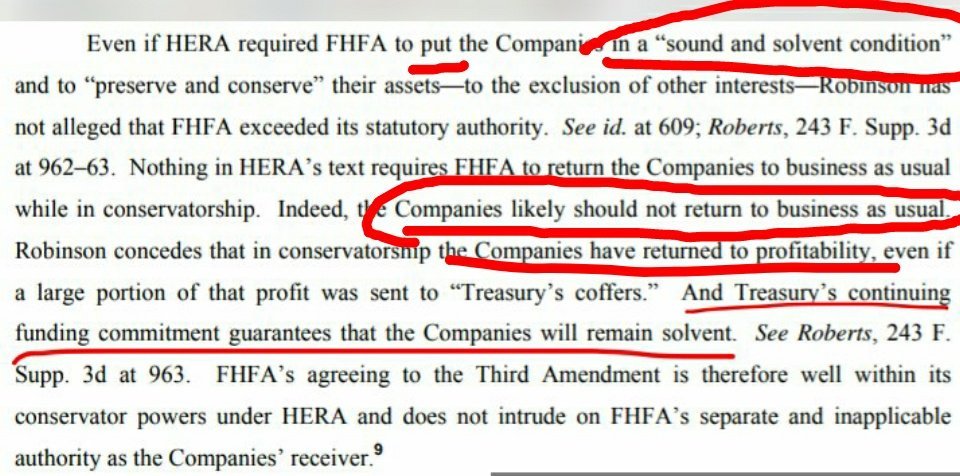
This court, with the important Robinson case (2017. Berkowitz's attorney, David Thompson, again), claimed that "put in a sound condition" in the FHFA-C's Rehab Power, was achieved with the return to profitability, "even if a large portion of that profit was sent to 'Treasury's coffers'". Unaware that, in a financial company, the soundness is measured with the capital levels, where the earnings must be retained by the enterprises in order to be recorded as Core Capital or CET1 Capital.
Likewise with the "put in a solvent condition", the judge claimed that it's achieved with the Funding Commitment from the UST (emanating from the Charter Act by the way: Authority of Treasury to Purchase Obligations), when it's measured with financial ratios, like Debt/Ebitda; Liquidity ratios,... and it includes the reduction of the obligations SPS as well, a debenture with the taxpayer that has to be paid back asap, which is what has been done with the assessments sent to Treasury under the guise of dividends, as per the law (a NWS dividend, the fastest speed to that end, as the 10% dividend prompted a death spiral)
Let alone that "put" means "to restore", and these judges even dared to claim that "the Companies likely should not return to business as usual". No one asked for their opinion on this subject.

The "may" word preceding this Rehab power, is some leeway related to activities that may incur losses or increase risk. The same with the "take any action authorized by this section, in the best interests of the Agency" of the Incidental Power, as explained by Freddie Mac.
It's not an authorization to break the law at its will.


There is a reason why to became FHFA Director, it's required by law knowledge in financial matters and the mortgage market.
The same reason why the courts are precluded from taking actions that affect the conservatorships. U.S. Code 4617 (f).
With an adjusted $402 billion capital shortfall over Minimum Leverage capital requirement, Sandra Thompson has a lot of explaining to do.
Let alone an adjusted $-216 billion Accumulated Deficit Retained Earnings account to absorb future "unexpected" losses and pay dividends.

The Warrant is a security that was authorized "to (iii) protect the taxpayer", regardless that it was issued for free to avoid this prerequisite on purchases by UST. Barred in the Fee Limitation, both as collateral or as a higher compensation on the funding commitment. Therefore, an illegal collateral.
An exercise price of $0.00001ps confirms that it had the purpose of collateral of the SPS (a guaranty for the repayment of the debenture SPS. Hence the "to protect the taxpayer"), although the true purpose was the assault on the ownership by Wall Street and the Community Banks, paying nothing, through the covenant 2.1: shares assigned to any Person (BLK, JPM, MS, BX, GS, etc.)
They become owners of FnF one day by immaculate conception.
icon url

Wise Man

01/03/24 3:54 AM

#780680 RE: bradford86 #780605

The idea that the banks won't buy 30-year securities anymore, just because now they are compelled to record the unrealized loss on Equity (AOCI line item), like anyone else does, is insane.
There have been two problems with the U.S. banks that are interrelated: Wrong loss on Assets and a hidden capital hole.
-Liquidity crisis: debt securities in Held-To-Maturity portfolios, valued at amortized cost with a small write-down, just like a loan. It's only allowed either a loss on fair value (volatility in earnings) or a loss on AOCI (directly on Equity). Thus, there are two categories, not three as the Federal Reserve claims on a Schedule on how to fill out a Balance Sheet.

-The hidden hole in Equity that has popped up in 2023. The accumulated losses on debt securities mentioned before, should have been funded the last years (asset sales, issuance of stocks, Prompt Corrective Actions like dividends and stock buybacks suspended). The problem has been FDIC rulemaking that authorized them an AOCI opt-out election, when calculating the CET1 = Retained Earnings + AOCI (accumulated unrealized losses) + common stock par value - Treasury Stock (buybacks) + APIC.
CET1 = CE + regulatory adjustments.
The FDIC has some explaining to do.

BOTTOM LINE
The key: all of the above is related to a bank that is not "an advanced approaches FDIC-supervised institution", that may make a one-time election to opt out of recording AOCI.
That is, for banking organizations with assets between $100B and $700B (Categories III and IV)
This will change with the proposed changes in the capital requirements, now in place with a comment period: "Basel III framework endgame".
There won't be opt-out election. Those banks will be required to include the full AOCI on the CET1, phased in during a 3-year transition period, beginning in July 1, 2025.
This is about a flawed rulemaking (AOCI opt-out election) for the regional banks and Medium- and Small-sized banks, but unrelated to the large banks (Category II and GSIBs) that simply broke the rules (Trump's famous deregulation rhetoric), because they didn't have this election.
So, the large banks will have higher capital requirements as well, but it's because they are catching up with the compliance with the rules they broke.

Rogue bankers, as seen in the latest earnings report of JPM, want to pass the new proposal Basel framework endgame, off as a brand new rulemaking with a transition period for GSIBs beginning in 2025, when they were already subject to these requirements.

Deregulation, break the laws, external position (off-Balance Sheet; off-Federal Budget),.... The Age of Plunder.
DISCLAIMER: It's my understanding after reading the proposed Basel III endgame.