Exactly -- Opinion This plan for a third-party presidential bid in 2024 is dangerous
"The 'No Labels' agenda is more disturbing than you know [...] Such a candidacy could hand the presidency to the Republican candidate in 2024 because Manchin and Sinema both have had a longtime affiliation with the Democratic Party. Few Republicans would vote for either, but both could pull enough Democratic and independent votes to swing the election. P - Stories about this often note that Jill Stein received more votes than Trump’s 2016 margin of victory in the swing states, or that Ralph Nader’s 90,000+ votes in Florida were almost certainly drawn more from Democrats than Republicans in an election George W. Bush “won” by 537 ballots before the US Supreme Court stopped the recount. Without Stein and Nader on the ballots, we’d probably have had President Gore and President Hillary Clinton. [...] Most Americans want Social Security strengthened, for example, but New York bankers and hedge fund managers want those trillions parked with them. And some billionaire businessmen think it would be better for their industries if there were no social safety net at all, so workers would be more terrified, compliant, and willing to work for wages closer to what is paid in China or Mexico. P - This is why today the entire GOP is dedicated to taking down what Alexander Hamilton called The American Plan — which built and created our middle class — and instead are working at turning America into an authoritarian oligarchy. P - Giant insurance companies who fund and support them, similarly, want to get their hands on Medicare, which they’ve already seized half of through George W. Bush’s Medicare Advantage scam. P - Thus, just this week, one of the largest Republican groups in the House of Representatives — the Republican Study Committee — introduced legislation to gut Social Security while turning Medicare into a voucher program with all of the revenue first going through the hands of the insurance companies."
By Jonathan Cowan, Rahna Epting and Patrick Gaspard April 14, 2023 at 6:00 a.m. EDT
Former president Donald Trump at Mar-a-Lago this month. (AP Photo/Evan Vucci)
Jonathan Cowan is president of Third Way, Rahna Epting is executive director of MoveOn and Patrick Gaspard is CEO of the Center for American Progress Action Fund.
As leaders of three groups that represent various segments of the Democratic Party coalition, we don’t always agree on policy or politics. But lately, we find ourselves strongly united on one alarming issue: the possibility of a well-financed third-party presidential campaign that could help elect a MAGA extremist president in 2024.
The group — founded in 2010 to combat rising political polarization — has said it is raising at least $70 million for the effort and is planning a convention in Dallas for April 2024. No Labels has condemned Donald Trump and Joe Biden as equally extreme and claims that their likely nominations by the major parties require another choice.
We understand the sentiment that has driven donors to the No Labels banner. But there is simply no equating a party led by Biden to today’s MAGA Republican Party. One side believes in American democracy, while the other has attacked it. One is governing from the mainstream, while the other champions extremism. One seeks to work collaboratively on the issues; the other has given way to conspiracy theorists and cranks.
Moreover, No Labels has yet to say what makes Biden .. https://www.washingtonpost.com/politics/2023/04/02/no-labels-third-party-election/?itid=lk_inline_manual_11 .. an “unacceptable” candidate. The group’s members say they value cross-party compromise — and Biden has shepherded into law major bipartisan legislation on infrastructure, domestic manufacturing, climate change, gun safety, protecting our troops and veterans, protecting same-sex and interracial marriage, election integrity, and more. No Labels says it wants leadership — and Biden has rallied the free world to respond to Russia’s barbaric aggression in Ukraine. It seeks mainstream values — and Biden is a man of abiding decency, faith and respect for the law. The contrast with someone like Trump hardly needs to be detailed.
Despite this glaring hole in its argument, No Labels is forging ahead. It claims to be in it to win it and has released a map purporting to show that its ticket could take nearly 40 states, including Biden’s home state of Delaware.
Such an outcome is sheer fantasy. No third-party candidate has ever come remotely close to winning, including Theodore Roosevelt, running on a Progressive Party ticket just four years after leaving office as an enormously popular Republican president. In fact, no third-party candidate has won a single electoral vote since 1968.
Though it can’t win the race, No Labels can affect the outcome. In 2016, Trump won the battleground states of Pennsylvania, Wisconsin and Michigan. In 2020, his share of the vote in each actually increased .. https://www.thirdway.org/report/the-dangerous-illusion-of-a-presidential-third-party-in-2024 , but he lost all three. The reason? Biden won the votes of those who had chosen Jill Stein, Gary Johnson or another also-ran in 2016 by a 30-point margin. Such voters have peeled away before, and, if given the choice, they could certainly do so again, especially if lured by a well-funded campaign.
No Labels insists that it doesn’t want to field a spoiler candidate. But spoiling is what third-party candidates do. In 2000, Ralph Nader won 97,000 votes in Florida, the decisive state Al Gore lost by just 537 votes. And Nader, Stein and Johnson swung the outcome of their races with tiny war chests. Between them, Stein and Johnson spent less than $16 million, and Nader spent a bit over $9 million. With $70 million or more, the No Labels candidate is nearly certain to outperform all three, increasing the odds of serving as a stalking horse for an extreme MAGA Republican.
No Labels is offering an illusion, not a choice. At a time when our nation is being tested, this organization could help defeat a mainstream president and elect or reelect a radical and vindictive MAGA Republican. For the sake of our country, leaders across the political spectrum should call on No Labels to stand down
Trump as Trump. The American electorate i still have faith in:
The dangerous No Labels - A revisit excerpt from yours:
"It’s a new ethic that Dwight Eisenhower would’ve instantly recognized and called corruption. Harry Truman once called it “fascism,” as did Vice President Henry Wallace on the pages of The New York Times.
In early 1944, the New York Times asked Wallace to, as Wallace noted:
“Write a piece answering the following questions: What is a fascist? How many fascists have we? How dangerous are they?” Vice President Wallace’s answer to those questions was published in The New York Times on April 9, 1944, at the height of our war against the Axis powers of Germany and Japan.
“The really dangerous American fascists,” Wallace wrote, “are not those who are hooked up directly or indirectly with the Axis. The FBI has its finger on those.”
As if he had a time machine and could see the “conservative” media landscape today, Wallace continued:
“The American fascist would prefer not to use violence. His method is to poison the channels of public information.
“With a fascist the problem is never how best to present the truth to the public but how best to use the news to deceive the public into giving the fascist and his group more money or more power.”
Nowadays, pretty much any Republican who gets elected will use that position corruptly to strengthen the party and/or for their own personal gain. Screw the interests of America and American working people.
It’s become normal. It’s rarely even reported in the newspapers anymore.
This is just the tiniest glimpse into how dark money can alter the outcome of American elections in ways that are unrealized by the average voter.
No Labels CEO defends 2024 ticket against spoiler charges
"The 'No Labels' agenda is more disturbing than you know Thom Hartmann June 17, 2023, 12:35 PM ET"
VIDEO - No Labels leader Nancy Jacobson said her group won’t help Donald Trump win again. But she declined to say how it would decide whether to stand down. 18:10
WASHINGTON — No Labels is facing increasing scrutiny over the possibility it could play a spoiler role in the 2024 presidential election, and its founder and CEO said in an exclusive interview that she vows to end the group’s third-party 2024 effort if it risks putting Donald Trump back in the White House.
But Nancy Jacobson repeatedly declined to offer any metric on how the group would determine whether to stand down.
“As a Democrat? Categorically, that will not happen,” Jacobson said in response to a question about concerns that a third-party ticket, running on the ballot line No Labels is seeking in every state, could siphon off votes from President Joe Biden and benefit Trump. “This effort will nev — we’ll pull it down.”
Jacobson immediately added: “We will not spoil for either side. The only reason to do this is to win.”
It’s a bold statement in a nation where the most successful third-party presidential effort in the last century finished a distant third. And even as the No Labels effort stepped out this week with a public campaign-style event in Manchester, New Hampshire, much of its political effort remains secret.
The group doesn’t reveal its donors and isn’t publicly discussing its deliberations over whom it may recruit to run on its planned bipartisan ticket. The details of how it’ll operate its convention in Dallas in April also aren’t clear, though the group has no plans to hold traditional primaries or caucuses in which voters select a presidential nominee. Jacobson said the group will assess its standing after Super Tuesday and the Florida primary next year.
Jacobson worked as a major fundraiser for the Clintons and the Democratic Party before she formed No Labels in 2010, helped create the congressional Problem Solvers Caucus and aided moderate members of Congress from both parties in their elections.
Jacobson, a Democrat, demurred when she was asked whether Biden represented the bipartisan leader No Labels has hinged its efforts on. Biden ran his 2020 presidential campaign on the promise to work with congressional Republicans. His campaign has often pointed to the passage of the CHIPS Act, the infrastructure package and the debt ceiling deal — deals celebrated by No Labels’ allies in Congress — as evidence of the president’s work.
“Joe Biden is a good man. There has been a lot of tremendous legislation, but the point is it’s about the voters. It’s not about us,” Jacobson said. “It’s about the voters, and the voters of this country right now are not saying they want him as a choice — right now.”
Aspects of current polling are grim for Biden. Though he retained a slight lead against Trump in the most recent NBC News national poll, his approval rating stood at 43%. And 44% of voters, including a larger share of Democrats than Republicans, say they’re open to considering a third-party candidate.
It’s against that backdrop that national Democrats have expressed deep concern about the consequences of No Labels’ presidential efforts.
“I don’t think No Labels is a political party,” Sen. Mark Kelly, D-Ariz., said Sunday on CNN .. https://www.cnn.com/videos/politics/2023/07/16/sotu-mark-kelly-no-labels-2024.cnn . “I mean, this is a few individuals putting dark money behind an organization, and that’s not what our democracy should be about. … I’m obviously concerned about what’s going on here in Arizona and across the country.”
Jacobson said the group wouldn’t disclose its donors, saying, “There’s nothing nefarious going on here.”
She said the group isn’t legally obligated to reveal its financial sources.
The Arizona Democratic Party filed a complaint .. https://azdem.org/arizona-democratic-no-labels/ .. with the Arizona secretary of state’s office last week, arguing that No Labels should be suspended as a political party for failing to follow the same financial disclosure rules as the state’s Republican and Democratic parties.
Even though it registered as a political party, Jacobson denied the group — which is incorporated as a so-called social welfare nonprofit organization — is acting in the capacity of a party, arguing that it will only make its ballot line available for a presidential ticket, not actually operate the eventual campaign.
“That’s just language,” Jacobson said. “That’s not — you know, we are not functioning — we are one ticket, one time.
[]iNSERT: Hmmm. Normally i like fudge in small doses, but that Jacobson fudge is carrying curried sweetness way toooo far.
“A party — [the] definition of a party is running candidates up and down the ballot. That is not what we’re doing,” she continued.
Some Biden allies, seeing No Labels as a clear potential spoiler, have questioned the true motivations behind Jacobson’s mission. But one of her longtime senior advisers, William Galston, who left the organization in April over his opposition to the presidential ticket operation, defended her intentions in an interview.
“I do not question the motives or the patriotism or the integrity of anybody involved in this effort,” Galston said. “My opposition is a simple matter of political analysis. I believe there is a gap between what No Labels wants to do and what its efforts will, in fact, achieve.”
Galston, a senior fellow at the Brookings Institution, helped Jacobson start No Labels in 2010 but left the organization in April over his opposition to the presidential ticket operation.
“I cannot see a serious possibility that an independent, bipartisan, centrist, third-party ticket can succeed and win the presidency,” said Galston, adding: “I fear that despite its intentions to the contrary, if it proceeds, it will end up — it will end up helping Donald Trump.”
According to the NBC News exit poll, most of those who voted third-party in 2016 decided to back Biden four years later, helping deny Trump re-election. Now, Democrats worry that a growing third-party vote in 2024 would lower the threshold Trump needs to win again — as it did in 2016, when 47% to 48% of the vote was enough for him to capture key swing states.
Jacobson defended the organization’s credibility in her interview, citing the numerous nationally recognized figures affiliated with it.
“Because we’ve been around for 13 years. They can see the leaders around this,” Jacobson said. “They can see Sen. Joe Lieberman. They can see Gov. Larry Hogan. They can see a civil rights leader, Ben Chavis. They can see all the leaders. They can see our work for the last 13 years.”
Monday in New Hampshire, Sen. Joe Manchin, D-W.Va., and Jon Huntsman, the Republican former governor of Utah and ambassador to China, headlined No Labels’ “Common Sense Town Hall” at Saint Anselm College.
Purdue Pharma, Sacklers' OxyContin settlement lands at the Supreme Court
"The 'No Labels' agenda is more disturbing than you know [...]In his twitter thread, Wilson notes: “They formed No Labels as a long con, a way to break the Democrats, get rich doing it (and again, they are VERY rich), and punish their imagined enemies.” P - Congressman Mark Pocan, former co-chair of the Congressional Progressive Caucus and a regular on my radio program for years, tells the story of joining No Labels and their “Problem Solvers Caucus” when he first went to Congress, thinking the idea of reaching across the aisle to get things done was noble. P - When he asked the group who provided their funding, however, he said they instead offered to “quietly” delete his name from their membership roster. [...]Most Americans want Social Security strengthened, for example, but New York bankers and hedge fund managers want those trillions parked with them. And some billionaire businessmen think it would be better for their industries if there were no social safety net at all, so workers would be more terrified, compliant, and willing to work for wages closer to what is paid in China or Mexico. P - This is why today the entire GOP is dedicated to taking down what Alexander Hamilton called The American Plan — which built and created our middle class — and instead are working at turning America into an authoritarian oligarchy. P - Giant insurance companies who fund and support them, similarly, want to get their hands on Medicare, which they’ve already seized half of through George W. Bush’s Medicare Advantage scam."
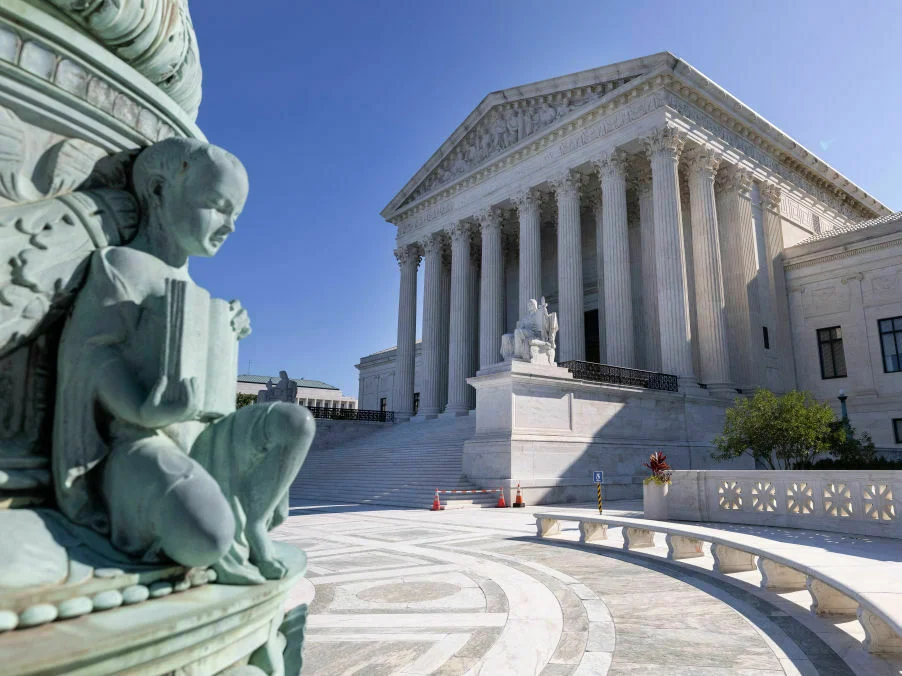
The Supreme Court hears arguments Monday in a challenge to the deal meant to compensate victims of the highly addictive painkiller OxyContin. Kevin Dietsch/Getty Images
The opioid crisis comes to the Supreme Court Monday as the justices hear arguments in a challenge to the bankruptcy deal meant to compensate victims of the highly addictive pain killer OxyContin.
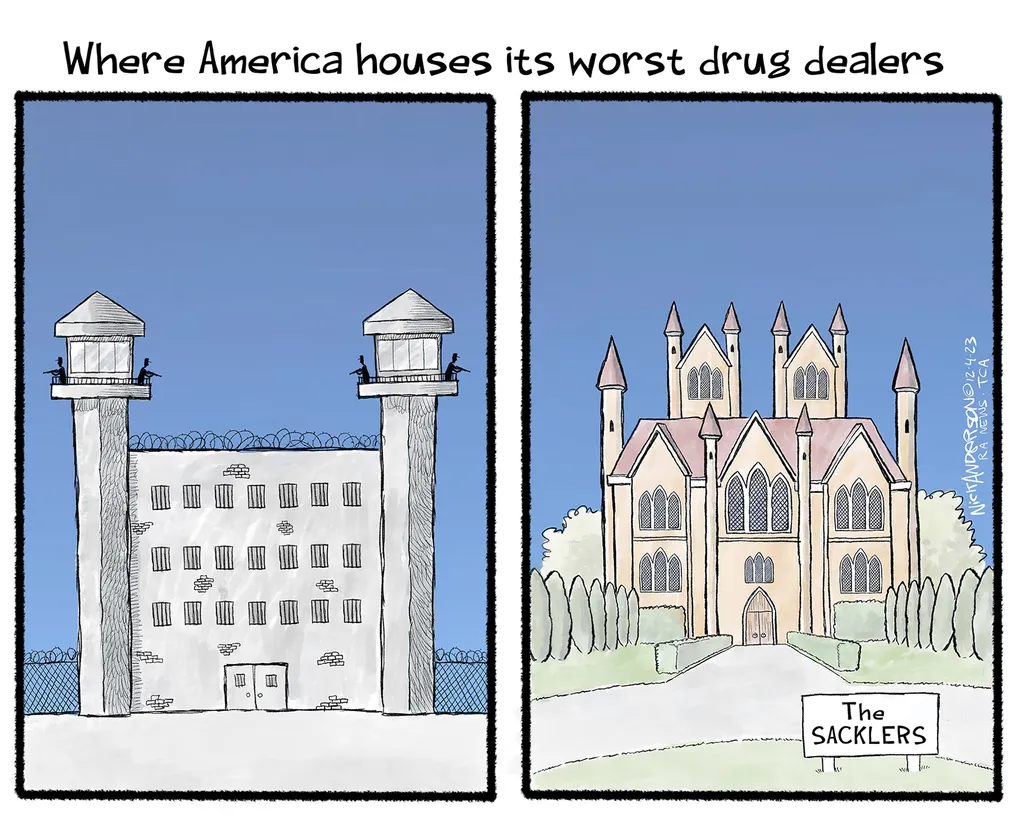
Under the terms of the deal approved by a lower court, Purdue Pharma—the maker, aggressive peddler, and deceptive marketer of Oxycontin— agreed to pay billions of dollars to those harmed in the opioid epidemic. In exchange, the deal shields members of the Sackler family from personal liability, though they owned and ran the company.
Just what happened at Purdue Pharma, and what the Sacklers did, was not known for a long time. Now, however, their role and the company's have been well documented, in court and movies, books, and documentaries, like Crime of the Century.
"Within the last 20 years, more than 500,000 Americans have been killed by overdoses," the documentary recounts. "This was a new drug cartel. They were drug dealers wearing suits and lab coats."
The deal at the center of the case
By 2020, Purdue Pharma pleaded guilty to three criminal charges. The company agreed that it owed $8 billion in criminal and civil fines, most of it to be paid to state and local governments handling the fallout of the opioid crisis. Most of the money was conditioned on the company reaching a deal in bankruptcy court that would reimburse victims of the opioid epidemic, including those state and local governments, as well as individuals who were harmed.
That deal that is at the center of Monday's case because it releases the Sacklers from personal liability, despite the fact that all three of the original Sackler brothers who bought Purdue and ultimately developed OxyContin were doctors. And, six Sacklers sat on the board of the company, including the chairman Richard Sackler, who closely directed the firm's aggressive and deceptive marketing strategy of OxyContin as not causing addiction.
Under the original bankruptcy deal with the company, the Sacklers kicked in $4 billion to be divided among the state and local governments, and others. But, at the same time the Sackler family members were to be released from any further liability.
When eight states and the District of Columbia balked at the amount, the Sacklers upped the ante to $6 billion, with the remaining $2 billion coming from the assets and future earnings of a new non-profit company formed after Purdue's dissolution.
After the Sacklers increased their contribution to $6 billion, the objecting states withdrew their opposition, and 95% of the state, local and tribal governments, as well as groups of individuals voted to approve the settlement.
What critics of the agreement say
But, United States Trustee William Harrington, who oversees bankruptcy cases in New York, Connecticut and Vermont, objected to the deal. Representing him in the Supreme Court Monday, the Biden administration will argue that the bankruptcy law does not authorize bankruptcy courts to approve a release from liability for third parties like the Sacklers.
Georgetown University law professor Adam Levitin says that the Sacklers' $6 billion to be paid over eight years is buying them not only a release from liability, it is ensuring that they will not have to testify about their misdeeds in future litigation, and they will be able to keep about half of their money and other assets.
"The Sacklers do not want to have to be in the bankruptcy fishbowl," Levitin says. "They're wanting to get bankruptcy at half price."
Levitin add that the release from liability covers more than just the Sacklers. It also includes lots of other Sackler acolytes, from their lawyers to consultants, doctors, even former Sen. Luther Strange, who was a Purdue lobbyist after leaving the Senate. "None of them have to pay a dime," he observers, but all of them would be released from liability in the deal.
"Bankruptcy is supposed to provide relief for honest but unfortunate debtors. And those are people who file for bankruptcy and pay the price. They come clean about their assets and give up all of their assets to their creditors," says Levitin. "The Sacklers are not doing either of those things."
'The perfect can't be the enemy of the good'
Not everyone who studies bankruptcy agrees.
"I think its backseat driving to say that it's not good enough," Columbia Law professor Edward Morrison says. "The perfect can't be the enemy of the good."
Indeed, as Morrison notes, the Sacklers have had 20 years to hide their money overseas in places that are perhaps possible but costly and time consuming to reach.
"Do we want to burn up value reaching those assets and those people, or do we want to just pay the money that's available to the victims?" Morrison asks. "Maybe its a tradeoff we wouldn't have to make in an ideal world. But we don't live in a perfect world."
Bankruptcy court has a special role to play particularly in large cases like this, he notes, because this is the one place where a settlement can be reached with so many victims from so many places, with so many diverse interests.
That said, though, the Supreme Court has, of late, signaled its skepticism about bankruptcy judges, viewing them as a lesser form of judge because they serve for limited terms and are appointed by courts of appeal, not the president.
And yet, as Morrison points out, bankruptcy courts serve as something of "a safety valve" for dealing with wrongful conduct that results in mass injuries.
So, if the justices do reverse the Purdue Pharma deal, Morrison says, "it'll be a huge mess."


 Market Data
  Markets


 AI
AI