B402, Firstly this of yours - "The supply chain issue would be a great opportunity for Biden to point out how vulnerable/stupid we really are.....We do need to get back to manufacturing more of what we need here at home,,,Its win, win " That puzzles me as in virtually every clip i've seen of Biden talking about his domestic priorities he has been talking about bringing manufacturing back home. So i don't understand at all why you said that. It feels like a conservative hit on Biden.
then on your claim Biden lied in claiming BBB paid for itself i see that as possibly harsh. It could be argued, i think, Biden was as into being optimistic as into lying about it. This 2 Pinocchios effort goes to that:
To a third bit of yours - Why the Dems have real conflicts with the "tax cut for the rich" seems fairly straight forward, but since you weren't specific at all with your "I believe he would have gotten rid of the 'Tax cut for the rich' in it which would have gotten it closer to fully funded....(or at least tried, it was a weird Justification the dems gave for not removing it when Bernie brought it up) " i decided to fly blind. Never hurts me anyway to start over, so to speak, on things which have become fuzzy with time.
Looking backwards at it from Nov. 2018 felt is a good way to start. I'm thinking there wouldn't be much new here for you:
shemann7, The GOP Tax Bill Was a Deliberate Attack on Blue States—and California Plans to Fight Back
[...]
There are three ways the bill hits residents of California, New York, New Jersey, and a handful of other states—all of which are already “donor states,” meaning that their taxpayers send more money to Washington than they get back in federal spending—peculiarly hard: First, in capping the amount of state, local, and property taxes that taxpayers can deduct from their federal income calculations, the bill ensures that middle-income earners in these states will be double-taxed when they pay federal taxes. Approximately 3 million Californians, experts calculate, already pay more than $10,000 a year in state taxes.
Second, in limiting the homeowner mortgage-interest deduction, the bill deliberately targets the middle classes of states like California, where property costs far more than any other state except Hawaii. While progressives have long urged reform of this part of the tax code, their hope was that in eliminating a boon to homeowners, money would be liberated for social spending on affordable housing, health-care expansion, debt-free higher education, and other social goods that would benefit the whole community, including the taxpayers being asked to foot higher bills. Instead, homeowners in Los Angeles, San Francisco, New York, Boston, and other high-cost cities will now be subsidizing billionaires’ tax breaks and a rollback of the estate tax for America’s wealthiest families.
Third, the bill entirely eliminates the personal exemption—a little more than $4,000 per family member—that a family can take off of their taxable income. This deduction was intended to acknowledge that larger families have higher out-of-pocket expenses than do smaller families. Nationally, most households in which couples file jointly won’t see the full effect of losing this exemption, as its cost will be largely offset by the doubling of the standard deduction, from roughly $12,000 to $24,000, as well as a slight lowering of tax rates for most income brackets. But this particular change in the tax code, at the hands of the so-called Family Values party, will hit two groups particularly hard: The first is large families who in the past could protect a significant proportion of their income from the IRS. The second is families who itemize deductions and live mainly in affluent and disproportionately Democratic parts of the country with high costs of living. This sector will be hurt because their annual deductible expenses were already well over $12,000; they won’t benefit from the increased standard deduction, or at least won’t benefit very much, but they will suddenly lose their $4,000 per-person per-year deduction. For a family of four, absent other changes canceling this out, that means an additional $16,000 of their income will be subject to federal taxes.
Left unchallenged, the legislation has the potential to catapult New York, California, and the other high cost-of-living, high-real-estate-value, relatively high-income states into political and economic crisis. After all, in recent years the blue states have made significant efforts to use their state and local tax dollars to boost social-safety-net spending. California has done this by expanding health-care access to millions of residents, by making important environmental investments, and by expanding higher-education grants to large numbers of poorer residents and to the undocumented population.
There’s a political poison pill at the heart of the GOP tax legislation: In restructuring vital deductions, Trump and his Congressional enablers are gambling that electorates in blue states will demand that their state and local governments scale back taxation and local expenditures so as to minimize the cost of the federal changes. If the GOP gamble succeeds, it will strangle blue state efforts to protect, and in some cases expand, vital New Deal and Great Society programs. The goal is to impose a Kansas-like low-tax, low-services model countrywide.
To today -A Wonky Tax Break for the Well-Off Is a Bigger Problem for Democrats Than You'd Think
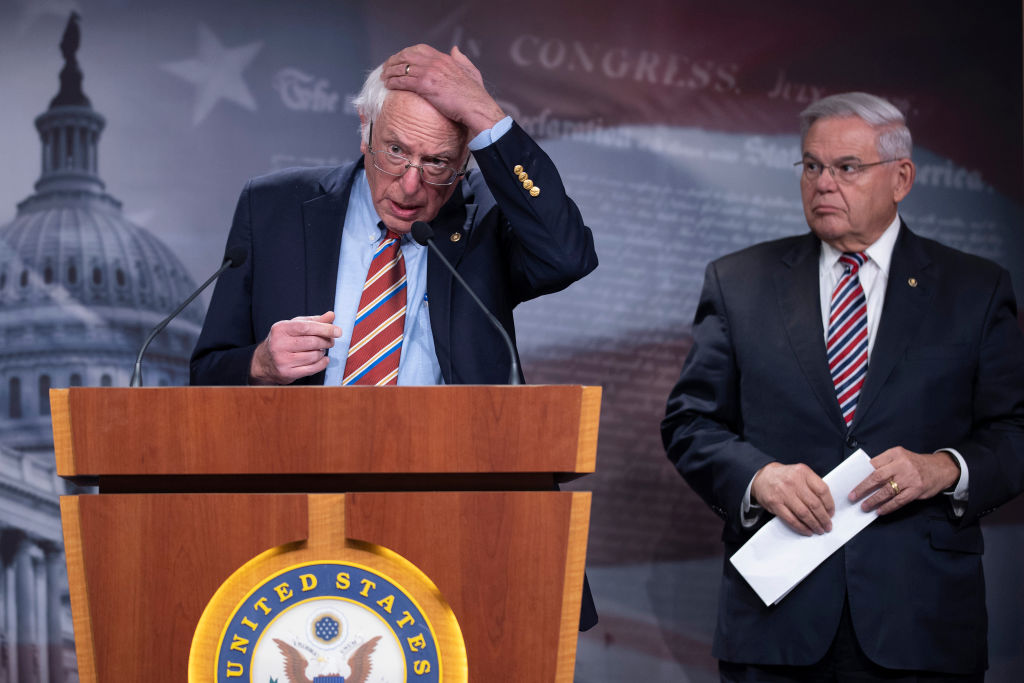
Senate Budget Committee Chairman Bernie Sanders (I-VT) and Sen. Robert Menendez (D-NJ) hold a news conference about state and local tax (SALT) deductions as part of the Build Back Better reconciliation legislation at the U.S. Capitol on November 03, 2021 in Washington, DC. Photo by Chip Somodevilla/Getty Images
By Abby Vesoulis December 16, 2021 12:50 PM EST
In its edible form, salt is used to dry out meat; in its mineral form, it’s used to dry out snowy highways; and in its tax form, SALT—the acronym for state and local tax deductions that disproportionately benefit well-heeled taxpayers—might sound like a topic bound to dry out conversations.
Even Sen. Bernie Sanders, a key player on negotiations concerning the SALT cap in the Democrats’ flagship $1.7 trillion social spending and climate Build Back Better (BBB) package .. https://time.com/6121415/build-back-better-spending-bill-summary/ , quipped that SALT does not excite most people on the Hill. “I thought she was the only person in the world who was concerned about SALT,” he told me, gesturing to another reporter, when I asked him for an update on SALT’s status.
But don’t be fooled. As Senate Democrats struggle to pass BBB, the debate over SALT may be one of the more interesting things happening at the Capitol. Whatever form the provision ends up taking could have major financial implications for taxpayers in high-tax states; huge electoral consequences for the Democrats who represent those states; and significant political fall-out for the party’s make-the-rich-pay-their-fair-share political messaging.
That’s because raising the cap on SALT deductions from $10,000 to $80,000, as prescribed in the House-passed version of BBB, would disproportionately help taxpayers rich enough to benefit from itemizing their federal tax deductions—which is to say, the richest fifth of Americans. According to a November analysis .. https://itep.org/analysis-of-the-house-of-representatives-build-back-better-legislation/ .. from the nonpartisan Institute on Taxation and Economic Policy, the higher SALT cap would primarily benefit the richest 20% of taxpayers, and three-fourths of the benefits would go to the richest 5%.
Democrats are split over what to do about it. Some Democrats, like Sen. Bob Menendez and Rep. Tom Suozzi, who recently announced a run for New York Governor, support raising the cap on SALT deductions as a means to reverse the effect of Trump’s 2017 tax bill, which led to tax hikes in blue states. Others, like Rep. Jared Golden, argue against including raising the cap on the grounds that it paints the Democratic party as hypocrites. If they raise the SALT cap, the second-most expensive item in a bill designed to bolster American working families would be a tax break for coastal elites.
The standoff leaves Democrats in a damned-if-they-do, damned-if-they-don’t bind: deliver a windfall to wealthy Americans or screw over Democratic states on the eve of a midterm election where Democrats’ narrow majorities in both chambers are at risk.
The tricky politics of raising the SALT cap—or not
Republicans created the $10,000 cap on SALT deductions as a means to offset the cost of their other tax cuts in the 2017 Tax Cuts and Jobs Act (TCJA). The TCJA reduced the corporate tax rate from 35% to 21% and decreased individual tax rates across the board. Because the TCJA nearly doubled the standard deductible, the main losers of the new $10,000 SALT deduction cap were well-to-do people in states with the highest property taxes—Democratic states, like California, New York and New Jersey.
Republicans argued that the federal government should not subsidize the progressive benefits that coastal blue states offer by allowing the states’ residents to deduct their higher SALT liabilities from their federal taxes. “My 29 million constituents in Texas are not interested in subsidizing bad governing decisions made in places like New York or San Francisco, and they shouldn’t have to,” Sen. John Cornyn, a Texas Republican, said at a December press conference.
Democrats in favor of raising the SALT cap argue that allowing taxpayers to deduct more state taxes isn’t a gift just for the rich. It’s a gift for middle-class wage-earners, like teachers or firefighters, who might have relatively high combined household incomes—say $200,000—but see much of their earnings wiped out by high costs of living in big metropolitan centers. The median home price in Hoboken, New Jersey is $749,000, for example, while the median price in Cheyenne, Wyoming is $340,000. “Our cost of living is higher here, so our folks need to make more. They shouldn’t be punished and double taxed for it,” Rep. Josh Gottheimer, a New Jersey Democrat who refused to vote on the House’s version of BBB without a higher SALT cap, said earlier this month. More from TIME
Some Democrats also say that failing to raise the SALT cap may hamstring the progressive movement.Their argument? The TCJA’s low cap could have the effect of driving high taxpayers out of high-tax states, which would reduce blue states’ revenue and, in turn, gut their ability to provide robust social policies, like tax credits for electric vehicles, and city and state-run universal pre-k and paid family leave programs. A higher SALT cap enables coastal blue states to be “laboratories for democracy” where progressive policies can be tested before they become federal law, one Democratic aides, granted anonymity to discuss sensitive negotiations, told TIME.
But raising the SALT cap comes with a hefty price tag: $275 billion over five years, according to the hawkish Committee for a Responsible Federal Budget . https://www.crfb.org/blogs/new-salt-proposals-would-improve-house-bill . That cost, some Democrats argue, is egregious considering that lawmakers already scrapped (free community college) or watered down (paid family leave) a slew of progressive policies in order to make the bill’s cost projection more appealing to centrist Senators Joe Manchin and Kyrsten Sinema.
“Our priorities should be making sure that families have affordable childcare, our priority should be making sure that we have paid family and medical leave and that it’s meaningful,” Sen. Michael Bennet, a Colorado Democrat also leading the negotiations, tells TIME. “To the extent that we’re spending money on a regressive tax policy, like SALT, I think that does diminish our ability to do those other things.”
No matter how you cut it, the politics of the SALT debate aren’t good for Democrats. Those in favor of raising the cap must, essentially, defend their decision to include a tax break for the relatively well-off in a bill that is being sold—by the President of the United States, no less—as a tool to bolster the middle class. The argument leaves them wide open to attacks from the GOP, and Republicans are taking their cue. With TCJA, “our Democrat colleagues railed against us,” Republican Sen. Pat Toomey, ranking member of the Senate Banking Committee, told TIME. “Now, with the first chance they get, they do this huge tax giveaway to their wealthiest supporters.”
But Democrats against raising the cap must grapple with the fact that it leaves many of their colleagues especially vulnerable in 2022. East Coast House Democrats like Reps. Tom Malinowski and Mikie Sherrill of New Jersey campaigned in their 2018 elections to repeal the low SALT cap. Failing to deliver on that by the 2022 midterms could put their swing district seats at risk.
A slow-motion debate
Weary of under- or over-SALTing their preeminent policy package, the caucus has yet to agree on the tax measure, and Senate Majority Leader Chuck Schumer’s goal of voting before Christmas becomes less and less likely by the day .. https://time.com/6128838/democrats-congress-year-end/ .. . The updated draft of the bill that Senate Finance Committee Chairman Ron Wyden released Saturday contained no language on the SALT provision, instead reading: “PLACEHOLDER FOR COMPROMISE ON DEDUCTION FOR STATE AND LOCAL TAXES” under the SALT subhead.
Sens. Menendez of New Jersey and Sanders of Vermont are among those trying to hash out an agreement that eases the tax burden on middle class families without providing a boon to the richest 1% of Americans. One idea is to eliminate the House-proposed $80,000 SALT cap entirely, and instead phase out the ability to take advantage of SALT deductions by limiting it to taxpayers under a yet-to-be-determined income threshold. Menendez and Sanders are currently considering maximum incomes of somewhere between $400,000 and $550,000 for single-filers per year, a Democratic aide says. Sanders prefers a figure closer to the former while Menendez has pushed for something closer to the latter, the aide adds, noting that cost of living is higher in much of New Jersey than in Vermont.
Whatever the final cap, the ongoing debate is feeding Republican fodder that Democrats are at odds with one another, and with their own priorities. “It sounds like they’re conflicted,” Cornyn joked to TIME on Tuesday.
It may be one the few occasions he and Bennet come close to agreement on something.
“The [expanded] child tax credit [costs] $190 [billion] versus $275 billion for SALT,” says Bennet. “I do think that it raises the question about what our priorities really are.”


 Market Data
  Markets