Are Finland and Sweden wanting to join NATO because of their security concerns only amplified by Russia invading Ukraine...
Or should the world trust Russia that it has no ambition outside of its current borders....
Your Highlighted words [But it is also true that the West erred in dismissing Russia’s legitimate security concerns about NATO setting up shop on the other side of its 1,000-mile-plus border with Ukraine.
"Putin’s War in Ukraine Is a Watershed. Time for America to Get Real. "Chomsky: Let’s Focus on Preventing Nuclear War, Rather Than Debating “Just War"
Rudd is a former Australian PM. Speaks Chinese and is a considered China expert .. he gets some plaudits near bottom here .. AUSTRALIAN election soon.At this gravest of times the Coalition has served up an election budget designed simply to keep itself in power https://investorshub.advfn.com/boards/read_msg.aspx?message_id=168377534
By Kevin Rudd March 26, 2022 — 8.30am
Xi Jinping’s political modus operandi when confronted with a challenge — either foreign or domestic— is to double down; to crash through or crash.
He is a calculated risk-taker. His critical skill is to identify a political or policy vacuum and to fill it before others do. Xi is a master tactician in building political momentum across the cumbersome internal machinery of the Chinese Communist Party by deploying key personnel to critical positions; mobilising the party’s propaganda apparatus; and anchoring his worldview in a single, all-encompassing ideological framework to convince the party and the country that they are critical parts of a historical, righteous and “correct” cause.
[Insert: As Trump's GOP is doing in key state electoral offices restripe, If you are sincerely concerned about attempts to fix elections you can not ignore Republican efforts: Trump’s Next Coup Has Already Begun [...] For more than a year now, with tacit and explicit support from their party’s national leaders, state Republican operatives have been building an apparatus of election theft. Elected officials in Arizona, Texas, Georgia, Pennsylvania, Wisconsin, Michigan, and other states have studied Donald Trump’s crusade to overturn the 2020 election. They have noted the points of failure and have taken concrete steps to avoid failure next time. Some of them have rewritten statutes to seize partisan control of decisions about which ballots to count and which to discard, which results to certify and which to reject. They are driving out or stripping power from election officials who refused to go along with the plot last November, aiming to replace them with exponents of the Big Lie. They are fine-tuning a legal argument that purports to allow state legislators to override the choice of the voters.https://investorshub.advfn.com/boards/read_msg.aspx?message_id=167072165 If you are genuinely concerned, that is factual information. https://investorshub.advfn.com/boards/read_msg.aspx?message_id=168404775]
VIDEO - China's Xi says Asia must not return to Cold War 1:07 The Asia-Pacific region must not return to the tensions of the Cold War era, China's leader Xi Jinping said ahead of a virtual meeting with US President Joe Biden expected as soon as next week.
Xi is also his own master class in internal party politics, possessing a ruthlessness not seen since Mao in dealing with political opponents. For these reasons, there is no credible competitor of comparable political stature left standing in the inner sanctums of Chinese party politics — or, at least, none that we know of. Xi has broken the norms of post-Cultural Revolution politics.
For any political opposition to effectively mobilise against Xi’s reappointment in late 2022, there would need to be a series of catalytic and catastrophic events. These events could take a number of different forms. The most credible would be any self-inflicted economic crisis, decline or even financial collapse. The party has only relatively recently rebuilt its domestic credibility and political legitimacy in China following the country’s near economic collapse of the Great Leap Forward and, later, the Cultural Revolution. That’s because in the decades after 1978, the party finally lifted people’s living standards. To undo the unspoken social contract between party and people (ie. political control in exchange for economic prosperity) in any way would rebound badly on Xi.
Second, natural calamities (including pandemics) also have the potential to destabilise (as they have throughout Chinese history, in which disasters were commonly taken to mean leaders had lost the “mandate of heaven”).
This is why the internal politics of China became particularly intense in the first half of 2020, following the eruption of COVID-19 in Wuhan and the leadership’s initially tepid response. It also underscores the party’s acute response to any foreign attacks regarding the Chinese origins of the virus for fear this would become part of the country’s internal discourse, in addition to an international loss of face.
In Xi’s case in particular, the critique was that because of his feared status as an unforgiving and dictatorial leader, senior provincial officials hid the news of the pandemic from Beijing in its early and most critical weeks, hoping to contain it locally rather than following long-agreed protocols mandating immediate national and global notification.
A third cataclysmic event would be a military defeat, large or small, at the hands of either the US or Japan. Xi’s national political narrative about “the rise of the East and the decline of the West” carries with it the assumption that China would prevail in any direct contest. This has been furthered by Xi’s decision to militarise his presidency (wearing battle fatigues, frequent troop reviews, and constant public references to China’s ever-growing national power) to the extent that an inability to win an outright victory in any armed confrontation with the US or its allies would be politically lethal. It would be doubly so if this occurred in any scenario over Taiwan, which Xi has vowed to return to Beijing’s control .. https://www.smh.com.au/world/north-america/my-old-friend-biden-xi-begin-superpower-summit-on-friendly-note-20211116-p599cj.html .. as part of the China Dream.
Xi has therefore adopted a generally cautious approach to these significant strategic risks, in contrast to his approach to tactical politics, where he has been much more agile and audacious. In the case of the pandemic, he quashed all domestic dissent and adopted a zero-tolerance strategy toward the virus itself — all the while deploying the party’s propaganda apparatus to ensure that any international criticism is aggressively rebutted through his global team of wolf warrior diplomats, even seeking to sow doubt as to whether the virus actually originated in China.
On potential military crises, Xi may be forward-leaning in dealing with US and Japanese naval and air incursions into what he describes as Chinese territory. But he is unlikely to allow any incidents to escalate to a point of no return —unless convinced that there is no risk that Chinese forces would not prevail or that the domestic political cost of blinking and backing down is simply too great.
The economy is not his policy strong suit. Therefore, his recent major adjustments to China’s domestic economic growth model, including the re-emphasis of the state over the market, and his new restrictions on the Chinese private sector pose a real political danger to his leadership if growth, employment or living standards were to stall. This is Xi’s greatest liability, particularly given that his critics in the party leadership elite have previously championed a different economic policy strategy for China’s future.
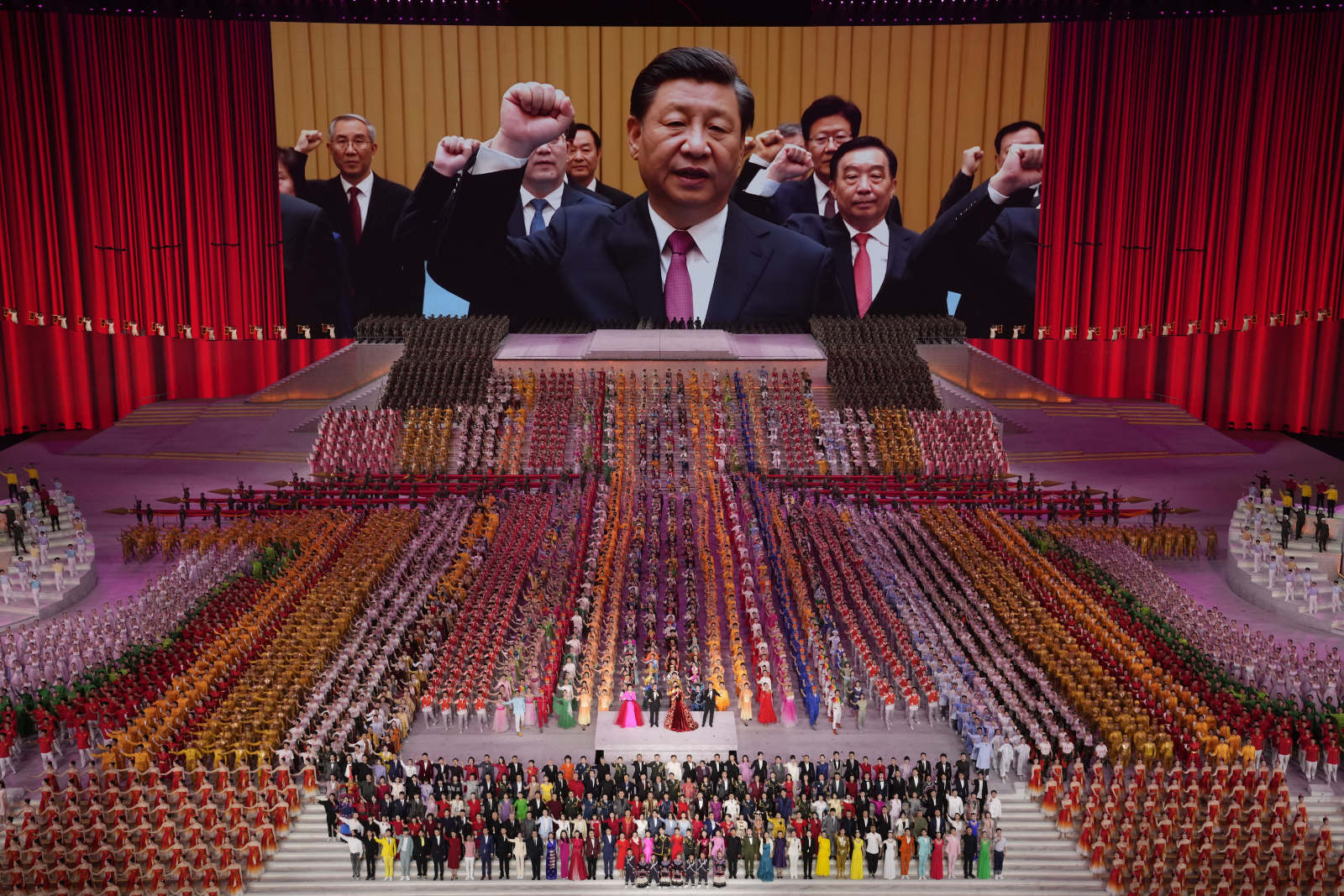
Chinese President Xi Jinping leads a pledge to the Chinese Communist Party ahead of the 100th anniversary of its founding in June last year. AP
Xi Jinping’s efforts to secure long-term control over the party have not been limited to coercive means. His efforts have also been directed at developing a personality cult elevating himself as the “indispensable core leader” in the eyes of the party’s mass membership and the wider Chinese public. He has been accorded symbolically significant new titles, including leader (lingxiu) and the helmsman piloting the country’s future - both designations previously reserved for Mao alone.
But, most spectacularly, Xi has also become the author of the entire body of an eponymous Xi Jinping Thought that has been incorporated into both the party and state constitutions.
It is designed to navigate the party and the country along a new course that will deal with the “imbalances,” “inadequacies,” and “inequalities” of its previous era of unrestrained capitalist growth. Indeed, it is specifically designed to provide a theoretical justification for Xi’s reorientation of political, economic and social policy in a new pro-party state-interventionist direction across the board.
Xi Jinping Thought is substantive in some core propositions, but it is also politically elastic: to expand and contract to absorb new political and policy developments as they arise and, as a result, ideologically legitimise them by attaching the Xi Jinping Thought mantra to them.
For all these reasons, Xi’s domestic political position as he approaches the 20th Party Congress in late 2022 is relatively robust. There is no apparent challenger. He would also fear that if he did step down, he would become powerless in the face of the many he had purged or marginalised, who would then seek revenge. The likelihood of a large-scale destabilising internal or external event is therefore limited, although we should always keep a close weather eye on what could flow politically from the economy’s performance in the future during 2022.
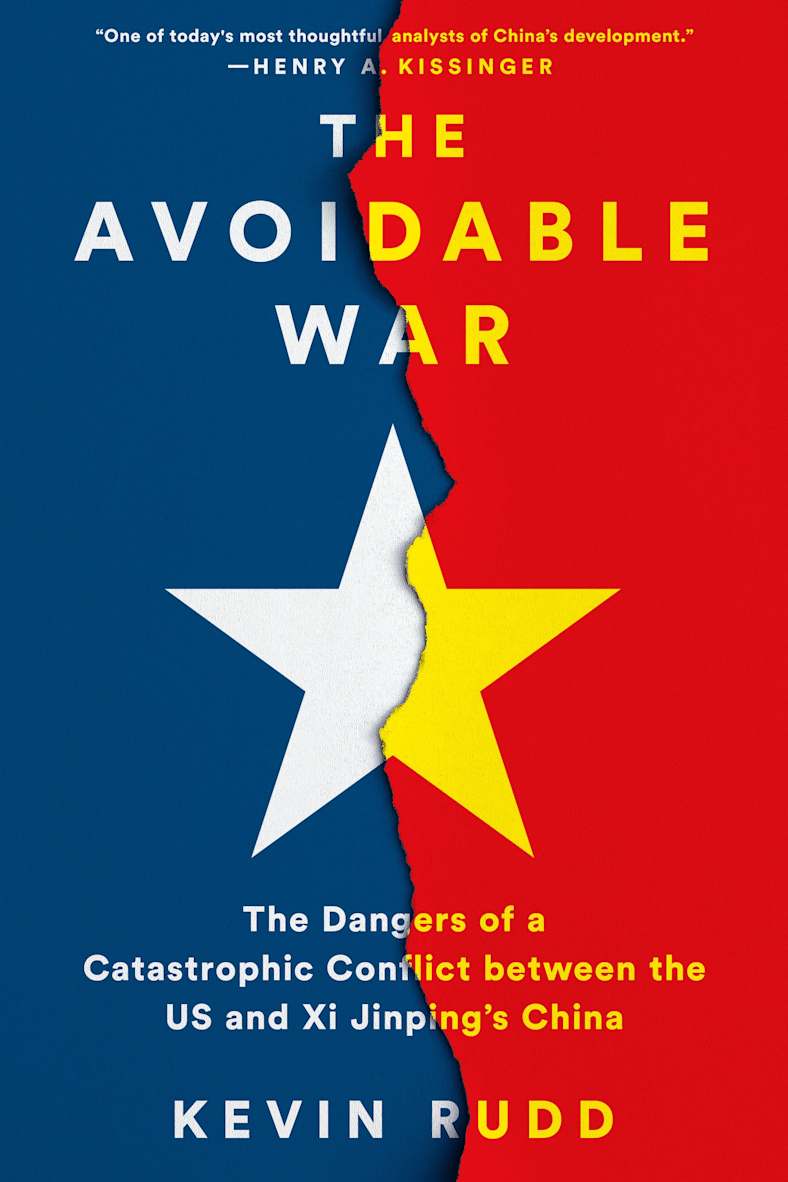
Kevin Rudd’s new book The Avoidable War published by Hachette Australia, March 30.
Xi has become (like Mao) the party’s “ideologist in chief ” — so much so that there is a Xi Jinping Thought textbook available for compulsory study for every school student, printed under the snappy subtitle Happiness Only Comes Through Struggle. But should Marxism-Leninism falter in its capacity to offer a convincing narrative for explaining the significant changes he has already introduced and, more importantly, should the economy fail, Xi could still harness the ancient alchemy of Chinese nationalism as the ultimate legitimising force behind his leadership.
Based on what we know, Xi’s material power is likely to continue to hold up into the future. It would, therefore, be prudent for American presidents to assume that Xi will be their opponent for much, and likely all, of the decade ahead - barring, of course, an early natural demise.
This is an edited extract from The Avoidable War: the dangers of a catastrophic conflict between the US and Xi Jinping’s China by Kevin Rudd. Published by Hachette Australia on March 30.
Kevin Rudd is president of the Asia Society Policy Institute and was the 26th prime minister of Australia. Connect via Twitter or Facebook.
"Putin’s War in Ukraine Is a Watershed. Time for America to Get Real. [...]Not long after NATO in 2008 pledged .. https://www.nato.int/cps/en/natolive/official_texts_8443.htm .. that Georgia and Ukraine “will become members of NATO,” Georgia’s president, Mikheil Saakashvili, launched an offensive against pro-Russian separatists in South Ossetia with whom the country had been sporadically fighting for years. Russia promptly carved up Georgia, grabbing control of South Ossetia and Abkhazia. Mr. Saakashvili thought the West had his back, but he miscalculated and overreached."
Related: Opinion Believe it or not, Trump’s following a familiar script on Russia [...]The Russo-Georgian war established a modus operandi that Putin would employ against Ukraine .. https://www.vox.com/cards/ukraine-everything-you-need-to-know/is-russia-going-to-invade-eastern-ukraine .. almost exactly six years later. In both cases, the Russian attack was preceded and accompanied by extensive cyberwarfare and “fake news.” In both cases, Russian forces moved in surreptitiously before the main attack. Both invasions were cloaked in ambiguity and confusion, leading many in the West to blame the victims. In both cases, Moscow claimed to be defending pro-Russian populations from alleged mistreatment. But the real purpose was to restore Russian hegemony over former Soviet republics seeking to integrate into the liberal world order — in Ukraine’s case by negotiating a trade deal .. https://www.nytimes.com/2014/06/28/world/europe/ukraine-signs-trade-agreement-with-european-union.html .. with the European Union. P - The Russian attack on Georgia also displayed the effectiveness of Putin’s narrative of grievance. Although Russia committed the aggression, many in the West blamed others — Saakashvili, Bush, NATO — for “forcing” Putin’s hand. Today, “realists” and the left blame the United States and the West for provoking Putin in Ukraine. Russia should have its sphere of interest, they argue. The enlargement of NATO made Putin and the Russians feel insecure. The West pushed too far. P - [i[]Insert: must admit i fell into that trap myself for a time.] P - It is one of Putin’s greatest triumphs that this narrative is widely accepted today in the American academy and by large segments of both political parties. As McFaul explains .. https://www.amazon.com/gp/product/0544716248/ref=as_li_qf_asin_il_tl?ie=UTF8&tag=washpost-20&creative=9325&linkCode=as2&creativeASIN=0544716248&linkId=4b298cdeb6a2c0a8f24345d2ba84bbbf, however, it is mostly a myth, designed by Putin to justify his increasingly autocratic and personalistic rule to his own people. American and European actions after the Cold War did not prevent cooperation with Russia during the 1990s, after 9/11 or during the first two years of the Obama administration. The United States and Europe provided billions of dollars in aid to Russia and sought to help integrate Russia into the world economy. The United States created post-Cold War security and economic arrangements such as the NATO-Russia Council .. https://www.nato.int/cps/ic/natohq/topics_50091.htm , the Group of Eight and the expanded Organization for Security and Co-operation in Europe .. https://www.osce.org/ .. to strengthen ties with Moscow and give it a greater say in global councils. The two powers negotiated and ratified arms control agreements and cooperated on Afghanistan and Iran. P - All this began to change as Putin came to worry about his own hold on power in Moscow. He was alarmed by the democratic revolutions in Georgia... https://investorshub.advfn.com/boards/read_msg.aspx?message_id=169415442
The Atlantic Column / By Anne Applebaum / February 3, 2023
Sixteen months after his arrest, Mikheil Saakashvili has lost more than 90 pounds and needs a walker to move around his prison hospital. The former Georgian president was for a time, on a hunger strike, which helps explain his weight loss and his exhaustion. But it does not explain the traces of arsenic, mercury, and other toxins that a doctor found in his hair and nail clippings. It does not explain the beatings he has described to his lawyer. It does not explain the constant pain in his left shoulder, neck, and spine.
Nor can anything other than malice—organized, official, state-sponsored malice—explain why Saakashvili is on a strange medical regimen that includes 14 different drugs, some addictive, some not approved for sale in the United States. Or why he has mild brain damage. Or why he has seizures. Giorgi Badridze, a former Georgian ambassador who keeps in constant touch with Saakashvili’s family, told me that “nothing has been exaggerated. He is doing really badly.” At age 55, Saakashvili is declining rapidly. And as he declines, so do the prospects of a sovereign, democratic Georgia.
Georgia is a former Soviet republic, and to those who live in the former Soviet empire—the same empire that Vladimir Putin, the Russian president, now seeks to re-create—Saakashvili’s accumulated prison illnesses form a familiar pattern. The slow prison death was a Soviet speciality: not a murder, not an assassination, just a well-monitored, carefully controlled, long, drawn-out decline. Most of the people who died in Soviet prison camps were not executed; they were merely starved until their heart stopped beating. In Putin’s Russia, torture and the deprivation of medical aid famously killed Sergei Magnitsky, a lawyer who uncovered an infamous corruption scandal at the highest levels of the Russian regime. Isolation, withholding of food, and other punishments are right now being inflicted on Alexei Navalny and other political prisoners too.
The readoption of this old Soviet practice in Georgia, a country that has, or had, aspirations to be part of NATO and the European Union, represents a symbolic return to the old Soviet empire. The decision to inflict this form of torture on Saakashvili carries even more symbolic weight. As president from 2004 to 2013, he was notable mostly for pushing his country, which borders Russia, Turkey, Armenia, and Azerbaijan, in the direction of Western liberal democracy. In his years in office, he broke the power of the post-Soviet mafia, battled corruption, fought back against a Russian invasion, and opened the economy. Putin loathed him and his political program so much that he reportedly once said Saakashvili should be “hung by his balls.” He hated Saakashvili for the same reason he now hates the Ukrainian president, Volodymyr Zelensky: because he used the language of liberal democracy; because he talked about a European, Western future for his country; and because he rejected Putin’s kleptocratic, illiberal ideology.
Saakashvili angered plenty of Georgians too. He made enemies not just among the mafiosi whose careers he destroyed, but also among Georgian liberals and democrats. He cut corners and crossed the edges of legality several times himself. Extravagant stories about him (and there are many) involve Munich nightclubs, Ferris-wheel rides, and late-night, high-speed drives through Tbilisi. His life story is not a black-and-white morality tale of any kind.
But when Saakashvili lost an election, he did step down, which is not typical behavior in the former Soviet world. He left Georgia in 2013, and spent several years in Ukraine—he speaks Ukrainian, having studied there—and enjoyed what can best be described as an exceptionally controversial term as governor of the Odesa region. He received Ukrainian citizenship, was stripped of it, and then got it back again. Finally he went back to Georgia in October 2021, clearly hoping to reenter politics.
This, his supporters believe, is the real reason he was arrested on what his lawyer describes as trumped-up charges, based on cases from years ago investigated in absentia. They also say this is the reason for the slow torment, and perhaps for the slow poisoning of Saakashvili, and indeed leaders of the ruling Georgian Dream party have said, in so many words, that he is in prison because he would cause trouble for them if he were free. Irakli Kobakhidze, the party’s chairman, recently put it like this: “If Saakashvili gets out, he will immediately engage in political processes and will try to take in his hands the function of leadership of the radical opposition.” The government can’t let him out, in other words, because he might try to win. Or he might at least make what Kobakhidze calls the “radical opposition” into a unified and coherent force.
At the moment, that opposition, although it probably represents the majority of the voters, is deeply divided, as so often happens in democracies that have been slowly dismantled by an illiberal political party. Georgian Dream is certainly that: Backed and controlled by Bidzina Ivanishvili, Georgia’s wealthiest man, the party has not only locked up Saakashvili but also imprisoned Nika Gvaramia, the director of an independent television station; put pressure on judges; and repeated wearily familiar nationalist, homophobic, and anti-Western themes borrowed from Russian propaganda. The party’s leaders, many of whom are former Ivanishvili employees, have verbally attacked the U.S. ambassador, even falsely accusing her of trying to force Georgia to go to war with Russia. All of that helps explain why, in June, the European Union formally recognized Ukraine and Moldova as candidates for membership but spurned Georgia.
Officially, the Georgian government regretted that decision. Unofficially, maybe not so much. Ivanishvili’s fortune was earned in Russia, and under his leadership, Georgia’s relationship with Russia has evolved into something very hard to explain and understand. On the one hand, Georgians continue to fear a further Russian invasion, which is unsurprising: Russian troops, some stationed less than 40 miles from Tbilisi, occupy about 20 percent of the country. Georgians are vocally supportive of Ukraine, and large majorities say they want to join NATO.
On the other hand, the quantity of what appears to be sanctions-busting cargo flowing through Georgia to Russia surged in the first half of 2022. The Georgian government doesn’t support Russia, but it doesn’t like to say it doesn’t support Russia, or at least not too loudly. And by deliberately antagonizing Georgia’s Western friends, it is slowly making Georgian membership in Western clubs an impossibility. “The reality is that it looks like Putin is winning in Georgia,” Badridze told me.
The slow torment of Saakashvili is a part of that project. His lawyer and his family are asking the government to release him on humanitarian grounds and let him transfer to a hospital in Europe or the U.S. If not, he may well die in prison. But that may be what Putin and his proxies in Georgia are hoping for. If the man who still symbolizes Georgia’s old aspirations to join the liberal democratic world succumbs to a Soviet-style prison death, then those aspirations will die along with him.


 Market Data
  Markets


 AI
AI