



 AI
AI








Monday, April 18, 2022 2:02:35 AM
Xi Jinping the gambler’s greatest fear isn’t war
"Putin’s War in Ukraine Is a Watershed. Time for America to Get Real.
"Chomsky: Let’s Focus on Preventing Nuclear War, Rather Than Debating “Just War"
Rudd is a former Australian PM. Speaks Chinese and is a considered China expert .. he gets some plaudits near bottom here ..
AUSTRALIAN election soon. At this gravest of times the Coalition has served up an election budget designed simply to keep itself in power
https://investorshub.advfn.com/boards/read_msg.aspx?message_id=168377534
By Kevin Rudd
March 26, 2022 — 8.30am
Xi Jinping’s political modus operandi when confronted with a challenge — either foreign or domestic— is to double down; to crash through or crash.
He is a calculated risk-taker. His critical skill is to identify a political or policy vacuum and to fill it before others do. Xi is a master tactician in building political momentum across the cumbersome internal machinery of the Chinese Communist Party by deploying key personnel to critical positions; mobilising the party’s propaganda apparatus; and anchoring his worldview in a single, all-encompassing ideological framework to convince the party and the country that they are critical parts of a historical, righteous and “correct” cause.
[Insert: As Trump's GOP is doing in key state electoral offices
restripe, If you are sincerely concerned about attempts to fix elections
you can not ignore Republican efforts:
Trump’s Next Coup Has Already Begun
[...]
For more than a year now, with tacit and explicit support from their party’s national leaders, state Republican operatives have been building an apparatus of election theft. Elected officials in Arizona, Texas, Georgia, Pennsylvania, Wisconsin, Michigan, and other states have studied Donald Trump’s crusade to overturn the 2020 election. They have noted the points of failure and have taken concrete steps to avoid failure next time. Some of them have rewritten statutes to seize partisan control of decisions about which ballots to count and which to discard, which results to certify and which to reject. They are driving out or stripping power from election officials who refused to go along with the plot last November, aiming to replace them with exponents of the Big Lie. They are fine-tuning a legal argument that purports to allow state legislators to override the choice of the voters. https://investorshub.advfn.com/boards/read_msg.aspx?message_id=167072165
If you are genuinely concerned, that is factual information.
https://investorshub.advfn.com/boards/read_msg.aspx?message_id=168404775]
VIDEO - China's Xi says Asia must not return to Cold War 1:07
The Asia-Pacific region must not return to the tensions of the
Cold War era, China's leader Xi Jinping said ahead of a virtual meeting with US President Joe Biden expected as soon as next week.
Xi is also his own master class in internal party politics, possessing a ruthlessness not seen since Mao in dealing with political opponents. For these reasons, there is no credible competitor of comparable political stature left standing in the inner sanctums of Chinese party politics — or, at least, none that we know of. Xi has broken the norms of post-Cultural Revolution politics.
For any political opposition to effectively mobilise against Xi’s reappointment in late 2022, there would need to be a series of catalytic and catastrophic events. These events could take a number of different forms. The most credible would be any self-inflicted economic crisis, decline or even financial collapse. The party has only relatively recently rebuilt its domestic credibility and political legitimacy in China following the country’s near economic collapse of the Great Leap Forward and, later, the Cultural Revolution. That’s because in the decades after 1978, the party finally lifted people’s living standards. To undo the unspoken social contract between party and people (ie. political control in exchange for economic prosperity) in any way would rebound badly on Xi.
Related Article
Inside China
China just set its lowest target for economic growth in 30 years. It still looks ambitious
Stephen Bartholomeusz Senior business columnist
https://www.smh.com.au/business/markets/china-just-set-its-lowest-target-for-economic-growth-in-30-years-it-still-looks-ambitious-20220307-p5a2bc.html
Second, natural calamities (including pandemics) also have the potential to destabilise (as they have throughout Chinese history, in which disasters were commonly taken to mean leaders had lost the “mandate of heaven”).
This is why the internal politics of China became particularly intense in the first half of 2020, following the eruption of COVID-19 in Wuhan and the leadership’s initially tepid response. It also underscores the party’s acute response to any foreign attacks regarding the Chinese origins of the virus for fear this would become part of the country’s internal discourse, in addition to an international loss of face.
In Xi’s case in particular, the critique was that because of his feared status as an unforgiving and dictatorial leader, senior provincial officials hid the news of the pandemic from Beijing in its early and most critical weeks, hoping to contain it locally rather than following long-agreed protocols mandating immediate national and global notification.
A third cataclysmic event would be a military defeat, large or small, at the hands of either the US or Japan. Xi’s national political narrative about “the rise of the East and the decline of the West” carries with it the assumption that China would prevail in any direct contest. This has been furthered by Xi’s decision to militarise his presidency (wearing battle fatigues, frequent troop reviews, and constant public references to China’s ever-growing national power) to the extent that an inability to win an outright victory in any armed confrontation with the US or its allies would be politically lethal. It would be doubly so if this occurred in any scenario over Taiwan, which Xi has vowed to return to Beijing’s control .. https://www.smh.com.au/world/north-america/my-old-friend-biden-xi-begin-superpower-summit-on-friendly-note-20211116-p599cj.html .. as part of the China Dream.
Related Article
China relations
Beijing blames Australia’s ‘wrong words and deeds’ for trade war after US rebuke
https://www.smh.com.au/world/asia/after-us-pledge-on-china-coercion-beijing-lays-blame-back-on-australian-government-20210317-p57be1.html
Xi has therefore adopted a generally cautious approach to these significant strategic risks, in contrast to his approach to tactical politics, where he has been much more agile and audacious. In the case of the pandemic, he quashed all domestic dissent and adopted a zero-tolerance strategy toward the virus itself — all the while deploying the party’s propaganda apparatus to ensure that any international criticism is aggressively rebutted through his global team of wolf warrior diplomats, even seeking to sow doubt as to whether the virus actually originated in China.
On potential military crises, Xi may be forward-leaning in dealing with US and Japanese naval and air incursions into what he describes as Chinese territory. But he is unlikely to allow any incidents to escalate to a point of no return —unless convinced that there is no risk that Chinese forces would not prevail or that the domestic political cost of blinking and backing down is simply too great.
The economy is not his policy strong suit. Therefore, his recent major adjustments to China’s domestic economic growth model, including the re-emphasis of the state over the market, and his new restrictions on the Chinese private sector pose a real political danger to his leadership if growth, employment or living standards were to stall. This is Xi’s greatest liability, particularly given that his critics in the party leadership elite have previously championed a different economic policy strategy for China’s future.
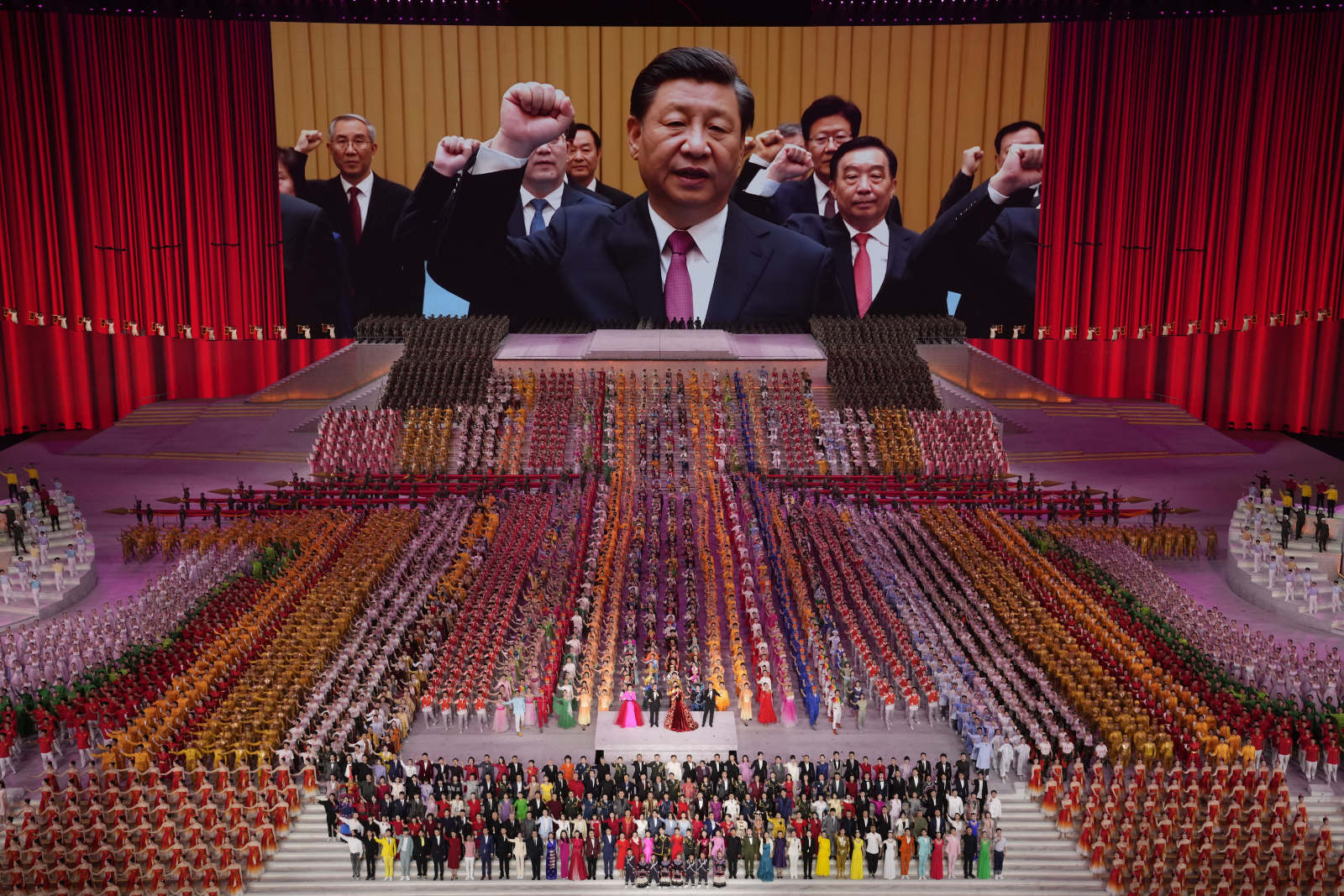
Chinese President Xi Jinping leads a pledge to the Chinese Communist Party ahead of the 100th anniversary of its founding in June last year. AP
Xi Jinping’s efforts to secure long-term control over the party have not been limited to coercive means. His efforts have also been directed at developing a personality cult elevating himself as the “indispensable core leader” in the eyes of the party’s mass membership and the wider Chinese public. He has been accorded symbolically significant new titles, including leader (lingxiu) and the helmsman piloting the country’s future - both designations previously reserved for Mao alone.
But, most spectacularly, Xi has also become the author of the entire body of an eponymous Xi Jinping Thought that has been incorporated into both the party and state constitutions.
It is designed to navigate the party and the country along a new course that will deal with the “imbalances,” “inadequacies,” and “inequalities” of its previous era of unrestrained capitalist growth. Indeed, it is specifically designed to provide a theoretical justification for Xi’s reorientation of political, economic and social policy in a new pro-party state-interventionist direction across the board.
Related Article
China's Great Leap Backwards: Xi Jinping and the cult of Mao
https://www.smh.com.au/world/chinas-great-leap-backwards-xi-jinping-and-the-cult-of-mao-20160512-gotfiz.html
Xi Jinping Thought is substantive in some core propositions, but it is also politically elastic: to expand and contract to absorb new political and policy developments as they arise and, as a result, ideologically legitimise them by attaching the Xi Jinping Thought mantra to them.
For all these reasons, Xi’s domestic political position as he approaches the 20th Party Congress in late 2022 is relatively robust. There is no apparent challenger. He would also fear that if he did step down, he would become powerless in the face of the many he had purged or marginalised, who would then seek revenge. The likelihood of a large-scale destabilising internal or external event is therefore limited, although we should always keep a close weather eye on what could flow politically from the economy’s performance in the future during 2022.
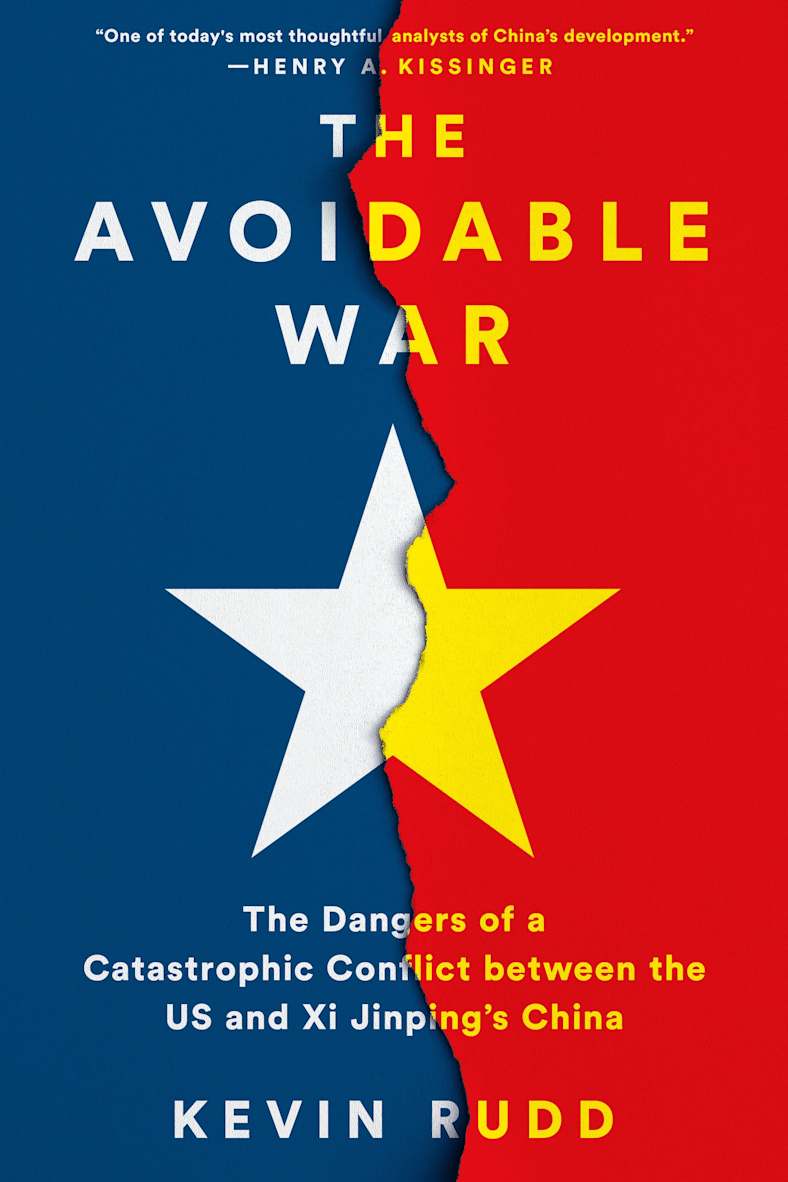
Kevin Rudd’s new book The Avoidable War published by Hachette Australia, March 30.
Xi has become (like Mao) the party’s “ideologist in chief ” — so much so that there is a Xi Jinping Thought textbook available for compulsory study for every school student, printed under the snappy subtitle Happiness Only Comes Through Struggle. But should Marxism-Leninism falter in its capacity to offer a convincing narrative for explaining the significant changes he has already introduced and, more importantly, should the economy fail, Xi could still harness the ancient alchemy of Chinese nationalism as the ultimate legitimising force behind his leadership.
Based on what we know, Xi’s material power is likely to continue to hold up into the future. It would, therefore, be prudent for American presidents to assume that Xi will be their opponent for much, and likely all, of the decade ahead - barring, of course, an early natural demise.
This is an edited extract from The Avoidable War: the dangers of a catastrophic conflict between
the US and Xi Jinping’s China by Kevin Rudd. Published by Hachette Australia on March 30.
Kevin Rudd is president of the Asia Society Policy Institute and was the
26th prime minister of Australia. Connect via Twitter or Facebook.
https://www.smh.com.au/world/asia/xi-jinping-the-gambler-s-greatest-fear-isn-t-war-20220323-p5a7b1.html
"Putin’s War in Ukraine Is a Watershed. Time for America to Get Real.
"Chomsky: Let’s Focus on Preventing Nuclear War, Rather Than Debating “Just War"
Rudd is a former Australian PM. Speaks Chinese and is a considered China expert .. he gets some plaudits near bottom here ..
AUSTRALIAN election soon. At this gravest of times the Coalition has served up an election budget designed simply to keep itself in power
https://investorshub.advfn.com/boards/read_msg.aspx?message_id=168377534
By Kevin Rudd
March 26, 2022 — 8.30am
Xi Jinping’s political modus operandi when confronted with a challenge — either foreign or domestic— is to double down; to crash through or crash.
He is a calculated risk-taker. His critical skill is to identify a political or policy vacuum and to fill it before others do. Xi is a master tactician in building political momentum across the cumbersome internal machinery of the Chinese Communist Party by deploying key personnel to critical positions; mobilising the party’s propaganda apparatus; and anchoring his worldview in a single, all-encompassing ideological framework to convince the party and the country that they are critical parts of a historical, righteous and “correct” cause.
[Insert: As Trump's GOP is doing in key state electoral offices
restripe, If you are sincerely concerned about attempts to fix elections
you can not ignore Republican efforts:
Trump’s Next Coup Has Already Begun
[...]
For more than a year now, with tacit and explicit support from their party’s national leaders, state Republican operatives have been building an apparatus of election theft. Elected officials in Arizona, Texas, Georgia, Pennsylvania, Wisconsin, Michigan, and other states have studied Donald Trump’s crusade to overturn the 2020 election. They have noted the points of failure and have taken concrete steps to avoid failure next time. Some of them have rewritten statutes to seize partisan control of decisions about which ballots to count and which to discard, which results to certify and which to reject. They are driving out or stripping power from election officials who refused to go along with the plot last November, aiming to replace them with exponents of the Big Lie. They are fine-tuning a legal argument that purports to allow state legislators to override the choice of the voters. https://investorshub.advfn.com/boards/read_msg.aspx?message_id=167072165
If you are genuinely concerned, that is factual information.
https://investorshub.advfn.com/boards/read_msg.aspx?message_id=168404775]
VIDEO - China's Xi says Asia must not return to Cold War 1:07
The Asia-Pacific region must not return to the tensions of the
Cold War era, China's leader Xi Jinping said ahead of a virtual meeting with US President Joe Biden expected as soon as next week.
Xi is also his own master class in internal party politics, possessing a ruthlessness not seen since Mao in dealing with political opponents. For these reasons, there is no credible competitor of comparable political stature left standing in the inner sanctums of Chinese party politics — or, at least, none that we know of. Xi has broken the norms of post-Cultural Revolution politics.
For any political opposition to effectively mobilise against Xi’s reappointment in late 2022, there would need to be a series of catalytic and catastrophic events. These events could take a number of different forms. The most credible would be any self-inflicted economic crisis, decline or even financial collapse. The party has only relatively recently rebuilt its domestic credibility and political legitimacy in China following the country’s near economic collapse of the Great Leap Forward and, later, the Cultural Revolution. That’s because in the decades after 1978, the party finally lifted people’s living standards. To undo the unspoken social contract between party and people (ie. political control in exchange for economic prosperity) in any way would rebound badly on Xi.
Related Article
Inside China
China just set its lowest target for economic growth in 30 years. It still looks ambitious
Stephen Bartholomeusz Senior business columnist
https://www.smh.com.au/business/markets/china-just-set-its-lowest-target-for-economic-growth-in-30-years-it-still-looks-ambitious-20220307-p5a2bc.html
Second, natural calamities (including pandemics) also have the potential to destabilise (as they have throughout Chinese history, in which disasters were commonly taken to mean leaders had lost the “mandate of heaven”).
This is why the internal politics of China became particularly intense in the first half of 2020, following the eruption of COVID-19 in Wuhan and the leadership’s initially tepid response. It also underscores the party’s acute response to any foreign attacks regarding the Chinese origins of the virus for fear this would become part of the country’s internal discourse, in addition to an international loss of face.
In Xi’s case in particular, the critique was that because of his feared status as an unforgiving and dictatorial leader, senior provincial officials hid the news of the pandemic from Beijing in its early and most critical weeks, hoping to contain it locally rather than following long-agreed protocols mandating immediate national and global notification.
A third cataclysmic event would be a military defeat, large or small, at the hands of either the US or Japan. Xi’s national political narrative about “the rise of the East and the decline of the West” carries with it the assumption that China would prevail in any direct contest. This has been furthered by Xi’s decision to militarise his presidency (wearing battle fatigues, frequent troop reviews, and constant public references to China’s ever-growing national power) to the extent that an inability to win an outright victory in any armed confrontation with the US or its allies would be politically lethal. It would be doubly so if this occurred in any scenario over Taiwan, which Xi has vowed to return to Beijing’s control .. https://www.smh.com.au/world/north-america/my-old-friend-biden-xi-begin-superpower-summit-on-friendly-note-20211116-p599cj.html .. as part of the China Dream.
Related Article
China relations
Beijing blames Australia’s ‘wrong words and deeds’ for trade war after US rebuke
https://www.smh.com.au/world/asia/after-us-pledge-on-china-coercion-beijing-lays-blame-back-on-australian-government-20210317-p57be1.html
Xi has therefore adopted a generally cautious approach to these significant strategic risks, in contrast to his approach to tactical politics, where he has been much more agile and audacious. In the case of the pandemic, he quashed all domestic dissent and adopted a zero-tolerance strategy toward the virus itself — all the while deploying the party’s propaganda apparatus to ensure that any international criticism is aggressively rebutted through his global team of wolf warrior diplomats, even seeking to sow doubt as to whether the virus actually originated in China.
On potential military crises, Xi may be forward-leaning in dealing with US and Japanese naval and air incursions into what he describes as Chinese territory. But he is unlikely to allow any incidents to escalate to a point of no return —unless convinced that there is no risk that Chinese forces would not prevail or that the domestic political cost of blinking and backing down is simply too great.
The economy is not his policy strong suit. Therefore, his recent major adjustments to China’s domestic economic growth model, including the re-emphasis of the state over the market, and his new restrictions on the Chinese private sector pose a real political danger to his leadership if growth, employment or living standards were to stall. This is Xi’s greatest liability, particularly given that his critics in the party leadership elite have previously championed a different economic policy strategy for China’s future.
Chinese President Xi Jinping leads a pledge to the Chinese Communist Party ahead of the 100th anniversary of its founding in June last year. AP
Xi Jinping’s efforts to secure long-term control over the party have not been limited to coercive means. His efforts have also been directed at developing a personality cult elevating himself as the “indispensable core leader” in the eyes of the party’s mass membership and the wider Chinese public. He has been accorded symbolically significant new titles, including leader (lingxiu) and the helmsman piloting the country’s future - both designations previously reserved for Mao alone.
But, most spectacularly, Xi has also become the author of the entire body of an eponymous Xi Jinping Thought that has been incorporated into both the party and state constitutions.
It is designed to navigate the party and the country along a new course that will deal with the “imbalances,” “inadequacies,” and “inequalities” of its previous era of unrestrained capitalist growth. Indeed, it is specifically designed to provide a theoretical justification for Xi’s reorientation of political, economic and social policy in a new pro-party state-interventionist direction across the board.
Related Article
China's Great Leap Backwards: Xi Jinping and the cult of Mao
https://www.smh.com.au/world/chinas-great-leap-backwards-xi-jinping-and-the-cult-of-mao-20160512-gotfiz.html
Xi Jinping Thought is substantive in some core propositions, but it is also politically elastic: to expand and contract to absorb new political and policy developments as they arise and, as a result, ideologically legitimise them by attaching the Xi Jinping Thought mantra to them.
For all these reasons, Xi’s domestic political position as he approaches the 20th Party Congress in late 2022 is relatively robust. There is no apparent challenger. He would also fear that if he did step down, he would become powerless in the face of the many he had purged or marginalised, who would then seek revenge. The likelihood of a large-scale destabilising internal or external event is therefore limited, although we should always keep a close weather eye on what could flow politically from the economy’s performance in the future during 2022.
Kevin Rudd’s new book The Avoidable War published by Hachette Australia, March 30.
Xi has become (like Mao) the party’s “ideologist in chief ” — so much so that there is a Xi Jinping Thought textbook available for compulsory study for every school student, printed under the snappy subtitle Happiness Only Comes Through Struggle. But should Marxism-Leninism falter in its capacity to offer a convincing narrative for explaining the significant changes he has already introduced and, more importantly, should the economy fail, Xi could still harness the ancient alchemy of Chinese nationalism as the ultimate legitimising force behind his leadership.
Based on what we know, Xi’s material power is likely to continue to hold up into the future. It would, therefore, be prudent for American presidents to assume that Xi will be their opponent for much, and likely all, of the decade ahead - barring, of course, an early natural demise.
This is an edited extract from The Avoidable War: the dangers of a catastrophic conflict between
the US and Xi Jinping’s China by Kevin Rudd. Published by Hachette Australia on March 30.
Kevin Rudd is president of the Asia Society Policy Institute and was the
26th prime minister of Australia. Connect via Twitter or Facebook.
https://www.smh.com.au/world/asia/xi-jinping-the-gambler-s-greatest-fear-isn-t-war-20220323-p5a7b1.html
It was Plato who said, “He, O men, is the wisest, who like Socrates, knows that his wisdom is in truth worth nothing”
Discover What Traders Are Watching
Explore small cap ideas before they hit the headlines.



