News Focus
News Focus
icon url

fuagf

06/12/21 4:38 AM

#376993 RE: fuagf #375695

Krugman Dismisses 1970s-Style Inflation, With Faith in Fed

"Four Rules That Should Guide Bidenomics
"Paul Krugman: The banality of democratic collapse
"McCarthy, McConnell drive over their lieutenants to stop bipartisan Jan. 6 commission""
"

By Julia Fanzeres

19 March 2021, 9:00 am AEDT Updated on 19 March 2021, 10:45 pm AEDT

* Nobel laureate says Fed not constrained by bond-market worries
* Past inflation crisis came after years of ‘screwing things up’

WATCH: Paul Krugman doesn't think inflation will get out of control again like it did in the 1970's.

Nobel Laureate economist Paul Krugman rejected the threat of inflation getting out of control -- like it did in the 1970s -- as a result of President Joe Biden’s $1.9 trillion pandemic-relief bill.

“It took really more than a decade of screwing things up -- year after year -- to get to that pass, and I don’t think we’re going to do that again,” Krugman said of the inflation scourge of the 1970s to early 1980s. He spoke in an interview with David Westin for Bloomberg Television’s “Wall Street Week” to be broadcast Friday.

The Federal Reserve has “easy” tools to address price pressures if needed, and is unlikely to adopt the “seriously, seriously irresponsible monetary policy” of the 1970s, said Krugman, who’s currently a professor at the City University of New York.


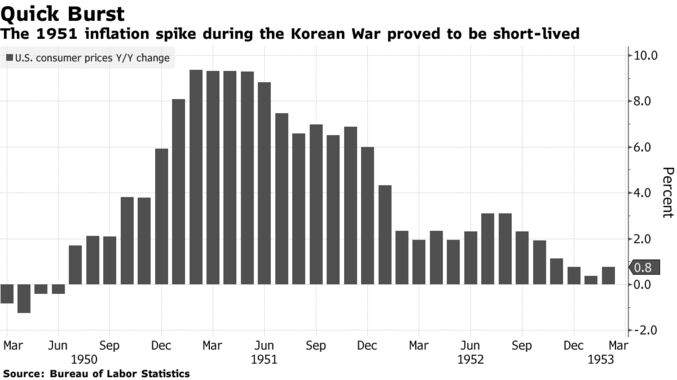
The 1951 inflation spike during the Korean War proved to be short-lived

The worst-case scenario out of the fiscal stimulus package would be a transitory spike in consumer prices as was seen early in the Korean War, Krugman said. The relief bill is “definitely significant stimulus but not wildly inflationary stimulus,” he said.

The liberal economist also suggested that Fed policy makers won’t be dissuaded from taking action out of fear about the reaction in the bond market, where there has already been a surge in yields that’s had ripple effects into equities.

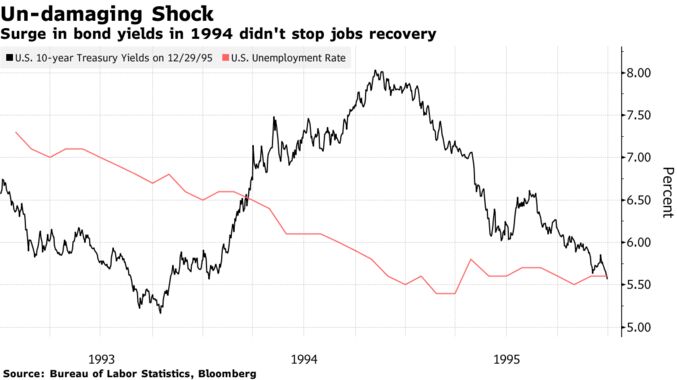
Fed tightening spurred a shock rout in Treasuries in 1994, but “nothing really terrible happened” ultimately, and policy makers will keep that in mind, Krugman said. “No one at the Fed wants to be the people responsible for bringing back the 1970s, so I don’t think they’re that much constrained.”


Surge in bond yields in 1994 didn't stop jobs recovery

It was a combination of excessive expansionary fiscal policy under President Lyndon B. Johnson, two oil shocks, and irresponsible monetary policy under the Fed Chair Arthur Burns that combined to create the double-digit inflation of the 1970s that peaked in 1980, Krugman said.

Economists predict that the core inflation measure tied to consumer spending that the Fed uses in its forecasts will remain under 2% this year and next, a Bloomberg survey shows. A different gauge, the consumer price index is seen at 2.4% in 2021 and 2.2% next year. The CPI peaked at over 13% in 1980.

Related: Yellen, Summers Spar About Overheating Risk in Stimulus Plan
https://www.bloomberg.com/news/articles/2021-02-07/yellen-summers-spar-about-overheating-risk-in-stimulus-debate

The risk is that policy makers are “fighting the last war” -- countering the undershooting of the 2% inflation target and limited fiscal measures taken after the 2007-09 financial crisis, the economists said.

Even so, he argued that “redistributionist” aspects of the pandemic-relief package will reduce the need for the Fed to keep monetary stimulus too strong for too long in order to address pockets of high unemployment. Fed Chair Jerome Powell has repeatedly said the central bank wants to see very broad strengthening in the labor market, not just a drop in the national jobless rate.

“It’s not silly to think that there might be some inflationary pressure” from the fiscal package, Krugman said. But it was designed less as stimulus than as a relief plan, he said.

— With assistance by Vince Golle
(Adds inflation forecasts in second paragraph after second chart.)

https://www.bloomberg.com/news/articles/2021-03-18/krugman-dismisses-1970s-style-inflation-risk-with-faith-in-fed

-

What’s the Fed doing in response to the COVID-19 crisis? What more could it do?
Jeffrey Cheng, Tyler Powell, Dave Skidmore, and David Wessel Tuesday, March 30, 2021
https://www.brookings.edu/research/fed-response-to-covid19/


icon url

fuagf

06/17/21 11:52 PM

#377651 RE: fuagf #375695

Affordable Care Act Survives Latest Supreme Court Challenge

"Four Rules That Should Guide Bidenomics
"Paul Krugman: The banality of democratic collapse
"McCarthy, McConnell drive over their lieutenants to stop bipartisan Jan. 6 commission""
"

The court sidestepped the larger issue in the case, whether the 2010 health care law can stand without a provision that required most Americans to obtain insurance or pay a penalty.


A seven-justice majority ruled that the plaintiffs had not suffered the sort of direct injury that gave them standing to sue. Stefani Reynolds for The New York Times

By Adam Liptak
June 17, 2021Updated 5:16 p.m. ET

WASHINGTON — The Affordable Care Act on Thursday survived a third major challenge .. https://www.supremecourt.gov/opinions/20pdf/19-840_6jfm.pdf .. as the Supreme Court, on a 7-to-2 vote, turned aside the latest effort by Republicans to kill the health care law.

The legislation, President Barack Obama’s defining domestic legacy .. https://www.nytimes.com/2010/03/22/health/policy/22health.html , has been the subject of relentless Republican hostility. But attempts in Congress to repeal it failed, as did two earlier Supreme Court challenges, in 2012 .. https://www.nytimes.com/2012/06/29/us/supreme-court-lets-health-law-largely-stand.html .. and 2015 .. https://www.nytimes.com/2015/06/26/us/obamacare-supreme-court.html . With the passing years, the law gained popularity and became woven into the fabric of the health care system.

On Thursday, in what Justice Samuel A. Alito Jr. called, in dissent, “the third installment in our epic Affordable Care Act trilogy,” the Supreme Court again sustained the law. Its future now seems secure and its potency as a political issue for Republicans reduced.

The margin of victory was wider than in the earlier cases, with six members of the court joining Justice Stephen G. Breyer’s modest and technical majority opinion, one that said only that the 18 Republican-led states and two individuals who brought the case had not suffered the sort of direct injury that gave them standing to sue.

Chief Justice John G. Roberts Jr., who had cast the decisive vote to save the law in 2012, was in the majority. So was Justice Clarence Thomas, who had dissented in the earlier decisions.

“Whatever the act’s dubious history in this court,” Justice Thomas wrote in a concurring opinion, “we must assess the current suit on its own terms. And, here, there is a fundamental problem with the arguments advanced by the plaintiffs in attacking the act — they have not identified any unlawful action that has injured them.”

Justices Sonia Sotomayor, Elena Kagan, Brett M. Kavanaugh and Amy Coney Barrett also joined Justice Breyer’s majority opinion. At Justice Barrett’s confirmation hearings last year, Democrats portrayed her as a grave threat .. https://www.nytimes.com/2020/09/27/health/obamacare-supreme-court-barrett-ginsburg.html .. to the health care law.

The court did not touch the larger issues in the case: whether the bulk of the law could stand without a provision that initially required most Americans to obtain insurance or pay a penalty.

“This ruling reaffirms what we have long known to be true: the Affordable Care Act is here to stay,” Mr. Obama said on Twitter .. https://twitter.com/BarackObama/status/1405578416095731712?s=20 .

Nine Supreme Court Cases to Watch This Term
Public opinion is closely divided on health care, voting, religion and gay rights cases.
https://www.nytimes.com/interactive/2021/06/01/us/major-supreme-court-cases-2021.html?action=click&module=RelatedLinks&pgtype=Article

In the 11 years since Mr. Obama signed the legislation into law, Republicans have assailed the Affordable Care Act as a step toward socialized medicine, government intrusion into health care decisions and a costly boondoggle.

They challenged it on a variety of fronts in the courts and made calls for its repeal a staple of their campaigns. But some of its provisions, like coverage for pre-existing conditions and for adult children up to age 26, proved popular across party lines. Even when they controlled the Senate, the House and the White House, Republicans failed to muster the votes to repeal the law — and despite President Donald J. Trump’s promises to deliver a better alternative, he never produced a detailed proposal of his own.

While health care remains a potent political issue — and the Affordable Care Act has shortcomings Democrats have acknowledged — the latest court ruling suggests that Republican chances of winning a legal battle to kill it are now much diminished.

“With millions of people relying on the Affordable Care Act for coverage, it remains, as ever, a BFD,” President Biden said on Twitter .. https://twitter.com/POTUS/status/1405551328877744129?s=20 .. after the ruling, alluding to his obscenity-punctuated comment to Mr. Obama on the day in March 2010 the bill was signed into law that the legislation was a big deal. Mr. Biden has signaled that he now wants to build on the legislation through a series of steps to expand access to health care.

Republicans were critical of the decision but suggested the battle would now focus on the policy fight in Congress.

“The failed Obamacare system will stagger on as a result of this decision,” said Senator John Barrasso, Republican of Wyoming.

“Every American’s health care has been harmed by Obamacare,” he said. “Republicans remain focused on making health care more affordable for families in Wyoming and around the country. Democrats keep pouring money into Obamacare instead of fixing the many problems facing patients and health care providers.”

The challengers in the case sought to take advantage of the 2012 ruling, in which Chief Justice Roberts upheld a central provision of the law, its individual mandate requiring most Americans to obtain health insurance or pay a penalty, saying it was authorized by Congress’s power to levy taxes.

They argued that the mandate became unconstitutional after Congress in 2017 eliminated the penalty .. https://www.nytimes.com/2017/12/21/upshot/individual-health-insurance-mandate-end-impact.html .. for failing to obtain coverage because it could no longer be justified as a tax. They went on to say that this meant the rest of the law must also fall.

The challenge was largely successful in the lower courts.
A federal judge in Texas ruled that the entire law was invalid .. https://www.nytimes.com/2018/12/14/health/obamacare-unconstitutional-texas-judge.html , but he postponed the effects of his ruling until the case could be appealed. In 2019, the United States Court of Appeals for the Fifth Circuit, in New Orleans, agreed that the mandate was unconstitutional but declined to rule .. https://www.nytimes.com/2019/12/19/upshot/obamacare-ruling.html .. on the fate of the remainder of the health law, asking the lower court to reconsider the question in more detail.

Justice Breyer did not address most of the arguments that were the basis of those decisions, focusing instead on whether the plaintiffs were entitled to sue at all.

The two individuals, he wrote, suffered no harm from a toothless provision that in effect merely urged them to obtain health insurance. Similarly, he wrote, the states did not sustain injuries tied directly to the elimination of the penalty that had been part of the individual mandate.

The states argued that the revised mandate would cause more people to take advantage of state-sponsored insurance programs. Justice Breyer rejected that theory.

“The state plaintiffs have failed to show,” he wrote, “that the challenged minimum essential coverage provision, without any prospect of penalty, will harm them by leading more individuals to enroll in these programs.”

“Neither logic nor intuition suggests that the presence of the minimum essential coverage requirement would lead an individual to enroll in one of those programs that its absence would lead them to ignore,” Justice Breyer wrote. “A penalty might have led some inertia-bound individuals to enroll. But without a penalty, what incentive could the provision provide?”

In a vigorous dissent, Justice Alito, joined by Justice Neil M. Gorsuch, said the third installment of the court’s Affordable Care Act trilogy “follows the same pattern as Installments 1 and 2.”

“In all three episodes, with the Affordable Care Act facing a serious threat,” he wrote, “the court has pulled off an improbable rescue.”

Justice Alito wrote that the court has routinely found that states have standing to challenge federal initiatives. “Just recently,” he wrote, “New York and certain other states were permitted to challenge the inclusion of a citizenship question in the 2020 census even though any effect on them depended on a speculative chain of events.”

He said there were “novel questions” about whether the individual plaintiffs could sue. But “the states have standing for reasons that are straightforward and meritorious,” he wrote. “The court’s contrary holding is based on a fundamental distortion of our standing jurisprudence.”

Unlike the majority, Justice Alito went on to address the larger issues in the case, California v. Texas, No. 19-840 .. https://www.supremecourt.gov/docket/docketfiles/html/public/19-840.html .. , saying the mandate was now unconstitutional and could not be severed from much of the rest of the law.

Had Justice Alito’s view prevailed, the nation’s health care system would have experienced an earthquake.

Striking down the Affordable Care Act .. https://www.nytimes.com/2020/11/13/your-money/obamacare-open-enrollment-deadline.html .. would have expanded the ranks of the uninsured in the United States by about 21 million people — a nearly 70 percent increase — according to recent estimates .. https://www.urban.org/sites/default/files/publication/103072/the-potential-effects-of-a-supreme-court-decision-to-overturn-the-affordable-care-act-updated-estimates_01.pdf .. from the Urban Institute.

The biggest loss of coverage would have been among low-income adults who became eligible for Medicaid under the law after most states expanded the program to include them. But millions of Americans would also have lost private insurance, including young adults whom the law allowed to stay on their parents’ plans until they turned 26 and families whose income was modest enough to qualify for subsidies that help pay their monthly premiums.

A ruling against the law would also have doomed its protections for Americans with past or current health problems. The protections bans insurers from denying them coverage or charging them more for pre-existing conditions.

“Today’s decision means that all Americans continue to have a right to access affordable care, free of discrimination,” said Xavier Becerra, the secretary of health and human services, who in his previous job as California’s attorney general helped defend the law in Thursday’s case.

Mr. Biden has said he wants to build on the Affordable Care Act through steps like expanded health insurance subsidies, and some Democrats are pushing for bigger proposals like expanding Medicare coverage to more people.

Republicans suggested on Thursday that their focus would now be less on seeking to repeal the law than on the debate in Congress and on the campaign trail for 2022 over how to address issues like the affordability of health insurance.

“While the Supreme Court ruled today that states do not have standing to challenge the mandate, the ruling does not change the fact that Obamacare failed to meet its promises and is hurting hard-working American families,” the three top Republicans in the House, Representatives Kevin McCarthy, Steve Scalise and Elise Stefanik, said in a statement. “Now, Congress must work together to improve American health care.”

https://www.nytimes.com/2021/06/17/us/obamacare-supreme-court.html
icon url

fuagf

09/19/21 6:59 PM

#385972 RE: fuagf #375695

How Accounting Giants Craft Favorable Tax Rules From Inside Government

"Four Rules That Should Guide Bidenomics
"Paul Krugman: The banality of democratic collapse
"McCarthy, McConnell drive over their lieutenants to stop bipartisan Jan. 6 commission""
"

Lawyers from top accounting firms do brief stints in the Treasury Department, with the expectation of big raises when they return.

IMAGE - The Treasury Department. Stefani Reynolds for The New York Times

By Jesse Drucker and Danny Hakim

Sept. 19, 2021, 5:00 a.m. ET

For six years, Audrey Ellis and Adam Feuerstein worked together at PwC, the giant accounting firm, helping the world’s biggest companies avoid taxes.

In mid-2018, one of Mr. Feuerstein’s clients .. https://lda.senate.gov/filings/public/filing/feaf9fd1-3713-463c-b5d8-63d2380bf5e1/print/ , an influential association of real estate companies, was trying to persuade government officials that its members should qualify for a new federal tax break. Mr. Feuerstein knew just the person to turn to for help. Ms. Ellis had recently joined the Treasury Department, and she was drafting the rules for this very deduction.

That summer, Ms. Ellis met with Mr. Feuerstein and his client’s lobbyists. The next week, the Treasury granted their wish .. https://www.irs.gov/pub/irs-drop/reg-107892-18.pdf — a decision potentially worth billions of dollars to PwC’s clients.

About a year later, Ms. Ellis returned to PwC, where she was immediately promoted to partner. She and Mr. Feuerstein now work together ..https://podcastaddict.com/episode/112565908 .. advising large companies on how to exploit wrinkles in the tax regulations that Ms. Ellis helped write .. https://www.reginfo.gov/public/do/eAgendaViewRule?pubId=201810&RIN=1545-BO81 .

[INSERT: To exploit such wrinkles in tax law is to steal. Give me enough to live. Let others be corrupted by excess.]

Ms. Ellis’s case — detailed in public records and by people with direct knowledge of her work at the Treasury and at PwC — is no outlier.

The largest U.S. accounting firms have perfected a remarkably effective behind-the-scenes system to promote their interests in Washington. Their tax lawyers take senior jobs at the Treasury Department, where they write policies that are frequently favorable to their former corporate clients, often with the expectation that they will soon return to their old employers. The firms welcome them back with loftier titles and higher pay, according to public records reviewed by The New York Times and interviews with current and former government and industry officials.

From their government posts, many of the industry veterans approved loopholes long exploited by their former firms, gave tax breaks to former clients and rolled back efforts to rein in tax shelters — with enormous impact.

After lobbying by PwC, a former PwC partner in the Trump Treasury Department helped write regulations that allowed large multinational companies to avoid tens of billions of dollars in taxes; he then returned to PwC. A senior executive at another major accounting firm, RSM, took a top job at Treasury, where his office expanded a tax break in ways sought by RSM; he then returned to the firm.

Even some former industry veterans said they viewed the rapid back-and-forth arrangements as a big part of the reason that tax policy had become so skewed in favor of the wealthy, at the expense of just about everyone else. President Biden and congressional Democrats are now seeking to overhaul parts of the tax code that overwhelmingly benefit the richest Americans.

“The accounting firms have a desire to get in favorable rules for their clients,” said Michael Hamersley, a former tax lawyer at EY and KPMG .. http://hptaxlaw.com/aboutus.html . “And the person in the government has a desire to grant their wish because they know they will be rewarded when they get out.”

The so-called revolving door .. https://www.opensecrets.org/revolving/ , in which people cycle between the public and private sectors, is nothing new. But the ability of the world’s largest accounting firms to embed their top lawyers inside the government’s most important tax-policy jobs has largely escaped public scrutiny.


Audrey Ellis went from PwC to the Treasury Department. Two years later, she returned to her old firm, which promoted her to partner.
Photo Illustration by The New York Times; PwC

In the last four presidential administrations, there were at least 35 instances of round trips from big accounting firms through Treasury’s tax policy office, along with the Internal Revenue Service and the Congressional Joint Committee on Taxation, and back to the same firm, according to public records and interviews with government and industry officials.

In at least 16 of those cases, the officials were promoted to partner when they rejoined their old accounting firms. The firms often double the pay of employees upon their return from their government sojourns. Some partners end up earning more than $1 million a year.

Federal rules prohibit government officials from working on many matters in which they have financial interests, like having an unwritten agreement to return to their prior firm. The purpose of the rules is to avoid having officials beholden to private parties instead of working on behalf of the public, though it is hard to prove the existence of such financial entanglements.

“Lawyers who come from the private sector need to learn who their new client is, and it’s not their former clients. It’s the American public,” said Stephen Shay, a retired tax partner at Ropes & Gray .. https://www.bc.edu/bc-web/schools/law/academics-faculty/faculty-directory/stephen-shay.html .. who served in the Treasury during the Reagan and Obama administrations. “A certain percentage of people never make that switch. It’s really hard to make that switch when you know where you are going back in two years, and it’s to your old clients. The incentives are bad.”

Pay Cut Now, Rewards Later

Going from an accounting firm into the Treasury means taking a big pay cut. But lawyers know they are likely to be rewarded with significantly higher pay when they rejoin their old firm.

Eric Sloan, a former longtime tax lawyer at Deloitte, said he used to spell this out to young Deloitte lawyers to encourage them to do stints at the Treasury Department.

“Generally, lawyers stay in those positions for two to three years, after which they frequently return to the firms from which they came,” said Mr. Sloan, who is now co-chairman of the tax practice at the law firm Gibson, Dunn & Crutcher .. https://www.gibsondunn.com/lawyer/sloan-eric-b/ . The government experiences “allow them to command higher compensation upon their return to the private sector.”

Mr. Sloan and some other industry officials said they didn’t see anything wrong with this practice because the lawyers brought expertise to government.

[Expertise is fine. Expertise used to "exploit wrinkles" to screw
the ordinary, decent and honest working stiff, sucks big time.]


Representatives of KPMG, EY, PwC, Deloitte and RSM declined to comment.

[In my early 20's i got a plum starting position with what was Price Waterhouse then. The idea was that accounting opens doors so why not. Over decades since i've often thought what a good move it was to quit that 'rosy future' job, because it just didn't feel right. In reading this article am thinking again - wow - that really was a good move!]

One early trendsetter was Mark A. Weinberger .. https://www.ey.com/en_us/people/mark-weinberger , a partner at EY and for many years a top tax lobbyist in Washington. During the Clinton administration, he championed .. https://www.wsj.com/articles/SB909028201235757000 .. a corporate tax break for research and development that critics said was often abused.

In 2001, President George W. Bush appointed him to run .. https://georgewbush-whitehouse.archives.gov/news/releases/20010205-2.html .. the Treasury’s small but powerful Office of Tax Policy, which writes the rules to enact federal tax laws.

From that perch, Mr. Weinberger quickly helped reverse a rule that made it harder to qualify for the R&D tax credit.

Mr. Weinberger rejoined EY in April 2002, 14 months after he had left.

“My experience in the private sector undoubtedly made me a better public servant, and my government experience enabled me to better understand and apply public policy in my private sector roles,” Mr. Weinberger said in a statement.

Few dispute that the Treasury Department and the I.R.S. must rely in part on lawyers from the private sector to understand the real-world effects of the tax code and how companies and wealthy individuals try to navigate around it.

“If you want to know where the bodies are buried, you’ve got to get some of those people,” said Chye-Ching Huang, the head of the Tax Law Center at New York University’s law school .. https://www.law.nyu.edu/centers/tax-law-center/leadership/huang .


Mark A. Weinberger was a partner at EY before joining the Treasury as assistant secretary for tax policy. He later returned to EY, eventually
becoming chief executive. Photo Illustration by The New York Times; Lucy Nicholson/Reuters

But Mr. Weinberger’s career path has become a defining trend for the Office of Tax Policy. His successors came almost entirely from major law and accounting firms, to which they quickly returned after leaving the government.

Manufacturing Cheesecake

In 2002, a manager at PwC, George Manousos, joined the tax office. He played a key role writing a rule that allowed virtually any company to claim a tax credit intended for U.S. manufacturers, even if they weren’t manufacturing anything. (In one notorious example, The Huffington Post reported .. https://www.huffpost.com/entry/pwcs-other-debacle-a-tax-boondoggle-that-has-ballooned-out-of-control_n_58b73172e4b023018c6c9852 .. that restaurant companies were claiming to “manufacture” slices of cheesecake from whole cheesecakes.)

When Mr. Manousos returned to PwC a few years later, he was promoted to partner and became the firm’s national leader on the tax rules that he had written. He registered to lobby .. https://projects.propublica.org/represent/lobbying/r/300958409 .. the government on that specific provision. The pattern continued in the Obama administration.

In 2013, Craig Gerson, a tax lawyer at PwC .. https://www.pli.edu/faculty/craig-a.-gerson-15113 .. whose specialties included advising private equity firms on how to cut their taxes, joined the Office of Tax Policy as a so-called attorney-adviser. At the time, the Treasury was contemplating whether to crack down on a tax dodge used by private equity firms known as a “fee waiver.” The maneuver allowed executives to avoid taxes on much of their income.

Mr. Gerson oversaw the discussions inside the Treasury. In July 2015, the department issued proposed regulations .. https://www.jdsupra.com/legalnews/irs-issues-proposed-regulations-69165/ .. that essentially created a road map for how to construct waivers without running afoul of the I.R.S.

About two months later — after two and a half years at the Treasury — Mr. Gerson rejoined PwC, where he resumed his practice advising private equity firms.

Mr. Manousos and Mr. Gerson referred questions to PwC, which declined to comment on behalf of its employees.


George Manousos, a manager at PwC, spent a few years at the Treasury Department before returning to PwC, which promoted him to
partner. Photo Illustration by The New York Times; PwC

‘A Trap for the Unwary’

Around 2010, Deloitte and PwC each devised a lucrative new tax shelter. It enabled multinational companies like Bristol Myers Squibb to avoid billions of dollars in federal income taxes .. https://www.nytimes.com/2021/04/07/podcasts/the-daily/tax-scheme-bristol-myers-irs-janet-yellen.html .. by routing profits through offshore subsidiaries.

The I.R.S. argued that the transactions violated an anti-abuse provision of the federal tax laws. In the case of Bristol Myers .. https://www.nytimes.com/2021/04/01/business/bristol-myers-taxes-irs.html , which PwC had advised on the design of its offshore arrangement, the I.R.S. sought more than $1 billion in back taxes.

In 2015, the Treasury Department issued a warning notice .. https://www.irs.gov/pub/irs-drop/n-15-54.pdf .. intended to shut down the shelters.

But companies’ tax advisers protested that the Treasury was going too far. In May 2016, the tax section of the American Bar Association wrote a 42-page letter .. https://www.americanbar.org/content/dam/aba/administrative/taxation/policy/052316comments.pdf .. pleading to Treasury officials that the government’s actions were “overly broad” and potentially “a trap for the unwary.” One of the men who wrote the letter was Ari Berk, a tax lawyer for Deloitte, among the leading designers of the tax shelters.

Two weeks after sending the letter, Mr. Berk left Deloitte’s Washington offices and moved a few blocks west to work for the Treasury. His assignment was to oversee the regulations he had just been pushing to water down.

In January 2017, Mr. Berk’s office issued new regulations .. https://www.govinfo.gov/content/pkg/FR-2017-01-19/pdf/2017-01049.pdf .. that made it easier for companies .. https://www.alston.com/en/insights/publications/2017/02/international-tax-advisory-section-721/ .. to shift their profits offshore to avoid U.S. taxes. The most important change mirrored what Mr. Berk had sought in his letter eight months earlier.

That June, Mr. Berk returned to Deloitte. He had been gone barely a year and was immediately promoted to partner. He declined to comment.

[WTF! That sort of rotation feels blatantly fraudulent. Surely i shouldn't be too hard to fix.]

Wishes Granted

In the waning days of the Obama administration, the Treasury Department was writing closely watched rules to crack down on so-called corporate inversions, in which American companies merged with firms in low-tax jurisdictions. The transactions allowed the companies to siphon their taxable profits out of the United States.

As they put the final touches on the rules, Treasury officials met with two top PwC officials: Chip Harter .. https://www.pwc.com/us/en/services/tax/multinationals/podcasts/cross-border-tax-talks-behind-the-scenes-chip-harter.html .. and Pamela Olson .. https://www.pwc.com/us/en/contacts/o/olson-pam.html . The pair got what they wanted.


Pamela Olson, shown in 2003, served as assistant secretary for tax policy for barely a year before returning to Skadden Arps. She now
works for PwC.Credit...Photo Illustration by The New York Times; Tom Williams/Getty Images

A year later, in 2017, Mr. Harter, a longtime international tax lawyer, returned to the Treasury’s grand headquarters next door to the White House. This time he was there for a job. The Trump administration’s Treasury secretary, Steven Mnuchin, had named him to oversee international tax issues. While he worked there, PwC covered part of the cost of his private health insurance, ethics filings show.

Three months after his appointment, the Republican-controlled Congress approved a sweeping tax cut package .. https://www.nytimes.com/2017/12/19/us/politics/tax-bill-vote-congress.html .. that included major changes .. https://www.taxpolicycenter.org/taxvox/explaining-tcjas-international-reforms .. to the rules governing international taxation.

While the new law substantially reduced multinational companies’ tax burdens, it also contained a pair .. https://www.taxpolicycenter.org/briefing-book/what-tcja-base-erosion-and-anti-abuse-tax-and-how-does-it-work .. of new taxes .. https://www.taxpolicycenter.org/briefing-book/what-global-intangible-low-taxed-income-and-how-it-taxed-under-tcja .. intended to raise hundreds of billions of dollars from companies that had avoided taxes by claiming profits were earned overseas .. https://www.washingtonpost.com/wp-dyn/content/article/2010/10/30/AR2010103000034.html .

Mr. Harter’s job suddenly became much more important. The tax legislation was hastily passed and sloppily written .. https://www.brookings.edu/blog/up-front/2019/09/25/a-fixable-mistake-the-tax-cuts-and-jobs-act/ . It would be up to Mr. Harter to figure out how to put those new taxes into effect.

An intense lobbying campaign .. https://www.nytimes.com/2019/12/30/business/trump-tax-cuts-beat-gilti.html .. got underway. Companies wanted to water down the new taxes on offshore revenue and profits. One of the most active lobbyists was Mr. Harter’s former PwC colleague Ms. Olson, who had been the top tax official in the Bush administration’s Treasury Department.

On at least four occasions, Mr. Harter’s office granted requests that were made by Ms. Olson or by corporate trade groups for which she was a lobbyist. The changes included letting multinational companies escape a new tax .. https://rsmus.com/what-we-do/services/tax/international-tax-planning/beat-services-cost-method.html .. on overseas revenue, a move that drew widespread criticism and is likely to cost the federal government tens of billions of dollars over a decade.


Chip Harter rejoined PwC this year after serving as the Treasury’s top international tax official for most of the Trump administration. He had
previously been with PwC for 18 years. Photo Illustration by The New York Times; PwC

This year, Mr. Harter returned to PwC .. https://www.pwc.com/us/en/services/tax/multinationals/podcasts/cross-border-tax-talks-behind-the-scenes-chip-harter.html .

I fully complied with Treasury Department conflicts rules by not meeting with PwC representatives” during a two-year “cooling off” period that restricts government officials from meeting with their former employers, Mr. Harter said. Although he was involved in the construction of the offshore tax break .. https://www.duffandphelps.com/insights/publications/valuation-insights/valuation-insights-fourth-quarter-2018/beat-and-the-services-cost-method-exemption .. and met with corporate lobbyists, Mr. Harter said he did not recall meeting with Ms. Olson or other PwC officials on the topic.

Ms. Olson referred questions to PwC.

An Inside Track

The 2017 tax overhaul included a provision that let some people take a 20 percent tax deduction on certain types of business income. But the law — known as Section 199A .. https://taxprof.typepad.com/taxprof_blog/2018/12/reilly-shaviro-debate-the-new-199a-pass-through-rules.htmllargely excluded an undefined category of “brokerage services.” In 2018, lobbyists for several industries, including real estate and insurance, visited the Treasury to try to persuade officials that the broker prohibition should not apply to them.

On Aug. 1, records show, Ms. Ellis met with her former PwC colleague, Mr. Feuerstein, and three other lobbyists for his client, the National Association of Realtors. They wanted real estate brokers to qualify for the 20 percent deduction.

The meeting took place before the first draft of the proposed rules was even made public, which meant that, right off the bat, Ms. Ellis’s former PwC colleague and his client had an inside track.

When the Treasury published its first version .. https://www.irs.gov/pub/irs-drop/reg-107892-18.pdf .. of the proposed rules a week later, real estate brokers were eligible. The National Association of Realtors took credit .. https://realtorparty.realtor/rpac/section-199a-deduction-examples .. for the victory on its website. (The final rules applied only to brokers of stocks and other securities.)

Ms. Ellis’s meeting with Mr. Feuerstein appeared to violate a federal ethics rule .. https://www.law.cornell.edu/cfr/text/5/2635.502 .. that restricts government officials from meeting with their former private sector colleagues, said Don Fox, the acting director of the Office of Government Ethics during the Obama administration and, before that, a lawyer in Republican and Democratic administrations.

Mr. Fox described the meeting as improper. “It certainly is going to call into question how that regulation was drafted,” he said. “There’s no way to undo the taint that is now going to be attached to that.”

Over the course of the year, Ms. Ellis met with lobbyists for the insurance, auto and banking industries. The Treasury let their brokers in on the tax break, too. Mr. Mnuchin, the Treasury secretary, approved the decision.

Ms. Ellis returned to PwC in the fall of 2019. She was immediately promoted to partner.

Her colleague drafting the regulations for 199A was Wendy Kribell, a senior lawyer at the I.R.S. This summer, she joined Ms. Ellis at PwC.


A PwC spokeswoman declined to comment on behalf of Ms. Ellis and Mr. Feuerstein. Ms. Kribell didn’t respond to requests for comment.

‘Warmest Congratulations’

The top tax official in President Donald J. Trump’s Treasury Department was David J. Kautter. In addition to serving as assistant Treasury secretary for tax policy, he had a stint as acting I.R.S. commissioner.

Before joining the government, Mr. Kautter had a long history in the accounting industry. He spent 28 years at EY, rising to national tax director during the period when the firm marketed illegal tax shelters, leading to a $123 million .. https://www.justice.gov/usao-sdny/pr/manhattan-us-attorney-announces-agreement-ernst-young-llp-pay-123-million-resolve .. settlement with the Justice Department. (Mr. Kautter has said he was not directly involved in creating shelters, though he has noted that “I wish I had done things differently.”)


David J. Kautter returned to RSM in August after serving as the assistant Treasury secretary for tax policy. Photo Illustration by The
New York Times; Susan Walsh/Associated Press

After a few years in academia, Mr. Kautter joined the country’s fifth-largest accounting firm, RSM.

Soon after he entered the government, Mr. Kautter’s former colleagues at RSM began asking for favorable changes to tax policy, and they got some of what they sought.

“Warmest congratulations to you and your colleagues on the successful enactment” of the 2017 tax cut, Don Susswein, a top official at RSM, wrote to Mr. Kautter .. https://www.documentcloud.org/documents/21063019-possible-early-guidance-on-tcja-passthrough-provisions .. in January 2018. Mr. Susswein urged Mr. Kautter to make it easier to qualify for the Section 199A deduction.

The Treasury obliged
.. https://www.cadwalader.com/brass-tax/index.php?nid=4&eid=21 .

Nine months later, another letter .. https://www.documentcloud.org/documents/21052626-irs-2018-0021-0245_attachment_1 .. arrived. This one, from a group of RSM officials, asked Mr. Kautter and a senior I.R.S. lawyer to help more financial companies qualify for the 199A tax break.

Mr. Kautter’s office made that change, too .. https://www.cadwalader.com/brass-tax/index.php?nid=4&eid=21 .

Last month, Mr. Kautter returned to RSM .. https://rsmus.com/newsroom/news-releases/2021/dave-kautter-returns-to-rsm-as-federal-specialty-tax-leader.html . That meant that five of the last six people to run the Treasury tax office had returned to their previous accounting or law firms after stepping down from their government jobs. (The post is currently vacant.)

Mr. Kautter said in a statement last month that he was looking forward to helping RSM’s clients “understand the federal tax rules,” many of which he’d had a hand in crafting.

Kitty Bennett contributed research.

Jesse Drucker is an investigative reporter for the Business desk. He previously worked for The Wall Street Journal and Bloomberg News where he won a pair of awards in 2011 for investigative and explanatory reporting from the Society of American Business Editors and Writers for a series on how U.S. multinationals shift profits into tax havens. @JesseDrucker

Danny Hakim is an investigative reporter. He has been a European economics correspondent and bureau chief in Albany and Detroit. He was also a lead reporter on the team awarded the 2009 Pulitzer Prize for Breaking News. @dannyhakim • Facebook

418 comments - https://www.nytimes.com/2021/09/19/business/accounting-firms-tax-loopholes-government.html
icon url

fuagf

09/23/21 12:28 AM

#386235 RE: fuagf #375695

Biden cools Democratic fever over domestic agenda, but can't cure it

"Four Rules That Should Guide Bidenomics
[...]
Rule #1: Don’t doubt the power of government to help. The last time Democrats took the White House, they were still in something of a reflexive cringe, halfway accepting the conservative dogma that government always does more harm than good. But everything that has happened since 2009 says that government spending can be hugely beneficial.
[...]
Rule #2: Don’t obsess about debt. Constant warnings about the dangers of government borrowing hobbled the Obama agenda almost from the start. Biden shouldn’t let that happen again.
[...]
Rule #3: Don’t worry about inflation. Constant warnings about soaring prices .. https://www.nytimes.com/2014/07/07/opinion/paul-krugman-conservative-delusions-about-inflation.html , combined with false claims that the government was hiding the true rate of inflation (no, this sort of thing didn’t begin with Trump) also marked the Obama years; but inflation never took off. Nonetheless, the usual suspects are ramping up .. https://www.bloomberg.com/opinion/articles/2021-01-05/as-the-stimulus-debate-rages-trust-government-inflation-numbers?sref=qzusa8bC .. to try it again.
[...]
Rule #4: Don’t count on Republicans to help govern. The original sin of Obama economic policy was the underpowered stimulus of 2009. The American Recovery and Reinvestment Act helped stabilize the economy, but it was much too small given the depths of the crisis. This isn’t hindsight; some of us were very publicly tearing our hair out .. https://krugman.blogs.nytimes.com/2009/01/06/stimulus-arithmetic-wonkish-but-important/ .. in real time.
"

Both progressive and moderate Democrats met with the president Wednesday to discuss the party's sprawling agenda, but emerged with the same conflicts.


President Joe Biden met with members of Congress on Sept. 22, 2021, in Washington. | (Evan Vucci/AP Photo)

By SARAH FERRIS, MARIANNE LEVINE, HEATHER CAYGLE and LAURA BARRÓN-LÓPEZ

09/22/2021 07:45 PM EDT
Updated: 09/22/2021 09:29 PM EDT

Democrats returned from an Oval Office sitdown Wednesday with earnest pledges to break the logjam threatening their entire domestic agenda — even as deep cracks remain in their party.

“Everybody had a chance to say their piece, and there was a lot of pieces said,” Sen. Jon Tester (D-Mont.) said after meeting with President Joe Biden and other centrists for more than 90 minutes.

Biden convened the high-stakes summit with key progressives and moderates Wednesday in a bid to unify his fractious party — with its threadbare majority in Congress — behind one of the most ambitious presidential agendas in history. Democrats said Wednesday’s talks did not result in a formal detente between the clashing factions, which are caught in an ugly tug-of-war between Biden's two main priorities: a $3.5 trillion partisan social spending plan and a separate, narrower infrastructure bill.

There was at least one hint of movement to advance the broader, slow-moving package. Sen. Joe Manchin (D-W.Va.) said Biden gave him a specific request — come back to him with a topline price tag the powerful centrist will support.

“‘Please, just work on it. Give me a number, and tell me what you can live with and what you can’t,‘” Manchin said, relaying his conversation with Biden.

Democrats said Biden privately signaled to both the progressive and moderate camps that the overall size of the spending package was up for debate, though he revealed little about where the party expected to end up or when it might get there.

But lawmakers who spent Wednesday afternoon at the White House said they were offered little clarity about a critical looming deadline: a vote on the House floor on the infrastructure deal, which liberals are vowing to block without progress on the broader bill.

VIDEO - Biden delivers remarks after infrastructure senate vote, in 180 seconds

“The first step was to convene all of us, and get us to start acting like grown-ups again,” said Sen. Brian Schatz (D-Hawaii). “The next step is to develop a procedural pathway, and the final step is to negotiate all of the substance.”

“But those steps have to happen in that order,” Schatz said.

White House officials said in a statement afterward that Biden and his team planned to have several follow-up meetings “to continue to advance the process of passing these critical bills” — starting on Thursday.

Biden’s shuttle diplomacy was welcomed within the caucus after several Democrats privately complained the White House had been too hands off in recent weeks, particularly in the House, allowing tensions between the party’s two wings to boil over.

"We're calm and everybody's good and our work's almost done,” Speaker Nancy Pelosi said after her own hour-long meeting with Biden and Senate Majority Chuck Schumer ahead of a pivotal five-day stretch in the House.

The president sat down first with centrists in a lengthy session that included individually wrapped chocolate chip cookies for the roughly dozen lawmakers in the room. Biden largely allowed lawmakers to dominate the conversation, and refrained from diving into thorny details such as the price tag or a specific timeline.

“There is a common sense that we want to be able to pass both an infrastructure bill as well as a reconciliation bill,” centrist Rep. Stephanie Murphy (D-Fla.) said afterwards, referring to the $3.5 trillion spending plan that Hill Democrats plan to pass without GOP support using a wonky Senate budget process.

The conversation was "a good first step" on reconciliation, Murphy said, adding that she still expected the House to move ahead with a Monday vote on Biden's separate infrastructure bill, regardless of the status of the social spending legislation.

Most Democrats are eager to deliver both planks of Biden’s domestic agenda — more than $1 trillion for roads and bridges, plus much more for universal child care, free community college and other safety net programs. But a slim, three-vote margin in the House and a 50-50 Senate has meant that the party’s two disparate flanks are stuck in a public standoff over the fate of their own top priorities.

Leaders of the Congressional Progressive Caucus have warned that more than half of their roughly 100 members will vote against the bill on the floor without more progress on the bigger spending package — a message they reiterated on Wednesday to Biden.

“I reiterated what I have consistently said: progressives will vote for both bills because we proudly support the President’s entire Build Back Better package, but that a majority of our 96-member caucus will only vote for the small infrastructure bill after the Build Back Better Act passes,” CPC Chair Rep. Pramila Jayapal (D-Wash.) said in a statement afterward.

“Everybody’s trying to maximize their advantage,” Rep. Tom Malinowski (D-N.J.), who did not attend the meeting, said of the narrow majority in the House. “Somehow, within those constraints, we have to find the bill that achieves the most while holding the caucus together.”

Democrats hoped that the rare chance for face time with Biden would help tone down some of the intraparty bickering, which lawmakers and aides privately warn is escalating ahead of Monday’s vote on that Senate infrastructure deal.

As the party leader, several Democrats said a clear message from Biden about what he wants — and when he wants it — might be the only thing that could break through all of the noise. But others have been more frustrated, privately saying the president needed to meet with more than just the loudest voices in the caucus and that there are dozens more Democrats with their own concerns.

In a separate meeting in the Capitol on Wednesday, Democrats took part in a strategy session with White House Communications Director Kate Bedingfield about how to message their yet-to-pass bills. That included the best counterpoints for GOP attacks about the $3.5 trillion price tag, according to people in attendance, which will be echoed in a memo that will be sent to Hill offices on Thursday. It leaned into populist themes about sticking it to corporations and mentioned taxes 16 times.

The party’s political dilemma went largely unaddressed in the meeting at the Capitol, according to people who attended.

It remains unclear what will happen Monday when Democratic leaders are scheduled to bring a bill to the floor that they don’t have the votes to pass. Progressives are still insisting they won’t help pass the Senate infrastructure bill until the social spending plan is also teed up for a vote — a tall order given the bicameral haggling that is still underway on a range of unsettled issues related to that package.

Pelosi and her leadership team insist the infrastructure vote is still on track, though lawmakers privately say the outcome is uncertain.

“The bill’s going to be on the floor on Monday,” House Majority Leader Steny Hoyer told reporters Wednesday. Pelosi added later that "we are on schedule" when asked if the House would be considering the social spending plan Monday.

Moderates argue the House will have enough votes to pass that Senate infrastructure bill Monday, predicting that there aren’t enough liberals willing to oppose a plank of Biden’s agenda on the floor. They also say at least some Republicans have pledged to support it, but those GOP votes became harder to rely on Wednesday, with House Republican leaders deciding to whip against the infrastructure bill.

Only about 20 House liberals have gone public with threats to block the bill. But that figure alone could be enough to tank the bill, with multiple sources predicting that fewer than a dozen Republicans would vote for it.

Jayapal got public backing Wednesday afternoon from a group of 11 liberal senators who declared their support for House progressives’ position.

VIDEO - Progressives are angsty over the bipartisan infrastructure bill

“Abandoning the $3.5 trillion Build Back Better Act and passing the infrastructure bill first would be in violation of that agreement,” the group, led by Sanders, said in a statement.

Biden is entering the arena just five days before the House is expected to take that long-awaited vote on the Senate-passed infrastructure bill, while committee leaders race behind the scenes to assemble as much of the $3.5 trillion package as possible.

“I suspect what the president’s doing today ... is trying to establish that both sides, the moderates and progressives, are dealing in good faith. We’re both doing our best to get this stuff done,” said House Budget Committee Chair John Yarmuth (D-Ky.), who said he and other top Democrats are frantically pushing the Senate to move faster on key elements of the sweeping spending plan.

While Biden spent the summer selling his legacy-defining economic proposals to the public from the road, he's just now sitting down with the very people who will determine if his agenda becomes law. Ahead of the meetings on Wednesday, White House press secretary Jen Psaki stressed that Biden will listen, engage and play a constructive role as leader of the party.

Still, some Democrats said they had hoped the White House could have helped the various factions in the caucus come together to build trust long before votes have been scheduled.

“It’s hard to build a ship the day before you set sail,” said Rep. Dean Phillips (D-Minn.). “It’s a lot of last-minute wheeling and dealing, which is how it works here, but it’s hard to build trust."

https://www.politico.com/news/2021/09/22/biden-democratic-agenda-meeting-centrists-progressives-513668

The next a conservative view

Opinion | Failure on Biden's Reconcilation Bill Is Very Much an Option

The bill isn't too big to fail, but big enough potentially to fail spectacularly.


What sets President Joe Biden apart from all of his predecessors is the massive disconnect between the scale of the legislation he seeks and the narrow majorities that are supposed to pass it. | Doug Mills/CNP

Opinion by RICH LOWRY
09/22/2021 08:49 PM EDT

Rich Lowry is editor of National Review and a contributing editor with Politico Magazine.

Joe Biden's domestic agenda at the moment is, like his presidency, in peril.

It is caught between the Scylla of progressives .. https://en.wikipedia.org/wiki/Scylla .. insisting the bipartisan infrastructure bill can’t pass the House before the reconciliation bill passes the Senate and the Charybdis of moderates .. https://en.wikipedia.org/wiki/Scylla .. insisting the bipartisan infrastructure bill must pass the House before anything else happens.

It is, to switch metaphors, a standoff out of an old Western, with the intervention that will lead to all factions holstering their weapons not yet evident.

Still, the conventional wisdom is that Democrats will get both bills in the end. They will stare into the abyss, recognize the partywide debacle that would ensue if they pass nothing, and agree, somehow or other, on the infrastructure bill and a reduced reconciliation bill.

It's certainly true that, whatever the intervening drama, must-pass spending bills always pass. (There are very occasionally government shutdowns, which are only temporary pauses until the bills pass anyway.) But the possibility of a complete meltdown over the Biden spending bill shouldn't be underestimated.

The reconciliation bill isn't too big to fail, but big enough potentially to fail spectacularly. It has the hallmarks of other signature presidential initiatives that, despite huge investments of presidential political capital, have gone down at the hands of a president's own party.

In an unimaginable defeat at the time, Bill Clinton couldn't get his health care bill through Congress, despite a roughly 80-seat House majority and 56 or 57 senators.

After his reelection in 2004, George W. Bush's Social Security reform fizzled in a Republican Congress.

Out of the gate, Donald Trump suffered an embarrassing defeat on Obamacare repeal in 2017.

So, no, victory isn't inevitable, no matter how much Biden needs his bills.

It is a well-established axiom that delay, which characterized the Clinton health care debate, is a killer. Momentum is lost. Entropy takes a hand. Presidents don't tend get more popular after an election, and if a delay pushes a fight into a midterm-election year, members of his own party are likelier to conclude they need to go their own way to protect their interests.

This is why Sen. Joe Manchin's talk of putting off consideration of the reconciliation bill until 2022 is itself an existential threat to its prospects.


It's always a warning sign when a specific, partywide electoral mandate hasn't been built for an agenda.

Clinton didn't set out in any detail his ambitions on health care during the 1992 campaign, which were instead cooked up by a health care task force after his election.

Bush hardly campaigned on Social Security reform, and never had his congressional party on board.

Trump had no idea, and neither did the rest of the party, about what would replace Obamacare.

Biden did lay out out his agenda last year and it was clearly very ambitious, but he never made it front and center in the campaign. He didn't stump every day on $6 trillion in new spending. Instead, he presented himself as the anti-Trump who would bring the country together, cut bipartisan deals in Congress and defeat the virus.

Obviously the size of congressional majorities matters. Clinton and Bush couldn't work their will despite healthy numbers, whereas Trump had a very slender majority in the Senate, opening the way for John McCain's famous thumbs-down.

Biden technically doesn't even have a Senate majority, hence the power invested in Manchin and Kyrsten Sinema’s thumbs.

This gets to what sets Biden apart from all of his predecessors — the massive disconnect between the scale of the legislation he seeks and the narrow majorities that are supposed to pass it.

The amount of spending in reconciliation is greater than Barack Obama's stimulus in 2009, which Democrats passed when they had a filibuster-proof majority in the Senate.

There's more new health care spending than in Obamacare, which, again, passed the Senate when Democrats had 60 (then 59) votes.

There's a hunt for villains among progressive commentators as the Biden agenda encounters turbulence. There really shouldn't be any mystery here, though. A president who has an approval rating in the mid-40s, a tie in the Senate and single-digit majority in the House is having difficulties passing the most sweepingly ambitious progressive agenda in decades.

What else would anyone expect?

The Democrats' factions are empowered to make their conflicting demands because the margins are so small.

The bill is so huge, encompassing everything from climate to perhaps immigration, also because the margins are so small. (To avoid the filibuster, everything has to be in reconciliation instead of broken up and passed piecemeal in lower-stakes fights.)

Given the real risks of failure, it would make sense for Democrats to pass the infrastructure bill and pocket that success, then move on to reconciliation, realizing one way or the other that it is going to be slimmed down.

But that's not the mood right now.

As Yuval Levin of the American Enterprise Institute has pointed out, the process of a bill passing and a bill failing in Congress is often indistinguishable, so in the coming weeks it will be difficult to tell whether Democrats are, messily and haltingly, getting to "yes,” or stumbling into a box canyon.

But history says they should be afraid, very afraid.

https://www.politico.com/news/magazine/2021/09/22/failure-biden-reconciliation-bill-513686


icon url

fuagf

10/16/21 2:41 AM

#388259 RE: fuagf #375695

The Power of ‘Nobody Knows’
--
"Four Rules That Should Guide Bidenomics
Rule #1: Don’t doubt the power of government to help.
Rule #2: Don’t obsess about debt.
Rule #3: Don’t worry about inflation. .. https://www.nytimes.com/2014/07/07/opinion/paul-krugman-conservative-delusions-about-inflation.html , combined with false claims that the government was hiding the true rate of inflation (no, this sort of thing didn’t begin with Trump) also marked the Obama years; but inflation never took off. Nonetheless, the usual suspects are ramping up .. https://www.bloomberg.com/opinion/articles/2021-01-05/as-the-stimulus-debate-rages-trust-government-inflation-numbers?sref=qzusa8bC .. to try it again.
P - So this is a good time to emphasize one key lesson .. https://www.nytimes.com/2021/01/11/upshot/trump-economy-lessons-biden.html .. from the Trump years: We can run a “hot” economy, with low unemployment and large budget deficits, without runaway inflation. And Biden should do everything he can to make the American economy hot again.
Rule #4: Don’t count on Republicans to help govern.
"
--
Oct. 15, 2021


Getty Images

By Paul Krugman
Opinion Columnist

What’s happening to inflation? We know, of course, what the current numbers say: Inflation is high right now, although not 1970s high. But is this a blip or the beginning of a longer-term problem? Economists are deeply divided. I’m basically for the former, on what has come to be known as Team Transitory .. https://www.nytimes.com/2021/09/10/opinion/transitory-inflation-covid-consumer-prices.html , but I might be wrong — and the data are sufficiently ambiguous that both sides can claim that the evidence supports their take.

Yet policymakers can’t just shrug their shoulders; they have to, um, make policy. So what should they do in the face of uncertainty? The answer, I’d argue, is to make decisions that won’t do too much damage if their preferred take on inflation is wrong.

In the current context this means that the Federal Reserve should ignore calls for a quick tightening of monetary policy.

Why is it so hard to make a call on inflation right now? Because the current economy, still very much shaped by the pandemic, is, to use the technical term, weird. In particular, the standard measures economists use to distinguish between temporary price blips and underlying inflation are telling different stories.

The traditional measure of underlying inflation is the rate of change in the “core” price index, which excludes volatile food and energy prices. But there are alternative measures, like the median (as opposed to average) change in prices, which excludes drastic price moves in any sector.

During the last economic crisis it didn’t matter much which measure you used. All of them had the same message: Don’t panic. For example, when headline inflation was running hot in the winter of 2010-11, leading Republicans berated Ben Bernanke, the Fed chair, for loosening credit, warning that easy money might “debase” the dollar. But measures of underlying inflation were low and stable:


When core inflation gave the right advice. FRED

So the Fed stayed the course, and it was right.

These days, however, the different measures are telling very different stories:


We live in confusing times. FRED

A few months ago core inflation was looking high, driven by things like used-car prices — which clearly don’t represent underlying inflation, but are still part of the standard measure — while median inflation was subdued. More recently, core has subsided, but median inflation — mainly reflecting shelter prices — has surged.

So how serious is the inflation problem? We can argue about that, but maybe the crucial point is that nobody is going to win that argument in time to give helpful guidance to policymakers. Sorry, but ranting on cable TV and tweeting in CAPITAL LETTERS isn’t going to settle this.

So what should guide policy? I’d suggest that we heed the advice of Oliver Cromwell .. http://www.olivercromwell.org/Letters_and_speeches/letters/Letter_129.pdf .. : “I beseech you, in the bowels of Christ, think it possible you may be mistaken.” (OK, you can maybe skip the gastroenterology.)

Consider, as an example of what not to do, the fate of the Obama stimulus package that was enacted in 2009.

It’s now clear that while stimulus was necessary, the actual plan was much too small and short-lived (as some of us warned at the time .. https://krugman.blogs.nytimes.com/2009/01/06/stimulus-arithmetic-wonkish-but-important/ ). Why the undershoot?

Part of the answer is that the administration’s economic forecast was excessively optimistic, envisioning the kind of quick recovery that rarely happens in the aftermath of financial crises. But the larger problem was a failure to think through what would happen if the forecast was wrong.

If the stimulus had turned out to be too big, that wouldn’t have been a big problem: The Fed could have raised interest rates a bit to head off overheating. But if the stimulus proved too small, the Fed couldn’t cut rates because they were already zero. So then what?

A memo .. https://www.newyorker.com/magazine/2012/01/30/the-obama-memos .. from Larry Summers, Barack Obama’s top economist, suggested that the president could simply go back to Congress for more: “It is easier to add down the road to insufficient fiscal stimulus than to subtract from excessive fiscal stimulus.” But this was a wild misjudgment of the political landscape — again, something some of us warned at the time.

The point is that the Obama team messed up — not by making a bad forecast, but by failing to understand that the risks of going too small were much higher than the risks of going too big.

What does that say about our current situation? Fiscal policy is pretty much off the table: Whatever the fate of President Biden’s spending plans, they aren’t likely to have much impact on short-run economic developments. So the question is about Fed policy. Should the Fed raise interest rates soon, to head off inflation, or wait and see whether recent inflation proves transitory?

There are risks both ways. If the Fed waits, inflation might become embedded, and bringing it back down again could be painful — though doable. On the other hand, if the Fed raises rates to head off an inflation problem that proves exaggerated, it could damage the economic recovery in ways that are hard to reverse. (Interest rates are still very low, so there would be little room for cuts if the economy weakens.)

So wait-and-see looks like the prudent thing to do. I think current inflation is transitory, but I’m not sure. I am, however, confident that tightening monetary policy based on what we know now would be a big mistake, because the risks of moving too soon and moving too late are highly asymmetric.

In short, don’t just do something. Stand there — at least for now.

Paul Krugman has been an Opinion columnist since 2000 and is also a Distinguished Professor at the City University of New York Graduate Center. He won the 2008 Nobel Memorial Prize in Economic Sciences for his work on international trade and economic geography. @PaulKrugman

https://www.nytimes.com/2021/10/15/opinion/us-economy-inflation.html