



 AI
AI








Saturday, June 12, 2021 4:38:54 AM
Krugman Dismisses 1970s-Style Inflation, With Faith in Fed
"Four Rules That Should Guide Bidenomics
"Paul Krugman: The banality of democratic collapse
"McCarthy, McConnell drive over their lieutenants to stop bipartisan Jan. 6 commission"""
By Julia Fanzeres
19 March 2021, 9:00 am AEDT Updated on 19 March 2021, 10:45 pm AEDT
* Nobel laureate says Fed not constrained by bond-market worries
* Past inflation crisis came after years of ‘screwing things up’
WATCH: Paul Krugman doesn't think inflation will get out of control again like it did in the 1970's.
Nobel Laureate economist Paul Krugman rejected the threat of inflation getting out of control -- like it did in the 1970s -- as a result of President Joe Biden’s $1.9 trillion pandemic-relief bill.
“It took really more than a decade of screwing things up -- year after year -- to get to that pass, and I don’t think we’re going to do that again,” Krugman said of the inflation scourge of the 1970s to early 1980s. He spoke in an interview with David Westin for Bloomberg Television’s “Wall Street Week” to be broadcast Friday.
The Federal Reserve has “easy” tools to address price pressures if needed, and is unlikely to adopt the “seriously, seriously irresponsible monetary policy” of the 1970s, said Krugman, who’s currently a professor at the City University of New York.
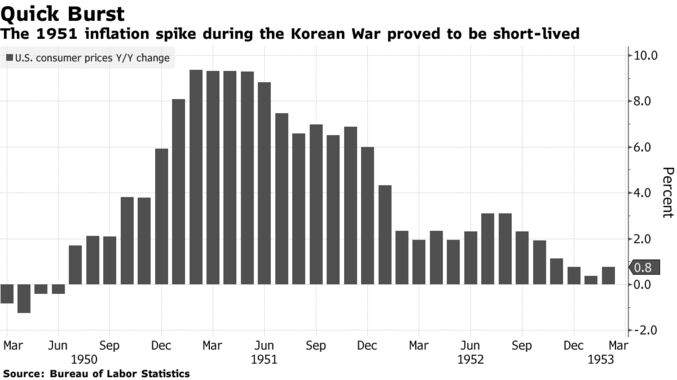
The 1951 inflation spike during the Korean War proved to be short-lived
The worst-case scenario out of the fiscal stimulus package would be a transitory spike in consumer prices as was seen early in the Korean War, Krugman said. The relief bill is “definitely significant stimulus but not wildly inflationary stimulus,” he said.
The liberal economist also suggested that Fed policy makers won’t be dissuaded from taking action out of fear about the reaction in the bond market, where there has already been a surge in yields that’s had ripple effects into equities.
Fed tightening spurred a shock rout in Treasuries in 1994, but “nothing really terrible happened” ultimately, and policy makers will keep that in mind, Krugman said. “No one at the Fed wants to be the people responsible for bringing back the 1970s, so I don’t think they’re that much constrained.”
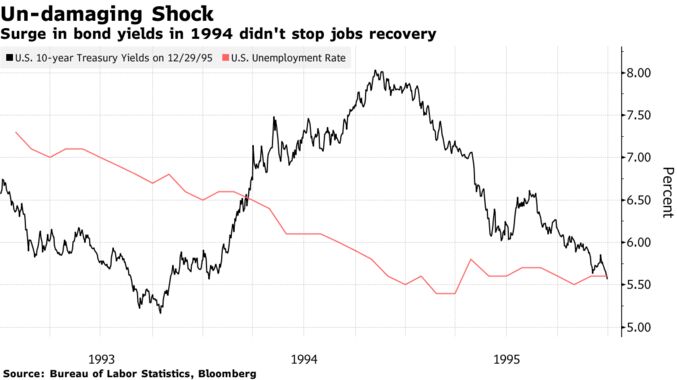
Surge in bond yields in 1994 didn't stop jobs recovery
It was a combination of excessive expansionary fiscal policy under President Lyndon B. Johnson, two oil shocks, and irresponsible monetary policy under the Fed Chair Arthur Burns that combined to create the double-digit inflation of the 1970s that peaked in 1980, Krugman said.
Economists predict that the core inflation measure tied to consumer spending that the Fed uses in its forecasts will remain under 2% this year and next, a Bloomberg survey shows. A different gauge, the consumer price index is seen at 2.4% in 2021 and 2.2% next year. The CPI peaked at over 13% in 1980.
Related: Yellen, Summers Spar About Overheating Risk in Stimulus Plan
https://www.bloomberg.com/news/articles/2021-02-07/yellen-summers-spar-about-overheating-risk-in-stimulus-debate
The risk is that policy makers are “fighting the last war” -- countering the undershooting of the 2% inflation target and limited fiscal measures taken after the 2007-09 financial crisis, the economists said.
Even so, he argued that “redistributionist” aspects of the pandemic-relief package will reduce the need for the Fed to keep monetary stimulus too strong for too long in order to address pockets of high unemployment. Fed Chair Jerome Powell has repeatedly said the central bank wants to see very broad strengthening in the labor market, not just a drop in the national jobless rate.
“It’s not silly to think that there might be some inflationary pressure” from the fiscal package, Krugman said. But it was designed less as stimulus than as a relief plan, he said.
— With assistance by Vince Golle
(Adds inflation forecasts in second paragraph after second chart.)
https://www.bloomberg.com/news/articles/2021-03-18/krugman-dismisses-1970s-style-inflation-risk-with-faith-in-fed
-
What’s the Fed doing in response to the COVID-19 crisis? What more could it do?
Jeffrey Cheng, Tyler Powell, Dave Skidmore, and David Wessel Tuesday, March 30, 2021
https://www.brookings.edu/research/fed-response-to-covid19/
"Four Rules That Should Guide Bidenomics
"Paul Krugman: The banality of democratic collapse
"McCarthy, McConnell drive over their lieutenants to stop bipartisan Jan. 6 commission"""
By Julia Fanzeres
19 March 2021, 9:00 am AEDT Updated on 19 March 2021, 10:45 pm AEDT
* Nobel laureate says Fed not constrained by bond-market worries
* Past inflation crisis came after years of ‘screwing things up’
WATCH: Paul Krugman doesn't think inflation will get out of control again like it did in the 1970's.
Nobel Laureate economist Paul Krugman rejected the threat of inflation getting out of control -- like it did in the 1970s -- as a result of President Joe Biden’s $1.9 trillion pandemic-relief bill.
“It took really more than a decade of screwing things up -- year after year -- to get to that pass, and I don’t think we’re going to do that again,” Krugman said of the inflation scourge of the 1970s to early 1980s. He spoke in an interview with David Westin for Bloomberg Television’s “Wall Street Week” to be broadcast Friday.
The Federal Reserve has “easy” tools to address price pressures if needed, and is unlikely to adopt the “seriously, seriously irresponsible monetary policy” of the 1970s, said Krugman, who’s currently a professor at the City University of New York.
The 1951 inflation spike during the Korean War proved to be short-lived
The worst-case scenario out of the fiscal stimulus package would be a transitory spike in consumer prices as was seen early in the Korean War, Krugman said. The relief bill is “definitely significant stimulus but not wildly inflationary stimulus,” he said.
The liberal economist also suggested that Fed policy makers won’t be dissuaded from taking action out of fear about the reaction in the bond market, where there has already been a surge in yields that’s had ripple effects into equities.
Fed tightening spurred a shock rout in Treasuries in 1994, but “nothing really terrible happened” ultimately, and policy makers will keep that in mind, Krugman said. “No one at the Fed wants to be the people responsible for bringing back the 1970s, so I don’t think they’re that much constrained.”
Surge in bond yields in 1994 didn't stop jobs recovery
It was a combination of excessive expansionary fiscal policy under President Lyndon B. Johnson, two oil shocks, and irresponsible monetary policy under the Fed Chair Arthur Burns that combined to create the double-digit inflation of the 1970s that peaked in 1980, Krugman said.
Economists predict that the core inflation measure tied to consumer spending that the Fed uses in its forecasts will remain under 2% this year and next, a Bloomberg survey shows. A different gauge, the consumer price index is seen at 2.4% in 2021 and 2.2% next year. The CPI peaked at over 13% in 1980.
Related: Yellen, Summers Spar About Overheating Risk in Stimulus Plan
https://www.bloomberg.com/news/articles/2021-02-07/yellen-summers-spar-about-overheating-risk-in-stimulus-debate
The risk is that policy makers are “fighting the last war” -- countering the undershooting of the 2% inflation target and limited fiscal measures taken after the 2007-09 financial crisis, the economists said.
Even so, he argued that “redistributionist” aspects of the pandemic-relief package will reduce the need for the Fed to keep monetary stimulus too strong for too long in order to address pockets of high unemployment. Fed Chair Jerome Powell has repeatedly said the central bank wants to see very broad strengthening in the labor market, not just a drop in the national jobless rate.
“It’s not silly to think that there might be some inflationary pressure” from the fiscal package, Krugman said. But it was designed less as stimulus than as a relief plan, he said.
— With assistance by Vince Golle
(Adds inflation forecasts in second paragraph after second chart.)
https://www.bloomberg.com/news/articles/2021-03-18/krugman-dismisses-1970s-style-inflation-risk-with-faith-in-fed
-
What’s the Fed doing in response to the COVID-19 crisis? What more could it do?
Jeffrey Cheng, Tyler Powell, Dave Skidmore, and David Wessel Tuesday, March 30, 2021
https://www.brookings.edu/research/fed-response-to-covid19/
It was Plato who said, “He, O men, is the wisest, who like Socrates, knows that his wisdom is in truth worth nothing”
Discover What Traders Are Watching
Explore small cap ideas before they hit the headlines.



