Analysis of government support for Australian agricultural producers
Author: Jared Greenville
Summary
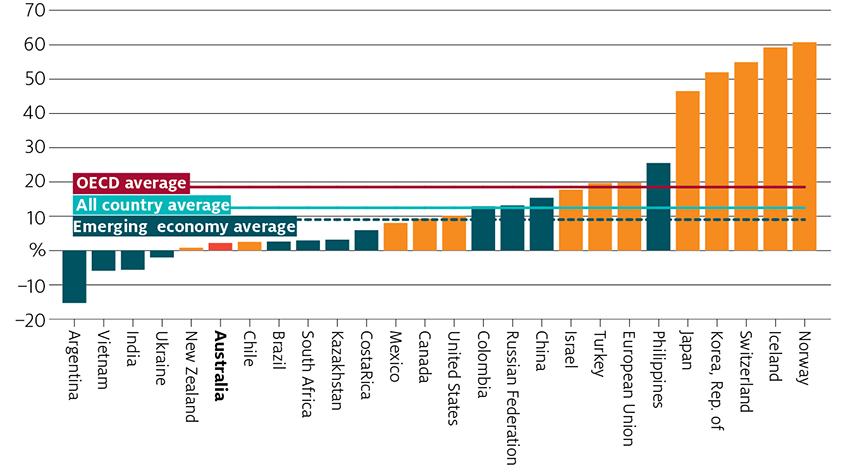
Australia has one of the lowest levels of support
Notes: Support measures as a share of gross farm receipts. The All countries total includes all OECD countries, non-OECD EU Member States, and the 12 Emerging Economies. The OECD total does not include the non-OECD EU Member States. Latvia and Lithuania are included only from 2004. The 12 Emerging Economies include Argentina, Brazil, China, Colombia, Costa Rica, India, Kazakhstan, the Philippines, Russian Federation, South Africa, Ukraine and Vietnam.
Source: OECD
Australian farmers are some of the least subsidised in the world – second only to New Zealand in terms of countries where comparable information is available. As measured by the OECD, just over 2% of Australian farmer revenues in 2016-18 were derived from government support. Globally, Norway (61%), Iceland (59%) and Switzerland (55%) in Europe, and Korea (52%) and Japan (46%) in Asia, provide the highest levels of agricultural subsidies.
Australia has reformed its approach to agricultural support over time, in line with national competition policy and other pro-competitive reforms and consistent with WTO obligations. Government support is now dominated by investments in sector capacity, such as R&D. Where direct farm support is provided, it is concentrated on risk management tools to help manage Australia’s uniquely variable climate. These tools include Farm Management Deposits and income tax smoothing.
Keeping subsidies low is important for both Australian producers and international markets. Australia’s reform experience shows that deregulating the agriculture sector and removing distorting forms of support spurs overall sector growth, increasing participation in global markets and the contribution that agriculture makes to the rural and national economy.
Current global levels of production and trade distorting support mean that global agricultural production and trade is lower than it could be and households are worse off. For Australia alone, estimates suggest that global subsidies and trade barriers could be costing Australian agriculture between $8 billion to $10 billion in exports annually (Anderson and Valenzuela 2020; Greenville et al. 2019c).
In recent years, with little progress at the WTO, global reductions in the level of production and trade distorting support have stalled. In fact, average levels of support across the OECD and emerging countries have been stable to rising. This trend has the potential to worsen with the introduction of some measures in response to the COVID-19 pandemic.
All governments have an interest in keeping agricultural markets free from distortions to promote global food security and contribute to rural development. Governments do need to make investments in agriculture to help meet global development goals, but it is important that these investments not harm producers elsewhere. Furthermore, the impact of rising levels of support have disproportionately larger negative impacts on the countries that implement those policies than on others. Future trade rules will be needed to help guide policy actions so they do not harm producers in other countries and to avoid an erosion of the past gains from freer agricultural markets made since the WTO Agreement on Agriculture came into effect.
How Farm Subsidies Harm Taxpayers, Consumers, and Farmers, Too Trump's tariffs enable him to increase the subsidization level of large American farmers even more. His way of introducing more socialism into the system. It all makes sense to Trump supporters. https://investorshub.advfn.com/boards/read_msg.aspx?message_id=148788609
Stiglitz: Here's How to Fix Inequality "Widening Income Inequality Bad For Economic Growth: IMF Report" In his new book, a Nobel laureate outlines how the huge disparity arose and the huge course correction needed to address it [...] Instead, he swings for the fences, suggesting a massive revision in the way the U.S. economy does business. First up is the attempt to tame what is called rent-seeking—the practice of increasing wealth by taking it from others rather than generating any actual economic activity. Lobbying, for example, allows large companies to spend money influencing laws and regulations in their favor, but lobbying itself isn’t helpful for the economy besides creating a small number of jobs in Washington; it produces nothing but helps an already rich and influential group grow more rich and more influential. Stiglitz suggests that reducing rent-seeking is critical to reining in inequality, especially when it comes to complex issues such as housing prices, patents, and the power that large corporations wield. [...] To further ensure that corporations, markets, and individuals aren’t pursuing profits at the expense of workers and the public, Stiglitz calls for a more active central bank. He accuses the Fed of being both too narrowly focused on macroeconomic indicators, and too deferential to the businesses and markets it has the ability to regulate. He wants the government to sponsor a homeownership agency that would dole out housing loans in a way that encourages buyers instead of developers and would closely monitor the market for fairness. P -Stiglitz’s thoroughness is admirable, but his prescriptions can be overwhelming, given how much it would take to make each change. The agenda also includes emphasizing the goal of full employment rather than focusing on the sometimes reductive unemployment figures; investment in public infrastructure; better access to financial services, childcare, health care, and paid leave; and strengthened opportunities for collective bargaining. Oh, and better wages for workers, and more corporate transparency, too. https://investorshub.advfn.com/boards/read_msg.aspx?message_id=119974049


 Market Data
  Markets


 AI
AI