Conservative fear campaign failed as principled Democrats held firm for impeachment vote.
Conservative groups target their impeachment ‘Dirty 30’
"The Billion-Dollar Disinformation Campaign to Reelect the President How new technologies and techniques pioneered by dictators will shape the 2020 election"
Advocacy organizations are running ads against the House Democrats who represent districts that Donald Trump won in 2016.
Donald Trump Jr. has encouraged his Twitter followers to go after the Democratic representatives from districts his father won. | Chip Somodevilla/Getty Images
By ANITA KUMAR 12/15/2019 07:13 AM EST Updated: 12/15/2019 08:29 PM EST
Residents in 31 congressional districts are about to be inundated with millions of dollars’ worth of TV spots, Facebook ads, texts and tweets blaring that the “radical left” is trying to remove the president after a “witch hunt” — and that their Democratic representative is complicit.
A new way 2020 candidates want to win your vote: tracking your phone’s location
The Billion-Dollar Disinformation Campaign to Reelect the President How new technologies and techniques pioneered by dictators will shape the 2020 election
The fight for your phone is “where the game is going to be played.” By Theodore Schleifer@teddyschleifer Dec 11, 2019, 8:00am EST
Open Sourced
If you think politicians already know too much about you — from your home address to what you like to search for on YouTube to whatever was leaked in the Cambridge Analytica scandal — just wait.
Campaigns are scouting out new, intrusive sources of political data to track possible supporters that both sides agree will, at some point, become the norm in American elections going forward.
Political campaigns have become contests in data collection, with both Democrats and Republicans pacing digital beaches with new and improved metal detectors meant to find the latest types of buried treasures. And in pitched presidential elections, with both sides on the hunt for ever-so-slight upper hands, data collection efforts are growing more sophisticated, disguised, and all-encompassing.
Democratic presidential candidate and former Vice President Joe Biden takes a selfie as he greets attendees during an event in Council Bluffs, Iowa, on November 30, 2019. Joshua Lott/Getty Images
That spells trouble for activists who worry about the reach of political candidates and of tech companies — especially when the two combine forces. If political campaigns can invade our privacy and manipulate our opinions with the data they collect, some fear it will erode our democracy.
“Campaigns are collecting anything and everything that’s possible,” said Frank Ahearn, a privacy expert who advises clients on how to scrub their digital footprint. “Online data has become a new weapon.”
Your phone’s location is “where the game is going to be played”
Political data begins and ends at the voter file, which is a compendium of information about you that’s rooted in offline data such as your voting frequency, party registration, and what you may have told volunteers when they knocked on your door. Political operatives are always working to enrich this offline data with new, digital data about you — and to do so better and faster than their political rivals.
Part of the reason that campaigns are seeking new data sources is that some of the favored sources of the past — most notably, cookies — are proving less useful. Browsers such as Safari, Chrome, and Firefox .. https://www.vox.com/recode/2019/8/22/20828551/google-chrome-advertising-privacy .. have recently made it more difficult to track specific people on desktop and mobile browsers as they cycle across the internet. These cookies used to be a major part of campaigns’ advertising strategies.
And so some political operatives on both sides see mobile advertising IDs — basically, a profile of each cellphone user, based on location data, that is assigned an “ID” and is theoretically anonymous — as the next frontier in political data collection. They’re already a well-worn data set in commercial advertising .. https://www.nytimes.com/interactive/2018/12/10/business/location-data-privacy-apps.html , an area where some are starting to voice privacy concerns.
“Getting device IDs is where the game is going to be played,” said Keegan Goudiss, who served as the Bernie Sanders campaign’s head of digital advertising in 2016.
Here’s how it works: Certain apps you’ve downloaded on your phone and given permission to collect your location data then sell that data to brokers, who then sell that information to bidders like political campaigns. Campaigns can — with the help of third parties — then match specific mobile advertising IDs to specific voters and harness that data to present these people with the optimal campaign messaging.
Phone location data is one of the data sources that political operatives have been using to gain an edge on their political rivals. Justin Sullivan/Getty Images
Experts in the field have ideas about how the GOP or Democrats might use this kind of data. One Democratic strategist imagined a scenario in which the GOP could use people’s phone IDs to construct mass datasets — for example, one that contains information about every churchgoer in America. Then Republicans could match that data with voting history and come up with a list of churchgoers who infrequently show up on Election Day. The GOP could then send its volunteers to knock on specific doors in specific neighborhoods, for instance, and try to get those voters to the polls.
Cyrus Krohn, who oversaw digital strategy for the Republican National Committee in 2008, floated another possibility: What if Republicans used phone locations to track which routine patrons of Chick-fil-A have stopped visiting the chain after the company announced it would no longer support anti-LGBTQ organizations? Republicans could then target these disaffected social conservatives with messaging meant to reenergize them.
This is all no longer theoretical: The Trump campaign earlier this year changed its .. https://mashable.com/article/trump-campaign-beacons-privacy-policy/ .. privacy policy to alert voters that it might use beacons, or transmitters that use Bluetooth to track you and your phone’s proximity to a specific location. The campaign has never actually ever used beacons, a campaign source said.
A pro-Trump super PAC, Committee to Defend the President, has reportedly .. https://www.wsj.com/articles/political-campaigns-track-cellphones-to-identify-and-target-individual-voters-11570718889 .. gone ahead and employed beacons to capture mobile IDs. Democrats say that they, too, have experimented with collecting location-based data in the past, but on a smaller scale. And strategists think it’s only a matter of time before this becomes de rigueur in presidential politics.
“Telephone tells all of our truths. We confess to our phones almost daily,” says Ahearn. “The mobile phone is the gold of information.”
But privacy advocates worry about this new era we’re entering.
“Anytime you’re looking at targeted advertising based on location, you’re inviting manipulative practices. And when it comes to political advertising, there’s a lot of room for abuse and a lot of reason to be concerned,” said Lindsey Barrett, an attorney who specializes in tech privacy issues. That’s especially true, she said, for a “Trump campaign in particular that has shown no problem whatsoever about lying and shoving really dangerous rhetoric .. https://www.vox.com/policy-and-politics/2018/11/2/18051420/trump-closing-argument-ugly-immigration-speech .. down people’s throats.”
Campaigns already know plenty about you
But that’s mostly what’s coming in the future. And the present is already concerning.
Democratic and GOP campaigns have focused primarily on collecting what is called “first-party data,” or data that it directly collects from voters that it considers the gold standard. That explains the vast amount of surveys, petitions, and emails that flood the inboxes and feeds of American voters — and the Trump campaign, in particular, wants to know who its most committed voters are. Purchases through the campaign store count, too.
Of particular value to Trump is your cellphone number. His campaign has invested heavily in building out its text messaging list, according to a person familiar with the matter. Campaign rallies, which Trump has been holding continuously since he was first elected, reportedly require at least one attendee per group .. https://www.wsj.com/articles/trumps-rallies-arent-just-part-of-his-campaign-they-are-the-campaign-11571753199 .. to provide their phone number to receive their tickets, supplying the Trump campaign with a robust list of its most committed backers.
“We can use it as a data mining opportunity,” campaign manager Brad Parscale told one interviewer .. https://www.foxnews.com/politics/trump-campaign-manager-claims-dems-are-freaked-out-over-campaigns-digital-dominance . “Turn every single one of our rally goers into a volunteer on-site for the rally. They can get out there and actually collect data. ‘Hey, who were your 10 friends? Who were your hundred friends? Tell us what your friends like about Trump. Give us their phone numbers.’ That will give us an even greater opportunity to expand the spider web of data.”
A small text message list can in theory raise as much money as a large email list. That’s because those who have taken action, such as attending an event, or texting a campaign account, are more likely to be super supporters.
“The data that’s going to be dragged from those peer-to-peer interactions could potentially provide insights into who’s my best possible persuader,” Krohn said.
However, the backbone of political campaigns’ data collection continues to come from so-called second-party data: commercial information obtained from brokers.
Campaigns buy data such as credit card information that illuminates the buying habits of specific voters. Datasets can be built with as many as 300 different attributes — such as whether homeowners own DVD players, whether they’ve bought crochet supplies recently, whether they smoke cigarettes, or whether they have a premium credit card — and then, when that data is run through a custom-built model and added to a party’s voter file, it can help campaigns target their likely voters.
But the Trump campaign source said the campaign prioritizes obtaining first-party data since the respondent is taking initiative to interact with Trump’s messaging.
Data like that is added to the Trump campaign’s voter file and determines the types of ads that you and other voters might see as you crawl across Facebook or Google. On those platforms, the Trump campaign became known in 2016 for essentially testing loads of ads simultaneously to observe infinitesimal differences in spots, essentially a “throw everything at the wall and see what sticks” strategy for the digital age. During the 2016 campaign, Trump ran 5.9 million unique ads.
All this experimentation — and boundary pushing — worries many Democrats, who are likely to be locked in their own political battles well into 2020 as Trump refines his digital tactics.
“They have a lot of money invested in how do we get as much data from our supporters and potential supporters as possible,” Goudiss said, “at a larger scale than the Democrats.”
Open Sourced is made possible by the Omidyar Network. All Open Sourced content is editorially independent and produced by our journalists.
"The Billion-Dollar Disinformation Campaign to Reelect the President How new technologies and techniques pioneered by dictators will shape the 2020 election"
By Lisa Marie Pane, The Associated Press
Posted Mar 30, 2020 at 4:20 PM Updated Mar 30, 2020 at 8:30 PM
The Trump administration has ruled that gun shops are considered ‘essential’ businesses that should remain open as other businesses are closed to try to stop the spread of coronavirus. Gun control groups are balking, calling it a policy that puts profits over public health after intense lobbying by the firearms industry.
In the past several weeks, various states and municipalities have offered different interpretations of whether gun stores should be allowed to remain open as Americans stay at home to avoid spreading the virus. In Los Angeles, for example, County Sheriff Alex Villanueva has twice ordered gun shops in his territory to close, leading to legal challenges from gun rights advocates.
After days of lobbying by the National Rifle Association, the National Shooting Sports Foundation and other gun groups, the Department of Homeland Security this past weekend issued an advisory declaring that firearms dealers should be considered essential services ” just like grocery stores, pharmacies and hospitals ” and allowed to remain open. The agency said its ruling was not a mandate but merely guidance for cities, towns and states as they weigh how to prevent the spread of the coronavirus.
Still, gun control groups called it a move to put profits over public health. The Brady group on Monday filed a Freedom of Information request with DHS seeking emails and documents that explain how the agency reached its decision to issue the advisory and to determine if it consulted with any public health experts.
For most people, the new coronavirus causes mild or moderate symptoms, such as fever and cough, that clear up in two to three weeks. For some, especially older adults and people with existing health problems, it can cause more severe illness, including pneumonia, and death.
‘The gun lobby is not willing to stand for a few days or a few weeks of less profit in order to protect public health, and it’s outrageous and definitely not required by the Second Amendment,’ said Jonathan Lowy, chief counsel for Brady. He added later: ‘It’s a public health issue, not a Second Amendment issue. The fact is that guns, the nature of guns, require that they be sold with a lot of close interaction. They can’t be sold from vending machines, can’t be sold with curbside pickup.’
The gun lobby has been pushing back vigorously against places where some authorities have deemed federally licensed gun dealers are not essential and should close as part of stay-at-home directives. The gun lobby has said it’s critical these shops remain open so Americans, who are buying firearms in record numbers, have the ability to exercise their constitutional rights.
In recent weeks, firearm sales have skyrocketed. Background checks ” the key barometer of gun sales ” already were at record numbers in January and February, likely fueled by a presidential election year. Since the coronavirus outbreak, gun shops have reported long lines and runs on firearms and ammunition.
Background checks were up 300% on March 16, compared with the same date a year ago, according to federal data shared with the NSSF, which represents gunmakers. Since Feb. 23, each day has seen roughly double the volume over 2019, according to Mark Oliva, spokesman for the group.
In Texas, the attorney general there issued a legal opinion saying that emergency orders shuttering gun shops are unconstitutional. That stands in contrast to some municipalities, such as New Orleans, where the mayor has issued an emergency proclamation that declares the authority to restrict sales of firearms and ammunition.
NSSF and other gun lobbying groups hailed the ruling as a victory for gun owners, especially first-time buyers of a firearm who are concerned that upheaval and turmoil over the virus could affect personal safety.
’We have seen over the past week hundreds of thousands, even millions, of Americans choosing to exercise their right to keep and bear arms to ensure their safety and the safety of loved ones during these uncertain times,” said Lawrence Keane, senior vice president and general counsel for NSSF. ‘Americans must not be denied the ability to exercise that right to lawfully purchase and acquire firearms during times of emergency.’
Brady’s Lowy said it shouldn’t be considered a violation of Second Amendment rights since it’s temporary and in the midst of a pandemic. He likened it to constitutional rights to peaceably assemble, a right that is being curtailed at the moment as Americans practice social distancing.
“If you have a gun in the home, you are exercising your Second Amendment rights. No court has held that you have a Second Amendment right to a stockpile of guns,' he said.
The vast majority of states are allowing gun shops to remain open. However, some states that have been the hardest hit by the coronavirus have ruled that gun shops are not essential and should close. In the absence of a mandate from federal authorities, gun groups have been filing lawsuits challenging state and local authorities who are ordering gun shops and ranges to close.
The NRA thanked President Donald Trump for the DHS ruling. The NRA has been an unflinching backer of Trump, pumping about $30 million toward his 2016 campaign.
"The Billion-Dollar Disinformation Campaign to Reelect the President How new technologies and techniques pioneered by dictators will shape the 2020 election"
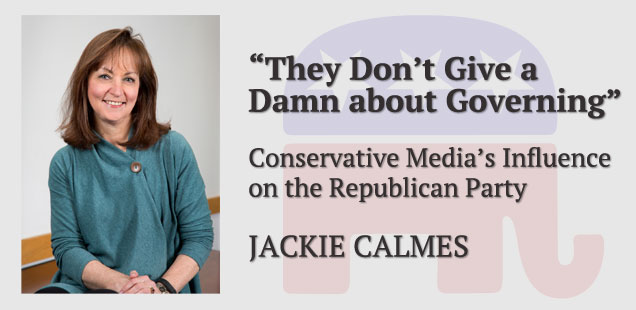
Conservative Media’s Influence on the Republican Party
July 27, 2015, 9:30 am
By Jackie Calmes
A paper by Jackie Calmes, Joan Shorenstein Fellow (Spring 2015) and national correspondent for The New York Times, examines the increasing influence of conservative media on the Republican Party’s agenda.
Calmes traces the history of conservative media, from its founding after World War II to the present-day proliferation of talk radio and Internet personalities. She finds that beyond the big names and outlets such as Limbaugh and Fox, smaller local personalities also exert significant influence over listeners and politicians.
This influence is troubling to leaders in the Republican Party, who Calmes interviewed extensively for the paper. She argues that today’s conservative media now shapes the agenda of the party, pushing it to the far right – at the expense of its ability to govern and pick presidential nominees.
Read related articles by Calmes in The New York Times, “As the GOP Base Clamors for Confrontation, Candidates Oblige” and in The New York Times Magazine, “Steve Deace and the Power of Conservative Media.”
Listen to Calmes discuss her paper on our Media & Politics Podcast:
That article is linked in the article below which in essence is as relevant to America as much as it is to Australia.
Hard-right columnists with no mass audience cause enough turmoil to ruin leaders
* This article is more than 1 year old
Jason Wilson @jason_a_w
Recycling discontent through drama-hungry media, they can bring about the self-fulfilling prophecy of a divided government
Wed 29 Aug 2018 13.28 AEST Last modified on Mon 21 Oct 2019 20.51 AEDT
‘Particular outlets, skilled at playing the attention economy game, have an outsized influence because they can mobilise particular segments of the public and put pressure on key political actors on the right’ Photograph: Sam Mooy/EPA
In his parting words last week, Malcolm Turnbull .. https://www.theguardian.com/australia-news/malcolm-turnbull .. lashed out at a “determined insurgency” from some colleagues and “powerful voices in the media” to “bring down my prime ministership”.
It followed similar assessments from media commentators, including Channel Nine’s Chris Uhlmann, who said News Corp properties and radio station 2GB had been “waging a war” on Turnbull.
Both men perhaps minimised the role that Turnbull’s own shortcomings played in his downfall. But they’re right that hard-right columnists in News Corp papers, Sky News .. https://www.theguardian.com/media/sky-news .. presenters and talkback radio blowhards sought to undermine Turnbull from the moment he himself knifed their man, Tony Abbott.
Still, perhaps Turnbull shouldn’t take it too personally. The attempt to drag conservative parties even further right is, after all, an international phenomenon.
In the United States, as in Australia, it is pursued by a “conservative-industrial complex” which has little regard for the electability or political viability of the parties it works on.
In 2015, not long after Donald Trump declared his candidacy, journalist Jackie Calmes sounded a warning about the relationship between US conservative media and conservative politics.
"Hard-right media figures repeatedly take on those who attempt to come to the centre for pragmatic purposes
She published a prescient report .. https://shorensteincenter.org/conservative-media-influence-on-republican-party-jackie-calmes/ .. for Harvard’s Shorenstein Center, appropriately entitled “They Don’t Give a Damn about Governing”. Calmes interviewed a range of Republican party insiders who voiced frustrations similar to Turnbull’s – conservative media relentlessly attempted to actively meddle in politics, inhibited compromise and good policy, and ceaselessly dragged the GOP right. The principal means they employed was to punish anyone who made deals with Democrats, or even voiced moderate sentiments, by turning the most active segment of the Republican base against them.
“Conservative media, having helped push the party so far to the anti-government, anti-compromise ideological right, attacks Republican leaders for taking the smallest step toward the moderate middle”, the report said.
Calmes pointed to the perverse circumstances which allowed this to happen. Conservative media did not need to attract moderate listeners, but sought instead to maximise the engagement of their committed niche audience. And in an attention economy, the requirement for edginess and outrage completely overwhelms any residual commitment to good faith debate. Their audience was also more likely than moderate conservatives, let alone independents, to vote in the primary elections in which candidates were selected.
All of this led to a peculiar cycle which may sound familiar to Australians, despite the different dynamics in our political systems.
Hard-right media figures repeatedly take on those who attempt to come to the centre for pragmatic purposes, because in doing so, they can’t lose.
“Those in conservative media, whether in print, online, or radio and TV broadcasting, invariably see these fights as a win-win”, Calmes wrote. “They and their audiences repeatedly get to set the agenda, to provoke a confrontation in defense of what they see as conservative principles. And when the fight fails – well, that is Republican leaders’ fault for not fighting hard enough.“
None of this means that these broadcasters are not authentically committed to far-right positions – in a fragmenting, overcrowded media and information landscape, authenticity is yet another way for particular voices to differentiate themselves. Nor does it discount broader influences on their positions – Calmes shows how in the US case, the policy priorities of extractive industries and billionaires filter through an ecology of rightwing thinktanks and patronage networks to inform broadcasters’ agendas.
But the current state of the media business also means that particular outlets, skilled at playing the attention-economy game, have an outsized influence because they can mobilise particular segments of the public and put pressure on key political actors on the right.
News Corp columnists such as Bolt, his fellow Sky presenters, and the dinosaurs of talkback cannot claim to have a true mass audience. But like conservative media in the US, they can leverage the audience they have to cause such turmoil in conservative politics that the position of a leader like Turnbull – moderate only relative to the bloody-minded reactionaries on his backbench – becomes utterly untenable.
By putting together a segment of the Liberal party .. https://www.theguardian.com/australia-news/liberal-party .. “base” with parliamentary ideologues, and having the resulting discontent recycled through drama-hungry news media for weeks and months, they can bring about the self-fulfilling prophecy of a weak and divided government.
Last week in parliament, we saw once again that the Liberal party right and their media sponsors can’t even command a majority of the Liberals’ party room, let alone a majority of public opinion.
But they can ruin prime ministers, delay action on climate change, offer a platform to those pushing white nationalism and present all of this to their audiences as victory.
Suspicious robocall campaign warning people to ‘stay home’ spooks voters nationwide
"The Billion-Dollar Disinformation Campaign to Reelect the President"
A Department of Homeland Security official said the FBI was investigating the call, which, along with new robotexts that surfaced in Michigan, prompted warnings about misinformation
VIDEO - How to spot voter intimidation and what to do if it happens to you 4:03 Some states have already seen signs of voter intimidation at early voting locations. Here’s your guide on how to spot and avoid it. (Blair Guild, John Farrell/The Washington Post)
By Tony Romm and Isaac Stanley-Becker
November 4, 2020 at 8:44 a.m. GMT+11
A wave of suspicious robocalls and texts bombarded voters as they began to cast their ballots on Tuesday, sparking fresh concerns about the extent to which malicious actors might harness Americans’ smartphones to scare people from the polls.
Across the country, voters have received an estimated 10 million automated, spam calls in recent days telling them to “stay safe and stay home,” according to experts who track the telecom industry. In Michigan, government officials on Tuesday said they had witnessed additional attempts to deceive their state’s voters in particular, including one robocall campaign targeting the city of Flint that inaccurately told people to vote tomorrow if they hoped to avoid long lines today.
The origins of the each of the calls and texts remain unclear, reflecting the sophisticated tactics that robocallers typically deploy in order to reach Americans en masse across a wide array of devices and services. State election officials have scrambled to reassure voters in response, with Michigan Gov. Gretchen Whitmer pledging Tuesday to “work quickly to stamp out misinformation." The FBI also has opened an investigation into the Michigan robocalls, a Trump administration official said.
The reach and timing of the “stay home” calls similarly caught the attention of state and federal government leaders, including New York Attorney General Letitia James (D), who said she had already sent subpoenas to investigate the source of the intrusion. Data prepared for The Washington Post by YouMail, a tech company that offers a robocall-blocking app for smartphones, shows that the calls have reached 280 of the country’s 317 area codes since the campaign began in the summer. The country’s top telecom carriers believe the calls are foreign in origin.