



 AI
AI








Sunday, April 26, 2020 12:22:22 AM
“They Don’t Give a Damn about Governing”
"The Billion-Dollar Disinformation Campaign to Reelect the President
How new technologies and techniques pioneered by dictators will shape the 2020 election"
Conservative Media’s Influence on the Republican Party
July 27, 2015, 9:30 am
By Jackie Calmes
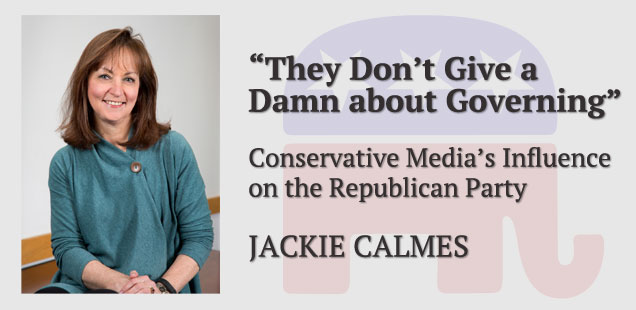
A paper by Jackie Calmes, Joan Shorenstein Fellow (Spring 2015) and national correspondent for The New York Times, examines the increasing influence of conservative media on the Republican Party’s agenda.
Calmes traces the history of conservative media, from its founding after World War II to the present-day proliferation of talk radio and Internet personalities. She finds that beyond the big names and outlets such as Limbaugh and Fox, smaller local personalities also exert significant influence over listeners and politicians.
This influence is troubling to leaders in the Republican Party, who Calmes interviewed extensively for the paper. She argues that today’s conservative media now shapes the agenda of the party, pushing it to the far right – at the expense of its ability to govern and pick presidential nominees.
Read related articles by Calmes in The New York Times, “As the GOP Base Clamors for Confrontation, Candidates Oblige” and in The New York Times Magazine, “Steve Deace and the Power of Conservative Media.”
Listen to Calmes discuss her paper on our Media & Politics Podcast:
Overview
https://shorensteincenter.org/conservative-media-influence-on-republican-party-jackie-calmes/
That article is linked in the article below which in essence is as relevant to America as much as it is to Australia.
Hard-right columnists with no mass audience cause enough turmoil to ruin leaders
* This article is more than 1 year old
Jason Wilson @jason_a_w
Recycling discontent through drama-hungry media, they can bring about the self-fulfilling prophecy of a divided government
Wed 29 Aug 2018 13.28 AEST
Last modified on Mon 21 Oct 2019 20.51 AEDT

‘Particular outlets, skilled at playing the attention economy game, have an outsized influence because they can mobilise particular segments of the public and put pressure on key political actors on the right’ Photograph: Sam Mooy/EPA
In his parting words last week, Malcolm Turnbull .. https://www.theguardian.com/australia-news/malcolm-turnbull .. lashed out at a “determined insurgency” from some colleagues and “powerful voices in the media” to “bring down my prime ministership”.
It followed similar assessments from media commentators, including Channel Nine’s Chris Uhlmann, who said News Corp properties and radio station 2GB had been “waging a war” on Turnbull.
Turnbull says forces 'outside the parliament' have worked to destabilise leadership
Read more > https://www.theguardian.com/australia-news/2018/aug/23/turnbull-says-forces-outside-the-parliament-have-worked-to-destabilise-leadership
Both men perhaps minimised the role that Turnbull’s own shortcomings played in his downfall. But they’re right that hard-right columnists in News Corp papers, Sky News .. https://www.theguardian.com/media/sky-news .. presenters and talkback radio blowhards sought to undermine Turnbull from the moment he himself knifed their man, Tony Abbott.
Memorably, conservative columnists had their own internecine biff on this score, in which Turnbull loyalist Miranda Devine labelled .. https://www.theguardian.com/commentisfree/2016/apr/15/in-defence-of-abbott-for-the-delcons-electoral-victory-doesnt-matter .. Abbott’s hit squad “delusional conservatives”, an appellation they proudly adopted. Ever since he took the reins, the likes of Andrew Bolt, Alan Jones and the denizens of Sky After Dark .. https://www.smh.com.au/national/sky-news-after-dark-a-digital-nuremberg-rally-20180807-p4zvxr.html .. habitually went after Turnbull in the most personal and vitriolic terms.
Still, perhaps Turnbull shouldn’t take it too personally. The attempt to drag conservative parties even further right is, after all, an international phenomenon.
In the United States, as in Australia, it is pursued by a “conservative-industrial complex” which has little regard for the electability or political viability of the parties it works on.
In 2015, not long after Donald Trump declared his candidacy, journalist Jackie Calmes sounded a warning about the relationship between US conservative media and conservative politics.
"Hard-right media figures repeatedly take on those who attempt
to come to the centre for pragmatic purposes
She published a prescient report .. https://shorensteincenter.org/conservative-media-influence-on-republican-party-jackie-calmes/ .. for Harvard’s Shorenstein Center, appropriately entitled “They Don’t Give a Damn about Governing”. Calmes interviewed a range of Republican party insiders who voiced frustrations similar to Turnbull’s – conservative media relentlessly attempted to actively meddle in politics, inhibited compromise and good policy, and ceaselessly dragged the GOP right. The principal means they employed was to punish anyone who made deals with Democrats, or even voiced moderate sentiments, by turning the most active segment of the Republican base against them.
“Conservative media, having helped push the party so far to the anti-government, anti-compromise ideological right, attacks Republican leaders for taking the smallest step toward the moderate middle”, the report said.
Calmes pointed to the perverse circumstances which allowed this to happen. Conservative media did not need to attract moderate listeners, but sought instead to maximise the engagement of their committed niche audience. And in an attention economy, the requirement for edginess and outrage completely overwhelms any residual commitment to good faith debate. Their audience was also more likely than moderate conservatives, let alone independents, to vote in the primary elections in which candidates were selected.
All of this led to a peculiar cycle which may sound familiar to Australians, despite the different dynamics in our political systems.
Hard-right media figures repeatedly take on those who attempt to come to the centre for pragmatic purposes, because in doing so, they can’t lose.
“Those in conservative media, whether in print, online, or radio and TV broadcasting, invariably see these fights as a win-win”, Calmes wrote. “They and their audiences repeatedly get to set the agenda, to provoke a confrontation in defense of what they see as conservative principles. And when the fight fails – well, that is Republican leaders’ fault for not fighting hard enough.“
None of this means that these broadcasters are not authentically committed to far-right positions – in a fragmenting, overcrowded media and information landscape, authenticity is yet another way for particular voices to differentiate themselves. Nor does it discount broader influences on their positions – Calmes shows how in the US case, the policy priorities of extractive industries and billionaires filter through an ecology of rightwing thinktanks and patronage networks to inform broadcasters’ agendas.
But the current state of the media business also means that particular outlets, skilled at playing the attention-economy game, have an outsized influence because they can mobilise particular segments of the public and put pressure on key political actors on the right.
News Corp bites back after Uhlmann's spray on Liberal leadership
Amanda Meade
Read more > https://www.theguardian.com/media/2018/aug/24/news-corp-bites-back-after-uhlmanns-spray-on-liberal-leadership
News Corp columnists such as Bolt, his fellow Sky presenters, and the dinosaurs of talkback cannot claim to have a true mass audience. But like conservative media in the US, they can leverage the audience they have to cause such turmoil in conservative politics that the position of a leader like Turnbull – moderate only relative to the bloody-minded reactionaries on his backbench – becomes utterly untenable.
By putting together a segment of the Liberal party .. https://www.theguardian.com/australia-news/liberal-party .. “base” with parliamentary ideologues, and having the resulting discontent recycled through drama-hungry news media for weeks and months, they can bring about the self-fulfilling prophecy of a weak and divided government.
Last week in parliament, we saw once again that the Liberal party right and their media sponsors can’t even command a majority of the Liberals’ party room, let alone a majority of public opinion.
But they can ruin prime ministers, delay action on climate change, offer a platform to those pushing white nationalism and present all of this to their audiences as victory.
• Jason Wilson is a Guardian writer and columnist
https://www.theguardian.com/australia-news/commentisfree/2018/aug/29/hard-right-columnists-with-no-mass-audience-cause-enough-turmoil-to-ruin-leaders
"The Billion-Dollar Disinformation Campaign to Reelect the President
How new technologies and techniques pioneered by dictators will shape the 2020 election"
Conservative Media’s Influence on the Republican Party
July 27, 2015, 9:30 am
By Jackie Calmes
A paper by Jackie Calmes, Joan Shorenstein Fellow (Spring 2015) and national correspondent for The New York Times, examines the increasing influence of conservative media on the Republican Party’s agenda.
Calmes traces the history of conservative media, from its founding after World War II to the present-day proliferation of talk radio and Internet personalities. She finds that beyond the big names and outlets such as Limbaugh and Fox, smaller local personalities also exert significant influence over listeners and politicians.
This influence is troubling to leaders in the Republican Party, who Calmes interviewed extensively for the paper. She argues that today’s conservative media now shapes the agenda of the party, pushing it to the far right – at the expense of its ability to govern and pick presidential nominees.
Read related articles by Calmes in The New York Times, “As the GOP Base Clamors for Confrontation, Candidates Oblige” and in The New York Times Magazine, “Steve Deace and the Power of Conservative Media.”
Listen to Calmes discuss her paper on our Media & Politics Podcast:
Overview
https://shorensteincenter.org/conservative-media-influence-on-republican-party-jackie-calmes/
That article is linked in the article below which in essence is as relevant to America as much as it is to Australia.
Hard-right columnists with no mass audience cause enough turmoil to ruin leaders
* This article is more than 1 year old
Jason Wilson @jason_a_w
Recycling discontent through drama-hungry media, they can bring about the self-fulfilling prophecy of a divided government
Wed 29 Aug 2018 13.28 AEST
Last modified on Mon 21 Oct 2019 20.51 AEDT

‘Particular outlets, skilled at playing the attention economy game, have an outsized influence because they can mobilise particular segments of the public and put pressure on key political actors on the right’ Photograph: Sam Mooy/EPA
In his parting words last week, Malcolm Turnbull .. https://www.theguardian.com/australia-news/malcolm-turnbull .. lashed out at a “determined insurgency” from some colleagues and “powerful voices in the media” to “bring down my prime ministership”.
It followed similar assessments from media commentators, including Channel Nine’s Chris Uhlmann, who said News Corp properties and radio station 2GB had been “waging a war” on Turnbull.
Turnbull says forces 'outside the parliament' have worked to destabilise leadership
Read more > https://www.theguardian.com/australia-news/2018/aug/23/turnbull-says-forces-outside-the-parliament-have-worked-to-destabilise-leadership
Both men perhaps minimised the role that Turnbull’s own shortcomings played in his downfall. But they’re right that hard-right columnists in News Corp papers, Sky News .. https://www.theguardian.com/media/sky-news .. presenters and talkback radio blowhards sought to undermine Turnbull from the moment he himself knifed their man, Tony Abbott.
Memorably, conservative columnists had their own internecine biff on this score, in which Turnbull loyalist Miranda Devine labelled .. https://www.theguardian.com/commentisfree/2016/apr/15/in-defence-of-abbott-for-the-delcons-electoral-victory-doesnt-matter .. Abbott’s hit squad “delusional conservatives”, an appellation they proudly adopted. Ever since he took the reins, the likes of Andrew Bolt, Alan Jones and the denizens of Sky After Dark .. https://www.smh.com.au/national/sky-news-after-dark-a-digital-nuremberg-rally-20180807-p4zvxr.html .. habitually went after Turnbull in the most personal and vitriolic terms.
Still, perhaps Turnbull shouldn’t take it too personally. The attempt to drag conservative parties even further right is, after all, an international phenomenon.
In the United States, as in Australia, it is pursued by a “conservative-industrial complex” which has little regard for the electability or political viability of the parties it works on.
In 2015, not long after Donald Trump declared his candidacy, journalist Jackie Calmes sounded a warning about the relationship between US conservative media and conservative politics.
"Hard-right media figures repeatedly take on those who attempt
to come to the centre for pragmatic purposes
She published a prescient report .. https://shorensteincenter.org/conservative-media-influence-on-republican-party-jackie-calmes/ .. for Harvard’s Shorenstein Center, appropriately entitled “They Don’t Give a Damn about Governing”. Calmes interviewed a range of Republican party insiders who voiced frustrations similar to Turnbull’s – conservative media relentlessly attempted to actively meddle in politics, inhibited compromise and good policy, and ceaselessly dragged the GOP right. The principal means they employed was to punish anyone who made deals with Democrats, or even voiced moderate sentiments, by turning the most active segment of the Republican base against them.
“Conservative media, having helped push the party so far to the anti-government, anti-compromise ideological right, attacks Republican leaders for taking the smallest step toward the moderate middle”, the report said.
Calmes pointed to the perverse circumstances which allowed this to happen. Conservative media did not need to attract moderate listeners, but sought instead to maximise the engagement of their committed niche audience. And in an attention economy, the requirement for edginess and outrage completely overwhelms any residual commitment to good faith debate. Their audience was also more likely than moderate conservatives, let alone independents, to vote in the primary elections in which candidates were selected.
All of this led to a peculiar cycle which may sound familiar to Australians, despite the different dynamics in our political systems.
Hard-right media figures repeatedly take on those who attempt to come to the centre for pragmatic purposes, because in doing so, they can’t lose.
“Those in conservative media, whether in print, online, or radio and TV broadcasting, invariably see these fights as a win-win”, Calmes wrote. “They and their audiences repeatedly get to set the agenda, to provoke a confrontation in defense of what they see as conservative principles. And when the fight fails – well, that is Republican leaders’ fault for not fighting hard enough.“
None of this means that these broadcasters are not authentically committed to far-right positions – in a fragmenting, overcrowded media and information landscape, authenticity is yet another way for particular voices to differentiate themselves. Nor does it discount broader influences on their positions – Calmes shows how in the US case, the policy priorities of extractive industries and billionaires filter through an ecology of rightwing thinktanks and patronage networks to inform broadcasters’ agendas.
But the current state of the media business also means that particular outlets, skilled at playing the attention-economy game, have an outsized influence because they can mobilise particular segments of the public and put pressure on key political actors on the right.
News Corp bites back after Uhlmann's spray on Liberal leadership
Amanda Meade
Read more > https://www.theguardian.com/media/2018/aug/24/news-corp-bites-back-after-uhlmanns-spray-on-liberal-leadership
News Corp columnists such as Bolt, his fellow Sky presenters, and the dinosaurs of talkback cannot claim to have a true mass audience. But like conservative media in the US, they can leverage the audience they have to cause such turmoil in conservative politics that the position of a leader like Turnbull – moderate only relative to the bloody-minded reactionaries on his backbench – becomes utterly untenable.
By putting together a segment of the Liberal party .. https://www.theguardian.com/australia-news/liberal-party .. “base” with parliamentary ideologues, and having the resulting discontent recycled through drama-hungry news media for weeks and months, they can bring about the self-fulfilling prophecy of a weak and divided government.
Last week in parliament, we saw once again that the Liberal party right and their media sponsors can’t even command a majority of the Liberals’ party room, let alone a majority of public opinion.
But they can ruin prime ministers, delay action on climate change, offer a platform to those pushing white nationalism and present all of this to their audiences as victory.
• Jason Wilson is a Guardian writer and columnist
https://www.theguardian.com/australia-news/commentisfree/2018/aug/29/hard-right-columnists-with-no-mass-audience-cause-enough-turmoil-to-ruin-leaders
It was Plato who said, “He, O men, is the wisest, who like Socrates, knows that his wisdom is in truth worth nothing”
Discover What Traders Are Watching
Explore small cap ideas before they hit the headlines.



