"Esper says ‘no decisions’ have been finalized on AFRICOM changes"
Exploitation of Africa continues. On water and on land. Once the West took their people. That slavery is gone, yet through our immigration policies we still take many of their best, don't we. So, in difference sense we still do exploit them in a way which helps us and hurts them. Yep, we give a lot too, but surely we could stop stealing their fucking fish. And their livelihoods. Why can't we stop even that? Seems at least that should be relatively easy to stop if all nations did what felt fair in the fisheries sphere, at least.
by John C. Cannon on 3 February 2020
IMAGE - "Banner image of villagers fishing on a beach in Maroantsetra, Madagascar, by Rhett A. Butler/Mongabay."
* A new analysis shows that industrial fishing fleets operating in the waters of African countries and territories spend an average of nearly 6% of their fishing effort inside zones set aside for small-scale fisheries.
* In some countries, foreign fleets spend the bulk of their time — more than 90% in Somalia, for example — within the prohibited zone.
* Communities along Africa’s coasts are often dependent on fish as a source of food and protein.
* But incursions by large-scale fishing vessels, called “the most common form of illegal fishing in the region,” can threaten the sustainability of the resource, create conflict over it, and endanger the lives of fishers themselves.
Fish are an indispensable source of food and protein for communities in many African countries. But the growth in industrial-scale fishing fleets around the continent has put that resource and the livelihoods it supports at risk, according to a recent analysis .. https://onlinelibrary.wiley.com/doi/full/10.1111/faf.12436 .
In a study published Dec. 30 in the journal Fish and Fisheries, a team of researchers shows that nearly 6% of the industrial fishing effort in the waters around 33 African countries and territories occurs in zones reserved for small-scale fishing communities. In some places, that figure is much higher in what the authors describe as “the most common form of illegal fishing in the region.”
These incursions threaten the sustainability of fish stocks, create conflict over those resources, and endanger the lives of the fishers themselves, said Dyhia Belhabib, the study’s lead author.
“In West Africa, for example, 250 people every year die in collisions with industrial vessels within their artisanal waters,” Belhabib, principal investigator for fisheries at the NGO Ecotrust Canada .. http://ecotrust.ca/ , said in an interview. “And this is not a small number.”
Wooden fishing vessels on a beach in Senegal. Image by John C. Cannon/Mongabay.
The study builds on data from the research platform Global Fishing Watch .. https://globalfishingwatch.org/ , which tracks the positions of fishing vessels through their onboard automatic identification system, or AIS. This system was initially designed to keep ships from running into each other. But it has since become an indispensable tool for authorities and conservation groups to verify that fleets are complying with the laws of the country in whose waters they’re operating.
In 2018, researchers developed an algorithm .. https://doi.org/10.1126/scien%20ce.aao5646 .. based on how a fishing vessel moves through the water that uses the satellite-relayed AIS information to pinpoint when and where it’s actually hauling in fish. For this study, Belhabib and her colleagues compared this information with maps of the slice of the ocean that each country or territory controls — what is known as an exclusive economic zone, or EEZ — along with the boundaries of any designated artisanal fishing areas. Most, but not all, of the coastal countries and territories in Africa set aside part of their marine environment for local fishing communities. In general, such regulations prohibit some or all forms of industrial fishing within a specific range, up to 44.4 kilometers (24 nautical miles) from shore.
The team calculated fishing effort in kilowatt-hours using the time spent fishing and the size of the vessels. In their analysis of where that effort occurred between 2012 and 2016, the researchers found that large fishing boats have levied a heavy toll on some countries’ artisanal zones. In Somalia’s waters, for example, 93% of industrial-scale fishing happened in a zone where the law prohibits fishing by these boats. “This is massive,” Belhabib said. “It means that they barely fish outside of the prohibited zone.”
The team also verified each ship’s name and country of origin using data from Global Fishing Watch along with official records and media reports. It can be tricky to parse this information, since vessels sometimes fly a different country’s flag to disguise their origins: A Chinese ship might fly a Ghanaian flag, for example. But the data showed that South Korean, European Union — of which most were Greek, Spanish and French — and Chinese flags were most common after flags from African countries.
Belhabib said the origin countries must follow through on sanctioning their ships caught breaking the law to deal with this often-unchecked illegal fishing.
“The flag state is heavily responsible and accountable for what their fleets are doing in these waters and anywhere in the world,” she said.
Belhabib said each African country faces a unique set of challenges, ranging from their capacity for monitoring to their stage of development to the political will behind enforcement. Even with those hurdles, though, several have made strides toward protecting their homegrown, small-scale fisheries.
Madagascar recently ended an agreement that would have allowed 300 Chinese fishing vessels into its waters. Sierra Leone requires that ships use their AIS and be licensed to operate in the country’s territorial waters. And consortiums such as the Fisheries Committee for the West Central Gulf of Guinea .. https://fcwc-fish.org/about-us/member-states .. aim to ensure sustainable fisheries for their West African member states.
Still, Belhabib said, more must be done.
“As far as political engagement goes, I think there needs to be much, much more done to be able to address this issue.”
Banner image of villagers fishing on a beach in Maroantsetra, Madagascar, by Rhett A. Butler/Mongabay.
John Cannon is a staff features writer at Mongabay. Find him on Twitter: @johnccannon
Civilian deaths and atrocities escalate as chaos builds in Sahel
"Esper says ‘no decisions’ have been finalized on AFRICOM changes "AFRICOM: Wrong for Liberia, Disastrous for Africa""
Human Rights Watch report describes mounting violence in the region from armed militias and Islamist extremists
Jason Burke
Mon 10 Feb 2020 17.10 AEDT Last modified on Tue 11 Feb 2020 01.42 AEDT
Senegalese soldiers in Gao, Mali, on a UN mission, patrolling after a suicide bomb attack on a peace-keeping base in July 2019. Photograph: Souleymane Ag Anara/AFP via Getty Images
The 90-page survey by global campaigners Human Rights Watch .. https://www.hrw.org/ .. describes how a multitude of different armed groups in Mali burned villagers alive, killed others with bombs, and pulled men off buses to execute them by the roadside, in scores of attacks on civilians.
Islamist extremists were responsible for some of the worst attacks, deliberately targeting small children, and killing 17 people at a funeral by hiding a bomb on the remains of a disabled man killed in an earlier attack.
[Insert: Religious zealots, paid mercenaries, separatists, common criminals - mix and match.]
since a coalition of Islamists and local separatisttribesmen took control over much of its northern half in 2012,prompting a French military intervention and a $1bn-a-year peace-keeping operation that has so far failed to stabilise the country.
“Armed groups are killing, maiming, and terrorising communities throughout central Mali with no apparent fear of being held to account … The human toll in shattered lives is mounting as the deadly cycles of violence and revenge continue,” said Corinne Dufka .. https://www.hrw.org/about/people/corinne-dufka , West Africa director at Human Rights Watch and author of the report .. https://www.hrw.org/node/338506/ .
----- [One outed here, Why are French soldiers in the Sahel? Protesters have an answer Alexandra Reza Macron’s autocratic attitude towards dissent in countries such as Niger and Mali is only stoking anti-French sentiment [...] In this context, President Macron says the French Operation Barkhane, which replaced Serval in 2014, exists in the name of the “collective security” of the Sahel and the wider world. P - But France still has significant commercial and political interests in the region. The state-owned energy company, Areva, gets a large proportion of its uranium from Niger. Total has oil fields in Mali. The French have a military base in Chad (when Macron visited in 2018, he brought enough champagne for 1,300 troops). Despite years of fighting, the insecurity and attacks on civilians continue. Four thousand deaths were reported last year alone. P - Sahelian public resistance to the French military presence is a problem for Macron’s government. with links - https://www.theguardian.com/commentisfree/2020/feb/20/france-soldiers-sahel-emmanuel-macron-protest ] -----
Mohamed Ibn Chambas, the UN’s envoy for the fragile region on the southern rim of the Sahara, said the Sahel had experienced “a devastating surge in terrorist attacks against civilian and military targets”.
Violence in central Mali has escalated steadily in recent years as armed Islamist groups allied to al-Qaida began moving from the north. Many of the bloodiest attacks last year were attributed to an Isis affiliate, Islamic State in the Greater Sahara (ISGS).
Both al-Qaida and Isis have sought to exploit ethnic tensions in the Sahel, where competition between communities has been exacerbated by climate change and demographic pressure on scant resources.
Armed Islamists have recruited fighters from pastoralist Fulani communities, leading others to form self-defence groups. Malian authorities have vowed to disarm the militias but have struggled to do so. Weapons are not difficult to obtain in the region, and criminal networks overlap with the armed groups.
Fulani militia in Sevare, Mali, at an informal demobilisation camp intended to reduce jihadism. Photograph: Marco Longari/AFP via Getty Images
Atrocities by armed Islamists include the killing of at least 38 civilians in simultaneous attacks on the villages of Yoro and Gangafani villages in June .. https://www.theguardian.com/world/2019/jun/18/mali-attack-shooting-yoro-gangafani-2-villages-latest . A witness told the Human Rights Watch report’s authors that Islamist extremists dragged a four year old from a house during the massacre and shot his father in the head.
Human Rights Watch believes the total number of civilians killed in communal and armed Islamist attacks in 2019 is much higher than those documented. Most attacks go unreported.
The Malian government promised to bring those responsible for the worst atrocities to justice. In 2019, Malian courts opened several investigations and convicted about 45 people for smaller incidents of communal violence.
However, judicial authorities have yet to pursue the powerful armed group leaders believed responsible for numerous recent attacks. Many villagers said the lack of accountability was emboldening armed groups to commit further abuses.
“The government, with the help of its international partners, needs to do much more to prosecute those responsible for crimes and dismantle abusive armed groups,” said Dufka.
The rise in violence comes amid reports that the US is likely to reduce its military presence in the Sahel, as it refocuses on great power rivals as a more significant threat than terrorism.
The US currently has thousands of troops in the region and recently opened a major $100m air base in Niger.
The prospect of many of its forces withdrawing from the region has dismayed many actors. A small detachment of British troops is due to deploy later this year to Mali as part of the UN peacekeeping force there.
Gabon coup: The latest in a series of military takeovers on the continent
Related Sudan crisis explained: What’s behind the latest fighting and how it fits nation’s troubled past "Sudan Will Decide the Outcome of the Ethiopian Civil War "Mali’s President Exits After Being Arrested in Military Coup "Civilian deaths and atrocities escalate as chaos builds in Sahel "Esper says ‘no decisions’ have been finalized on AFRICOM changes "AFRICOM: Wrong for Liberia, Disastrous for Africa""""" .. add today a link to that last one .. https://investorshub.advfn.com/boards/read_msg.aspx?message_id=59092358 April, 2023 - https://investorshub.advfn.com/boards/read_msg.aspx?message_id=171728195
Published 30 August
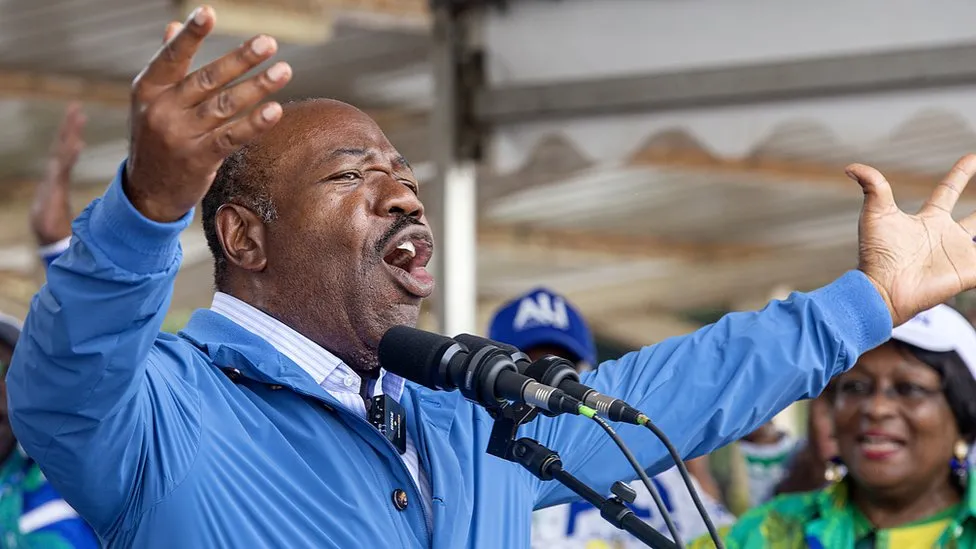
Ali Bongo Ondimba and his father have ruled Gabon for over fifty years. Getty Images
By Peter Mwai BBC News, Nairobi
Military coups were a regular occurrence in some parts of Africa in the decades after independence. Now, after a period of relative democratic stability, there are indications they are on the rise again.
The takeover in Gabon is just the latest in a string of coups that have taken place in recent years, and comes just a month after soldiers took control in Niger.
There were two in Burkina Faso in 2022 as well as failed coup attempts in Guinea Bissau,The Gambia and the island nation of Sao Tome and Principe.
In 2021, there were six coup attempts in Africa, four of them successful.
Last year, a senior African Union official, Moussa Faki Mahamat, expressed concern about "the resurgence of unconstitutional changes of government".
When is a coup a coup?
A coup can be defined as an illegal and overt attempt by the military - or by other civilian officials - to unseat sitting leaders.
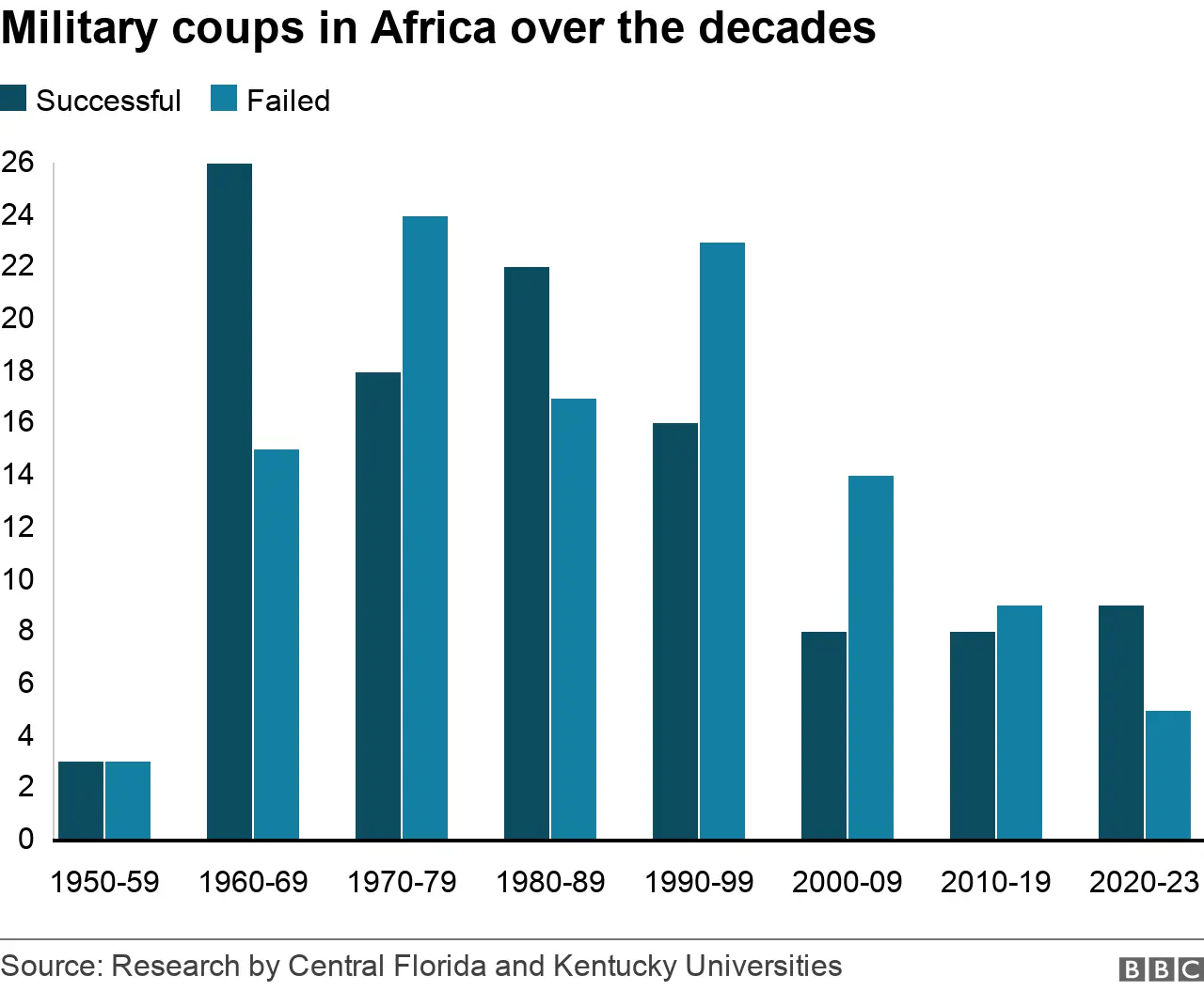
A study by two US researchers, Jonathan Powell and Clayton Thyne, has identified over 200 such attempts in Africa since the 1950s. About half of these have been successful.
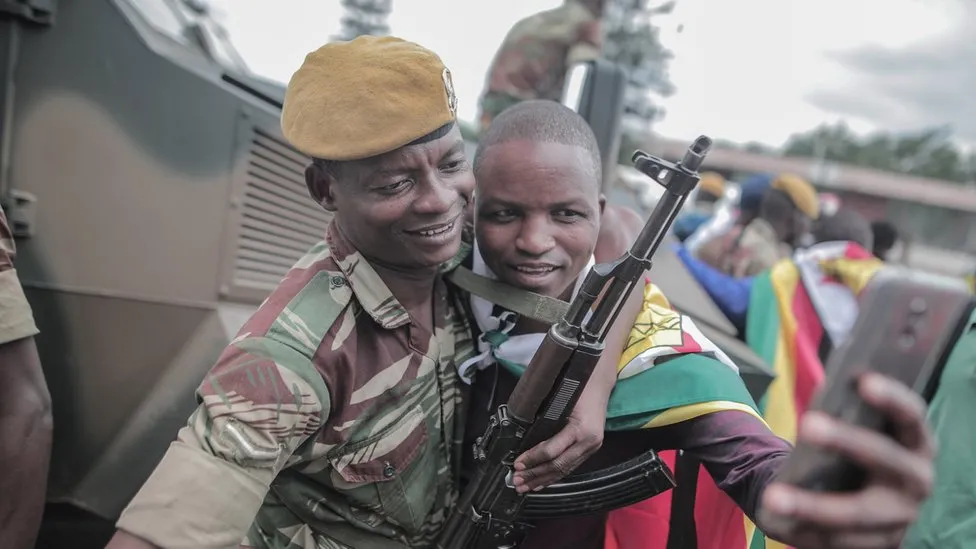
The army in Zimbabwe intervened against President Mugabe in 2017 but denied it was a coup Getty Images
Sometimes, those taking part in such an intervention deny it's a coup.
In 2017 in Zimbabwe, a military takeover brought Robert Mugabe's 37-year rule to and end. But one of the leaders, Maj Gen Sibusiso Moyo, appeared on television at the time, flatly denying it was a military takeover.
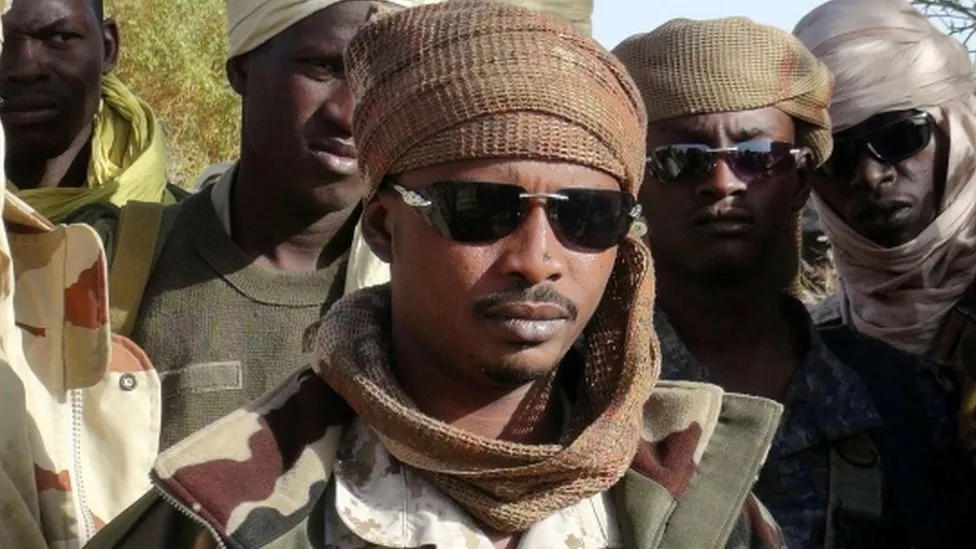
In April 2021 after the death of the Chadian leader, Idriss Déby, the army installed his son as interim president, leading a transitional military council. His opponents called it a "dynastic coup".
"Coup leaders almost invariably deny their action was a coup in an effort to appear legitimate," says Jonathan Powell.
How frequent are coups in Africa?
The overall number of coup attempts in Africa remained fairly consistent at an average of around four a year between 1960 and 2000.
Jonathan Powell says this is not surprising, given the instability many countries experienced in the years after independence.
"African countries have had conditions common for coups, like poverty and poor economic performance. When a country has one coup, that's often a harbinger of more coups."
In the years after 2000, there was a noticeable decline in military interventions.
It's only in the last couple of years that coups have become more prevalent.
In 2020, there was just one coup (in Mali).
Then in 2021 five countries experienced military interventions (Chad, Mali, Guinea, Sudan and Niger).
In 2022, there were also five attempts, with two - both in Burkina Faso - succeeding.
Mahamat Idriss Déby Itno succeeded his father as Chadian leader in April 2021 Reuters
Ndubuisi Christian Ani from the University of KwaZulu-Natal says popular uprisings against long-serving dictators have provided an opportunity for the return of coups in Africa.
"While popular uprisings are legitimate and people-led, success is often determined by the decisions taken by the military," he says.
Which countries have had the most coups?
Sudan has had the most coups and attempted takeovers amounting to 17 - six of them successful.
In 2019, long-serving leader Omar al-Bashir was removed from power following months of protests .. https://www.bbc.com/news/world-africa-47852496 . Bashir himself had taken over in a military coup in 1989.
Burkina Faso in West Africa, has had the most successful coups, with nine takeovers and one failed coup.
Nigeria had a reputation for military coups following independence with eight between January 1966 and the takeover by Gen Sani Abacha in 1993. However, since 1999 transfers of power in Africa's most populous nation have been by democratic election.
Burundi's history has been marked by eleven separate coups, mostly driven by the tensions between the Hutu and Tutsi communities.
Sierra Leone experienced three coups between 1967 and 1968, and another one in 1971. Between 1992 and 1997, it experienced five further coup attempts.
Ghana has also had its share of military coups, with eight in two decades. The first was in 1966, when Kwame Nkrumah was removed from power, and in the following year there was an unsuccessful attempt by junior army officers.
In 2021, the UN Secretary-General António Guterres said that "military coups are back," adding that "geo-political divisions are undermining international co-operation and...a sense of impunity is taking hold," he said.
Overall, Africa has experienced more coups than any other continent. Of the 18 coups recorded globally since 2017, all but one - Myanmar in 2021 - have been in Africa.
Chronology: Liberia's civil war left legacy of violence
Reuters 8 Nov 2005
Nov 8 (Reuters) - Liberians voted on Tuesday to choose their first president after a brutal civil war in an historic runoff ballot between millionaire soccer star George Weah and a Harvard-trained former finance minister. Here is a short chronology of the major political and military events in Liberia since the start of the war.
1989 - Charles Taylor's National Patriotic Front of Liberia (NPFL) begins an uprising against the government of President Samuel Doe, who came to power in a coup in 1980.
1990 - Peacekeeping troops of the Economic Community of West African States (ECOWAS) intervene in Liberia. Doe is gruesomely executed by an NPFL splinter group.
1997 - After several years of chaotic, stop-go fighting, Taylor wins a presidential election. Two years later, the last members of the West African peacekeeping force depart.
July 2000 - Government reports first attacks by rebels who it says are backed by Guinea. They identify themselves as Liberians United for Reconciliation and Democracy (LURD).
2003 - Rebels close in on Monrovia; a new rebel force, Movement for Democracy in Liberia (Model), emerges. Taylor is indicted by a U.N.-backed war crimes court for his alleged role in fuelling Sierra Leone's civil war.
June 2003 - Warring factions sign a ceasefire accord leading to negotiations to form a transition government without Taylor. In July, Taylor, under U.S. pressure to quit, accepts an offer of asylum from Nigeria.
Aug. 2003 - Nigerian soldiers reach Liberiaas part of latest African peacekeeping force, soon to be followed by U.N. force. Government and rebels sign peace deal setting up new transitional administration to prepare for elections in 2005.
Oct. 2003 - Gyude Bryant becomes interim leader with a mission to rebuild after years of war.
April 2004 - Rebel fighters hand in weapons under U.N.-backed disarmament scheme.
Oct. 11 2005 - Parliamentary election and first round of presidential election. Weah wins, but must contest run-off against second-placed Johnson-Sirleaf.
Nov. 8 - Second round presidential runoff between Weah and Johnson-Sirleaf.
How many years in the future will pundits be saying something like this about Donald Trump
25 years after his demise, Samuel Doe continues to cast a long shadow across Liberian politics
By Brooks Marmon September 9, 2015
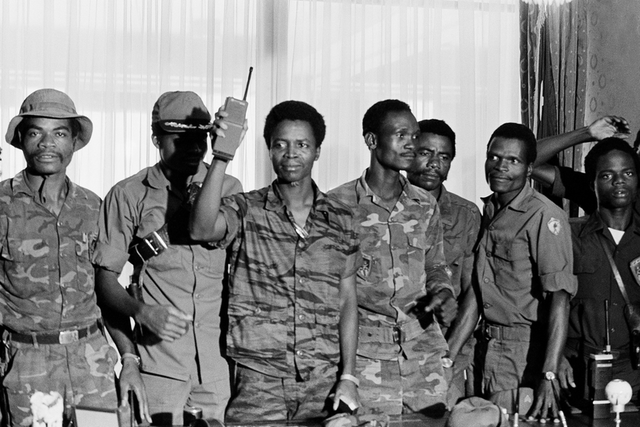
When a 28-year-old Master Sergeant took power in 1980, he set in motion a series of events that reverberates in Liberia to this day.
Former President Samuel K. Doe, holding a walkie-talkie, after the 1980 coup that toppled President William Tolbert Jr. Photograph by Sando Moore/AP.
In 1980, Samuel K. Doe, a 28 year-old Master Sergeant, assumed power in Liberia in a blaze of glory. In a surprise night-time attack on the Executive Mansion overlooking the Atlantic Ocean, Doe and his accomplices brutally murdered President William R. Tolbert Jr, ending 133 years of rule by black American settlers and their descendants (known as Americo-Liberians). Having discarded with Tolbert, Doe became Liberia’s first president of “exclusive indigenous heritage”.
In the subsequent decade, President Doe inflamed ethnic politics and eked out a suspiciously close victory in the 1985 elections, before he met an even less dignified end than his predecessor. At the end of the Cold War, his previously unwavering support from the US evaporated and, as Liberia erupted into civil war, Doe was left vulnerable. Nine months into the conflict on 9 September, 1990, Doe was captured on a visit to the recently deployed ECOWAS Monitoring Group (ECOMOG) in Monrovia.
Liberia’s George Weah concedes to Joseph Boakai in presidential polls
Sitting President Weah was accused of failing to live up to his promises of curbing poverty and fighting corruption.
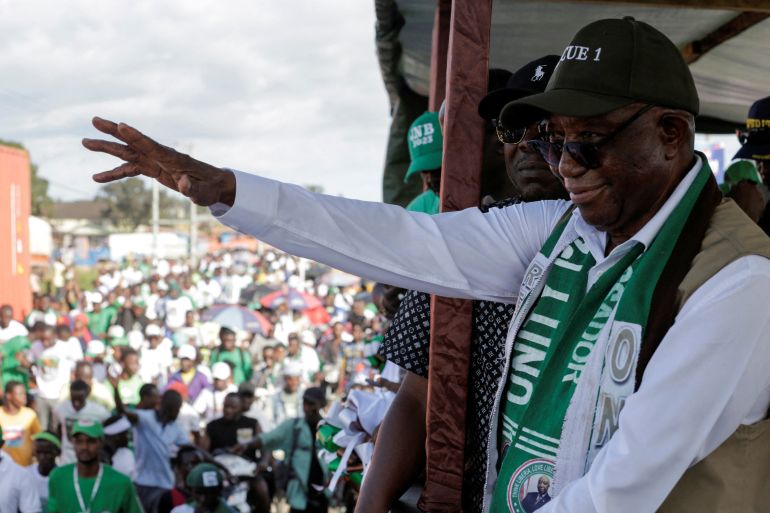
The peaceful Boakai victory comes at a time when the region has seen several military coups in the span of a few years [File: Carielle Doe/Reuters]
Published On 18 Nov 202318 Nov 2023
Joseph Boakai has become Liberia’s new leader after his rival and sitting President George Weah conceded a tight election to mark a peaceful transfer of power in a region that has recently seen many military coups.
The country’s elections commission said on Friday that the 78-year-old Boakai, a former vice president, has managed to secure a narrow victory with 50.9 percent of the vote to Weah’s 49.1 percent, with almost all the votes counted.


 Market Data
  Markets


 AI
AI