Netanyahu Is in Trouble, and Other Takeaways From the Israeli Election
"Netanyahu vows to begin annexing West Bank settlements "Landgrab continues - Israel plans to entrench annexation of East Jerusalem: Report""
Israeli voters went to the polls on Tuesday for the second time in five months. The results aren’t certain, but Prime Minister Benjamin Netanyahu failed to gain the support he had hoped for.
Prime Minister Benjamin Netanyahu meeting with Jewish settlers in Hebron this month. Sergey Ponomarev for The New York Times Megan Specia
As expected, neither Mr. Netanyahu nor his main rival, the former army chief Benny Gantz, a centrist, won enough votes to claim an outright majority in the Israeli Parliament. Crucially, neither seems to have a straightforward path to forming a governing coalition with at least 61 of the 120 lawmakers in Parliament.
That means the contest for prime minister will be decided not by the vote tally but by coalition talks, and Mr. Gantz and his Blue and White party seem likely to be given the first chance to form a government. The support of a smaller third party, Yisrael Beiteinu, could prove essential, putting the power to decide the future Israeli government into the hands of that party’s leader, Avigdor Liberman.
Mr. Netanyahu, who has led Israel for the past decade, had been aiming for a record fifth term in office, but his chances look increasingly slim based on the early results of Tuesday’s vote. The right-wing nationalist and ultra-Orthodox parties of his presumed bloc failed to gain enough seats to provide him a majority, and Mr. Liberman is not inclined to put him over the top.
Mr. Netanyahu failed to produce a governing coalition after the April elections, and chose to send Israelis back to the polls rather than give someone else a chance to form a government. He had hoped to achieve a stronger mandate this time around, with the support of smaller parties on the religious right, but he seems to have made no gains and the support of those groups seems unlikely to be enough to form a governing coalition.
What happens now?
An election victory doesn’t necessarily mean a successful new government. The Israeli president, Reuven Rivlin, has the discretion to choose who has the best chance of assembling a majority coalition within 28 days, though a two-week extension is possible. Typically, but not always, the first opportunity to form a government goes to the leader of the party with the most votes.
Benny Gantz, center, at a polling station in Rosh Ha-ain, Israel, on Tuesday. He could be given the first chance to form a government. Sergey Ponomarev for The New York Times
That opportunity could fall to Mr. Gantz, whose broader bloc of center-left parties may give him the support he needs, provided he can count on the backing of Mr. Liberman.
The Joint List of Arab parties, which performed better than expected, could also be a factor. It has not ruled out the idea of joining a coalition with Mr. Gantz’s party.
What will Mr. Liberman do?
The secular ultranationalist party Yisrael Beiteinu, which is expected to win nine seats in the Knesset, may have the potential to make or break a coalition. Its leader, Avigdor Liberman, appears to hold the power to be a kingmaker.
On Tuesday, as the election results rolled in, Mr. Liberman told his supporters that there was only one option for a government: “A broad, liberal, national government made up of Yisrael Beiteinu, Likud and Blue and White.”
Avigdor Liberman, center, the leader of Yisrael Beiteinu, could play kingmaker. Sergey Ponomarev for The New York Times
Mr. Gantz has vowed that he would not sit on a government with Mr. Netanyahu because of the looming corruption allegations. But if the prime minister stepped down as the head of his party, there is a possibility that could happen. There is also the possibility that Blue and White could form a majority by partnering with Mr. Liberman’s party and other center-left groups, including potentially the Joint List of Arab parties — though Mr. Liberman would probably refuse to sit with Arab parties.
Arab voters came out in force.
Israeli Arabs make up around 20 percent of the voting population, and they showed up on Tuesday in larger numbers than expected — a huge departure from five months ago.
But Arab politicians — and even some center-left Jewish parties — made efforts to appeal to Arab voters in the recent campaign with promises to address crime, housing shortages and other issues. The Joint List of Arab parties — a coalition of the four largest Arab-majority parties — has regained the influence it lost in April and looks set to be the third-largest party in the Knesset, according to early results.
Mr. Odeh told reporters outside his home on Wednesday .. https://www.ynetnews.com/articles/0,7340,L-5591650,00.html .. that he might recommend Mr. Gantz as the next prime minister. He also signaled a willingness to join a coalition, under certain conditions.
But he said his party would not be willing to join a unity government like the one put forth by Mr. Liberman. He also signaled that he wanted to lead the opposition.
Israel’s opposition leader fails to form coalition government
"Netanyahu vows to begin annexing West Bank settlements "Landgrab continues - Israel plans to entrench annexation of East Jerusalem: Report""
Benny Gantz’s lack of success pushes country closer to third round of elections in a year
Oliver Holmes in Jerusalem Thu 21 Nov 2019 06.39 AEDT First published on Thu 21 Nov 2019 05.19 AEDT
The Blue and White party leader, Benny Gantz, had a month to form a coalition. Photograph: Amir Cohen/Reuters
Israel’s opposition leader, Benny Gantz, has failed to form a government, increasing the likelihood of the country holding an unprecedented third round of elections.
Under Israeli law, midnight on Wednesday was the deadline, after which Gantz was obliged to return the mandate to the president, Reuven Rivlin. The former Israeli army chief told Rivlin four hours before the deadline that he had not succeeded, his Blue and White party said in a statement.
Politicians loyal to Netanyahu had blocked his attempts, Gantz said in a speech on Wednesday evening, “insisting only on the best interest of one person”. Gantz added he had sought to reach out to the prime minister, but his efforts had been met with “insults, slander and childish videos”, referring to Netanyahu’s frequent social media rants.
Gantz’s failure does not automatically trigger elections. It kicks off a final 21-day period in which the Knesset, Israel’s parliament, can nominate any candidate to be prime minister, including Netanyahu or Gantz. However, the divided makeup of the Knesset would lead to a tough battle as no political alliance has a majority of 61 seats. After that period, Israelis will be on course to go to the polls again, the third time in a year.
The political stalemate has played out during a fraught time for Israel as an increasingly open conflict heats up with Iran, its arch-enemy and a regional powerhouse.
Israel’s military said on Wednesday its jets had bombed dozens of Syrian and Iranian targets overnight in neighbouring Syria. The British-based monitoring group the Syrian Observatory for Human Rights said 23 people had been killed in the strikes, 21 fighters and two civilians.
Rivlin had been pressing the two main parties to put aside their differences and form a unity government as they would have more than enough seats for a majority. But there have been vast differences between the rivals during negotiations on key aspects such as how the next administration will look, including who leads it.
Gantz ran his election campaign on the promise to topple Netanyahu, making it difficult for the opposition leader to accept a power-sharing deal without losing credibility.
Meanwhile, the prime minister has insisted his traditional allies from hardline nationalists to religious parties be included in any unity government, a precondition Gantz has rejected.
Netanyahu also faces the possibility of court cases that could lead to jail time. Israel’s attorney general is deciding whether to indict him in three potential corruption cases .. https://www.theguardian.com/world/2019/oct/02/israel-pm-benjamin-netanyahu-faces-pre-trial-corruption-hearing . If he retains the role of prime minister, he will not be required to step down, even if indicted, and could use his position to push for immunity. Netanyahu has denied all allegations.
Gantz had several ways of forging a coalition, including the possibility of courting politicians from Israel’s Arab minority, which makes up close to a fifth of the country’s population.
To block this route, Netanyahu has claimed that a government propped up by Arab parties would be a “historic danger to Israel’s security” and accused Arab politicians of allegiance to Palestinian militant groups.
Rivlin, who is tasked with overseeing the government formation, strongly rebuked Netanyahu for the campaign. “The characterisation of all Arab elected officials as a ‘threat’ to the existence of the state of Israel .. .. https://www.theguardian.com/world/israel .. and as a ‘fifth column’ must be emphatically denounced,” he said this week.
It’s too late for a two-state solution in Israel-Palestine January 7, 2016 6.15am EST Author Padraig O'Malley John Joseph Moakley Distinguished Professor of Peace and Reconciliation, University of Massachusetts Boston https://investorshub.advfn.com/boards/read_msg.aspx?message_id=119715629
Allies, officials and now the Congress have sounded the alarm about the U.S. president's foreign policy. From Syria to Iran, Haaretz takes a deep dive into the impact of three years of Trumpism in the Mideast. Click on 'hotspots' and 'administration' for the complete breakdown
"Netanyahu vows to begin annexing West Bank settlements"
Ramallah, occupied West Bank - Hundreds of Palestinians in the occupied West Bank are protesting against the United States' Middle East peace plan, taking to the streets on the eve of a US-sponsored summit in Bahrain where Washington is expected to reveal details of its long-awaited initiative.
The two-day event, which is led by Jared Kushner, US President Donald Trump's son-in-law and senior adviser, is boycotted by the Palestinian leadership.
Palestinian leaders say the gathering circumvents a political settlement based on a two-state solution, describing it as an ill-fated attempt by the US administration and some of its Middle Eastern allies - including Israel and several Arab countries - to "liquidate" the Palestinian cause.
A number of Arab countries, including Jordan, Egypt, the United Arab Emirates and Saudi Arabia, are sending delegates to the event.
"Some Arab countries are going to participate with low-level representatives, but even mere participation would amount to endorsing the conspiracy against the rights of the Palestinian people," Issa Qaraqae, a senior of Fatah, which exercises limited rule in some areas of the West Bank, told Al Jazeera.
"We call on the Arab societies to awaken and to make a real stand and support the Palestinian people in blocking this conspiracy," Qaraqae added.
A Palestinian protester in Ramallah holds a sign reading: 'Participating in the Bahrain workshop is collusion with the occupation' [Ibrahim Husseini/Al Jazeera]
His comments came as hundreds of protesters on Monday gathered in central Ramallah, where they raised Palestinian flags and held signs condemning the US-led initiative and the Arab countries taking part.
"Participating in the Bahrain workshop is collusion with the occupation," one of the signs read. "Our national constants are: independence for the state of Palestine, al-Quds (Jerusalem) is our eternal capital, the right of refugees to return to their lands," read another.
The White House has billed the Manama workshop as "a pivotal opportunity" for government, civil society and business leaders to "share ideas, discuss strategies and galvanise support for potential economic investments and initiatives that could be made possible by a peace agreement".
The US said its plan would double the Palestinians' gross domestic product, create a million jobs and lower unemployment to single digits, as well as reduce the poverty rate by half - all within a decade, provided that Palestinians accepted the yet-to-be-announced political settlement plan.
But Kushner's plan has been rejected by the Palestinians, long before its unveiling.
The Palestinian leadership has excluded the US from any role mediating peace with the Israeli side in the wake of Washington's recognition of Jerusalem as Israel's capital in late 2017; the subsequent moving of the US embassy from Tel Aviv there; and the cuts to the funding assistance to the United Nations Relief and Works Agency for Palestine Refugees in the Near East (UNRWA).
On Monday, Palestinian Prime Minister Muhammad Shtayeh struck a defiant tone even as he confirmed his government's financial crisis.
"The financial situation is difficult but we will not surrender and we will not brand our martyrs and prisoners as terrorists," Shtayyeh told his cabinet, before criticising the Manama workshop.
"The context of the Bahrain workshop is thin and its outputs are sterile and our absence has delegitimised it," he said. "The Palestinian cause has a political solution: ending the occupation and control of our resources," he added.
'A trap'
The workshop in Bahrain is also likely to sour relations between Palestinians and participating countries - although no senior Palestinian official has commented publicly on the issue.
VIDEO - Is the US an honest broker between the Israelis-Palestinians? (6:53)
Calling the event a "trap", Ramzi Rabah, of the Democratic Front for the Liberation of Palestine-DFLP, warned Arab countries against providing legitimacy to the "deal of the century".
"There are disagreements [with Arab countries] in vision, disagreements in positions we hope the Arab position becomes realigned with the Palestinian interests," Rabah told Al Jazeera in Ramallah's Manara square.
"We call on the Arab countries to listen to the voice of its peoples in Amman, Beirut, Baghdad, Morrocco, Yemen and Tunis that have all came out against this workshop," Rabah added.
In Lebanon, where there is a large presence of Palestinian refugees, Lebanese Parliament Speaker Nabih Berri came out against Kushner's plan.
"Those who think that waving billions of dollars can lure Lebanon, which is under the weight of a suffocating economic crisis, into succumbing or bartering over its principles are mistaken," Berri said in a statement.
"One message has to be clear to all the countries participating in Manama," Mustafa Barghouti, the leader of the Palestinian National Initiative, told Al Jazeera.
"This is happening against the will of the Palestinian people."
In the Palestinian refugee camp of Dheisheh in Bethlehem, Palestinians also gathered to denounce the Manama workshop.
At the rally on Monday, protesters unveiled a large poster with the images of three leaders imprinted on it: Trump, Israeli Prime Minister Benjamin Netanyahu, and Bahrain's King Hamad bin Issa Al Khalifa. A large X was covering each leader's face.
"The Manama workshop, in short, is an American-Zionist conspiracy to end the political rights of the Palestinian people," Muhammad al-Ja'afari, local Fatah leader, told Al Jazeera.
"We expected, and we hoped that no Arab country would participate in this conference which amounts to a stab in our chest and our back by a poisonous American-Zionist dagger," al-Ja'afri added. Why is the US withholding aid for Palestinian refugees?
VIDEO - Inside Story Why is the US withholding aid for Palestinian refugees? SOURCE: Al Jazeera News
Palestinians' Mahmoud Abbas rejects Trump's Middle East peace plan
"Netanyahu vows to begin annexing West Bank settlements"
By Pamela Falk
February 11, 2020 / 1:01 PM / CBS News
[...]
"We are ready to start negotiations," Abbas told the council, but he said the Palestinian Authority would only do so under the auspices of the so-called U.N. Quartet. That group, which includes the Palestinians, the U.N., the European Union, Russia and the U.S., previously spear-headed Mideast peace negotiations, but that dialogue has been stalled for years, as the Trump administration worked on its own plan.
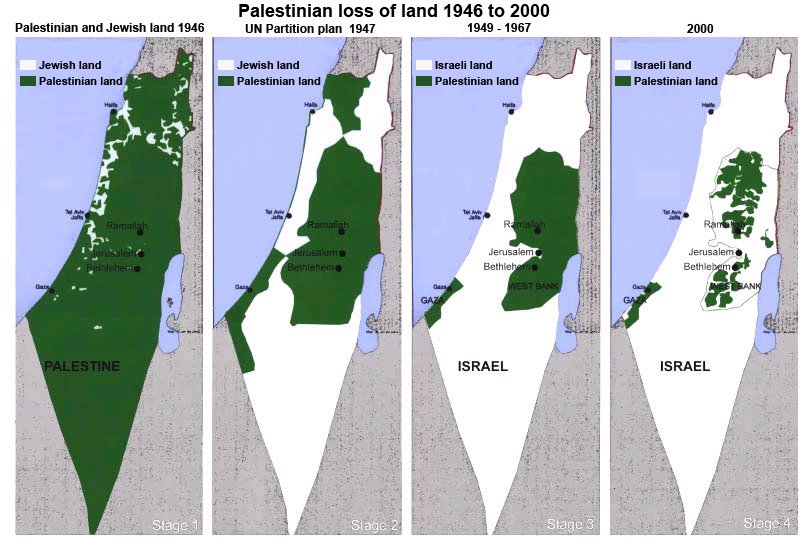
Holding up maps of the Palestinian state envisioned by the White House plan, Abbas ridiculed the proposal.
"This is the state they will give us," he said. "It's like Swiss cheese." Critics point out that Mr. Trump's plan would give Israel most of what it has long sought, and carve a future Palestinian state into separate chunks surrounded by Israeli territory.
"The U.S. cannot be the sole mediator," Abbas said Tuesday, hinting that the opposition building to the U.S. proposal in the Palestinian territories could boil up into violence. There have already been scattered clashes since the Trump plan was unveiled.
Trump dealmaker playbook, make it up ourselves. Who could reasonably argue against the Abbas condition above?
-
Palestinian leader Abbas slams Trump's peace plan at UN
[...]
A poll published on Tuesday showed that 94% of Palestinians reject Trump's plan. Also, 64% now favor a return to armed struggle in response to the plan, according to the survey published by the Palestinian Center for Policy and Survey Research.
Trump Unveils the “Giveaway of the Century” on Middle East Peace [...] “The Trump proposals released today were formally presented as a basis for negotiations, but that’s not in fact how they are structured. They are structured as a diktat,” Tamara Cofman Wittes, a former deputy assistant secretary of state for Near Eastern Affairs who is now at the Brookings Institution, told me. “The Administration has made it clear that it plans to recognize Israeli sovereignty over all the land indicated for the Israelis in Trump’s map, whether the Palestinians accept it or not. That makes the Trump plan an imposed peace.” P - Wittes noted that the timing of the plan conspicuously aids Trump and Netanyahu politically. Both men face tough reëlection bids this year, and also perilous legal challenges. https://investorshub.advfn.com/boards/read_msg.aspx?message_id=153555738


 Market Data
  Markets


 AI
AI