News Focus
News Focus
icon url

fuagf

05/23/19 3:45 AM

#312163 RE: fuagf #312162

OK. Nine years ago Krugman's - Steve Roach Goes Batty

"conix, Why the US has a weak case against China’s ‘unfair’ trade practices"

Paul Krugman - New York Times Blog
March 19, 2010 7:55 am March 19, 2010 7:55 am

Ahem .. https://www.bloomberg.com/apps/news?pid=20601010&sid=a1xSIQaApAFU .

----
March 19 (Bloomberg) — Morgan Stanley Asia Chairman Stephen Roach said that Paul Krugman’s call to push China to allow a stronger yuan is “very bad” advice and that increased Chinese spending is a better way of reducing trade imbalances.

“We should take out the baseball bat on Paul Krugman — I mean I think that the advice is completely wrong,” Roach said in an Bloomberg Television interview in Beijing when asked about Krugman’s call, characterized as akin to taking a baseball bat to China. “We’re lashing out at China rather than tending to our own business,” which is raising U.S. savings, Roach said.
----

I really don’t understand Roach’s argument here; he seems to have subscribed to the Underpants Gnomes theory of trade balances:

1. Increase savings
2. ?????
3. Exports!

To be honest, sometimes I feel that I’ve spent most of my adult life knocking down the same misunderstanding, over and over again. I wrote about more or less the same issue more than 20 years ago .. https://papers.ssrn.com/sol3/papers.cfm?abstract_id=227111 :

----
There is a widespread view that world payments imbalances can be remedied through increased demand in surplus countries and reduced demand in deficit countries, without any need for real exchange rate changes. In fact shifts in demand and real exchange rate adjustment are necessary complements, not substitutes.
----

Also, from the Bloomberg article:

----
“I’m a little curious what Steve thinks would happen if the U.S. increased savings” without a stronger yuan, Krugman said today. “Where would the demand” for goods and services come from, he asked. Boosting savings should be done “in the long run,” not now, he also said.

Krugman is “giving Washington very, very bad advice,” Roach said in a later interview when asked to respond to Krugman’s reaction to his remarks. “I totally reject his idea that savings is bad.”
----

(Btw, this was from a cell phone conversation held while I was, um, sitting on the beach).

What I wonder here is how Roach — or anyone thinks that increased savings would help right now. What would cause an attempt to increase savings to be translated into increased investment, or an improved trade balance, as opposed to simply a more depressed economy. Yes, I know that macroeconomics at the zero lower bound is different from the normal scene — but how can an economist as good as Steve Roach not get that after more or less two years in a liquidity trap?

Update: I probably should add that I never said anything about taking a baseball bat to China. That was Bloomberg’s characterization of what I’ve been saying, and not one I would agree with.

https://krugman.blogs.nytimes.com/2010/03/19/steve-roach-goes-batty/
icon url

fuagf

05/23/19 3:57 AM

#312164 RE: fuagf #312162

To link - Killing the Pax Americana

"An A- for the U.S. Economy, but Failing Grades for Trump’s Policies"

Trump’s trade war is about more than economics.

https://investorshub.advfn.com/boards/read_msg.aspx?message_id=148789940

"conix, Why the US has a weak case against China’s ‘unfair’ trade practices"
icon url

fuagf

09/10/19 5:58 PM

#325263 RE: fuagf #312162

A light amid the gloom of the US-China trade war

"conix, Why the US has a weak case against China’s ‘unfair’ trade practices"

John Edwards

Everything leaks in Washington, except the 150-page summary of the trade talks – and that’s a good sign of seriousness.


Donald Trump says US-China trade negotiations will resume in September, although this is not yet confirmed (Photo: Eva Claire Hambach/AFP via Getty)

Published 2 Sep 2019 13:30 0 Comments

China Trade United States

Despite an optimistic bounce in global financial markets Friday, the relentless trade war between the US and China resumed Sunday. Threatened 15% tariffs by the US on another $250 billion of China imports went into effect Sunday morning, as did new China tariffs on US crude oil, soybeans and pharmaceuticals.

More increases are planned. President Donald Trump has announced that existing 25% tariffs on $250 billion of China imports will be increased to 30% on 1 October, and 15% tariffs on the remainder of China exports to the US will be imposed 15 December.

China promises equivalent pain. Already China has dramatically cut back on US imports of soybeans and liquid natural gas. More and precisely targeted reprisals will follow, probably including cars.

--
The discretion about the contents of the document exercised by both sides suggests this is still
a real negotiation, taken seriously by both sides, which may yet result in some sort of agreement.

--

Talks between the US and China may resume in a week or two, but against a background of ill-will, increasing tension, and the likelihood that the entire goods trade between these two economic giants will be discouraged by punitive tariffs within four months.

As Australia’s Reserve Bank Governor Phil Lowe pointed out at the recent Jackson Hole central banking symposium, the trade war is becoming a serious risk to the global economy. World trade is well down. The CPD World Trade Monitor calculates a decline in global trade volumes of 0.7% in the second quarter of this year, following a smaller fall in the first quarter. The WTO Trade Barometer suggests trade volume growth will remain weak through this third quarter.

Trade between the US and China has led the decline. In the year to June, China’s goods exports to the US were down 13%, and US goods exports to China were down 17%. Along with the decline in trade, there has been an associated decline in world industrial production, and increasing hesitancy in global business investment.

Not all of the slowdown is related to the US China quarrel, but as Lowe and Reserve Bank of New Zealand Governor Adrian Orr argue, the weakness in global investment spending is probably now linked to uncertainty about the global trade outlook. Reflecting on the Jackson Hole discussion, Orr mentioned the “pockets of volatile politics” affecting trade, investment, and growth, and the “ongoing funk” in world business.


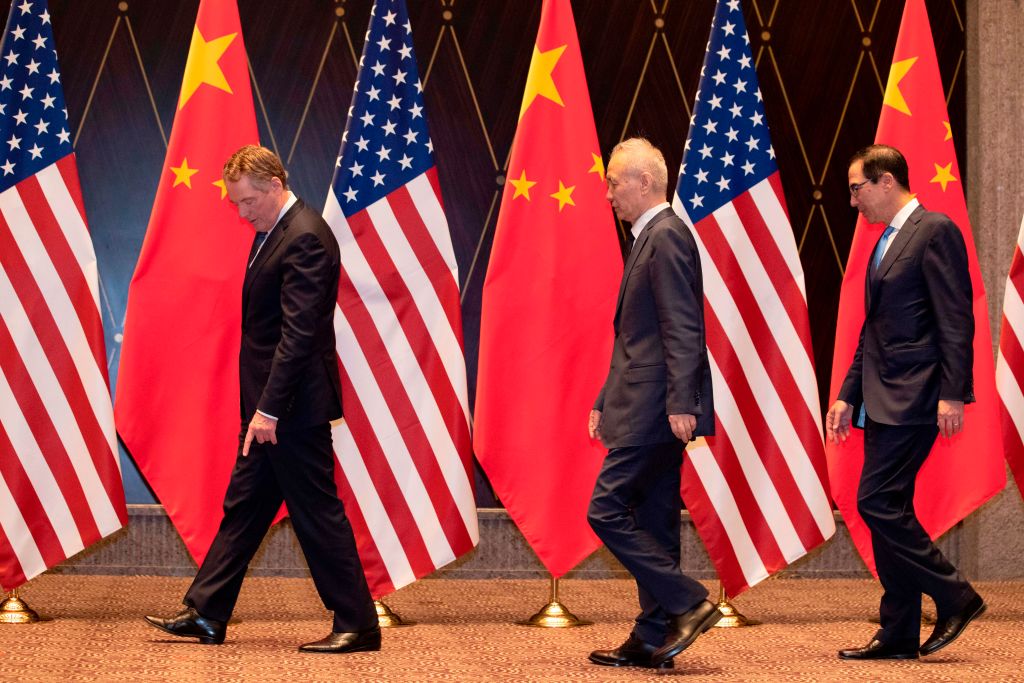
Marking positions: US Trade Representative Robert Lighthizer (left) followed by Chinese Vice Premier Liu and US Treasury Secretary
Steven Mnuchin for a photo-op during talks in July (Photo by Ng Han Guan/AFP/Getty)

For all the gloom, however, there are still signs that a deal may be possible. Sooner or later pretty much everything leaks in Washington, but not so far the mystery document at the heart of these economic negotiations between China and the US. This is the 150-page paper presented by the chief US negotiator, US Trade Representative Robert Lighthizer, to his Chinese counterpart, Vice Premier Lui He, in Beijing at the end of April.

China’s leadership asked for revisions on the paper, said by the American side to summarise the agreements reached after a year of talks. The US then protested that China was backing out of commitments already made, and the talks broke down. Four months and several rounds of threatened tit-for-tat tariff increases later, the world economy poised precariously on the lip of a serious downturn, the contents of that document remain secret.

It has not yet been confirmed that negotiations will resume in Washington mid-September, though Trump has said they will. What is clear, however, is that the success or failure of negotiations, the risk of a painful slowdown in the global economy arising from the increasingly costly trade war between its two biggest members, depend on what is in that 150 page document, and the nature of the revisions sought by China.


The trade war is becoming a serious risk to the global economy (Photo: Mark Ralston/AFP/Getty Images)

The discretion about the contents of the document exercised by both sides suggests this is still a real negotiation, taken seriously by both sides, which may yet result in some sort of agreement. So, too, does the report, not convincingly repudiated by the White House, that Trump’s 1 August decision to impose additional tariffs on China was opposed by almost all his advisers, including Lighthizer and Treasury Secretary Steven Mnuchin.

While the April paper remains secret, we can presume that it covered intellectual property protections, the removal of some China investment restrictions, increased purchases of US goods by China, and something about industry subsidies – the major elements of the negotiation. To get as far as it did, we may presume it does not contain clauses about the role of the Communist Party or of state-owned enterprises or state planning, all of which would have been ruled out by Lui very early in the discussions. In explaining China’s refusal to accept the document in its then form, China analysts refer not to the substance but to the enforcement provisions, thought belittling and unnecessarily prescriptive.

If a deal cannot be reached in September, it will become progressively more difficult as the US presidential and congressional races preoccupy political attention and limit options. With an increasingly severe commercial assault on leading Chinese technology company Huawei, both the breadth and the depth of the sanctions the US is imposing on China will soon pose more difficult choices for third countries – including Japan, Korea, much of Southeast Asia, and Australia.

A tough trade negotiation between the two giants is one thing. Prolonged economic warfare is quite another.

https://www.lowyinstitute.org/the-interpreter/light-amid-gloom-us-china-trade-war

h/t ergo sum - they are down 13% We are down 17%. This is what you call winning.
https://investorshub.advfn.com/boards/read_msg.aspx?message_id=151042574


icon url

fuagf

10/30/19 4:16 PM

#330256 RE: fuagf #312162

Att: conix. Trump’s Trade Quagmire (Wonkish)

"conix, Why the US has a weak case against China’s ‘unfair’ trade practices"

He just keeps escalating as his strategy fails.

By Paul Krugman
Opinion Columnist

Aug. 3, 2019


President Trump boards Air Force One for a campaign rally in Cincinnati on Thursday. Doug Mills/The New York Times

Remember the Vietnam quagmire? (Actually, I hope many of my readers are young enough that they don’t, but you’ve presumably heard about it.) In political discourse, “quagmire” has come to have a quite specific meaning. It’s what happens when a government has committed itself to a policy that isn’t working, but can’t bring itself to admit failure and cut its losses. So it just keeps escalating, and things keep getting worse.

Well, here’s my thought: Trump’s trade war is looking more and more like a classic policy quagmire. It’s not working — that is, it isn’t at all delivering the results Trump wants. But he’s even less willing than the average politician to admit to a mistake, so he keeps doing even more of what’s not working. And if you extrapolate based on that insight, the implications for the U.S. and world economies are starting to get pretty scary.

This article, by the way, while not very technical, is going to make use of a number of charts and even a few terms of art, hence the “wonkish” warning.

To preview, I’m going to make five points:

1. The trade war is getting big. Tariffs on Chinese goods are back to levels we associate with pre-1930s protectionism. And the trade war is reaching the point where it becomes a significant drag on the U.S. economy.

2. Nonetheless, the trade war is failing in its goals, at least as Trump sees them: the Chinese aren’t crying uncle, and the trade deficit is rising, not falling.

3. The Fed probably can’t offset the harm the trade war is doing, and is probably getting less willing even to try.

4. Trump is likely to respond to his disappointments by escalating, with tariffs on more stuff and more countries, and — despite denials — in the end, with currency intervention.

5. Other countries will retaliate, and this will get very ugly, very fast.

I could, of course, be wrong. But that’s how it looks given what we know now.

O. K., let’s start with the scale of the policy. The invaluable people at the Peterson Institute for International Economics have a nice chart showing the escalation of tariffs on Chinese goods under Trump:


Trump’s tariff escalation PIIE

So roughly speaking, we’ve seen a 20 percent tax imposed on the $500 billion worth of goods we import from China each year. Although Trump keeps insisting that the Chinese are paying that tax, they aren’t. When you compare what has happened to prices of imports subject to new tariffs with those of other imports, it’s overwhelmingly clear that the burden is falling on U.S. businesses and consumers .. https://www.princeton.edu/~reddings/papers/CEPR-DP13564.pdf .

So that’s a $100 billion a year tax hike. However, we aren’t collecting nearly that much in extra tariff revenue:


Some revenue, but not much Federal Reserve of St. Louis

Partly that’s because the revenue numbers don’t yet include the full range of Trump tariffs. But it’s also because one big effect of the Trump tariffs on China has been to shift the sourcing of U.S. imports — e.g., instead of importing from China, we buy stuff from higher-cost sources like Vietnam. When this “trade diversion” happens, it’s still a de facto tax increase on U.S. consumers, who are paying more, but it doesn’t even have the benefit of generating new revenue.

So this is a pretty big tax hike, which amounts to contractionary fiscal policy.
And we should add in two other effects: foreign retaliation, which hurts U.S. exports, and uncertainty: Why build a new factory when for all you know Trump will suddenly decide to cut off your market, your supply chain, or both?

I don’t think it’s outlandish to suggest that the overall anti-stimulus from the Trump tariffs is comparable in scale to the stimulus from his tax cut, which largely went to corporations that just used the money to buy back their own stock. And that stimulus is behind us, while the drag from his trade war is just getting started.

But why is Trump doing this? A lot of center-right apologists for Trump used to claim that he wasn’t really fixated on bilateral trade balances, which every economist knows is stupid, that it was really about intellectual property or something. I’m not hearing that much anymore; it’s increasingly clear that he is, indeed, fixated on trade balances, and believes that America runs trade deficits because other countries don’t play fair.

Strange to say, however, despite all those new tariffs the U.S. trade deficit is getting bigger, not smaller, on his watch:


The deficit that wouldn’t come down Federal Reserve of St. Louis

And adjusted for inflation, imports are still growing strongly, while U.S. exports have been shriveling:


Who’s winning this trade war, exactly?Credit...Federal Reserve of St. Louis

Why aren’t tariffs shrinking the trade deficit? Mainly the answer is that Trump’s theory of the case is all wrong. Trade balances are mainly about macroeconomics, not tariff policy. In particular, the persistent weakness of the Japanese and European economies, probably mainly the result of shrinking prime-age work forces, keeps the yen and the euro low and makes the U.S. less competitive.

When it comes to recent import and export trends, there may also be an asymmetric effect of the tariffs themselves. As I already mentioned, U.S. tariffs on Chinese goods don’t do much to reduce overall imports, because we just shift to products from other Asian economies. On the other hand, when the Chinese stop buying our soybeans, there aren’t any major alternative markets.

Whatever the explanation, Trump’s tariffs aren’t producing the results he wanted. Nor are they getting the other thing he wants: Splashy concessions from China that he can portray as victories (“tweetable deliveries”). As Gavyn Davies says .. https://www.ft.com/content/ab213fb0-a891-11e9-984c-fac8325aaa04 , China seems “increasingly confident it can weather the trade wars,” and it’s not showing any urge to placate the U.S.

So this might seem to be a good time to hit the pause button and rethink strategy. Instead, however, Trump went ahead and slapped on a new round of tariffs. Why?

Well, stock traders reportedly think .. https://www.bloomberg.com/news/articles/2019-08-01/stock-traders-have-theories-about-timing-of-trump-s-tariff-tweet .. that Trump was emboldened by the Fed’s rate cut, which he imagines means that the Fed will insulate the U.S. economy from any adverse effects of his trade war. We have no way of knowing if that’s true. However, if Trump does think that, he’s almost surely wrong.

For one thing, the Fed probably doesn’t have much traction: interest rates are already very low. And the sector most influenced by interest rates, housing, hasn’t shown much response to what is already a sharp drop in mortgage rates.

Furthermore, the Fed itself must be wondering if its rate cut was seen by Trump as an implicit promise to underwrite his trade war, which will make it less willing to do more — a novel form of moral hazard.

There is, by the way, a strong contrast here with China, which for all its problems retains the ability to pursue coordinated monetary and fiscal stimulus to a degree unimaginable here. Trump probably can’t bully the Fed into offsetting the damage he’s inflicting (and just try to imagine him getting Nancy Pelosi to bail him out); Xi is in a position to do whatever it takes.

So what will Trump do next? My guess is that instead of rethinking, he’ll escalate, which he can do on several fronts. He can push those China tariffs even higher. He can try to deal with trade diversion by expanding the trade war to include more countries (good morning, Vietnam!).

And he can sell dollars on foreign exchange markets, in an attempt to depreciate our currency. The Fed would actually carry out the intervention, but currency policy is normally up to the Treasury Department, and in June Jerome Powell reiterated that this is still the Fed’s view. So we might well see a unilateral decision by Trump to attempt to weaken the dollar.

But a deliberate attempt to weaken the dollar, gaining competitive advantage at a time when other economies are struggling, would be widely — and correctly — seen as beggar-thy-neighbor “currency war.” It would lead to widespread retaliation, even though it would also probably be ineffective. And the U.S. would have forfeited whatever remaining claims it may still have to being a benevolent global hegemon.

https://www.nytimes.com/2019/08/03/opinion/trumps-trade-quagmire-wonkish.html

icon url

fuagf

10/31/19 6:09 AM

#330302 RE: fuagf #312162

Scrapped Chile APEC summit throws up new hurdle for U.S.-China trade deal

"conix, Why the US has a weak case against China’s ‘unfair’ trade practices"

Andrea Shalal, Steve Holland, Lusha Zhang
October 31, 2019 / 11:27 AM / Updated 3 minutes ago

By Andrea Shalal, Steve Holland and Lusha Zhang

FILE PHOTO: Chinese and U.S. flags flutter near The Bund, before U.S. trade delegation meet their Chinese counterparts for talks in Shanghai, China July 30, 2019. REUTERS/Aly Song

WASHINGTON/BEIJING/SINGAPORE (Reuters) - Leaders from the United States and China encountered a new obstacle in their struggle to end a damaging trade war on Wednesday, when the summit where they were supposed to meet was canceled because of violent protests.

U.S. President Donald Trump said this week he hoped to sign an interim trade deal with Chinese counterpart Xi Jinping during the Nov. 16-17 Asia-Pacific Economic Cooperation summit in Chile. Chilean officials said they canceled the summit to focus on restoring law and order in the country.

The White House said afterwards the United States still expects to sign an initial trade agreement with China next month, but no alternate location had yet been set for Xi and Trump to meet.

“We look forward to finalizing Phase One of the historic trade deal with China within the same time frame,” the White House said in a statement that omitted a mention of the president or his planned meeting with Xi.

China’s commerce ministry said in a statement on Thursday the bilateral talks will continue to proceed as previously planned and the lead trade negotiators from both countries will speak by telephone on Friday.

China’s foreign ministry spokesman Geng Shuang also said during a daily briefing on Thursday that Trump and Xi have maintained contact through various means about a bilateral summit for the trade deal, without elaborating.

U.S. and Chinese negotiators have been racing to finalize a text of the “phase one” agreement for Trump and Xi to sign next month, a process clouded by wrangling over U.S. demands for a timetable of Chinese purchases of U.S. farm products.

Treasury Secretary Steven Mnuchin, who was traveling in the Middle East, told Reuters on Wednesday that U.S. discussions with China had been productive, and work on finalizing the text of the deal was continuing. China’s commerce ministry also said on Thursday the negotiations were progressing well.

The White House intends to offer some U.S. locations as alternatives for the APEC summit, according to one source familiar with U.S. thinking. Alaska and Hawaii could be potential options that would be acceptable to China, said a second source familiar with the issue.

China has also suggested Macau as a possible venue, according to one China trade source familiar with the issue.

“LOTS OF OPTIONS”

The White House had no immediate comment on alternative locations, and the Chinese commerce ministry’s statement on Thursday did not address whether Trump and Xi would still meet next month. But trade experts said arranging another summit at short notice would be tough.

“These summits - especially one involving 21 leaders - are a massive undertaking, and moving one with two weeks’ notice is all but impossible,” said Matthew Goodman, a former National Security Council official and an adviser at the Center for Strategic and International Studies, a Washington think tank.

The White House is “clearly signaling that it really wants the Trump-Xi bilateral to go ahead,” Goodman said. “But it seems more likely that they’ll have trade ministers or ambassadors sign the ‘phase one’ deal and save the leaders’ meeting for later.”

Even though this is a phased agreement, it will not be rushed, said a Chinese official with knowledge of the matter.

“Consultations should happen one step at a time,” the official said, requesting anonymity. “Nothing would be signed for the sake of signing.”

Bloomberg reported on Thursday, citing unnamed sources, that Chinese officials continue to harbor doubts about whether they can strike a comprehensive long-term trade deal with Washington.

The officials remain concerned about Trump’s impulsive nature and the possibility that he could back out of even the interim deal the two sides are racing to clinch in the coming weeks, according to the report.

A critical date is Dec. 15, when new U.S. tariffs on Chinese imports such as laptops, toys and electronics kick in. Both the United States and China have an interest in reaching a deal and averting those tariffs.

Trump suspended U.S. tariffs that were planned for Oct. 15 earlier this month, after trade talks in Washington. But the White House has not announced any plans to defer or cancel the Dec. 15 ones.

“I personally think that the two sides hope to reach an ‘armistice agreement’ by the end of the year. He (Trump) needs it and we do too,” Jin Canrong, Deputy Dean of the School of International Studies at Beijing’s elite Renmin University and a government adviser, told Reuters.

There is no obvious international meeting in the near future where Trump and Xi could meet on the sidelines, since Trump is not attending the East Asian Summit in Thailand next week, one diplomat said.

Trump has expressed interest in visiting Australia for the Presidents Cup golf tournament that starts Dec. 9, which would put him in the region.

“There are lots of options out there for the two leaders to sign the deal,” said Wei Jianguo, vice chairman of Chinese state-backed think tank China Center for International Economic Exchange told Reuters during a forum in Singapore on China-U.S. relations. “The deal can be signed in China, the U.S., or any third-party country, like Singapore.”

Reporting by Andrea Shalal, Steve Holland and David Brunnstrom in Washington; additional reporting by Jing Xu, Lusha Zhang, Liangping Gao, Stella Qiu and Cate Cadell in Beijing, Keith Zhai in Singapore; editing by Richard Pullin & Simon Cameron-Moore