"shermann7, Opinion: Trump tax cut undermines most dynamic parts of the economy"
Republicans aren’t even trying to run on their policies.
By Paul Krugman Opinion Columnist Sept. 24, 2018
Tom Brenner for The New York Times
Democrats will almost certainly receive more votes than Republicans in the midterm elections. But gerrymandering and other factors have severely tilted the playing field, so they would need to win the popular vote by a wide margin to retake the House, and a huge margin to retake the Senate. I don’t know how it will turn out — or what will happen to the perceived legitimacy of the federal government if all three branches are controlled by people the voters rejected. Neither does anyone else.
One thing we do know, however, is that Republicans have decisively lost the battle of ideas. All of their major policy moves, on health care, taxes and tariffs, are playing badly with voters.
In fact, Republican policies are so unpopular that the party’s candidates are barely trying to sell them. Instead, they’re pretending to stand for things they actually don’t .. https://www.huffingtonpost.com/entry/gop-pre-existing-condition-promise-fraud_us_5b8053bfe4b0cd327dfc8a1c — like protecting health coverage for Americans with pre-existing conditions — or trying to distract voters with culture war and appeals to white racial identity. The G.O.P. has become the party of no ideas.
Have they sent out their job applications? Because the American people aren’t buying. A few weeks ago an internal G.O.P. survey found that “we’ve lost the messaging battle” on the legislation, with voters overwhelmingly believing that the tax cuts went to corporations and the rich, and many worried that increased deficits will endanger Social Security and Medicare.
Finally, there’s the Donald Trump twist — the one area where he is somewhat at odds with G.O.P. orthodoxy: His economic nationalism, embodied in a rapidly expanding set of import tariffs.
After the 2016 election, many commentators argued that Trump’s Electoral College win reflected a backlash against globalization. And that suggested that his protectionist turn might prove popular. But it hasn’t.
Why are Republican policy ideas falling so flat? At one level, the answer is obvious: G.O.P. policies are unpopular because they hurt far more Americans than they help. Why should anyone expect cutting taxes on the rich while taking health care away from the sick to be popular?
The question is why such policies were ever popular. The answer, I think, is that in the past, voters didn’t see the connections.
When Bush pushed through his tax cut, we had a budget surplus, so it wasn’t clear to voters that less revenue might mean cuts to programs they count on. When you push through big tax cuts in the face of a budget deficit — and when your own party has spent years warning about imminent fiscal doom and demanding spending cuts — the implications are more obvious.
In the case of health care, it was a lot easier to peddle scare stories about Obamacare before it went into effect, insuring tens of millions, than it is to defend taking away coverage people already have.
And Trump’s tariffs suffer politically because some Americans are already being hurt, while the supposed beneficiaries have good reason to doubt whether they will be helped. In fact, even as Trump boasts that his steel tariffs have revived the industry, two major steelworker unions have voted to go on strike .. https://www.cnbc.com/2018/09/19/a-steel-worker-strike-has-potential-to-derail-trumps-steel-resurgence.html — because while corporate profits have surged, workers’ wages haven’t.
In short, the American public seems to have wised up; voters seem to have recognized the G.O.P.’s reverse Robin Hood agenda of taking from ordinary families and giving to the rich for what it is.
And it might work. After all, studies of the 2016 election clearly show that racial resentment, not “economic anxiety,” was what put Trump over the top.
But if the G.O.P. does win, it will have won very, very ugly. And American politics will become even worse.
"Opinion: Trump tax cut undermines most dynamic parts of the economy"
And what we can do about it
By Joseph E. Stiglitz | Scientific American November 2018 Issue
Credit: Andrea Ucini
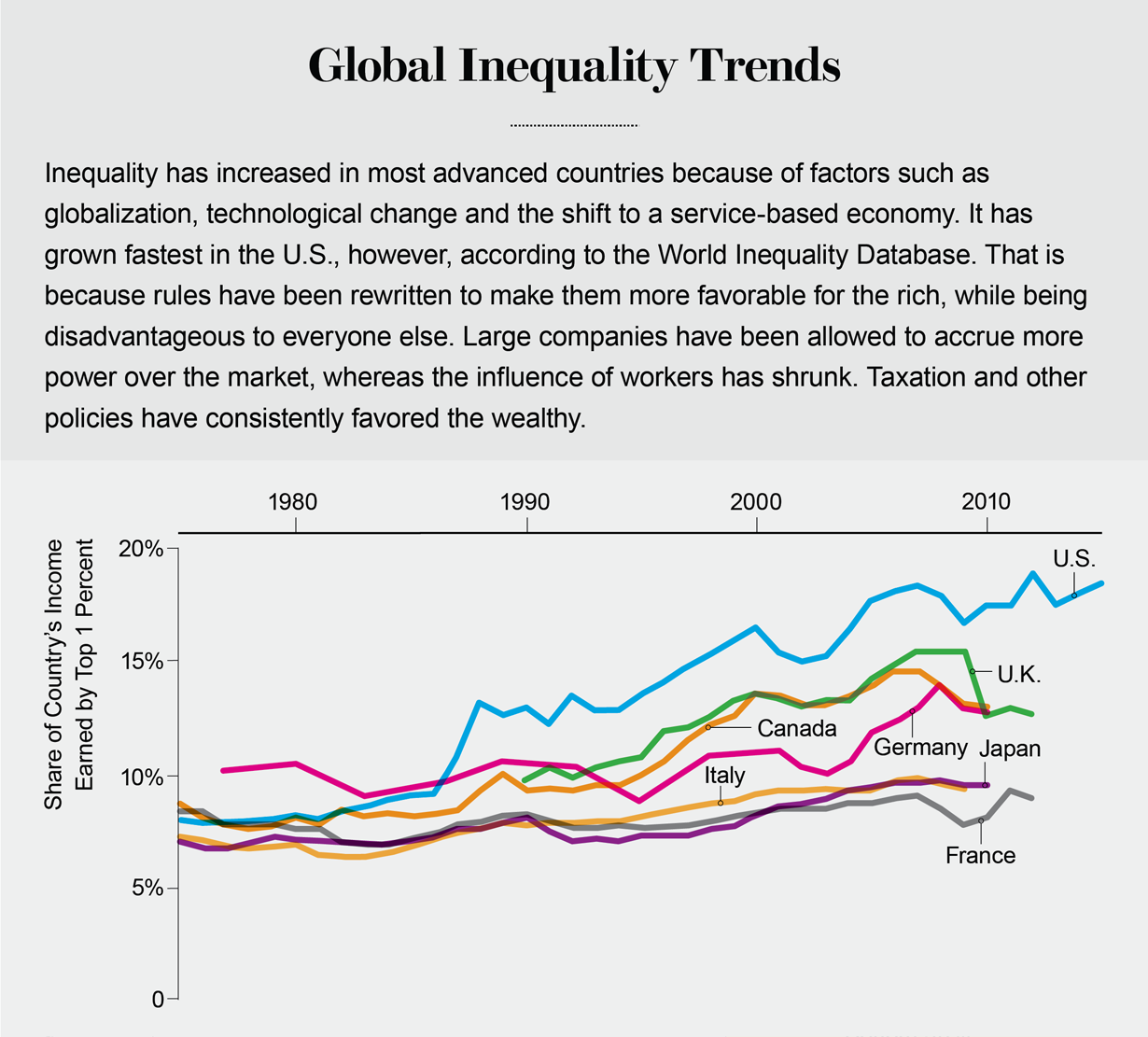
Americans are used to thinking that their nation is special. In many ways, it is: the U.S. has by far the most Nobel Prize winners, the largest defense expenditures (almost equal to the next 10 or so countries put together) and the most billionaires (twice as many as China, the closest competitor). But some examples of American Exceptionalism should not make us proud. By most accounts, the U.S. has the highest level of economic inequality among developed countries. It has the world's greatest per capita health expenditures yet the lowest life expectancy among comparable countries. It is also one of a few developed countries jostling for the dubious distinction of having the lowest measures of equality of opportunity.
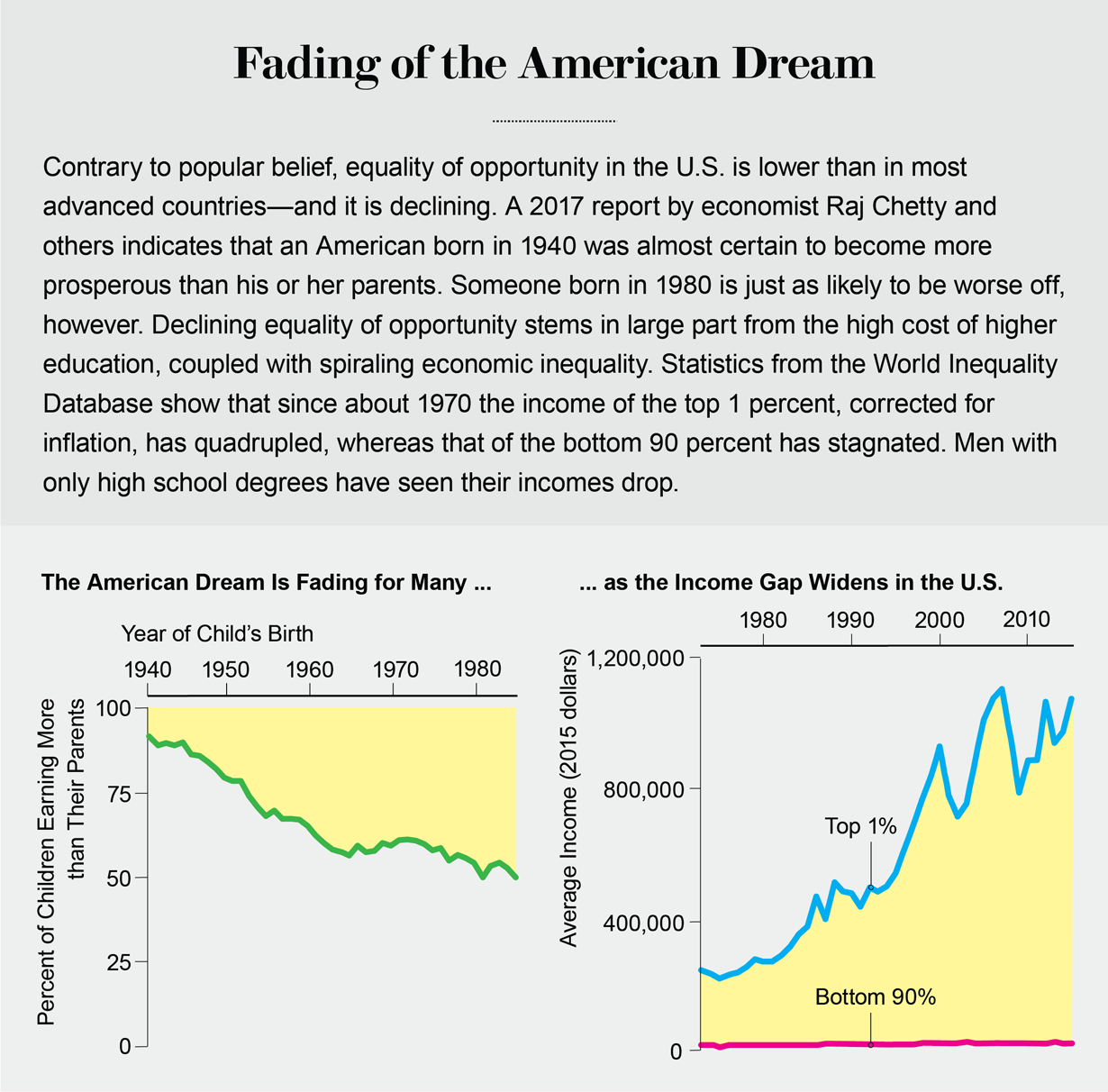
The notion of the American Dream—that, unlike old Europe, we are a land of opportunity—is part of our essence. Yet the numbers say otherwise. The life prospects of a young American depend more on the income and education of his or her parents than in almost any other advanced country. When poor-boy-makes-good anecdotes get passed around in the media, that is precisely because such stories are so rare.
Things appear to be getting worse, partly as a result of forces, such as technology and globalization, that seem beyond our control, but most disturbingly because of those within our command. It is not the laws of nature that have led to this dire situation: it is the laws of humankind. Markets do not exist in a vacuum: they are shaped by rules and regulations, which can be designed to favor one group over another. President Donald Trump was right in saying that the system is rigged—by those in the inherited plutocracy of which he himself is a member. And he is making it much, much worse.
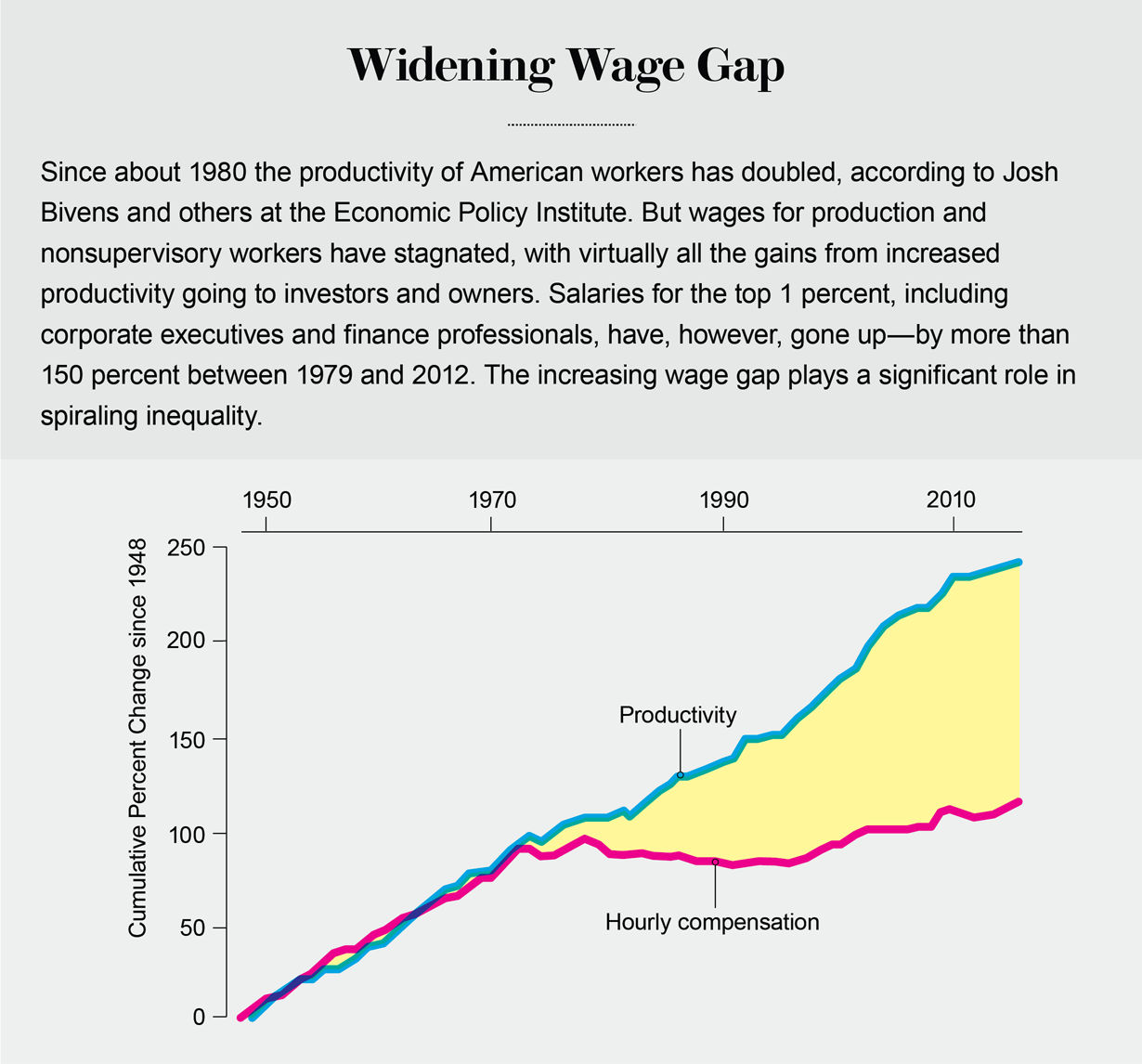
America has long outdone others in its level of inequality, but in the past 40 years it has reached new heights. Whereas the income share of the top 0.1 percent has more than quadrupled and that of the top 1 percent has almost doubled, that of the bottom 90 percent has declined. Wages at the bottom, adjusted for inflation, are about the same as they were some 60 years ago! In fact, for those with a high school education or less, incomes have fallen over recent decades. Males have been particularly hard hit, as the U.S. has moved away from manufacturing industries into an economy based on services.
Deaths of Despair
Wealth is even less equally distributed, with just three Americans having as much as the bottom 50 percent—testimony to how much money there is at the top and how little there is at the bottom. Families in the bottom 50 percent hardly have the cash reserves to meet an emergency. Newspapers are replete with stories of those for whom the breakdown of a car or an illness starts a downward spiral from which they never recover.
In significant part because of high inequality [see “The Health-Wealth Gap,” by Robert M. Sapolsky], U.S. life expectancy, exceptionally low to begin with, is experiencing sustained declines. This in spite of the marvels of medical science, many advances of which occur right here in America and which are made readily available to the rich. Economist Ann Case and 2015 Nobel laureate in economics Angus Deaton describe one of the main causes of rising morbidity—the increase in alcoholism, drug overdoses and suicides—as “deaths of despair” by those who have given up hope.
Credit: Jen Christiansen; Sources: “The Fading American Dream: Trends in Absolute Income Mobility Since 1940,” by Raj Chetty et al., in Science, Vol. 356; April 28, 2017 (child-parent wealth comparison); World Inequality database (90% versus 1% wealth trend data)
Defenders of America's inequality have a pat explanation. They refer to the workings of a competitive market, where the laws of supply and demand determine wages, prices and even interest rates—a mechanical system, much like that describing the physical universe. Those with scarce assets or skills are amply rewarded, they argue, because of the larger contributions they make to the economy. What they get merely represents what they have contributed. Often they take out less than they contributed, so what is left over for the rest is that much more.
This fictional narrative may at one time have assuaged the guilt of those at the top and persuaded everyone else to accept this sorry state of affairs. Perhaps the defining moment exposing the lie was the 2008 financial crisis, when the bankers who brought the global economy to the brink of ruin with predatory lending, market manipulation and various other antisocial practices walked away with millions of dollars in bonuses just as millions of Americans lost their jobs and homes and tens of millions more worldwide suffered on their account. Virtually none of these bankers were ever held to account for their misdeeds.
I became aware of the fantastical nature of this narrative as a schoolboy, when I thought of the wealth of the plantation owners, built on the backs of slaves. At the time of the Civil War, the market value of the slaves in the South was approximately half of the region's total wealth, including the value of the land and the physical capital—the factories and equipment. The wealth of at least this part of this nation was not based on industry, innovation and commerce but rather on exploitation. Today we have replaced this open exploitation with more insidious forms, which have intensified since the Reagan-Thatcher revolution of the 1980s. This exploitation, I will argue, is largely to blame for the escalating inequality in the U.S.
After the New Deal of the 1930s, American inequality went into decline. By the 1950s inequality had receded to such an extent that another Nobel laureate in economics, Simon Kuznets, formulated what came to be called Kuznets's law. In the early stages of development, as some parts of a country seize new opportunities, inequalities grow, he postulated; in the later stages, they shrink. The theory long fit the data—but then, around the early 1980s, the trend abruptly reversed.
Explaining Inequality
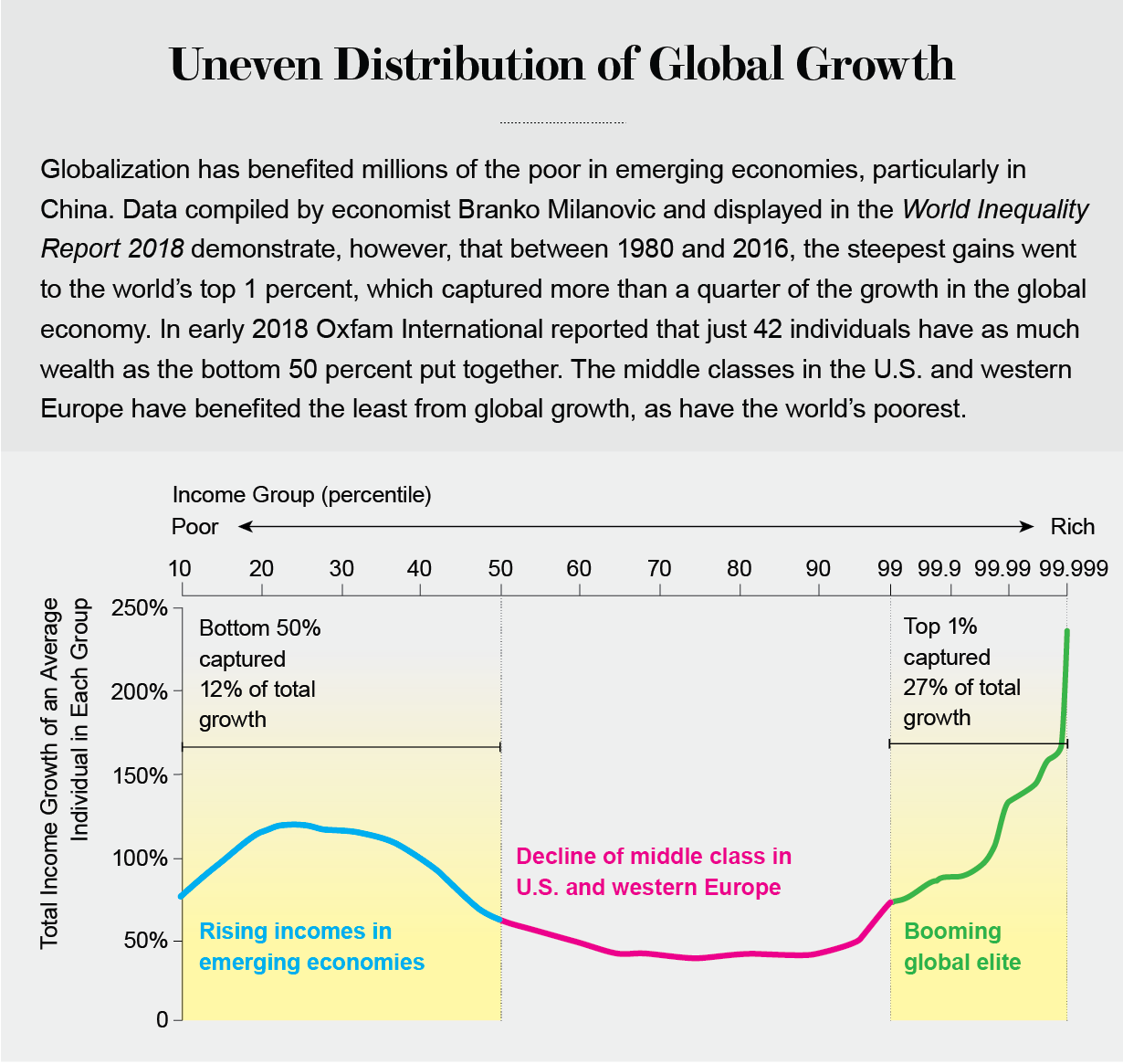
Economists have put forward a range of explanations for why inequality has in fact been increasing in many developed countries. Some argue that advances in technology have spurred the demand for skilled labor relative to unskilled labor, thereby depressing the wages of the latter. Yet that alone cannot explain why even skilled labor has done so poorly over the past two decades, why average wages have done so badly and why matters are so much worse in the U.S. than in other developed nations. Changes in technology are global and should affect all advanced economies in the same way. Other economists blame globalization itself, which has weakened the power of workers. Firms can and do move abroad unless demands for higher wages are curtailed. But again, globalization has been integral to all advanced economies. Why is its impact so much worse in the U.S.?
The shift from a manufacturing to a service-based economy is partly to blame. At its extreme—a firm of one person—the service economy is a winner-takes-all system. A movie star makes millions, for example, whereas most actors make a pittance. Overall, wages are likely to be far more widely dispersed in a service economy than in one based on manufacturing, so the transition contributes to greater inequality. This fact does not explain, however, why the average wage has not improved for decades. Moreover, the shift to the service sector is happening in most other advanced countries: Why are matters so much worse in the U.S.?
Again, because services are often provided locally, firms have more market power: the ability to raise prices above what would prevail in a competitive market. A small town in rural America may have only one authorized Toyota repair shop, which virtually every Toyota owner is forced to patronize. The providers of these local services can raise prices over costs, increasing their profits and the share of income going to owners and managers. This, too, increases inequality. But again, why is U.S. inequality practically unique?
In his celebrated 2013 treatise Capital in the Twenty-First Century, French economist Thomas Piketty shifts the gaze to capitalists. He suggests that the few who own much of a country's capital save so much that, given the stable and high return to capital (relative to the growth rate of the economy), their share of the national income has been increasing. His theory has, however, been questioned on many grounds. For instance, the savings rate of even the rich in the U.S. is so low, compared with the rich in other countries, that the increase in inequality should be lower here, not greater.
An alternative theory is far more consonant with the facts. Since the mid-1970s the rules of the economic game have been rewritten, both globally and nationally, in ways that advantage the rich and disadvantage the rest. And they have been rewritten further in this perverse direction in the U.S. than in other developed countries—even though the rules in the U.S. were already less favorable to workers. From this perspective, increasing inequality is a matter of choice: a consequence of our policies, laws and regulations.
In the U.S., the market power of large corporations, which was greater than in most other advanced countries to begin with, has increased even more than elsewhere. On the other hand, the market power of workers, which started out less than in most other advanced countries, has fallen further than elsewhere. This is not only because of the shift to a service-sector economy—it is because of the rigged rules of the game, rules set in a political system that is itself rigged through gerrymandering, voter suppression and the influence of money. A vicious spiral has formed: economic inequality translates into political inequality, which leads to rules that favor the wealthy, which in turn reinforces economic inequality.
Feedback Loop
Political scientists have documented the ways in which money influences politics in certain political systems, converting higher economic inequality into greater political inequality. Political inequality, in its turn, gives rise to more economic inequality as the rich use their political power to shape the rules of the game in ways that favor them—for instance, by softening antitrust laws and weakening unions. Using mathematical models, economists such as myself have shown that this two-way feedback loop between money and regulations leads to at least two stable points. If an economy starts out with lower inequality, the political system generates rules that sustain it, leading to one equilibrium situation. The American system is the other equilibrium—and will continue to be unless there is a democratic political awakening.
An account of how the rules have been shaped must begin with antitrust laws, first enacted 128 years ago in the U.S. to prevent the agglomeration of market power. Their enforcement has weakened—at a time when, if anything, the laws themselves should have been strengthened. Technological changes have concentrated market power in the hands of a few global players, in part because of so-called network effects: you are far more likely to join a particular social network or use a certain word processor if everyone you know is already using it. Once established, a firm such as Facebook or Microsoft is hard to dislodge. Moreover, fixed costs, such as that of developing a piece of software, have increased as compared with marginal costs—that of duplicating the software. A new entrant has to bear all these fixed costs up front, and if it does enter, the rich incumbent can respond by lowering prices drastically. The cost of making an additional e-book or photo-editing program is essentially zero. Advertisement
In short, entry is hard and risky, which gives established firms with deep war chests enormous power to crush competitors and ultimately raise prices. Making matters worse, U.S. firms have been innovative not only in the products they make but in thinking of ways to extend and amplify their market power. The European Commission has imposed fines of billions of dollars on Microsoft and Google and ordered them to stop their anticompetitive practices (such as Google privileging its own comparison shopping service). In the U.S., we have done too little to control concentrations of market power, so it is not a surprise that it has increased in many sectors.
Credit: Jen Christiansen; Sources: Economic Report of the President. January 2017; World Inequality database
Rigged rules also explain why the impact of globalization may have been worse in the U.S. A concerted attack on unions has almost halved the fraction of unionized workers in the nation, to about 11 percent. (In Scandinavia, it is roughly 70 percent.) Weaker unions provide workers less protection against the efforts of firms to drive down wages or worsen working conditions. Moreover, U.S. investment treaties such as the North Atlantic Free Trade Agreement—treaties that were sold as a way of preventing foreign countries from discriminating against American firms—also protect investors against a tightening of environmental and health regulations abroad. For instance, they enable corporations to sue nations in private international arbitration panels for passing laws that protect citizens and the environment but threaten the multinational company's bottom line. Firms like these provisions, which enhance the credibility of a company's threat to move abroad if workers do not temper their demands. In short, these investment agreements weaken U.S. workers' bargaining power even further.
Liberated Finance
Many other changes to our norms, laws, rules and regulations have contributed to inequality. Weak corporate governance laws have allowed chief executives in the U.S. to compensate themselves 361 times more than the average worker, far more than in other developed countries. Financial liberalization—the stripping away of regulations designed to prevent the financial sector from imposing harms, such as the 2008 economic crisis, on the rest of society—has enabled the finance industry to grow in size and profitability and has increased its opportunities to exploit everyone else. Banks routinely indulge in practices that are legal but should not be, such as imposing usurious interest rates on borrowers or exorbitant fees on merchants for credit and debit cards and creating securities that are designed to fail. They also frequently do things that are illegal, including market manipulation and insider trading. In all of this, the financial sector has moved money away from ordinary Americans to rich bankers and the banks' shareholders. This redistribution of wealth is an important contributor to American inequality.
Other means of so-called rent extraction—the withdrawal of income from the national pie that is incommensurate with societal contribution—abound. For example, a legal provision enacted in 2003 prohibited the government from negotiating drug prices for Medicare—a gift of some $50 billion a year or more to the pharmaceutical industry. Special favors, such as extractive industries' obtaining public resources such as oil at below fair-market value or banks' getting funds from the Federal Reserve at near-zero interest rates (which they relend at high interest rates), also amount to rent extraction. Further exacerbating inequality is favorable tax treatment for the rich. In the U.S., those at the top pay a smaller fraction of their income in taxes than those who are much poorer—a form of largesse that the Trump administration has just worsened with the 2017 tax bill.
Some economists have argued that we can lessen inequality only by giving up on growth and efficiency. But recent research, such as work done by Jonathan Ostry and others at the International Monetary Fund, suggests that economies with greater equality perform better, with higher growth, better average standards of living and greater stability. Inequality in the extremes observed in the U.S. and in the manner generated there actually damages the economy. The exploitation of market power and the variety of other distortions I have described, for instance, makes markets less efficient, leading to underproduction of valuable goods such as basic research and overproduction of others, such as exploitative financial products.
Credit: Jen Christiansen; Sources: World Inequality Report 2018. World Inequality Lab, 2017; Branko Milanovic
Moreover, because the rich typically spend a smaller fraction of their income on consumption than the poor, total or “aggregate” demand in countries with higher inequality is weaker. Societies could make up for this gap by increasing government spending—on infrastructure, education and health, for instance, all of which are investments necessary for long-term growth. But the politics of unequal societies typically puts the burden on monetary policy: interest rates are lowered to stimulate spending. Artificially low interest rates, especially if coupled with inadequate financial market regulation, often give rise to bubbles, which is what happened with the 2008 housing crisis.
It is no surprise that, on average, people living in unequal societies have less equality of opportunity: those at the bottom never get the education that would enable them to live up to their potential. This fact, in turn, exacerbates inequality while wasting the country's most valuable resource: Americans themselves.
Restoring Justice
Morale is lower in unequal societies, especially when inequality is seen as unjust, and the feeling of being used or cheated leads to lower productivity. When those who run gambling casinos or bankers suffering from moral turpitude make a zillion times more than the scientists and inventors who brought us lasers, transistors and an understanding of DNA, it is clear that something is wrong. Then again, the children of the rich come to think of themselves as a class apart, entitled to their good fortune, and accordingly more likely to break the rules necessary for making society function. All of this contributes to a breakdown of trust, with its attendant impact on social cohesion and economic performance.
There is no magic bullet to remedy a problem as deep-rooted as America's inequality. Its origins are largely political, so it is hard to imagine meaningful change without a concerted effort to take money out of politics—through, for instance, campaign finance reform. Blocking the revolving doors by which regulators and other government officials come from and return to the same industries they regulate and work with is also essential.
Credit: Jen Christiansen; Sources: Raising America’s Pay: Why It’s Our Central Economic Policy Challenge, by Josh Bivens et al. Economic Policy Institute, June 4, 2014; The State of Working America, by Lawrence Mishel, Josh Bivens, Elise Gould and Heidi Shierholz. 12th Edition. ILR Press, 2012
Beyond that, we need more progressive taxation and high-quality federally funded public education, including affordable access to universities for all, no ruinous loans required. We need modern competition laws to deal with the problems posed by 21st-century market power and stronger enforcement of the laws we do have. We need labor laws that protect workers and their rights to unionize. We need corporate governance laws that curb exorbitant salaries bestowed on chief executives, and we need stronger financial regulations that will prevent banks from engaging in the exploitative practices that have become their hallmark. We need better enforcement of antidiscrimination laws: it is unconscionable that women and minorities get paid a mere fraction of what their white male counterparts receive. We also need more sensible inheritance laws that will reduce the intergenerational transmission of advantage and disadvantage.
The basic perquisites of a middle-class life, including a secure old age, are no longer attainable for most Americans. We need to guarantee access to health care. We need to strengthen and reform retirement programs, which have put an increasing burden of risk management on workers (who are expected to manage their portfolios to guard simultaneously against the risks of inflation and market collapse) and opened them up to exploitation by our financial sector (which sells them products designed to maximize bank fees rather than retirement security). Our mortgage system was our Achilles' heel, and we have not really fixed it. With such a large fraction of Americans living in cities, we have to have urban housing policies that ensure affordable housing for all.
It is a long agenda—but a doable one. When skeptics say it is nice but not affordable, I reply: We cannot afford to not do these things. We are already paying a high price for inequality, but it is just a down payment on what we will have to pay if we do not do something—and quickly. It is not just our economy that is at stake; we are risking our democracy.
As more of our citizens come to understand why the fruits of economic progress have been so unequally shared, there is a real danger that they will become open to a demagogue blaming the country's problems on others and making false promises of rectifying “a rigged system.” We are already experiencing a foretaste of what might happen. It could get much worse.
This article was originally published with the title "A Rigged Economy"
MORE TO EXPLORE
The Price of Inequality: How Today's Divided Society Endangers Our Future. Joseph E. Stiglitz. W. W. Norton, 2012.
The Great Divide: Unequal Societies and What We Can Do about Them. Joseph E. Stiglitz. W. W. Norton, 2015.
Rewriting the Rules of the American Economy: An Agenda for Growth and Shared Prosperity. Joseph E. Stiglitz. W. W. Norton, 2015.
Globalization and Its Discontents Revisited: Anti-globalization in the Era of Trump. Joseph E. Stiglitz. W. W. Norton, 2017.
Your passion for cherry picking anecdotes to justify conservative positions has as many holes in it as do your president's multiple falsehoods each day.
Your strawman 'they want to get rid of capitalism' has no basis in any realty other than your truebeliever-land. gunballs covered that well here
And again. No one has suggested we do away with capitalism. The only people whom think about that idea or the ones whom can't feel safe enough to sit on their couch and watch Fox News without a gun by their side. The paranoid ones. Reality. Give it a try. https://investorshub.advfn.com/boards/read_msg.aspx?message_id=141849641
Most all emphasis is in the original. I've basically just added a few words into it here and there.
By Kimberly Amadeo Updated February 07, 2019
On December 22, 2017, President Trump signed the Tax Cuts and Jobs Act. It cuts individual income tax rates, doubles the standard deduction, and eliminates personal exemptions. The top individual tax rate drops to 37 percent.
The Act cut the corporate tax rate from 35 percent to 21 percent beginning in 2018. The corporate cuts are permanent, while the individual changes expire at the end of 2025.
Individual Income Tax Rate
The Act lowers tax rates but keeps the seven income tax brackets.
Changes in withholding occurred by employees' February 2018 paychecks. These rates revert in 2026.
The Act created the following chart. The highest tax bracket is $500,000 for single people and $600,000 for married couples. In 2018, they pay a 37 percent rate after exemptions and deductions. That's lower than the 2017 rate of 39.6 percent.
Income Tax Rate Income Levels for Those Filing As: 2017 2018-2025 Single Married-Joint 10% 10% $0-$9,525 $0-$19,050 15% 12% $9,525-$38,700 $19,050-$77,400 25% 22% $38,700-$82,500 $77,400-$165,000 28% 24% $82,500-$157,500 $165,000-$315,000 33% 32% $157,500-$200,000 $315,000-$400,000 33%-35% 35% $200,000-$500,000 $400,000-$600,000 39.6% 37% $500,000+ $600,000+
The income levels rise each year with inflation.
As a result, more people will be subject to the highest bracket than they would under the old method. By 2025, 8.9 percent of taxpayers will pay more than they would have under the previous tax law.
In 2018, only 4.8 percent of households pay more.
Individual Income Tax Deductions and Exemptions
Trump's tax plan doubles the standard deduction. A single filer's deduction increases from $6,350 to $12,000. The deduction for married and joint filers increases from $12,700 to $24,000. It reverts back to the current level in 2026.
It's estimated that 94 percent of taxpayers will take the standard deduction. That will save them time in preparing their taxes. It can also hurt the tax preparation industry and decrease charitable contributions.
The National Association of Home Builders and the National Association of Realtors opposed this. As more taxpayers take a standard deduction, fewer would take advantage of the mortgage interest deduction. That could lower housing prices. But this could be a good time to do that. Many people are concerned that the real estate market is in a bubble that could lead to another collapse.
It eliminates personal exemptions. Before the Act, taxpayers subtracted $4,150 from income for each person claimed. As a result, some families with many children will pay higher taxes despite the Act's increased standard deductions.
The Act eliminates most itemized deductions. That includes moving expenses, except for members of the military. Those paying alimony can no longer deduct it, while those receiving it can. This change is effective for divorces signed in 2018.
It keeps deductions for charitable contributions, retirement savings, and student loan interest.
The Act limits the deduction on mortgage interest to the first $750,000 of the loan.
Interest on home equity lines of credit can no longer be deducted. Current mortgage holders aren't affected.
Taxpayers can deduct up to $10,000 in state and local taxes. They must choose between property taxes and income or sales taxes. This will harm taxpayers in high-tax states like New York and California.
The Act expanded the deduction for medical expenses for 2017 and 2018. It allows taxpayers to deduct medical expenses that are 7.5 percent or more of income. Before the bill, the cutoff was 10 percent. Seniors already had the 7.5 percent cutoff. At least 8.8 million people used the deduction in 2015.
The Act doubles the estate tax exemption to $11.2 million for singles and $22.4 million for couples. That helps the top 1 percent of the population who pay it. These top 4,918 tax returns contribute $17 billion in taxes.
The exemption reverts to pre-Act levels in 2026.
The Act increases the Child Tax Credit from $1,000 to $2,000. Even parents who don't earn enough to pay taxes can claim the credit up to $1,400. It increases the income level from $110,000 to $400,000 for married tax filers.
It allows parents to use 529 savings plans for tuition at private and religious K-12 schools. They can also use the funds for expenses for home-schooled students.
It allows a $500 credit for each non-child dependent. The credit helps families caring for elderly parents.
Other Changes to Income Taxes
The Act repeals the Obamacare tax on those without health insurance in 2019. Without the mandate, the Congressional Budget Office estimates 13 million fewer people would be insured. The government would save $338 billion by not having to pay their subsidies. But health care costs would rise because fewer people would get the preventive care needed to avoid expensive emergency room visits. Health insurance companies would lose money. Healthier people would drop coverage, leaving insurance firms with a higher proportion of sick enrollees.
The plan keeps the Alternative Minimum Tax. It increases the exemption from $54,300 to $70,300 for singles and from $84,500 to $109,400 for joint. The exemptions phase out at $500,000 for singles and $1 million for joint. The exemption reverts to pre-Act levels in 2026.
Business Tax Rate
The Act lowers the maximum corporate tax rate from 35 percent to 21 percent, the lowest since 1939. The United States has one of the highest rates in the world. But most corporations don't pay the top rate. On average, the effective rate is 18 percent. Large corporations have tax attorneys who help them avoid paying more.
Business Deductions
It raises the standard deduction to 20 percent for pass-through businesses. This deduction ends after 2025. Pass-through businesses include sole proprietorships, partnerships, limited liability companies, and S corporations. They also include real estate companies, hedge funds, and private equity funds. The deductions phase out for service professionals once their income reaches $157,500 for singles and $315,000 for joint filers.
The Act limits corporations' ability to deduct interest expense to 30 percent of income. For the first four years, income is based on EBITDA. This acronym refers to earnings before interest, tax, depreciation, and amortization. Starting in the fifth year, it's based on earnings before interest and taxes. That makes it more expensive for financial firms to borrow. Companies would be less likely to issue bonds and buy back their stock. Stock prices could fall. But the limit generates revenue to pay for other tax breaks.
It allows businesses to deduct the cost of depreciable assets in one year instead of amortizing them over several years. It does not apply to structures. To qualify, the equipment must be purchased after September 27, 2017, and before January 1, 2023.
The Act stiffens the requirements on carried interest profits. Carried interest is taxed at 23.8 percent instead of the top 39.6 percent income rate. Firms must hold assets for a year to qualify for the lower rate. The Act extends that requirement to three years. That might hurt hedge funds that tend to trade frequently. It would not affect private equity funds that hold on to assets for around five years. The change would raise $1.2 billion in revenue.
It retains tax credits for electric vehicles and wind farms.
It cuts deductions for client entertainment from 50 percent to zero. It retained the 50 percent deduction for client meals.
Other Changes to Corporate Taxes
The Act eliminates the corporate AMT. The corporate alternative minimum tax had a 20 percent tax rate that kicked in if tax credits pushed a firm's effective tax rate below 20 percent. Under the AMT, companies could not deduct research and development spending or investments in a low-income neighborhood. Elimination of the corporate AMT adds $40 billion to the deficit.
Trump's tax plan advocates a change from the current "worldwide" tax system to a "territorial" system. Under the worldwide system, multinationals are taxed on foreign income earned. They don't pay the tax until they bring the profits home. As a result, many corporations leave it parked overseas. Under the territorial system, they aren't taxed on that foreign profit. They would be more likely to reinvest it in the United States. This will benefit pharmaceutical and high tech companies the most.
The Act allows companies to repatriate the $2.6 trillion they hold in foreign cash stockpiles. They pay a one-time tax rate of 15.5 percent on cash and 8 percent on equipment. The Congressional Research Service found that a similar 2004 tax holiday didn't do much to boost the economy. Companies distributed repatriated cash to shareholders, not employees.
It allows oil drilling in the Arctic National Wildlife Refuge. That's estimated to add $1.1 billion in revenues over 10 years. But drilling in the refuge won't be profitable until oil prices are at least $70 a barrel.
Seven Ways It Affects You
The Tax Act is so complex it affects each family differently depending on their personal situation. Here is a broad description of how it might affect the following seven groups:
1. High Income: If you have a very high income, the tax plan helps you the most. The Tax Foundation said those who earn more than 95 percent of the population would receive a 2.2 percent increase in after-tax income. Those in the 20 to 80 percent range would receive a 1.7 percent increase. The Tax Policy Center said those in bottom 20 percent would only receive a 0.4 percent increase.
2. Heirs to Wealth: If you inherit a lot of money, the larger exemption for the estate tax will benefit you.
[So 2. as 1. helps wealthy families the most.]
3. Few Deductions: If your itemized deductions are less than the new standard deduction, you win on two levels. First, the larger standard deduction will reduce your taxes. Second, you can skip the complicated process of itemizing. That not only saves you time but also money if you no longer need to pay a tax advisor.
4. Large Families: You may be hurt by the elimination of personal exemptions. The higher credits for children and elderly dependents may not be enough to offset that loss.
5. Homeowners: If take out a new home equity line of credit, you can only deduct the mortgage interest if you use it to buy or improve a home. If you take out a new mortgage or refinance an existing one, you can only deduct the interest up to the limit. If you live in a state with high property taxes, you can only deduct the first $10,000.
6. Young People: Since young people are generally healthier, they are more likely to benefit from the elimination of the Obamacare tax.
7. Self-employed: If you are a 1099 contractor, own your own business, or are self-employed, you may benefit from the 20 percent deduction on qualified income.
To see how Trump's tax plan affects you personally, use this federal income tax calculator.
How It Affects Businesses
The tax plan helps businesses more than individuals. Business tax cuts are permanent, while the individual cuts expire in 2025. But the nation's largest private employer, Walmart, said it will raise wages. It will also use the money saved by the tax cuts to give $1,000 bonuses and increase benefits.
As of March 2018, the tax cut spurred a record number of mergers. Corporations are using the cash windfalls to award dividends and buy back their own stock. In the first quarter, they spent $305 billion on share buybacks and cash mergers. They only spent $131 billion to increase wages, according to TrimTabs. That's just slightly above the pace over the last five years.
Apple agreed to pay $38 billion to bring home as much as $252 billion in overseas cash. It will invest $30 billion in capital spending, creating 20,000 jobs. The repatriation could also raise Treasury note yields. Corporations hold most of the cash in 10-year Treasury notes. When they sell them, the excess supply would send yields higher.
JPMorgan announced a $20 billion, five-year investment across its businesses. It would increase charity donations by 40 percent to $1.75 billion over five years.
Impact on the Economy
The Act makes the U.S. progressive income tax more regressive. Tax rates are lowered for everyone, but they are lowered the most for the highest-income taxpayers.
[Yep, again Trump's tax act helps the wealthy more than the middle class.]
The increase in the standard deduction would benefit 6 million taxpayers. That's 47.5 percent of all tax filers, according to Evercore ISI. But for many income brackets, that won't offset lost deductions.
The Trump tax cuts cost the government even more. The Act increases the deficit by $1 trillion over the next 10 years according to the Joint Committee on Taxation. It says the Act will increase growth by 0.7 percent annually, reducing some of the revenue loss from the $1.5 trillion in tax cuts.
The Tax Foundation made a slightly different estimate. It said the Act will add almost $448 billion to the deficit over the next 10 years. The tax cuts themselves would cost $1.47 billion. But that's offset by $700 billion in growth and savings from eliminating the ACA mandate. The plan would boost gross domestic product by 1.7 percent a year. It would create 339,000 jobs and add 1.5 percent to wages.
The U.S. Treasury reported that the bill would bring in $1.8 trillion in new revenue. It projected economic growth of 2.9 percent a year on average. The Treasury report is so optimistic because it assumes the rest of Trump's plans will be implemented. These include infrastructure spending, deregulation, and welfare reform.
The JCT analysis is probably the most accurate since it only analyses the cost of the tax cuts themselves. The tax cuts' increase to the debt means that budget-conscious Republicans have done an about-face. The party fought hard to pass sequestration. In 2011, some members even threatened to default on the debt rather than add to it. Now they say that the tax cuts would boost the economy so much that the additional revenues would offset the tax cuts. They ignore the reasons why Reaganomics would not work today .. https://www.thebalance.com/reaganomics-did-it-work-would-it-today-3305569 .
The impact on the $21 trillion national debt will eventually be higher than projected. A future Congress will probably extend the tax cuts that expire in 2025.
Increase in sovereign debt dampens economic growth in the long run. Investors see it as a tax increase on future generations. That's especially true if the ratio of debt-to-GDP is near 77 percent. That's the tipping point, according to a study by the World Bank. It found that every percentage point of debt above this level costs the country 1.7 percent in growth. The U.S. debt-to-GDP ratio was 104 percent before the tax cuts.
Also, supply-side economics worked during the Reagan administration because the highest tax rate was 70 percent. According to the Laffer Curve, that's in the prohibitive range. The range occurs at tax levels so high that cuts boost growth enough to offset any revenue loss. But trickle-down economics no longer works because the 2017 tax rates are half of what they were in the 1980s.
Many large corporations confirmed .. https://www.bloomberg.com/news/articles/2017-11-29/trump-s-tax-promises-undercut-by-ceo-plans-to-reward-investors?wpisrc=nl_finance202&wpmm=1 .. they won't use the tax cuts to create jobs. Corporations are sitting on a record $2.3 trillion in cash reserves, double the level in 2001. The CEOs of Cisco, Pfizer, and Coca-Cola would instead use the extra cash to pay dividends to shareholders. The CEO of Amgen will use the proceeds to buy back shares of stock. In effect, the corporate tax cuts will boost stock prices but won't create jobs.
The most significant tax cuts should go to the middle class who are more likely to spend every dollar they get. The wealthy use tax cuts to save or invest. It helps the stock market but doesn't drive demand. Once demand is there, then businesses create jobs to meet it. Middle-class tax cuts create more jobs. But the best unemployment solution is government spending to build infrastructure and directly create jobs.
Trump Proposed a New Tax Cut for Middle-Income Families
On October 23, 2018, Trump proposed a new 10 percent tax cut focused on the middle class. But the plan fell apart after the mid-term elections.
Trump Versus Bush and Obama Tax Cuts
The biggest difference between the Trump and Bush or Obama tax cuts is the timing. The Trump tax cut occurred while the economy was solidly in the expansion phase of the business cycle.
The Bush tax cuts occurred during the 2001 recession and the years immediately following. Congress was concerned that the recession would worsen without the cuts
President Obama cut taxes in the 2009 economic stimulus package. Between that and the government spending, the recession ended in July. The 2010 Obama cuts occurred only two years after the 2008 financial crisis. Ending the cuts might have thrown the economy back into recession.
All three cuts increased the deficit and debt.
Trump's Promises No Longer in the Plan
Trump's 2016 proposal allowed up to $2,000 to be deposited tax-free into a Dependent Care Savings Account. The account would grow tax-free to pay for a child's education. Taxpayers could also receive a rebate for the Earned Income Tax Credit and deposit it in the DCSA.
Trump promised to end the AMT for individuals.
Trump promised to increase taxes on carried interest profits, not just stiffen requirements. But lobbyists for those industries convinced Congress to ignore Trump's pledge.
Trump promised to end the Affordable Care Act tax on investment income.
[I've slightly altered the original format for these.]