AP finds evidence for graves, Rohingya massacre in Myanmar In this Jan. 14, 2018 photo, Rohingya Muslim refugee Mohammad Karim, 26, center, shows a mobile video of Gu Dar Pyin’s massacre to other refugees in Kutupalong refugee camp, Bangladesh. On Sept. 9, a villager from Gu Dar Pyin, captured three videos of mass graves that were time-stamped between 10:12 a.m. and 10:14 a.m., when he said soldiers chased him away. When he fled to Bangladesh, Karim removed the memory card from his phone, wrapped it in plastic and tied it to his thigh to hide it from Myanmar police. Feb. 1, 2018 BALUKHALI REFUGEE CAMP, Bangladesh (AP) — The faces of the men half-buried in the mass graves had been burned away by acid or blasted by bullets. Noor Kadir finally recognized his friends only by the colors of their shorts. Kadir and 14 others, all Rohingya Muslims in the Myanmar village of Gu Dar Pyin, had been choosing players for the soccer-like game of chinlone when the gunfire began. They scattered from what sounded like hard rain on a tin roof. By the time the Myanmar military stopped shooting, only Kadir and two teammates were left alive. Days later, Kadir found six of his friends among the bodies in two graves. They are among at least five mass graves, all previously unreported, that have been confirmed by The Associated Press through multiple interviews with more than two dozen survivors in Bangladesh refugee camps and through time-stamped cellphone videos. The Myanmar government regularly claims such massacres of the Rohingya never happened, and has acknowledged only one mass grave containing 10 “terrorists” in the village of Inn Din. However, the AP’s reporting shows a systematic slaughter of Rohingya Muslim civilians by the military, with help from Buddhist neighbors — and suggests many more graves hold many more people. “It was a mixed-up jumble of corpses piled on top of each other,” said Kadir, a 24-year-old firewood collector. “I felt such sorrow for them.” The graves are the newest piece of evidence for what looks increasingly like a genocide in Myanmar’s western Rakhine state against the Rohingya, a long-persecuted ethnic Muslim minority in the predominantly Buddhist country. U.N. spokesman Stephane Dujarric called the AP report “extremely troubling,” and urged Myanmar to allow access to the region for further investigation. Phil Robertson, deputy Asia director for Human Rights Watch, also said in a statement that the AP report “raises the stakes for the international community to demand accountability from Myanmar.” Repeated calls to Myanmar’s military communications office went unanswered Wednesday and Thursday. Htun Naing, a local security police officer in Buthidaung township, where the village is located, said he “hasn’t heard of such mass graves.” [...] https://www.apnews.com/ef46719c5d1d4bf98cfefcc4031a5434/AP-finds-evidence-for-graves,-Rohingya-massacre-in-Myanmar [with embedded video ( https://www.apnews.com/05d3c66be4bf405eadc9a223a59e6013/AP-Confirms-Five-Mass-Graves-In-Myanmar , https://www.apnews.com/05d3c66be4bf405eadc9a223a59e6013/AP-Confirms-Five-Mass-Graves-In-Myanmar )]
Myanmar: After the Protests, Out Come the Cartoonists
Jan., 2018 "In a first, Burmese military admits that soldiers killed Rohingya found in mass grave "Squalor and disease await Rohingya babies born in Bangladesh camps""
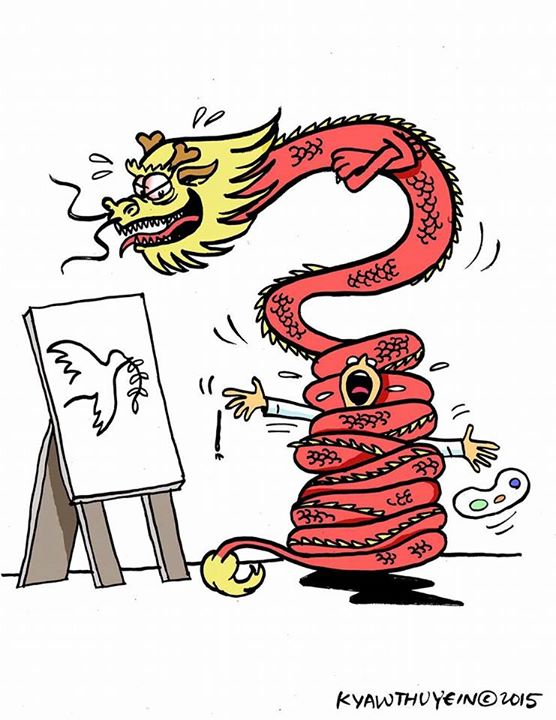
In Myanmar, cartoonists skewer authority and mostly get away with it, though fear remains.
By Poppy McPherson March 22, 2015
Credit: Aw Pi Kyeh
Within minutes of news breaking that police had violently broken up a peaceful student protest in downtown Yangon earlier this month, Salai Suanpi set to work. The cartoonist, who by day is employed by non-profits but spends his nights poking fun at the powerful with biting illustrations, drew a typically irreverent sketch and uploaded it to social media. Dozens of his colleagues did the same.
Source: Courtesy of Salai Suanpi
The images, depicting the thugs .. https://globalvoicesonline.org/2015/03/11/cartoons-condemn-state-brutality-in-myanmar-after-police-thugs-attack-student-rally/ .. who were employed to disperse education reform demonstrators, were shared thousands of times. Some painted the thugs, a loathed civilian branch of police known as Swan Ar Shin who wore red armbands emblazoned with the word “duty,” as an ugly threat to democratic transition. The following morning, more were splashed across the newsstands. It was a powerful statement in a country in which, until three years ago, independent media did not exist.
Since the abolition of censorship in 2012, shortly after military rule gave over to a quasi-civilian government, cartoonists in Myanmar have enjoyed new freedoms. It’s not a way to make a living – journals and newspapers typically pay just $10 per image – so most of the cartoonists have other jobs. But, published under pen names like “Loudspeaker” and “The Greatness,” their stinging pictures have won them thousands of fans.
“People have so many feelings that they didn’t have an outlet for during the past four decades under the junta,” said Myint Kyaw, the secretary general of the Myanmar Journalists Network (MJN). “The cartoonists understand these feelings, and people applaud them.”
Cartoonists, who have been publishing in Myanmar since the 1930s, have escaped some of the scrutiny applied to other media professionals. Surprisingly, for an occupation that skewers authority in a deeply paranoid and, for generations, wholly authoritarian state, there have been no defamation cases brought against them in recent years, according to the MJN. And with the proliferation of daily newspapers in the country and the advent of social media, they now have more platforms than ever on which to disburse their pictorial commentary. Facebook pages like Brainwave .. https://www.facebook.com/nyanhline?ref=br_rs .. collate and share the cartoons to tens of thousands of followers.
Salai Suanpi, a diminutive, high-spirited 27-year-old who wears rectangular glasses, a small goatee and a stud in his left ear, is one of the best-known of the younger generation. He sells images to local media but focuses most of his attention online. “I use a lot of my energy on social media,” he said. “They say we are in the global village now, right? This way, my cartoons will be seen around the world.”
But as cartoonists explore their post-censorship boundaries, enthusiasm has been dampened by fear. In the past year, more than 10 journalists have been jailed. Last October, a freelance reporter was shot dead in the custody of the Burmese army. In February, a photojournalist was arrested after posting a satirical image of a military battle on Facebook. He was later released but the episode left many unsettled. Cartoonists routinely practice self-censorship.
Get first-read access to major articles yet to be released, as well as links to thought-provoking commentaries and in-depth articles from our Asia-Pacific correspondents. Subscribe Newsletter
Some issues – namely religion – are simply off-limits. “It is not possible to draw Charlie Hebdo cartoons in our country,” said Kyaw Thu Rein, whose online portfolio features illustrations expressing sympathy with the Paris-based magazine that was the victim of an Islamist terror attack in January. Religious tensions in Myanmar have escalated in recent years as an extreme strain of Buddhist nationalism has gained followers. This week, a New Zealand bar manager and two Burmese colleagues were sentenced to two and a half years in prison .. https://thediplomat.com/2015/03/new-zealander-jailed-in-myanmar-for-disrespecting-buddha/ .. for posting an image of the Buddha wearing headphones on Facebook.
When Yangon-based cartoonists get together in teashops and beer halls, they swap stories that include disturbing episodes of intimidation. In 2013, Salai Suanpi drew a cartoon for a Burmese-language journal that showed up the military. In response, he got an email threatening him with jail time. “They are always watching our cartoonists,” he said, referring to the authorities. “If you write down text, a lot of people won’t read it. But if you do cartoons they see it…They say there is freedom, but still this kind of thing is happening to a lot of cartoonists in Myanmar.”
It’s a familiar scenario for Aw Pi Kyeh .. http://www.sampsoniaway.org/blog/2011/09/29/slide-show-burmese-political-cartoonist-aw-pi-kyeh/ , 56, one of the country’s most beloved cartoonists. Throughout his career, which began in the 1970s, he has had more than 300 cartoons banned. Most of the time, government lackeys simply ripped the pages out. “If they understand, they censor; if they don’t understand, they censor,” he said, with a toothy chuckle. “The other cartoonist, on the back of my cartoon, he is unlucky.”
Enjoying this article? Click here to subscribe for full access. Just $5 a month.
When he talks about how the rules have changed since pre-publication censorship was abandoned, Aw Pi Kyeh likes to use football metaphors. Before the end of censorship, Aw Pi Kyeh said, “we need to use a corner kick – we kick and the audience must think, using their head, to shoot to the goal,” he said, in an interview at his Yangon home. “Now, we can kick penalties. But they have the red card. And we are afraid of that.”
The younger generation are far more prolific, though less skilled, than their old masters, in Aw Pi Kyeh’s view. “When we were young we had no space, because the older famous cartoonists got all the pages. But now there is more space than cartoonists so they draw a lot,” he said. “The quantity will change to the quality over the next two or three years.”
Nonetheless, after the recent response to student protest violence, Aw Pi Kyeh was impressed. “The [written] journalism came quite late, but when the cartoonists saw the news they started drawing and, five or ten minutes later, the images popped up on Facebook,” he said. “I thought, ‘they are very good people, they are dutiful.’”
Salai Suanpi taken up the mantle in a fluctuating environment. He doesn’t know where the limits lie. “Maybe the cartoonists are clever, or maybe the government doesn’t want to arrest them,” he said. “But I don’t know what will happen tomorrow – it can change, day and night.” And so, day and night, Salai Suanpi, who says he does his best work in the hours between 11 p.m. and 5 a.m., will work to keep up. “I am lucky, because the time is changing, and I have to catch it.”
Poppy McPherson is a freelance journalist in Southeast Asia.
These refugees have built a Lego robot to fight COVID-19
"In a first, Burmese military admits that soldiers killed Rohingya found in mass grave "Squalor and disease await Rohingya babies born in Bangladesh camps""
A team of refugees has designed a Lego robot which dispenses hand sanitizer without being touched. Image: Unsplash/ Rick Mason
15 May 2020 Harry Kretchmer Senior Writer, Formative Content
* A team of robotics-trained refugees has designed a Lego robot which dispenses hand sanitizer without being touched.
* The invention – to help refugees combat the coronavirus – has now been replicated elsewhere.
* The refugees are from the Za’atari camp in Jordan, one of the world’s largest settlements for displaced Syrians.
* The UN Refugee Agency says the world’s 71 million refugees and forcibly displaced people are among the most vulnerable to coronavirus.
Living in close quarters and with basic health and sanitation facilities, residents of Jordan’s Za’atari settlement are worried about what will happen if the virus reaches them, according to the UNHCR.
The idea is simple: help prevent the spread of COVID-19 with a cheap sanitizer dispenser that can easily be replicated. But to reduce transmission of the virus it has to operate without the need to touch a bottle.
With a whir and a bow, the robot deposits sanitizer on the hand and returns to its upright position, saying “good job, thank you” as it finishes.
Making a difference
The machine has generated a great deal of interest. Even people with robotics experience have asked about its design and programming, Marwan says.
‘’We want to be part of the fight against coronavirus,’’ he continues, explaining that he and other displaced people want to help people both inside and outside the camp at a moment of global crisis.
To do this, they decided to make their design freely available for others to use. “We as refugees, as humans, must help and so we offered them this information and they then made more than one robot,” he says.
What is the World Economic Forum doing about the coronavirus outbreak?
The consequences of large-scale transmission would be devastating .. https://www.unhcr.org/uk/news/press/2020/5/5eb98df24.html , the UNHCR has warned. The UN agency says the world’s 71 million refugees and forcibly displaced people are among the most vulnerable to the virus; 134 refugee-hosting countries are currently reporting local transmission.
The UNHCR is trying to raise $745 million to help it deal with outbreaks of COVID-19 among refugees and displaced people around the world.
Greece extends coronavirus lockdown at refugee camps
Author Andriana Simos Date May 11, 2020
A coronavirus lockdown imposed since March on refugee camps in Greece has now been extended to May 21, the Migration and Asylum Ministry of Greece said in a statement on Sunday.
First virus case in Lebanon Palestinian refugee camp: UN
published : 22 Apr 2020 at 18:45
writer: AFP
Aid groups have warned that hundreds of thousands of Palestinian and Syrian refugees living in Lebanon's overcrowded camps are the most vulnerable amid the Covid-19 pandemic.
BEIRUT: A Palestinian refugee camp in Lebanon was on lockdown Wednesday after the UN announced the first confirmed case of coronavirus in one of the country's numerous and crowded camps.
The patient, a Palestinian refugee from Syria, has been taken to the state-run Rafic Hariri hospital in Beirut, the UN agency for Palestinian refugees, UNRWA, said in a statement late Tuesday.
More than 800,000 refugees live in Cox's Bazar.(AP: Altaf Qadri)
I waved goodbye to my parents in October last year as I boarded a plane back to Bangladesh.
There I'd spend a second year working with the United Nations World Food Programme in Cox's Bazar — a giant refugee camp where 855,000 Rohingya refugees rely on food assistance to survive.
Myanmar’s Leader, Daw Aung San Suu Kyi, Is Detained Amid Coup
"In a first, Burmese military admits that soldiers killed Rohingya found in mass grave "Squalor and disease await Rohingya babies born in Bangladesh camps""
Communications were suspended and flights disrupted as the military took power from an elected government and declared a one-year state of emergency.
Myanmar’s leader, Daw Aung San Suu Kyi, in Naypyidaw, the nation’s capital, last week. Thet Aung/Agence France-Presse — Getty Images
Officials from the National League for Democracy, Ms. Aung San Suu Kyi’s party, confirmed the detentions on Monday morning. Hours later, with politicians and activists alike racing to find out who had been detained, a military television network announced a one-year state of emergency with ultimate authority transferred to the army chief, Senior Gen. Min Aung Hlaing.
Mobile networks and the internet were down in major cities in Myanmar, and some local journalists went into hiding for fear that their reporting could compromise their safety. Domestic flights were suspended, and the main international airport in Yangon, the largest city in Myanmar, had been shuttered, according to residents.
Myanmar had been celebrated as a rare case in which generals willingly handed over some power to civilians, honoring 2015 election results that ushered into office the National League for Democracy.
The stalwarts of that party had spent years in jail for their political opposition to the military. Ms. Aung San Suu Kyi, the political party’s patron saint, spent 15 years under house arrest and won a Nobel Peace Prize .. https://www.nytimes.com/2020/11/12/world/nobel-peace-prize-list.html .. in 1991 for her nonviolent resistance to the junta that locked her up.
But the army, now led by General Min Aung Hlaing, has maintained important levers of power in the country, and the detentions on Monday of the top government leaders, along with activists and other veteran politicians, appeared to prove the lie in its commitment to democracy.
Senior Gen. Min Aung Hlaing in 2018. Ye Aung Thu/Agence France-Presse — Getty Images
In addition to Ms. Aung San Suu Kyi, others who were reported to have been detained by their family, friends and colleagues included President U Win Myint, cabinet ministers, the chief ministers of several regions, opposition politicians, writers and activists.
“The doors just opened to a different, almost certainly darker future,” said Thant Myint-U, a historian of Myanmar who has written several books about the country. “Myanmar is a country already at war with itself, awash in weapons, with millions barely able to feed themselves, deeply divided along religious and ethnic lines.”
“That it was able to make any progress this past decade toward democracy was a near miracle,” he said. “I’m not sure anyone will be able to control what comes next.”
In a statement late on Sunday in Washington, Antony J. Blinken, the secretary of state, said that the Biden administration expressed “grave concern and alarm” over the military’s escalation and called on the authorities to release government and civil society leaders.
“The United States stands with the people of Burma in their aspirations for democracy, freedom, peace, and development,” Mr. Blinken said, referring to the country by its former name. “The military must reverse these actions immediately.”
As it began its political evolution, Myanmar was lauded by Western governments, including the Obama administration, as a democratic beacon in a world where authoritarianism was on the rise. But the political transition in the Southeast Asian nation was never quite as smooth or as significant as the political fairy tale made it out to be.
The army, which began a political transition toward what it called, confusingly, “discipline-flourishing democracy” in 2011, made sure to keep significant power for itself. One quarter of Parliament is filled by men in military uniforms. Key ministries are under army control. And in the chaotic years of early democratization, fire sales of state assets often ended up with military companies or their proxies capturing the choicest prizes.
The state of emergency was announced on Monday on the state-media channel Myanmar Radio and Television. Myanmar Radio and Television, via Agence France-Presse — Getty Images
In 2017, the military stepped up its brutal campaign against the Rohingya .. https://www.nytimes.com/2020/09/08/world/asia/myanmar-rohingya-genocide.html , compelling 750,000 members of the Muslim ethnic minority to flee to neighboring Bangladesh in one of the largest global outpourings of refugees in a generation. United Nations officials have said the mass burnings of Rohingya villages, complete with systematic executions and rape, were carried out with genocidal intent.
President Biden’s administration is reviewing whether the United States will officially label the campaign against the Rohingya genocide. Western nations, including the United States, have already slapped financial sanctions on some high-ranking officers implicated in the violence against the Rohingya, including General Min Aung Hlaing himself.
The latest turmoil was ostensibly provoked by concerns about fraud in the November elections .. https://www.nytimes.com/2020/11/11/world/asia/myanmar-election-aung-san-suu-kyi-results.html , which delivered an even bigger landslide to the National League for Democracy than the party enjoyed five years earlier. The governing party secured 396 out of 476 seats in Parliament, while the military’s proxy party, the Union Solidarity and Development Party, managed just 33.
The Union Solidarity and Development Party cried foul, as did political parties representing hundreds of thousands of ethnic minorities .. https://www.nytimes.com/2020/11/06/world/asia/myanmar-election.html .. who were disenfranchised shortly before the vote because the areas where they lived were supposedly too gripped by strife for elections to take place. Rohingya Muslims were also unable to cast their ballots.
But few in Myanmar believed that the detentions on Monday, which netted top National League for Democracy officials, were made only over concerns over electoral fraud. Worries that the military might intervene started in October, when the vote was canceled in some of the ethnic minority areas.
Supporters of Ms. Aung San Suu Kyi, celebrating the electoral victory in November. Ye Aung Thu/Agence France-Presse — Getty Images
“The ominous warning signs had been in plain sight all along,” said U Khin Zaw Win, who runs a policy think tank in Yangon, the commercial capital of Myanmar.
A former political prisoner, Mr. Khin Zaw Win had been warning of a possible putsch for months. Even as the military stepped up its complaints against the National League for Democracy, the army’s negotiations with the civilian government languished.
“I would even say this is one coup that could have been averted politically,” Mr. Khin Zaw Win said, referring to failed talks between the military and civilian leaders after the November elections. “This doesn’t come as a surprise. It’s a case of not if but when.”
The military’s reassertion of authority will prolong the power of General Min Aung Hlaing, who is supposed to age out as army chief this summer. His patronage network, centered on lucrative family businesses, could well have been undermined by his retirement, especially had he not been able to secure a clean exit.
The coup came just two days after António Guterres, the secretary general of the United Nations, warned against any provocations. In a statement late on Sunday, a spokesman for Mr. Guterres expressed “grave concern regarding the declaration of the transfer of all legislative, executive and judicial powers to the military.”
“These developments represent a serious blow to democratic reforms in Myanmar,” the statement added.
In recent years, Ms. Aung San Suu Kyi, 75, once celebrated as an international champion of human rights for her campaign of conscience against the junta while under house arrest, emerged as one of the military’s biggest public defenders. Despite a mountain of evidence against the military, she has publicly rejected accusations that the security forces waged a genocidal campaign .. https://www.nytimes.com/2019/12/11/world/asia/aung-san-suu-kyi-rohingya-myanmar-genocide-hague.html .. against the Rohingya.
But with her national popularity enduring, and her party receiving another electoral mandate, the generals began visibly losing patience with the facade of civilian rule that they had designed.
Military supporters holding Myanmar national flags marching in Yangon, the country’s largest city, on Saturday. Thein Zaw/Associated Press
Last week, an army spokesman refused to rule out the possibility of a coup, and General Min Aung Hlaing said that the Constitution could be scrapped if the law was broken. Armored vehicles appeared on the streets of two cities, spooking residents unused to seeing such firepower cruising through urban centers.
On Saturday, the military appeared to step back, releasing a statement saying that as an armed organization, it was bound by the law, including the Constitution. Another statement on Sunday said that it “was the one adhering to democratic norms.”
The detention of the senior civilian government leaders occurred just hours before Parliament was supposed to begin its opening session after the November election.
The country had buzzed with coup rumors for days, prompting a number of diplomatic missions, including that of the United States, to issue a statement on Friday.
“We oppose any attempt to alter the outcome of the elections or impede Myanmar’s democratic transition,” the joint diplomatic statement said.
The military fired back with its own statement on Sunday, urging the diplomatic missions in the country “not to make unwarranted assumptions about the situation.”
Soldiers moving sandbags into Yangon City Hall on Monday.Credit...Lynn Bo Bo/EPA, via Shutterstock
The first time guns crackled in pursuit of a coup in Myanmar was in 1962, when Gen. Ne Win .. https://www.nytimes.com/2002/12/06/world/ne-win-ex-burmese-military-strongman-dies-at-81.html ll overthrew a fragile government that had enjoyed little more than a decade of independence from Britain. During the military’s 49-year direct hold on power, a country that was once one of the richest in Asia fell into disrepair.
The military tried to justify the 1962 putsch as necessary to keep the Union of Burma, as the country was then known, unified in the face of ethnic insurgencies in the country’s borderlands. Minority groups, which make up roughly one third of the country’s population, suffered widespread persecution during military rule.Children were forced to become minesweepers, and women were subjected to gang rape.
But military-linked abuses were directed against the Bamar ethnic majority, too. Thousands were thrown into jail as political prisoners, and a fearsome military intelligence network convinced many that walls, whether cement or bamboo, had eyes and ears to spy on them.
After a massacre of pro-democracy protesters in 1988, elections were held two years later. The National League for Democracy, the same political force that is in power now, won convincingly, but the results were ignored by the generals. A generation of politicians spent their prime in prison.
Even though Ms. Aung San Suu Kyi had vowed to tackle the country’s enduring ethnic conflicts .. https://www.nytimes.com/2018/01/27/world/asia/myanmar-military-ethnic-cleansing.html .. when she emerged from house arrest in 2010, violence has intensified since then. Ethnic armies are engaged in open warfare with the Myanmar military in the country’s vast periphery, as elites fight for control over natural resources. Civilians are again caught in the crossfire.
People walk next to Sule Pagoda in Yangon on Monday.Credit...Agence France-Presse — Getty Images
And rather than holding the Myanmar military to account for its offensives, Ms. Aung San Suu Kyi, the daughter of the assassinated founder of the country’s modern army, has defended its soldiers. She even argued in their defense at The Hague .. https://www.nytimes.com/2019/12/11/world/asia/aung-san-suu-kyi-rohingya-myanmar-genocide-hague.html , where Myanmar, a Buddhist majority nation, has been accused in an international court of genocide against Rohingya Muslims.
A businessman from the north of Myanmar, Ko Thar Htet, lamented the turn of events on Monday.
“I’m so angry to see the military threatening people, instead of helping the government for the sake of people,” he said. “They have committed so many crimes.”
Hannah Beech has been the Southeast Asia bureau chief since 2017, based in Bangkok. Before joining The Times, she reported for Time magazine for 20 years from bases in Shanghai, Beijing, Bangkok and Hong Kong. @hkbeec