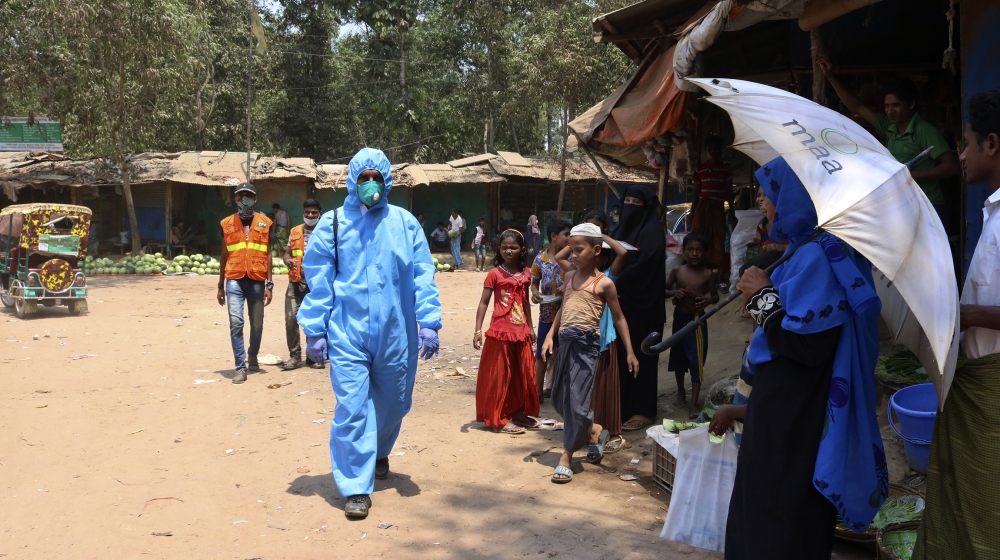
Despite this, the first cases in the camps were detected in mid-May.
"None of the infections are critical. Most hardly show any symptoms. Still, we have brought them in isolation centres and quarantined their families," Toha Bhuiyan, a senior health official in the surrounding Cox's Bazar area told AFP news agency on Monday.
He said narrow roads to three camp districts - where the majority of the infections were detected - have been blocked off by authorities.
The 15,000 Rohingya inside these so-called blocks faced further restrictions on their movement, he said.
This comes as charity workers expressed fears over being infected in the camps as they worked without adequate protection.
Two of the areas under isolation are in Kutupalong camp, home to roughly 600,000 Rohingya.
"We are trying to scale up testing as fast as possible to make sure that we can trace out all the infected people and their contacts," Bhuiyan said.
Seven isolation centres with the capacity to treat more than 700 COVID-19 patients have been prepared, he said, with officials hoping to have just under 2,000 by the end of May.
But, according to Nay San Lwin, co-founder of Free Rohingya Coalition, there are not enough ICU beds and ventilators available for refugees and the local community in Cox's Bazar region.
'Very worried'
Mahbubur Rahman, chief health official of Cox's Bazar, said authorities hoped this week they would double the number of tests being performed daily, which stand at 188.
He said further entry restrictions have been imposed on the camp, with a 14-day quarantine in place for anyone visiting from Dhaka.
"We are very worried because the Rohingya camps are very densely populated. We suspect community transmission (of the virus) has already begun," Rahman told AFP.
Emergency teams worked to contain the spread of the virus in the world's largest refugee settlement [File: Shafiqur Rahman/AP]
Bangladesh on Monday had a record single-day spike in coronavirus cases, with 1,975 new infections, taking the toll to 35,585 cases and 501 deaths.
Charity workers and activists have raised concerns about the lack of hygiene and protection in the camps.
"As the camps are overcrowded, social distancing is almost impossible," Lwin told Al Jazeera.
There is also a lack of awareness about the virus, he added, after local authorities cut off access to the internet in September to combat, they said, drug traffickers and other criminals.
[INSERT: There you go Donald, your wall arguments are everywhere. And another excuse you could use to shut down twitter. If only you could, eh.]
"Many are unaware of how this disease spreads, how to prevent and contain," Lwin said.
"Unlike global citizens, their suffering is a bit more than others. Others can access information to prevent from being infected, but Rohingya in the camps are not even allowed access to information."
More than 740,000 Rohingya fled a brutal 2017 military crackdown in Myanmar to Cox's Bazar, where some 200,000 refugees were already living.
Virus threat marks ‘worst Eid ever’ for Rohingya refugees in Bangladesh camps
Rohingya refugees walk on a road at the Balukhali camp in Cox’s Bazar, Bangladesh. (Reuters)
Shehab Sumon May 27, 2020 20:04
* Health officials work to increase testing, beds capacity to deal with rise in COVID-19 cases
* Government officials said 25 cases of COVID-19 have been reported in the camps, after the first infection among Rohingya was recorded in mid-May
DHAKA: Eid Al-Fitr celebrations for Rohingya Muslims in Bangladesh’s refugee camps have been overshadowed by the specter of the deadly coronavirus disease (COVID-19) pandemic.
Some members of the ethnic group said fears of contracting the virus had turned the religious holiday into “the worst festival ever.”
Mohammad Hashem, 32, a former international aid agency volunteer worker, told Arab News: “This was the worst Eid I have ever experienced in my life. Due to the coronavirus situation, I lost my temporary job and there was no money in hand. So, I could not buy anything for my three children.”
Another refugee, who would only give her name as Begum, said she had pawned her gold jewelry for $100 so she could make Eid special for her children.
“I brought some new clothes for my son and daughter with the money. The rest I spent on arranging some special Eid dishes for the family,” she added.
Government officials told Arab News that as of Tuesday, 25 cases of COVID-19 had been reported in the camps, after the first infection among Rohingya was recorded in mid-May.
It resulted in more than 15,000 being placed under lockdown as authorities also struggled to contain the outbreak in the densely populated camps of Cox’s Bazar which house more than 1 million refugees.
Kazi Mohammad Mozammel Huq, additional commissioner of Bangladesh’s Refugee Relief and Repatriation Commission (RRRC), said: “We are focusing mostly on maintaining social distancing at this critical juncture.
“Special Eid prayers were also organized in line with this direction and Rohingya offered the Eid prayers in different groups instead of gathering at a time.”
Officials said the uptick in infections and lack of COVID-19 testing kits meant a sizeable number of samples were yet to be tested.
Dr. Mahbubur Rahman, chief medical officer for the district of Cox’s Bazar, told Arab News: “Currently we have 1,200 samples waiting to be tested. On average, we can test a maximum of 190 samples per day.”
He added that authorities were working to improve facilities and double the frequency of testing over the coming days.
However, the district has yet to establish intensive care unit (ICU) facilities in hospitals to treat critical patients.
“Some of the machinery for the ICU has reached Cox’s Bazar but others are awaited. Hopefully, we will be able to provide the services shortly, but I can’t predict the exact timing,” Rahman said.
Dr. Abu Taha Bhuyan, from the RRRC, said most COVID-19 patients among the Rohingyas were doing well.
“There are four types of COVID-19 patients – mild, moderate, severe, and critical. Until now we have found only two-thirds of Rohingya patients with moderate conditions while others are mostly asymptomatic,” he added.
Aid agencies are preparing to deal with an anticipated increase in the number of patients by placing their focus on boosting bed capacity.
Catalin Bercaru, the World Health Organization’s (WHO) spokesperson in Dhaka, said: “The current capacity in the district is 300 beds. This includes two newly installed treatment centers with a capacity of 200 beds built by the UNHCR (UN refugee agency) and supported by WHO. Other partners are planning on opening nine additional facilities with a total capacity of 700 beds.”
Bercaru added that, at present, there were six quarantine facilities available for more than 1,000 people.


 Market Data
  Markets


 AI
AI